Q-Theory Representations are logically equivalent
to Autosegmental Representations
Nick Danis Program in Linguistics
Princeton University [email protected]
Adam Jardine Department of Linguistics
Rutgers University
Abstract
We use model theory and logical interpreta-tions to systematically compare two compet-ing representational theories in phonology, Q-Theory (Shih and Inkelas, 2014, forthcom-ing) and Autosegmental Phonology (Gold-smith,1976). We find that, under reasonable assumptions for capturing tone patterns, Q-Theory Representations are equivalent to Au-tosegmental Representations, in that any con-straint that can be written in one theory can be written in another. This contradicts the as-sertions of Shih and Inkelas, who claim that Q-Theory Representations are different from, and superior to, Autosegmental Representa-tions.
1 Introduction
Model theory and mathematical logic can be used to rigorously define phonological represen-tations and constraints (Bird, 1995; Potts and Pullum, 2002). The logical notion of interpreta-tion (Enderton, 1972; Courcelle, 1994; Hodges,
1997) between logics of different kinds of mod-els then allows us to compare and contrast differ-ing representational theories, and rigorously ex-amine whether or not they are truly distinct or if they are simply notational variants of one another (Strother-Garcia and Heinz,2017).
This paper uses these techniques to critically examine the Q-Theory Representations (QRs) of
Shih and Inkelas(forthcoming, henceforth SI; see alsoShih and Inkelas(2014)). SI argue for QRs as a superior alternative to Autosegmental Represen-tations (ARs;Goldsmith(1976)), specifically with respect to phonological tone patterns. We find that, to the contrary, the differences are notational. We show that for any constraint that can be written in the first-order logic of QRs, there is an equivalent constraint in ARs, and vice versa.
The fundamental idea behind QRs is that ev-ery segment, or Q, is divided into three sub-segments, or qs. Agreement and disagreement is based on correspondence (Hansson, 2001; Rose and Walker,2004;Bennett,2015), a relation that holds betweenqs and betweenQs. To give an ex-ample, SI give the following QR in (1a) for the Basa´a word [h´olˆol] ‘ripen’ (Dimmendaal, 1988;
Hyman,2003), in which the first vowel is a level high tone and the second vowel is a falling tone. Each [o] vowelQis split into threeqs, which each carry a tone. Indices on theqs represent correspon-dence. (Consonantqs have been abbreviated.)
a. h(´o1 ´o1,2´o2,3)l(´o3 `o4 `o4)l b. H L
V V
(1)
In (1a), the firstqof the second vowel is high-toned while the rest are low-high-toned; this thus repre-sents the falling contour of the second vowel. Fur-thermore, the lastqof the first vowel and the first q in the second are in correspondence (and both high-toned). This indicates that the falling contour on the second vowel is the result of partial agree-ment with the high-toned first vowel.
In contrast, ARs would depict [h´olˆol] using sep-arate strings ofautosegmentsassociated to one an-other. An AR for [h´olˆol], given in (1b), represents a high (H) tone associated to both the first vowel (V) and the second vowel.
SI make several claims about QRs in favor of ARs. First, they claim that representations like in (1) capture tone patterns without “the special rep-resentational machinery of autosegments and as-sociation lines” (SI, pp. 18-9). They give a number of analyses which they argue shows that QRs are “better at capturing key tone behaviors” (p. 2).
By precisely studying the nature of these rep-resentations, however, we show that QRs are log-ically equivalent to ARs. First, we give
a. H
1
H
2
H
3
H
4
L
5
L
6
Q
7
Q
8
7! H
10
L
50
V
70
V
80
b. H
3
L
4
V
1
V
2
7! H
11
H
12
H
13
H
21
L
22
L
23
Q
10
Q
[image:2.612.119.482.65.190.2]20
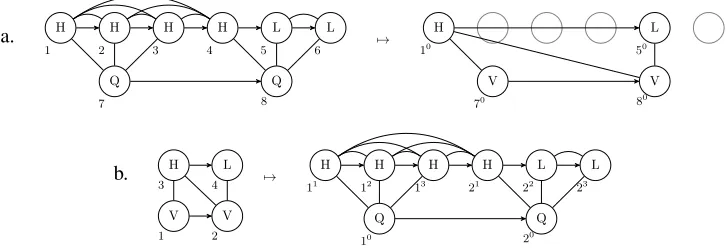
Figure 1: Overview of the transductions (a) from QRs to ARs and (b) from ARs to QRs.
theoretic definitions of both QRs and ARs. This shows that, contra to SI’s claims, QRsdorequire an ‘association’ relation betweenqs andQs. Sec-ond, based on the logical transductions of Cour-celle(1994), we give afirst-order (FO) transduc-tionfrom QRs to ARs, and from ARs to QRs. This guarantees that, given any FO statement ' writ-ten over QRs, there is an equivalent FO statement '0 in ARs such that any QR model satisfies'if
and only if its equivalent AR model satisfies'0. In
phonological terms, this means that for any con-straint that we can write in FO logic of QRs, there is an equivalent constraint in the FO logic of ARs (and vice versa). These models and transductions reveal an equivalence between chains ofqs con-nected by correspondence in QRs and tonal au-tosegments in ARs.
This paper is not meant to be a complete rebut-tal of SI, but instead to lay the formal groundwork for establishing the similarity of QRs and ARs. Throughout, we assume that FO logic as the up-per bound for the expressivity necessary to capture constraints in natural language phonology (Bird,
1995;Rogers et al.,2013).
This paper is structured as follows.§2 summa-rizes the equivalence between structures in infor-mal terms.§3gives the preliminaries of model the-ory and logic;§4defines ARs and QRs in terms of model theory; and§5defines the transductions between them.§6 summarizes and discusses the results, and§7concludes.
2 Overview
Before going into the formal details, we first give a brief overview of how transductions between the two representations proceed. These are illustrated with examples in Fig.1showing transductions be-tween models for the representations in (1).
As shown in the left-hand side of Fig.1a, defin-ing QRs precisely reveals that there must be a re-lation pairing tone-bearingqs (depicted with Hs and Ls) with vowelQs. Moving from a QR to an AR, then, is a matter of identifying the first mem-ber of a chain of correspondingqs (indicated by curved lines) and as assigning it to a tone in the output AR. All otherqs in that chain are ‘merged’ into that autosegment—thus, for example, as both vowelQs are associated to correspondents of1in the QR in Fig.1a, both equivalent Vs in the AR are associated to its output tone10.
In the other direction, illustrated in Fig.1b, we create three additional copies of each V in the AR, representing the outputqs. For example, vowel1 in the left-hand side of Fig.1b has copies11,12, and13in the right-hand side. These copies are la-beled and related through correspondence accord-ing to the associations in the AR. For a series of vowels associated to the same tone in the AR, their outputQs are associated to a chain of correspond-ingqs of the same tone value. For example, both vowels1and2in the left-hand side of Fig.1b are associated to the same H tone, so their outputQs are associated to a chain of corresponding H-toned qs in the output. This thus implements the equiv-alence of tonal autosegments toq-correspondence chains in the transduction from ARs to QRs.
3 Preliminaries 3.1 Models
The following is based on standard concepts of finite relational structures (Enderton, 1972;
Libkin, 2004). A signature S is a fixed set
{R1, R2, ..., Rn}of n named relations. A model
M over a signature is a tuplehD;R1, R2, ..., Rni
rela-tions where eachRi ✓ Dk for somek. Here,k
is equal to either1or2; that is, we consider only unary and binary relations.
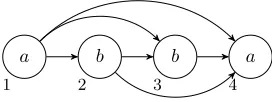
For example, the signature{<, Pa, Pb}can
de-scribe the set of strings over the alphabetaandb. A model in this signature is given in Fig.2.
a
1
b
2
b
3
a
4
Figure 2: A model of the stringabba.D={1,2,3,4},
PaandPbare indicated by labels on the nodes, and<
by arrows.
3.2 Logic
A fixed signature induces a first-order (FO) log-ical languageLS as follows. For everyRi 2 S,
Ri(x1, ..., xk)is an atomic formula inLS, which
is interpreted as true in a modelMwhenx1, ..., xk
are evaluated tod1, ..., dk 2Dand(d1, ..., dk)2
Ri in M. We also assume an equality predicate
x ⇡ ythat is true when xandyare both evalu-ated to somei 2 D. We then define the FO logic ofLS and its semantics in the usual way; for de-tails, see, e.g.,Enderton(1972). For a FO formula '(x1, ..., xk)we write M |= '(d1, ..., dk)when
'(x1, ..., xk)is true inMwhenx1, ..., xkare
eval-uated tod1, ..., dk inD. Asentenceis a formula
with no free variables; for a sentence'we write M|='when'is true inM.
3.3 Transductions and interpretations To directly compare structures in distinct sig-natures we use logical transductions (Courcelle,
1994), in which the relations in an output structure are defined using the logic of an input structure. Given an input signatureS and an output signa-tureT = {R1, ..., Rn}, we define eachRiinLS.
Such a transduction thus induces aninterpretation ofT in S; that is, for any formula we can write
inLT, there exists a translation intoLS (
Ender-ton,1972;Hodges,1997). If there then also exists a transduction back fromT to S, there then ex-ists an interpretation ofS inT. If interpretations in both directions exist, we say thatS and T are bi-interpretable.
A FO transduction is defined as follows. Fix a copy set C = {1, ..., k}, an input signature S, and an output signatureT ={R1, ..., Rn}. A FO
transduction⌧ fromS toT is thus a set of for-mulae'c1,...,cm
i (x1, ..., xm)for eachRi 2 T and
eachc1, ..., cm2Cm, wheremis the arity ofRi.
The output of such a transduction is calculated as follows.1For a stuctureMover the input
signa-tureS, and whose domain isD,⌧(M)is a struc-tureN =hD0, R1, ..., Rnidefined as follows:
1. For everyd2D, there is a copydc 2D0iff
there is exactly one unary predicateRc i(x)in
⌧ such thatM |='i(d).
2. For anyRiof aritym,(d1c1, ..., dcmm)2Riif
and only if there is a d1, ..., dm 2 Dmand
a 'c1,...,cm
i (x1, ..., xm) in⌧ such that M |=
'c1,...,cm
i (d1, ..., dm), and each d ci
i 2 D0 as
per the requirement in (1).
Intuitively, given a structureMoverS, the out-put structure inT can have up to |C| copies of elements in the domain ofD, and the relations in
T are defined relative to these copies.
For example, given the string signature S de-fined above we can define a transduction into a pseudo-autosegmental signature T = {/0 , A0, Pc0, Pb0}as follows. Set the copy set to C =
{1,2}. Then define a transduction⌧as
x /01,1ydef= x < y^ ¬(9z)[x < z^z < y],
x /02,2ydef= x < y^ ¬(9z)[x < z^z < y], xA01,2ydef= x⇡y,
P02
b (x)
def
= Pb(x),
Pc01(x)def= Pb(x)_Pa(x),
and for all otheri, j 2C,x /0i,j ydef= xA0i,jydef=
False, andP01
b
def
= P02
c
def
= False.
b
22
b
32
c
11
c
21
c
31
c
[image:3.612.132.268.152.203.2]41
Figure 3: Output structure inT obtained by applying⌧
to the string model in Fig.2. Arrows denote/0and lines
without arrows denoteA0. Indices of the nodes are of
the formdc, wheredis a node from Fig.2andc2C.
1We use an abbreviated construction used for those in
We interpret⌧ as follows; an example is given in Fig. 3. As P01
c (x)
def
= Pb(x)_ Pa(x), every
nodedin the input string is given a copyd1in the output labeledc. Similarly, asPb02(x) def= Pb(x)
means that for anydlabeledbin the input, there is a second copy d2 labeled b in the output. As P01
b (x) = Pc02(x) = False, no other copies are
produced. Thus, thebnodes in Fig.2have both a correspondingcnode andbnode in Fig.3, but the anodes only have a correspondingcnode.
The definitions forx /01,1 yandx /02,2 ythen establish asuccessorrelation between the first and second copies of nodes, respectively. Thus, for two nodesd1 andd2 in the input structure, d12 is the successor ofd1
1if and only ifi < jin in the input structure and no node intervenes between them; likewise for d21 and d22. As x /0i,j y is False
for all otheri, j 2 C, the first and second copies are not ordered with respect to each other. Instead, xA01,2ydef= x⇡yestablishes that for anyd,d1in the output is associated to its own second copyd2 in the output (assuming that it survives according to (1) above). This can be seen for the copies of thebnodes2and3from Fig.2in Fig.3.
As such a transduction is defined in terms of the atomic predicates of the output signature, it also induces an interpretation from the logic of the out-put signature to the logic of the inout-put signature. Lemma 1 (Courcelle et al.(2012)) A FO trans-duction⌧fromStoT induces a translationffrom the FO languageLS ofSto the FO languageLT ofT such that for every sentence'inLS there is a sentencef(')inLT such that for any structure MoverS,M |='if and only if⌧(M)|=f(').
In terms of phonology, if there is a FO transduc-tion from one representatransduc-tional theorySto another
T, Lemma1means that for any FO constraintC overSthere is a FO constraintC0overT such that a representation inS satisfiesC if and only if its equivalent representation inT satisfiesC0.
4 Phonological representations as models We now apply this technique to studying the rela-tionship between ARs and QRs. First, we define the representations in model-theoretic terms.
4.1 Autosegmental representations
We assume a basic theory of autosegmental repre-sentations (ARs), which also follows SI’s charac-terization of ARs (p. 2). The crucial assumptions
are that there exists a tier of timing units (in our case, vowels), and featural elements are associated to elements on this tier. Each type of featural el-ement (for our purposes, Hs and Ls) are also on their own tier, ordered together. For the patterns discussed in SI, a single tonal tier is sufficient. The signature for ARs is thus as below.
A={/A, AA, VA, HA, LA} (2)
VA,HA, andLAare unary relations that label el-ements as vowels, H tones, and L tones, respec-tively. The association relation isAA; to simplify definitions we treatAAas antisymmetric and di-rected from vowels to tones; that is,xAAyholds only ifVA(x)is true and eitherHA(y)orLA(y).
H
1
L
2
V
3
V
4
Figure 4: An example AR of the sequence ´V ˆV.
Each tier is ordered by the /A successor rela-tion. Thus, the set of elements labeledVAare or-dered, as are the set of elements labeledHAorLA. A vowel can be associated to more than one tone (a contour) or a tone can be associated to more than one vowel (spreading). This is shown in Fig-ure4. For further simplicity, we also assume full specification: there are no toneless vowels and no floating tones. This last assumption is somewhat generous, as by SI’s own admission, QRs cannot capture floating tones (see SI§6.1).
Next, we assume two axioms that specially require the use of precedence (<). The first is No Gapping (NG), which prohibits autosegments from being linked to non-contiguous elements on the timing tier (N´ı Chio´sain and Padgett,2001).
NGdef= (8x, y, z, w)⇥ x < y < z^AA(x, w)
^AA(z, w) !AA(y, w)⇤
We also adopt the No-Crossing Constraint (NCC), which states that association must respect prece-dence on each tier (Goldsmith,1976).
NCCdef= (8x, y, v, w)⇥ (xAAv^yAAw
^x < y)!v < w⇤
Finally, we assume that vowels can only asso-ciate to at most three tones—this maintains equiv-alence between ARs and QRs. While this has not traditionally been explicitly stated as an axiom of ARs, recent proposals do state such constraints (Yli-Jyr¨a,2013;Jardine and Heinz,2015). 4.2 Q-Theory representations
Q-Theory Representations (QRs) consist of two sets of ordered elements: one ofQs, and one of qs. EachQconsists of exactly 3qs, and everyqis part of exactly oneQ. According to SI,qs are sub-segments; the featural information of the segment is carried on theq. For our purposes, the relevant features are the tone features H and L. Thus, be-cause constraints in SI refer to the featural infor-mation of someQ, it must be able to “see” what qs are relevant; a Q and its qs must be in some relation. We denote this relationAQ.
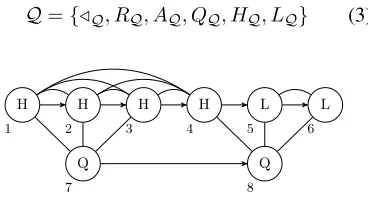
We thus consider the following signature for QRs. Fig.5 gives an example model in this sig-nature of the QR for [h´olˆol] from (1).
Q={/Q, RQ, AQ, QQ, HQ, LQ} (3)
H
1
H
2
H
3
H
4
L
5
L
6
Q
7
Q
[image:5.612.113.297.351.453.2]8
Figure 5: An example QR of the sequence ´V ˆV.
This signature includes a sucessor relation/Q, a correspondence relationRQ(the curved lines in Fig.5), the relationAQassociatingQs toqs, and three unary relationsQQ,HQ, and LQ, labeling Qs, H-tonedqs, and L-tonedqs, respectively.
The axioms that governRQare not straightfor-ward and so we discuss them here. We base our axioms forRQ on both the explicit and implicit discussion in SI.
First, we assume that RQ is transitive. While SI claim their correspondence to be non-transitive, their constraints crucially refer tocorrespondence chains, or unbroken chains of corresponding ele-ments. They state: “[A] sequence of three identical consecutive segments S in a grammar requiring that identical segments correspond would satisfy that constraint as follows:S1S1,2S2, where
coin-dexation encodes correspondence” (SI, p. 5). In
other words, the first S1 and third S2, although they do not directly correspond, satisfy any cor-respondence constraints because there is a corre-spondence chain connecting them (through the in-termediaryS1,2). Thus, in practice, the
correspon-dence relation of SI is transitive.
For ease of definition we further assumeRQis also reflexive and symmetric and thus an equiva-lence relation (perBennett(2015)).
EQdef= 8(x, y, z)[ (xRQy!yRQx)^ (xRQx)^
((xRQy^yRQz)!xRQz) ]
However, this choice is not crucial to our results. Furthermore, like SI, we defineRQto be local: “‘Local’ means consecutive; thus V-to-V corre-spondence is still considered local even if a conso-nant intervenes, as long as the closest two vowels in the string correspond” (SI: 4–5). In all of their case studies, correspondence is always between adjacent vowels. (The only candidate that includes non-local correspondence in terms of vowels is SI:(8d), which is not an optimum.) In the models here, consonants are not included, so vowels are strictly adjacent.
To restrict correspondence to a span of adjacent elements, we must adopt the following axiom.
ADJdef= (8x, y, z)[(x < y^y < z^xRQz)
!(xRQy^yRQz)]
ADJstates that for anyxandzin correspondence, all interveningymust also be in correspondence. Note that this axiom requires specially adopting the<relation, as it must hold forallintervening elementsy. This is stricter than SI’s requirement of ‘consecutivity’, which instead restricts corre-spondence to intervening elements of some type— e.g., vowels—but as they are vague about how this is determined we ignore this here, and note only that relativizing ‘consecutivity’ to a particular type of element is also FO-definable (Graf,2017).
Thus, we assumeQmodels satisfyEQ^ADJ. (For comparison to models that do not, see§6.2.)
Finally, correspondence implies identity. As SI state: “Our operating assumption is that GEN does not even produce candidates in which elements obey CORRbut violate the associated IDENT-XX
5 Transductions
We now show the FO-equivalence between these two representational theories by defining a trans-duction fromQtoA, and then fromAtoQ. 5.1 From Q-Theory Representations
We begin with a transductions from QRs inQto ARs inA. Intuitively, this transduction is based on the idea that a correspondence chain ofqs in a QR is equivalent to a tone in an AR.
We identifyqs by the fact that they carry tones.
qQ(x)def= HQ(x)_LQ(y)
Then, to uniquely identify each chain of cor-respondingqs, we define the following predicate
FC(x), which identifies the first correspondent; i.e., the first element in a correspondence chain.
FC(x)def= ¬(9y)[xRQy^y /Qx]
This is possible with a successor relation/Q be-cause of the adjacency axiomADJ. Ify /Qxand
¬yRQxand there is noz such that z <Q xand zRQx, thenxmust be first in the chain.
The transduction is thus as given in Table1. The copy set isC={1}, so we omit superscripts indi-cating copies. An example output structure, given Fig.5as an input, is given in Fig.6.
VA(x) def= QQ(x)
HA(x) def= HQ(x)^FC(x)
LA(x) def= LQ(x)^FC(x)
x /Ay def= QQ(x)^QQ(y)^x /Qy _ qQ(x)^qQ(y)^FC(x)^FC(y)^
[image:6.612.332.504.58.117.2](9z)[xRQz^z /Qy] xAAy def= FC(x)^(9z)[xRQz^zAQy]
Table 1: Transduction fromQtoA.
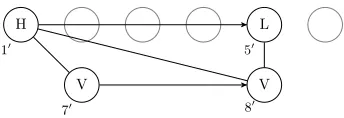
First, the definitions of VA(x), HA(x), and LA(x), are straightforward. As vowels in ARs and Qs in QRs are equivalent, we setVA(x)equal to QQ(x). ForHA(x), andLA(x), we set each to the firstqof a chain that is valued either H or L, re-spectively. Thus, for example in Fig.6, only nodes 1and5are copied over from Fig.5.
The definition ofx /Ay, then, is relativized to elements for which these predicate are true. The
H
10
L
50
V
70
V
80
Figure 6: Output of the transduction in Table1given Fig.5as input;i0indicates a surviving copy of nodei
from Fig.5.
disjunct QQ(x)^QQ(y)^x /Q y means that the successor relation between vowels in the AR is identical to the successor relation betweenQs in the QR. The other disjunct defines the succes-sor relation between tones. This has two parts: qQ(x)^qQ(y)^FC(x)^FC(y)ensures that the suc-cessor relation only holds between first elements in correspondence chains, and(9z)[xRQz^z /Q y]identifies for some xthe elementy that starts the next correspondence chain; that is, it succeeds the elementz that is the last element in x’s cor-respondence chain. This can be seen in Fig.6 be-tween10and50. In Fig.5, in both1and5are first in their chains and5is the successor of 4, which corresponds with1; thus50succeeds10in Fig.6.
In a similar fashion, the definition for xAAy holds true whenxis the first member of a chain andythat is associated to somezthat corresponds with x. Thus, for example, since 4is associated to 8 in Fig. 5 and 4 is a member of 1’s corre-spondence chain,10 and 80 are associated in Fig.
6. Thus,Ais definable fromQ.
Lemma 2 Ais FO-definable fromQ.
Proof: Witnessed by transduction defined in Table1. Note that these ARs will satisfyNGand NCC. Briefly, this is because AA and /A are defined through RQ, which satisfies ADJ as outlined in Sec. 4.2. ADJ essentially orders correspondence chains, and thus the tones and association relations defined viaRQ. ⇤
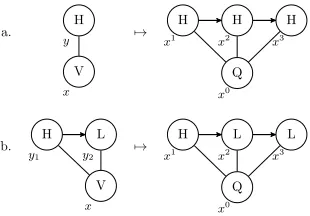
5.2 From Autosegmental Representations For this transformation, the copy set is C =
[image:6.612.99.296.453.568.2]AR, as (partially) summarized in Table2.2
Tones qs H !H1H1,2H2
HL !H1L2L2 HLH!H1L2H3
Tones qs L !L1L1,2L2
[image:7.612.105.288.83.138.2]LH !L1H2H2 LHL!L1H2L3
Table 2: Mapping from strings of tones associated to a vowel (AR) to strings ofqs associated to aQ(QR).
a. first(x, y) def= ¬(9z)[xAAz^z /Ay] b.last(x, y) def= ¬(9z)[xAAz^y /Az] c. second(x, y) def= (9z)[xAAz^z /Ay
[image:7.612.95.298.195.276.2]^first(x, z)] d.only(x, y) def= first(x, y)^last(x, y)
Table 3: Predicates used in the AR to QR transduction
a. H
y
V
x
7! x1H
H
x2
H
x3
Q
x0
b. yH
1
L
y2
V
x
7! x1H
L
x2
L
x3
Q
x0
Figure 7: Deriving strings ofqs from strings of tones. On the right,xiindicates theith copy ofx.
These correspondences are FO-definable. First, we define a series of predicates first(x, y),
second(x, y),last(x, y), andonly(x, y)that in-dicate whenyis the first, second, last, or only tone associated tox, respectively. These definitions are given in Table3. (These do not explicitly associate ytox; this will be invoked in later definitions.)
From these predicates we can determine, for each vowel in the AR, how to label itsq copies in the QR. This is given in Table4b. For example, HQ1(x)is true when there is a H toneythat is the first tone associated tox. This means that copy1 ofxwill be aqvalued H. Similarly,HQ2(x)is true when there is some H tone associated toxthat is either the second tone or theonlytone associated tox. This last disjunct is necessary in casexhas a 2It is also the case that, e.g., a vowel associated to a string
of three H tones (i.e., HHH) will be output as aQassociated to a string of three, non-corresponding Hqs (H1H2H3).
single H associated to it in the AR, for its equiva-lent QR all threeqs will be H (see Fig.7a).
Table 4a specifies when Qs are built: the 0th copy of each vowelxis labeledQ. Table4cthen specifies that the 0th copy of x is associated to each of its own copies1, 2, and 3 (i.e., theqs). The specification thatx⇡yensures that theQfor each vowel is associated to each of itsq copies. Likewise, Table4dspecifies that the successor re-lation/Abetween vowels is preserved betweenQs (i.e., the0copies of vowels) and, that for the1st through3rd copies of vowelx, itsith copy is suc-ceeded by its owni + 1th copy. The reader can confirm this via the examples in Fig.7.
Finally, we define RQ. First, as described in
§4.2, correspondence betweenQs is dependent on identity betweenQs, which again depends on their associatedqs. Thus,xRQ0,0y should be true when the outputQs ofx andy are associated to iden-tical strings ofqs. The values of q copies of are determined by the tones associated toxandy, re-spectively. Thus, Table4edefinesxR0Q,0ywith the predicateident(x, y), which is true if and only if the first, second, and last tones ofx and y have the same value. (Let same(x, y) def= HA(x)^ HA(y) _ LA(x)^LA(y) .) For example, this is true of the vowels in Fig.8a, but not in8b.
Betweenqs, we define correspondence based on shared associations. Table4fthus definesxRi,jQy for1 i, j 3to be true when there is somez for which bothxandy are associated. However, whichqs ofxandycorrespond depend onz’s po-sition relative to other tones associated toxand y. Thus,zmust also satisfy requirements'i(x, z)
and'j(y, z)based on the value ofiandj.
For example, when i = 1 and j = 1—that is, when defining correspondence between the1st q of x and the 1st q of y—z must satisfy both
first(x, z)andfirst(y, z). Intuitively, the first qofxand the firstqofycorrespond only ifxand yshare an association toz andz is thefirsttone associated to bothxandy. This can be seen in Fig.
8; for example, in Fig.8b, bothxandyshare an initial tonez, and sox1andy1correspond.
Thus, Table4is a transduction fromAtoQ. Lemma 3 Qis FO-definable fromA.
[image:7.612.117.272.319.427.2]a.Qi Q(x)
def=V
A(x)fori= 0;Falseotherwise
b. ForT 2 {H, L}, T0
Q(x)
def
= False
TQ1(x)def= (9y)[xAAy^TA(y)^first(x, y)] T2
Q(x)
def= (
9y)[xAAy^TA(y)^(only(x, y)_second(x, y))] T3
Q(x)
def
= (9y)[xAAy^TA(y)^last(x, y)] c.xAi,jQy def=x⇡yfori= 0and1i3;Falseotherwise.
d.x /i,jQ ydef=x / yfori, j = 0ori= 3, j= 1;x⇡yfor1i, j 3, j=i+ 1;Falseotherwise. e.xR0Q,0y def=ident(x, y)^(x /Qy_y /Qx), where
ident(x, y)def= (8v, w)⇥ (xAAv^yAAw)^ (first(x, v)^first(y, w))_
((only(x, v)_second(x, v)^(only(y, w)_second(y, w))_ (last(x, v)^last(y, w)) !same(v, w)⇤;
xRi,Q0ydef= xRQ0,jydef= Falsefor any1i, j 3 f. xRi,jQydef= (9z)[xAAz^yAAz^'i(x, z)^'j(y, z)],
where'n(v, w)def= first(v, w) ifn= 1,
(only(v, w)_second(v, w))ifn= 2, and
[image:8.612.91.521.57.484.2]last(v, w) ifn= 3,for1i, j 3.
Table 4: Transduction fromAtoQ
a. H L H L
V
x
V
y
7! H
x1
L
x2
L
x3
H
y1
L
y2
L
y3
Q
x0
Q
y0
b. H
z
L
V
x
V
y
7! H
x1
H
x2
H
x3
H
y1
L
y2
L
y3
Q
x0
Q
y0
Figure 8: DerivingRQfrom tonal associations.
reflexive and symmetric. Finally, the fact thatRQ is transitive derives from the fact that the relation defined by(8z)[xAAz^yAAz]is transitive.
Also, because any input AR satisfies NG, x andyin an AR only share associations if they are adjacent, and thusRQwill satisfyADJ. ⇤
6 Summary and discussion 6.1 Equivalence of the models
We have now shown that A is definable from
QandQis definable fromA.
Theorem 1 AandQare FO bi-interpretable.
Proof: From Lemmas2and3. ⇤
As stated in the introduction, this means that for any FO constraint written for QRs, there is an equivalent FO constraint on ARs, and vice-versa. Thus, while QRs may be based on a particular set of axioms and constraints, an equivalent set of ax-ioms and constraints can be written in ARs, with-out changing the complexity of the constraints.
fixed number of 3 subsegments predicts contrasts between HHL and HLL-toned vowels, for instance (SI, p. 14). While not commonly proposed for ARs, this contrast is possible for ARs as well if the OCP is relaxed (as argued byOdden 1986).
6.2 Relation to other correspondence models As noted in Sec.4.2, we follow SI in restricting the correspondence relation to adjacent elements. This is more restrictive than other theories of cor-respondence; the formulation of Bennett (2013), for example, obeysEQbut notADJ. How do ARs compare to QRs given a less restrictive correspon-dence relation? We conjecture thatA and Qare
incomparable to such a signature.
To see why, consider a signature identical toQ
with the exception that models inQ0 only satisfy
EQ, thus allowing unbounded correspondence. DefiningRQfromR0would require defining a bi-nary predicate in the FO logic ofQ0that satisfies
ADJ. However, it is likely that no such predicate exists, because the definition ofADJcrucially re-quires<, and it is well-known that< cannot be defined from/. (See, e.g.,Libkin(2004).)
Going the other way,Q0 essentially allows for
quantification over a single abstract binary predi-cate whose only restriction is that it is an equiv-alence relation. For example, the FO language of
Q0includes sentences such as
(8x, y)⇥ (first(x)^last(y)!xR0y)^ (8z, w)[w /0
Qx^y /0Qz!wR0z]
⇤
,
where first(x) = (8y)[¬y /Q x] and
last(x) = (8y)[¬x /Qy]. This enforces ‘center embedding’ correspondence where in a string of elementsa0a1a2...a` 2a` 1a`, each ai and a` i
(fori`/2) are in correspondence.
Such a relation is almost certainly more ex-pressive than anything definable in Q and A. First, A is FO-definable from strings with < (Jardine, 2017). FO-transductions are closed un-der composition (Courcelle et al., 2012). If Q0 were to be FO-definable from A, it would then have to be FO-definable from strings. As ‘center embedding’-type relations are well-known to not be FO-definable, this is very likely not to be true.
6.3 Future work
An even stronger result would be that A and
Qare equivalent under quantifier-free (QF)
trans-ductions (Chandlee and Lindell, forthcoming;
Strother-Garcia, 2017). However, QF transduc-tions of Chandlee and Lindell and Strother-Garcia crucially use models with functions instead of pure relational models. Here, in order to hew to the standard definitions of association and correspon-dence as relations, we leave the interesting ques-tion of QF transducques-tions for future work.
The result here is based on the machinery neces-sary to capture the case studies from SI, which all involve local tone interactions. As they also sug-gest extending their theory to segmental phonol-ogy, the obvious next direction is long-distance segmental phenomena. This involves more fea-tures, or unary predicates onqs, in addition to re-laxing theADJaxiom.
7 Conclusion
Model theory and logic provide for a power-ful way to compare representational theories in phonology. Here, we have shown that ARs and QRs are not as different as they appear. This paper also serves as a case study for how logical transfor-mations can be used to precisely evaluate theories of representation in phonology.
References
William Bennett. 2013.Dissimilation, Consonant Har-mony, and Surface Correspondence. Ph.D. thesis, Rutgers, the State University of New Jersey. William G. Bennett. 2015. The phonology of
conso-nants: Harmony, dissimilation, and correspondence.
Cambridge, UK: Cambridge University Press. Steven Bird. 1995. Computational phonology: A
constraint-based approach. Studies in Natural Lan-guage Processing. Cambridge University Press. Jane Chandlee and Steven Lindell. forthcoming. A
log-ical characterization of strictly local functions. In Jeffrey Heinz, editor,Doing Computational Phonol-ogy. OUP.
Bruno Courcelle. 1994. Monadic second-order de-finable graph transductions: a survey. Theoretical Computer Science, 126:53–75.
Bruno Courcelle, Joost Engelfriet, and Maurice Nivat. 2012. Graph structure and monadic second-order logic: A language-theoretic approach. Cambridge University Press.
Gerrit Dimmendaal. 1988. Aspects du basaa. In
Bibliographie de la SELAF 96. Paris, France: Peeters/SELAF. Trans. Luc Bouquiaux.
Joost Engelfriet and Hendrik Jan Hoogeboom. 2001. MSO definable string transductions and two-way finite-state transducers. ACM Transations on Com-putational Logic, 2:216–254.
John Goldsmith. 1976. Autosegmental Phonology. Ph.D. thesis, Massachussets Institute of Technology. Thomas Graf. 2017. The power of locality domains in
phonology.Phonology, 34:385–405.
Gunnar ´Olafur Hansson. 2001. Theoretical and Typo-logical Issues in Consonant Harmony. Ph.D. thesis, University of California, Berkeley.
Wilfred Hodges. 1997.A Shorter Model Theory. Cam-bridge: Cambridge University Press.
Larry Hyman. 2003. Basaa a.43. In Derek Nurse and G´erard Philippson, editors, The Bantu Languages, pages 257–282. London, UK: Routledge.
Adam Jardine. 2017. On the logical complexity of autosegmental representations. In Proceedings of the 15th Meeting on the Mathematics of Language, pages 22–35, London, UK. Association for Compu-tational Linguistics.
Adam Jardine and Jeffrey Heinz. 2015. A concatena-tion operaconcatena-tion to derive autosegmental graphs. In
Proceedings of the 14th Meeting on the Mathematics of Language (MoL 2015), pages 139–151, Chicago, USA. Association for Computational Linguistics. Leonid Libkin. 2004. Elements of Finite Model
The-ory. Berlin: Springer-Verlag.
Maire N´ı Chio´sain and Jaye Padgett. 2001. Marked-ness, segment realization, and locality in spreading. In Linda Lombardi, editor,Segmental phonology in Optimality Theory, pages 118–156. Cambridge Uni-versity Press.
David Odden. 1986. On the role of the Obligatory Con-tour Principle in phonological theory. Language, 62(2):353–383.
Christopher Potts and Geoffrey K. Pullum. 2002. Model theory and the content of OT constraints.
Phonology, 19:361–393.
James Rogers, Jeffrey Heinz, Margaret Fero, Jeremy Hurst, Dakotah Lambert, and Sean Wibel. 2013. Cognitive and sub-regular complexity. In Formal Grammar, volume 8036 of Lecture Notes in Com-puter Science, pages 90–108. Springer.
Sharon Rose and Rachel Walker. 2004. A typology of consonant agreement as correspondence.Language, 80:475–531.
Stephanie Shih and Sharon Inkelas. 2014. A sub-segmental correspondence approach to contour tone (dis)harmony patterns. InProceedings of the 2013 Meeting on Phonology (UMass Amherst), Proceed-ings of the Annual MeetProceed-ings on Phonology. LSA.
Stephanie Shih and Sharon Inkelas. forthcoming. Au-tosegmental aims in surface optimizing phonology. Ms. available at lingbuzz/002520.
Kristina Strother-Garcia. 2017. Imdlawn Tashlhiyt Berber syllabification is quantifier-free. In Proceed-ings of the first annual meeting of the Society for Computation in Linguistics, volume 1, pages 145– 153.
Kristina Strother-Garcia and Jeffrey Heinz. 2017. Log-ical foundations of syllable representations. Poster presented at the5thAnnual Meeting on Phonology,
New York University, New York City.