Original Article
Association of endothelin-converting enzyme-1
polymorphisms with risk of ischemic stroke
in the Chinese Han population
Qu Li, Huiyuan Zhang, Xu Liu, Zhiyi He
Department of Neurology, First Affiliated Hospital of China Medical University, Shenyang 110001, Liaoning, China
Received February 19, 2016; Accepted May 15, 2016; Epub July 15, 2016; Published July 30, 2016
Abstract: Background: The endothelconverting enzyme-1 (ECE-1), a membrane bound metalloprotease, is in-volved in proteolytic processing of precursor big endothelin to activated endothelin-1 (ET-1). ET-1 is implicated in the regulation of vascular function and development of atherosclerosis. As such, ECE-1 may play a crucial role in the pathogenesis of cerebral vascular disease via actions of ET-1. This study aims to investigate whether ECE-1 polymorphisms are associated with ischemic stroke and its subtypes in the Chinese Han population. Methods: We studied 397 ischemic stroke patients and 380 healthy subjects. ECE-1 polymorphisms (C-338A and T-839G) were determined by polymerase chain reaction-ligation detection reaction. Results: 207 patients with atherothrombotic stroke and 190 patients with small artery disease were enrolled in case group. In subgroup of atherothrombotic stroke, the frequency of CA+AA genotype and A allele of C-338A as well as TG+GG genotype and G allele of T-839G was higher in the patient group compared with that in the control group. Logistic regression analysis revealed an increased risk of atherothrombotic stroke in dominant model for both C-338A and T-839G. Conclusions: The present
finding demonstrates that ECE-1 polymorphisms are associated with increased risk of developing atherothrombotic
stroke in the Chinese Han population.
Keywords: Endothelin-converting enzyme-1, gene polymorphism, ischemic stroke, atherothrombotic stroke, small artery disease
Introduction
Stroke is a major cause of death and disability worldwide [1]. It is estimated that 41% to 79% of all stroke cases are ischemic stroke in China
[2]. The significant increase in ischemic stroke
burden has led to a series of public health prob-lems [3]. Therefore, effective prevention and treatment for ischemic stroke is an important medical matter. Ischemic stroke is a complex disease caused by both environmental and genetic risk factors. Twin and family history studies provide evidence that genetic factors play an important role in mediating susceptibil-ity to ischemic stroke [4, 5]. Thus, investiga-tions of the genetics of ischemic stroke could be of great value in discovering underlying molecular mechanisms and identifying novel therapeutic strategies for ischemic stroke. Endothelin-converting enzyme-1 (ECE-1), as a membrane bound metalloprotease, is involved
in the proteolytic processing of precursor big endothelin to activated endothelin-1 (ET-1) [6]. Increased expression of ECE-1 could promote ET-1 biosynthesis. ET-1 is an endogenous vasoconstrictor, which is known to take part in regulation of vascular tone and proliferation of smooth muscle cells [7-9]. The previous data demonstrated that overexpression of ET-1 decreased plasma high density lipid (HDL),
ele-vated superoxide generation and inflammatory cell infiltration in atherosclerotic lesions and
vascular wall, and further promoted to athero-sclerosis progression [10-12]. Moreover, ex- pression of ET-1 as well as ECE-1 was increased in human atherosclerotic plaque [13-15]. Con- sequently, ECE-1 is believed to contribute to the development of atherosclerosis and various vascular diseases by ET-1 mediated pathophys-iological events [13, 16-18].
Several ECE-1 gene polymorphisms have been investigated. The most prevalent is the C-338A, which is associated with susceptibility to hyper-tension, coronary artery disease, carotid ath-erosclerosis, and ischemic stroke [20-24]. The other functional polymorphic site in the ECE-1 promoter region, T-839G, has also been
identi-fied. The -338A/-839G haplotype showed
incre-ased transcriptional activities compared with the wild type (-338C/-839T) [20]. The two ECE-1 gene polymorphisms presumably act in an additive manner to promote the development of vascular diseases [20]. However, the rela-tionship between T-839G polymorphism and the risk of ischemic stroke hasn’t been investi-gated so far.
Therefore, the purposes of our study were to determine whether the two polymorphisms (C-338A and T-839G) of ECE-1 gene affected the susceptibility to ischemic stroke and wheth-er the role diffwheth-ered between cwheth-ertain pathogenic subtypes of ischemic stroke in a cohort of Chinese Han population.
Materials and methods
Study population
397 cases hospitalized in the Department of
Neurology at The First Affiliated Hospital of
subjects with cerebrovascular disease, isch-emic heart diseases, peripheral vascular dis-ease, tumor or severe underlying diseases were excluded from the control group.
All subjects were from Han population living in northern China. The demographic data and clinical parameters, including gender, age, medical history, drug history, blood pressure,
blood glucose, lipid profile and smoking status, were collected. Dyslipidemia was defined as total cholesterol level (TC) ≥ 5.72 mmol/L and/ or triglycerides (TG) level ≥ 1.70 mmol/L or on
drugs. The study was approved by the ethics committees of both hospitals, and all study subjects signed informed written consents. Genotyping
Fasting venous blood of all participants was sampled in ethylene diamine tetraacetic acid (EDTA) tube. Genomic DNA was extracted from
[image:2.612.91.319.226.329.2]peripheral blood leukocytes using a DNA purifi -cation kit from Promega (Madison, WI, USA). Genotype was determined by polymerase chain reaction-ligation detection reaction (PCR-LDR) assay. The primer sequences used for PCRs were as following: for C-338A, forward 5’- GGTCCCCAGTGGCAGATAACAA-3’, reverse 5’-TT- CATCCCGTGTCAGGGAG TTC-3’; and for T-839G, forward 5’-ATTGCTCCAGGGGGAGTCAGAA-3’, re-
Table 1. LDR detection probes SNPs Probes for LDR
C-338A RG: TCTCTCGGGTCAATTCGTCCTTTGTCTTGATTGCTCTGGGCAAC
RT: TGTTCGTGGGCCGGATTAGTTGTCTTGATTGCTCTGGGCGAA
RP: ATCGAGGGCACCTTCCTGATTTTTTTTT
T-839G FA: TACGGTTATTCGGGCTCCTGTCTGTCCCAACCAAGAACCACA
FC: TTCCGCGTTCGGACTGATATCTGTCCCAACCAAGAACCACC FP: GAGAGGTCTAACCCAGCAGATTTCCTTTTTTTTTTTTT
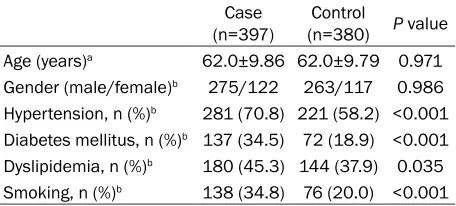
Table 2. Characteristics of case and control in this study cohort
Case
(n=397) (n=380)Control P value Age (years)a 62.0±9.86 62.0±9.79 0.971 Gender (male/female)b 275/122 263/117 0.986 Hypertension, n (%)b 281 (70.8) 221 (58.2) <0.001 Diabetes mellitus, n (%)b 137 (34.5) 72 (18.9) <0.001 Dyslipidemia, n (%)b 180 (45.3) 144 (37.9) 0.035 Smoking, n (%)b 138 (34.8) 76 (20.0) <0.001
aMann-Whitney U test; bχ2 test.
Acute Stroke Treatment) criteria [25]. Only patients with atherothrombosis (AT) and small artery disease (SAD) subtypes were included in this study. Patients with cerebral embolism, transient ischemic attack, cere-brovascular malformations, hemorrhagic stroke, coagulation disorders or other chronic diseases were excluded from this study.
During the same period, 380 unrelated con-trols matched by age and sex were selected from the Physical Examination Center of the Red Cross Hospital (Shenyang, China). The China Medical University (Shen- yang, China) between October 2011 and March 2013 was enrolled in this study. The diagno-sis of ischemic stroke was made according to clinical history and neurological examination and
verse 5’-CGCCTTGCTAGAAGCGGAGAGT-3’. PC- Rs were performed as the following condition: 95°C for 2 min; followed by 11 cycles of 94°C for 20 sec, 65°C-0.5°C/cycle for 40 sec, 72°C for 90 sec; 24 cycles of 94°C for 20 sec, 59°C for 30 sec, 72°C for 90 sec; and 72°C for 2 min
at the final extension reaction. The probes for
LDR are listed in Table 1. The ligation reactions
were performed in a total volume of 10 μl, con
-taining 6 μl of double distilled H2O, 2 μl of PCR product, 1 μl of 10× ligation buffer, 0.4 μl of each discriminating probe, and 0.25 μl of Taq
DNA ligase (New England Biolabs, USA). The LDR cycling conditions were as follows: 38 cycles of 94°C for 60 sec and 56°C for 4 min,
4°C forever. Then, 0.5 μl of purified product was mixed with 0.5 μl of Liz500 SIZE STANDARD and 9 μl of Hi-Di followed by denaturation at 95°C for 5 min. The purified final products of
PCR-LDR were sequenced by the ABI Prism 3730XL DNA sequencer (ABI, Foster city, CA, USA) and the data was analyzed by GeneMapper 4.1 (Applied Biosystems, USA).
Statistical analysis
The data were presented as mean ± standard deviation or percent frequency. Differences in clinicopathological characteristics between patients and controls were evaluated by using Mann-Whitney U test for continuous variables
and χ2 test for categorical variables. Genotype
frequency for each single nucleotide
polymor-phism (SNP) in two groups was checked for Hardy-Weinberg equilibrium (HWE) by χ2 test.
Differences of the distributions of genotypes and alleles between cases and controls were estimated by χ2 test. The relation between
ECE-1 gene SNPs and susceptibility to ischemic stroke was analyzed by computing the odds
ratios (OR) and 95% confidence intervals (CI)
from binary logistic regression analysis. A P
value <0.05 was considered statistically signifi -cant. Statistical analyses were carried out using SPSS version 17.0 software.
Results
The baseline characteristics of patients (n= 397) and controls (n=380) are shown in Table 2. Age and gender were matched in this case-control study. Compared to case-controls, the per-centage of subjects with hypertension, diabe-tes mellitus, dyslipidemia, or tobacco smoking
was significantly higher in the case group.
Genotypic distributions of ECE-1 C-338A and T-839G polymorphism in both groups followed HWE. For C-338A, P=0.384 and 0.544 be- tween case and control, respectively; whereas, for T-839G, P=0.147 and 0.700 between case and control, respectively.
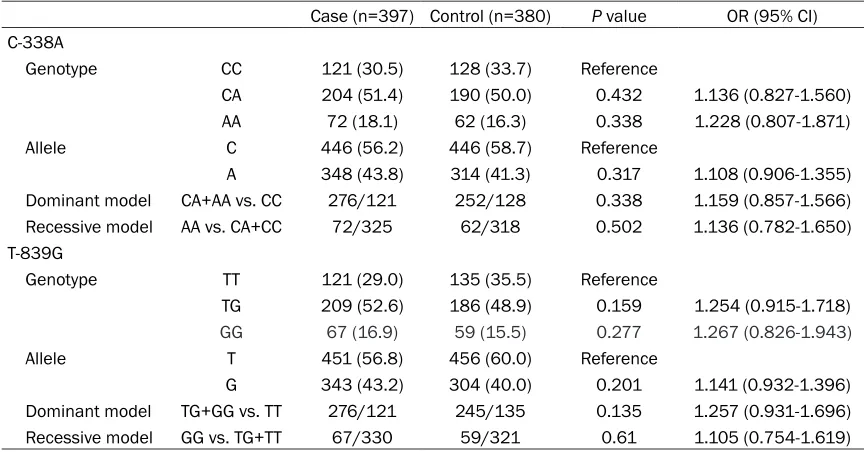
Specifically, in the analyses of total study popu -lation, for both two SNPs, there was no
statisti-cally significant difference found in either geno
-Table 3. Genotypic distribution and allelic frequency between case and control
Case (n=397) Control (n=380) P value OR (95% CI) C-338A
Genotype CC 121 (30.5) 128 (33.7) Reference
CA 204 (51.4) 190 (50.0) 0.432 1.136 (0.827-1.560)
AA 72 (18.1) 62 (16.3) 0.338 1.228 (0.807-1.871)
Allele C 446 (56.2) 446 (58.7) Reference
A 348 (43.8) 314 (41.3) 0.317 1.108 (0.906-1.355)
Dominant model CA+AA vs. CC 276/121 252/128 0.338 1.159 (0.857-1.566) Recessive model AA vs. CA+CC 72/325 62/318 0.502 1.136 (0.782-1.650) T-839G
Genotype TT 121 (29.0) 135 (35.5) Reference
TG 209 (52.6) 186 (48.9) 0.159 1.254 (0.915-1.718)
GG 67 (16.9) 59 (15.5) 0.277 1.267 (0.826-1.943)
Allele T 451 (56.8) 456 (60.0) Reference
G 343 (43.2) 304 (40.0) 0.201 1.141 (0.932-1.396)
[image:3.612.89.521.84.310.2]typic distribution or allelic frequency between patients and controls (Table 3).
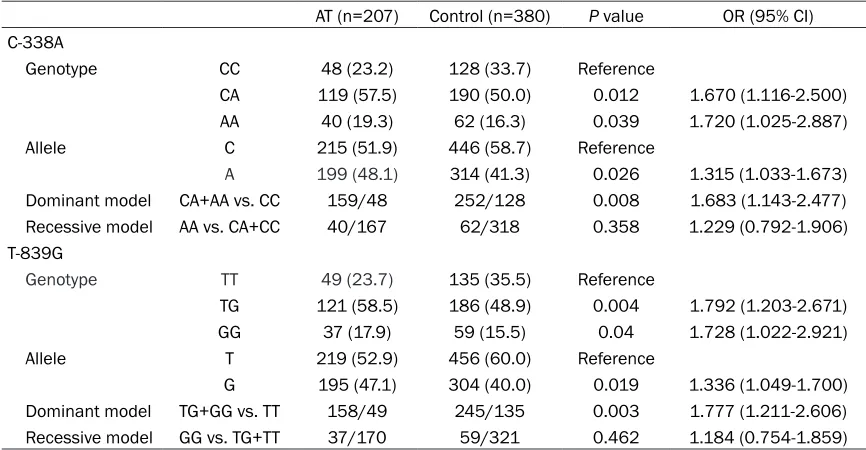
While, in the analyses of AT subgroup, consist-ed of 207 AT cases and 380 controls, we found some meaningful results (Tables 4, 5). For ECE-1 C-338A, genotypic frequencies found among patients with AT and controls were 23.2% CC, 57.5% CA, 19.3% AA and 33.7% CC,
50.0% CA, 16.3% AA respectively, a significant
increased risk of atherothrombotic stroke was observed in both CA (OR: 1.670, 95% CI=1.116-2.500, P=0.012) and AA (OR: 1.720, 95% CI= 1.025-2.887, P=0.039) genotypes. Allelic
fre-quency of A was significantly higher in patients
with AT than in the controls (OR=1.315, 95% CI=1.033-1.673, P=0.026). There was also a positive correlation between C-338A polymor-phism and atherothrombosis subtype in the dominant model analysis (CA+AA vs. CC: OR= 1.683, 95% CI=1.143-2.477, P=0.008) (Table 4). Logistic regression analysis revealed that
T-839G, the frequencies of TG and GG geno-type were significantly higher in AT subgroup
than in control group (OR: 1.792, 95% CI= 1.203-2.671, P=0.004; OR=1.728, 95% CI= 1.022-2.921, P=0.040, respectively). The
inci-dence of G allele was significantly more fre -quent in atherothrombotic stroke patients than in control subjects (47.1% vs. 40%; OR=1.336, 95% CI=1.049-1.700, P=0.019).
Significant association was observed in the
dominant model for T-839G (TG+GG vs. TT: OR=1.777, 95% CI=1.211-2.606, P=0.003). Moreover, after adjustment for confounding variables, the TG+GG genotype group still exhibited an increased risk of atherothrombotic stroke compared to the TT genotype group (adjusted OR=1.821, 95% CI=1.221-2.716, P=0.003) (Tables 4, 5).
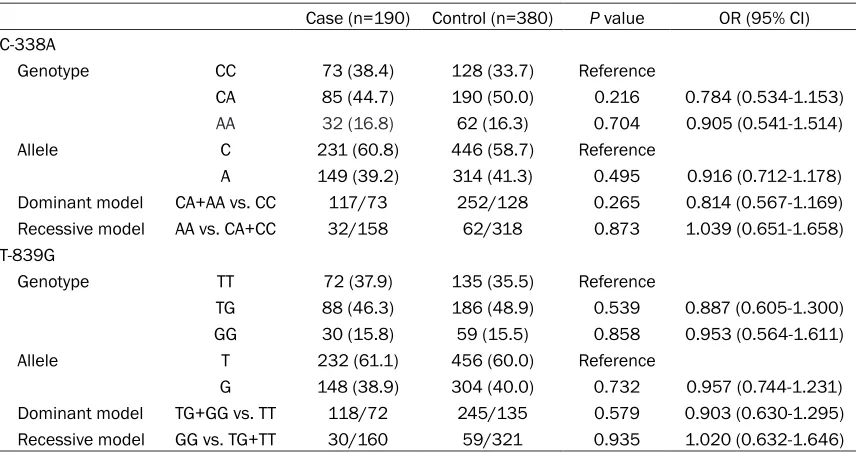
However, in the analyses of SAD subgroup, both the C-338A and T-839G variations were not related to the risk of SAD (Table 6).
Table 4. Genotypic distribution and allelic frequency in patients with AT and controls
AT (n=207) Control (n=380) P value OR (95% CI) C-338A
Genotype CC 48 (23.2) 128 (33.7) Reference
CA 119 (57.5) 190 (50.0) 0.012 1.670 (1.116-2.500)
AA 40 (19.3) 62 (16.3) 0.039 1.720 (1.025-2.887)
Allele C 215 (51.9) 446 (58.7) Reference
A 199 (48.1) 314 (41.3) 0.026 1.315 (1.033-1.673) Dominant model CA+AA vs. CC 159/48 252/128 0.008 1.683 (1.143-2.477) Recessive model AA vs. CA+CC 40/167 62/318 0.358 1.229 (0.792-1.906) T-839G
Genotype TT 49 (23.7) 135 (35.5) Reference
TG 121 (58.5) 186 (48.9) 0.004 1.792 (1.203-2.671)
GG 37 (17.9) 59 (15.5) 0.04 1.728 (1.022-2.921)
Allele T 219 (52.9) 456 (60.0) Reference
G 195 (47.1) 304 (40.0) 0.019 1.336 (1.049-1.700)
[image:4.612.89.522.84.309.2]Dominant model TG+GG vs. TT 158/49 245/135 0.003 1.777 (1.211-2.606) Recessive model GG vs. TG+TT 37/170 59/321 0.462 1.184 (0.754-1.859)
Table 5. Logistic regression analysis
SNPs Genetic model Genotype contrasts valueP Adjusted OR (95% CI)a C-338A Dominant model CA+AA vs. CC 0.008 1.726 (1.153-2.585) T-839G Dominant model TG+GG vs. TT 0.003 1.821 (1.221-2.716)
aAdjusted OR and 95% CI were adjusted for hypertension, diabetes mellitus,
dyslipidemia, smoking as confounding variables between patients with AT and controls.
Discussion
In this study, we investigated the association between ECE-1 polymorphisms (C-338A and T-839G) and ischemic stroke in a cohort of Chinese Han population. Our results suggested that the genotypic distribution and allelic fre-quency of C-338A and T-839G were associ- ated with increased risk of atherothrombotic stroke, but there was no association found in small artery disease subgroup or total cohort population.
Functional analyses suggested that the -338A allele of ECE-1 gene had increased transcrip-tional activity than -338C allele by increasing
transcription factor binding affinity to ECE-1 gene promoter [20]. A further research report-ed that in human prefrontal neocortex, carriers of the -338A allele showed higher level of ECE-1 mRNA expression than non-carriers [26]. A number of genetic association studies demon-strated that C-338A polymorphism of ECE-1
gene was associated with diversified vascular
diseases. Funke-Kaiser et al. discovered that -338A allele was associated with higher blood pressure values in hypertensive women with-out medication [20]. Wang et al. demonstrated an association between this functional poly-morphic site and coronary artery disease in Chinese population, the A allele was associat-ed with an increasassociat-ed risk of coronary artery
dis-ease [27]. Zhao and colleagues found that A allele was associated with increased risk of carotid atherosclerosis, an early marker for generalized atherosclerosis [22]. Two subse-quent studies demonstrated that ECE-1 C- 338A polymorphism may contribute to incre- ased ischemic stroke susceptibility [23, 24]. While, ischemic stroke is a complex disease caused by various potential etiologies. The underlying mechanisms of different subtypes are distinguishing. Studies targeted on isch-emic stroke subtypes could raise the possibility to reveal underlying different genetic back-ground. However, the previous studies haven’t elucidated whether the role of ECE-1 C-338A polymorphism differs between certain sub-types of ischemic stroke. The epidemiological studies have validated an increased genetic effect on atherothrombosis and small artery disease subtypes. Therefore, we selected pati- ents with atherothrombosis or small artery dis-ease subtype according to Korean TOAST crite-ria into our present study, while other subtypes were excluded. We found that the associations between C-338A and risk of ischemic stroke were dependent on disease subtypes. In the AT subgroup, patients with CA and AA genotype
and A allele had a significantly increased risk of
[image:5.612.93.521.83.310.2]ischemic stroke than those with CC genotype and C allele. Multivariate analyses showed that CA+AA genotype was a risk factor for athero-thrombotic stroke.
Table 6. Genotypic distribution and allelic frequency in patients with SAD and controls
Case (n=190) Control (n=380) P value OR (95% CI) C-338A
Genotype CC 73 (38.4) 128 (33.7) Reference
CA 85 (44.7) 190 (50.0) 0.216 0.784 (0.534-1.153)
AA 32 (16.8) 62 (16.3) 0.704 0.905 (0.541-1.514)
Allele C 231 (60.8) 446 (58.7) Reference
A 149 (39.2) 314 (41.3) 0.495 0.916 (0.712-1.178)
Dominant model CA+AA vs. CC 117/73 252/128 0.265 0.814 (0.567-1.169) Recessive model AA vs. CA+CC 32/158 62/318 0.873 1.039 (0.651-1.658) T-839G
Genotype TT 72 (37.9) 135 (35.5) Reference
TG 88 (46.3) 186 (48.9) 0.539 0.887 (0.605-1.300)
GG 30 (15.8) 59 (15.5) 0.858 0.953 (0.564-1.611)
Allele T 232 (61.1) 456 (60.0) Reference
G 148 (38.9) 304 (40.0) 0.732 0.957 (0.744-1.231)
Besides C-338A, we selected the other poly-morphic site T-839G. It has also been reported
that the T-839G polymorphism is significantly
associated with congenital heart disease in the Chinese population and blood pressure levels in females in the Germany population [20, 28]. The results were similar to those obtained from the C-338A study. The -839G allele carriers
had a significantly increased risk for athero -thrombotic stroke.
However, our data showed no association between these two ECE1 gene SNPs and risk of small artery disease subtype.
Atherothrombotic stroke is typically caused by atherosclerotic plaque formation in large arter-ies [25]. In contrast, small artery disease sub-type is predominantly caused by small vessel sclerosis and lipohyalinosis related to hyperten-sion [29, 30]. ECE-1, as the key enzyme to pro-mote formation of ET-1, is implicated in the pathogenesis of vascular diseases via actions of ET-1. Especially, it has been shown that ECE-1 is closely associated with atherosclero-sis. Previous studies demonstrated that the lev-els of both ET-1 and ECE-1 were increased in human atherosclerotic plaque [31]. The upregu-lation of the ECE-1/ET-1 system may promote vasoconstriction, smooth muscle cell
prolifera-tion and inflammatory cell infiltraprolifera-tion in early
stages of atherosclerosis, and may lead to plaque unstable in advanced stages of athero-sclerosis [17, 31]. In addition, it was reported earlier that polymorphisms in other genes of endothelin system (ET, ET type A receptor and ET type B receptor) were not the determinants of genetic risk of cerebral small vessel disease [32]. Hence, ECE-1 seems to affect large artery atherosclerosis but not small artery disease. This study indicates that ECE-1 gene variants confer the susceptibility to atherothrombotic stroke, but not to small artery disease sub- type in the Chinese Han population. Our results are therefore in line with these previous observations.
As expected, it is of note that this study was conducted in a relative small sample size. Furthermore, the study did not determine the functional studies of these mutations. There- fore, the suggested relationship between test-ed SNPs and atherothrombotic stroke still netest-ed validation study in large population, and func-tional investigation should be conducted in
future studies to explore the potential etiology of ischemic stroke.
Acknowledgements
This study was supported in part by grants from the National Natural Science Foundation of China (#81070913 and #81400950).
Disclosure of conflict of interest
None.
Address correspondence to: Zhiyi He, Department
of Neurology, First Affiliated Hospital of China
Medical University, No. 155 North Nanjing Street, Shenyang 110001, Liaoning, China. Tel: +86 24 83282513; E-mail: [email protected]
References
[1] Donnan GA, Fisher M, Macleod M and Davis SM. Stroke. Lancet 2008; 371: 1612-1623. [2] Tsai CF, Thomas B and Sudlow CL. Epidemiology
of stroke and its subtypes in Chinese vs white populations: a systematic review. Neurology 2013; 81: 264-272.
[3] Bennett DA, Krishnamurthi RV, Barker-Collo S, Forouzanfar MH, Naghavi M, Connor M, Lawes CM, Moran AE, Anderson LM, Roth GA, Mensah GA, Ezzati M, Murray CJ, Feigin VL; Global Burden of Diseases, Injuries, and Risk Factors 2010 Study Stroke Expert Group. The global
burden of ischemic stroke: findings of the GBD
2010 study. Glob Heart 2014; 9: 107-112. [4] Bak S, Gaist D, Sindrup SH, Skytthe A and
Christensen K. Genetic liability in stroke: a long-term follow-up study of Danish twins. Stroke 2002; 33: 769-774.
[5] Jousilahti P, Rastenyte D, Tuomilehto J, Sarti C and Vartiainen E. Parental history of cardio-vascular disease and risk of stroke. A prospec-tive follow-up of 14371 middle-aged men and women in Finland. Stroke 1997; 28: 1361-1366.
[6] Opgenorth TJ, Wu-Wong JR and Shiosaki K. Endothelin-converting enzymes. FASEB J 1992; 6: 2653-2659.
[7] Yanagisawa M, Kurihara H, Kimura S, Tomobe Y, Kobayashi M, Mitsui Y, Yazaki Y, Goto K and Masaki T. A novel potent vasoconstrictor pep-tide produced by vascular endothelial cells. Nature 1988; 332: 411-415.
[9] Yoshizumi M, Kim S, Kagami S, Hamaguchi A, Tsuchiya K, Houchi H, Iwao H, Kido H and Tamaki T. Effect of endothelin-1 (1-31) on ex-tracellular signal-regulated kinase and prolif-eration of human coronary artery smooth mus-cle cells. Br J Pharmacol 1998; 125: 1019-1027.
[10] Li MW, Mian MO, Barhoumi T, Rehman A, Mann K, Paradis P and Schiffrin EL. Endothelin-1 overexpression exacerbates atherosclerosis and induces aortic aneurysms in apolipopro-tein E knockout mice. Arterioscler Thromb Vasc Biol 2013; 33: 2306-2315.
[11] Amiri F, Virdis A, Neves MF, Iglarz M, Seidah NG, Touyz RM, Reudelhuber TL and Schiffrin EL. Endothelium-restricted overexpression of human endothelin-1 causes vascular remodel-ing and endothelial dysfunction. Circulation 2004; 110: 2233-2240.
[12] Amiri F, Paradis P, Reudelhuber TL and Schiffrin
EL. Vascular inflammation in absence of blood
pressure elevation in transgenic murine model overexpressing endothelin-1 in endothelial cells. J Hypertens 2008; 26: 1102-1109. [13] Ihling C, Bohrmann B, Schaefer HE,
Technau-Ihling K and Loeffler BM. Endothelin-1 and en -dothelin converting enzyme-1 in human ath-erosclerosis--novel targets for pharmacothera-py in atherosclerosis. Curr Vasc Pharmacol 2004; 2: 249-258.
[14] Bacon CR, Cary NR and Davenport AP. Endothelin peptide and receptors in human atherosclerotic coronary artery and aorta. Circ Res 1996; 79: 794-801.
[15] Minamino T, Kurihara H, Takahashi M, Shimada K, Maemura K, Oda H, Ishikawa T, Uchiyama T, Tanzawa K and Yazaki Y. Endothelin-converting enzyme expression in the rat vascular injury model and human coro-nary atherosclerosis. Circulation 1997; 95: 221-230.
[16] Ruschitzka F, Moehrlen U, Quaschning T, Lachat M, Noll G, Shaw S, Yang Z, Teupser D, Subkowski T, Turina MI and Luscher TF. Tissue endothelin-converting enzyme activity corre-lates with cardiovascular risk factors in coro-nary artery disease. Circulation 2000; 102: 1086-1092.
[17] Hai E, Ikura Y, Naruko T, Shirai N, Yoshimi N, Kayo S, Sugama Y, Fujino H, Ohsawa M, Tanzawa K, Yokota T and Ueda M. Alterations of endothelin-converting enzyme expression in early and advanced stages of human coronary atherosclerosis. Int J Mol Med 2004; 13: 649-654.
[18] Wengenmayer C, Krikov M, Mueller S, Lucht K, Villringer A, Hocher B, Unger T and Thoene-Reineke C. Novel therapy approach in primary stroke prevention: simultaneous inhibition of
endothelin converting enzyme and neutral en-dopeptidase in spontaneously hypertensive, stroke-prone rats improves survival. Neurol Res 2011; 33: 201-207.
[19] Valdenaire O, Rohrbacher E and Mattei MG. Organization of the gene encoding the human endothelin-converting enzyme (ECE-1). J Biol Chem 1995; 270: 29794-29798.
[20] Funke-Kaiser H, Reichenberger F, Kopke K, Herrmann SM, Pfeifer J, Orzechowski HD, Zidek W, Paul M and Brand E. Differential bind-ing of transcription factor E2F-2 to the endo-thelin-converting enzyme-1b promoter affects blood pressure regulation. Hum Mol Genet 2003; 12: 423-433.
[21] Scacchi R, Gambina G, Broggio E, Ruggeri M and Corbo RM. C-338A polymorphism of the endothelin-converting enzyme (ECE-1) gene and the susceptibility to sporadic late-onset Alzheimer’s disease and coronary artery dis-ease. Dis Markers 2008; 24: 175-179. [22] Jin Z, Luxiang C, Huadong Z, Zhiqiang X, Lihua
H and Huiyun L. C-338A polymorphism of the endothelin-converting enzyme-1 gene and the susceptibility to carotid atherosclerosis. Microvasc Res 2009; 78: 128-131.
[23] Li R, Cui M, Zhao J, Yu M, Ying Z, Zhou S and Zhou H. Association of endothelin-converting enzyme-1b C-338A polymorphism with in-creased risk of ischemic stroke in Chinese Han population. J Mol Neurosci 2013; 51: 485-492.
[24] Sui R and He Z. Polymorphisms of ECE1 may contribute to susceptibility to ischemic stroke in Han Chinese of Northern China. Cell Biochem Biophys 2014; 69: 237-246.
[25] Han SW, Kim SH, Lee JY, Chu CK, Yang JH, Shin HY, Nam HS, Lee BI and Heo JH. A
new subtype classification of ischemic stroke
based on treatment and etiologic mechanism. Eur Neurol 2007; 57: 96-102.
[26] Funalot B, Ouimet T, Claperon A, Fallet C, Delacourte A, Epelbaum J, Subkowski T, Leonard N, Codron V, David JP, Amouyel P, Schwartz JC and Helbecque N. Endothelin-converting enzyme-1 is expressed in human cerebral cortex and protects against Alzhei- mer’s disease. Mol Psychiatry 2004; 9: 1122-1128, 1059.
[27] Wang LS, Tang NP, Zhu HJ, Zhou B, Yang L and Wang B. Endothelin-converting enzyme-1b C-338A polymorphism is associated with the increased risk of coronary artery disease in Chinese population. Clin Chim Acta 2007; 384: 75-79.
[29] Fisher CM. Lacunar strokes and infarcts: a re-view. Neurology 1982; 32: 871-876.
[30] Weisberg LA. Diagnostic classification of
stroke, especially Lacunes. Stroke 1988; 19: 1071-1073.
[31] Ihling C, Szombathy T, Bohrmann B, Brockhaus
M, Schaefer HE and Loeffler BM. Coexpression
of endothelin-converting enzyme-1 and endo-thelin-1 in different stages of human athero-sclerosis. Circulation 2001; 104: 864-869.