I
I
I
I
I
I
I
I
I
I
I
I
I
I
I
I
I
Automatically generating hypertext in newspaper articles by computing
semantic relatedness
Stephen J.
G r e e n M i c r o s o f t R e s e a r c h I n s t i t u t eS c h o o l o f M a t h e m a t i c s , P h y s i c s , C o m p u t i n g a n d E l e c t r o n i c s * M a c q u a r i e U n i v e r s i t y
S y d n e y , N S W 2 1 0 9 A u s t r a l i a sj g r e e n @ m r i . m q . e d u . a u
Abstract
We discuss an automatic method for the construction of hypertext links within and between newspaper articles. The method comprises three steps: determining the lexical chains in a text, building links between the paragraphs of articles, and building links between articles. Lexical chains capture the semantic relations between words that occur throughout a text. Each chain is a set of related words that captures a portion of the cohesive structure of a text. By considering the distribution of chains within an article, we can build links between the paragraphs. By computing the similarity of the chains contained in two different articles, we can decide whether or not to place a link between them. We also describe the results of an evaluation performed to test the methodology.
1
I n t r o d u c t i o n
A survey, reported in Outing (1996), found that there were 1,115 commercial newspaper online services world- wide, 94% o f which were on the World-Wide Web (WWW). O f these online newspapers, 73% are in North America. Outing predicted that the number of newspa- pers online would increase to more than 2,000 by the end of 1997.
The problem is that these services are not making full use o f the hypertext capabilities of the WWW. The user may be able to navigate to a particular article in the cur- rent edition o f an online paper by using hypertext links, but they must then read the entire article to find the in- formation that interests them. These databases are "shal- low" hypertexts; the documents that are being retrieved are dead ends in the hypertext, rather than offering start- ing points for explorations. In order to truly reflect the hypertext nature of the Web, links should to be placed within and between the documents.
As Westland (1991) has pointed out, manually creat- ing and maintaining the sets of links needed for a large- scale hypertext is prohibitively expensive. This is espe- cially true for newspapers, given the volume of articles
Work done at the Department of Computer Science of the Univer- sity of Toronto
produced every day. This could certainly account for the state o f current W W W newspaper efforts. Aside from the time-and-money aspects o f building such large hypertexts manually, humans are inconsistent in assigning hypertext links between the paragraphs of documents (Ellis et al., 1994; Green, 1997). That is, different linkers disagree with each other as to where to insert hypertext links into a document.
The cost and inconsistency of manually constructed hypertexts does not necessarily mean that large-scale hy- pertexts can never be built. It is well known in the IR community that humans are inconsistent in assigning in- dex terms to documents, but this has not hindered the construction of automatic indexing systems intended to be used for very large collections of documents. Simi- larly, we can turn to automatically constructed hypertexts to address the issues o f cost and inconsistency.
In this paper, we will describe a novel method for building hypertext links within and between newspaper articles. We have selected newspaper articles for two main reasons. First, as we stated above, there is a grow- ing number o f services devoted to providing this informa- tion in a hypertext environment. Second, many newspa- per articles have a standard structure that we can exploit in building hypertext links.
Most o f the proposed methods for automatic hypertext construction rely on term repetition. The underlying phi- losophy o f these systems is that texts that are related will tend to use the same terms. Our system is based on lexi-
cal chaining and the philosophy that texts that are related
will tend to use related terms.
2
Lexical chains
A lexical chain
(Morris
and Hirst, 1991) is a sequence ofsemantically related words in a text. For example, ifa text contained the words apple and fruit, they would appear in a chain together, since apple is a kind of fruit. Each word in a text may appear in only one chain, but a document will contain many chains, each of which captures a por- tion of the cohesive structure o f the document. Cohesion
Green 101 Automatically generating hypertext
is what, as Halliday and Hasan (1976) put it, helps a text "hang together as a whole". The lexical chains contained in a text will tend to delineate the parts of the text that are "about" the same thing. Morris and Hirst showed that the organization o f the lexical chains in a document mirrors, in some sense, the discourse structure o f that document.
The lexical chains in a text can be identified using any lexical resource that relates words by their meaning. Our current lexical chainer (based on the one described by St- Onge, 1995) uses the WordNet database (Beckwith et al., 199 I). The WordNet database is composed o f synonym sets or
synsets.
Each synset contains one or more words that have the same meaning. A word may appear in many synsets, depending on the number of senses that it has. Synsets can be connected to each other by several dif- ferent types o f links that indicate different relations. For example, two synsets can be connected by a hypernym link, which indicates that the words in the source synset are instances o f the words in the target synset.For the purposes o f chaining, each type of link between WordNet synsets is assigned a direction of up, down, or horizontal. Upward links correspond to generalization: for example, an upward link from
apple to fruit
indicates thatfruit
is more general thanapple.
Downward links correspond to specialization: for example, a link fromfruit
toapple
would have a downward direction. Hori- zontal links are very specific specializations. For exam- ple, the antonymy relation in WordNet is given a direc- tion o f horizontal, since it specializes the sense o f a word very accurately, that is, if a word and its antonym appear in a text, the two words are very likely being used in the senses that are antonyms.Given these types o f links, three kinds of relations are built between words:
Extra strong An exwa strong relation is said to exist be- tween repetitions of the same word: i.e., term repe- tition.
Strong A strong relation is said to exist between words that are in the same WordNet synset (i.e., words that are synonymous). Strong relations are also said to exist between words that have synsets connected by a single horizontal link or words that have synsets connected by a single IS-A or INCLUDES relation.
Regular A regular relation is said" to exist between two words when there is at least one
allowable
path between a synset containing the first word and a synset containing the second word in the WordNet database. A path is allowable if it is short (less than n links, where n is typically 3 or 4) and adheres to three rules:1. No other direction may precede an upward link.
2. No more than one change of direction is al- lowed.
3. A horizontal link may be used to move from an upward to a downward direction.
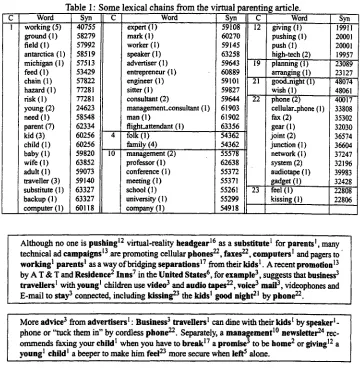
When a word is processed during chaining, it is ini- tially associated with all of the synsets of which it is a member. When the word is added to a chain, the chainer attempts to find connections between the synsets associ- ated with the new word and the synsets associated with words that are already in the chain. Synsets that can be connected are retained and all others are discarded. The result of this processing is that, as the chains are built, the words in the chains are progressively sense- disambiguated. When an article has been chained, a de- scription of the chains contained in the document is writ- ten to a file. Table 1 shows some of the chains that were recovered from an article about the trend towards "virtual parenting" (Shellenbarger, 1995). In this table, the num- bers in parentheses show the number of occurrences o f a particular word.
The process o f lexical chaining is not perfect, but if we wish to process articles quickly, then we must ac- cept some errors or at least bad decisions. In our sam- ple article, for example, chain 1 is a conglomeration o f words that would have better been separated into differ- ent chains. This is a side effect of the current implemen- tation o f the lexical chainer, but even with these difficul- ties, we are able to perform useful tasks. We expect to address some o f these problems in subsequent versions o f the chainer, hopefully with no loss in efficiency.
3 Building links within an article
3.1 Analyzing the iexicai chains
Newspaper articles are written so that one may stop read- ing at the end o f any paragraph and feel as though one has read a complete unit. For this reason, it is natural to choose to use paragraphs as the nodes in our hypertext. Table 1 showed the lexical chains recovered from a news article about the trend towards "virtual parenting". Figure 1 shows the second and eighth paragraphs o f this article with the words that participate in lexical chains tagged with their chain numbers. We will use this particular arti- cle to illustrate the process of building intra-article links. The first step in the process is to determine how im- portant each chain is to each paragraph in an article. We judge the importance of a chain by calculating the frac- tion of the content words of the paragraph that are in that chain. We refer to this fraction as the
density
o f that chain in that paragraph. The density of chain c in paragraph p,dc,p,
is defined as:dc,p ~ Wc,p
wp
Green
102Automatically generating hypertext
I
I
I
I
I
I
I
I
I
I
I
I
I
II
II
II
/
/
/
l
/
/
/
/
/
/
/
/
/
/
/
II
l
Table I:
Word Syn
working (5) 40755
ground (I) 58279
field (1) 57992
antarctica (I) 58519
michigan (I) 57513
feed (I) 53429
chain (I) 57822
hazard (1) 77281
risk ( 1 ) 77281
young (2) 24623
need (1) 58548
parent (7) 62334
kid (3) 60256
child (1) 60256
baby (1) 59820
wife (1) 63852
adult (I) 59073
traveller (3) 59140 substitute (1) 63327
backup (1) 63327
computer(l) 60118
Some lexical chains from the virtual parenting article.
4
10
C Word
expert(I) mark ( 1 ) worker (I) speaker (1) advertiser (I) entrepreneur (I) engineer (1) sitter (I) consultant (2)
management_consultant ( I ) man (1)
flight_attendant (I) folk (1) family (4) management (2) professor (i) conference (1) meeting (I) school (I) university (I) company (!) Sya 59108 60270 59145 63258 59643 60889 59101 59827 59644 61903 619O2 63356 54362 54362 55578 62638 55372 55371 55261 55299 54918
C Word
12 giving (I) pushing (!) push (1) high-tech (2) 19 planning (1)
arranging ( 1 )
21 good_night(l)
wish (l)
22 phone (2)
cellular.phone (I) fax (2) gear (1) joint (2) junction (1) network (I) system (2) audiotape (1) gadget (I) 23 feel (I)
kissing (I) Syn 19911 20001 2000 I 19957 23089 23127 48074 48061 40017 33808 35302 32030 36574 36604 37247 32196 39983 32428 22808 22806
Although no one is p u s h i n g 12 virtual-reality h e a d g e a r 16 as a substitute I for p a r e n t s I, many I technical ad c a m p a i g n s 13 are promoting cellular phones ~ , faxes ~ , computers I and pagers to"
l
w o r k i n g I p a r e n t s ! as a way o f bridging s e p a r a t i o n s 17 from their kids I . A recent promotion 13
by A T & T and Residence 2 Inns 7 in the U n i t e d States 6 , for example 3, suggests that business 3 travellers I with young j children use video 3 and audio tapes ~ , voice 3 mail 3, videophones and E-mail to stay 3 connected, including k i s s i n g ~ the kids I good n i g h t 21 by phone 22.
More advice 3 from advertisers t: Business s travellers I can dine with their kids t by speakerL
phone or "tuck them in" by cordless p h o n e z2. Separately, a m a n a g e m e n t I0 newsletter 24 rec- o m m e n d s faxing your child I when you have to b r e a k 17 a p r o m i s e 3 to be h o m e 2 or giving 12 a y o u n g I child I a beeper to make him feel ~ more secure when left "s alone.
F i g u r e 1: T w o p o r t i o n s o f a text t a g g e d w i t h c h a i n n u m b e r s .
where wc,p is the number o f words from chain c that appear in paragraph p and w v is the number o f content words (i.e., words that are not stop words) in p. For ex- ample, if we consider paragraph two o f our sample arti- cle, we see that there are 9 words from chain 1. We also note that there are 48 content words in the paragraph. So, in this case the density o f chain 1 in paragraph I, dr,z, is
9
4-g = 0.19.
The result of these calculations is that each paragraph in the article has associated with it a vector o f chain den- sities, with an element for each o f the chains in the article. Table 2 shows these chain density vectors for the chains shown in table I. Note that an empty element indicates a density o f 0.
3.2 Determining paragraph links
As we said earlier, the parts of a document that are about the same thing, and therefore related, will tend to contain the same lexical chains. Given the chain density vectors
that we described above, we need to develop a method to determine the similarity o f the sets of chains contained in each paragraph. The second stage of paragraph linking, therefore, is to compute the similarity between the para- graphs o f the article by computing the similarity between the chain density vectors representing them. We can com- pute these similarities using any one of 16 similarity co- efficients that we have taken from Ellis et al. (1994).
This similarity is computed for each pair of chain den- sity vectors, giving us a symmetric p x p matrix o f simi- laritie s, where p is the number of paragraphs in the arti- cle. From this matrix we can calculate the mean and the standard deviation o f the paragraph similarities.
The next step is to decide which paragraphs should be linked, on the basis o f the similarities computed in the previous step. We make this decision by looking at how the similarity of two paragraphs compares to the mean paragraph similarity across the entire article. Each sim- ilarity between two paragraphs i and j, si,j, is converted
[image:3.612.127.487.59.430.2]Table 2: Some chain density vectors for the virtual parenting article.
Chain
1
4 10 12 19 21
22
23
1
0.14 0.07
Chain Words 8 Content 14 Density 0.57
Paragraph
2 3 4 5 6 7 8 / 9 10
0.19 0 . 0 7 0.16 0.28 0.18 0.10 0.25 [ 0.24 0.13
0.11 0.05 0.03 0.03
0.07 0.05 0.11 0.04 0.03
0.02 0 . 0 4 0.05 0.04 0.03
0.04 0.06
I1 0.33
0.02 0.05
0.08 0 . 0 4 0 . 0 5 0.I1 0.07 0.07 0 . 0 8 0.03
0.02 0.04
30 15 15 10 15 16 19 20 15 6
48 27 19 18 28 29 28 38 30 9
0.62 0 . 5 6 0 . 7 9 0.56 0.54 0 . 5 5 0.68 0 . 5 3 0.5'0 0.67
Table 3: Adjacency matrix for the virtual parenting arti- cle.
Par
1 2 3 4 5 6 7 8 9 10 11
1 2 3 4 5 6 7 8 9 10 11
0 0 0 0 0 0 0 0 0 0 0 0 0 0 1 0 0 I I 1 0 0 0 0 0 0 0 0 0 0 0 0 0 0 0 0 0 0 0 0 0 1 I 0 0 0 0 0 0 1 0 0 0 0 1 0 0 1 0 0 0 0 I 0 0 0
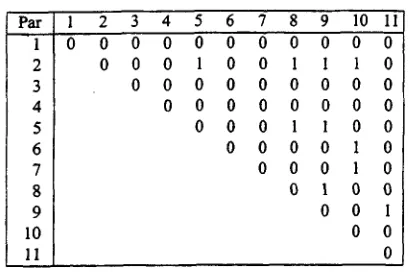
to a z-score, zi,j. If two paragraphs are more similar than a threshold given in terms o f a number of standard de- viations, then a link is placed between them. The result is a symmetric adjacency matrix where a 1 indicates that a link should be placed between two paragraphs. Figure 3 shows the adjacency matrix that is produced when a z- score threshold o f 1.0 is used to compute the links for our virtual parenting example.
Once we have decided which paragraphs should be linked, we need to be able to produce a representation o f the hypertext that can be used for browsing. In the current system, there are two ways to output the HTML representation o f an article. The first simply displays all o f the links that were computed during the last stage o f the process described above. The second is more compli- cated, showing only some o f the links. The idea is that links between physically adjacent paragraphs should be omitted so that they do not clutter the hypertext.
4 Building
links between articles
While it is useful to be able to build links within articles, for a large scale hypertext, links also need to be placed
between articles. You will recall from section 2 that the
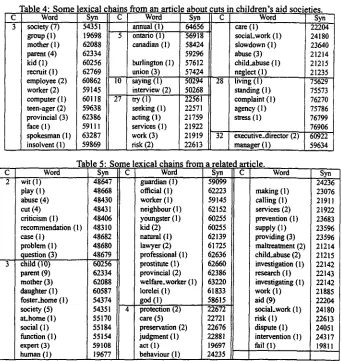
output of the lexical chainer is a list of chains, each chain consisting of one or more words. Each word in a chain has associated with it one or more synsets. These synsets indicate the sense o f the word as it is being used in this chain. An example of the kind of output produced by the ehainer is shown in table 4, which shows a portion o f the chains extracted from an article (Gadd, 1995b) about cuts in staffat children's aid societies due to a reduction in provincial grants. Table 5 shows a portion o f another set o f chains, this time from an article (Gadd, 1995a) de- scribing the changes in child-protection agencies, due in part to budget cuts.
It seems quite clear that these two articles are related, and that we would like to place a link from one to the other. It is also clear that the words in these two articles display both o f the linguistic factors that affect IR per- formance, namely synonymy and polysemy. For exam- ple, the first set o f chains contains the word abuse, while the second set contains the synonym maltreatment. Sim- ilarly, the first set o f chains includes the word kid, while the second contains child. The word abuse in the first ar- ticle has been disambiguated by the lexieal chainer into the "cruel or inhuman treatment" sense, as has the word
maltreatment from the second article. We once again note
that the lexieal chaining process is not perfect: for exam- ple, both texts contain the word abuse, but it has been d.isambiguated into different s e n s e s - - in the first article, it is meant in the sense o f "ill-treatment", while in the second it is meant in the sense o f "verbal abuse".
Although the articles share a large number o f words, by missing the synonyms or by making incorrect (or no) judgments about different senses, a traditional IR system might miss the relation between these documents or rank them as less related than they really are. Aside from the problems of synonymy and polysemy, we can see that there are also more-distant relations between the words o f these two articles. For example, the second set o f chains
Green 104 Automatically generating hypertext
II
1
Ii
1
1
l
1
II
1
II
II
Ii
II
[image:4.612.134.477.62.212.2] [image:4.612.85.290.274.410.2]l
/
/
I
I
l
I
I
I
/
I
I
I
/
/
I
Table 4: Some lexical chains from an articl
Word Syn C Word
society (7) 54351 annual (1)
group (I) 19698 5 ontario (I)
mother(l) 62088 canadian (I)
parent (4) 62334
kid (1) 60256 burlington (1)
recruit (!) 62769 union (3)
employee (2) 60862 10 saying (1)
worker (2) 59145 interview (2)
computer(l) 60118 27 try(1)
teen-ager (2) 59638 seeking (1)
provincial (3) 62386 acting (1)
face (I) 59111 services (I)
spokesman (I) 63287 work (3)
insolvent (I) 59869 risk (2)
about cuts in children's aid societies.
Syn C Word Syn'
64656 care (I) 22204
5 6 9 1 8 social_work (l) 24180
58424 slowdown (1) 23640
59296 abuse (3) 21214
5 7 6 1 2 child..abuse ( l ) 21215
57424 neglect ( 1 ) 21235
50294 28 living (I) 7562~
50268 standing (I) 75573
22561 complaint ( I ) 76270
22571 agency (I) 75786
21759 stress (1) 76799
21922 76906
21919 32 executive_director (2) 60922
22613 manager (l) 59634
Table 5: Some lexical chains from
Word Syn C Word
wit (I) 48647 guardian (1)
play ( I ) 48668 official (I)
abuse (4) 48430 worker (1)
cut (4) 4 8 4 3 1 neighbour (1)
criticism (1) 4 8 4 0 6 youngster (1)
recommendation (I) 48310 kid (2)
case (1) 48682 natural (1)
problem (I) 48680 lawyer (2)
question (3) 4 8 6 7 9 professional (I)
child ( 1 O) 60256 prostitute ( 1 )
parent (9) 6 2 3 3 4 provincial (2)
mother (3) 6 2 0 8 8 welfare_worker (1)
daughter (1) 60587 lorelei (1)
foster.home (I) 54374 god (I)
society (5) 54351 4 protection (2)
at_home (i) 55170 care (5)
social (1) 5 5 1 8 4 preservation (2)
function (1) 5 5 1 5 4 judgment (I)
expert (3) 59108 act (1)
human (1) 19677 behaviour (I)
related article. Syn 59099 62223 59145 62152 60255 60255 62139 61725 62636 62660 62386 63220 61833 58615 22672 22721 22676 22881 19697 24235
C Word
making (1) calling (I) services (2) prevention (l) supply (1) providing (3) maltrea~'nent (2) child.abuse (2) investigation (I) research (I) investigating ( 1 ) work (1) aid (9)
social.work ( 1 ) risk (1) dispute (1) intervention (1) fail (1) Syn 24236 23076 21911 21922 23683 23596 23596 21214 21215 22142 22143 22142 21885 22204 24180 22613 24051 24317 19811
contains the word
maltreatment
while the first set con- tains the related wordchild abuse
(a kind of maltreat-ment) as well as the repetition
of child abuse.
We can build these
inter-article
links by determiningthe similarity o f the two
sets
o f chains contained in two articles. In essence, we wish to perform a kind of cross- document chaining.4.1 Synset weight vectors
We can represent each document in a database by two vectors. Each vector will have an element for each synset in WordNet. An element in the first vector will contain a weight based on the n u m b e r o f occurrences o f that par- ticular synset in the words o f the chains contained in the document. A n element in the second vector will contain a weight based on the n u m b e r o f occurrences of that par- ticular synset when it is one link away from a synset as- sociated with a word in the chains. We will call these
vectors the
member and linked synset vectors,
or simplythe m e m b e r and linked vectors, respectively.
The weight o f a particular synset in a particular docu- ment is not based solely on the frequency o f that synset
in the document, but also on how frequently that term ap- pears throughout the database. The synsets that are the most heavily weighted in a document are the ones that appear frequently in that document but infrequently in the entire database. The weights are calculated using the standard ff-idf weighting function:
Wik =-
sf ik" log(N/nk)
~/Y~= t (sf ij) 2. (log(N lnj) )2
where
sfik
is the frequency o f synset k in document i, N is the size of the document collection, n , is the n u m b e r of documents in the collection that contain synset k, and s is the number o f synsets in all documents. Note that this equation incorporates the normalization o f the synset weight vectors.The weights are calculated independently for the mem- ber and linked vectors. We do this because the linked vectors introduce a large n u m b e r o f synsets that do not necessarily appear in the original chains o f an article, and should therefore n o t influence the frequency counts o f the member synsets. Thus, we make a distinction between
[image:5.612.136.478.60.421.2]strong links that occur due to synonymy, and strong links that occur due to IS-A or INCLUDES relations. The simi- larity between two documents, DI and/32, is then deter- mined by calculating three cosine similarities:
1. The similarity of the member vectors of DI and/)2; 2. The similarity of the member vector of Dl and
linked vector olD2; and
3. The similarity of the linked vector of Di and the member vector of D2.
Clearly, the first similarity measure (the member-
member similarity) is the most important, as it will cap-
ture extra-strong relations as well as strong relations be- tween synonymous words. The last two measures (the
member-linked similarities) are less important as they
capture strong relations that occur between synsets that are one link away from each other. If we enforce a thresh- old on these measures o f relatedness, then we ensure that there are several connections between two articles, since each element o f the vectors will contribute only a small part of the overall similarity.
4.2 Building inter-article finks
Once we have built a set of synset weight vectors for a collection of documents, the process of building links be- tween articles is relatively simple. Given an article that we wish to build links from, we can compute the simi- larity between the article's symet weight vectors and the vectors o f all other documents. Documents whose mem- ber vectors exceed a given threshold of similarity will have a link placed between them. Our preliminary work shows that a threshold o f 0.15 will include most related documents while excluding many unrelated documents.
This is almost exactly the methodology used in vector- space IR systems such as SMART, with the difference being that for each pair of documents we are calculating three separate similarity measures. The best way to cope with these multiple measurements seems to be to rank related documents by the sum of the three similarities. The sum of the three similarities can lie, theoretically, anywhere between 0 and 3. In practice, the sum is usually less than 1. For example, the average sum of the three similarities when running the vectors of a single article against 5,592 other articles is 0.039.
5 Evaluation
In the evaluation that we conducted, the basic question that we asked was: Is our hypertext linking methodology superior to other methodologies that have been proposed (e.g., that of Allan, 1995)? The obvious way to answer the question was to test whether the links generated by our methodology lead to better performance when they were used in the context of an appropriate IR task.
We selected a question-answering task for our study. We made this choice because it appears that this kind of task is well suited to the browsing methodology that hypertext links are meant to support. This kind of task is also useful because it can be performed easily using
only hypertext browsing. This is necessary because in the
interface used for our experiment, no query engine was provided for the subjects.
We used the "Narrative" section of three TREC topics (Harman, 1994) to build three questions for our subjects to answer. There were approximately 1996 documents that were relevant to the topics from which these ques- tions were created. We read these documents and pre- pared lists of answers for the questions. Our test database consisted of these articles combined randomly with ap- proximately 29,000 other articles selected randomly from the TREC corpus. The combination of these articles pro- vided us with a database that was large enough for a reasonable evaluation and yet small enough to be easily manageable.
5.1 The test system
We considered two possible methods for generating inter- article hypertext links. The first is our own method, de- scribed above. The second method uses a vector space IR system called Managing Gigabytes (MG) (Witten et al., 1994) to generate links by calculating a document simi- laxity that is based strictly on term repetition. We used the MG system to generate links in a way very similar to that presented in Allan (1995). For simplicity's sake, we will call the links generated by our technique HT links and the
links generated by the MG system MG links.
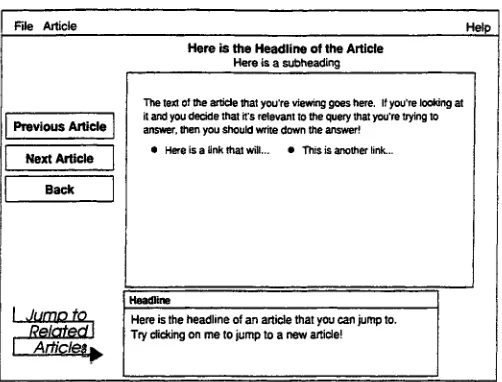
Figure 2 shows the interface of the test system used. The main part of the screen showed the text of a single article. The subjects could navigate through the article by using the intra-article links, a scroll bar, or the page up and down keys. The Previous Article and Next Article
buttons could be used for navigating through the set of ar- ticles that had been visited and the Back button returned the user to the point from which an intra-article link was taken. Each search began on a "starter" page that con- mined the text of the appropriate TREC topic as the "ar- ticle" and the list of articles related to the topic shown (this was computed by using the text of the topic as the initial "query" to the database). Subjects were expected to traverse the links, writing down whatever answers they could find.
At each stage during a subject's browsing, a set of inter-article links was generated by combining the set of I-IT links and the set of MG links. By using this strat- egy, the subjects "vote" for the system that they prefer by choosing the links generated by that system. O f course, the subjects are not aware of which system generated the links that they are following - - they can only decide to
Green 106 Automatically generating hypertext
1
1
1
1
II
1
1
II
1
II
II
II
1
1
1
II
1
II
II
II
II
II
II
II
II
II
II
II
II
II
II
II
II
II
I!
II
File Article Help
Previous Article
I Next Article
Back
I Jurno to Reloted I I Arh'clet=.
H e r e i s the Headline of the A r t i c l e Here is a subheading
The text 0t the arlJcle thal you're viewing goes here. If you're looking at it and you decide that it's relevant to the query that you're trying to ans',tc, r, then you should write down the answer!
• Here is a link that will,.. • This is another rink...
Headline
Here is the headline of an article that you can jump to. Try clicking on me to jump to a new article!
Figure 2: The interface o f the evaluation system.
follow a link by considering the article headlines dis- played as anchors. We can, however, determine which system they "voted" for by considering their success in answering the questions they were asked. If we can show that their success was greater when they followed more I-IT links, then we can say that they have "voted" for the superiority o f HT links. A similar methodology has been used previously by Nordhausen et al. (1991) in their com- parison o f human and machine-generated hypertext links. The two sets of inter-article links can be combined by simply taking the
unique
links from each set, that is, the links that we take are those that appear in only one o f the sets o f links. O f Course, we would expect the two methods to have many links in common, but it is diffi- cult to tell how these links should be counted in the "vot- ing" procedure. By leaving them out, we test the differ- ences between the methods rather than their similarities. O f course, by excluding the links that the methods agree on we are reducing the ability o f the subjects to find an- swers to the questions that we have posed for them. In fact, we found that nearly 40% o f the links found were found by both methods. It does seem, however, that the users could find enough answers to give some interesting results.5.2 Experimental results
The number o f both inter- and intra-articte links followed was, on average, quite small and variable (full data are given in Green, 1997). The number o f correct answers found was also low and variable, which we believe is due partly to the methodology and partly to the time restric- tions placed on the searches (15 minutes). On average, the subjects showed a slight bias for HT links, choosing
47.9% MG links and 52.1% HT links. This is interesting, especially in light o f the fact that, for all the articles the subjects visited, 50.4% of the links available were MG links, while 49.6% were HT links. A paired t-test, how- ever indicates that this difference is not significant.
For the remainder o f the discussion, we will use the variable
LHT
tO refer to the number of HT links that a subject followed,LMG
to refer to the number of MG links followed, and L / t o refer to the number of intra-article links followed. The variable Ans will refer to the number o f correct answers that a subject found. We can combineLHr and LMG
into a ratio, LR = ~u-'~G" I fLR
> 1, then a" W . M ~ .
subject folio ed more HT links than MG hnks. An inter- esting question to ask is: did subjects with significantly higher values for LR find more answers? With 23 subjects each answering 3 questions, we have 69 values for LR. I f we sort these values in decreasing order and divide the resulting list at the median, we have two groups with a significant difference in LR. An unpaired t-test then tells us that the differences in
Ans
for these two groups are significant at the 0. I level.So it seems that there may be some relationship be- tween the number and kinds o f links that a subject fol- lowed and his or her success in finding answers to the questions pose. We can explore this relationship using two different regression analyses, one incorporating only inter-article links and another incorporating both inter- and intra-article links. These analyses will express the relationship between the number o f links followed and the number of correct answers found.
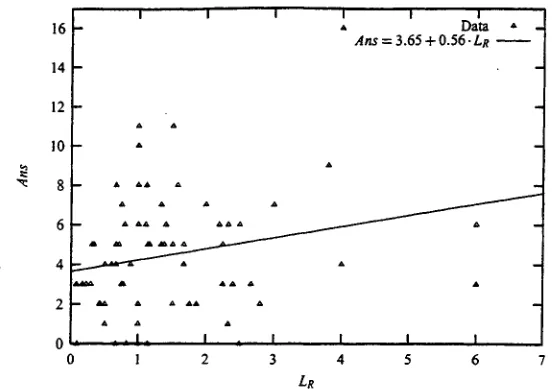
5.2.1 Inter-article links
A model incorporating only the inter-article links that our subjects followed gives us the following equation:
[image:7.612.185.436.55.246.2]II
II
il
II
II
II
II
II
II
II
II
II
II
II
II
II
16
14
12
10
8
6
I I I
A
- - t 4 4 A
• 4 •
- - • A A 4. 4 & A
~ A • • •
4 A •
0 " ' | " I ,
0 1 2
I I I
, D a t a
Aria = 3.65 + 0.56- LR
/ J
I I I I
3 4 5 6
LR
Figure 3: Data and regression line for a two-dimensional model.
we can see a set o f subjects (the High Web group) who found significantly more answers
and
followed signifi- cantly more I-IT links, indicating the advantage o f HT links over MG links.5.2.4 V i e w e d answers
In the analyses that we've performed to this point, we have been using the number of correct answers that the subjects provided as our dependent variable. Part o f the reason we are using this dependent variable is that the subjects were limited in the amount o f time that they could spend on each search, and so they could only find a certain number o f answers, no matter how many answers there were to find. We can mitigate this effect by intro- ducing a new dependent variable,
Ansv,
or the number of.viewed answers.
The number o f viewed answers for a particular ques- tion is simply the number o f answers that were contained in articles that a subject visited while attempting to an- swer a question. These answers need not have been writ- ten down. We are merely saying that, given more time, the subjects might have been able to read the article more fully and find these answers. This idea is analogous to the use
of judged
andviewed recall
by Golovchinsky (1997) in his studies.When we consider Ansi, as our dependent variable, the model for the High Web group is still not significant, and there is still a high probability that the coefficient o f
L/
is 0. For our Low Web group, who followed signifi- cantly more intra-article links than the High Web group, the model that results is significant and has the following equation:
Ansv
= 0.58.L,~r + 0.21 .LMG + 0.21 "L1 (R 2 = 0.41)Table 9:
model using viewed answers.
Parameter Value t
Ltcr
0.58 4.37LMG
0.21 1.62L!
0.21 2.1995% confidence intervals for coefficients in a
p Low High 0.00 0.31 0.85 0.06 - 0 . 0 5 0.47 0.02 0.01 0.40
Table 9 shows the 95% confidence intervals for this model. We see that the coefficient o f Lt is always pos- itive, indicating some effect on
Ansv
from intra-article links. We also see that the probability that this coeffi- cient is 0 is less than 0.02. We note, however, that for this model we earmot claim that the coefficient of LHr is always greater than the coefficient o f LMG. This is not too surprising in light o f the fact that the High Web group chose significantly more HT links than did the Low Web group.6 Conclusions and future work
Our evaluation shows that we cannot reject our null hy- pothesis that there is no difference in the two methods for generating inter-article links. Having said this, we can demonstrate a partition o f the subjects such that the only significant differences between them are the number o f HT links followed and the number of answers found. Fur- thermore, we determined that the probability o f obtaining results such as these by chance is less than 0.1. Our in- ability to achieve a significant result may be due to several implementation factors, described in Green (1997). Thus, we conclude that we need to replicate the experiment in order to gain further information about the relationship between the two kinds of inter-article links.
[image:9.612.169.447.62.257.2]