∗
University of Washington Department of Linguistics
∗ University of Washington
Department of Linguistics Department of LinguisticsUniversity of Washington
In the context of the ongoing AGGREGA-TION project concerned with inferring gram-mars from interlinear glossed text, we explore the integration of morphological patterns ex-tracted from IGT data with inferred syntac-tic properties in the context of creating im-plemented linguistic grammars. We present a case study of Chintang, in which we put em-phasis on evaluating the accuracy of these pre-dictions by using them to generate a grammar and parse running text. Our coverage over the corpus is low because the lexicon produced by our system only includes intransitive and tran-sitive verbs and nouns, but it outperforms an expert-built, oracle grammar of similar scope.
Machine-readable grammars are useful for lin-guistic hypothesis testing via parsing and tree-banking (selecting the best parse for each sen-tence) because they represent internally coherent models and can be explored automatically ( Ben-der et al., 2011, 2012a; Fokkens, 2014; Müller,
1999, 2016). Multilingual grammar engineering frameworks such as CoreGram (Müller,2015) and the LinGO Grammar Matrix (Bender et al.,2002,
2010) facilitate the development of machine-readable grammars by providing shared analyses, but still require significant human effort to select the appropriate analyses for a given language. To partially automate this process, the AGGREGA-TION project takes advantage of the stored anal-yses in the Grammar Matrix and the linguistic information encoded in Interlinear Glossed Text (IGT). While at this stage the project efforts are mostly experimental in nature and focus on evalu-ating grammars obtained in this way, there already have been successful collaborations with docu-mentary linguists which in at least one case led
∗The first two authors made equal contribution.
to insights into the language’s morphological pat-terns (Zamaraeva et al.,2017).
The IGT data format, widely used by linguists, is well suited to inference tasks because it features detailed morpheme-by-morpheme annotation and translations to high-resource languages (Xia and Lewis,2007;Bender et al., 2013). However, the inference processes required are heterogeneous. On the morphological side, an inference system identifies position and inflectional classes. On the syntactic side, an inference system uses syntac-tic generalizations to identify broad characterissyntac-tics and defines lexical classes according to syntactic properties. The challenge we address here is in in-tegrating the two. In this paper, we integrate a sys-tem that identifies morphological patterns in IGT data with one that predicts syntactic properties to define lexical classes that encode both morpholog-ical and syntactic features. We evaluate by repli-cating the case study of Bender et al. (2014), in which they automatically produced separate gram-mar fragments based on morphotactic and syntac-tic information and evaluated their system on a corpus of Chintang. We compare their results to our integrated system which includes both mor-photactic and syntactic properties.1
Chintang (ISO639-3: ctn) is a Sino-Tibetan lan-guage spoken by∼5000 people in Nepal (Bickel et al., 2010; Schikowski et al., 2015). Here we summarize the characteristics of the language that are directly relevant to this case study.
The relative order of the verb and its core ar-guments (hereafter ‘word order’) in Chintang is described as free bySchikowski et al. (2015), in that all verb and argument permutations are valid
1Our code and sample data are available here:
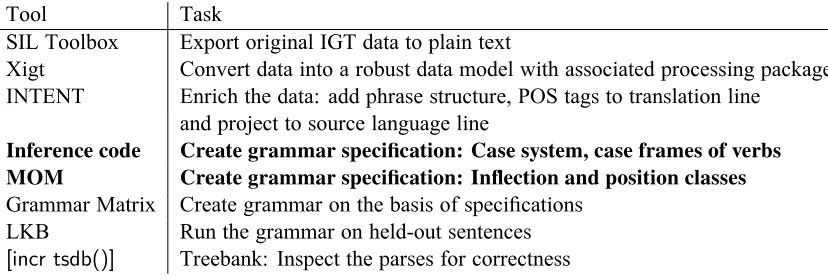
Tool Task
SIL Toolbox Export original IGT data to plain text
Xigt Convert data into a robust data model with associated processing package INTENT Enrich the data: add phrase structure, POS tags to translation line
and project to source language line
Grammar Matrix Create grammar on the basis of specifications
LKB Run the grammar on held-out sentences
[image:2.595.89.503.62.202.2]Treebank: Inspect the parses for correctness
Table 1: AGGREGATION pipeline, indicates this paper’s contribution
in the language, with the felicity of these combi-nations being governed primarily by information structure. AlthoughSchikowski et al.(2015) note that no detailed analysis has been carried out re-garding what other factors condition word order, they say that SV, APV and AGTV are the most frequent orders that they observe.2 Dropping of
core arguments is also common in the language (Schikowski et al.,2015).
The case system follows an ergative-absolutive pattern, with some exceptions (Stoll and Bickel,
2012; Schikowski et al., 2015). In
ergative-absolutive languages, the subject of an intransi-tive verb has the same case marking as the most patient-like argument of a transitive verb, typi-cally referred to as absolutive. The most agent-like argument of a transitive verb has a distinct case marking, usually called ergative. In Chin-tang, ergative case is marked with an overt marker while absolutive is zero-marked. A number of exceptions to the ergative-absolutive pattern arise due to valence changing operations (such as re-flexive and benefactive). Other exceptions include variable ergative marking on first and second per-son pronouns and an overt absolutive marker on the pronoun ‘who’.3
Chintang’s flexible word order, scarcity of overt case marking, and frequent argument drop-ping introduce challenges to grammar inference. First, the variety of phrase structure rules required to accommodate free word order in addition to argument optionally introduces potential for am-biguity to any implemented grammar. In some cases, this ambiguity is legitimate (in that multi-ple parses map to multimulti-ple semantic readings), but in other cases it may be an indication of
under-2S=subject, P=patient, G=goal, T=theme, A=agent 3For a much more detailed account of the case frame for
various verb types, seeSchikowski et al. 2015.
constrained rules. Second, the lack of overt ab-solutive case marking in Chintang, together with common pronoun dropping, results in relatively few overt case morphemes in the corpus for a syn-tactic inference script to use.
The AGGREGATION project4is dedicated to
au-tomating the creation of grammars from IGT.5
Ta-ble1presents all the tools involved in the pipeline, with information on which task each performs. We elaborate on the pieces of the pipeline below and encourage the reader to refer back to this table as needed to track what each component is.
As part of the AGGREGATION project, Ben-der et al.(2014) present the first end-to-end study of grammar inference from IGT by extracting broad syntactic properties (namely, word order, case system and case frame) and morphological patterns and testing the coverage of the result-ing grammars on held out data. They used the methodology of Bender et al. (2013) for syntac-tic inference and Wax (2014) for morphological inference. However, they left integrating the two and creating grammars which benefit from both types of information to future work.
LikeBender et al.(2014), we take advantage of the Grammar Matrix customization system ( Ben-der et al., 2002, 2010), which creates precision grammars that emphasize syntactically accurate coverage and attempt to minimize ambiguity. It uses stored analysis for particular phenomena to
4
5We are aware of one project with similar goals:
create a grammar based on a user’s specifica-tion of linguistic properties. These specificaspecifica-tions are recorded in a ‘choices file’. We follow the methodology ofBender et al.(2014) of formatting the output of our inference systems as a choices file, so that it can be directly input to the Grammar Matrix for grammar customization.
UnlikeBender et al.(2014), we take advantage of the Xigt data model (Goodman et al., 2015). This extensible and flexible format encodes the information in IGT data in such a way that rela-tions between bits of information, such as the con-nection between a morpheme and its gloss, can be easily identified. Data encoded with Xigt is compatible with the INTENT system for enriching IGT by parsing the English translation and pro-jecting that information onto the source language text (Georgi, 2016). Where Bender et al. (2014) use the methodology of Xia and Lewis (2007), in this work we use INTENT. We also use up-dated, Xigt-compatible versions of morphological and lexical class inference (Zamaraeva,2016; Za-maraeva et al., 2017) and case system inference (Howell et al.,2017).
Our goal is to maximize the information that we can learn about a language both morphologically and syntactically in order to produce grammars that parse strings with minimal ambiguity. We present a methodology that analyzes morpholog-ical and syntactic information independently and then creates lexical classes that share the informa-tion from both analyses.
MOM is a system which infers morphotactic graphs from IGT. Developed originally by Wax
(2014) to infer position classes, it was updated to work with the Xigt data model byZamaraeva
(2016) and to infer inflectional classes by Zama-raeva et al.(2017). Below we summarize the main inference algorithm shared across these different versions. As with most work using MOM and the Grammar Matrix, we target the morpheme-segmented line, and assume that the grammars produced will eventually need to be paired with a morphophonological analyzer to map to surface spelling or pronunciation.
MOM starts by reading in IGT that has been enriched with information about each morpheme,
-are am
port cap
-o
-io fac
[image:3.595.318.511.61.148.2]-ere
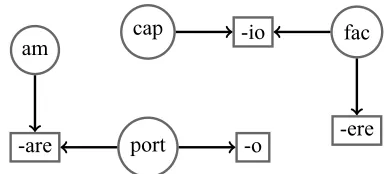
Figure 1: Sample graph MOM will initially build on the example training data consisting of Latin verbs
(‘to love’), (‘to carry’), (‘I carry’), (‘I take’), (‘I do’), and (‘to do’).
-are, -o am, port
-ere, -io cap, fac
Figure 2: Sample MOM output, after compressing the graph in Figure1with a 50% overlap value.
including a part of speech (POS) tag of the word it belongs to as well as whether it is an affix or a stem. Then MOM iterates over the items with the relevant POS tag and builds a graph where nodes are stems and affixes while edges are in-put relationships. For example, if MOM sees
the Latin verbs (‘to love’), (‘to
carry’), (‘I carry’), (‘I take’), (‘I do’), and (‘to do’) in the training data, it will create nodes and edges as depicted in Fig-ure 1. Finally, after the original graph has been constructed, MOM will recursively merge nodes which have edge overlap above the threshold pro-vided by the user (e.g. 50%, see Figure2), in order to discover position classes for affixes and inflec-tional classes for stems.
Whereas MOM creates lexical classes based on morphotactics, the inference system described in this section creates lexical classes for verbs based on their valence in two steps: We first infer the overall case system of the language and second in-fer whether each verb in the training data is transi-tive or intransitransi-tive. We then create lexical classes that specify the argument structure and case re-quirements on those arguments.
[image:3.595.357.475.224.318.2]et al.(2013) and updated byHowell et al.(2017). We reimplement Bender et al.’s gram method, which counts the case grams in the corpus and uses a heuristic to assign nominative-accusative, ergative-absolutive, split-ergative or none to the language based on the relative frequencies of the case grams. We apply one change to this system: because the split-ergative prediction does not give any information regarding the nature of the split (e.g. whether it is split according to features of nouns or verbs), we map the split-ergative (which it predicts for Chintang) to ergative-absolutive.
To determine the transitivity of verbs in the cor-pus, we take advantage of the English translation in the IGT. The dataset, which has been partially enriched by INTENT (Georgi, 2016),6 includes
parse trees and POS tags for the English trans-lation. Furthermore, the Chintang words in the dataset are annotated for part of speech by the authors of the corpus. To infer transitivity using this information, we first do a string comparison between the gloss of the Chintang verb and each word in the language line to identify the English verb that it corresponds to. If no match is found, for example the verb is glossed with , but the English translation contains instead, the verb is skipped. However, if a match is found, we tra-verse the English parse tree to check if the V is sister to an NP. If so, it is classified as transitive, otherwise it is classified as intransitive. We ex-clude passive sentences from consideration; how-ever, under this algorithm, verbs that take a ver-bal complement are classified as intransitive. We leave further fine-tuning in this respect to future work. Finally, once we have the case system and the transitivity for each verb, we assign the verb’s case frame according to a heuristic specific to the case system. In the case of ergative-absolutive, we specify ergative case on the subject of transitive verbs and absolutive on the subject of intransitive verbs and object of transitive verbs.
We modified the MOM system by extending the data structure that it expects as input with fields for transitivity and case frame and by mak-ing it check these fields every time it consid-ers which lexical class to assign to an item (we describe this process in more detail in §4.4).
6For this particular dataset, INTENT was not able to
pro-duce bilingual alignments. This means that we were not able to take advantage of word to word mappings.
We added functionality so that MOM infers case lexical rules for nouns. Next, we added func-tions to collapse all homonym stems in each class into one stem with a disjunctive predication (e.g. stem , predication
).7 Furthermore, we
improved the way MOM is dealing with stems that occur bare in the data. Previously, MOM put all bare stems into a lexical class which could not merge with inflecting classes later, even if the same stem occurred with affixes in other portions of the data. Our fixing this problem led to fewer lexical classes in the grammar, which means bet-ter coverage potential. Finally, we made neces-sary additions to MOM’s output format so that all relevant information for each lexical class, includ-ing case features and transitivity values, would be encoded into a valid choices file that can be cus-tomized by the Grammar Matrix.
We integrated the systems described in §4.2 and §4.3 such that lexical types are defined accord-ing to the output of both systems. We expect our grammars produced in this fashion to outper-form either of the kinds of grammars produced by Bender et al. (2014), because our integrated verb classes contain both morphological and va-lence constraints, rather than leaving one of these categories underspecified.
We run the syntactic inference system before MOM, so that transitivity and case frame are in-cluded in MOM’s input. While MOM builds lex-ical classes based on morphology, it also checks transitivity and case frame for compatibility be-fore adding an item to a lexical class. Verbs for which there is no case frame prediction are clas-sified in a ‘dummy’ category, rather than being thrown out in order to maximize the morphologi-cal patterns that can be detected by MOM. That is, we want to include these verbs in the graph during the morphological inference process.8 However,
without constraints on their valence, their inclu-sion in the final grammar would result in spurious ambiguity. Therefore, we allow these verbs in the grammar, but change their orthography to contain
7This follows the conventions of Minimal Recursion
Se-mantics, seeCopestake et al. 2005andFlickinger et al. 2014.
8As will be mentioned in §5.2.4, we also allow MOM to
Grammar spec Origin description
oracle Bender et al. 2012b Expert-constructed
baseline Bender et al. 2014 Full-form lexicon, free word order (WO), no case mom-default-none Bender et al. 2014 MOM-inferred lexicon, free WO, no case
ff-auto-gram Bender et al. 2014 Full-form lexicon, V-final WO, erg-abs case system integrated This paper MOM-inferred lexicon, case frames, free WO, erg-abs
Table 2: Grammars used in evaluation
a non-Chintang string, so that they are effectively excluded from the working grammar unless they were merged into a verb class with valid valence constraints.
So far we have described a methodology that ex-tracts both syntactic and morphological informa-tion from IGT data, and outputs this informainforma-tion in a format compatible with the Grammar Ma-trix customization system. Now we present a case study of this system on a Chintang dataset, described in §5.1. We describe our comparison grammars as well as the output of our system (§5.2) and grammar development and parsing pro-cess (§5.3) before presenting the results in §6and the discussion in §7.
For our experiment, we use the same subset of the Chintang Language Resource Program (CLRP)9 corpus as Bender et al. (2014), which
contains 10862 instances of Interlinnear Glossed Text. These IGT comprise narratives and other recorded speech that were transcribed, translated and glossed by the CLRP. Example (1) illustrates the thorough glossing of IGT in this corpus. How-ever, it is noteworthy, especially for the purposes of inference, that syntactic characteristics that do not correspond with an overt morpheme (such as sg and abs) are not glossed in this data. We use the same train (8863 IGT), dev (1069 IGT) and test (930 IGT) splits asBender et al.(2014).
(1) unisaŋa u-nisa-ŋa
3sposs-younger.brother-erg.a khatte khatt-e take-ind.pst mo
mo dem.down
kosiʔ kosi-iʔ river-loc
moba mo-pe
dem.down-loc
‘The younger brother took it to the river.’ [ctn] (Bickel et al.,2013)
9https://www.uzh.ch/clrp/
Figure 3: Excerpts from a choices file
We use a version of the training portion of the data that has been converted to the Xigt data model. The converter skipped 169 IGT, resulting in a slightly smaller training set than that used by
Bender et al. (2014). This dataset was enriched with English parses and part of speech tags using INTENT (Georgi,2016).
The output of the morphotactic and syntactic in-ference scripts described earlier in this section is encoded in a ‘choices file’, illustrated in Figure3, which is the suitable input to the Grammar Ma-trix customization system (Bender et al., 2010). In this subsection, we describe the choices files we developed for the baseline, oracle and our in-ference system, as well as the comparison choices from the 2014 experiment.10
Our first point of comparison is a manually con-structed ‘oracle’ choices file, from Bender et al.
10For this comparison, we regenerated thebaseline and
the oracle grammars from their choices files. For mom-default-noneandff-auto-gramwe worked from the same
2012b. This choices file was developed by im-porting CLRP’s Toolbox lexicon and defining the rest of the specifications by hand, based on lin-guistic analysis. As a result, the grammar pro-duced by this choices file is expected to have very high precision, with moderate recall. It speci-fies the word order as verb-final (corresponding to the most frequent word orders observed by
Schikowski et al.(2015)) and the case system as ergative-absolutive, and it defines both subject and object dropping as possible for all verbs. It also includes hand-specified lexical rules based on the analysis inSchikowski 2012.
Because the Grammar Matrix only included simple transitive and intransitive verbs at the time this choices file was developed, only those two classes were defined. Their case frames were specified by hand such that the intransitive verb class has an absolutive subject and the transitive verb class has an ergative subject and an absolu-tive object. Finally, because the Grammar Ma-trix did not support adjectives, adverbs, and many other lexical categories, the resulting grammar is not expected to parse any sentence containing those lexical categories. Conveniently, the limi-tations of the grammar defined by Bender et al.
(2012b) make it a good comparison to the
gram-mar we are able to produce using only the infer-ence described in this paper.11
As a second point of comparison, we use a choices file that is designed to create a working grammar with a sufficient lexicon that is otherwise naïve with respect to the particular grammatical char-acteristics of Chintang. We take this choices file
fromBender et al. (2014), but make some
modi-fications. The lexicon was extracted according to the methodology ofXia and Lewis(2007), defin-ing bare bones classes for nouns, verbs and de-terminers. Because the inference system we use in the this paper does not consider determiners, we removed them from the baseline choices file. Finally, the baseline predicts free word order, no case system and argument dropping for subjects and objects of all verbs because these choices are expected to result in the highest coverage (though low precision) for any language.12
11We do still have to add some default choices to our
in-ferred grammar, as described in §5.2.4.
12It is incidental that these word order and argument
dropping predictions are arguably valid analyses for this
Our final comparison is to the results for the choices files created by Bender et al. (2014) that are most comparable to our present work. We look at theirmom-default-noneand ff-auto-gramgrammars which represent the two types of inference that we have integrated.
Themom-default-nonechoices file uses a lexi-con produced by MOM and the default choices for word order (free), case system (none), and argu-ment optionality (all arguargu-ments are optional). The ff-auto-gram uses a lexicon of full word forms, as in the baseline but with case frames for each verb as observed in the data. The word order (V-final) and case system (ergative-absolutive) were inferred using syntactic inference.
We produced the inferred choices file by extract-ing the lexicon, case system and morphological rules, as described in §4.1, §4.2and §4.3. We ran the inference system on training data, debugging and selecting an overlap value by parsing the dev data with the resulting grammars. Our system pre-dicted ergative-absolutive case and a robust lexi-con and set of morphological rules. We used the default word order (free) and default argument op-tionality choices (any verb can drop subject or ob-ject) fromBender et al. 2014. We also added the necessary choices for the ‘dummy verb’ category described in §4.3.
We ran MOM with 10 overlap values from 0.1 to 1.0. Then we parsed sentences from the development set to identify the grammar that optimizes both coverage and ambi-guity. For these data, that showed the optimum overlap value to be 0.2.13 We inspected the
dif-ferences in coverage and verified that they fall into three categories. First, some lexical entries which originally lacked a valence frame (the in-ference script was not able to assign one) success-fully merged into lexical classes which did have a valid valence frame.14 Second, some entries
hap-pened to merge into only an intransitive class in one grammar but only into a transitive class in an-other. Finally, upon merging into lexical classes, language.
13The 0.1 grammar had marginally lower ambiguity (2.76
fewer parses on average), but it parsed two fewer sentences.
14We assume that if a verb without a known valence frame
lexical entries gained access to morphological pat-terns which were unseen in the training data. This happens with both noun and verb lexical entries. For example, not all grammars that we produced were able to successfully produce a parse tree for (2), because they did not merge the stem with a class that is compatible with the prefix .
(2)
u-3sa-silbite.and.pull.out-u-3p-set-destr.tr-kV-3p -ce
-ind.npst -3nsp
‘They snatch and kill them’ [ctn] (Bickel et al.,2013)
After producing the choices files, we used the Grammar Matrix customization system15 to
pro-duce customized grammars. We loaded these into the LKB parsing software (Copestake,2002) and
used (Flickinger and Oepen, 1998)
to create stored profiles of syntactic and seman-tic parses. We treebanked these parses using to identify correct parses, or parses that produce the desired semantic representation for the sentence. In particular, we checked to make sure that the predicate-argument structure matched what was indicated in the gloss, but did not require information such as negation, person and number or tense and aspect (all morphologi-cally marked in Chintang), as our system doesn’t yet attempt to extract these.
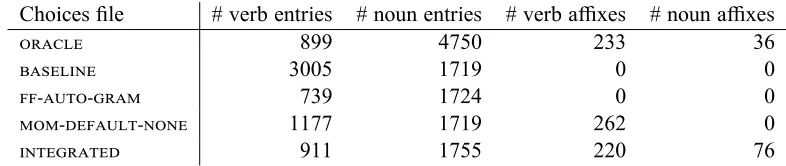
To put the results of parsing the strings from Chin-tang in context, we first describe the produced grammars in terms of their size. Table 3reports the size of the lexicons and the number of affixes of each grammar. The oracle grammar’s lexi-con includes the imported Toolbox lexilexi-con from CLRP, so it includes many more stems than the others. The baseline andff-auto-gram lexicons include full form lexical entries,16while the
gram-mar produced by ourintegrated system has lex-icons that include stems extracted from the train-ing data. mom-default-noneonly did morpholog-ical analysis on verbs; for nouns it includes full-form entries. Theoraclegrammar has a number of morphological rules for nouns and verbs that
15svn://lemur.ling.washington.edu/shared/matrix/trunk at
revision 41969
16Note that the ff-auto-gram grammar only included
verbs for which a case frame could be predicted.
were hand-crafted, while mom-default-noneand integrated’s lexical rules were extracted from the training data.
The results are reported in Table 4. ‘Lexical coverage’ is the number of sentences for which the grammar could produce an analysis (via full form lexical entry or morphological rules) for ev-ery word form. These numbers are quite small because there are no lexical entries for categories other than nouns and verbs. ‘Parsed’ shows the number of sentences in test data that received some spanning syntactic analysis, and ‘correct’ the number of items for which there was a correct parse, according to manual inspection and tree-banking. Finally we report the number of read-ings, which shows the degree of ambiguity in the grammar. Ourintegratedsystem had the highest coverage as well as the highest correct coverage, but also had the most ambiguity.
We expect integrated to have broader cover-age than ff-auto-gram and baseline because it includes morphological rules allowing it to gen-eralize to unseen entries. We also expect inte-gratedto have higher precision (a higher propor-tion of correct parses) thanmom-default-none be-cause unlikemom-default-none, it integrates case frames which can rule out spurious analyses. We also expect it to have higher coverage than mom-default-none because it includes inferred mor-phological rules for nouns (in addition to verbs). Though the absolute numbers are small, these pre-dictions are borne out by the data in Table4.
To get a better sense of the differences between the systems, we performed an error analysis. We looked at all the parsed items (not just the tree-banked ones) to get a broader view into the be-havior of the grammars. This section provides the results of our analysis as well as some exploration into the higher ambiguity found byintegrated.
As expected (and as with the other grammars), the parsing errors forintegratedare due to either lex-ical or syntactic failures. For 825 items, the parser
did not succeed in . In principle,
Choices file # verb entries # noun entries # verb affixes # noun affixes
oracle 899 4750 233 36
baseline 3005 1719 0 0
ff-auto-gram 739 1724 0 0
mom-default-none 1177 1719 262 0
[image:8.595.100.493.62.145.2]integrated 911 1755 220 76
Table 3: Amount of lexical information in each choices file
choices file lexical coverage (%) parsed (%) correct (%) readings
oracle 116 (12.5) 20 (2.2) 10 (1.1) 1.35
baseline* 38 (0.4) 15 (1.6) 8 (0.9) 27.67
ff-auto-gram 18 (1.9) 4 (0.4) 2 (0.2) 5.00
mom-default-none 39 (4.2) 16 (1.7) 3 (0.3) 10.81
integrated 105 (11.3) 32 (3.4) 15 (1.6) 91.56
*We report slightly different results for lexical coverage and average readings for the baseline
thanBender et al.(2014) because we removed determiners from the choices file. Table 4: Results on 930 held-out sentences
sample of 50 such items and only found instances of missing stems and affixes, and no failed com-binatorics. The remaining 73 errors are accounted
for on the . These break into three
categories: (1) both a V/VP and an NP could be formed, but the NP had a case marker incompat-ible with the verb’s case frame (e.g. locative; 6 items of this kind total);17 (2) a sentence did not
contain a word which could be analyzed as a verb by the grammar (only as a noun, e.g. a sentence fragment; 23 total); (3) finally, the sentence was complex, i.e., contained more than one verb. This third category was the most common (44 total), as the grammar does not include subordination or coordination rules.
We also compared our results on the held-out data to the baseline and the oracle grammars. Whileintegratedoutperforms bothbaselineand oracle, baseline and oracle parse some sen-tences thatintegrateddoes not.
Comparison between or-acleandintegratedyields 130 different results. Of these, most are due to differences in lexical analysis. In particular, there are 55 items which fail due to lexical analysis in integratedbut fail due to syntactic analysis inoracle. In all of these cases, our grammar lacked a lexical entry that the oracle grammar had; this is expected as the oracle lexicon is based on a different source. There are 38 items for whichoraclecannot provide lexical
17What is missing here is a grammar rule that handles e.g.
locative NPs functioning as modifiers.
analysis andintegrated can but fails at the syn-tactic stage. Of these, most are missing stems and affixes in the oracle grammar but for one item, oracle is actually lacking the required affix or-dering thatintegratedpicks up from the training data. In addition, there are 11 cases whereoracle fails at lexical analysis and integrated succeeds at both lexical and syntactic analysis. In two of those eleven cases, integrated outperforms or-acle due to the robustness of the morphological rules, not the lexicon. In contrast, there are 3 items at whichintegratedfails lexically and ora-clegives a parse, all due to lexicon differences. In 6 cases,oraclefails at the syntactic stage where integratedsucceeds. Of these, 1 was rejected in treebanking,18two items are true wins due to
mor-photactic inference for nouns; two are because or-acleonly has a noun entry for something which integrated picked up as a verb, and finally one is parsed byintegrated because it admits head-initial word orders whileoracleinsists on V-final. In contrast,oraclecan parse one item for which integratedcan perform lexical analysis but fails to parse. The sentence is andoraclehas both a verb and a noun entry for the word whileintegrateddoes not.
The difference between integrated and baseline is mainly due to lexi-cal coverage. The baseline grammar featuring
18If none of the parses have a structure and a semantic
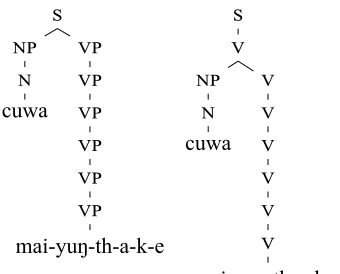
s np
n cuwa
vp vp vp vp vp vp mai-yuŋ-th-a-k-e
s v np
n cuwa
v v v v v v
[image:9.595.95.265.62.199.2]mai-yuŋ-th-a-k-e Figure 4: Analyses like the one above (for (3)) use homonymous intransitive (left) and transitive verb en-try with a dropped argument (right). Together with the homonymous verb position classes, this produces ambiguity.
full-form lexical entries can lexically analyze 6 items that integrated cannot, while integrated analyzes 22 items that baseline cannot. Neither wins at syntactic analysis.19
integrated produces noticeably more trees per sentence than either the oracle grammar or the baseline grammar, on average (see ‘readings’ col-umn in Table4). The baseline’s low ambiguity is not striking, because it only parses a few syntacti-cally and morphologisyntacti-cally simple sentences. Still, on some items the baseline grammar produces hundreds of trees. The oracle grammar clearly has less ambiguity. The main reason for more ambiguity inintegratedis simple combinatorics. We infer noun and verb inflectional and position classes, and often end up with homophonous af-fixes as well as homophonous transitive and in-transitive entries for verbs. For example, the verb , meaning ‘sit’, ‘be’ or ‘squat’, is associated with both a transitive and an intransitive entry in integrated. Figure 4 illustrates two of the trees that this grammar finds for (3).
(3) cuwa
watermai-yuŋ-th-a-k-eneg-be.there-neg-pst-ipfv-ind.pst ‘Was there water?”
These homophonous lexical resources combine with the argument optionality rules, word order
19A few of these differences are due to the fact that base-lineincludes pronouns and other word categories (such as
interjections) as ‘nouns’ in the lexicon. We builtintegrated
assuming only things marked as nouns go in. In future work, we will include pronouns (but not interjections).
flexibility and the actual complexity of Chintang morphotactics to create a large search space for the parser.
The default setting in MOM is to produce mor-phological rules which are optional. Further-more, MOM does not yet infer non-inflecting lex-ical rules. This means that uninflected forms are passed through to the syntax without being associ-ated with the morphosyntactic or morphosemantic information that the zero in the paradigm actu-ally reflects. In future work, we will explore how to automatically posit such zero-marked rules, including how to make sure that their position classes are required, so that the grammar can prop-erly differentiate ‘zero’ and ‘uninflected’.
We plan to extend our syntactic inference al-gorithm to account for verbs with alternate or ‘quirky’ case frames. Another avenue that our error analysis shows as particularly promising is to handle complex clauses, as there are tools to model coordination (Drellishak and Bender,2005) and subordination (Howell and Zamaraeva,2018;
Zamaraeva et al., 2019) in the Grammar Matrix
framework.
This material is based upon work supported by the National Science Foundation under Grant No. BCS-1561833. Any opinions, findings, and con-clusions or recommendations expressed in this material are those of the author(s) and do not nec-essarily reflect the views of the National Science Foundation.
We would like to thank Alex Burrell for pro-viding code from a previous project that we built on in order to infer transitivity.
We thank previous AGGREGATION research assistants for converting the corpus into Xigt and enriching it with INTENT.
Emily M Bender, Dan Flickinger, and Stephan Oepen. 2002. The Grammar Matrix: An open-source starter-kit for the rapid development of cross-linguistically consistent broad-coverage precision grammars. In John Carroll, Nelleke Oostdijk, and Richard Sutcliffe, editors,
, pages 8–14, Taipei, Taiwan, 2002. Emily M Bender, Scott Drellishak, Antske Fokkens,
Laurie Poulson, and Safiyyah Saleem. 2010. Gram-mar customization.
, 8:1–50. ISSN 1570-7075.
Emily M. Bender, Dan Flickinger, and Stephan Oepen. 2011. Grammar engineering and linguistic hypoth-esis testing: Computational support for complexity in syntactic analysis. In Emily M. Bender and Jen-nifer E. Arnold, editors,
, pages 5–29. CSLI Publications, Stanford, CA. Emily M. Bender, Sumukh Ghodke, Timothy Baldwin,
and Rebecca Dridan. 2012a. From database to tree-bank: Enhancing hypertext grammars with gram-mar engineering and treebank search. In Sebastian Nordhoff and Karl-Ludwig G. Poggeman, editors, , pages 179–206. Uni-versity of Hawaii Press, Honolulu.
Emily M Bender, Robert Schikowski, and Balthasar Bickel. 2012b. Deriving a lexicon for a precision grammar from language documentation resources: A case study of Chintang.
, pages 247–262.
Emily M Bender, Michael Wayne Goodman, Joshua Crowgey, and Fei Xia. August 2013. To-wards creating precision grammars from interlin-ear glossed text: Inferring large-scale typological properties. In
, pages 74–83, Sofia, Bulgaria, August 2013. Association for Compu-tational Linguistics. URL
.
Emily M Bender, Joshua Crowgey, Michael Wayne Goodman, and Fei Xia. June 2014. Learning grammar specifications from IGT: A case study of Chintang. In
, pages 43–53, Bal-timore, Maryland, USA, June 2014. Association for Computational Linguistics. URL
.
Balthasar Bickel, Manoj Rai, Netra Paudyal, Goma Banjade, Toya Nath Bhatta, Martin Gaenszle, Elena Lieven, Iccha Purna Rai, Novel K Rai, and Sabine Stoll. 2010. The syntax of three-argument verbs in Chintang and Belhare (Southeastern Kiranti).
, pages 382–408.
Balthasar Bickel, Martin Gaenszle, Novel Kishore Rai, Vishnu Singh Rai, Elena Lieven, Sabine Stoll, G. Banjade, T. N. Bhatta, N Paudyal, J Pettigrew, and M Rai, I. P.and Rai. 2013. Tale of a poor guy. URL
. Accessed: 22 October 2018.
Ann Copestake. 2002.
. CSLI publications, Stanford. Ann Copestake, Dan Flickinger, Carl Pollard, and
Ivan A Sag. 2005. Minimal recursion semantics: An introduction.
, 3(2-3):281–332.
Scott Drellishak and Emily Bender. 2005. A coordina-tion module for a crosslinguistic grammar resource. In
, volume 12, pages 108–128. URL
.
Dan Flickinger, Emily M Bender, and Stephan Oepen. 2014. ERG semantic documentation. URL
. Accessed on 2018-10-22.
Daniel P. Flickinger and Stephan Oepen. 1998. To-wards systematic grammar profiling. Test suite tech-nology ten years after. In
, Hei-delberg, 1998.
Antske Sibelle Fokkens. 2014.
Ryan Georgi. 2016.
. PhD thesis, University of Washington.
Michael Wayne Goodman, Joshua Crowgey, Fei Xia, and Emily M Bender. 2015. Xigt: Extensible interlinear gloss text for natural language
process-ing. , 49 (2):
455–485.
Lars Hellan and Dorothee Beermann. 2014. Induc-ing grammars from IGT. In Mariani J. Vetulani Z., editor,
, volume 8287
of .
Springer.
Kristen Howell and Olga Zamaraeva. 2018. Clausal modifiers in the Grammar Matrix. In
, pages 2939–2952.
Kristen Howell, Emily M Bender, Michael Lockwood, Fei Xia, and Olga Zamaraeva. 2017. Inferring case systems from IGT: Impacts and detection of variable glossing practices. , pages 67–75. Stefan Müller. 1999.
. Number 394 in Linguistische Arbeiten. Max Niemeyer Verlag, Tübingen.
Stefan Müller. 2015. The CoreGram project: The-oretical linguistics, theory development and
ver-ification. , 3(1):
21–86. URL
. Stefan Müller. 2016.
. Language Science Press.
Robert Schikowski. Chintang morphology. Unpub-lished ms, University of Zürich, 2012.
Robert Schikowski, NP Paudyal, and Balthasar Bickel. 2015. Flexible valency in Chintang.
.
Sabine Stoll and Balthasar Bickel. 2012. How to measure frequency? Different ways of count-ing ergatives in Chintang (Tibeto-Burman, Nepal) and their implications. In Frank Seifart, Geof-frey Haig, Nikolaus P. Himmelmann, Dagmar Jung, Anna Margetts, and Paul Trilsbeek, editors,
, pages 83–89. University of Hawai’i Press.
David Wax. 2014. Automated grammar engineering for verbal morphology. Master’s thesis, University of Washington.
Fei Xia and William D. Lewis. 2007. Multilingual structural projection across interlinear text. In
, pages 452–459, Rochester, New York, 2007.
Olga Zamaraeva. 2016. Inferring morphotactics from interlinear glossed text: combining clustering and precision grammars. In
, pages 141–150.
Olga Zamaraeva, František Kratochvíl, Emily M Ben-der, Fei Xia, and Kristen Howell. 2017. Compu-tational support for finding word classes: A case study of Abui. In
, pages 130–140.
Olga Zamaraeva, Kristen Howell, and Emily M. Bender. 2019. Modeling clausal com-plementation for a grammar engineering re-source. In
, volume 2, page Article 6. URL