Probabilistic Frame Induction
Jackie Chi Kit Cheung∗ Department of Computer Science
University of Toronto Toronto, ON, M5S 3G4, Canada
Hoifung Poon One Microsoft Way Microsoft Research Redmond, WA 98052, USA
Lucy Vanderwende One Microsoft Way Microsoft Research Redmond, WA 98052, USA
Abstract
In natural-language discourse, related events tend to appear near each other to describe a larger scenario. Such structures can be formal-ized by the notion of aframe(a.k.a. template), which comprises a set of related events and prototypical participants and event transitions. Identifying frames is a prerequisite for infor-mation extraction and natural language gen-eration, and is usually done manually. Meth-ods for inducing frames have been proposed recently, but they typically use ad hoc proce-dures and are difficult to diagnose or extend. In this paper, we propose the first probabilistic approach to frame induction, which incorpo-rates frames, events, and participants as latent topics and learns those frame and event transi-tions that best explain the text. The number of frame components is inferred by a novel application of a split-merge method from syn-tactic parsing. In end-to-end evaluations from text to induced frames and extracted facts, our method produces state-of-the-art results while substantially reducing engineering effort.
1 Introduction
Events with causal or temporal relations tend to oc-cur near each other in text. For example, a BOMB
-ING scenario in an article on terrorism might be-gin with a DETONATION event, in which terrorists
set off a bomb. Then, a DAMAGEevent might
en-sue to describe the resulting destruction and any
casualties, followed by an INVESTIGATION event
∗
This research was undertaken during the author’s internship at Microsoft Research.
covering subsequent police investigations. After-wards, the BOMBING scenario may transition into a CRIMINAL-PROCESSING scenario, which begins with police catching the terrorists, and proceeds to a trial, sentencing, etc. A common set of partici-pants serves as the event arguments; e.g., the agent (or subject) of DETONATION is often the same as the theme (or object) of INVESTIGATIONand
corre-sponds to a PERPETRATOR.
Such structures can be formally captured by the notion of aframe(a.k.a. template, scenario), which consists of a set ofevents with prototypical transi-tions, as well as a set ofslotsrepresenting the com-mon participants. Identifying frames is an explicit or implicit prerequisite for many NLP tasks. Infor-mation extraction, for example, stipulates the types of events and slots that are extracted for a frame or template. Online applications such as dialogue sys-tems and personal-assistant applications also model users’ goals and subgoals using frame-like represen-tations. In natural-language generation, frames are often used to represent contents to be expressed as well as to support surface realization.
Until recently, frames and related representations have been manually constructed, which has limited their applicability to a relatively small number of do-mains and a few slots within a domain. Furthermore, additional manual effort is needed after the frames are defined in order to extract frame components from text (e.g., in annotating examples and design-ing features to train a supervised learndesign-ing model). This paradigm makes generalizing across tasks dif-ficult, and might suffer from annotator bias.
Recently, there has been increasing interest in
tomatically inducing frames from text. A notable example is Chambers and Jurafsky (2011), which first clusters related verbs to form frames, and then clusters the verbs’ syntactic arguments to identify slots. While Chambers and Jurafsky (2011) repre-sents a major step forward in frame induction, it is also limited in several aspects. The clustering used ad hoc steps and customized similarity metrics, as well as an additional retrieval step from a large ex-ternal text corpus for slot generation. This makes it hard to replicate their approach or adapt it to new domains. Lacking a coherent model, it is also diffi-cult to incorporate additional linguistic insights and prior knowledge.
In this paper, we present PROFINDER
(PROba-bilistic Frame INDucER), the first proba(PROba-bilistic
ap-proach to frame induction. PROFINDER defines
a joint distribution over the words in a document and their frame assignments by modeling frame and event transitions, correlations among events and slots, and their surface realizations. Given a set of documents, PROFINDER outputs a set of induced frames with learned parameters, as well as the most probable frame assignments that can be used for event and entity extraction. The numbers of events and slots are dynamically determined by a novel application of the split-merge approach from syn-tactic parsing (Petrov et al., 2006). In end-to-end evaluations from text to entity extraction using stan-dard MUC and TAC datasets, PROFINDERachieved
state-of-the-art results while significantly reducing engineering effort and requiring no external data.
2 Related Work
In information extraction and other semantic pro-cessing tasks, the dominant paradigm requires two stages of manual effort. First, the target representa-tion is defined manually by domain experts. Then, manual effort is required to construct an extractor or to annotate examples to train a machine-learning system. Recently, there has been a burgeoning body of work in reducing such manual effort. For exam-ple, a popular approach to reduce annotation effort is bootstrapping from seed examples (Patwardhan and Riloff, 2007; Huang and Riloff, 2012). However, this still requires prespecified frames or templates, and selecting seed words is often a challenging task
(Curran et al., 2007). Filatova et al. (2006) construct simple domain templates by mining verbs and the named entity type of verbal arguments that are topi-cal, whereas Shinyama and Sekine (2006) identify query-focused slots by clustering common named entities and their syntactic contexts. Open IE (Banko and Etzioni, 2008) limits the manual effort to de-signing a few domain-independent relation patterns, which can then be applied to extract relational triples from text. While extremely scalable, this approach can only extract atomic factoids within a sentence, and the resulting triples are noisy, non-canonicalized text fragments.
More relevant to our approach is the recent work in unsupervised semantic induction, such as un-supervised semantic parsing (Poon and Domingos, 2009), unsupervised semantical role labeling (Swier and Stevenson, 2004) and induction (Lang and Lap-ata, 2011, e.g.), and slot induction from web search logs (Cheung and Li, 2012). As in PROFINDER, they model distributional contexts for slots and roles. However, these approaches focus on the se-mantics of independent sentences or queries, and do not capture discourse-level dependencies.
The modeling of frame and event transitions in PROFINDER is similar to a sequential topic model (Gruber et al., 2007), and is inspired by the suc-cessful applications of such topic models in sum-marization (Barzilay and Lee, 2004; Daum´e III and Marcu, 2006; Haghighi and Vanderwende, 2009, in-ter alia). There are, however, two main differences. First, PROFINDER contains not a single sequential topic model, but two (for frames and events, respec-tively). In addition, it also models the interdepen-dencies among events, slots, and surface text, which is analogous to the USP model (Poon and Domin-gos, 2009). PROFINDER can thus be viewed as a novel combination of state-of-the-art models in un-supervised semantics and discourse modeling.
augmented with additional linguistically-motivated features. Likewise, PROFINDERcan easily be used as a semi-supervised system if some slot designa-tions and labeled examples are available.
The idea of representing and capturing stereotyp-ical knowledge has a long history in artificial in-telligence and psychology, and has assumed vari-ous names such asframes(Minsky, 1974),schemata (Rumelhart, 1975), and scripts (Schank and Abel-son, 1977). In the linguistics and computational linguistics communities, frame semantics (Fillmore, 1982) uses frames as the central representation of word meaning, culminating in the development of FrameNet (Baker et al., 1998), which contains over 1000 manually annotated frames. A similarly rich lexical resource is the MindNet project (Richard-son et al., 1998). Our notion of frame is related to these representations, but there are also subtle differ-ences. For example, Minsky’s frame emphasizes in-heritance, which we do not model in this paper1. As in semantic role labeling, FrameNet focuses on se-mantic roles and does not model event or frame tran-sitions, so the scope of its frames is often no more than an event in our model. Perhaps the most sim-ilar to our frame is Roger Schank’s scripts, which capture prototypical events and participants in a sce-nario such as restaurant dining. In their approach, however, scripts are manually defined, making it hard to generalize. In this regard, our work may be viewed as an attempt to revive a long tradition in AI and linguistics, by leveraging the recent advances in computational power, NLP, and machine learning.
3 Probabilistic Frame Induction
In this section, we present PROFINDER, a proba-bilistic model for frame induction. LetFbe a set of frames, where each frameF = (EF, SF)comprises a unique set of events EF and slots SF. Given a documentDand a wordwinD,Zw= (f, e) repre-sents an assignment ofwto framef ∈ F and frame elemente∈ Ef ∪Sf. At the heart of PROFINDER is a generative modelPθ(D, Z)that defines a joint distribution over documentDand the frame assign-ment to its wordsZ. Given a set of documents D,
1
This should be a straightforward extension — using the split-and-merge approach, PROFINDERalready produces a hi-erarchy of events and slots in learning, although currently it makes no use of the intermediate levels.
frame induction in PROFINDER amounts to deter-mining the number of events and slots in each frame, as well as learning the parametersθby summing out the latent assignmentsZ to maximize the likelihood of the document set
Y
D∈D
Pθ(D).
The induced frames identify the key event structures in the document set. Additionally, PROFINDERcan conduct event and entity extraction by computing the most probable frame assignment Z. In the re-mainder of the section, we first present the base
model for PROFINDER. We then introduce
sev-eral linguistically motivated refinements, as well as efficient algorithms for learning and inference in PROFINDER.
3.1 Base Model
The probabilistic formulation of PROFINDERmakes it extremely flexible for incorporating linguistic in-tuition and prior knowledge. In this paper, we design our PROFINDERmodel to capture three types of de-pendencies.
Frame transitions between clauses A sentence contains one or more clauses, each of which is a minimal unit expressing a proposition. A clause is unlikely to straddle different frames, so we stipu-late that the words in a clause be assigned to the same frame. On the other hand, frame transitions can happen between clauses, and we adopt the com-mon Markov assumption that the frame of a clause only depends on the previous clause in the docu-ment. Clauses are automatically extracted from the dependency parse and further decomposed into an event headand its syntactic arguments.
Event transitions within a frame Events tend to transition into related events in the same frame, as determined by their causal or temporal relations. Each clause is assigned an event compatible with its frame assignment (i.e., the event is in the given frame). Like frame transitions, we assume that the event assignment of a clause depends only on the event of the previous clause.
a multinomial from which the event head is
gener-ated; e.g., a DETONATION event might use verbs
such as detonate, set off or nouns such as
denota-tion, bombing as its event head. Additionally, as
in USP (Poon and Domingos, 2009), an event also contains a multinomial of slots for each of its argu-ment types2; e.g., the agent argument of a DETONA
-TION event is generally the PERPETRATOR slot of the BOMBINGframe. Finally, each slot has its own
multinomials for generating the argument head and dependency label, regardless of the event.
Formally, letDbe a document andC1,· · ·, Clbe its clauses, the PROFINDERmodel is defined by
Pθ(D, Z) =PF−INIT(F1)×
Y
i
PF−TRAN(Fi+1|Fi)
×PE−INIT(E1|F1)
×Y i
PE−TRAN(Ei+1|Ei, Fi+1, Fi)
×Y i
PE−HEAD(ei|Ei)
×Y i,j
PSLOT(Si,j|Ei,j, Ai,j)
×Y i,j
PA−HEAD(ai,j|Si,j)
×Y i,j
PA−DEP(depi,j|Si,j)
Here, Fi, Ei denote the frame and event assign-ment to clause Ci, respectively, andei denotes the event head. For the j-th argument of clause i,
Si,j denotes the slot assignment,Ai,j the argument type,ai,jthe head word, anddepi,j the dependency from the event head. PE−TRAN(Ei+1|Ei, Fi+1, Fi) =
PE−INIT(Ei+1|Fi+1)ifFi+1 6=Fi.
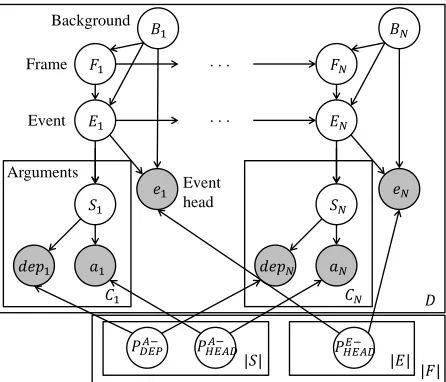
Essentially, PROFINDERcombines a frame HMM with an event HMM, where the first models frame transition and emits events, and the second models event transition within a frame and emits argument slots.
3.2 Model refinements
The base model captures the main dependencies in event narrative, but it can be easily extended to
lever-2
USP generates the argument types along with events from clustering. For simplicity, in PROFINDERwe simply classify a syntactic argument into subject, object, and prepositional ob-ject, according to its Stanford dependency to the event head.
age additional linguistic intuition. PROFINDER in-corporates three such refinements.
Background frame Event narratives often con-tain interjections of general content common to all frames. For example, in newswire articles, ATTRI
-BUTION is commonplace to describe who said or
reported a particular quote or fact. To avoid con-taminating frames with generic content, we intro-duce a background frame with its own events, slots, and emission distributions, and a binary switch vari-ableBi ∈ {BKG, CN T}that determines whether clauseiis generated from the actual content frame
Fi (CN T) or background (BKG). We also stipu-late that ifBKGis chosen, the nominal frame stays the same as the previous clause.
Stickiness in frame and event transitions Prior work has demonstrated that promoting topic coher-ence in natural-language discourse helps discourse
modeling (Barzilay and Lee, 2004). We extend
PROFINDERto leverage this intuition by incorporat-ing a “stickiness” prior (Haghighi and Vanderwende, 2009) to encourage neighboring clauses to stay in the same frame. Specifically, along with introducing the background frame, the frame transition compo-nent now becomes
PF−TRAN(Fi+1|Fi, Bi+1) = (1)
1(Fi+1 =Fi), ifBi+1=BKG β1(Fi+1 =Fi)+
(1−β)PF−TRAN(Fi+1|Fi),
ifBi+1=CN T
where β is the stickiness parameter, and the event transition component correspondingly becomes
PE−TRAN(Ei+1|Ei, Fi+1, Fi, Bi+1) = (2)
1(Ei+1 =Ei), ifBi+1=BKG
PE−TRAN(Ei+1|Ei), ifBi+1=CN T, Fi=Fi+1 PE−INIT(Ei+1), ifBi+1=CN T, Fi6=Fi+1
Frame
Event Background
Event head
𝐶1
𝐵1
𝐹1
𝐸1
𝑒1
𝑆1
𝑑𝑒𝑝1 𝑎1
𝐷 𝐶𝑁
𝐵𝑁
𝐹𝑁
𝐸𝑁
𝑒𝑁
𝑆𝑁
𝑑𝑒𝑝𝑁 𝑎𝑁
. . .
[image:5.612.75.298.60.251.2]. . .
|𝐹| |𝑆| 𝑃𝐻𝐸𝐴𝐷 |𝐸|
𝐸−
Arguments
𝑃𝐻𝐸𝐴𝐷𝐴−
𝑃𝐷𝐸𝑃𝐴−
Figure 1: Graphical representation of our model. Hyper-parameters, the stickiness factor, and the frame and event initial and transition distributions are not shown for clar-ity.
the dependency from the event head to an event ar-gument depi,j, our model instead emits the pair of event head and dependency relation, which we call
acaseframefollowing Bean and Riloff (2004).
3.3 Full generative story
To summarize, the distributions that are learned by our model are the default distributions PBKG(B),
PF−INIT(F), PE−INIT(E); the transition distri-butions PF−TRAN(Fi+1|Fi), PE−TRAN(Ei+1|Ei); and the emission distributions PSLOT(S|E, A, B),
PE−HEAD(e|E, B), PA−HEAD(a|S), PA−DEP(dep|S). We used additive smoothing with uniform Dirich-let priors for all the multinomials. The overall generative story of our model is as follows:
1. Draw a Bernoulli distribution forPBKG(B) 2. Draw the frame, event, and slot distributions 3. Draw an event head emission distribution
PE−HEAD(e|E, B)for each frame including the background frame
4. Draw event argument lemma and caseframe emission distributions for each slot in each frame including the background frame
5. For each clause in each document, generate the clause-internal structure.
The clause-internal structure at clauseiis gener-ated by the following steps:
1. Generate whether this clause is background (Bi ∈ {CN T, BKG} ∼PBKG(B))
2. Generate the frame Fi and event Ei from
PF−INIT(F), PE−INIT(E), or according to equations 1 and 2
3. Generate the observed event head ei from
PE−HEAD(ei|Ei).
4. For each event argument:
(a) Generate the slot Si,j from
PSLOT(S|E, A, B).
(b) Generate the dependency/caseframe emis-sion depi,j ∼ PA−DEP(dep|S) and the lemma of the head word of the event ar-gumentai,j ∼PA−HEAD(a|S).
3.4 Learning and Inference
Our generative model admits efficient inference by dynamic programming. In particular, after collaps-ing the latent assignment of frame, event, and back-ground into a single hidden variable for each clause, the expectation and most probable assignment can be computed using standard forward-backward and Viterbi algorithms on fixed tree structures.
Parameter learning can be done using EM by al-ternating the computation of expected counts and the maximization of multinomial parameters. In par-ticular, PROFINDER uses incremental EM, which has been shown to have better and faster con-vergence properties than standard EM (Liang and Klein, 2009).
Determining the optimal number of events and slots is challenging. One solution is to adopt a non-parametric Bayesian method by incorporating a hi-erarchical prior over the parameters (e.g., a Dirich-let process). However, this approach can impose unrealistic restrictions on the model choice and re-sult in intractability which requires sampling or ap-proximate inference to overcome. Additionally, EM learning can suffer from local optima due to its non-convex learning objective, especially when dealing with a large number hidden states without a good initialization.
one event and two slots. Starting from this mini-mal structure, EM training begins. After a number of iterations, each event and slot state is “split” in two; that is, each original state now becomes two new states. Each of the new states is generated with half of the probability of the original, and contains a duplicate of the associated emission distributions. Some perturbation is then added to the probabilities to break symmetry. After splitting, we merge back a portion of the newly split events and slots that re-sult in the least improvement in the likelihood of the training data. For more details on split-merge, see Petrov et al. (2006)
By adjusting the number of split-merge cycles and the merge parameters, our model learns the number of events and slots in a dynamical fashion that is tai-lored to the data. Moreover, our model starts with a small number of frame elements, which reduces the number of local optima and facilitates initial learn-ing. After each split, the subsequent learning starts with (a perturbed version of) the previously learned parameters, which makes a good initialization that is crucial for EM. Finally, it is also compatible with the hierarchical nature of events and slots. For ex-ample, slots can first be coarsely split into persons versus locations, and later refined into subcategories such as perpetrators and victims.
4 MUC-4 Entity Extraction Experiments
We first evaluate our model on a standard entity extraction task, using the evaluation settings from Chambers and Jurafsky (2011) (henceforth, C&J) to enable a head-to-head comparison. Specifically, we use the MUC-4 data set (1992) , which contains 1300 training and development documents on ter-rorism in South America, with 200 additional doc-uments for testing. MUC-4 contains four templates: ATTACK, KIDNAPPING, BOMBING, and ARSON.3 All templates share the same set of predefined slots, with the evaluation focusing on the following four: PERPETRATOR, PHYSICAL TARGET, HUMAN TAR
-GET, and INSTRUMENT.
For each slot in a MUC template, the system first identifies an induced slot that best maps to it by F1 on the development set. As in C&J,
tem-3
Two other templates have negligible counts and are ignored as in C&J.
plate is ignored in final evaluation, so all the clusters that belong to the same slot are then merged across the templates; e.g., the PERPETRATOR clusters for
KIDNAPPING and BOMBING are merged. The fi-nal precision, recall, andF1are computed based on these merged clusters. Correctness is determined by matching head words, and slots marked as optional in MUC are ignored when computing recall. All hy-perparameters are tuned on the development set (see Appendix A for their values).
Named entity type Named entity type is a useful feature to filter out entities for particular slots; e.g. a location cannot be an INSTRUMENT. We thus divide
each induced cluster into four clusters by named entity type before performing the mapping, follow-ing C&J’s heuristic and usfollow-ing a named entity recog-nizer and word lists derived from WordNet: PER
-SON/ORGANIZATION, PHYSICALOBJECT, LOCA
-TION, and OTHER.
Document classification The MUC-4 dataset contains many documents that have words related to MUC slots (e.g.,planeandaviation), but are not about terrorism. To reduce precision errors, C&J first filtered irrelevant documents based on the speci-ficity of event heads to learned frames. To estimate the specificity, they used additional data retrieved from a large external corpus. In PROFINDER,
how-ever, specificity can be easily estimated using the probability distributions learned during training. In particular, we define the probability of an event head in a framejas:
PF(w) = X
EF∈F
PE−HEAD(w|E)/|F|, (3)
and the probability of a frame given an event head as:
P(F|w) =PF(w)/ X
F0∈F
PF0(w). (4)
We then follow the rest of C&J’s procedure to score each learned frame with each MUC document. Specifically, a document is mapped to a frame if the averagePF(w)in the document is above a threshold and the document contains at least onetrigger word
Unsupervised methods P R F1
PROFINDER(This work) 32 37 34
Chambers and Jurafsky (2011) 48 25 33
With additional information
PROFINDER+doc. classification 41 44 43
[image:7.612.314.541.53.244.2]C&J 2011 +granularity 44 36 40
Table 1: Results on MUC-4 entity extraction. C&J 2011 +granularity refers to their experiment in which they mapped one of their templates to five learned clusters rather than one.
Results Compared to C&J, PROFINDER is
con-ceptually much simpler, using a single probabilis-tic model and standard learning and inference algo-rithms, and not requiring multiple processing steps or customized similarity metrics. It only used the data in MUC-4, whereas C&J required additional text to be retrieved from a large external corpus (Gi-gaword (Graff et al., 2005)) for each event cluster. It currently does not make use of coreference infor-mation, whereas C&J did. Remarkably, despite all these, PROFINDERwas still able to outperform C&J on entity extraction, as shown in Table 1. We also evaluated PROFINDER’s performance assuming
per-fect document classification (+doc. classification). This led to a substantially higher precision, suggest-ing that further improvement is possible from better document classification.
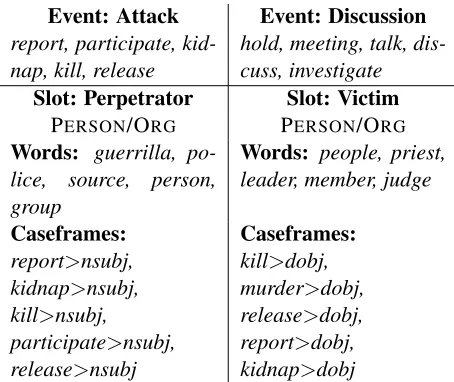
Figure 2 shows part of a frame learned by PROFINDER, which includes some slots and events annotated in MUC. PROFINDERis also able to iden-tify events and slots not annotated in MUC, a de-sirable characteristic of unsupervised methods. For
example, it found a DISCUSSION event, an AR
-REST event (call, arrest, express, meet, charge), a PEACE AGREEMENT slot (agreement, rights, law, proposal), and an AUTHORITIES slot (police,
gov-ernment, force, command). The background frame
was able to capture many verbs related to attribu-tion, such assay, continue, add, believe, although it missedreport.
5 Evaluating Frame Induction Using Guided Summarization Templates
The MUC-4 dataset was originally designed for information extraction and focuses on a limited
number of template and slot types. To
evalu-Event: Attack Event: Discussion
report, participate, kid-nap, kill, release
hold, meeting, talk, dis-cuss, investigate
Slot: Perpetrator Slot: Victim
PERSON/ORG PERSON/ORG
Words: guerrilla,
po-lice, source, person,
group
Words: people, priest, leader, member, judge
Caseframes:
report>nsubj, kidnap>nsubj, kill>nsubj,
participate>nsubj, release>nsubj
Caseframes:
kill>dobj, murder>dobj, release>dobj, report>dobj, kidnap>dobj
Figure 2: A partial frame learned by PROFINDER from the MUC-4 data set, with the most probable emissions for each event and slot. Labels are assigned by the authors for readability.
ate PROFINDER’s capabilities in generalizing to a greater variety of text, we designed and con-ducted a novel evaluation based on the TAC guided-summarization dataset. This evaluation was inspired by the connection between summarization and infor-mation extraction (White et al., 2001), and reflects a conceptualization of summarization as inducing and extracting structured information from source text. Essentially, we adapted the TAC summarization an-notation to create gold-standard slots, and used them to evaluate entity extraction as in MUC-4.
Dataset We used the TAC 2010
guided-summarization dataset in our experiments
(Owczarzak and Dang, 2010). This data set con-sists of text from five domains (termed categories in TAC), each with a template defined by TAC organizers. In total, there are 46 document clusters (termedtopics in TAC), each of which contains 20 documents and has eight human-written summaries. Each summary was manually segmented using the Pyramid method (Nenkova and Passonneau, 2004) and each segment was annotated with a slot
(termed aspect in TAC) from the corresponding
template. Figure 3 shows an example and the full
set of templates is available at http://www.
nist.gov/tac/2010/Summarization/
(a) Accidents and Natural Disasters:
WHAT: what happened
WHEN: date, time, other temporal markers WHERE: physical location
WHY: reasons for accident/disaster WHO AFFECTED: casualties... DAMAGES: ... caused by the disaster COUNTERMEASURES: rescue efforts...
(b) (WHEN During the night of July 17,)
(WHATa 23-foot<WHATtsunami) hit the north coast of Papua New Guinea (PNG)>,
(WHY triggered by a 7.0 undersea
earth-quake in the area).
(c) WHEN:night WHAT:tsunami, coast
WHY:earthquake
Figure 3: (a) A frame from the TAC Guided Summariza-tion task with abbreviated slot descripSummariza-tions. (b) A TAC text span, segmented into several contributors with slot labels. Note that the two WHATcontributors overlap, and are demarcated by different bracket types. (c) The entities that are extracted for evaluation.
TAC, each annotated segment (Figure 3b) is called acontributor.
Evaluation Method We converted the contribu-tors into a form that is more similar to the previ-ous MUC evaluation, so that we can fairly compare against previous work such as C&J that were de-signed to extract information into that form. Specif-ically, we extracted the head lemma from all the maximal noun phrases found in the contributor (Fig-ure 3c) and treated them as gold-standard entity slots to extract. While this conversion may not be ideal in some cases, it simplifies the TAC slots and enables automatic evaluation. We leave the refinement of this conversion to future work, and believe it could be done by crowdsourcing.
For each TAC slot in a TAC category, we extract entities from the summaries that belong to the given TAC category. A system-induced entity is consid-ered a match to a TAC-derived entity from the same document if the head lemma in the former matches one in the latter. Based on this matching criterion, the system-induced slots are mapped to the TAC slots in a way that achieves the best F1 for each
TAC slot. We allow a system slot to map to mul-tiple TAC slots, due to potential overlaps in entities
1-best 5-best
Systems P R F1 P R F1
PROFINDER 24 25 24 21 38 27
C&J 58 6.1 11 50 12 20
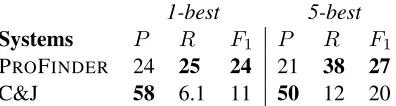
Table 2: Results on TAC 2010 entity extraction withN -best mapping forN = 1andN = 5. Intermediate values ofNproduce intermediate results, and are not shown for brevity.
among TAC slots. For example, in a document about a tsunami,earthquakemay appear both in the WHAT
slot as a disaster itself, and in the CAUSE slot as a cause for the tsunami.
One salient difference between TAC and MUC slots is that TAC slots are often more general than
MUC slots. For example, TAC slots such as WHY
and COUNTERMEASURESlikely correspond to
mul-tiple slots at the granularity of MUC. As a result, we also consider mapping the N-best system-induced slots to each TAC slot, forN up to 5.
Experiments We trained PROFINDERand a
reim-plementation of C&J on the 920 full source texts of TAC 2010, and tested them on the 368 model sum-maries. We did not provide C&J’s model with access to external data, in order to enable fair comparison with our model. Since all of the summary sentences are expected to be relevant, we did not conduct doc-ument or sentence relevance classification in C&J or PROFINDER. We tuned all parameters by two-fold cross validation on the summaries. We computed the overall precision, recall, andF1 by taking a
micro-average over the results for each TAC slot.
[image:8.612.329.527.55.108.2]6 Conclusion
We have presented PROFINDER, the first probabilis-tic approach to frame induction and shown that it achieves state-of-the-art results on end-to-end entity extraction in standard MUC and TAC data sets. Our model is inspired by recent advances in unsuper-vised semantic induction and content modeling in summarization. Our probabilistic approach makes it easy to extend the model with additional linguistic insights and prior knowledge. While we have made a case for unsupervised methods and the importance of robustness across domains, our method is also amenable to semi-supervised or supervised learn-ing if annotated data is available. In future work, we would like to further investigate frame induction evaluation, particularly in evaluating event cluster-ing.
Acknowledgments
We would like to thank Nate Chambers for answer-ing questions about his system. We would also like to thank Chris Quirk for help with preprocessing the MUC corpus, and the members of the NLP group at Microsoft Research for useful discussions.
Appendix A. Hyperparameter Settings
We document below the hyperparameter settings for PROFINDER that were used to generate the results in the paper.
Hyperparameter MUC TAC
Number of frames,|F | 9 8
Frame stickiness,β 0.125 0.5
Smoothing (frames, events, slots) 0.5 2
Smoothing (emissions) 0.05 0.2
Number of split-merge cycles 4 2
Iterations per cycle 10 10
References
Collin F. Baker, Charles J. Fillmore, and John B. Lowe. 1998. The Berkeley FrameNet project. In Proceed-ings of the 17th International Conference on Compu-tational linguistics.
Michele Banko and Oren Etzioni. 2008. The tradeoffs between open and traditional relation extraction. Pro-ceedings of ACL-08: HLT, pages 28–36.
Regina Barzilay and Lillian Lee. 2004. Catching the drift: Probabilistic content models, with applications to generation and summarization. InProceedings of the Human Language Technology Conference of the North American Chapter of the Association for Com-putational Linguistics: HLT-NAACL 2004.
David Bean and Ellen Riloff. 2004. Unsupervised learn-ing of contextual role knowledge for coreference reso-lution. InProceedings of the Human Language Tech-nology Conference of the North American Chapter of the Association for Computational Linguistics: HLT-NAACL 2004.
Nathanael Chambers and Dan Jurafsky. 2008. Unsu-pervised learning of narrative event chains. In Pro-ceedings of ACL-08: HLT, pages 789–797, Columbus, Ohio, June. Association for Computational Linguis-tics.
Nathanael Chambers and Dan Jurafsky. 2009. Unsuper-vised learning of narrative schemas and their partici-pants. InProceedings of the Joint Conference of the 47th Annual Meeting of the ACL and the 4th Interna-tional Joint Conference on Natural Language Process-ing of the AFNLP. Association for Computational Lin-guistics.
Nathanael Chambers and Dan Jurafsky. 2011. Template-based information extraction without the templates. In
Proceedings of the 49th Annual Meeting of the Asso-ciation for Computational Linguistics: Human Lan-guage Technologies, pages 976–986, Portland, Ore-gon, USA, June. Association for Computational Lin-guistics.
Jackie C. K. Cheung and Xiao Li. 2012. Sequence clus-tering and labeling for unsupervised query intent dis-covery. InProceedings of the 5th ACM International Conference on Web Search and Data Mining, pages 383–392.
James R. Curran, Tara Murphy, and Bernhard Scholz. 2007. Minimising semantic drift with mutual exclu-sion bootstrapping. InProceedings of the 10th Con-ference of the Pacific Association for Computational Linguistics.
Hal Daum´e III and Daniel Marcu. 2006. Bayesian Query-Focused summarization. InProceedings of the 21st International Conference on Computational Lin-guistics and 44th Annual Meeting of the Association for Computational Linguistics, pages 305–312, Syd-ney, Australia, July. Association for Computational Linguistics.
Charles J. Fillmore. 1982. Frame semantics. Linguistics in the Morning Calm, pages 111–137.
David Graff, Junbo Kong, Ke Chen, and Kazuaki Maeda. 2005. English gigaword second edition. Linguistic Data Consortium, Philadelphia.
Amit Gruber, Michael Rosen-Zvi, and Yair Weiss. 2007. Hidden topic markov models. Artificial Intelligence and Statistics (AISTATS).
Aria Haghighi and Lucy Vanderwende. 2009. Exploring content models for multi-document summarization. In
Proceedings of Human Language Technologies: The 2009 Annual Conference of the North American Chap-ter of the Association for Computational Linguistics, pages 362–370, Boulder, Colorado, June. Association for Computational Linguistics.
Ruihong Huang and Ellen Riloff. 2012. Bootstrapped training of event extraction classifiers. In Proceed-ings of the 13th Conference of the European Chap-ter of the Association for Computational Linguistics, pages 286–295, Avignon, France, April. Association for Computational Linguistics.
Joel Lang and Mirella Lapata. 2011. Unsupervised se-mantic role induction via split-merge clustering. In
Proceedings of the 49th Annual Meeting of the Asso-ciation for Computational Linguistics: Human Lan-guage Technologies, pages 1117–1126, Portland, Ore-gon, USA, June. Association for Computational Lin-guistics.
Percy Liang and Dan Klein. 2009. Online EM for un-supervised models. In Proceedings of Human Lan-guage Technologies: The 2009 Annual Conference of the North American Chapter of the Association for Computational Linguistics, pages 611–619, Boulder, Colorado, June. Association for Computational Lin-guistics.
Marvin Minsky. 1974. A framework for representing knowledge. Technical report, Cambridge, MA, USA. 1992.Proceedings of the Fourth Message Understanding
Conference (MUC-4). Morgan Kaufmann.
Ani Nenkova and Rebecca Passonneau. 2004. Evaluat-ing content selection in summarization: The pyramid method. InProceedings of the Human Language Tech-nology Conference of the North American Chapter of the Association for Computational Linguistics: HLT-NAACL 2004, volume 2004, pages 145–152.
Karolina Owczarzak and Hoa T. Dang. 2010. TAC 2010 guided summarization task guidelines.
Siddharth Patwardhan and Ellen Riloff. 2007. Effec-tive information extraction with semantic affinity pat-terns and relevant regions. In Proceedings of the 2007 Joint Conference on Empirical Methods in Nat-ural Language Processing and Computational Natu-ral Language Learning (EMNLP-CoNLL), pages 717–
727, Prague, Czech Republic, June. Association for Computational Linguistics.
Slav Petrov, Leon Barrett, Romain Thibaux, and Dan Klein. 2006. Learning accurate, compact, and inter-pretable tree annotation. In Proceedings of the 21st International Conference on Computational Linguis-tics and 44th Annual Meeting of the Association for Computational Linguistics.
Hoifung Poon and Pedro Domingos. 2009. Unsuper-vised semantic parsing. InProceedings of the 2009 Conference on Empirical Methods in Natural Lan-guage Processing, pages 1–10.
Stephen D. Richardson, William B. Dolan, and Lucy Van-derwende. 1998. MindNet: Acquiring and structuring semantic information from text. InProceedings of the 36th Annual Meeting of the Association for Computa-tional Linguistics and 17th InternaComputa-tional Conference on Computational Linguistics, Volume 2, pages 1098– 1102, Montreal, Quebec, Canada, August. Association for Computational Linguistics.
David Rumelhart, 1975. Notes on a schema for stories, pages 211–236. Academic Press, Inc.
Roger C. Schank and Robert P. Abelson. 1977. Scripts, Plans, Goals, and Understanding: An Inquiry Into Hu-man Knowledge Structures. Lawrence Erlbaum, July. Yusuke Shinyama and Satoshi Sekine. 2006. Preemptive
information extraction using unrestricted relation dis-covery. InProceedings of the Human Language Tech-nology Conference of the NAACL, Main Conference, New York City, USA, June. Association for Computa-tional Linguistics.
Robert S. Swier and Suzanne Stevenson. 2004. Un-supervised semantic role labelling. In Dekang Lin and Dekai Wu, editors,Proceedings of EMNLP 2004, pages 95–102, Barcelona, Spain, July. Association for Computational Linguistics.
Michael White, Tanya Korelsky, Claire Cardie, Vincent Ng, David Pierce, and Kiri Wagstaff. 2001. Multidoc-ument summarization via information extraction. In