Template Kernels for Dependency Parsing
Hillel Taub-Tabib Hebrew University Jerusalem, Israel
{hillel.t,yoav.goldberg}@gmail.com Yoav Goldberg Bar-Ilan University
Ramat-Gan, Israel
Amir Globerson Hebrew University
Jerusalem, Israel [email protected]
Abstract
A common approach to dependency parsing is scoring a parse via a linear function of a set of indicator features. These features are typically manually constructed from templates that are applied to parts of the parse tree. The templates define which properties of a part should combine to create features. Existing approaches consider only a small subset of the possible combinations, due to statistical and computational efficiency considerations. In this work we present a novel kernel which facilitates efficient parsing with feature rep-resentations corresponding to a much larger set of combinations. We integrate the kernel into a parse reranking system and demonstrate its effectiveness on four languages from the CoNLL-X shared task.1
1 Introduction
Dependency parsing is the task of labeling a sen-tencexwith a syntactic dependency treey∈ Y(x), whereY(x)denotes the space of valid trees overx. Each word in x is represented as a list of linguis-tic properties (e.g. word form, part of speech, base form, gender, number, etc.). In the graph based ap-proach (McDonald et al., 2005b) parsing is cast as a structured linear prediction problem:
hv(x) =argmax
y∈Y(x) v
T ·Φ (x, y) (1)
whereΦ (x, y) ∈ Rdis a feature representation de-fined over a sentence and its parse tree, andv∈Rd is a vector of parameters.
To construct an effective representation, Φ (x, y) is typically decomposed into local representations
1See https://bitbucket.org/hillel/templatekernels for
imple-mentation.
over partspof the treey: Φ (x, y) =X
p∈y
φ(x, p)
Standard decompositions include different types of parts:arcs,sibling arcs,grandparent arcs, etc. Fea-ture templates are then applied to the parts to con-struct the local representations. The templates de-termine how the linguistic properties of the words in each part should combine to create features (see Section 2).
Substantial effort has been dedicated to the man-ual construction of feature templates (McDonald et al., 2005b; Carreras, 2007; Koo and Collins, 2010). Still, for both computational and statistical reasons, existing templates consider only a small subset of the possible combinations of properties. From a computational perspective, solving Eq. 1 involves applying the templates to y and calculating a dot product in the effective dimension of Φ. The use of many templates thus quickly leads to computa-tional infeasibility (the dimensionality ofv, as well as the number of non-zero features in Φ, become very large). From a statistical perspective, the use of a large number of feature templates can lead to overfitting.
Several recent works have proposed solutions to the above problem. Lei et al., (2014) represented the space of all possible property combinations in an arc-factored model as a third order tensor and learned the parameter matrix for the tensor under a low rank assumption. In the context of transi-tion parsers, Chen and Manning (2014) have im-plemented a neural network that uses dense repre-sentations of words and parts of speech as its put and implicitly considers combinations in its in-ner layers. Earlier work on transition-based depen-dency parsing used SVM classifiers with 2nd order polynomial kernels to achieve similar effects (Hall
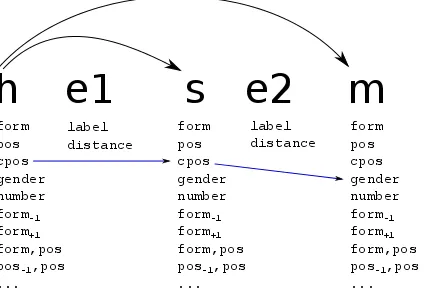
Figure 1: Feature template over the second order con-secutive siblings part type. The part type contains slots for the head (h), sibling (s) and modifier (m) words, as well as for the two edges (e1 and e2). Each slot is asso-ciated with a set of properties. The directed path skips over the edge properties and defines the partial template <h-cpos=?; s-cpos=?; m-gender=?>.
et al., 2006). While training greedy transition-based parsers such as the ones used in (Chen and Manning, 2014) and (Hall et al., 2006) amounts to training a multiclass classifier, the graph-based parsing frame-work explored in (Lei et al., 2014) and in the present work is a more involved structured-learning task.
In this paper we present a kernel based approach to automated feature generation in the context of graph-based parsing. Compared to tensors and neu-ral networks, kernel methods have the attractive properties of a convex objective and well understood generalization bounds (Shawe-Taylor and Cristian-ini, 2004). We introduce a kernel that allows us to learn the parameters for a representation similar to the tensor representation in (Lei et al., 2014) but without the low rank assumption, and without ex-plicitly instantiating the exponentially many possi-ble features.
In contrast to previous works on parsing with nels (Collins and Duffy, 2002), in which the ker-nels are defined over trees and count the number of shared subtrees, our focus is on feature combi-nations. In that sense our work is more closely re-lated to work on tree kernels for relation extraction (Zelenko et al., 2003; Culotta and Sorensen, 2004; Reichartz et al., 2010; Sun and Han, 2014), but the kernel we propose is designed to generate combi-nations of properties within selected part types and does not involve the all-subtrees representation.
2 Template Kernels
For simplicity, we begin with the case where parts pcorrespond to head modifier pairs(h, m)(i.e. all parts belong to the ”arc” part type). The features in φ(x, p)can then depend on any property ofh, mand the sentencex. We denote properties related toh us-ing the prefixh- (e.g.,h-pos corresponds to the part-of-speech of the head), and similarly for m-. We also usee- to denote properties related to the triplets h, m, x(e.g., the surface distance betweenh, minx is denoted bye-dist).
Templates defined over the ”arc” part type will then combine different properties of h, m and e, to create features. e.g. the template <h-form=?; e-dist=?; m-form=?,m-pos=?>, when applied to a dependency arc, may yield the feature: < h-form=dog;e-dist=1;m-form=black,m-pos=JJ>.
More generally, a parse tree part can be seen as ordered lists of slots that contain properties (differ-ent part types will contain differ(differ-ent lists of slots). The feature templates defined over them select one property from each slot (possibly skipping some slots to produce partial templates). A template can thus be thought of as a directed path between the properties it selects in the different slots. Clearly, the number of possible templates in a given part type is exponential in the number of its slots. Figure 1 de-picts the process for sibling parts.
As discussed in Section 1, manually constructed feature templates consider only a small subset of the combinations of properties (i.e. a small number of “good” paths is manually identified and selected). Our goal is to introduce a kernel that allows us to represent all possible paths for a part type in poly-nomial time.
Formally, letΦ (x, y) = P
p∈yφ(x, p)be a feature representation which associates a feature with any distinct combination of properties in any of the tree parts in the training set. For a given partp, the effec-tive dimensionality ofφ(x, p)is thusO(ms)where sis the number of slots inp, andmis the maximal number of properties in a slot.
themselves. In the context of reranking (see Sec-tion 3), it means we can learn classifiers if we can calculate dot products K(y1, y2) = ΦT (x1, y1) ·
Φ (x2, y2)for two sentences and candidate parses.2
We first note that such dot products can be ex-pressed as sum of dot products over parts:
K(y1, y2) =
X
p∈y1
X
p0∈y2
k p, p0
wherek(p, p0) =φ(x
1, p)·φ(x2, p).
To calculate k(p, p0) we’ll assume for simplic-ity that p and p0 are of the same type (otherwise k(p, p0) = 0). Let p
ij andp0ij be the values of the i’th property in thej’th slot inp, p0 (e.g., for a sec-ond order sibling part as in Figure 1, p1,4 will
cor-respond to the label of the edge e2 in p) , and let Cp↔p0 ∈ {0,1}m×sbe a binary matrix comparingp andp0 such thatC
p↔p0ij = 1whenpij =p0ij and 0 otherwise. Simple algebra yields that:
k p, p0=Y j
~1T ·C p↔p0:,j
That is, calculating k(p, p0) amounts to multiply-ing the sums of the columns inC.3 The runtime of
k(p, p0)is thenO(m×s)which means the overall runtime ofK(y1, y2)isO(|y1| × |y2| × |s| × |m|),
where|y1|,|y2|are the number of parts iny1andy2.
Finally, note that adding 1 to one of the column counts ofCcorresponds to a slot that can be skipped to produce a partial template (this simulates a wild card property that is always on).
3 Kernel Reranker
We next show how to use the template kernels within a reranker. In the reranking approach (Collins and Koo, 2005; Charniak and Johnson, 2005), a base parser produces a list of k-best candidate parses for an input sentence and a separately trained reranking model is used to select the best one.
2For brevity we’ll omit x from the kernel parameters and use
K(y1, y2)instead ofK((x1, y1),(x2, y2)).
3We omit the proof, but intuitively, the product of column
sums is equal to the number of 1 valued paths between elements in the different columns ofC. Each such path corresponds to a path inpandp0where all the properties have identical values. i.e. it corresponds to a feature that is active in bothφ(x1, p)and
φ(x2, p0)and thus contributes 1 towards the dot product.
Features: Our feature vector will have two parts. One,Φg(x, y) ∈ Rd1, consists of features obtained from manually constructed templates. The other, Φk(x, y)∈Rd2, corresponds to our kernel features. We will not evaluate or store it, but rather use the kernel trick for implicitly learning with it, as ex-plained below. The score of a candidate parse y for sentencexis calculated via the following linear function:
Φ (x, y) = [Φg(x, y),Φk(x, y)]
hv(x, y) = v·Φ (x, y) (2)
Learning For learning we use the passive-aggressive algorithm (Crammer et al., 2006; Mc-Donald et al., 2005a), and adapt it to use with ker-nels. Formally, letS ={(xi,K(xi))}ni=1be a
train-ing set of sizensuch thatK(xi) = {yi1, . . . , yik} is the set of k-best candidate trees produced for the sentencexi. Assume thatyi1 is the optimal tree in
terms of Hamming distance to the gold tree.
A key observation to make is that thevgenerated by the PA algorithm will depend on two parameters. One is a weight vectorw ∈ Rd1, in the manually
constructed Φg feature space. The other is a set of weightsαij withi= 1, . . . , nandj= 1, . . . , k cor-responding to thejthcandidate for theithsample.4
The score is then given by:
fw,α(x, y) =v·Φ (x, y) =w·Φg(x, y)+fα(x, y) where:
fα(x, y) = X
i,j
αij ·(K(yi1, y)−K(yij, y))
We can now rewrite the updates of the PA algo-rithm usingw, α, as described in Alg 1.5
4 Implementation
The classifier depends on parametersαij, which are updated using the PA algorithm. In the worst case, allnkof these may be non-zero. For large datasets, this may slow down both learning and prediction.
4This follows from tracing the steps of PA and noting their
dependence on dot products.
5The denominator in line 5 is equal to
kΦg(xi, yij)−Φg(xi, yi1)k2+K(yij, yij)−2K(yij, yi1)+ K(yi1, yi1)so it can be calculated efficiently using the kernel. kyi1 −yijk1 is the hamming distance between yi1 and yij.
Below we discuss implementation techniques to mit-igate this problem. To facilitate the discussion we rewrite the dot-product computation as follows:
fα(x, y) = X
p0∈y ˆ
fα x, p0 (3)
where:
ˆ
fα x, p0= X
i,j αij
X
p∈yi1
k p, p0−X
p∈yij
k p, p0
Reducing Prediction Runtime From Equation 3 we note several facts. First, prediction involves cal-culating k(p, p0) for every combination of a part p from the support instances (i.e., those for which αij >0) and partp0from the instances in the k-best list. Our implementation thus maintains its support as a set of parts rather than a set of instances.
Second, parts that appear in both yi1 andyij do not affect the result of fα(x, y) since they can-cel each other out. Our implementation thus only updates the support set with parts that belong ex-clusively to either yi1 or yij. This improves per-formance significantly since the number of non-overlapping parts in yi1 and yij is typically much smaller than the total number of parts therein.
Another important performance gain is obtained by caching the results offˆα(x, p0)when calculating fα(x, y)for the different instances in the k-best list. This avoids recalculating the summation for parts that occur multiple times in the k-best list. Once again, this amounts to a considerable gain, as the number of distinct parts in the k-best list is much smaller than the total number of parts therein. Reducing Training Runtime We greatly improve training speed by caching the results offα(xi, yij) between training iterations so that on each repeat-ing invocation of the function, only the support parts added since the previous iteration need to be consid-ered. Since the predictions of the learning algorithm become increasingly more accurate, the number of added support parts decreases sharply between iter-ations6, and so does the runtime. In practice, all
iter-ations from the 3rd onwards have negligible runtime compared to the first and second iterations. This technique allows us to comfortably train the kernel
6On correct predictions, τt at line 5 of Alg 1 is 0, so no
update is taking place and no support parts are added.
Algorithm 1PA Algorithm for Template Kernels Input: S = {(xi,K(xi))}ni=1, NumIters,
Ag-gressiveness parameterC
1: ∀i, j αij ←0, α¯ij ←0;T ←n×NumIters 2: fort= 1toT do
3: i←t mod n 4: j← argmax
j:yij∈K(xi)
fw,α(xi, yij)
5: τt←min n
C,fw,α(x,yij)−fw,α(x,yi1)+kyi1−yijk1
kΦ(xi,yij)−Φ(xi,yi1)k2
o
6: αij ←αij +τt
7: α¯ij ←α¯ij +τt(T−t+ 1)
8: w(t+1)←w(t)+τt(Φg(xi, yi1)−Φg(xi, yij)) 9: end for
10: ∀i, j, α¯ij ← α¯ij
T , w¯ = T1 T P t=1w
(t)
Output: predictor: argmax
y∈K(x) (fw¯,α¯(x, y))
predictor on large datasets.
5 Experimental Setup
Datasets We test our system on 4 languages from the CoNLL 2006 shared task, all with rich mor-phological features.7 The properties provided for
each word in these datasets are its form, part of speech (pos), coarse part of speech (cpos), lemma
and morph features (number, gender, person, etc. around 10-20 feats in total). We use 20-fold jack-knifing to create the k-best lists for the reranker (Collins and Duffy, 2002).
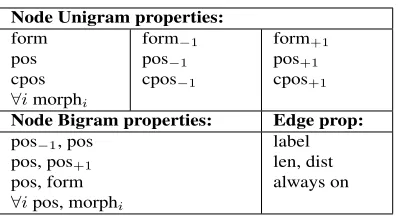
Base Parser The base parser used in experiments was the sampling parser of Lei et al. (2014), aug-mented to produce the k-best trees encountered dur-ing sampldur-ing. The parser was set to use feature tem-plates over third order part types, but its tensor com-ponent and global templates were deactivated. Features The manual features Φg were based on first to third order templates from Lei et al. (2014). For the kernel featuresΦk we annotated the nodes and edges in each tree with the properties in Table 1. We used a first order template kernel to train a model using all the the possible combinations of head, edge and modifier properties. Our kernel also produces all the property combinations of the head and modifier words (disregarding the edge properties).
7Our property combination approach is less relevant for
Node Unigram properties:
form pos cpos ∀imorphi
form−1 pos−1 cpos−1
form+1 pos+1 cpos+1
Node Bigram properties: Edge prop:
pos−1, pos
pos, pos+1 pos, form ∀ipos, morphi
[image:5.612.75.274.54.162.2]label len, dist always on
Table 1: Linguistic properties for nodes and edges.
Results For each language we train a Kernel Rerankerby running Alg 1 for 10 iterations over the training set, using k-best lists of size 25 and C set to infinity. As baseline, we train aBase Rerankerin the same setup but with kernel features turned off. Table 2 shows the results for the two systems. Even though they use the same feature set, the base-reranker lags behind the base-parser. We attribute this to the fact that the reranker explores a much smaller fraction of the search space, and that the gold parse tree may not be available to it in either train or test time. However, the kernel-reranker significantly im-proves over the base-reranker. In Bulgarian and Danish, the kernel-reranker outperforms the base-parser. This is not the case for Slovene and Ara-bic, which we attribute to the low oracle accuracy of the k-best lists in these languages. As is common in reranking (Jagarlamudi and Daum´e III, 2012), our final system incorporates the scores assigned to sen-tences by the base parser: i.e. scorefinal(x, y) = βscorebase(x, y) +scorereranker(x, y).β is tuned per language on a development set.8 Our final
sys-tem outperforms the base parser, as well as Tur-boParser (Martins et al., 2013), a parser based on manually constructed feature templates over up to third order parts. The system lags slightly behind the sampling parser of Zhang et al. (2014) which ad-ditionally uses global features (not used by our sys-tem) and a tensor component for property combi-nations. Another important difference between the systems is that our search is severely restricted by the use of a reranker. It is likely that using our ker-nel in a graph-based parser will further improve its
reason we did not select the English treebank.
8To obtain a development set we further split the reranker
training sets into tuning training and a development sets (90/10). We then tuneβper language on the respective development sets by selecting the best value from a list of{0, 0.05, . . . ,3}
Arabic Slovene Danish Bulgarian Base Parser 80.15 86.13 90.76 92.98 Base Reranker 79.46 84.61 90.36 92.27 Kernel Reranker 79.48 85.25 91.04 93.28 Final System 80.19 86.44 91.56 93.4 Turbo Parser 79.64 86.01 91.48 93.1 Zhang et al. 80.24 86.72 91.86 93.72
Table 2: System Performance (UAS excluding punctua-tion). TurboParser is (Martins et al., 2013), Zhang et al. is (Zhang et al., 2014)
Arabic Slovene Danish Bulgarian Sentences 1,460 1,534 5,190 12,823
Avg. Sent Len 37 19 18 15
Support Parts 15,466 10,101 31,627 58,842
Training Time 6m 7m 31m 57m
tokens/sec 551 432 223 99
Table 3: Runtime statistics, measured on a standard Mac-book Pro 2.8 GHz Core i7 using 8 threads.
accuracy.
Performance Table 3 lists the performance met-rics of our system on the four evaluation treebanks. While training times are reasonable even for large datasets, the increase in support size causes predic-tion to become slow for medium and large training sets. The number of support instances is a gen-eral problem with kernel methods. It has been ad-dressed using techniques like feature maps (Rahimi and Recht, 2007; Lu et al., 2014) and bounded on-line algorithms (Dekel et al., 2008; Zhao et al., 2012). The application of these techniques to tem-plate kernels is a topic for future research.
6 Conclusions
[image:5.612.314.547.56.138.2]References
Xavier Carreras. 2007. Experiments with a higher-order projective dependency parser. In EMNLP-CoNLL, pages 957–961.
Eugene Charniak and Mark Johnson. 2005. Coarse-to-fine n-best parsing and maxent discriminative rerank-ing. In Proceedings of the 43rd Annual Meeting of the Association for Computational Linguistics, pages 173–180.
Danqi Chen and Christopher D Manning. 2014. A fast and accurate dependency parser using neural net-works. In Proceedings of the 2014 Conference on Empirical Methods in Natural Language Processing (EMNLP), volume 1, pages 740–750.
Michael Collins and Nigel Duffy. 2002. New ranking algorithms for parsing and tagging: Kernels over dis-crete structures, and the voted perceptron. In Proceed-ings of the 40th Annual Meeting of the Association for Computational Linguistics, pages 263–270. Associa-tion for ComputaAssocia-tional Linguistics.
Michael Collins and Terry Koo. 2005. Discrimina-tive reranking for natural language parsing. Compu-tational Linguistics, 31(1):25–70.
Koby Crammer, Ofer Dekel, Joseph Keshet, Shai Shalev-Shwartz, and Yoram Singer. 2006. Online passive-aggressive algorithms. The Journal of Machine Learn-ing Research, 7:551–585.
Aron Culotta and Jeffrey Sorensen. 2004. Dependency tree kernels for relation extraction. InProceedings of the 42nd Annual Meeting on Association for Compu-tational Linguistics, page 423. Association for Com-putational Linguistics.
Ofer Dekel, Shai Shalev-Shwartz, and Yoram Singer. 2008. The forgetron: A kernel-based perceptron on a budget. SIAM Journal on Computing, 37(5):1342– 1372.
Johan Hall, Joakim Nivre, and Jens Nilsson. 2006. Dis-criminative classifiers for deterministic dependency parsing. InProceedings of the COLING/ACL on Main conference poster sessions, pages 316–323.
Jagadeesh Jagarlamudi and Hal Daum´e III. 2012. Low-dimensional discriminative reranking. InProceedings of the 2012 Conference of the North American Chap-ter of the Association for Computational Linguistics: Human Language Technologies, pages 699–709. Terry Koo and Michael Collins. 2010. Efficient
third-order dependency parsers. InProceedings of the 48th Annual Meeting of the Association for Computational Linguistics, pages 1–11. Association for Computa-tional Linguistics.
Tao Lei, Yu Xin, Yuan Zhang, Regina Barzilay, and Tommi Jaakkola. 2014. Low-rank tensors for scor-ing dependency structures. InProceedings of the 52nd
Annual Meeting of the Association for Computational Linguistics, volume 1, pages 1381–1391.
Zhiyun Lu, Avner May, Kuan Liu, Alireza Bagheri Garakani, Dong Guo, Aur´elien Bellet, Linxi Fan, Michael Collins, Brian Kingsbury, Michael Picheny, et al. 2014. How to scale up kernel methods to be as good as deep neural nets. arXiv preprint arXiv:1411.4000.
Andr´e FT Martins, Miguel Almeida, and Noah A Smith. 2013. Turning on the turbo: Fast third-order non-projective turbo parsers. In Proceedings of the 51st Annual Meeting of the Association for Computational Linguistics, pages 617–622.
Ryan McDonald, Koby Crammer, and Fernando Pereira. 2005a. Online large-margin training of dependency parsers. InProceedings of the 43rd Annual Meeting of the Association for Computational Linguistics, pages 91–98.
Ryan McDonald, Fernando Pereira, Kiril Ribarov, and Jan Hajiˇc. 2005b. Non-projective dependency pars-ing uspars-ing spannpars-ing tree algorithms. InProceedings of the conference on Human Language Technology and Empirical Methods in Natural Language Processing, pages 523–530. Association for Computational Lin-guistics.
Ali Rahimi and Benjamin Recht. 2007. Random features for large-scale kernel machines. InAdvances in neural information processing systems, pages 1177–1184. Frank Reichartz, Hannes Korte, and Gerhard Paass.
2010. Semantic relation extraction with kernels over typed dependency trees. In Proceedings of the 16th ACM SIGKDD international conference on Knowl-edge discovery and data mining, pages 773–782. John Shawe-Taylor and Nello Cristianini. 2004. Kernel
methods for pattern analysis. Cambridge university press.
Le Sun and Xianpei Han. 2014. A feature-enriched tree kernel for relation extraction. In The 52nd Annual Meeting of the Association for Computational Linguis-tics, volume 2, pages 61–67.
Dmitry Zelenko, Chinatsu Aone, and Anthony Richardella. 2003. Kernel methods for relation extraction. The Journal of Machine Learning Research, 3:1083–1106.
Yuan Zhang, Tao Lei, Regina Barzilay, and Tommi Jaakkola. 2014. Greed is good if randomized: New inference for dependency parsing. InProceedings of the 2014 Conference on Empirical Methods in Natural Language Processing (EMNLP), pages 1013–1024. Peilin Zhao, Jialei Wang, Pengcheng Wu, Rong Jin, and