Toward Stance Classification Based on Claim Microstructures
Filip Boltuˇzi´c and Jan ˇSnajder
University of Zagreb, Faculty of Electrical Engineering and Computing Text Analysis and Knowledge Engineering Lab
Unska 3, 10000 Zagreb, Croatia
{filip.boltuzic,jan.snajder}@fer.hr
Abstract
Claims are the building blocks of argu-ments and the reasons underpinning opin-ions, thus analyzing claims is important for both argumentation mining and opinion mining. We propose a framework for rep-resenting claims asmicrostructures, which express the beliefs, judgments, and poli-cies about the relations between domain-specific concepts. In a proof-of-concept study, we manually build microstructures for over 800 claims extracted from an on-line debate. We test the so-obtained mi-crostructures on the task of claim stance classification, achieving considerable im-provements over text-based baselines. 1 Introduction
In online discussions, users express their opin-ions using more or less well structured arguments. The building blocks of these arguments areclaims: statements that are in dispute and that we are try-ing to support with reasonGovier(2013). Claims can support or attack other claims, giving rise to complex argumentative structures. Thus, the ability to identify and analyze claims in text is a crucial part of argumentation mining (Moens,2014;Lippi and Torroni, 2016). Outside the realm of well-structured argumentation, the ability to analyze claims is crucial for tasks such as stance classi-fication (Anand et al.,2011;Hasan and Ng,2013;
Mohammad et al.,2016) and fine-grained opinion analysis (Stoyanov and Cardie, 2008; Yang and Cardie, 2013), as well as the converging task of argument-based opinion mining (Clos et al.,2014;
Boltuˇzi´c and ˇSnajder,2014), which aims to uncover the reasons underpinning the opinions.
Previous research has tackled the claim detec-tion task for diverse domains, including legal
docu-ments (Palau and Moens,2009), microtexts ( Peld-szus and Stede, 2015), Wikipedia articles ( Aha-roni et al.,2014;Levy et al.,2014;Rinott et al.,
2015), student essays (Stab and Gurevych,2017), and user-generated web discourse (Habernal and Gurevych,2015).Boltuˇzi´c and ˇSnajder(2015) ad-dressed the task of identifying prominent claims in online debates, whileBoltuˇzi´c and ˇSnajder(2016) analyzed the implicit premises between two claims. Recently, Bar-Haim et al. (2017) introduced the claim stance classification task, where classifica-tion is done at the claim rather than document level. In this paper, we address the task of claim anal-ysis from a different angle. While prior work has dealt with claims as textual fragments, we study the possibility of a more precise, domain-specific anal-ysis of claims based on their internal logical struc-ture. The work closest to ours is that ofWyner and Van Engers(2010) andWyner et al.(2016), who ex-plored normalizing claims from the policy making domain by translating them to Attempto Controlled English (Fuchs et al., 2008), and then mapping them to propositions. In contrast, we propose a framework for representing claims as microstruc-tures: structures expressing the relations between the domain-specific concepts, reflecting the beliefs, value judgments, or desired policies of the claim author. We present a preliminary proof-of-concept study, where we use the proposed framework to manually create microstructures for over eight hun-dred claims extracted from an online debate.
We envisage that claim microstructures could play an important role in a variety of opinion min-ing and argument minmin-ing tasks, includmin-ing stance classification, extraction of argumentative struc-tures, analysis of implicit premises, fine-grained opinion mining, identifying prominent claims, and claim matching. To demonstrate the viability of claim microstructures for a downstream task, we look into supervised claim stance classification
and show that, even with a simple encoding of microstructures as features, we get substantial im-provements on this task over text-based baselines.
The contribution of our work may be summed up as follows: (1) we investigate the feasibility of using microstructures for representing claims, (2) we demonstrate the use of microstructures for stance classification, and (3) to promote further research, we make available the dataset annotated with claim paraphrases and microstructures.1
2 Claim Microstructures
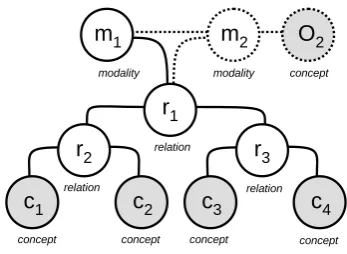
We introduce a framework for representing claims from text using logicalmicrostructureswhose pur-pose is to capture the gist of a claim. The initial motivation came from the analysis of our dataset (cf. Section 4), which revealed that a large majority of claims can be conceived of as expressing rela-tions betweenconcepts using a certainmodality. Figure 1 shows a claim microstructure bringing together these three elements.
Relations. Many claims can be represented as expressing a relation between two concepts. For example, on the topic of gay rights, the relations may be ‘promotes(GayMarriage, Depopulation)’ or ‘purpose(Love, Procreation)’. There are also comparably fewer claims that can be expressed via higher-order relations, e.g., ‘entails(Constitution, allow(State, GayMarriage)))‘. Each relation can be negated, e.g., ‘¬promotes(GayMarriage, Depopu-lation)’ expresses that gay marriage does not cause depopulation.
Concepts. The relations are established between concepts, expressed by noun phrases. For ease of access, these can be arranged into a small, domain-specific taxonomy of concepts. For instance, “gay marriage”, “heterosexual marriage”, and “religious marriage” all belong under the concept of “mar-riage”. The taxonomic relations could also be use-ful for later computational processing. Unlike rela-tions, concepts are domain dependent and need to be defined for each new topic.
Modalities. We furthermore observed that the claims express different modalities, which can roughly be categorized into beliefs, value judg-ments, and policies. We formalize this via unary relations ‘believes’, ‘approves’, and ‘de-sires’, corresponding to beliefs (factual, religious,
[image:2.595.327.501.59.186.2]1http://takelab.fer.hr/claim-micro
Figure 1: Claim microstructure (2nd-order).
and opinion-based), positive value judgment, and desired policy (desired state of affairs), respec-tively. The three modalities act as a wrapper on the propositional content of the claim, effec-tively modulating what is being claimed. For instance, ‘believes(purpose(Love, Procreation))’ expresses the belief that love serves procreation, while ‘desires(¬allow(State, GayMarriage))’ ex-presses the wish for the state not to allow gay marriages. Finally, we observed that in a fair number of cases the claims are supported by a reference to a second opinion holder (e.g., the Bible, the state). We represent this by introduc-ing one additional modality layer with the opin-ion holder as an additopin-ional modifier. For instance, ‘believes(believes[State](promotes(Marriage, Ad-vancement)))’ corresponds to the belief that the state believes gay marriages lead to an advance-ment. By convention, the opinion holder of the first modality is always the author of the post.
Let R, C, and M denote the set of relations, concepts, and modalities, respectively. Formally, we define a claim microstructure as a quadruple
(m1, m2, o2, r), where m1 ∈ M and
(option-ally) m2 ∈ M ∪ {} are the modalities, o2 ∈
C ∪ {} is the (optional) second opinion holder, and r = (t, c1, c2) ∈ R is the (possibly
higher-order) relation between two concepts or relations c1, c2 ∈ C ∪ R, conveyed by the relation typet.
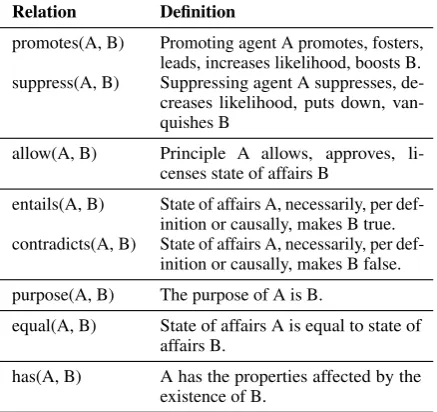
Table1defines the relation types used in this work. It should be noted that, unlike Aharoni et al.
Relation Definition
promotes(A, B) Promoting agent A promotes, fosters, leads, increases likelihood, boosts B. suppress(A, B) Suppressing agent A suppresses,
de-creases likelihood, puts down, van-quishes B
allow(A, B) Principle A allows, approves, li-censes state of affairs B
entails(A, B) State of affairs A, necessarily, per def-inition or causally, makes B true. contradicts(A, B) State of affairs A, necessarily, per
def-inition or causally, makes B false. purpose(A, B) The purpose of A is B.
equal(A, B) State of affairs A is equal to state of affairs B.
[image:3.595.72.291.65.271.2]has(A, B) A has the properties affected by the existence of B.
Table 1: Relations types in claim microstructures.
3 Data Annotation
We adopted the dataset of Hasan and Ng(2014), which contains user posts from online two-sided debates on a number of topics. For reasons of fea-sibility, in this study we consider only one topic: “Gay rights”. We sampled 100 posts (50 for and 50 against) from this topic. The manual annota-tion was carried out in two steps. In the first step, the annotators segmented out the individual claims from user posts and paraphrased them into well-articulated claims. In the second step, the anno-tators translated each paraphrased claim into the corresponding logical microstructure.
While in principle the claim microstructures could have been built directly from segments, we chose to introduce the additional step of claim para-phrasing for three reasons. First, we assumed that paraphrasing would help in identifying the seg-ments corresponding to individual claims, since paraphrasing demonstrates understanding. In that respect, our work is similar to that ofWyner and Van Engers(2010), who used a controlled language for paraphrasing the claims. Second, we assumed that paraphrases will make overt the logical struc-ture of claims, making their translation into mi-crostructures easier. Lastly, we assumed that para-phrases could help in identifying the prominent concepts for the domain-specific taxonomy.
3.1 Claim Segments and Paraphrases
The purpose of the this step was to extract claim segments from user posts, thus separating argu-mentative from non-arguargu-mentative content, and to
paraphrase the claims into simple, well-articulated statements. This obviously involves two non-trivial tasks: segmentation and paraphrasing. Arguably, there are many ways in which a post can be seg-mented into claims, and even more ways in which each segment could be paraphrased. We hypothe-size that much of this ambiguity can be reduced by considering these two tasks jointly, and by adopt-ing certain paraphrasadopt-ing principles aimed at obtain-ingsimplifying paraphrases– paraphrases that ex-presses the essence of the claims devoid of superflu-ous words and phrases. To this end, we adopted the following nine paraphrasing principles: (1) Argu-mentativeness– Only argumentative text should be paraphrased; (2)Atomicity– A claim should convey a single thought; (3)Authority– Experts in claims from expert opinion should be made explicit in the paraphrase; (4)Brevity– Paraphrases should keep only the relevant argumentative content; (5)
Canonicity– Canonical terms and phrases are pre-ferred over idiomatic language; (6)Contextuality– Claims should be paraphrased by considering their local and topical context as well as their context; (7)Declarativity– paraphrases should be in declar-ative form, and (8)Dereferencing– Pronouns and nominal references should be resolved; and (9)
Explicitness– Only explicitly stated information should be paraphrased, and not whatever might be implied by the claim.
The annotation was carried out by one trained annotator and took 25 hours. The 100 user posts yielded 920 claim segments and the same number of paraphrases. Table2gives an example. Note that generally the claim segments may overlap, though this is not the case in this example. Overall, the seg-ments covered 79.6% of the text, while the remain-ing 20.4% may be considered non-argumentative.
3.2 Claim Microstructures
User post Claim segment Claim paraphrase Claim microstructure Men should fall in
love with women that’s why they where created and women should get married to men because it makes everything easier.
Men should fall in love
with women. People of opposite sexshould fall in love. desires(entails(OppositeSex, FallingInLove)) that’s why they where
created Men and women are cre-ated to pair. believes(purpose(MenAndWomen, Procreation)) women should get
mar-ried to men because it makes everything easier.
Heterosexual marriages
[image:4.595.71.526.67.166.2]make everything easier. believes(entails(HeterosexualMarriage, Normal))
Table 2: An example of a user post segmented into three claim segments, each paraphrased and translated into the corresponding claim microstructure.
Out of 920 claim paraphrases, annotator A1 man-aged to translate 882 claims into 707 distinct mi-crostructures, while annotator A2 translated 842 claims into 767 distinct microstructures. The aver-age annotation effort was 33 hours. The number of claims for which both annotators provided a microstructure is 819 (89%), while the number of claims for which both provided an identical mi-crostructure is only 58 (6.3%), The annotators in-troduced a total of 157 new concepts, indicating that the initial taxonomy was of too limited a scope. The low annotator agreement and the relatively large number of newly added concepts suggest that a fair amount of ambiguity exists in translating paraphrases to microstructures. Our analysis re-vealed that, in the majority of cases, the ambiguity is genuine and in such cases having more candidate microstructures for a single claim can be consid-ered advantageous.
The analysis also revealed that ‘believes’ is the most frequent modality, used for about 79% of claims. For A1,entailsis by far the most common relation (61%), while A2 made a more balanced use of relations, with the top two beinghas(21%) andentails(15%). The concepts most frequently used by A1 arehomosexuality,homosexual people
andmarriage, while for A2 these are The Bible,
homosexual people, andgovernment interest.
4 Stance Classification
4.1 Setup
Annotation. We consider claim stance classifi-cation as one potential appliclassifi-cation of claim mi-crostructures. To this end, we asked two annotators to label the stance of each of 819 claim paraphrases on a five-point scale: strong favor (F),likely fa-vor(f),neither(N),likely against(a), and,strong against(A). We adopt the definition of F, N, and A stance fromMohammad et al.(2016), with the
Stance Claim paraphrase A1 A2 Gay couples should be able to experience
par-enting. F F
Gay couples don’t have children. N N By natural means, infertility is wrong. a a A homosexual relationship lacks the ability to
[image:4.595.313.522.227.342.2]procreate. a A
Table 3: Claim stance annotations.
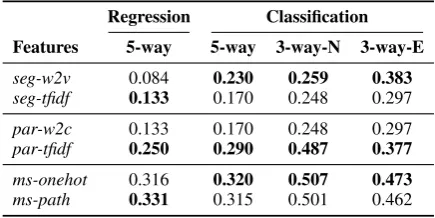
Regression Classification Features 5-way 5-way 3-way-N 3-way-E seg-w2v 0.084 0.230 0.259 0.383 seg-tfidf 0.133 0.170 0.248 0.297 par-w2c 0.133 0.170 0.248 0.297 par-tfidf 0.250 0.290 0.487 0.377 ms-onehot 0.316 0.320 0.507 0.473 ms-path 0.331 0.315 0.501 0.462 Table 4: Stance classification macro-averaged F1-score using segments (seg), paraphrases (par), and microstructures(ms)as features. The best result in each group is shown in boldface.
addition of the between options (f and a) for in-dicating implicit or indirect stance. Table3shows some examples. On the five classes, we observe a moderate inter-annotator agreement of 0.53 Co-hen’sκ(Cohen,1960). The aggregation was done by first removing 16 instances on which the anno-tators disagreed in stance polarity, and then averag-ing and roundaverag-ing the two labels by treataverag-ing them as numbers from the[−2,+2]interval.
[image:4.595.307.525.377.486.2]vec-tors (Mikolov et al., 2013)2 for each word and a (2) tf-idf unigram and bigram representation of a claim. For baselines, we use these representa-tions on claim segments (seg). For the sake of completeness, we also run the baselines on claim paraphrases (par), but note that this serves only as a reference, as obtaining paraphrases is arguably a task that is more difficult to automate than obtain-ing microstructures.
Microstructures. To represent the claim mi-crostructures (ms), we adopted a simple one-hot encoding scheme: we use one one-hot vector for each of the modalities, relations, relation negations, concepts, and opinion holders concatenating the vectors into a single feature vector (onehot). In addition, to leverage the taxonomical relations be-tween concepts, we experimented with encoding for each concept its ancestors in the taxonomy, by encoding the nodes along the path leading from the root to the concept (path).
Models. We used support vector machine (SVM) classifier and regression models with an RBF ker-nel, as implemented in the LibSVM library of
Chang and Lin(2011). We trained and evaluated the models on 803 claim instances (either seg-ments, paraphrases, or microstructures) using a 5×3 nested cross-validation, using grid search to optimize hyperparametersCandγ.
Tasks. We considered four task: (1) a 5-way re-gression setup, in which the model is trained to predict the numeric stance score, but afterwards the predictions are rounded and mapped to labels, (2) a 5-way classification task, (3) a 3-way classi-fication task in which the implicit labels (a and f) are mapped to neutral (3-way-N), and a (4) 3-way classification task in which the implicit labels are mapped to explicit for and against labels (3-way-E). The last two tasks are easier, so we expected the models to perform better on these tasks.
4.2 Results
Table 4 shows the classification results in terms of macro-averaged F1-score. As expected, the 3-way classification tasks are easier than 5-way classification tasks. Furthermore, the 5-way re-gression model performs better than 5-way classi-fier, suggesting that using distance-sensitive loss is beneficial for this task. In all four tasks, the
2We use the pre-trained vectors available at https://code.google.com/p/word2vec/
claim microstructures considerably outperform both segment-based baselines, yielding between 9 and 25 points of improvement in F1-score, de-pending on the task. All differences between the baseline and the microstructure model are statis-tically significant at p<0.05 (tested using a two-tailed permutation test (Yeh,2000)). By comparing with claim paraphrases as a reference, we find that microstructures give comparable performance for 5-way and 3-way-N classification tasks (the differ-ences are not statistically significant at p<0.05), while for 5-way regression and 3-way-E classifi-cation tasks the microstructures outperform para-phrase representations. Finally, the performance difference between one-hot encoded microstruc-tures and microstrucmicrostruc-tures with path-encoded con-cepts are not statistically significant at p<0.05, sug-gesting that stance classification did not profit from encoding taxonomical relations.
In the above experiments, the results for mi-crostructures were obtained on annotations of A1. The models trained on annotations of A2 gave con-sistently lower performance, albeit still better (and statistically different) than the baseline.
We conclude the experimental section by noting that microstructures improve claim stance classifi-cation performance over a segment-based baseline by a maximum of 50.7% F1-score for a 3-way clas-sification setup.
5 Conclusion and Future Work
We presented a framework for representing the mi-crostructures of claims. A microstructure expresses the relations between domain-specific concepts, and is intended to capture the beliefs, value judg-ments, and desired policies conveyed by claims. In the proof-of-concept study, we manually annotated microstructures for one debating topic. The anno-tators were able to translate 89% of claims into microstructures, thus proving the viability of the approach. We next demonstrated the usefulness of microstructures on the task of claim stance classifi-cation, where a simple encoding of microstructures yielded notable performance improvements over segment-based baselines. This in turn suggests that a claim microstructure does a good job in capturing the argumentative gist of the claim.
microstructures from text. In our study, the claims were segmented and paraphrased by human anno-tators; an end-to-end system would need to both segment out the claims and extract the correspond-ing microstructures. We believe that one way to tackle this problem might be to frame it as an infor-mation extraction task.
In our preliminary study, the annotators managed to translate most of the claims into microstructures. However, the low agreement rate (6.3%) suggests that the annotation workflow could perhaps be im-proved.
Another issue worth investigating is the applica-tion of the framework to a new domain: the tedious work of deriving a domain-specific taxonomy of concepts and the microstructures could perhaps be alleviated using active learning methods.
Finally, it would of course be interesting to inves-tigate the use of microstructures in other opinion mining and argument mining tasks, including tasks that could profit from analyzing the logical links between claims. We intend to pursue some of these directions in future work.
References
Ehud Aharoni, Anatoly Polnarov, Tamar Lavee, Daniel Hershcovich, Ran Levy, Ruty Rinott, Dan Gutfre-und, and Noam Slonim. 2014. A benchmark dataset for automatic detection of claims and evidence in the context of controversial topics. In Proceedings of the First Workshop on Argumentation Mining, pages 64–68.
Pranav Anand, Marilyn Walker, Rob Abbott, Jean E Fox Tree, Robeson Bowmani, and Michael Mi-nor. 2011. Cats rule and dogs drool!: Classifying stance in online debate. InProceedings of the 2nd workshop on computational approaches to subjectiv-ity and sentiment analysis, pages 1–9. Association for Computational Linguistics.
Roy Bar-Haim, Indrajit Bhattacharya, Francesco Din-uzzo, Amrita Saha, and Noam Slonim. 2017. Stance classification of context-dependent claims. In Pro-ceedings of the 15th Conference of the European Chapter of the Association for Computational Lin-guistics, pages 251–256. Association for Computa-tional Linguistics.
Filip Boltuˇzi´c and Jan ˇSnajder. 2014. Back up your stance: Recognizing arguments in online discus-sions. InProceedings of the First Workshop on Ar-gumentation Mining, pages 49–58. Association for Computational Linguistics.
Filip Boltuˇzi´c and Jan ˇSnajder. 2015. Identifying prominent arguments in online debates using seman-tic textual similarity. In Proceedings of the 2nd
Workshop on Argumentation Mining, pages 110–115. Association for Computational Linguistics.
Filip Boltuˇzi´c and Jan ˇSnajder. 2016. Fill the gap! An-alyzing implicit premises between claims from on-line debates. InProceedings of the 3rd Workshop on Argument Mining, pages 124–133. Association for Computational Linguistics.
Chih-Chung Chang and Chih-Jen Lin. 2011. LIB-SVM: A library for support vector machines. ACM Transactions on Intelligent Systems and Technology (TIST), 2(3):27.
J´er´emie Clos, Nirmalie Wiratunga, Joemon Jose, Stew-art Massie, and Guillaume Cabanac. 2014. Towards argumentative opinion mining in online discussions. InProceedings of the SICSA Workshop on Argument Mining (the Scottish Informatics & Computer Sci-ence Alliance), page 10.
Jacob Cohen. 1960. A coefficient of agreement for nominal scales. Educational and psychological mea-surement, 20(1):37–46.
Norbert E Fuchs, Kaarel Kaljurand, and Tobias Kuhn. 2008. Attempto controlled English for knowledge representation. InReasoning Web, pages 104–124. Springer.
Trudy Govier. 2013. A Practical Study of Argument, Enhanced Edition, 7th edition. Cengage Learning.
Ivan Habernal and Iryna Gurevych. 2015. Exploit-ing debate portals for semi-supervised argumenta-tion mining in user-generated web discourse. In Pro-ceedings of the 2015 Conference on Empirical Meth-ods in Natural Language Processing, pages 2127– 2137.
Kazi Saidul Hasan and Vincent Ng. 2013. Stance clas-sification of ideological debates: Data, models, fea-tures, and constraints. InInternational Joint Confer-ence on Natural Language Processing, pages 1348– 1356.
Kazi Saidul Hasan and Vincent Ng. 2014. Why are you taking this stance? Identifying and classifying reasons in ideological debates. In Proceedings of the 2014 Conference on Empirical Methods in Natu-ral Language Processing (EMNLP), pages 751–762. Association for Computational Linguistics.
Ran Levy, Yonatan Bilu, Daniel Hershcovich, Ehud Aharoni, and Noam Slonim. 2014. Context depen-dent claim detection. In Proceedings of COLING 2014, the 25th International Conference on Compu-tational Linguistics: Technical Papers.
Tomas Mikolov, Kai Chen, Greg Corrado, and Jeffrey Dean. 2013. Efficient estimation of word represen-tations in vector space. In Proceedings of ICLR, Scottsdale, AZ, USA.
Marie-Francine Moens. 2014. Argumentation mining: Where are we now, where do we want to be and how do we get there? InPost-proceedings of the forum for information retrieval evaluation (FIRE 2013).
Saif M. Mohammad, Svetlana Kiritchenko, Parinaz Sobhani, Xiaodan Zhu, and Colin Cherry. 2016. SemEval-2016 Task 6: Detecting stance in tweets. InProceedings of SemEval-2016, pages 31–41. As-sociation for Computational Linguistics.
Raquel Mochales Palau and Marie-Francine Moens. 2009. Argumentation mining: The detection, clas-sification and structure of arguments in text. In Pro-ceedings of the 12th International Conference on Ar-tificial Intelligence and Law, pages 98–107. ACM.
Andreas Peldszus and Manfred Stede. 2015. Joint pre-diction in mst-style discourse parsing for argumenta-tion mining. InProceedings of the 2015 Conference on Empirical Methods in Natural Language Process-ing, pages 938–948. Association for Computational Linguistics.
Ruty Rinott, Lena Dankin, Carlos Alzate Perez, Mitesh M Khapra, Ehud Aharoni, and Noam Slonim. 2015. Show me your evidence-an automatic method for context dependent evidence detection. In Pro-ceedings of the 2015 Conference on Empirical Meth-ods in Natural Language Processing, pages 440– 450. Association for Computational Linguistics.
Parinaz Sobhani, Saif M Mohammad, and Svetlana Kir-itchenko. 2016. Detecting stance in tweets and ana-lyzing its interaction with sentiment. InProceedings of the Fifth Joint Conference on Lexical and Com-putational Semantics (*SEM 2016), pages 159–168. Association for Computational Linguistics.
Christian Stab and Iryna Gurevych. 2017. Parsing ar-gumentation structures in persuasive essays. Com-putational Linguistics, (in press).
Veselin Stoyanov and Claire Cardie. 2008. Topic identification for fine-grained opinion analysis. In Proceedings of the 22nd International Conference on Computational Linguistics-Volume 1, pages 817– 824. Association for Computational Linguistics.
Adam Wyner, Tom van Engers, and Anthony Hunter. 2016. Working on the argument pipeline: Through flow issues between natural language argument, instantiated arguments, and argumentation frame-works.Argument & Computation, 7(1):69–89.
Adam Wyner and Tom Van Engers. 2010. A frame-work for enriched, controlled on-line discussion fo-rums for e-government policy-making. In Proceed-ings of eGov 2010, pages 1–11.
Bishan Yang and Claire Cardie. 2013. Joint inference for fine-grained opinion extraction. InProceedings of the 51st Annual Meeting of the Association for Computational Linguistics, pages 1640–1649. Asso-ciation for Computational Linguistics.