Re-Framing the knowledge to action challenge through
NIHR knowledge mobilisation research fellows. Comment
on “CIHR Health System Impact Fellows: Reflections on
‘Driving Change’ Within the Health System"
RYCROFT-MALONE, Jo and LANGLEY, Joe <http://orcid.org/0000-0002-9770-8720>
Available from Sheffield Hallam University Research Archive (SHURA) at:
http://shura.shu.ac.uk/25641/
This document is the author deposited version. You are advised to consult the publisher's version if you wish to cite from it.
Published version
RYCROFT-MALONE, Jo and LANGLEY, Joe (2020). Re-Framing the knowledge to action challenge through NIHR knowledge mobilisation research fellows. Comment on “CIHR Health System Impact Fellows: Reflections on ‘Driving Change’ Within the Health System". International Journal of Health Policy and Management (IJHPM).
Copyright and re-use policy
See http://shura.shu.ac.uk/information.html
1
Type: Commentary
1
Re-Framing the Knowledge to Action Challenge through NIHR Knowledge
2
Mobilisation Research Fellows
3
Comment on “CIHR Health System Impact Fellows: Reflections on ‘Driving Change’ Within
4
the Health System”
5
Abstract
6
The ambition of the Canadian Institutes for Health Research (CIHR) Health Service Impact
7
(HIS) Fellowship initiative to modernise the health system is impressive. Embedded
8
researchers who work between academia and non-academic settings offer an opportunity to
9
reframe the problem of evidence uptake as a product of a gap between those who produce
10
knowledge and those who use it. As such, there has been an increasing interest in the
11
potential of people in embedded research roles to work with stakeholders in the
co-12
production of knowledge to address service challenges. In this commentary, we draw on
13
research and experiential evidence of an embedded researcher initiative, which has similar
14
intentions to the HIS Fellowships programme: the National Institute for Health Research
15
(NIHR) Knowledge Mobilisation Research Fellowship (KMRF) scheme. We outline the
16
similarities and differences between the two schemes, and then consider the work,
17
characteristics and skills, and organisational arrangements evident in operationalising these
18
types of roles.
19
Keywords: Embedded Researcher, Knowledge Mobilisation, Evidence, Fellowship,
Co-20
Production
21
Despite ever increasing attention, resource and research effort, how to best support a
22
knowledge based health and care service delivery system, particularly at scale, remains
23
frustratingly elusive. As such, the ambition of the pan-Canadian Health Services Impact
24
(HSI) Fellowship initiative that aims to “drive change and modernize the health system”1, p328
25
is impressive. This initiative provides a deliberate attempt to build capacity and capability
26
within the health system through the development of individuals in roles that co-locate in
27
service and academic institutions – as ‘embedded researchers.’ This idea of embedding
28
researchers in these boundary spanning or intermediary roles is in part a response to how the
29
challenge has traditionally been framed, i.e. that the problem of evidence use and uptake is a
30
consequence of a gap between those that produce knowledge and those that use it. Embedded
2
researchers who work within non-academic contexts but have an affiliation with academia, in
1
theory, offer an opportunity by reframing this problem. Rather than filling a gap between
2
producers and users, the focus is on considering all stakeholders as producers and users of
3
different forms of knowledge, and to carry out work to co-produce (co-create and use)
4
knowledge.
5
As noted by Sim et al,1 internationally there is increasing attention on intermediary or
6
embedded researcher type roles2,3,4,5 in efforts to bring knowledge to bear on particular
7
service challenges. An increased focus on the potential of embedded researcher roles is also
8
reflective of a turn to co-productive ways of working, and the infrastructure, capacity and
9
capability required to support this way of working6
10
As eluded to by Sim et al1, and other commentators,7, 8 the establishment of embedded roles,
11
the development of the individuals who take them on, and the infrastructure required to
12
support them requires considerable thought and investment. Additionally, enacting these roles
13
is not without challenge. As Vindrola-Padros et al2 note, dual affiliation and role strain,
14
building trusting relationships whilst maintaining critical distance, and being constrained by
15
host organisation’s when there are negative or harmful research results are issues that need
16
constant attention and negotiation. Thus far, despite the increasing popularity of
17
establishing these roles, we argue that there has been perhaps too little attention on their
18
evaluation, with some exceptions.9, 10,11 Here we reflect on an English embedded researcher
19
type initiative that has had a longer history than HIS (2012-2017), but had similar ambitions
20
called the National Institute of Health Research (NIHR) Knowledge Mobilisation Research
21
Fellowships (KMRF). In reflecting on the KMRF scheme, we draw on the research evidence
22
base about embedded researchers and experiential evidence of a KMRF (JL).
23
Knowledge Mobilisation Research Fellowships
24
Table 1 describes the five key objectives of the KMRF scheme.
25
Table 1: KMRF scheme objectives
26
Objective
1. To build capacity by developing individuals who can lead and champion knowledge
mobilisation for NIHR funded research and other applied health research
2. To improve and share the research-informed evidence base around knowledge
3
3. To improve the uptake, application and influence of NIHR funded research and other
applied health research within the National Health Service (NHS)
4. To develop capacity in NHS organisations that contributes to knowledge mobilisation
research evidence
5. To improve the quality and relevance of NIHR research through greater service
involvement
The first round of the scheme was called Knowledge Mobilisation Fellowships, and focused
1
on mobilising research evidence into practice (Objectives 1, 3-5 Table 1). From round two,
2
research [‘R’] was introduced (Objective 2, Table 1). This addition was to ensure that the
3
fellowships were about doing and researching knowledge mobilisation. Fellowships were
4
funded in a competitive process based on the quality of their plans for the development of
5
self, doing knowledge mobilisation, researching knowledge mobilisation, developing
6
capacity in NHS organisation to mobilise research evidence and building service involvement
7
in research.
8
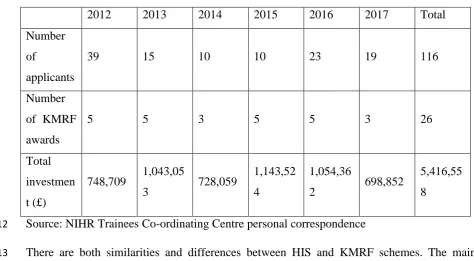
A maximum of five fellowships were awarded in each annual competition. Table 2
9
summarises annual numbers of applicants, fellowships awarded and total investment.
[image:4.595.46.521.443.704.2]10
Table 2 KMRF awarded
11
2012 2013 2014 2015 2016 2017 Total
Number
of
applicants
39 15 10 10 23 19 116
Number
of KMRF
awards
5 5 3 5 5 3 26
Total
investmen
t (£)
748,709 1,043,05
3 728,059
1,143,52
4
1,054,36
2 698,852
5,416,55
8
Source: NIHR Trainees Co-ordinating Centre personal correspondence
12
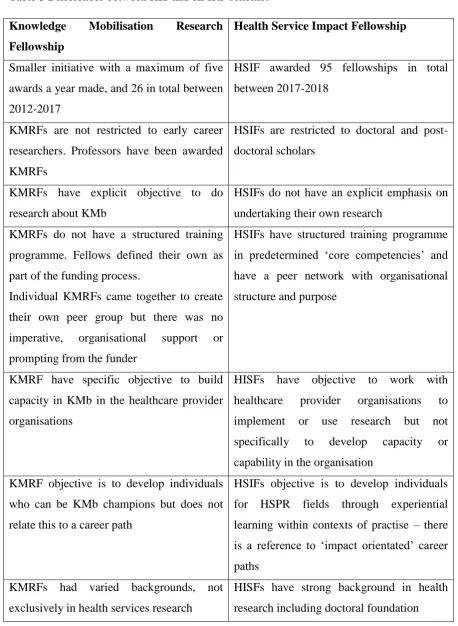
There are both similarities and differences between HIS and KMRF schemes. The main
13
similarities are that both have an objective to do some kind of translational work, i.e. putting
14
evidence into practice. Additionally, both HSI and KMRF expect dual host organisational set
4
up, with one being an academic organisation and the other being a service delivery
1
organisation. However, there are some differences, which are summarised in Table 3.
[image:5.595.63.522.132.759.2]2
Table 3 Differences between HIS and KMRF schemes
3
Knowledge Mobilisation Research Fellowship
Health Service Impact Fellowship
Smaller initiative with a maximum of five
awards a year made, and 26 in total between
2012-2017
HSIF awarded 95 fellowships in total
between 2017-2018
KMRFs are not restricted to early career
researchers. Professors have been awarded
KMRFs
HSIFs are restricted to doctoral and
post-doctoral scholars
KMRFs have explicit objective to do
research about KMb
HSIFs do not have an explicit emphasis on
undertaking their own research
KMRFs do not have a structured training
programme. Fellows defined their own as
part of the funding process.
Individual KMRFs came together to create
their own peer group but there was no
imperative, organisational support or
prompting from the funder
HSIFs have structured training programme
in predetermined ‘core competencies’ and
have a peer network with organisational
structure and purpose
KMRF have specific objective to build
capacity in KMb in the healthcare provider
organisations
HISFs have objective to work with
healthcare provider organisations to
implement or use research but not
specifically to develop capacity or
capability in the organisation
KMRF objective is to develop individuals
who can be KMb champions but does not
relate this to a career path
HSIFs objective is to develop individuals
for HSPR fields through experiential
learning within contexts of practise – there
is a reference to ‘impact orientated’ career
paths
KMRFs had varied backgrounds, not
exclusively in health services research
HISFs have strong background in health
5
Whilst the ambition of the initiatives are broadly similar, as Table 3 shows, the parameters of
1
the two schemes were different in that the KMRF competition appears to have been more
2
open in terms of, for example, applicants’ backgrounds. As such, the cohort of 26 KMRFs
3
represent a variety of backgrounds and therefore approaches to the embedded role from the
4
more traditional health services research12 to the more co-creative.13 Despite a difference in
5
approach, the unifying feature was an expectation that the KMRFs work with or alongside
6
those in health and care services.
7
The work
8
Sim et al1 touch on the work done in their embedded researcher roles, including the
co-9
production of outputs to support practice innovation and improvement. Given the aim of the
10
HSI fellowship is to bridge the knowledge practice gap, it is assumed that the ability to work
11
across boundaries through developing and maintaining partnerships with different people and
12
communities would be particularly critical to success. Bridging or spanning boundaries
13
episodically (for example for specific tasks), as well as blurring them through a more
14
continuous approach to being embedded in day-to-day activities9 and being critical friends14
15
requires considerable effort and work. As Cassidy et al7 suggest, this will require the HSI
16
fellows to ‘attune to the relationship components embedded within the programme.’p456 The
17
need to attend to relationships is also evident in the on-going research into embedded
18
researchers of Ward and colleagues:
19
(https://www.embeddedresearch.org/uploads/8/0/2/1/80213224/ukkmbf.3.pdf) which
20
identifies one of the features of embedded research initiatives as ‘Relational Role.’ In their
21
conceptualisation, Relational Role includes the independence of the embedded researcher and
22
their approach to providing input.
23
‘Authentic collaboration, partnership and engagement provides a context for action’6, p221
for
24
those occupying embedded roles, however this requires careful navigation to align
25
expectations and to work across boundaries. It also requires an ability to work with different
26
types of evidence. For example, with a background of design engineering JL uses design
27
practises as a means of discovery and research. As part of his knowledge mobilisation
28
fellowship he has explored whether design practises, which take the form of eliciting,
29
articulating and synthesising knowledge, and embodying it in material objects (prototypes)
30
are useful for co-creating knowledge. His research suggests the practice of ‘Collective
31
Making’ has additional value in the way it can manage relationships and power dynamics.13
6
Personal dynamics such as dominant personalities, being introvert or extroverts, and social
1
and structural dynamics such gender, age, discipline and education levels can be negotiated
2
through ‘making’ because:
3
1. as an activity it is equally ‘out of the norm’ for all parties, when used in research
4
contexts; it therefore a leveller.
5
2. ‘Making’ and ‘playing’ are associated with childhood, hobbies, and activities people
6
choose to do for pleasure and leisure, as such they take away hierarchies and give
7
permission to be less formal.
8
3. The process changes language and modes of thinking being less reliant on words,
9
which enables a different and collective way of communicating.
10
Brokering relationships and increasing the flow and use of knowledge through social
11
contact14 also requires those in embedded roles to, as JL describes it, ‘fill in the gaps’ and
12
provide ‘leadership between the cracks.’ Filling in the gaps refers to the work required to
13
manage different tasks, activities and people, which are dynamic and shifting as the work
14
progresses leaving spaces that need connecting for maintaining forward momentum. Whilst
15
leadership between cracks refers to a type of informal leadership required to work with and
16
between disparate individuals and groups to drive motivation and action.
17
Characteristics and Skills
18
Given the work of those in embedded roles, people working in them need to embody a
19
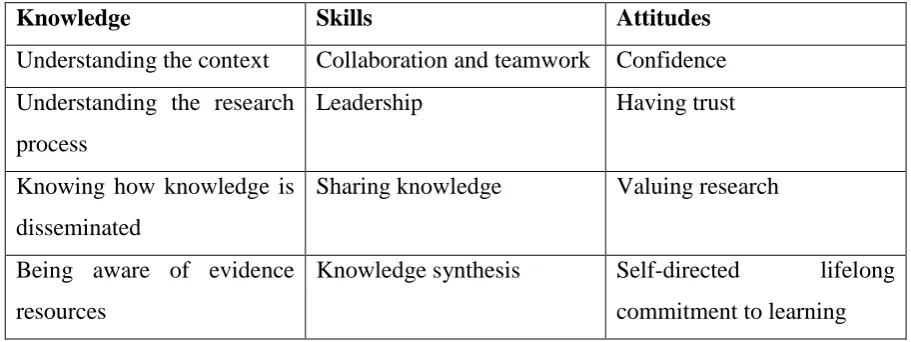
variety of characteristics and skills. In a review of published and grey literature of the
20
knowledge, skills, and attitudes of people15 working in knowledge translation roles, a number
21
of core competencies were identified, which are summarised in Table 4.
[image:7.595.64.520.595.766.2]22
Table 4 Core competencies
23
Knowledge Skills Attitudes
Understanding the context Collaboration and teamwork Confidence
Understanding the research
process
Leadership Having trust
Knowing how knowledge is
disseminated
Sharing knowledge Valuing research
Being aware of evidence
resources
Knowledge synthesis Self-directed lifelong
7
Understanding KT and EBP
processes
Dissemination of research
findings
Valuing teamwork
Use of research findings
Fostering innovation
Knowledge brokering
From grey literature:
Quality improvement
methods and tools
KT planning Integrity
Communication strategies Project management Commitment to professional
work ethic and professional
behaviour in interaction with
internal and external
contacts
Health policy and systems Information technology use Commitment to high
standards of professionalism
Sound judgment Interest in the developments
in communications
Discretion/tact/diplomacy
resourcefulness
Experientially, and perhaps as a function of a design engineering background, JL identified
1
less with the knowledge components, and more with skills and attitudes. This highlights that
2
embodying these embedded roles is partially a function of the person’s background, but also
3
about how that aligns with what is needed for the role at the time, in that context, and with
4
those people. In fact, over time it has become apparent to JL that knowledge synthesis and
5
brokering were inherent to his way of working because it is the modus operandi of a designer.
6
Presenting himself as a design engineer and as naïve to the clinical contexts of those he was
7
working with was an advantage because it removed assumptions about a baseline of
8
knowledge for all participants. The idea of credibility being a function of the characteristics
9
of the person, rather than their level of knowledge is also evident from other research.14,16 For
10
example, it might in some circumstances be advantageous for an embedded researcher to be a
11
non-clinician, because being at a distance from the clinical challenge enables a focus on the
12
research process. However, this runs counter to Sim et al1’s reflections in which they identify
8
their current or former health professional background knowledge and experience as helpful
1
for supporting networking and relationship building for effective collaboration.
2
We argue that approaches to identifying potential embedded researchers be guided, but not
3
constrained, by a list of specific competencies or particular background. As noted by others6
4
being able to work productively with different constituencies in dynamic contexts requires
5
transferable qualities such as being comfortable with messiness, a good communicator with
6
different audiences, being flexible, being able to manage conflict and being tenacious and
7
creative.
8
Organisational arrangements
9
Sim et al1 describe the role of a HIS fellow as a ‘central agent’ who navigates the health
10
system to become a ‘conduit for system level change.’ As part of these arrangements, the
11
fellows work alongside decision makers in the health system whilst maintaining a link to
12
academia. It is less clear in their reflection and their Framework for Understanding the HSI
13
Fellow as an Embedded Researchers how and what particular organisational arrangements
14
and contexts facilitate role enactment. Within England, the Collaborations for Leadership in
15
Applied Health Research and Care (CLAHRC) have provided an organisational arrangement
16
for the development and support of a number of different types of embedded researcher type
17
roles. In later rounds of the KMRF scheme, the CLAHRCs where host organisations for
18
individual fellows. CLAHRCs were a distributed regional service and academic partnerships
19
funded to increase applied health research and the use of research in practice. Evidence from
20
evaluations of CLAHRCs14,16,17,18,19 have demonstrated the pivotal role that embedded
21
researcher type roles played in developing the partnerships themselves, as well as in
co-22
producing research and knowledge mobilisation through inhabiting the worlds of service and
23
academia.
24
However, there were features of CLAHRCs that were more facilitative of individuals
25
operating in these embedded roles.16,18 For example, the existence of matched funding
26
incentivised health service and academic organisations to work together, and helped to ensure
27
role holders had dedicated resources, including protected time. Second, CLAHRCs that
28
positioned their strategy and approach towards evidence co-production in contrast to a
29
knowledge transfer approach created contexts more conducive to enacting an embedded role
30
because they were a better cultural fit. Finally, CLAHRCs that were structured and organised
9
in a way that facilitated connection between people and organisations, as opposed to silos,
1
enabled easier navigation across boundaries.
2
Beyond the generalisable benefits of the host organisation attributes described above, there
3
will be idiosyncratic benefits for each individual embedded researcher, some of which will be
4
emergent and serendipitous whilst others can be carefully considered in advance to get the
5
best ‘fit’ between embedded researcher, proposed work and host organisation. The work of
6
Ward and colleagues
7
((https://www.embeddedresearch.org/uploads/8/0/2/1/80213224/ukkmbf.3.pdf) ) is
8
prompting people to do this, particularly from the perspective of the researcher.
9
From experience, JL’s ‘home’ was in Yorkshire & Humber CLAHRC’s Translating
10
Knowledge to Action theme, which had a strong focus on co-design and coproduction, and
11
was therefore a good fit for someone with a design background. This CLAHRC was a
12
conducive context for operating as a knowledge mobilisation fellow because there were
13
already brokered and trusted relationships with service provider organisations and a rich
14
organisational know-how of working together. This context was a ‘ready-made’ collaborative
15
and trusted network for JL to navigate, and a context in which to facilitate the introduction of
16
new ways of working such as ‘collective making.’13 Within this context JL benefitted from
17
relative autonomy from service and academic affiliations and agendas. This context was also
18
more conducive to sustaining an individual in an embedded researcher role as the funding and
19
host arrangements ensured an appropriate support structure.
20
Conclusion
21
The potential contribution of embedded research type roles in the co-production of
22
knowledge towards service improvement and transformation is evident, and as such the
23
numbers, and associated labels for such roles, is increasing. Specific initiatives such as the
24
Canadian HIS Fellowships and England’s KMR Fellowships also demonstrate national
25
funders’ commitment to the potential of this way of working. We have highlighted some
26
similarities and differences between these schemes, and drawn on research and experiential
27
evidence to show that people operating in these embedded researcher roles have to navigate
28
complex environments and tailor their action accordingly. Their success is likely to be
29
mediated by how flexibly and appropriately they can draw on a varied toolbox and personal
30
skill set, and by the organisational arrangements, that is, resources and culture, which support
31
them. However, whilst there is an increase in embedded roles there has not been a
10
corresponding growth in systematic and large-scale research about the mechanisms and
1
impacts of these roles. This is now a gap that needs to be filled.
2
3
References
4
1. Sim SM, Lai J, Aubrecht K et al. CIHR health system impact fellows: reflections on
5
“driving change” within the health system. Int J Health Policy Manag.
2019;8(6):325-6
328. Doi:10.15171/ijhpm.2018.124
7
2. Vindrola-Padros C, Pape T, Utley M, et al. The role of embedded research in quality
8
improvement: a narrative review. BMJ Qual Saf. 2017;26:70–80.
9
http://dx.doi.org/10.1136/bmjqs-2015-004877
10
3. Ward V, Why, whose, what and how? A framework for knowledge mobilsers. Evid
11
Policy 2017;13:3:477-497. https://doi.org/10.1332/174426416X14634763278725
12
4. Marshall M, Pagel C, French C, et al. Moving improvement research closer to practice:
13
the Researcher-in-Residence model. BMJ Qual Saf. 2014;23:801–805.
14
http://dx.doi.org/10.1136/bmjqs-2013-002779
15
5. Chew S, Armstrong N, Martin G. Institutionalising knowledge brokering as a sustainable
16
knowledge translation solution in healthcare: how can it work in practice? Evid Policy
17
2013;9(3):335–51. https://doi.org/10.1332/174426413X662734
18
6. Rycroft-Malone J, Burton CR, Bucknall T, et al. Collaboration and co-production of
19
knowledge in healthcare: opportunities and challenges. Int J Health Policy Manag.
20
2016;5(4):221–223. doi:10.15171/ijhpm.2016.08
21
7. Cassidy CE, Burgess S, Graham ID. It’s all about the IKT approach: three perspectives on
22
an embedded research fellowship: Comment on “CIHR health system impact fellows:
23
reflections on ‘driving change’ within the health system.” Int J Health Policy Manag.
24
2019;8(7):455–458. doi:10.15171/ijhpm.2019.31
25
8. Hunter DJ. Meeting the challenge of the “know-do” gap: Comment on “CIHR health
26
system impact fellows: reflections on ‘driving change’ within the health system.” Int J
27
Health Policy Manag. 2019;8(8):498–500. doi:10.15171/ijhpm.2019.37
28
9. Evans S, Scarborough H, Supporting knowledge translation through collaborative
29
translational research initiatives: ‘Bridging’ versus ‘blurring’ boundary-spanning
30
approaches in the UK CLAHRC initiative. Soc Sci Med. 2014 April;106: 119–127.
31
doi:10.1016/j.socscimed.2014.01.025
11
10. Bornbaum CC, Kornas K, Peirson L, et al. Exploring the function and effectiveness of
1
knowledge brokers as facilitators of knowledge translation in health-related settings: a
2
systematic review and thematic analysis. Implement Sci. 2015;10:162. Doi:
3
10.1186/s13012-015-0351-9.
4
11. Marshall M, Mear L, Ward V et al Optimising the impact of health services research on
5
the organisation and delivery of health services: a study of embedded models of
6
knowledge co-production in the NHS (Embedded) protocol. NIHR HS&DR Journals
7
https://www.journalslibrary.nihr.ac.uk/programmes/hsdr/165221/#/
8
12. Dziedzic KS, French S, Davis AM et al Implementation of musculoskeletal models of
9
care in primary care setting: theory, practice, evaluation and outcomes for
10
musculoskeletal health in high income countries. Best Practice & Research Clinical
11
Rheumatology. 2016;30(3):375-397. DOI 10.1186/s13012-015-0351-9.
12
13. Langley J, Wolstenholme D, Cooke J Collective Making as knowledge mobilisation: the
13
contribution of participatory design in the co-creation of knowledge in healthcare. BMC
14
Health Services Research. 2018;18:585 doi.org/10.1186/s12913-018-3397-y
15
14. Wye, L., Cramer, H., Carey, J. et al. Knowledge brokers or relationship brokers? The role
16
of an embedded knowledge mobilisation team. Evid Policy. 2017;15[2], 277–292, DOI:
17
10.1332/174426417X15123845516148
18
15. Mallidou AA, Atherton P, Chan L. et al. Core knowledge translation competencies: A
19
scoping review. BMC Health Services Research, 2018; 18(1):502.
20
https://doi.org/10.1186/s12913-018-3314-4
21
16. Rycroft-Malone J, Burton C, Wilkinson J, et al Collective action for implementation: a
22
realist evaluation of organisational collaboration in healthcare. Implement Sci. 2016;11:17
23
DOI 10.1186/s13012-016-0380-z
24
17. Rowley E, Morriss R, Currie G, et al. Research into practice: Collaboration for
25
Leadership in Applied Health Research and Care (CLAHRC) for Nottinghamshire,
26
Derbyshire, Lincolnshire (NDL). Implement Sci 2012;7:40–51. doi:
10.1186/1748-5908-27
7-40
28
18. Rycroft-Malone J, Burton C, Wilkinson J, et al. Collective action for knowledge
29
mobilisation: a realist evaluation of the collaborations for leadership in applied health
30
research and care. Health Serv Deliv Res. 2015;3(44). doi:10.12927/hcpol.2007.18876
31
19. Soper B, Hinrichs S, Drabble S, et al. Delivering the aims of the Collaborations for
32
Leadership in Applied Health Research and Care: understanding their strategies and
33
contributions. Health Serv Deliv Res. 2015;3(25). DOI 10.3310/hsdr03250