Abstract--Adaptive hypertext provides a powerful approach to the problems of providing information that is appropriate to the diverse needs of users, and it is most commonly implemented in education. In this paper we describe how an experimental XML-based adaptive learning environment (WHURLE) has been built to facilitate the creation of reusable educational content. WHURLE authors fall into three categories – subject experts create “chunks” – conceptually discrete units of content; teachers create “lessons” and technical authors create the user models that inform the systems adaptation. WHURLE has a modular architecture so that alternative skins and adaptation filters may be used to radically change its appearance and behaviour. We also consider issues involved with navigation in an adaptive docuverse, and describe a mechanism for user-control of the adaptation – tantamount to a manual override of the user model.
Index Terms--Adaptive Systems, Educational Technology, Hypertext Systems, Web and Internet Services
I. INTRODUCTION
S the volumes of information available on the WWW
increases, the problem arises of providing information that is appropriate to the needs of end users with differing goals and interests. Content management systems that are capable of delivering adaptive hypermedia are providing an increasingly important approach to addressing this problem. So far the majority of such adaptive systems that have been implemented on the web are for educational applications [1].
When IT is used as the medium for distributed learning, it must be remembered that the users almost invariably have diverse needs and requirements. Not only do students vary in their abilities and prior experience, but also the manner in
During the course of this work Craig Stewart was supported by the Hong Kong Higher Education Funding Council.
T.J. Brailsford is with the School of Computer Science and Information Technology, University of Nottingham, NG8 1BB, UK (telephone: +44 115 951 4231, e-mail: [email protected]).
H.L. Ashman is with the School of Computer Science and Information Technology, University of Nottingham, NG8 1BB, UK (telephone: +44 115 951 4237, e-mail: [email protected]).
C.D. Stewart is with the School of Computer Science and Information Technology, University of Nottingham, NG8 1BB, UK (e-mail: [email protected]).
M.R. Zakaria is with the School of Computer Science and Information Technology, University of Nottingham, NG8 1BB, UK (e-mail: [email protected]).
A. Moore is with the School of Civil Engineering, University of Nottingham, NG7 2RD, UK (telephone: +44 115 846 6492, e-mail: [email protected]).
ICITA2002 ISBN: 1-86467-114-9
which people learn varies enormously between individuals [2] and moreover these preferences are highly changeable [3]. In order to be effective the pedagogic design of educational software should reflect this complex system. Ignoring the needs of individual users and focusing upon the “average” student is a serious flaw that is all too commonly found in technology-based learning. Indeed evaluation studies have found that static web-based systems can have a polarising effect upon students of different abilities [4]. Some students perform better using such systems than they do with conventional teaching methods, but some are seriously and systematically disadvantaged.
The ideal of using adaptive hypertext in education is to create systems that “understand” the learning requirements of users, and present information that fulfils these requirements in terms of content, structure and pedagogy [5].
The presentation of dynamic adaptive information on the web, rather than more conventional static “pages”, raises many issues ranging from authoring metaphors to user interface design and navigation within a changing docuverse. Most of these issues arise from the fact that a fundamental paradigm of the web breaks down in such systems – the end user no longer necessarily sees what the content author sees. In this paper we describe how we have addressed some issues of navigation in the ongoing development of WHURLE1 (Web-based Hierarchical Universal Reactive Learning Environment) – an experimental adaptive learning environment and educational content management system.
II. THE WHURLE FRAMEWORK
WHURLE is designed to provide a discipline-independent framework that manages easily reusable content, is pedagogically flexible and has the capability of implementing adaptation [6], [7]. An important feature of this framework is that it distinguishes between three types of authors of educational hypermedia – subject experts, teachers and technical authors. The subject experts are responsible for the content, the teachers for the implementation of that content and the technical authors for the user model of the adaptation and the appearance and behaviour of the system.
A. The Learning Environment
WHURLE is an integrated learning environment that provides students with an interactive learning space that contains tools and services to facilitate independent study. The content is presented to students in the form of “lessons” – which are constrained constructs of hierarchical pages. These
User Control of Adaptation in an Automated
Web-Based Learning Environment
Timothy Brailsford, Helen Ashman, Craig Stewart, Mohamed Ramzy Zakaria and Adam Moore
pages may contain information, problems, simulations or assignments and although the teacher provides a default pathway this is not imposed upon the student, (ie each node is semantically autonomous). The lessons are manifest as virtual documents, that are adapted to meet the requirements of the user according to rules that are defined by both the user model and personal data stored in a user profile. Virtual documents are constructed from underlying resources by means of conditional transclusion [8].
Transclusion is a central component of Nelson’s original vision of hypertext that he has described as the “heart of connection” [9]. Transclusion is the dynamic inclusion of an arbitrary component of one document inside another, and is one of the more rarely implemented aspects of hypertext. The adaptation of WHURLE is achieved by using a simplified version of transclusion to create the virtual documents that are visible only to the user. The conditionality of the transclusion is dependent upon information that is stored in user profiles which allows the transparent assembly of content to meet the needs of the individual.
B. The Content Model
The content is authored in the form of conceptually discrete units called chunks. In most cases a chunk is a small construct typically containing a single media item (eg a paragraph of text) or a small group of related media items (eg a captioned image), together with appropriate metadata. All of the chunks available to any one installation of WHURLE are collectively referred to as the melange. The encapsulation of content into chunks that are created by subject experts provides the system with the flexibility required for adaptation, but this is completely transparent to the end-users. What a student sees is a virtual document – the content of which is derived from one or more chunks.
Lessons are defined by lesson plans, which consist of a pathway through the melange created by teachers. At its simplest a lesson plan might be nothing more than a hierarchy of levels – each containing one or more pages – which are themselves constructed by the transclusion of chunks. In an adaptive lesson, the lesson plan also contains dependencies – which determine whether chunks, pages or lesson levels are included in the virtual document.
C. The Implementation
WHURLE is an XML system currently implemented using XSLT that is processed on the server, delivering dynamic HTML. In order to minimise the processing overhead XInclude is used to retrieve chunks as they are required. XSLT and XInclude are processed using the Cocoon XML publishing framework2. The user profiles are stored using a MySQL database3, chunks and lesson plans are XML files and configuration and navigation information is specified as request parameters of the URI (see [7] for further details).
D. Navigation and Linking
WHURLE contains an autonavigation system to generate the links between components of virtual documents from the
nodal relationships in the underlying lesson plan. This saves the teacher from having to create such links, guarantees link integrity and allows the reuse of chunks in a position-independent manner. In addition to the autonavigation there is a robust system of node to node linking provided for authored links. These links are specified in an XML linkbase that may be created by either teachers or students. They are all bi-directional and may be either single (ie one to one), plural (ie many to many) or hubs (ie one to many). The linkbase and lesson plan are incorporated into a composite XML node-tree using XInclude and the links are rendered onto pages of the virtual document.
E. System Architecture
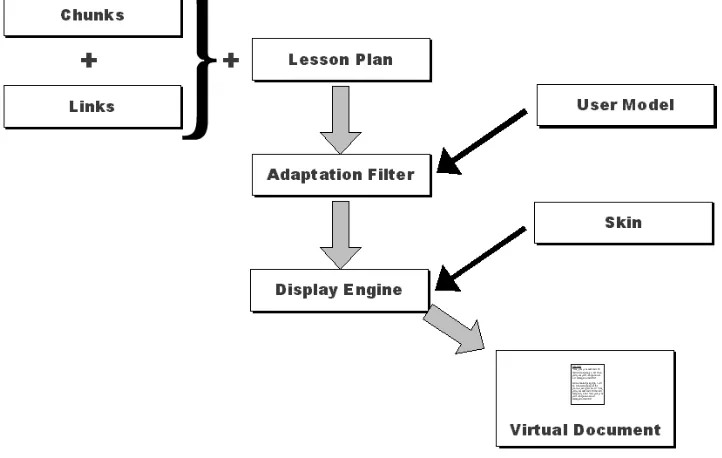
WHURLE is designed to be modular – with the functionality of adaptation and rendering separated to facilitate experimentation and development (see Fig. 1). At parse-time the system builds a node-tree from the lesson plan, the linkbase and those chunks that are specified in that lesson plan. This is then processed by the adaptation filter, which is an XSLT stylesheet that implements the user model. The adaptation filter passes those nodes that are to be incorporated into the virtual document to the display engine, which is an XSLT stylesheet that is responsible for rendering the final output.
The display engine overlays a navigational system on top of the content (ie the autonavigation described above), as well as a user-interface that is defined by a skin (this is an XML file that specifies the cosmetic appearance and associated learning tools). The output document of the display engine is dynamic HTML that is capable of being displayed in most web browsers. This architecture allows the adaptation filter, display engine and skin to be modified independently of each other – which is a facility that is invaluable both for research and implementation. Thus, WHURLE is not tied to any particular user model or interface, both of which can be created by technical authors.
F. User Modelling
III. NAVIGATING AN ADAPTIVE DOCUVERSE There are a number of issues relating to navigation within an adaptive docuverse, which are compounded by the transparent content model of adaptation that WHURLE uses. The issue that we will discuss here is that of what happens to material that is deemed inappropriate according to the user model.
Many adaptive hypertext systems use link annotation as the major interface mechanism by which adaptation is implemented. For example in the AHA system [13] links are rated, according to the user model, as good, neutral or bad. In Interbook [14] the educational states of “known”, “ready to be learned” and “not ready to be learned” are distinguished. In these circumstances the issue of adapting material out of the system does not occur. The adaptation is effectively presented to the user as suggestion rather than prescription, and it is ultimately his or her choice as to whether or not to accept the systems guidance.
However, this is not the case if the adaptation is at the content rather than the link level. It is especially problematic if this is transparent to the user – as it was with the first adaptive filter that we developed for WHURLE [10]. Using this filter the user has no way of knowing what material is being excluded. The narrative flow is entirely generated by the system, in accordance with the user model, with no conscious intervention from the user and no opportunity to override it. Although this approach has the advantage that it simplifies the narrative structure of the apparent docuverse, it also has major problems. One is that not only is the excluded material lost to the user, but also the links contained within it
are lost too. Thus the user will not see inappropriate material that might nonetheless contains useful links. Also there is a risk (indeed the virtual certainty) that in some cases the mechanism for assessing the users requirements will be flawed. Under these circumstances, the exclusion of the adaptation filter will be equally flawed and much of the usefulness of the adaptation will break down.
[image:3.612.122.483.29.258.2]It is thus important that there be some form of user-control of the adaptation – tantamount to a manual override of the user model. There are a number of possible approaches to address this. The simplest would be to simply allow the user to disable the adaptation filter. Although this might be useful in a small system it would be unwieldy in a large one – potentially swamping the user with inappropriate information. A more useful possibility would be to allow students to consciously modify their own profiles should they so wish. This represents non-trivial interface design issues, as the tools to do this need to be intuitive to users who, in all probability, do not understand the underlying user model.
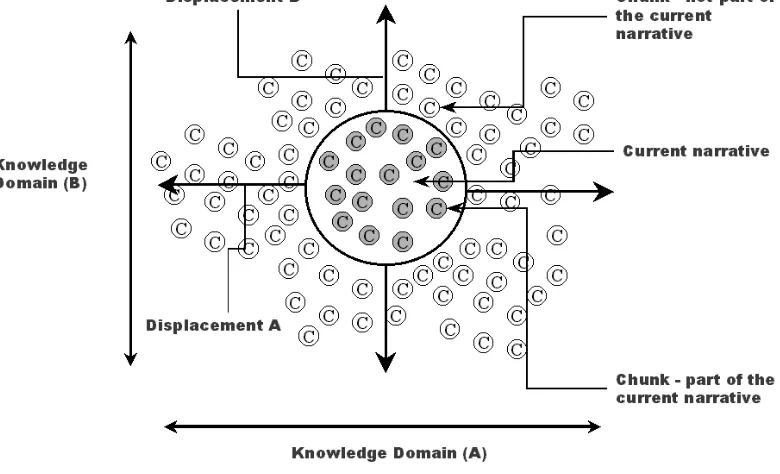
An alternative approach to user-controlled adaptation is what we have called narrative displacement, which we are currently testing in an experimental WHURLE adaptation filter. The narrative in WHURLE may be thought of as the users path through the virtual docuverse. In the early implementations of adaptation, this was the users only view of the content. In the “narrative displacement” adaptation filter the narrative may be envisaged as a restricted view of the melange (see Fig. 2). The user is provided with a graphical representation of their position within the melange with each domain being represented as a sliding dimension that they can adjust if they so wish. For example, a student who finds the mathematical requirements of some material too demanding could turn down the level of difficulty of the maths. This would have the effect of displacing the view over the melange, and thus changing their own personal narrative experience. The user profile does not need to be permanently modified by such actions, although the user model could take them into account if that was felt to be desirable.
IV. CONCLUSIONS
There is little doubt that techniques of adaptive hypertext have great potential to reign in the confusion that can be all too easily generated by large quantities of inappropriate material on the web. We believe that the content-based model of adaptation that we have implemented in WHURLE is potentially valuable. However, one of its most important features – its transparency to users – is also potentially dangerous. An entirely machine controlled mechanism of adaptation, with no possibility of user intervention, would be of questionable educational value. We believe that narrative displacement under user control will provide a compromise solution to this problem.
ENDNOTES
1. WHURLE is a collaborative project, and the software is available under the GPL licence. Further information is available at: http://whurle.sourceforge.net/.
2. Cocoon XML publishing framework – an open source system for server-side XML publishing, available from: http://xml.apache.org/cocoon/.
[image:4.612.125.515.12.249.2]3. MySQL – a relational database available from: http://www.mysql.com/.
ACKNOWLEDGMENT
We should like to thank Peter Murray-Rust, Peter Davies, Ban Seng Choo and members of the University of Nottingham Web Technology Group for many useful discussions. We are also grateful to the Virtual School of Biodiversity in the Universities of Nottingham and Hong Kong for their support during development and user trials.
REFERENCES
[1] P. Brusilovsky, “Adaptive hypermedia: From intelligent tutoring systems to Web-based education,” in: “Intelligent Tutoring Systems,” G. Gauthier, C. Frasson and K. VanLehn Eds. Lecture Notes in Computer Science, 1839, [Proceedings of 5th International Conference on Intelligent Tutoring Systems,ITS 2000, Montreal, Canada, June 19-23, 2000] Berlin: Springer Verlag, pp. 1-7, 2000.
Available via: http://www2.sis.pitt.edu/~peterb/papers/ITS00inv.html. [2] G. Hutchings, G. W. Hall, J. Briggs, N. Hammond, M.R. Kibby, C.
McKnight, and D. Riley, “Authoring and Evaluation of Hypermedia for Education,”. Computers and Education, vol 18, pp. 171-177, 1992. [3] K. Valley, “Learning styles and courseware design,” Association for
Learning Technology Journal, vol 5 (2), pp 42-51, 1997.
[4] M. Quentin-Baxter, “Quantitative evidence for differences between learners making use of passive hypermedia learning environments,”
ACM
Computing Surveys, 31(4), 1999. Available via:
http://www.cs.brown.edu/memex/ACM_HypertextTestbed/papers/52.ht ml
[5] P. Brusilovsky, “Adaptive Educational Systems on the World-Wide-Web: A Review of Available Technology”. Proceedings of Workshop "WWW-Based Tutoring" at 4th International Conference on Intelligent Tutoring Systems (ITS'98), San Antonio, TX, August 16-19, 1998. Available via: http://manic.cs.umass.edu/~stern/webits/itsworkshop/brusilovsky.html [6] T. J. Brailsford, A. Moore, C. D. Stewart, M. R. Zakaria, B. S. Choo, and
P. M. C. Davies, “Towards a framework for effective web-based distributed learning,” Tenth International World Wide Web Conference, May 1-5, 2001, Hong Kong. Poster Proceedings pp 120-121. 2001. Available via: http://www10.org/cdrom/posters/1124.pdf
[7] T. J. Brailsford, C. D. Stewart, M. R. Zakaria and A. Moore, “Autonavigation, Links and Narrative in an Adaptive Web-Based Integrated Learning Environment,” Eleventh International World Wide Web Conference, May 7-11, 2002, Honolulu, Hawaii. 2002. Available via: http://www2002.org/CDROM/alternate/738/
[8] A. Moore, T. J. Brailsford, and C. D. Stewart, “Personally tailored teaching in WHURLE using conditional transclusion,” Proceedings of the Twelfth ACM Conference on Hypertext and Hypermedia, August 14-18, 2001, Denmark. pp 163-164, 2001. Available via:
http://whurle.sourceforge.net/whurle-ht01-short-paper-final.pdf [9] T. H. Nelson. “The Heart of Connection: hypermedia unified by
transclusion”. Communications of the ACM, 38(8) pp 13-33, 1995. [10] M. R. Zakaria, A. Moore, H. Ashman, C. D. Stewart, and T. J.
Brailsford, “The Hybrid Model for Adaptive Educational Hypermedia,” Second International Conference on Adaptive Hypermedia and Adaptive Web Based Systems, May 29-31, 2002, Malaga. Poster.
[11] B. Carr, and I. Goldstein, “Overlays, a theory of modelling for computer aided instruction,” MIT AI Laboratory, AI Memo 406, MIT, Cambridge, MA. 1977.
[12] J. Eklund, P. Brusilovsky and E. Schwarz, “Adaptive Textbooks on the World Wide Web,” Third Australian WWW conference, Lismore NSW. 5-9 July 1997. Available via:
http://ausweb.scu.edu.au/proceedings/eklund/paper.html
[13] P. De Bra, ”Teaching hypertext and Hypermedia Through the Web”,
Journal of Universal Computer Science, vol 2 (12) pp 797-804. 1996. Available via: http://wwwis.win.tue.nl/~debra/webnet96/
[14] P. Brusilovsky, J. Eklund, and E. Schwarz, “A tool for Developing Adaptive electronic Textbooks on the WWW”. Proceedings of WebNet'96 - World Conference of the Web Society, San Francisco, CA, AACE. pp.
64-69, 1996. Available via: