The effect of increasing Learner Autonomy in engineering
laboratories for Foundation Year students
VERNON-PARRY, Karen <http://orcid.org/0000-0002-5844-9017> and JOSE, Asweni
Available from Sheffield Hallam University Research Archive (SHURA) at:
http://shura.shu.ac.uk/16974/
This document is the author deposited version. You are advised to consult the publisher's version if you wish to cite from it.
Published version
VERNON-PARRY, Karen and JOSE, Asweni (2017). The effect of increasing Learner Autonomy in engineering laboratories for Foundation Year students. In:
QUADRADO, Jose Carlos, BERNARDINO, Jorge and ROCHA, Joao, (eds.) SEFI Annual Conference Proceedings 18-21 September 2017, Azores, Portugal.
European Society for Engineering Education, 1378-1384.
Copyright and re-use policy
See http://shura.shu.ac.uk/information.html
Sheffield Hallam University Research Archive
The effect of increasing Learner Autonomy in engineering
laboratories for Foundation Year students
K.D. Vernon-Parry1
Deputy Head of Department of Engineering and Mathematics Sheffield Hallam University
Sheffield, UK
E-mail: [email protected]
A. Jose
Student
Sheffield Hallam University Sheffield, UK
E-mail: [email protected])
ABSTRACT
This paper reports an improvement in depth of understanding and student engagement observed when autonomy in experimental design is introduced in mechanics labs compared with didactic labs. This improvement was seen both quantitatively (from short tests at the beginning and end of each lab) and reported in interviews with both students and teaching staff. This effect was noticed within a single 2-hour lab session for students on a foundation year in engineering. Self-generated identity codes were used to enable longitudinal tracking while preserving anonymity; this approach enabled quantitative data from nearly 100 students to be collected. Semi-structured interviews with 16 students and two lecturers provided qualitative feedback on the lab experience in both autonomous and didactic labs. In addition, we used the results of the quantitative data to study the effect of scheduling labs before or after the relevant theory had been covered in lectures; unsurprisingly, students undertaking the labs after the lecture were found to have a better understanding of the topic.
Conference Key Areas: Engineering Education Research, Curriculum Development, Attractiveness of Engineering Education
Keywords: Learner Autonomy, Laboratory Design, Student Engagement
INTRODUCTION
45 SEFI Conference, 18-21 September 2017, Azores, Portugal
the enquiry-based laboratories described in the literature are designed to be planned in one session and then performed and analysed in a few more. This obviously limits the number of experiments that can be undertaken each semester, We wished to see if some of the benefits of this approach could be achieved within a single lab session, through the introduction of limited amounts of autonomy in experimental design, while keeping the range of topics covered as large as possible.
This paper reports the results of a practice-based evaluation of the effect of introducing varying degrees of autonomy in laboratory design in the second semester of a foundation year programme in engineering. Such programmes have been running in the United Kingdom for over 30 years, and offer an opportunity for students with a wide range of non-standard entry qualifications to acquire the necessary level of mathematical and physics knowledge to progress successfully onto an engineering undergraduate degree. They are a key strand of the Widening Participation agenda, and attract students with wide-ranging amounts of prior knowledge and ability. In the foundation year programme reported here, there is an Engineering Investigations module that contains 12 two-hour mechanical engineering laboratories, six undertaken in the first semester of study, and six in the second semester. Students undertake these laboratories working in groups of 2-4 with each lab session having up to 6 different experiments running simultaneously supported by two academics.
A small-scale study in 2015-2016 on the effect of time gap between a topic being introduced in lectures and reinforced in laboratory experiments suggested that the optimum time to schedule the laboratory is two weeks after the relevant lecture. [5]. In that study, a few more able students reported that the traditional lab experience, following very prescriptive instructions, did not encourage them to think deeply about what they were doing.
Accordingly, it was decided to explore the effect of giving some freedom in experimental methodology. The didactic lab sheets in the first semester were retained for two reasons: to enable students to make a comparison between the two approaches, and to reduce the possibility of students becoming overwhelmed by the many changes they experience during the transition to university life and study. In the second semester, varied degrees of autonomy in methodology (given constraints of equipment and time) were incorporated into the experiments.
Autonomy enables students to learn to make their own viable decisions [6] as well as developing graduates with independent mindsets and resilience, two key skills required of professional engineers. As this cohort of students were at the start of their university studies, and taking the findings of Wielenga-Meijer et al [7] into account, only partial autonomy was introduced in the second semester. The intention was that some of the motivational aspects involved with the concept of autonomy, such as the perception of control, competence and confidence in their academic capacity [8] would be experienced by the students.
1 METHODOLOGY
anonymity and enable longitudinal studies at a later date. For this set of 100 students (49 in semester 1 and 51 in semester 2), four questions generating an 8 character alphanumeric SGID code were found to be sufficient for unique codes to be generated for all participants.
1.1 Quantitative evaluation
For each of the 12 laboratories, six multiple choice questions (MCQ) were devised to test student understanding. Three questions were undertaken at the beginning of the laboratory, and three at the end. Each test was designed to take no more than 5 minutes within the 2 hour laboratory session. Each test was structured to give one easy, one medium and one searching question, and the “before” tests were deliberately made easier than the “after” tests so as not to discourage students before they undertook the laboratory. No students were given the answers to the tests, nor informed how well they had done. Statistical analysis was undertaken only
on results when a student had taken both the “before” and the “after” MCQ tests.
1.2 Qualitative evaluation
Semi-structured interviews were held with a total of 16 students after they had completed all 12 laboratories. Both lecturers teaching on the laboratories were also interviewed for their observations on how effectively students engaged with the experiments.
1.3 Introducing autonomy to the semester 2 laboratories
Each laboratory in the second semester was reviewed to identify how to introduce some autonomy without significantly re-designing the experiments and the apparatus. For some experiments, it was difficult to give much freedom in design in a 2 hour laboratory (for example, in an experiment to determine the specific heat capacity of aluminium, copper and lead, the metal specimens were already made, and the only readily variable parameter was the amount of water placed in the calorimeter). For other experiments, students could select apparatus from a range given, decide which (and how many) readings to take, and determine a suitable method of data analysis.
Five of the laboratories each semester were marked in session, and for these, the mark scheme in semester 2 was adjusted to include marks for experimental design. In addition, the students were required to complete an error table listing possible sources of error, the nature of the error (systematic or random) and the effect of the error on the accuracy and/or precision of the result of the experiment.
The other two laboratories are written up as full reports, one each semester. Again, the mark scheme for the report in semester 2 included marks for experimental design and detailed error analysis.
2 RESULTS AND DISCUSSION
2.1 Statistical Analysis
45 SEFI Conference, 18-21 September 2017, Azores, Portugal
[image:5.595.57.494.321.681.2]The average results of the tests taken in each semester are given in Table 1. On average, students scored higher in the “after” tests in semester 2, and showed a greater improvement in understanding of the topic.
Table 1. Average value of test scores in each semester
Average of “after” scores Difference score Average of
Semester 1
(labs 1-6) 1.98 0.507
Semester 2
(labs 7-12) 2.21 0.342
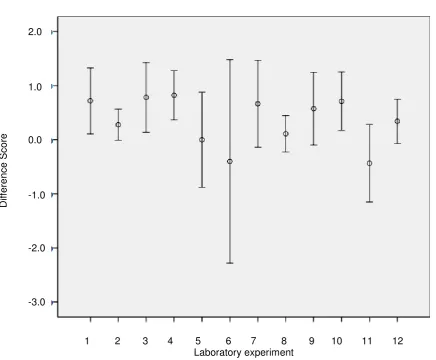
Fig. 1. Graph showing Difference score for each lab. The circle represents the mean score with the 95% confidence interval shown as a bar.
The individual results for each lab are plotted in Fig.1. Given that the “after” questions were deliberately more challenging, a Difference score of 0 still represents a greater depth of understanding after the laboratory. Task 6 in semester 1 was the only one undertaken before the relevant theory had been covered in lectures, and the students
2.0
1.0
0.0
-1.0
-2.0
-3.0
Di
ffe
re
nc
e
S
c
ore
had little/no understanding of the topic before doing the lab. Therefore it is not surprising that students demonstrated an increase in understanding of the topic, albeit with a large 95% confidence interval. Of the labs undertaken in semester 2, lab 7 had the least degree of autonomy and lab 11 the greatest. The results suggest that increasing the amount of autonomy has increased the depth of student learning during the lab.
To confirm the previous findings of the impact of timing of lab and lecture, the date of each test was recorded and compared to the date the relevant theory was covered in a lecture. In order to obtain significant numbers of tests, the time interval was set either as Lab First (this included data where the lab and the lecture occurred in the same week) or as Lecture First. The results of the linear mixed models analysis confirms that students scored on average 1.06 marks higher in their tests (but not the Difference) for Lecture First.
2.2 Semi-structured Interviews
In total, 16 students completed short semi-structured interviews. Of these, 12 students preferred the style of the semester 2 labs.
I felt more challenged and engaged by semester 2” [student A]
“I learned from it, rather than just copying it down from the sheet” [student B]
“... prefer semester 2 more because it makes you think more and makes you learn”
[student C]
“Semester 2 makes you more independent and makes you think more” [student D]
These responses confirm that the introduction of autonomy enhances students independent thought and their understanding of the theoretical knowledge, as reported by Deci et al. [8]
The design and justification of their experimental methodology in semester 2 required students to read the lab sheet thoroughly before starting the experiment. In semester 1, it was possible to complete the lab with only limited understanding of the underlying theory. This was noticed by some of the students: “In semester 2 (I)
couldn’t have started without reading the full lab sheet...in semester 1 no deep
understanding was there and made you more prone to mistakes” [student D] and “(I)
learned to read the lab sheets beforehand” [student E].
Comments from the 3 students who preferred the didactic labs in semester 1 included:
“You are worrying more about the experiment rather than learning...I prefer to take in
the results and theory better after the experiment [student F] and
“You have to think more” [student G].
These comments confirm the findings of Fakayode [4], where the students with a more negative view of increased autonomy did so because of the increased demands on the students' time and intellectual resources.
Students with a positive view of the labs in semester 2 reported increased self-confidence and felt ready to move on to undergraduate study.
When asked about the use of SGID codes, 14 of the 16 students said that they “felt
more comfortable” attempting the MCQs without revealing their identity. Only two
students said they were happy to reveal their identity.
45 SEFI Conference, 18-21 September 2017, Azores, Portugal
“Strong students are being pushed to think at a deeper level (in semester 2), which
before they didn’t really do” and “Students are having more collaboration with their
group members”. However, some of the students managed to stay only minimally
engaged throughout the entire module and as one lecturer noted, “It (autonomy) is
not a panacea.”
3 CONCLUSIONS AND FURTHER WORK
The structured introduction of autonomy in engineering labs has been shown to increase depth of learning, with the majority of students rising to the challenge. Students reported feeling more prepared for their undergraduate degree studies. Those students who preferred the didactic lab sheets in semester 1 tended to do so because those labs were perceived as less demanding.
The confirmation that it is beneficial for students to have studied the theoretical basis of the experiment at least one week before the lab has implications for timetabling. For the Engineering Investigations module, it is not possible to achieve this, given constraints on equipment availability, cohort size and the academic calendar.
The results have been sufficiently encouraging that the labs will stay in this format for the next academic year, and the results for the 2017-18 cohort will be compared to the findings from 2016-17.
To fully evaluate the effect of “lab before lecture” versus “lab after lecture”, next year
we will determine students’ understanding of each topic at the end of the semester as
well as at the end of the lab. In addition, short videos of relevant theory and self-assessment questions will be developed for two tasks where the majority of the students will not have had the lecture first. These resources will be deployed on the virtual learning environment; engagement with the resources will be monitored and the effect of the additional resource on the efficacy of the labs in developing
understanding of the topic will be studied.
REFERENCES
[1] T. Silva and E. Galembeck, “Developing and Supporting Students' Autonomy to Plan, Perform and Interpret Inquiry-Based Biochemistry Experiments,” Journal of Chemical Education, pp. 52-60, 2016.
[2] D. Rodenbaugh, C. Failing, E. Fuentes, A. Wagner and B. Yard, “Having Students Design and Develop Laboratory Exercises Improves Student Learning Outcomes in Undergraduate Physiology,” The FASEB Journal, vol. 21, p. 478.21, 2007. [3] T. Lord and T. Orkwiszewski, “Moving from Didactic to Inquiry-Based Instruction in
a Science Laboratory,” The American Biology Teacher, vol. 68, no. 6, pp. 342-345, 2006.
[4] S. Fakayode, “Guided-inquiry laboratory experiments in the analytical chemistry laboratory curriculum,” Analytical and Bioanalytical Chemistry, vol. 406, no. 5, pp. 1267-71, 2014.
[5] J. Goodwin-Jones, K. Vernon-Parry and A. Nortcliffe, “What does good
engineering pedagogy look like?,” in 44th SEFI, Tampere, 2016.
[6] M. Warnock, “Higher Education: The concept of autonomy,” Oxford Review of Education, vol. 18, pp. 119-24, 1992.
of Autonomy When Learning a Task: an Experimental Approach,” The Journal of Social Psychology, vol. 151, no. 3, pp. 292-313, 2011.
[8] E. Deci, R. Vallerand, L. Pelletier and R. Ryan, “Motivation and Education: The
Self-Determination Perspective,” Educational Psychologist, vol. 26, no. 3, pp.
325-346, 1991.
[9] A. Garvey Wilson, C. Hoge, D. McGurk, J. Thomas, J. Clark and C. Castro, “Application of a New Method for Linking Anonymous Survey Data in a Poulation of Soldiers Returning from Iraq.,” Annals of Epidemiology, vol. 20, no. 12, pp. 931-938, 2009.