Workforce participation : learning from the co-operative
sector
DE NORMANVILLE, Clare, WREN, David and RIDLEY-DUFF, Rory <http://orcid.org/0000-0002-5560-6312>
Available from Sheffield Hallam University Research Archive (SHURA) at: http://shura.shu.ac.uk/10104/
This document is the author deposited version. You are advised to consult the publisher's version if you wish to cite from it.
Published version
DE NORMANVILLE, Clare, WREN, David and RIDLEY-DUFF, Rory (2015). Workforce participation : learning from the co-operative sector. In: 5th EMES International Research Conference on Social Enterprise, Helsinki, June 30th - 3rd July. (In Press)
Copyright and re-use policy
See http://shura.shu.ac.uk/information.html
Workforce participation: learning from the
co-operative sector
Paper to EMES Research Conference, Governance of social enterprises Stream
Helsinki, June 30th – 3rd July 2015
Clare de Normanville, Faculty of Health and Well-Being, Sheffield Hallam University, Principal Lecturer in Nursing and Midwifery
David Wren, Sheffield Business School, Sheffield Hallam University PhD Candidate
Rory Ridley-Duff, Sheffield Business School, Sheffield Hallam University, Reader in Co-operative and Social Enterprise
Abstract
This paper builds on a theoretical framework developed by Ridley-Duff and Ponton (2013) to advance research on workforce participation in the social economy. We extend their framework, then test its efficacy through a discussion of governance at the Mondragon Co-operative
Corporation (MCC) and John Lewis Partnership (JLP). Our thinking is influenced by Arnstein (1969), Pateman (1970), Hyman and Mason (1995), Harley, Hyman and Thompson (2005) and Gaventa (2006). Using Gaventa’s work on ‘spaces’, we offer a new composite framework to generate insights into the social practices at MCC (in Spain) and JLP (in the UK). We conclude by theorising that the ‘visible’ power of an enabling constitution combined with the ‘invisible’ power of social economy’s normative values and principles can reshape managerial identities. It does this by reinforcing the rights of worker-members to continually (re)claim the spaces in which workplace democracy occurs, and to use it to reverse the hiring relationship between capital and labour.
Introduction
In this paper, we consider staff participation in decision-making by asking the question “what can be learnt about workforce participation through a comparison of the governance systems of the Mondragon coops and John Lewis Partnership?” As authors, we have professional and academic interests in the role of discursive democracy in the development of inclusive governance systems. Moreover, there has been particular interest by the UK Government in “mutual” organisations to deliver services traditionally under the purview of public sector bodies (The Cabinet Office, 2014). It is, therefore, timely to review the way contributions to the field of co-operative studies can inform efforts to democratise organisations and practice inclusive governance across an expanding social economy.
To facilitate this review, we outline the literature on the governance of the Mondragon Co-operative Corporation and John Lewis Partnership (hereafter referred to as MCC and JLP
respectively) to gain a theoretical understanding of key issues. MCC is constituted under Spanish Co-operative Law (Whyte & Whyte, 1991). JLP - while not satisfying UK legal definitions for a
bone fide co-operative – is widely recognised as one (Cathcart, 2009). It is second in the list of the UK’s 100 largest co-operatives (Co-operatives UK, 2013), and 34th in the International Cooperative Alliance’s list of the largest 300 cooperatives in the world1. Both organisations make corporate commitments to education as a means of sharing power and facilitating cooperative cultures (Lewis, 1954; Cheney, 2002; JLP, 2013; Heras-Saizarbitoria, 2014). There are a sufficient number of
studies of them both to test a theory of workforce participation that we build in this paper.
The paper is divided into four sections. In the first section, we navigate the debate about the impact of governance structures, processes and relationships on the distributions of power. We problematize assumptions about the link between participation, decision-making and democracy on the basis that it matters which interest group creates, controls and manages the spaces in which participation takes place. In the second section, we set out the context for governance at MCC and JLP, then apply our framework to develop insights into their governance systems. In the third section, we turn our attention to the way that the framework and reported practices at MCC and JLP can inform the field of governance in the wider social economy. In the final section, we summarise the paper and consider how an enabling constitution combined with normative values and principles can act to reshape managerial identities and bring about changes in the relationships between
managers, capital and labour.
1 As reported on 4th February 2014 by Co-operative News -
Governance Structures, Power and Participation
Kim (2008) defines governance as:
“...a process of strategic institutional-decision-making, and the authority to determine whom they involve and how and to whom they render account.”
(Kim, 2008, p. 33 emphasis added)
Thus governance structures determine the sources of power (‘authority’) to participate (‘whom they involve and how’) in determining systems of management. Lukes (2005) advances a theory in which there are three domains of power. The first is represented through observable expressions of power: the institutions and arrangements through which debate takes place in which parties are formally admitted and able to participate. This, however, ignores a hidden manifestation of power that looks beyond the assumptions of behaviourist theory. The second level of power is rooted in the agenda setting powers that each party in an institution can bring to bear. Lukes argues that the party identified as responsible for management can exert greater power over agendas and use this power to shape the topics that get discussed. Thirdly, Lukes argues that this capacity to manipulate agendas can be extended to communication systems and media. Active management of communication systems and media outlets enables a controlling elite to silence opposition to its ideas, and secure hegemonic control by ‘manufacturing consent’ (Gramsci, 1971; Chomsky & Herman, 1988).
Through these techniques, a population can be socialised into accepting the political agendas of those who have acquired management control, and can lose opportunities to engage in critical debate regarding their basis. Lukes theorises this as invisible power on the basis that affected parties may be oblivious to the process by which they came to accept the discourse of ‘others’. Where there is management control over channels of communication, and this is used to prevent access to
alternative bodies of knowledge, members of a workforce become unaware that their subjectivity is being manipulated (Townley, 1994).
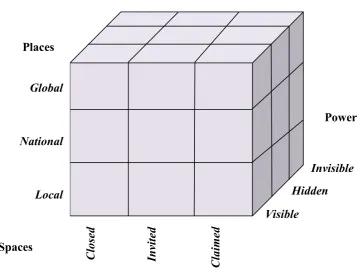
Lukes’ dimensions have been adapted by VeneKlasen and Miller as:
Visible Power: the power to influence / participate in decision-making Hidden Power: the power to set (political) agendas
Invisible Power: the power to shape meaning and what is acceptable
(VeneKlasen & Miller, 2002; Gaventa, 2006, p. 29)
Global
National
Local
Spaces
C
losed
In
vit
ed
C
lai
med
Invisible
Hidden
Visible
Power Places
[image:5.595.106.471.124.397.2]that participatory practices can change across an organisation depending on who has power over a given space.
Figure 1: The Power Cube (Gaventa, 2006)
The depth of participation in a given space is dependent on the way power is exercised by those who have created them. Gaventa (2006) identified 3 types of space, namely ‘closed’, ‘invited’ and ‘claimed’. Closed spaces are where discussion and decision making is limited to an ‘elite’, and participation by the wider workforce does not happen, nor is it felt necessary. Power (visible, hidden and invisible) can all be exercised in each space. This is also the case with invited spaces
where the capacity to participate is conditional on the power needs of an ‘elite’. As
Marchington (2005) argues, many ‘participation schemes’ are initiated and sponsored by managers to limit the likelihood that a similar space will be claimed and created by the workforce. This sponsorship (and political support) lasts only as long as it serves management needs and is frequently withdrawn when business conditions change. Claimed spaces are created by the workforce either independently or in collaboration with identified holders of power. Cornwall (2004) contends that power in these spaces is contested.
In the field of workplace democracy, however, it is Pateman’s (1970) work that is more widely cited. We choose this as our starting point for developing a new theory. She identified three levels of participation: ‘Pseudo’ where participation is effectively limited to endorsement of management ideas and plans; ‘Partial’ where the workforce can influence decisions but have no power to negotiate outcomes; and ‘Full’ where workers collectively have power to both influence and bargain about policy goals and outcomes (Pateman, 1970). Knudsen, Busck and Lind (2011) contend though that pseudo participation is difficult to identify in practice as the initiation of
consultation by a management group seeking endorsement of its ideas for can have the side effect of empowering workers to secure participation that goes beyond the original intentions of managers.
Hyman & Mason (1995) offer an alternate trio that is well aligned with Pateman’s conceptualisation. Employee Involvement (EI) takes place when employee participation is
managerially controlled and task based. It is viewed as an integrative unitary approach where both workers and managers share a common core purpose for the business. It is now commonly
associated with managerial rhetoric on performance management (Willmott, 1993; Grey, 1995; Johnson, 2006) and has matured into the field of employee engagement in management texts and government agendas (MacLeod & Clarke, 2009). Employee Participation (EP) is defined by Hyman & Mason (1995) as collective representation either through state sponsored interventions or the result of workers’ own initiatives. In this case, the integrity of management hierarchies is partially broken, but the workforce cannot collectively overrule management proposals (only negotiate their content). Industrial Democracy (ID) includes cooperatives and organisations with democratic and participative structures. In this case, decision making at different levels of the organisation is undertaken by (and/or is accountable to) members-owners (Cornforth, et al., 1988; Ellerman, 1990; Turnbull, 2001; 2002). In an industrial democracy, managers are framed as subservient to the workforce (the owners), and constitutional arrangements ensure that the workforce can collectively exercise their power to remove managers who do not act in their
interests (JLP, 2015). The choice of ‘democracy’ as opposed to ‘participation’ at this level reflects Robbins (1972) contention that there is a need to recognise the conceptual difference between participation initiated from the top by management, and bottom up initiatives by the workforce (Ellerman, 1990; Birchall, 2012; Ridley-Duff, 2012).
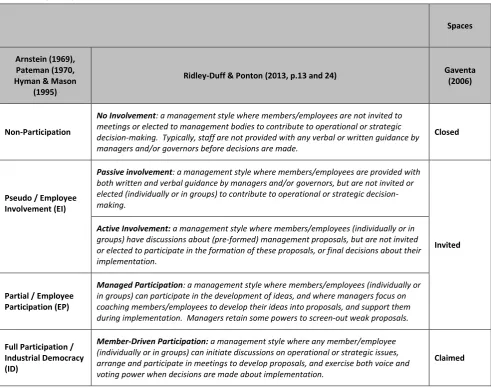
Ridley-Duff and Ponton, (2013) offer a more nuanced typology that builds on Hyman and Mason (1995) and Hollingshead, Nicholls and Tailby (2003), and reintroduces the realm of ‘non-participation’ (no involvement) identified by Arnstein (1969). The typology describes management styles associated with different ‘depths’ of participation. In Table 1, we offer a composite
democracy (on the basis that these have been ‘claimed’ by workforce members and can be modified at their behest). Ridley-Duff and Ponton's typology differs from preceding typologies in two other ways. Firstly, it identifies a category of No Involvement by recognising that in some workplaces new recruits have to ‘muddle through’ by asking colleagues how things are done. In this culture, there is minimal or no instruction by a management group. Secondly, they offer a more cautious view on the links between participation and democracy by commenting that:
[image:7.595.52.544.288.676.2]"…the relationship between ‘democracy’ and ‘participation’ is a complex one, and it is not automatically the case that increases in the scope, depth, level and forms of participation lead to industrial democracy (Harley et al., 2005)"
Table 1: Mapping of Typologies and Spaces against the ‘depths’ proposed by Ridley-Duff and Ponton (2013).
Spaces
Arnstein (1969), Pateman (1970, Hyman & Mason
(1995)
Ridley-Duff & Ponton (2013, p.13 and 24) Gaventa
(2006)
Non-Participation
No Involvement: a management style where members/employees are not invited to meetings or elected to management bodies to contribute to operational or strategic decision-making. Typically, staff are not provided with any verbal or written guidance by managers and/or governors before decisions are made.
Closed
Pseudo / Employee Involvement (EI)
Passive involvement: a managementstyle where members/employees are provided with both written and verbal guidance by managers and/or governors, but are not invited or elected (individually or in groups) to contribute to operational or strategic decision-making.
Invited
Active Involvement: a management style where members/employees (individually or in groups) have discussions about (pre-formed) management proposals, but are not invited or elected to participate in the formation of these proposals, or final decisions about their implementation.
Partial / Employee Participation (EP)
Managed Participation: a management style where members/employees (individually or in groups) can participate in the development of ideas, and where managers focus on coaching members/employees to develop their ideas into proposals, and support them during implementation. Managers retain some powers to screen-out weak proposals.
Full Participation / Industrial Democracy (ID)
Member-Driven Participation: a management style where any member/employee (individually or in groups) can initiate discussions on operational or strategic issues, arrange and participate in meetings to develop proposals, and exercise both voice and voting power when decisions are made about implementation.
Claimed
It matters who creates and claims the spaces, and who sets the terms for participation in a given space. For Ridley-Duff and Ponton, there is a further aspect of participation that is rarely acknowledged and discussed. In a cooperative, a closed or invited space might itself be a response to a decision taken by members: it can be a management space created as a by-product of
which it invites management. The power to create and invite ‘others’ into a space can be defined in a constitution (or Articles of Association) which is itself subject to change only under conditions of participatory democracy. Interestingly, Ridley-Duff and Ponton view the right of the governed to
exclude themselves from decision-making spaces of their choosing (and their capacity to delegate responsibility to a person or body that remains under their control) as a more sophisticated approach to workplace democracy that is compatible with a desire for operational efficiency and
effectiveness:
"The label ‘democratic participation’ to describe depth 5 is not defensible. A more fitting label is ‘member-driven participation’ in that the power to participate belongs to the member and is not ‘managed’ by others…democratic management is understood as the propensity and capacity of management systems to respond to workforce members’ desires
regarding the scope, depth, level and quality of their participation in management."
(Ridley-Duff & Ponton, 2013, pp. 23, emphasis in the original)
To summarise, we have set out a framework (Table 1) that will guide our exploration of the complexities of workforce participation in our two case studies. We have focussed our attention on different theorisations of the ‘levels’ and ‘depths’ of participation to argue that the relationship between managers and managed can be subject to a constitution that defines the powers of a management group and wider workforce to create spaces into which they invite each other for various management discussions and decision-making processes. Wherever this power is available to multiple interest groups, ‘management’ is just one of several groups capable of exercising management control. It is no longer the preserve of self-appointed elites and it potentially
transforms the enterprise governance system from one that protects the narrow interests of finance capital to one that protects the wider interests of member-owners (Birchall, 2012).
A Note on Methodology
time over 2.5 days (4th – 6th March 2003), provided opportunities to discuss four cooperatives with nine different people. In the evenings he recorded more than 2 hours of audio diary commentary, transcribed a further 2.5 hrs of recordings from meetings and made 28 pages of notes and
reflections on meetings with three other people on the same field trip. While this paper does not depend on (and is not derived from an analysis of) these author’s field work experiences, it puts the research team as a whole in a much stronger position to interpret claims in academic studies, company documents and third-party accounts of life inside the case study organisations.
The Contexts for Governance at MCC and JLP
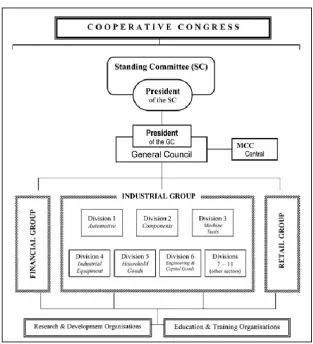
The corporate structures of MCC (see Figure 2) and JLP (see Figure 3) share similarities in that they are both independent, self-governing organisations that represent federations of interests
(Forcadell, 2005; Cathcart, 2013). The governing bodies at the apex of both institutions are tripartite structures protected by constitutions that set out power sharing arrangements and commitments to social, economic and environmental goals.
The institutions that underpin governance in the MCC started in 1941 with the formation of a technical school in the Basque region of Spain (Ridley-Duff & Bull, 2015). In the late 1950s, graduates of the school started an industrial enterprise that led to the formation of a community bank (Caja Laborale), research and development body (Ikerlan), social insurance scheme (Lagun-Aro). By 1980, over 80 cooperative enterprises had been supported by over 300,000 people through the community bank (The Mondragon Experiment, 1980). By the year 2000, 85 per cent of citizens in the town of Mondragon had a direct or indirect interest in one or more cooperatives (Long Island University, 2000).
Figure 2: MCC Corporate Governance Structure (Freundlich, et al., 2009)
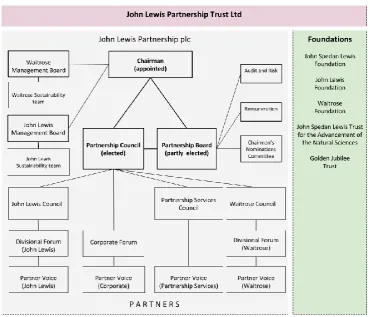
There is a similar tripartite structure at JLP, but this time centred on the powers of the Chairman (sic), a Partnership Council and Partnership Board. This structure was devised by John Spedan Lewis who inherited his father’s private firm (established 1864) in 1928. From 1914 he had been using a single branch to try out his “experiment in industrial democracy”. He transformed it from loss making to profitable, improved working conditions, initiated profit sharing (“the partnership benefit”), then introduced communication between the rank and file and management via “committees for communication” and weekly newsletters. Partly in response to his unease at receiving a third share in £26000 whilst the 300 employees received £16000 between them (worth £2m and £1.2m when adjusted for inflation (Erdal, 2011)), he created two irrevocable settlements in 1929 and 1950 through which he handed ownership in its entirety to a body that manages it for the benefit of all ‘partners’ (i.e. the workforce). Protected by statutory law, this can never be sold off (Lewis, 1948; 1954). JLP now employs over 90,000 partners with a turnover in excess of £10bn. In 2014 every partner received 15% of their salary as the partnership benefit (JLP, 2014).
advance social goals (Erdal, 2011; JLP, 2013; Cathcart, 2009; 2013). The plc is structured to control two retail chains (John Lewis Stores and Waitrose) whereas the trust company maintains the
[image:11.595.112.483.154.471.2]shareholding that benefits partners.
Figure 3 – John Lewis Partnership Corporate Structure
Interpretation of Cathcart (2009; 2013) and JLP (2013; 2014)
On paper, both MCC’s and JLP’s governing arrangements place (elected) leaders in a servant role, channelling their efforts to the benefit of members’ individual and collective needs. In 2003, MCC formalised a management model based on "the individual and their satisfaction, with the aim of achieving total quality" (Ridley-Duff, 2010, p. 130). This echoes Principle 1 in the constitution of JLP which states that its "ultimate purpose is the happiness of all its members, through their worthwhile and satisfying employment in a successful business" (JLP, 2013, p. 7).
By writing such principles into the constitutions of both organisations, it commits those in the governing bodies to operate for wider stakeholder benefit (including the community). By constituting under Co-operative Law, MCC must invest 10% of surplus in education and social projects. JLP is not under a statutory duty, but includes commitments to customers and the
Both JLPs principles and the Corporate Model at MCC represent a substantial departure from private sector norms in which senior managers are the agents of external investors and use control rights linked to shareholders’ capital investments to institute management practices that increase the value of shareholders’ capital (Erdal, 2011). The commitment to workplace democracy is expressed in MCC’s second principle which makes admission conditional on accepting "the basic equality of worker-members in terms of their rights to be, possess and know, which implies
acceptance of a democratically organised company" (MCC, 2014). This is similar to JLPs
constitutional commitment based on John Spedan Lewis's commitment to an "industrial democracy where employees share knowledge, power and profit" and to create a culture in which there is "as much equality…as differences of responsibility permit" (JLP, 2013, pp. 3, 7).
Developing Insights into MCC’s and JLP’s Governance Systems
At start-up, all the spaces for participation at MCC were 'claimed' as it operated without an explicit structure for its first 3 years (Whyte & Whyte, 1991; Molina, 2013). In 1959, the constitution was developed by Ulgor’s founders in discussion with Father José Maria Arizmendiarrieta
(‘Arizmendi’) (Whyte & Whyte, 1991). Whether this amounted to a closed space where visible power was being exercised is debatable: the constitution as it evolved was discussed and shaped with the associates who worked on an informal cooperative basis. It is worth noting, however, that invisible power was being exercised, particularly by Arizmendi, based on his studies of Catholic Social Doctrine and Co-operative Principles (Herrera, 2003; Ridley-Duff, 2010). His application of doctrine to the concepts and ideas of other social reformers, most notably Robert Owen and the Rochdale Pioneers (Whyte & Whyte, 1991) resulted in 10 cooperative principles that act as a benign invisible power. Documentary evidence continues to surface that attests to the enduring relevance of these underlying principles (Shift Change, 2013).
Cheney (2002), however, argued that the popularity of managerialist frameworks and
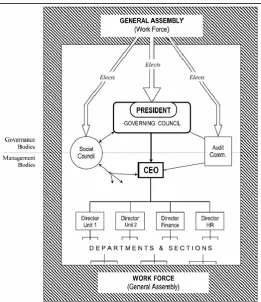
associative democracy discussed by Smith and Teasdale (2012) which provides further checks on managerialist tendencies. Lastly, the Social Council exists to represent worker interests: its
members are elected from departments by members of the General Assembly, and are not appointed by managers (see Figure 4).
The governance of individual cooperatives essentially replicates the structure of the congress (and vice versa). While primary cooperatives have individual members, the MCC
[image:13.595.299.561.237.540.2]Congress has organisational members with voting power proportional to the headcount in individual cooperatives. This prevents any one organisation having undue influence (Freundlich, et al., 2009).
Figure 4 - Governance in Individual
MCC Co-operatives
The MCC cooperatives operationalise the delegation of powers to people within these invited spaces (Forcadell, 2005). Power is made visible in that there is transparency in the decisions and political agendas pursued by their members, and they are continually shaped by the overarching cooperative principles. These governance structures therefore would appear to represent the highest level of democratic participation in all three typologies.
Cooperative members are invited into spaces that were claimed by founding members, where power is made visible and vested in the
workforce.
Cheney (2002) also questions whether the MCC can fully realise an industrial democracy. He contends that management changes, such as the importing of management approaches like TQM at ‘high’ levels within MCC disproportionately affect ‘lower’ levels and change the spaces in which workers deliberate. Cheney (2002) suggests that participation in MCC is more likely to be de jure
rather than de facto and is subject to invisible powers of neo-liberalism and marketization at national and global levels. This invisible power shapes values in organisations and society through the language of the ‘customer’ in MCC lexicon and by changing attitudes amongst workforce members towards consumption in society and political participation.
In addition, associated with marketization a further invisible power has, in recent years, re-emerged. In the wake of current global economic and political uncertainties affecting Spain, “the principle of secure membership and employment” (Heras-Saizarbitoria, 2014, p. 656) has become more important to MCC’s workers. Is insecurity exerting a pressure that leads to ‘degeneration’ of the democratic process (Cornforth, 1995) in which the integrity of democratic control is sacrificed out of a fear of job loss and economic insecurity? Pateman (1970), Cornforth et al. (1988) and Ridley Duff and Ponton (2013) all point to bodies of research that suggest the workforces do not necessarily want to participate in large numbers on governing bodies. Strauss (2006) views
participation pessimistically and considers that even in organisations established to be democratic, participation goes through a natural life-cycle. It could be that MCC is in a phase where atrophy has set in bringing about a
“…rhetoric of abandonment of the cooperative spirit and an abstainer stance…”
(Heras-Saizarbitoria, 2014, pp. 659, emphasis in original)
However this may be countered by MCC’s continued obligations to invest in education (Whyte and Whyte 1991, Cheney 2002), itself an invisible power, shaping attitudes and values underpinned by cooperative principles. Case study research has already shown that ‘degeneration’ is neither automatic nor sustained, and can be reversed through a renaissance in the application of co-operative values (Cornforth, 1995; Wilson, 2011).
If the MCC has suffered during the recent financial crisis, the same cannot be said of JLP which has been uncharacteristically resilient. John Spedan Lewis, the original Chairman, created the governance structure of JLP enshrined in a constitution which he personally oversaw. Initially, therefore, the participation spaces were all invited (Lewis, 1954). This led to the formation of a Trust (in which the majority of Trustees are elected by the Partnership Council) that determines the number of constituencies from which Council members are elected. As a result, spaces are still invited in the sense that they are under the control of the Trust Company, but as elected
ensures they are continually ‘claimed’ (JLP, 2013). Spedan noted the achievements of Robert Owen but claims he did not base any of his thinking on other theorists or practitioners. He pursued his own experiment and was cautious about making claims of ‘success’. He stated that ‘the whole thing has been a gradual, natural growth from practical efforts to solve the problems of one particular business’ (Lewis, 1948, p. IX) and as such it enabled the constitution to be refined as the partners learned about participation.
Currently the Partnership Council has 85 members (66 elected, 15 Partnership Board
members plus 4 other positions). The Council’s power is very visible as any partner can attend their meetings but not vote unless they are a Council member. The Partnership Board includes 5 elected Council members who, along with 3 independent non-executive directors, form the majority. The other 7 members are selected by the Chairman. The Council has a governance role, whereas the Board and Chairman have both governance and management roles (JLP, 2014). The Council retains the ultimate sanction (rule 10) of being able to dismiss the Chairman (via a constitutionally
mandated biannual vote) if s/he is not fulfilling ‘the responsibilities of his (sic) office’ (JLP, 2013, p. 10). Moreover, the Chairman is obligated (rule 45) ‘to accept as fully as possible the
recommendations of the Partnership Council. Before rejecting any he (sic) must consult the
Partnership Board’ (JLP, 2013, p. 18). In an interesting reversal of the normal power relations, it is the workforce (through the Partnership Council’s biannual vote) who continue to invite the
Chairman to participate in management and governance. The Council’s power meets the criteria for ‘managed participation’ of the Chairman (Ridley-Duff & Ponton, 2013).
In Tables 2 and 3 we summarise our interpretation of the findings from these case studies in workforce participation to test our theoretical framework. In the next section, we critically review our interpretation to draw out our learning and outline the implications for theories of participation.
Critical Comparison of Findings
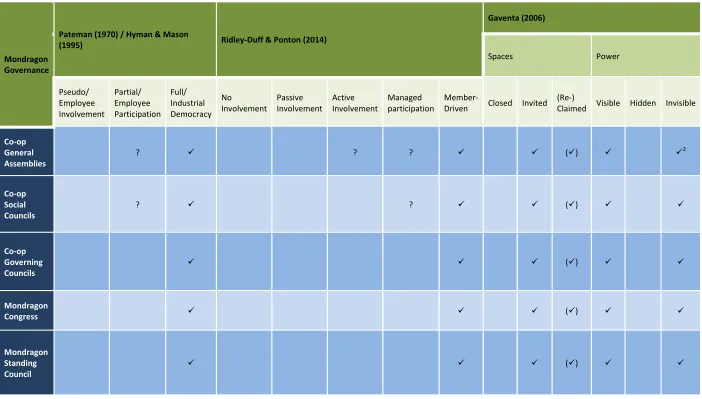
In Tables 2 and 3, we note our findings from both cases. Formally, the MCC (Table 2) is member-driven network of co-operatives, in which power comes from below (in both individual member coops and the Mondragon Congress). This is reflected in the constitutional provisions for member-driven participation in which democratic forums are visible, invited spaces for participatory
decision-making. In light of critical works, however, there is some ambiguity about the actual level of participation, particularly in the General Assembly, and some questions about the relative powers of the social, governing and management councils (Kasmir, 1996; Cheney, 2002;
Heras-Saizarbitoria, 2014). For this reason, we have left question marks (?) to represent opportunities for future research on the operations and role of the General Assembly and whether the social councils are sites of ‘partial participation’ rather than ‘industrial democracy’.
Formally, JLP (Table 3) is more complex, with a constitution that creates a mix of hidden, visible and invisible spaces for the Chairman and Partnership Board alongside visible sites of power to question their authority and hold the Chairman to account (through journals, the power of
Table 2 – Analysis of MCC
Mondragon Governance
Pateman (1970) / Hyman & Mason
(1995) Ridley-Duff & Ponton (2014)
Gaventa (2006)
Spaces Power
Pseudo/ Employee Involvement Partial/ Employee Participation Full/ Industrial Democracy No Involvement Passive Involvement Active Involvement Managed participation
Member-Driven Closed Invited (Re-)
Claimed Visible Hidden Invisible
Co-op General Assemblies
? ? ? () 2
Co-op Social Councils ? ? () Co-op Governing Councils () Mondragon
Congress ()
Mondragon Standing Council
()
Table 3 – Analysis of JLP
JLP Governance
Pateman (1970) / Hyman & Mason
(1995) Ridley-Duff & Ponton (2014)
Gaventa (2006)
Spaces Power
Pseudo/ Employee Involve-ment
Partial/ Employee Participation
Full/ Industrial Democracy
No
Involvement
Passive Involvement
Active Involvement
Managed participation
Member-Driven Closed Invited Claimed Visible Hidden Invisible
Partnership
Council ()
3
Partnership
Board ()
Chairman ()4 ()
Management
Boards
Company Specific Council
() ()
Divisional
Forum () ()
Partner Voice () ()
3 The ‘invisible’ power comes from the institutionalisation of the commitments to share power, information and gains (wealth).
Both MCC and JLP have ambiguous relationships with the trade union movement. The MCC permits solidarity strikes for wider social protest (and for members to speak on behalf of labour interest in the General Assembly), but there are also bylaws that ban strikes at work on the grounds that democratic forums are the place resolve conflict (Whyte & Whyte, 1991). At JLP, trade unions are not recognised for collective bargaining, but the constitution includes recognition of the right to join a trade union. The official line is that JLP offers better collective bargaining machinery than would be available through a union (Cathcart, 2009). Similarly, we noted paradoxes between the considerable powers of the Chairman to act (in visible, invisible and hidden ways) and a biannual votes on his / her performance. The complex checks and balances in the constitution at JLP are recognisably different to the contracts of association signed by MCC member cooperatives and these reflect differences in their histories.
On paper (see Tables 2 and 3), the MCC appears to embrace democracy more fully than the JLP. Each member has an individual vote in a General Assembly rather than a delegated one in the Partner Voice and Partners Council5. But when there have been attempts to demutualise JLP, its constitution has demonstrated itself to be robust (perhaps more so) than Mondragon’s cooperative model. This was demonstrated in 1999 when an anonymous partner openly questioned via the internal newspaper whether JLP could be sold. A successful sale might have realised a pay out of £100,000 for each partner. The Chairman was duty bound to answer and explained that he had sworn an oath not to sell and that it required an act of Parliament to change trust deeds “designed to safeguard the Partnership’s future” (JLP, 2015). Legal advice was sought and the Partnership Council (140 partners) unanimously voted to reject a referendum. The matter was then dropped (Cathcart, 2009).
A comparison can be made with the MCC through an account given by Mikel Lezamiz of an attempt to demutualise a cooperative in a previous study:
The president of one co-op found a German company interested in buying them out. Of course, the co-ops are allowed to vote themselves out of the MCC if they want. Each worker stood to make €160,000 – we are not talking small amounts of money here – we are talking of over £100,000 per worker if they sold to the Germans. The president took this to the General Assembly. Two options were presented: sell-out, or spend to take on more members. They voted by a majority of one to take on members. He said that in discussions like this, they don’t think about capital growth going to the workers – they think that the residual value
5 During fieldwork at JLP by the second named author, a partner described democracy as – “Leaders are paid to
they don’t take out is there for future generations. It is a collective asset they bequeath to the next generation.
(Ridley-Duff, 2005, p. 255)
The power to vote themselves out of the cooperative network is one of the ways that individual cooperatives can put pressure Mondragon to remain democratic (Smith & Teasdale, 2012; Mccrea, 2012), but it also shows that they may be more vulnerable to executive capture. After winning the vote, the entire Governing Council in the above cooperative had to resign. The actions of the President, and the closeness of the vote, is in stark contrast to the constitutional constraints at JLP that prevent the Chairman from advocating the abandonment of industrial democracy. In this case, the Partnership Council – under the same obligation to uphold the constitution – voted unanimously against a sale. So, at JLP, any initiative to sell would not only have to come ‘from below’, it would also have to secure support from a Partnership Council and Chairman who are constitutional bound by Trust Law to protect the company’s assets for future generations of partners. Whilst Lezamiz reported similar sentiments over the protection of assets for future generations in the cooperatives at Mondragon (Ridley-Duff, 2005), the closeness of this vote suggests that the model may have vulnerabilities that could be addressed by placing MCC cooperative presidents under obligations similar to those of the Chairman at JLP.
Our analysis would suggest that there are both invisible and visible powers at work. The visible powers (which are internalised as social norms) come from the institutionalised practices that have been built to fulfil the commitments in JLP’s and MCC’s written constitutions. The invisible powers come from the cooperative values and principles that guide Mondragon, and the commitments to sharing gain, information and power embodied in the writings of John Spedan Lewis. We observe in these case studies that the constitutions are the source of the invitations to workers to occupy democratic spaces, and that provisions for elections enable them to (re)claim them as sites of meaningful (member-driven) participation.
Our contention is supported by Storey, et al., (2014) who argue that whilst the degeneration theory set out by the Webbs in the 1920s can be seen at various points in the histories of both MCC and JLP, they have also been sites – beacons even - for the ‘regeneration’ of democratic
‘partners’ that he is acting in their interests, his managerial identity is defined by his oath to uphold the constitutional arrangements bequeathed to him. Two of the authors witnessed how this affects JLP’s Chairman at the 2015 Robert Oakeshott lecture in London. The following quotation, transcribed from the speech given by Charlie Mayfield, lends powerful support to Storey et al’s (2014) claim.
We can and will […] make sure that the returns to labour are just as important as the returns to capital […] Our shareholders – in the partnership’s case, our partners - will hold us, hold me and others, to account for the extent to which we are able to do that. I often say to people that the partnership will not live or die based on whether our profits are £50m higher or lower. It will live or die on the basis of whether our partners believe that we are running our business in their interests. That is the single most important thing.
Charlie Mayfield, JLP Chairman, Robert Oakeshott Lecture, 23rd March 2015
As a testament to the claim that a member-driven system of cooperative governance can reshape managerial identities (and so change the power relations between capital and labour) it would be hard to find a more eloquent example. This quotation, spoken not to the workforce of JLP, but to the leaders of employee-owned companies, shows the power of a constitution and culture to reshape managerial identities. To hear the leader of one of the UK’s largest companies describe JLP’s business model as one that measures success in terms of ‘returns to labour’ suggests that the combined effects of a well-written constitution and the normative power of social economy values do have the capacity to alter economic assumptions.
Conclusion
To conclude, we must return to the question we asked at the start. “What can we learn about workforce participation from a comparative study of MCC and JLP?” Initially, we have to sound a note of caution. In drawing on published literature regarding structures and governance
arrangements in MCC and JLP to inform our analysis, we are mindful that there has been a tendency, particularly with regard to MCC, to present co-operativism as a “managerial success story” (Heras-Saizarbitoria, 2014, p. 648). More critical literature draws attention to the reality of the “decoupling” (Meyer & Rowan, 1977) organisational rhetoric from day-to-day practice, hence our analysis remains largely theoretical and in need of follow up studies with more extensive field work.
together the works of different authors into a new theoretical framework, we discovered the value of considering who creates, manages and invites members into governance ‘spaces’. It matters who creates them, who is given the power of invitation and who manages them. ‘Spaces’ are the contexts in which ‘depth’, ‘scope’, ‘level’ and ‘quality’ of participation occurs, as set out by Ridley-Duff and Ponton (2013).
Just as Ellerman (1990) once claimed that it is the direction of the hiring arrangement (and not the ownership of what is hired) that determines who benefits from the use of an asset, so the constitution of an organisation (and not just the ownership of the company) can determine who creates, controls and uses governance ‘spaces’. Where the contract (constitution) follows the social economy norm of measuring success in terms of ‘returns to labour’, it follows that key spaces for governance must be managed by the representatives of labour. In these spaces, the managers (but not the owners) of capital are invited to account for their work. However, this arrangement does not extend to operational management. Here, the spaces continue to be created by specialists needed to organise production (operations managers). In these spaces, workers will continue to be invited by their managers to work under their direction. Understanding this paradox is something to investigate further and may account for the diversity of perspectives we found in the literature.
We have, however, satisfied ourselves that our theoretical framework provides a useful lens for considering the findings of case studies in social economy governance. Future studies can focus on effective ways of studying changes over time, and how to describe and report the management of different spaces. We are also satisfied that viewing workplace democracy in terms of the
responsiveness of management systems (and managers) to the desires and needs of the workforce and wider community merits more research. In finding that JLP’s constitutional commitments were effective in shaping managerial responses to an attempted demutualisation, this study suggests that replicating elements of JLP’s constitution could benefit social economy organisations that need to protect themselves against demutualisation. By making a cooperative president swear a legally binding oath to oppose the sale of members’ assets, there is a further line of defence against
demutualisation. However, this study also suggests there is further ‘added value’ to this practice. It creates cultural artefacts that reshape the identities of senior managers so that they align their interests with the social, and not the private, economy.
References
Arnstein, S., 1969. A ladder of citizen participation. Journal of American Planning Association,
35(4), pp. 216-24.
Birchall, J., 2012. A member-owned business approach to the classification of co-operatives and mutuals. In: D. McDonnell & E. Macknight, eds. The Co-operative Model in Practice.
Glasgow: Co-operative Education Trust Scotland, pp. 67-82.
Cathcart, A., 2009. Directing Democracy - The Case of the John Lewis Partnership. Unpublished PhD Thesis ed. Leicester: University of Leicester.
Cathcart, A., 2013. Paradoxes of participation: non-union workforce participation at the John Lewis Partnership. International Journal of Human Resource Management., 25(6), pp. 762-780.
Cheney, G., 2002. Values at Work: Employee Participation Meets Market Pressure at Mondragón.
New York: Cornell University Press.
Chomsky, N. & Herman, E., 1988. Manufacturing Consent: The Political Economy of the Mass Media. New York: Pantheon Books.
Co-operatives UK, 2013. The Co-operative Economy 2013, Manchester: Co-operatives UK.
Cornforth, C., 1995. Patterns of cooperative management. Economic and Industrial Democracy, pp. 487-523.
Cornforth, C. J., Thomas, A., S. R. G. & Lewis, J. M., 1988. Developing Successful Worker Co ops.
London: Sage Publications.
Cornwall, A., 2004. Spaces for Transformation? Reflections on Issues of Power and Difference in Participation in Development. In: S. Hickey & G. Mohan, eds. Participation from Tyranny to Transformation? Exploring New Approaches to Participation and Development. London: Zed Books Ltd, pp. 75-91.
Ellerman, D., 1990. The Democratic Worker-Owned Firm: A New Model for East and West.
Boston: Unwin.
Erdal, D., 2011. Beyond the Corporation Humanity Working. London: Bodley Head.
Freundlich, F., Grellier, H. & Altuna, R., 2009. Mondragon: notes on history, scope and structure.
International Journal of Technology Management & Sustainable Development, 8(1), pp. 3-12.
Gaventa, A., 2006. Finding the Spaces for Changes: A Power Analysis. IDS Bulletin, 37(6), pp. 23-33.
Gramsci, A., 1971. Selections from the Prison Notebooks. New York: International Publishers.
Grey, C. a. M. N., 1995. Management education: a polemic. Management Learning, 26(1), pp. 73-90.
Heras-Saizarbitoria, I., 2014. The ties that bind? Exploring the basic principles of worker-owned organizations in practice. Organization, 21(5), pp. 645-665.
Herrera, D., 2003. Mondragón: A Paradigm of Justice and Solidarity at the Workplace. Bilbao, s.n.
Hirst, P., 1994. Associative Democracy,. Cambridge: Polity Press.
Hollinshead, G., Nicholls, P. & Tailby, S., 2003. Employee Relations. 2nd Edition ed. London: FT Prentice Hall.
Hyman, J. & Mason, B., 1995. Managing Employee Involvement and Participation. London: Sage.
JLP, 2013. The Constitution of the John Lewis Partnership. [Online] Available at:
http://www.johnlewispartnership.co.uk/content/dam/cws/pdfs/about%20us/our%20constituti on/john-lewis-partnership-constitution.pdf
[Accessed 14 May 2014].
JLP, 2014. In the Hands of Our Partners: John Lewis Partnership plc, Annual Report and Accounts 2014, London: John Lewis Partnership .
JLP, 2015. It's your business. John Lewis Partnership plc. Annual Report and Accounts 2015.,
London: John Lewis Partnership.
JLP, 2015. John Lewis Partnership plc Unaudited results for 53 weeks ended 31 January 2015.
[Online]
Available at: http://www.johnlewispartnership.co.uk/media/press/y2015/press-release-12- march-2015-john-lewis-partnership-plc-unaudited-results-for-53-weeks-ended-31-january-2015.html
Johnson, P., 2006. Whence democracy? A review and critique of the conceptual dimensions and implications of the business case for organizational democracy. Organization, 13(2), pp. 245-74.
Kasmir, S., 1996. The Myth of Mondragon. New York: State University of New York Press.
Kim, T., 2008. Changing University Governance and Management in the UK and Elsewhere under Market Conditions: Issues of Quality Assurance and Accountability. Intellectual Economics,
2(4), pp. 33-42.
Knudsen, H., Busck, O. & Lind, J., 2011. Work enviroment quality: the role of workplace participation and democracy. Work, Employment and Society, 25(3), pp. 379-396.
Lewis, J., 1948. Partnership for All: A Third Four Year Old Experiment in Industrial Democracy.
London: Kerr-Cross Publishing.
Lewis, J., 1954. Fairer Shares: A Possible Advance in Civilisation and Perhaps the Only Alternative to Communism. London: Staples Press Ltd.
Long Island University, 2000. Spanish Town Without Poverty. [Online] Available at: http://www.newswise.com/articles/view/17012 [Accessed 26 March 2015].
Lukes, S., 2005. Power A Radical View. 2nd ed. Basingstoke: Palgrave.
MacLeod, D. & Clarke, N., 2009. Engaging for Success: enhancing performance through employee engagement, London: Department for Business, Innovation and Skills.
Marchington, M., 2005. Employee involvement: patterns and explanations. In: B. Harley, H. J. & P. Thompson, eds. Basingstoke: Palgrave Macmillan.
MCC, 2014. Our Prinicples. [Online]
Available at: http://www.mondragon-corporation.com/eng/co-operative-experience/our-principles/
[Accessed 15 May 2014].
Mccrea, C., 2012. Mondragon Cooperative Corporation (Trade Practices). [Online]
Available at: https://tradepractices.wordpress.com/2012/07/09/mondragon-cooperative-corporation-structure/
[Accessed 19 May 2015].
Meyer, J. & Rowan, B., 1977. Institutional Organizations: Formal structure as myth and ceremony.
Molina, F., 2013. Fagor Electodomésticos: The multinationalisation of a Basque co-operative, 1955-2010,. Business History, Volume 54, p. 945 – 963.
Pateman, C., 1970. Participation and Democratic Theory. Cambridge: Cambridge University Press.
Ridley-Duff, R., 2005. Communitarian Perspectives on Corporate Governance, PhD Thesis.
Sheffield: Sheffield Hallam University.
Ridley-Duff, R., 2012. New frontiers in democratic self-management. In: The Co-operative Model in Practice: International Perspectives. Glasgow: Co-operative Education Trust Scotland, pp. 99-117.
Ridley-Duff, R. & Bull, M., 2015. Understanding Social Enterprise: Theory and Practice. 2nd ed. London: Sage Publications.
Ridley-Duff, R. J., 2010. Communitarian Governance in Social Enterprises: Case Evidence from the Mondragon Co-operative Corporation and School Trends Ltd. Social Enterprise Journal, 6(2), pp. 125-145.
Ridley-Duff, R. & Ponton, 2013. Workforce Participation: Developing a theoretical framework for longitudinal research. Journal of Co-operative Studies, 46(3), pp. 3-26.
Shift Change. 2013. [Film] Directed by Mark Dworkin, Melissa Young. Canada: Moving Images.
Smith, G. & Teasdale, S., 2012. Associative democracy and the social economy: exploring the regulatory challenge. Economy and Society, 41(2), pp. 151-176.
Storey, J., Basterretxea, I. & Salaman, G., 2014. Managing and resisting ‘degeneration’ in employee-owned businesses: A comparative study of two large retailers in Spain and the United Kingdom. Organization, 21(5), pp. 626-644.
The Cabinet Office, 2014. The Cabinet Office is endorsing the Philip Baxendale Awards’ Public Service Mutual of the Year prize for the third year running., s.l.: The Cabinet Office.
The Mondragon Experiment. 1980. [Film] London: BBC.
Townley, B., 1994. Reframing Human Resource Management: Power, Ethics and the Subject at Work. London: Sage Publications.
Turnbull, S., 2001. The science of corporate governance. Corporate Governance: An International Review, 10(4), pp. 261-77.
VeneKlasen, L. & Miller, L., 2002. A New Weave of Power, People and Politics: The Action Guide for Advocacy and Citizen Participation. Oklahoma City: World Neighbours.
Whyte, W. & Whyte, K., 1991. Making Mondragón: The Growth and Dynamics of the Worker Cooperative Complex. 2nd ed. New York: Cornell University Press.
Willmott, H., 1993. Strength is ignorance; slavery is freedom; managing culture in modern organisations. Journal of Management Studies, 30(4), pp. 515-52.
Wilson, F., 2011. Co-operativism meets City ethics: the 1997 Lanica take-over bid for CWS. In: