Does FM destroy value? a polemic
PRICE, IlfrynAvailable from Sheffield Hallam University Research Archive (SHURA) at:
http://shura.shu.ac.uk/4245/
This document is the author deposited version. You are advised to consult the publisher's version if you wish to cite from it.
Published version
PRICE, Ilfryn (2012). Does FM destroy value? a polemic. In: CIB W70, Cape Town, Jan 2012. (Submitted)
Copyright and re-use policy
See http://shura.shu.ac.uk/information.html
Sheffield Hallam University Research Archive
DOES FM DESTROY VALUE? A POLEMIC Ilfryn Price
Centre for FM Development, Sheffield Business School, Sheffield Hallam University, City Campus, Sheffield S1 1WB UK
ABSTRACT
FM has a long history of declaring, without much evidence, that it adds value as well cutting cost. In practice the latter dominates. In the process FM often detracts from business or social value and transfers costs to others.
Keywords:facilities management, human resource mgnt, environmental impact, organizational culture, value destruction
INTRODUCTION
Much academic effort has been expended in recent years seeking to define how FM adds value. The topic is arguably as old as FM with the rhetoric of adding value and reducing cost traceable to the early days of the subject (e.g. Tranfield and Akhlaghi, 1995). The debate can be elusive but practice focuses overtly on the cost end of the combination. I want to risk approbation, and be slightly provocative, by asking whether FM in practice subtracts rather than adds value. In what deserves to become a seminal paper Crowther and Donlan (2011) have coined the concept of a value creation space and argued, without detail, that logically the concept must also embrace negative creation or value destruction. Although their concept derives from the domain of events marketing the danger of value destruction space must surely be on the FM radar.
The practice of managing buildings is as old as civilization (Roper, 2012) but has only been designated as Facility / Facilities Management (FM) since 1978 (Price, 2003). Since then the term has been adopted globally and has spread to encompass in practice the provision of an ever growing range of building services applied to an ever growing range of building purposes. Many would contend that there are generic aspects of FM, systems and processes that can be applied regardless of building purpose. Perhaps at the level of construction and day to day services that is true. I am concerned here with the, potentially oxymoronic, „intelligent client, (Roberts, 2001); that part of the FM function devoted to the interface with the „core business1‟; facilities planning rather than facilities provision (Thompson, 1988).
Whether that function, and the resulting facilities, add value, are neutral, or indeed destroy value must depend on a building‟s purpose, the strategy of the occupying business and the wider context. Buildings intended to promote cultural and social regeneration in say Cape Town (Michell 2010, 2012), must surely embody a different concept of value to say a for profit healthcare facility in Cape Cod. There may though be generic lessons. Michell‟s research has identified „white elephants‟; facilities that a community “does not feel they need or want” that stand empty and are subject to a high level of vandalism. If the investment in those facilities has not delivered its intended social impact have they actually wasted money, destroyed economic value, and also failed to enhance the social capital of the community for which they were intended. Does this failure to engage users characterize other facilities failures? The USA‟s „cube
farms‟ much satirized but still the prevailing office form2 might provide a, surprising parallel. Many in practice not only stand empty much of the day3 but also lead to office designs which consume more total space, hence both embodied and in use energy, an environmental cost. Equally they may be sub-optimal in contributing to a business‟s human capital and competitiveness (Vischer, 2012; Myerson, 2012; Haynes, 2012). How did the situation arise?
DESTROYING KNOWLEDGE VALUE?
Evolving the cube
FM, in the sense of workplace management and IFMA, traces its origins to a meeting in Herman Miller‟s offices in Ann Arbor Michigan in 1978. At the time Herman Miller were enjoying considerable success selling their Action Office. Robert Propst who headed Herman Miller‟s Research Corp is credited as the lead designer for the Action Office4, launched in 1968, and widely regarded as the ancestor of the cubicle.
An interview with Propst reported two years before his death survives online5.
"I don't even feel faintly guilty about Dilbert," Propst says from his suburban home near Redmond, Washington. "The things expressed in that comic are the very things we were trying to relieve and move beyond. It was a Dilbert world even back then. Everything we worked toward tries to express something more interesting."
"Back then" was the early Sixties, an era when offices were huge, open spaces filled with orderly rows of desks and chairs, surrounded by neat, closed-in rooms. "Those offices were devoid of the imprint of work or process," says Propst. "I call it the clean-desk syndrome. At the end of the day, ideally, you had no bodies or paper showing. It was so sterile. The CBS Building in New York was an interesting example. In there, you could not choose anything yourself, except maybe a picture of your wife or your dog."
He goes on to criticise those who picked up the concept and converted it into what it became [emphasis added]:
The austere quality for which cubicle-filled offices are now criticized was entirely intentional. "We tried to create a low-key, unself-conscious product that was not at all fashionable," says Propst. "The Action Office was supposed to be invisible and embellished with identity and communication artifacts and whatever you needed to create individuation. We tried to escape the idea of being stylish, which is gone in five years. We wanted this to be the vehicle to carry other expressions of identity. That's why we provided tackboards and all kinds of display surfaces [....]
There were early signs that not everybody understood. "A lot of people in the industry said, 'Where the devil is the design?' " Propst chuckles. Still, the Action Office caught on almost immediately, spreading throughout the American workplace, and spawning imitators (Propst's last count puts them at 42). But Propst's forward-thinking motives were misinterpreted by some companies, which simply crammed more workers into smaller spaces and took advantage of the system's huge potential for savings and tax
2 http://stocks.investopedia.com/stock-analysis/2011/Are-Companies-Replanting-Their-Cube-Farms-SCS-MLHR-KNL-HNI-ODP-OMX-SPLS0624.aspx#ixzz1YNsVQucF accessed on 18/09/2011
3 Utilisation studies time after time reveal work stations occupied between 70% (clerical grades) and 30% (executive grades) of the working day. Covert vandalization or at least failure to maintain workspaces is rampant (Nathan and Doyle 2002)
4http://hermanmiller.com/Designers/Propst accessed 20/09/2011
breaks (laws permit businesses to write off the depreciation of cubicles much more quickly than that of traditional offices). "The dark side of this is that not all organizations are intelligent and progressive," Propst says. "Lots are run by crass people who can take the same kind of equipment and create hellholes. They make little bitty cubicles and stuff people in them. Barren, rat-hole places."
So much, in Propst‟s opinion, for the first twenty years of FM. Others were making similar critiques. Becker (1990) commented on knowledge work as „rugby not relay‟ whilst Peters (1992) in addition to arguing for space management as the most ignored — and most powerful —tool for inducing culture change, speeding up innovation projects, and enhancing the learning process in far-flung organization commented that
while we fret ceaselessly about facilities issues such as office square footage allotted to various ranks, we all but ignore the key strategic issue — the parameters of intermingling. Duffy (2000), reflecting on a movement to which he contributed hugely
Facilities managers share with architects and designers a great deal of responsibility for what is, by any standard, an astonishing case of conservatism. This is odd because facilities management emerged as a fully-fledged profession 20 years ago, largely because of a growing realisation that the physical environment of the office, on its own, was not enough to solve what were already, even by the slower standards of that time, rapidly developing business requirements. I remember arguing at the time, as many others did, that the way in which office space was managed through time is of equal significance to office design. The big idea was that as software is to hardware, so facilities management is to design. It is unfortunate to have to admit, 20 years later, that it would have been rather more accurate to say, ``so facilities management should be to design''. What has happened has been very different from what we expected. The skill of managing office space may have developed but the office environment itself remains very much as it was dedicated to [emphasis added] rolling out formulaic solutions.
The cube farm did not take off so much in the UK6, perhaps because it was seen as consuming too much space. Instead we got serried blocks of four, or latterly 6 to 8, „workstations‟ arranged in neat straight lines. Such designs were easy to roll off CAD systems, and met a demand for notional efficiency. In practice were they value destroying? I want to argue that;
In the last 10 years alternatives have been shown to be possible
Those designs add value, in the genuine economic sense of more output per unit of input, and
They also actually cost less overall as well as leaving a lower carbon foot print but They demand a rethink of how offices function and therefore the design and investment priorities.
Proving the pudding
In 1998 Turner and Myerson reviewed workplace changes over the previous 10 years and distinguished modernisers from mould breakers. The former had invested in new, often out of town, office buildings rich in design features but without accompanying relaxation of older cultural norms. Staff felt uneasy using the newer interactive spaces. FM tried to control and preserve designs to which they were attached (Donald, 1994),
and imposed solutions without communication or consultative processes of change. Mould-breakers in contrast were typically young companies determined to rewrite the rules of office design by taking a radical new approach to use of time and space. They tended to be found in newer technologically literate industry segments. Ten years later (Myerson, 2012) more mould breaking examples could be found in big businesses, driven he believes by globalization and the increased emphasis on creativity in western economies. Indeed some of the mould breakers of the 1990s became big businesses themselves. Today‟s mould breakers are increasingly virtual. Looking back on the changes Myerson sees more emphasis on team, exchange and public spaces also more expression, in space of organizations‟ brands or narratives. What we do not know from that analysis is how many companies failed in the new globalized world while they clung to old ideas and old concepts of the workplace. Breslin (2012) provides one example.
Did FM drive the successful changes? In most of the examples I know well it only did where FM, or at least workplace management, was seen as part of the HR or people function, responsible for organizational culture. One of the finer examples was provided by the UK‟s Government Communications Headquarters (GCHQ) whose use of a new workspace to enable strategic changes is described online7. It includes the evidence of impact on the organization‟s delivery of its strategic role.
ECHQ, the London Headquarters of the global property firm E C Harris provides another example (Stuart, 2012). The project, completed in 2006, was part of a deliberate aim to differentiate the firm in a market sector which was becoming crowded and to some extent commoditized. Its derived benefits include an increase in available billable hours, an increase in staff satisfaction, retention and recruitment and an increase in commissions and margins as well as a ca 33% cost and carbon reduction per head compared to the firm‟s previous HQ. It operates at around 25% less cost per supported member of staff than the average corporate HQ in London and challenges prevailing design priorities in a number of ways (Beard and Price, forthcoming) including a complete emphasis on facilitating intermingling. It currently supports over 900 staff from 545 workstations; an occupation efficiency around twice that of supposedly vaunted examples of new European HQs such as Microsoft‟s HQ at Schipol Airport8. The occupiers, who regarded the building as a paradigm shift in 2006, are already seeing it as dated compared to what could be achieved (personal communications to the authors). It is an example of shifting the inner „nut‟: rethinking the fundamental assumptions about a facility and achieving a dramatic increase in both business productivity and, by some indicators, facilities efficiency. It was a business driven project from start to finish.
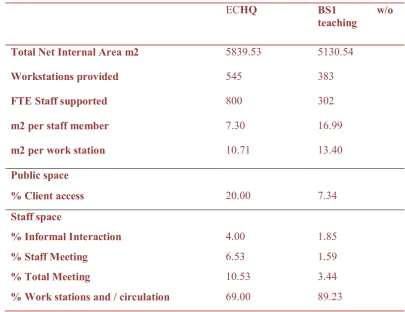
The priorities afforded to different kinds of space are also different (Table 1). Fully 20% of the Net Internal Area (NIA) of ECHQ is space accessible to clients or collaborators of various kinds. It includes a café-bar, various meeting facilities and a small conferencing suite. The accessible area (dubbed landside by comparison with airports) is finished and managed to a high standard. The „airside‟ behind a security barrier is laid out to be open and flexible with a design that subconsciously recaptures some of the feel of the
burolandschaft offices of the 1960s. Even so space for both formal and informal meeting is generous. When, as here, space planning starts from the perspective of better
7http://www.ogc.gov.uk/documents/Lovell_Elliot_-_Day2__Session5.pdf (available from author)
supporting business goals it is possible also to achieve far greater efficiency and saving of net cost and carbon.
The growing international movement for Corporate Social Responsibility [CSR] is increasingly calling for what triple bottom line (Elkington, 1998) reporting: i.e that companies report not only on their financial performance but also their ecological and social impact. A workspace such as ECHQ, while it is business led in the classic sense of Becker et al. (1994), or a lean asset (Price, 2007) is also genuinely demonstrated to make a triple bottom line contribution, hence the designation in this paper‟s title. The overall result incorporates a shift of emphasis away from a concentration on individual settings towards a higher proportion of shared space some of it semi-public in the sense of accessibility to the firm‟s clients and strategic contacts.
Both examples might be considered genuinely value adding, delivering or enabling the strategic purposes for which they were designed, and, inter alia being perceived as such by their users, the equivalents of Michell‟s (op. cit.) sustainable facilities rather than white elephants. Elsewhere office based FM delivers, in the interests of notional efficiency, too much space that is, at best neutral with respect to business and at worst destructive of knowledge creation, learning, and economic value adding. Are there examples from other sectors?
VALUE DESTRUCTION: GENERALIZING THE EXAMPLES.
Business Schools
Academia is in general cautious about embracing newer, open offices such as the example just illustrated (Price and Fortune, 2008; Price et al, 2010). Equally it is, in the USA and increasingly the UK, a sector that is becoming increasingly commercialized. Business Schools are in the forefront of that challenge and increasingly themselves globalised9. Many have invested in new buildings as part of their competitive strategy. In the UK the Association of Business Schools (ABS n. d.) have gone to the lengths of preparing a media bulletin illustrating 15 examples. A minister from the previous administration praises this example of his government‟s investment in higher education and boasting of the “huge reductions in carbon emissions” embodied in the buildings. That is indeed one feature. The buildings are environmentally efficient –in use -. They are also enormously wasteful of space in academic offices, hence larger than they need to be, while ineffective in terms of provision of meeting spaces. Contrast two buildings of similar size (Table 1). One is ECHQ. The other is an unrenovated business school in a university generally recognized in the sector as spatially efficient. Lecture theatres and other teaching spaces have been removed from the business school case.
The newer, supposedly carbon efficient buildings use approximately twice as much space per FTE and deliver even less interactive space. If Peters (1992) was correct when he described the “parameters of intermingling” as the critical dimension in knowledge creation, and Myerson‟s review (op cit.) suggests history has confirmed it (c.f. Price, 2002; Haynes and Price, 2004), these new Business School buildings are ill suited to their core purpose. They are also expensive with construction costs per m2 typically above £3,000. Is paying too much for too much ineffective space an effective value proposition? or, to echo Michell (op. cit.), are the buildings „green‟ elephants with a looming maintenance problem that cost per m2?
Table 1 Comparison of an exemplary corporate HQ and Business School that is notionally efficient on HEFCE performance measures and apparently 'full'
ECHQ BS1 w/o
teaching
Total Net Internal Area m2 5839.53 5130.54
Workstations provided 545 383
FTE Staff supported 800 302
m2 per staff member 7.30 16.99
m2 per work station 10.71 13.40
Public space
% Client access 20.00 7.34
Staff space
% Informal Interaction 4.00 1.85
% Staff Meeting 6.53 1.59
% Total Meeting 10.53 3.44
% Work stations and / circulation 69.00 89.23
The cost paradox
Cost, usually per m2 or per service episode still rules large. Since ca 1997 the UK has seen a rise in elaborate schemes designed to accurately compare costs in offices (IPD Occupiers), health facilities (ERIC10) and Higher Education (EMS11). There are two ways to reduce cost per m2.. One is to reduce costs. The other is to retain excess space, especially if nothing is spent on it. The result is an often an excess of poor quality space (May and Price, 2009; Price and Clark, 2009; Kennie and Price, forthcoming). The situation is a classic example of Goodhart‟s (1975) Law applied to the Public Sector (c.f. Pidd, 2005). Unfortunately recent government directives to reduce Public Sector assets do not often differentiate between the efficient and those who held a buffer against such circumstances. Should those surplus assets now be sold they will of course have less value than would have been the case say five years ago: a reduction in value born by the Taxpayer.
Hargreaves (2012) will report on another instance of taxpayer value destruction this time in Social Housing, again in the UK where it seems the cost of short-term contracts for remedial maintenance resulted in a net burden of £ billions. In a similar vein Martindale et al. (2008) identify failure of chilled storage units as the biggest single source of loss and waste in the UK supply chain. Short term maintenance contracting is a likely cause. DISCUSSION
10 Estates Return Information Collection run by the Department of Health
[image:7.595.88.494.95.407.2]Is this FM?
The examples above do no more than scratch the surface. Some might say they are a fact of life. Some might say they represent an opportunity to make money, a „tragedy of the commons‟ (Hardin, 1968). Some might blame procurement departments, or general management of core businesses, or political decision makers. All indeed contribute. That said the examples point to various instances of failure, by FM, to identify and contribute to various forms of net waste. Why? Various paradoxes suggest themselves.
Measurement
There is the old adage that you cannot manage what you cannot measure but do we measure what we can, then manage accordingly?
The wrong sort of engagement
Michell‟s white elephants represent failure to engage the community of users in co-creating (Alexander, 2012) future facilities and hence value. My green elephants and some over optimistic public projects arguably arise from failing to sufficiently challenge users‟ perceptions of what they need. The first appears as under consultation; the second as taking the user opinion, at least as expressed by management, at face value.
Misunderstanding efficiency
I am coming to wonder whether CAD systems have a lot to answer for. They make it easy to reproduce standard design elements, typically workstations across a template. The result is the cubicle farm or its UK equivalent, neat rows of four, or six workstations that fill a template with the precision of troops on parade
RE THINKING THE RECIPE
The examples point to a need to consider what goes into the modern workplace pudding, and how it is created. Some of the lessons I draw are as follows.
Business intent
These are workspaces created in pursuit of a strategic business objective, not with saving cost as their primary rationale. In the process they actually save more. The currently quoted average density of corporate HQ offices in London is 11.2 m2 per FTE12. ECHQ achieves less than 7m2. Its occupants have embraced working without dedicated desks because they have a variety of attractive locations to work from when they are in the building. GCHQ does something similar though the precise figures have not been released.
Unmanaged space
For many the various „desks‟ in these environments are better thought of as shelves for communications equipment than traditional desks or work-stations. There are places for team anchors (Greene and Myerson, 2011) but most people are mobile. Interestingly where they sit is not booked, managed or monitored in the manner of classic FM with bookable hotdesks, hotelling, space standards and all the other paraphernalia that have grown up in FM. People go where they need to to get done what they need to. There is ample, unmanaged, space for everyone. They are neither stationed or stationary.
Learning and the peripatos
Over the last 20 years, to name but a few, we have had the Learning Organization, Knowledge Management, the Experiential Economy and Value Co-creation. Implicit in
all of them is the emphasis on people learning and communicating; exchanging knowledge and ideas. The peripatetic school of philosophy founded by Aristotle apparently derived its name from his habit of teaching while moving. Using evidence from modern theories of cognition (Beard and Price, 2010, forthcoming; Beard 2012) have argued that such exchanges can be enriched by special settings. Much has been published on the benefits of informal interaction and its opposite the debilitating affect of unwanted disturbance. Once the link with a specific „station‟ is broken, as for many it can be, the dilemma disappears. Within less space overall it is possible to provide better environments for both interaction and concentrated individual thinking.
Process not solution
Employee satisfaction, measured by surveys and staff retention, rose in the cases I have described. In contrast Bull and Brown (forthcoming) describe a situation where the FM of „finaceco‟ were tasked with cutting costs and implemented a predesigned and regimented solution with all the usual trappings. Communication was left to line managers‟ interpretation of a brief. Many employees reported their loyalty to the company had decreased.
By contrast, in the examples above and other success stories employees were given the opportunity in various ways to comment on the proposed changes. Their reported fears are often consistent. “I need an office to concentrate, to have confidential conversations, to store xyz. Sometimes these are genuine. Very few honestly admit their concerns at loss of status.
CONCLUSION
Unfortunately after over 40 years of FM it is remarkably easy to find the same examples of spaces built and or managed according to guidelines and best practice that are too large, wrongly located, badly maintained or otherwise disappointing to those who create or deliver services from them. There is undoubted waste of investment money and daily budgets. There are constraints on building purpose, whether commercial or community. Is getting smarter at doing the wrong thing the limit of the FM research communities‟ ambition?
REFERENCES
ABS (n. d.) New Buildings and Facilities, U.K Association of Business Schools, ABS
MEDIA BULLETIN 23, retrieved from
http://associationofbusinessschools.org/sites/default/files/ABS%20MEDIA%20BULLE
TIN%2023.pdf on 27/09/2011
Alexander, K (2012) Co-creation of value in FM. In K. Alexander and I. Price (eds.) “Managing organizational ecologies: Space, management and organization”. New York: Routledge xx-xx.
Beard, C (2012) Spatial ecology: learning and working environments that change people and organizations. In K. Alexander and I. Price (eds.) “Managing organizational ecologies: Space, management and organization”. New York: Routledge xx-xx.
Beard, C and Price, I (2010). Space, conversations and place: lessons and questions from practice, “International Journal of Facilities Management”, 1(2), 1-14
Becker, F D (1990). “The total workplace: facilities management and the elastic organization”. New York: Van Nostrand Reinhold.
Becker FD Quinn, K L, Rappaport ,A J and Sims, W R (1994), “Implementing innovative workplaces - organizational implications of different strategies”. Ithaca NY Cornell International Workplace Studies Program
Breslin, D (2012) Spaces and the co-evolution of practices within a UK metallurgical equipment supplier. In K. Alexander and I. Price (eds.) “Managing organizational ecologies: Space, management and organization”. New York: Routledge xx-xx.
Bull, M and Brown, T (2011). Impact of change communication on satisfaction with alternative workplace strategies. “Facilities” - Published date tbc.
Crowther, P and Donlan, L (2011) Value Creation Space: The role of events in a service dominant marketing paradigm, “Journal of Marketing Management” Published date tbc. Donald, I (1994), Management and change in office environments. “Journal of Environmental Psychology” 14(1), 21-30.
Drew, S AW (2011) Strategic roles of centers in business school development. “Journal of Management Developmen” 30(9) 2011 pp. 793-815
Duffy, F (2000) Design and facilities management in a time of change. “Facilities”, 18(10/11/12), 371 – 375
Elkington, J (1997). “Cannibals With Forks: The Triple Bottom Line of 21st Century Business” Oxford: Capstone.
Goodhart, C A E (1975), “Monetary Relationships: A View from Threadneedle Street”. Papers in Monetary Economics (Reserve Bank of Australia)
Greene, C and Myerson, J (2011). Space for thought: designing for knowledge workers. “Facilities”, 29(1/2), 19-30.
Hardin, G (1968) The Tragedy of the Commons, “Science”, 162, 1243-1248.
Hargreaves, J (2012) Causes and consequences of FM short-termism in UK Social Housing. Unpublished DBA Thesis, Sheffield Business School.
Haynes, B and Price, I (2004) Quantifying the complex adaptive workplace. “Facilities”, 22(1/2), 8-18.
Haynes, B (2012) Conversational networks in knowledge offices. In K. Alexander and I. Price (eds.) “Managing organizational ecologies: Space, management and organization”. New York: Routledge xx-xx.
Kennie, T and Price, I (forthcoming) “Leadership lessons from other sectors: professional service firms and the higher education „system‟ post 2012”. London: Leadership Foundation for Higher Education.
Martindale, W, McGloin, R, Jones, M and Barlow, P (2008) The carbon dioxide emission footprint of food products and their application in the food system. “Aspects of Applied Biology 86, Greening the Food Chain” Retrieved from
http://www.aab.org.uk/contentok.php?id=355 on 27/09/2011.
Michell, K (2010) A Grounded Theory Approach to Community Based Facilities Management: The Context of Cape Town South Africa. Unpublished PhD Thesis, University of Cape Town.
Michell, K (2012) FM as a social enterprise, In K. Alexander and I. Price (eds.) “Managing organizational ecologies: Space, management and organization”. New York: Routledge xx-xx.
Myerson, J (2012) Workspace redesign to support the „front end‟ of innovation In K. Alexander and I. Price (eds.) “Managing organizational ecologies: Space, management and organization”. New York: Routledge xx-xx.
Nathan, M and Doyle, J (2002) “The state of the office - the politics and geography of working space”, London: The Industrial Society.
Peters, T (1992) “Liberation management: Necessary disorganization for the nanosecond nineties”. London: Macmillan.
Pidd, M (2005) Perversity in public service performance measurement, “International Journal of Productivity and Performance Management”, 54(5/6) 482-493.
Price, I (2002) The Complex Adaptive Workplace: A Theoretical Link between office Design and Productivity. In G T Frizelle and H Richards (eds.) “Tackling Industrial Complexity: the ideas that make a difference”. Cambridge: Institute for Manufacturing. Retrieved from http://www.ifm.eng.cam.ac.uk/mcn/pdf_files/part5_4.pdf on 25 August 2011
Price, I (2003) The development of facility management. In R .Best, C. Langston, and G.De Valence (eds.), “Workplace Strategies and Facilities Management: Building in Value”. Oxford: Butterworth-Heinemann, 49-66.
Price, I (2004) Business Critical FM. “Facilities”, 22(13/14), 353–358.
Price, I (2007) The Lean Asset: New language for new workplaces, “California Management Review”, 49(2) 102-118.
Price, I and Fortune, J (2008) Open plan and academe: pre- and post-hoc conversations. In D. S.-S.Then, and E. Finch, (eds.) Proceedings of the W070 conference: healthy and creative facilities. CIB publication (315). CIB, 613-620
Price, I and Clark, E (2009) An output approach to property portfolio performance measurement. “Property Management”, 27(1), 6-15.
Price, I, Beard, C, Ellison, I. and Matzdorf, F (2010). Shifting the patterns of business school space? In: British Academy of Management conference, Sheffield, 14-16 September 2010. Retreived from http://shura.shu.ac.uk/2113/ on 25/09/2011
Roberts, P (2001) Corporate Competence in FM: current problems and issues, “Facilities”, 19(7/8), 269-275.
Roper, K (2012) Educational implications for FM of a social constructionist view. In K. Alexander and I. Price (eds.) “Managing organizational ecologies: Space, management and organization”. New York: Routledge xx-xx.
Thomson, T (1988). Facilities Management Consultancy: The Development of a Plan for its Proposed Implementation in an Architectural Company. Unpublished MSc Dissertation, University of Reading.
Tranfield, D and Akhlaghi, F (1995) Performance measures: relating facilities to business indicators, “Facilities”, 13(3), 6 –14.
Turner, G and Myerson, J (1998). “New Workspace New Culture: office design as a catalyst for change”. Aldershot UK: Gower.