Exploring the development of learner autonomy from a
postmodern and social constructivist perspective:
prioritising voices
O'LEARY, ChristineAvailable from Sheffield Hallam University Research Archive (SHURA) at: http://shura.shu.ac.uk/22863/
This document is the author deposited version. You are advised to consult the publisher's version if you wish to cite from it.
Published version
O'LEARY, Christine (2018). Exploring the development of learner autonomy from a postmodern and social constructivist perspective: prioritising voices. The Learner Development Journal, 2.
Copyright and re-use policy
See http://shura.shu.ac.uk/information.html
1
Research Paper
Exploring the Development of Learner Autonomy from a Postmodern and Social Constructivist Perspective: Prioritizing Voices
Dr Christine O'Leary, Sheffield Hallam University
Learner autonomy defined as the learners' ability to take charge or control of their own learning (Holec, 1981; Benson, 2011), is considered as a key to effective lifelong learning (Dam, 2011). However, the multidimensional nature of the concept combined with the need to access both individual and social constructions, from a social constructivist perspective, presents significant ontological and epistemological challenges. Although learner autonomy and its development have been explored using a range of paradigms and theoretical
frameworks, none of the studies appear to have examined its development, within a formal educational context, from a postmodernist perspective. This article aims to discuss the benefits and practical implications of using a postmodernist approach to exploring the development of learner autonomy, in undergraduate specialist and non-specialist learners, studying advanced level French in an institution-wide language programme, within a large UK Higher Education Institution. After considering the background and examining in some detail the learner autonomy construct, the paper will discuss the choice of methodology, in relation to the challenges presented by prioritising voices, within a multifaceted and multi-dimensional theoretical framework. It will show how it was applied in practice, using a few illustrative extracts from the study's data analysis. The article will conclude with some recommendations and considerations of the limitations of such an approach, together with some reflection on the process and outcome of the case study research, including some implications for practice in a formal educational context. (236 words)
Key words
learner autonomy, postmodernist, research, Higher Education
Cognitive and more particularly constructivist views of student learning suggest that learners’
active and independent/interdependent involvement in their own learning, including shaping
the environment in which it occurs, increases motivation to learn (Raya & Lamb, 2008;
Hoidn & Kärkkäinen, 2014) and improves academic achievement (Bandura 1977, 1986;
Findley & Cooper 1993; Feuerstein, Klein & Tannenbaum, 1991). The development of
autonomy also depends on students' opportunity to influence the learning process (Boud,
2012).
As a key to effective lifelong language learning (Dam, 2011), the development of
autonomous language learners has been the subject of many studies (e.g. Raya & Lamb,
2
learners taking charge of their learning. However, many authors such as Little (2000) have
warned against simply equating an autonomous learner with an independent one, pointing out
that the development of a capacity for autonomy does not happen in isolation but through
interactions involving peers and teachers (Raya & Lamb, 2008; Raya et al., 2008). To
become autonomous, therefore, learners need to develop the psychological and emotional
capacity to control their own learning collaboratively as well as independently (Kohonen,
1992; O’Leary, 2014; Oxford, 1990, 2016).
However, the multidimensional nature of the concept (Benson, 2011) combined with
the need to access both individual and social constructions presents significant ontological
and epistemological challenges. Avoiding prioritising some voices, such as my own or
theorists' from the literature, over the students' was of particular concern when selecting my
methodology.
Learner autonomy and its development have been explored using a range of
paradigms and theoretical frameworks ranging from positivist quantitative approaches such
as Fazey and Fazey (2001)'s study of the autonomy of 1st year undergraduates to narrative qualitative ones (e.g., Karlsson & Kjisik, 2009). Although Postmodern theory has been
associated with practical applications for promoting learner autonomy (e.g. Curtis, 2004), I
have not found any studies that have researched the development of learner autonomy using a
Postmodern orientation, at least not explicitly.
This paper aims to discuss the benefits and practical implications of using a
postmodernist approach to exploring the development of learner autonomy, in undergraduate
specialist and non- specialist learners, studying advanced level French modulesi in an
institution-wide language programme within a large UK Higher Education Institution, from a
social constructivist perspective. After considering the background to the study and a detailed
examination of the learner autonomy construct, the paper will discuss the choice of
methodology, in view of the challenges presented by prioritising voices, within a multifaceted
and multi-dimensional theoretical framework. I will show how it was applied in practice,
using a few illustrative extracts from the study's data analysis. I will conclude with some
recommendations and consideration of the limitations of such an approach, together with
3
Background to the Study
The research was based on a case study of undergraduate specialist and non-specialist
students studying French at the advanced stages of the University Language Scheme (ULS)
-Stage 5 (CEFRii B2/C1) and Stage 6 a or b (CEFR C1).
The ULS, as an Institution-wide Language Programme, offers electives to students of
other disciplines (non-specialists) and core modules to students majoring or minoring in
Languages (specialists), alongside other specialisms such as International Business, Tourism
or TESOL, in six stages of languages, mapped on the CEFR, from ab-initio (A1) to degree
standards (C1). Although the ULS comprises of seven languages, only Spanish, French,
German and Italian can be studied at the two most advanced levels due to more limited
demand in other languages at these levels overall.
The ULS has a vocational orientation. At the advanced levels, the scheme had three key
aims:
the development of language skills to enable students to function in both a social and
business environment;
the acquisition of basic knowledge of the country/countries where the target language is spoken, together with the development of students’ awareness of its/their society,
traditions, customs and business culture;
the fostering and development of autonomous language learners.
Although the language study on the ULS could be described as common core rather
than discipline specific, Stages 5 and 6 module designs allowed students specialising in other
disciplines to focus part of their language study on their subject specialism through the
production of a subject-specific portfolio, report and presentation. In the case of students
majoring or doing a minor in Languages at ULS 6, the portfolio involved the development of
more specialist language skills such as negotiation, translation and interpreting. To encourage
planning and reflection, each portfolio included a planning record and self-evaluation
(normally in L2 although some were written in L1). ULS 5 and 6a students were also
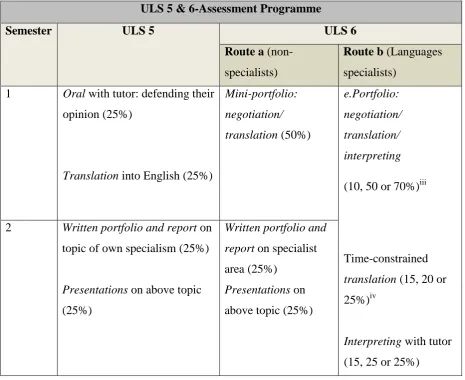
encouraged to keep a research diary in L1 or 2. A summary of the assessment programme for
4
Table 1. Assessment Programme
ULS 5 & 6-Assessment Programme
Semester ULS 5 ULS 6
Route a
(non-specialists)
Route b (Languages
specialists)
1 Oral with tutor: defending their opinion (25%)
Translation into English (25%)
Mini-portfolio: negotiation/ translation (50%)
e.Portfolio: negotiation/ translation/ interpreting
(10, 50 or 70%)iii
Time-constrained
translation (15, 20 or 25%)iv
Interpreting with tutor (15, 25 or 25%) 2 Written portfolio and report on
topic of own specialism (25%)
Presentations on above topic (25%)
Written portfolio and report on specialist area (25%)
Presentations on above topic (25%)
Learner Autonomy as a Construct
Individual level
As a starting point for my PhD study (O'Leary, 2010), I considered to use Benson's (2001)
model of autonomy for control at the individual level (p. 86) and William and Burden's
(1997) social constructivist model for learning and teaching (p. 43) for the social dimension
of the process. On the basis of an extensive literature review relating to learner autonomy,
Benson (2001, p. 87) identifies control over cognitive processes as probably “the most
fundamental level.” His model included three key areas for control over cognitive processes:
5
Metacognitive knowledge at task level encompassing any evidence of: decision to carry out the task, decisions about content, progression, place and time of learning,
the selection and use of cognitive strategies, and the criteria selected for evaluation;
reflection any form of reflection on the language, the learning process, their role within that process, (pp. 86-87).
Social level
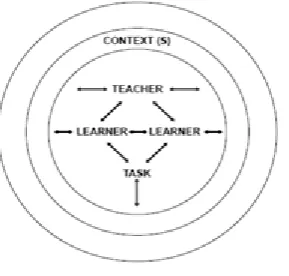
William and Burden's (1997, p. 43) social model of the teaching and learning process
complemented Benson's (2001) individual model through taking into account the learning
environment and the learning partnerships between teachers and learners. I adapted the model
[image:6.595.227.372.341.479.2]slightly by adding the learner to learner dimension as shown below (see Figure 1).
Figure 1. A social constructivist model of the teaching-learning process, adapted from Williams and Burden (1997, p. 43) adapted by O'Leary (2014, p. 22).
The Significance of Metacognition
Whilst attention and reflection were clearly important, my initial review of literature
suggested that the development of metacognitive knowledge (Wenden, 1995, 1998) was
perhaps the most significant in the development of autonomous learners. This led me to
choose a working title of “The Development of Metacognition within a Social Context” as a
6
Postmodernism as a theoretical framework: what can it offer to learner autonomy
research?
Other studies
Previous studies on learner autonomy have used a very wide range of paradigms. For instance,
Cotterall (1995) and Lai (2001) have used psychometric approaches using and/or developing
rating scales as part of their study of the development of autonomy. More recently, mixed
methods using a (neo) realist and pragmatistvtheoretical framework have been a
methodology of choice (see Cooker, 2015 or Tassinari, 2015). Practitioner action research
involving a strong reflective/reflexive element within the process was favoured by
researchers such as Champagne et al. (2001) and Karlsson (2008). Complexity theory seeking
to reflect the complexity of the learning process in relation to autonomy has also gained ground as a theoretical paradigm (see for instance Dörnyei, Macintyre & Henry, 2015), whilst narrative and highly inductive qualitative stories can be used to privilege the learner(s)'s voice (see Benson & Cooker, 2013). However, I was looking for an approach that would enable me to access all the voices, including the teacher's perspective without privileging any. I was also conscious of the potential influence of dominant theories within the literature. In addition, I wished to reflect the social interactive dimension of the research and its closeness to practice, within a social constructivist paradigm.
Postmodernism as a research orientation
Whilst Sarup (1993) suggests that modernism can be seen as the culture of modernity
underpinned by a belief in the power of science to deliver unified and legitimate knowledge,
Postmodernism, on the other hand, tends to reject "metanarratives" which offer this unified
and monolithic view of the world (Lyotard, 1984). Derrida (1976) rejects these narratives and
their claims to unmediated knowledge. He asserts that we can only know reality through our
own concepts or constructs within the theoretical frameworks we develop to make sense of
our experience and research data. The postmodern approach therefore assumes a pluralist
perspective and multiple “truths” contingent to specific settings. Haber (1994, p. 13) stresses
that Postmodernism is both "committed to" and "constitutive of difference". Although there is not one unified postmodern theory, postmodern theorists would all agree on- "the arbitrary
and conventional nature of everything social- language, culture, practice, subjectivity, and
7
1994) and much criticism of its excessive relativity (Hill et al, 1999), a postmodern stance
can offer new insights into complex and dynamic phenomena, in a situated context such as
researching educational practice (Brown & Jones, 2001; Stronach & McLure, 1997).
Moderate postmodernism that is a variant of postmodernism which accepts cumulative
knowledge (Roseneau, 1992), including non-postmodernist as well as postmodernist works,
enables rigour (i.e. in-depth theoretical consideration) without rigidity (e.g. imposition of a
metanarrative). This study which considered works emanating from various
philosophical/theoretical traditions came under the category of “moderate postmodernism.”
Fox (2000, p. 19), for example, distinguishes between three key principles guiding
postmodern research, particularly in relation to practitioner research/action research namely:
"Knowledge is local and contingent; the research is constitutive of difference" meaning that
the research question should neither “close down or limit the ways in which the subjects will
be understood or conceive of themselves,” i.e. participants should not be framed at the outset;
and "the theory should be related to practice" suggesting that research questions and "their
theoretical consequences will be of direct practical relevance to practice" (p. 20).
There are four main reasons why I decided to adopt a postmodernist stance to explore the
main themes of my study:
the first one was the need not to privilege individual or groups of individuals' constructions of the world, including my own based on experience and/or existing
literature, reflecting a "pluralist perspective";
the second was the situated nature of the study implying that the learners'
constructions or their version of the “truth” is contingent to the specific setting of the
research;
the third one was the move away from macro theories as a theoretical framework to a “micro logical/theoretical” level, more in line with the study's participants’ personal
theory and closer to practice;
the fourth one was the dynamic nature of the research, and the possibility of change
at a micro level working within the constraints imposed by the wider society, rather
than framing the research within a critical theory of resistance or conflict, in a quest
for an ideal practice (Brown & Jones, 2001) or an absolute solution to the
8
This was not to negate the political and ideological nature of the concept of autonomy
which Pennycook (1997, p. 35) stresses as central to the notion. It is clear that the
psychological dimension of autonomy does not operate in a vacuum, independently of the
cultural and social values of the broader society, as Pennycook (1997, p. 44) rightly points
out. Brown and Jones (2001) speak of "critical pedagogy in a postmodern world" because we
need to recognise that these values, and the need for as well as type of change, will be
different between individuals and communities depending on their background, education
and experiences.
Focus of the Study
Questions
The key questions posed in the case study relating to the development of autonomous
language learners were:
1) What do undergraduate language students believe about learning and their role
within the process?
2) How do these beliefs relate to current conceptualisation of learner autonomy in
existing literature?
3) What implications might this have on the conceptualisation of learner autonomy,
and associated operationalisation of the construct within the language curriculum and
beyond?
4) Is it possible to influence students' constructions of learning, particularly in relation
to tutor dependence?
5) What is the impact of students' beliefs/constructions of learning on their learning,
in relation to the development of autonomy in practice, within the languages
curriculum?
9
As I began the PhD study, I was particularly concerned with the need to ensure that all voices
were heard, including the learners and my own as learner researcher-practitioner. I was also
particularly concerned with the application to practice as an outcome of the research.
Implication of a Postmodernist Orientation
Methodology
Using a postmodern research orientation has a number of practical implications on the
research design, the way data is collected and analysed. The first consideration was the best
way to approach the literature review to avoid framing the participants' responses around
particular theories. I was also aware of my own focus on the development of metacognition
as the corner stone to learner development in relation to autonomy. I decided to divide the
research into two phases. Phase 1 would access the learners' voices prior to any literature being considered apart from the main definition for learner autonomy, answering question 1
and starting the following literature review from a student perspective. The literature review
and its implications would respond to questions 2, 3 and 4. The second phase would concentrate on the practical implications in answer to questions 5.
Dealing with language
One of the key issues of using a postmodernist research design was giving due consideration
to language and the plurality of meaning implied in this theoretical orientation. This meant
taking a poststructuralist rather than a structuralist perspective i.e. moving away from
Saussure's (1910-11) structuralist theory of language, where the link between the signifier or
word/system of representation and signified or the physical object/idea it represents is
constant and stable, to poststructuralist notions of plurality of meanings and shifting
meanings. For Derrida as cited in Sarup (1993), signifiers and signified are continually
separating to reattach themselves in "new combinations" (p. 33). In other words, whilst the
signifier and signified are still closely linked, the signifier has supremacy over the signified.
In practical terms, we cannot assume that there is one privileged interpretation of a written or
an oral discourse. Words, for instance, may have different meanings for different participants.
10
checked with participants during data collection and participants need to have some
involvement in the analysis. This was particularly relevant to Phase 1 which reflected the
students' perspective as opposed to Phase 2 which solely considered the
11
Literature review
The literature review was framed by the student responses in Phase 1. It focused particularly
on the link between the learners’ beliefs and existing literature through exploring primarily
the key areas highlighted by the focus group participants, including the role of the teacher in
the learning process.
Postmodernism and a social constructivist perspective
A social constructivist approach to knowledge and its acquisition fits in with the
postmodernist orientation/poststructuralist stance outlined earlier, in that it implies a
local/personal construction of the broader social context and the relativity of language
structures and meanings. Both my philosophical and theoretical position in undertaking this
study has been strongly influenced by constructivist theories of learning. Benson (2001, p.
35) citing Candy (1991, p. 252) broadly describes constructivism as “a cluster of approaches
which hold that knowledge cannot be taught but must be constructed by the learner.”
Constructivism, described in these terms, forms the basis for the concept of autonomy
outlined earlier. Benson (2001, p. 36) citing Paris and Byrnes (1989, p.170) links
constructivism with psychological theories of learning which assume that "knowledge is
produced through socially conditioned processes of interpretation" (p. 36). A constructivist
view of learning, therefore, stresses the importance of the learner's full participation in the
learning process for learning to be effective (Benson, 2001, p. 36).
My role as a researcher-practitioner
Maykut and Morehouse (1994) suggest that the qualitative/phenomenological researcher
adopts the posture of "indwelling" which they define as living between and within the
research meaning: "being at one with the person under investigation, walking a mile in the
other person's shoes, or understanding the person's point of view from an empathic rather
than a sympathetic position" (p. 25). It is, however, clear that my position as one of the voices
in the research constitutes more than in dwelling. My own reflection and reflexivity here
12
researcher practitioner within the study, giving my “voice” no more authority than that of the
learners. My research diary extract as a learner-researcher practitioner were analysed in Phase
2 using similar criteria to the ones used in the self-evaluation reports and diaries (see Phase 2
data collection, example of data/analysis and outcomes).
Scope and limitations of the research
Maykut and Morehouse (1994, p. 145) speak of the "trustworthiness" of the research, in
relation to its validity. A detailed description of the research process and its expected
outcomes can act as a basis for assessing its credibility (Nunan, 1992; Maykut & Morehouse,
1994). Transparency is an essential feature of qualitative research, particularly a clear audit
trail incorporating relevant materials to help readers "walk through the work from beginning
to end" (Maykut & Morehouse, 1994, p. 145).Face validity is another way of considering
whether the results of an investigation are valid. Face validity depends on whether the results
seem valid i.e. whether they resonate with the audience's experiences or whether they have a
predictive quality (Krueger, 1994, p. 32). Given its postmodern orientation, how this study’s
findings resonate with the readers’ experience and perception of “reality” played an important
role in “validating” its results as well as its process of enquiry. From a postmodernist
perspective, Smith and Hodkinson (2009, p. 38) stress that external evidence cannot force or
coerce individuals’ agreement to “see the social and educational world in the same way.” The
reader must be taken through the research journey and convinced by the author's arguments.
Using a Postmodernist and Social Constructivist Perspective in Practice
Data collection methods and analysis for Phases 1 and 2
As stated earlier, the research was subdivided into two Phases:
Phase 1 which was concerned with accessing learners' 'voices' through focus groups i.e. the student learners' and through a reflective diary for the learner
practitioner-researcher's as well as other 'learner' practitioner- researchers'/ researchers' 'voices'
13
Phase 2 which used the revised construct as the theoretical framework to the analysis of 28 self-evaluation reports and five detailed research diaries, drawn from the same
learners as the Phase 1 focus groups' participants, including the learner
practitioner-researcher, for evidence of 'autonomy in practice', in order to assess the construct's
usefulness as well as the autonomy of all the learners involved. The outcome of Phase
2 would determine further intervention through curriculum and assessment design at
the advanced stages on the ULS.
Phase 1 Data Collection Process, Examples of Data/analysis and Outcomes
Focus Group Process
Phase 1 used focus group described by Krueger (1994, p. 19) as group interactions aimed at
gauging feelings, ways of thinking and perceptions which may differ between participants
rather than seeking any consensus.
groups are selected because they have common characteristics that relate to the topic of the focus group, in this case they are all advanced learners;
the focus group is repeated several times with different people;
typically, a focus group approach will consist of a minimum of three focus groups but
could involve as many as several dozen;
the group discussion is conducted several times with similar participants to identify trends and patterns in perception.
During Phase 1 of the study, four focus groups of between two (group 2) and five
participants (group 3) met between one and three times over one academic year (see O'Leary,
2010), for a duration of one to one and a half hours as recommended by Krueger (1994). In
total, six focus group meetings were carried out: Group 1 met three times, Group 2 once,
Group 3 met once and Group 4 once. I had hoped for more meetings with Groups 2-4 but
workloads due to end of year exams limited volunteers' availability. The group consisted of
student volunteers studying French at Stage 6 (groups 1 & 3) and French at Stage 5 (groups 2
14
stage and in the same class with me as their teacher, with the exception of Group 4 (3
students).
The Focus groups were carried out in line with standard ethical consideration,
including confidentiality and the opportunity to withdraw at any point. An interview guide
was drawn up before each focus group with a summary of the outcomes of previous group
meetings and other focus groups as applicable, presented at the beginning of each meeting
(Krueger, 1994; Banister et al., 1994; Arskey & Knight, 1999). In order to access their
constructions of the learning process both generally and with regards to languages,
participants were asked to: identify the characteristics of a good teacher/language teacher; a good learner/language learner; describe successful and unsuccessful learning experiences
both generally and for languages; reflect on their own acquisition of language proficiency
and outline their plan for future language learning after University. These questions were kept sufficiently broad to cover their learning/language learning experience in HE, rather than
focusing on the last two years when I taught most of them. This was intended to mitigate the
inequalities in the power relationship, as I taught some of them. Krueger (1994) suggests that
the researcher may wish to modify the question structure and timing to get “confirmation of emerging themes and ideas” (p. 145). He observes that “typically the first focus group yields
a considerable amount of information,” in my case Group 1, however “each additional focus
group produces decreasing amounts of new insights” (op cit: 135). He suggests that some questions “might be eliminated altogether” if there is “saturation” i.e. no further insight. I
used summaries drawn up with the participants to devise the next interview guide for the
following group meetings. Some minor modifications were made to the structure of interview
guides as the study progressed. In particular, learner and teacher were interchanged to try and
elicit more data on the learner in Groups 2, 3 and 4.
Recording and analysing the data
In relation to the analysis of the data, Krueger (1994, pp. 143-144) identifies five possible
options :1) a transcript-based analysis; 2) a taped-based analysis using an abridged transcript
based on careful listening of the tape; 3) a note-based analysis; 4) a debriefing session and
summary comments at the conclusion of the focus group; and 5) memory-based analysis
15
third options, with some further adaptation: part of the analysis and the “debriefing” elements
of the third option taking place with the participants as co-constructors/co-researchers in
relation to the preliminary findings, as recorded on the flip charts; and I used the tape to
produce partial transcripts.
The interviews were conducted in English (their L1) using a “brainstorming”
approach in so far as each participant’s contributions were recorded, using as much as possible the participants’ own words, for instance Approachability (Scottvi, Group 1, meeting 1), Self-motivated (Lesley, Group 3), Curious person (Dallera, Group 4) and
Participation (Gregory, Group 2). I recapped the student’s responses so far on a
number of occasions, throughout the interview, using the statements written on t he flip
charts to partly analyse the data with the participants. The following extracts from
Group 1, meeting 1 show how the data was collected interactively (in conversation)
with the themes identified in the presence of the participants :
[Researcher (COL) writing headings: “What makes a good teacher/ what makes a
good learner” on different pages of the flip chart.]
Researcher (COL): Let’s start with the Teacher, sort of brainstorming. What makes a good teacher?
ANNA-MARIE: Someone who cares about students. Researcher (COL): In what way?
ANNA-MARIE: cares about the students, about the learning not about their pay packets at the end of the day.
Researcher (COL): right, so somebody who cares about students’ progress. ANNA-MARIE: Yes, yes.
[Researcher (COL) writes “student progress” on the flip chart]
[….]
SCOTT: Somebody who understands students what they do and what they want.
[Researcher (COL) writes on the flip chart
Somebody who understands students/ what they do/ what they want (SCOTT)]
16
SCOTT: Every student is an individual, [they] want different things. So it’s
understanding, I don’t know, the different students in your class and their objectives. You know which students are good. You know what they want.
Researcher (COL): Do you mean being aware of the needs of the students? SCOTT: Know which students are good, who wants to get on.
ANNA-MARIE: What’s their objectives.
JANINE: Within that, you know when students need more help as well. Researcher (COL): so? [Researcher (COL) starts writing on the chart Understand different students and their objectives (SCOTT, ANNA-MARIE)]
Krueger (1994, p. 115) identifies two essential techniques to moderate group
discussions namely: “the 5 second pause and the probe” (Ibid), in order to elicit
additional information. From a poststructuralist standpoint, probing was used to seek
clarification of the various concepts mentioned by the participants, for instance,
‘self-motivated’ (Group 3):
Researcher (COL): What do you mean by self-motivated?
LESLEY: To be a good learner, you have not just to go to your lessons but you’ve got to be motivated at home to do the work and learn yourself.
Students were then asked to rank the themes in order of importance with variation in
ranking between participants noted on the flip chart such as the extract below from Group 3,
meeting 1 concerning the good language learner:
Good Language Learner (additional characteristics)[ as written on flip chart]
Time out of lesson-learning vocab and grammar
Interested in the subject 1 (SIAN/ JOCELYN)/ ½ FRANCES (also valid outside of languages)
Very attentive -pronunciation 1 (DAVID)
Immersion in the target language 1 (LESLEY).
17
differences of opinion in relation to importance of, and/or support for different statements,
after they were recorded.
Findings
As illustrated by the extracts from flip chart summaries in the Appendix, the key findings
from the Focus groups highlighted: the importance of the affective dimension, particularly the student-teacher relationship; the centrality of the teacher in the learning process in their mind; the high expectation of the teacher's subject expertise; and their recognition that effective learning depends on the learners' ability to work independentlytogether with an awareness of the benefits of collaboration/peer support.
The findings were used to frame the literature review with a view to developing a conceptual
framework for the development of autonomy on the advanced levels of the ULS, which is
more aligned with our students’ beliefs and experience i.e. more ‘in tune’ with their ‘voices’.
The Literature Review
Based on the main themes identified in Phase 1, the review of existing literature focused,
more particularly, on theories and case study research relating toaffect, including motivation, and cognition/metacognition both from individual andcollaborative perspectives, together with the role of the teacher within the learning process.
Although the students’ construction of learning (and teaching) were very much what I
expected from my own discussions with students, particularly in relation to the inspirational
practitioner, I was surprised at the place given to affect in the participants’ responses. At
these levels of study, the affective dimension is seldom considered, particularly in relation to
learner development and/or training. This aspect and other finding implications, including
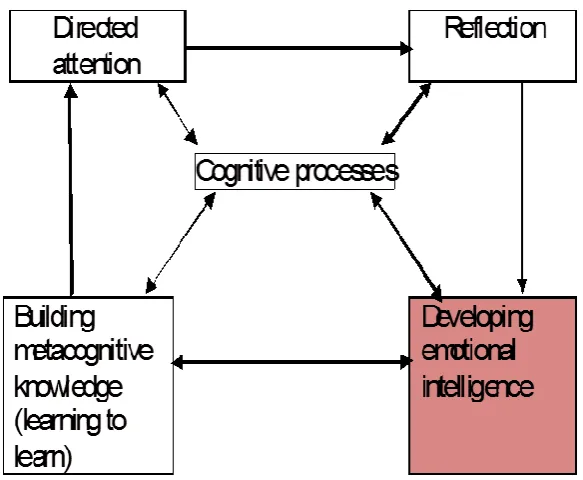
learner motivation and the role of collaboration, led to a revised definition and model which
emphasized the importance of affect as a category in its own right (as opposed to being
implied within the others), as shown below.
18
Figure 2. A model for the development of autonomy: individual level. The psychology of autonomous learning, adapted from Benson (2001, p. 86) (O'Leary, 2014, p. 21).
Phase 2 Data Collection, Example of Data/analysis and Outcomes
Based on the revised model of control over cognitive processes, I analysed 28 self-evaluation
reports (students produce only one per portfolio-based assessment) and five learner diaries
from the student learners (diaries were not compulsory and only five students completed
theirs) as well as entries from my own research diaries, as a learner practitioner-researcher,
for evidence of control over cognitive processes, using the following broad categories:
attention: active engagement with linguistic input, involving conscious apprehension and awareness of specific aspects of the language;
metacognitive knowledge at task level encompassing: any evidence of decision to carry out the task, decisions about content, progression, place and time of learning,
the selection and use of cognitive strategies, and the criteria selected for evaluation;
19
emotional intelligence (affect): any evidence of attempting to lower their own anxiety, encouraging themselves, taking their emotional temperature as well as empathizing
and cooperating with others.
There was some significant overlap between the categories so the choice of which
evidence to list under one rather than another could be arbitrary. However, all the evidence
contributed to demonstrating control over cognitive processes as proxy for evidence of
autonomy.
Self-evaluation reports
The findings suggested that, in practice, the student learners displayed some degree of autonomy. Contrary to expectations based on the focus group data, reliance on tutor support and subject expertise appeared to be more limited than expected, although there was a
discrepancy between the diary entries and the self-evaluation in this area which would be
worth exploring further. A few extracts below illustrate the data analysis:
Attention Although perhaps most difficult to identify, 7 out of the 28 self-evaluation reports indicated a focus on particular linguistic aspects such as specific items of vocabulary:
I also learnt a lot of new vocabulary as the medical and legal French was quite complicated (SE9)vii
or specific linguistic skills such as grammar:
Thanks to this report, I think I have made a lot of progress, particularly as far as my vocabulary and grammar are concerned (SE20).
Task Knowledge (Metacognitive knowledge at task level) was quite complex since the task’s aims included more than just linguistic development. The task knowledge implicit in the
students’ self-evaluation could relate to generic skills, subject knowledge as well as language
learning. A number of students appeared to approach the task in a holistic way rather than
attempt to distinguish between the various aspects of the learning experience. The distinction
20
accommodated in either. In the typical example below, the student was approaching the task
in a way that is contrary to the advice given i.e. to find a theme/topic then plan the content of
the report and then search for available sources. Only seven out of the 28 self-evaluations
referred to the chosen/theme topic at the beginning.
In doing the portfolio, I found a new way of working: research then write. When I write something for my law course, I write, and then I find examples or quotations to support what I think. (SE 12)
This constituted an indication of some degree of autonomy in the way content is selected
based on their prior experience.
Reflection: All the self-evaluation reports contained some form of reflection which is to be expected since their stated purpose is reflection on the learning experience. Not all students
covered all the aspects. In fact, learners seemed to have focused on negative aspects as well
as positive ones. 13 out of the 28 self-evaluation reports started with difficulties experienced
with sources such as:
It was difficult to find sites which simply covered law (SE11).
15 out of the 28 reports highlighted linguistic progress as part of their reflection. Six focused
on the acquisition of specialist language, particularly vocabulary:
I have learnt more vocabulary relating to my subject and I have developed my skills.
(SE10)
A minority (around 4 of the 28 self-evaluation reports) mentioned an improvement in skills
such as reading and writing or more specific ones such as summarising:
I have learnt how to do summaries, and now I can write a summary when I want.
21
Some described progress in very general terms or simply stated that vocabulary and/or
grammar had improved. Only two self-evaluation reports identified some weaknesses and
suggested how they might remedy them:
Generally, I am pleased with my progress but sometimes my grammar isn’t perfect because I have forgotten certain aspects and I need to revise these. (SE27)
Emotional intelligence (affect) was limited to motivation/engagement:
This project has given me a sense of achievement; also I have put a lot of time and effort into the project. (SE9)
The role/influence of the tutor, was not as prominent as might have been expected from Phase 1 findings. Despite the central role given to the teacher in Phase 1, only two students referred
to the influence of the tutor on their progress:
[..].the meetings with my tutor ensured that I made regular progress (SE14)
and
The comments, corrections, advice and recommendations of my tutor guided me.
(SE5)
Learner diaries
The five learner diaries ranged from weekly detailed accounts to a one sentence entry against
a list of dates. In terms of process, four out of the five started with the search for sources and
the problem associated with this:
22
Four out of the five referred to a tutor. A typical entry simply mentioned the existence of an
appointment with the tutor. Only one diary gives a detailed account of discussions and their
outcome:
I arranged an appointment with Mrs O [..] to check the progress of my research. We examined the sources I had found on work legislation and my ideas on how to plan the report.viii (LD 19)
The tutor was generally mentioned several times, up to five in one learner diary, LD3. This
was in sharp contrast with the self-evaluation reports which are supposed to be based on diary
entries. The teacher was not even mentioned once in SE3 relating to the above mentioned
diary. The explanation could lie with what they understood a self-evaluation task to be. The
available diaries included more information on the role of other agents such as the teacher
and much less on reflection about the task and their own progress.
Learner-researcher practitioner diary
My own diaries were analysed using the same categories as for the students'. In all 27 entries
between 10 and 20 pages long were analysed. The extracts gave a flavour of the context of
the research as I ‘lived’ it / perceived it.
Attention was as difficult to identify as in the case of the student learners. This was perhaps even more the case because my focus was not language as such. However, the following
extract from a diary entry suggested a focus on terminology although this is inextricably
linked with concepts and therefore overlaps with reflection.
23
Task Knowledge (Metacognitive knowledge at task level) was an aspect which had quite extensive coverage both in relation to literature review and the field work. The following
extract which was typical of many entries throughout the three years encompass evidence of
the decision to carry out the task, select its content and use of cognitive strategies:
[I] decided to spend the afternoon finishing “interviewing for social scientists”. The analysis and profile must be written (DOL 4)
Reflection as in the case of the student learners and as might be expected from the nature of a diary is wide-ranging. The diary entries included reflection on concepts and theories, research
process, student achievements relating to the study and dealing with dependent students
My last focus group ran just before Easter with a number of stage 4x students (3 actually since 2 didn’t turn up). The mix of the group was very different from the previous ones- [..] they were all reasonably cosmopolitan- an ‘independent’ group who were confident of their language ability. They also must have learnt an awful lot of the language whilst abroad and yet were still prepared to assert the centrality of the teacher in the learning process. (DOL 10)
Emotional intelligence (Affect) unlike the other two categories, in the same way as in the case of the student learners, there was little explicit evidence of “control over affect” although
there were a few examples of dialogue relating to curriculum development (partially
influenced by the study) which could fit within the social dimension of affect i.e.
“empathising” and “cooperating with others” as illustrated by the extracts below:
24
own research, and mooted the possibility of including a collaborative task to encourage peer support. This seems to appeal to most, except for Italian who had small numbers anyway […]. We discussed criteria. I did not really wish to include performance but was outnumbered. I did argue about it being ‘low stakes’ and we settled for 20% (DOL 12)
The role of the teacher (read here supervisor) was mentioned explicitly in a small number of entries (5 out of 27) but tails back as the thesis progressed. The entries referred to two aspects
of the supervisor’s role: help/feedback and as a ‘motivator’ to undertake the various activities
relating to the thesis.
Whilst Phase 2 concluded that there was some clear indication of the students
demonstrating their autonomy in relation to other aspects, explicit evidence of control over the affective dimension was limited. Apart from one or two of the Learner-researcher practitioner's diary entries, there was no evidence in relation to cooperation or other
relational aspectssuch as empathy with other learners, despite the prominence given to those aspects by the focus groups’ participants who were the authors of the majority of the
self-evaluation reports. These findings suggested the need for collaborative activities and for paying more attentionto the affective dimension of the learning process, through raising learners’ awareness at an individual as well as a collective level. Creating more opportunities
for collaboration with peers and encouraging students to engage with, as well as articulate,
the emotional dimension of the learning experience was something which the language team,
consisting of all the module leaders of the advanced ULS stages, myself included, considered
and developed through revising the curriculum delivery and assessment of the ULS 5, 6A and
6B modules as a result of discussions arising from the outcomes of the study. In relation to
the affective dimension, in particular, we now encourage feedback to peers and
self-evaluation relating to these issues after discussing these aspects in class.
Conclusion
In summary, Phase 1 of the research enabled the identification of emotional intelligence or
meta-affect as an important element in the development of autonomy, leading to its addition
25
assess the development of autonomy in practice, despite some difficulty with the “attention”
criteria. Although all the self-evaluation reports demonstrated that students had developed a
degree of autonomy, including some independence from the teacher, evidence of the
development of meta-affect was absent.
As demonstrated by the overview of the methodology and the above brief account of
its outcomes, I found the postmodern orientation to be an empowering approach to the use of
theories and frameworks; avoiding closing down or limiting the ways in which participants
can be understood or “conceive of themselves.” It facilitated a dynamic research design and
the adaptation as well as use of existing theories. It also gave me the opportunity to articulate
my own voice openly through the analysis of my diary entries and reflection sections, rather
than covertly. The student voice changed my perception that metacognition was the most
important element in the development of autonomy. The change of emphasis in my own
understanding of autonomy and focus of research is best reflected by the new broader title of
“Developing autonomous language learners within the HE curriculum: a postmodern and social constructivist perspective” finally adopted for the study. This has also impacted on the way I now approach learner development, in my own practice, particularly in relation to the
affective dimension which now forms an integral part of class discussions as well as oral and
written peer and tutor feedback, with some initial evidence of success (see O'Leary, 2014).
Review Process
This paper was peer-reviewed by the following contributors to Issue 2, Ryo Moriya. It was
26
References
Arskey, H. and Knight, P. (1999). Interviewing for Social Scientists. London: Sage Publication.
Bandura, A. (1977). Self-efficacy: toward a unifying theory of behavioural change.
Psychological Review, 41: 191-215 as cited in M Williams and R Burden (1997).
Psychology for Language Teachers. Cambridge:Cambridge University Press. Bandura, A. (1986). Social Foundations of Thought and Action: a social cognitive theory.
Englewood Cliffs, NJ: Prentice Hall.
Banister, P., Burman, E., Parker, I. & Taylor, C. (1994). Qualitative Methods in Psychology: a research guide. Buckingham, England: Open University Press.
Benson, P. (2001). Teaching and Researching Autonomy in Language Learning. Harlow, England: Longman.
Benson, P. (2011). Teaching and Researching Autonomy in Language Learning. Harlow, England: Longman (2nd Ed.).
Benson, P. and Cooker, L. (eds) (2013). The Applied Linguistsic Individual: Approaches to Identity, Agency and Autonomy. Sheffield: Equinox Publishing
Best, S. and Kellner, D. (1991). Postmodern Theory: critical interrogations. New York: Guildford Press.
Boud, D. (2012). Developing student autonomy in learning -London: Taylor and Francis Brown, T. & Jones, L. (2001). Action Research and Postmodernism: congruence and
critique. Milton Keynes: Open University Press.
Candy, P. (1991). Self-direction for lifelong learning. San Francisco: Jossey Bass. Council of Europe (2000). Common European Framework of Reference for Languages.
Available at http://www.coe.int/t/dg4/linguistic
Cooker, L. (2015). Assessment as Learner Autonomy. In C. Everhead & L. Murphy (eds)
Assessment and Autonomy in Language Learning. London: Palgrave Macmillan, pp 89-113.
Cotterall S. (1995). Readiness for autonomy: investigating learner beliefs.System, 23 (2): 195-206.
Curtis, B. (2004). Practical applications of Postmodern theory for promoting learner
autonomy in a foudation studies program. Printed proceedings of the Independent Learning Conference 2003 accessible at
http://citeseerx.ist.psu.edu/viewdoc/download?doi=10.1.1.138.757&rep=rep1&typ
27
Dam , L. (2011). Fostering learner autonomy in language learning. In D., Gardner (Ed)
Developing Learner Autonomy with School Kids: Principles, Practices and Results. Gaziantep: Zirve University, pp40-51
Derrida, J. (1976). Of Grammatalogy. Baltimore: John Hopkins.
Dörnyei, Z, MacIntyre, P. D. & Henry, A. (2015). Introduction: Applying complex dynamic
systems principles to empirical research on L2 motivation. In Z. Dörnyei, P. D.
MacIntyre & A. Henry (Eds.), Motivational dynamics in language learning. Bristol: Multilingual Matters, pp. 1-7.
Fazey, D. and Fazey, J. (2001). The Potential for autonomy in Learning: Perception of
competence, motivation and locus of control in first year undergraduate students.
Studies in Higher Education, 26 (3), pp. 345-361.
Feuerstein, R., Klein, S. & Tannenbaum, A. (1991). Mediated Learning Experience: theoretical, psychological and learning implications. London: Freund. Findley, M. and Cooper, H. (1983). Locus of Control and Academic Achievement: a
literature review. Journal of Personality and social Psychology, 44(2): 419-427. Fox, N. (2000). Social research in postmodern mood: reflexivity, collaboration and
transgression. Paper presented at Current issues in Qualitative Research Conference, University of East Anglia, UK 24-25 July.
Haber, H. (1994). Beyond Postmodern Politics. Lyotard, Rorty, Foucault. New York: Routledge.
Hill, D., McLaren, P., Cole, M. and Rikowski, G. (eds) (1999) Postmodernism in Educational Theory: Education and the Politics of Human Resistance. London: Tufnell Press. Hoidn, S. and Kӓrkkӓinen, K. (2014). Promoting Skills for Innovation in Higher Education: a
literature review on the effectiveness of problem-based learning and of teaching behaviours. [online]. OECD Education Working Papers, 100.
http://www.oecd.org/officialdocuments/publicdisplaydocumentpdf/?cote=EDU/W
KP(2013)15&docLanguage=En
Karlsson, L (2008). Turning the kaleidoscope: (E) FL Educational Experience and Inquiry as Auto/ biography. Helsinki: Helsinki University Language Centre Publications Krueger, A. (1994). Focus Group: A Practical Guide for Applied Research. London: Sage
publications (2nd edition).
Karlsson, L. & Kjisik, F. (2009). Whose story is it anyway? Auto/biography in language
28
Mapping the Terrain of Learner Autonomy (pp. 168-179). Tampere: University of Tampere.
Kohonen, V. (1992). Experiential language learning: second language learning as cooperative
learner education. In D. Nunan, D. (ed) Collaborative Language Learning and Teaching (pp14-39). Cambridge: Cambridge University Press.
Lai, J. (2001). Towards an analytic approach to assessing learner autonomy. In L. Dam (ed)
Learner Autonomy: new insights. AILA review 15: 34-44.
Lamb, J. (2009). Controlling learning: relationships between learners voices and motivation.
In S., Toogood, R., Pemberton and A. Barfield (eds). Maintaining control: Autonomy and Language Learning (pp 67-86). Hong Kong: Hong Kong Press. Little, D. (2000). Learner autonomy and human interdependence: Some theoretical
consequences of a social-interactive view of cognition, learning and language. In
B. Sinclair, I, McGrath, & T. Lamb (eds) Learner autonomy, teacher autonomy: Future directions (pp 15-23).London: Longman..
Lyotard, JF. (1984). The postmodern condition: a report on knowledge. Manchester, England: Manchester University Press.
Maykut, P. & Morehouse, R. (1994). Beginning qualitative research: A philosophic and practical guide. London: Falmer Press.
Nunan, D. (1992). Research Methods in Language Learning. Cambridge: Cambridge University Press.
O'Leary, C. (2006). Supporting the development of autonomy in advanced language learners
on an institution-wide language programme. In K. Smith (ed). Making Links, Sharing Research (pp 51-64). Sheffield, England: Sheffield Hallam University Press.
O'Leary, C, (2010). Developing autonomous language learners within the HE curriculum: a postmodern and social constructivist perspective. Unpublished thesis. Sheffield: Sheffield University Library.
O'Leary, C. (2014). Developing Autonomous Language Learners in HE: A Social
Constructivist Perspective. In G Murray (ed). Social Dimensions of Autonomy in Language Learning. London: Palgrave Macmillan.
Oxford, R. (1990). Language learning strategies: what every teacher should know. Rowley, Mass: Heinley and Heinley.
Oxford, R. (2016). Powerfully Positive: Searching for a Model of Language Learner
29
on Foreign Language Learning and Teaching (pp 21-37). Heldelberg: Springer International.
Paris, S. and Byrnes, J. (1989). The constructivist approach to self-regulation and learning in
the classroom. In B Zimmerman and D, Schunk (eds). Self-regulated Learning and Academic Achievement (pp 169-200). New York: Springer-Verlag.
Pennycook, A. (1997). Cultural alternatives and autonomy. In P Benson and P Voller (Eds).
Autonomy and Independence in Language Learning (pp 35-53). London and New York: Longman,
Raya, MJ., Lamb, T. & Vieira F. (2007). Pedagogy for Autonomy in Language Education in Europe: Towards a Framework for Learner and Teacher Development. Dublin: Authentik.
Raya, MJ. & Lamb, T. (2008). Pedagogy for Autonomy in Language Education. Dublin: Authentik.
Roseneau, P. (1992). Postmodernism and the Social Sciences. Princeton, NJ: Princeton University Press.
Sarup, M. (1993). Post-structuralism and Post-modernism. Hemel Hempsted: Harvester-Wheatsheaf.
Saussure, F. (1910-11). Third Course of Lectures on General Linguistics. New York: Pergamon.
Smith, J. and Hodkinson, P. (2009). Challenging Neorealism: A response to Hammersley. Qualitative Inquiries, 15(30): 30-39.
Stronach, I. and MacLure, M. (1997). Educational research undone: the postmodern embrace. Buckingham, England: Open University Press.
Tassinari, MG. (2015). Assessing Learner Autonomy : A Dynamic Model. In C Everhard, &
L Murphy (eds) Assessment and Autonomy in Language Learning (pp 64-88). London: Palgrave Macmillan.
Wenden, A. (1995). Learner training in context: a knowledge-based approach. System 23 (2): 183-94 as cited in Benson, P. 2001. Teaching and Researching Autonomy in Language Learning (pp 96-97). Harlow, England: Longman,
Wenden, A. (1998). Metacognitive knowledge and language learning, Applied Linguistics, 19(4): 515-37 as cited in P. BENSON (2001). Teaching and Researching
30 Appendix A
Focus group 1- - Stage 5- meeting 1 Present: Scott , Janine and Anna-Marie
What makes a good teacher?
Somebody who cares about students progress/ students' experience Approachability
Good listener
Somebody who understands students/ what they do/ What they want understands different students and their objectives
being aware of the needs of students
needs to be able to reach the students to inspire them
Break down barriers between students and teachers- encourages (social worker sort of role)
Teacher should have an interest in the subject-/passion & enthusiasm which is transmitted to students
Help should be readily available- they should make time. Job= teaching students therefore should be a priority
Recognition & rewards to good students prizes/ certificates
a word of praise/ book tokens
motivation-competition between students
Main role of the teacher is to get the students to learn
Ask the students what would motivate them/ setting achievable goals Teaching style on the level with their students
Patience- empathy with students' difficulties
Know how to handle different students- more experienced teachers appear more confident
Classroom management/ discipline organisation
What makes a good learner ? Hard-work
make sure you do your homework +reading round or doing something extra ask for help and advice
look what you are supposed to have learnt from homework Willingness to work
Learner aware of objectives given by teacher/ to make themselves acquainted with the subject
Work on their own + go back to teacher with questions- tutors= main experts/ source of advice
Main objectives= to pass the subject/ to know enough about the subject to pass (major) Understanding the subject for further studies (minor)
the ability to prioritise what they need to learn Making friends (minor)
Enjoying the subject
31 Relating to real life
Looking at background/ concrete examples from
Good teacher (follow-up from last focus group)
Subject knowledge- 1= (link to enthusiasm for their subject/ teaching) Empathy (understanding student needs/ objectives) 4=
Approachability 4= (link with empathy)
Experience 3= (link classroom management/ knowledge of teaching methodologies/ how to teach)
Good preparation 2= (link with organisation)
Classroom management 3= ((link experience/ knowledge of teaching methodologies/ how to teach)
organisation 2=(link with good preparation)
Enthusiasm for their subject/ teaching 1= (link with subject knowledge) Knowledge of teaching methodologies/ how to teach 3= (link classroom
management/experience)
Good learner- More general points applying to both School and HE
Willing to do (hard)- work- willingness to learn/ motivation/ organisation/ target setting 1
Ability to prioritise what they need to learn HE 3= (equal to recognition motivator/ pressure)
Willing to do extra work/ to find out more -using theory + applying own experience 4= Interest in the subject studied 2 (interest=experience)
School different from HE- HE requires self-motivation/ learning to be independent. Independence taught gradually.
Think of activities when you really learnt something-What/ how/ where/why
Example 1- Working for a seminar. Had to do research and then present it atUniversity. Worked because there was structure and discussion. You did your research, shared ideas and took time.
Example 2- Revision for an exam. Involved group work and discussion in bedroom in
France. Successful because worked together as a team / shared
Example 3- Research. Had to visit various places/ sites around the region-to be completed
32
Focus group 1, meeting 2 (continued)
Think of activities when you didn't learn What, how, where and why
Focus Group 3- Stage 5- Meeting 1 (only one meeting with this group) Present: David, Sian, Lesley, Jocelyn and Frances.
Good Learner
Self-motivated 1
want to learn
able to be motivated & learn yourself
Good listener 3= ( equal to attendance/ participation) open-minded- understands & accept others' opinions
Take time to understand 2= (equal to well-organised)
Well-organised- organisation/ time management 2= (equal to take time to understand)
Attendance 3= (equal to take time to understand/ participation) Participation 3= (equal to attendance/ good listener)
Good language learner (additional characteristics)
Time out of lesson- learning vocab and grammar.
Interested in the subject 1 (Sian/ Jocelyn)/ 1/ 2 (Frances) [also valid outside of languages] Very attentive- pronunciation 1 (David)
Immersion in the target language 1 (Lesley) Language- listening to radio/ reading etc.. Need to sustain effort- learning process gradual
Good Teacher
Able to come down to the level of the learner 2= ( equal to patience) No favouritism- no preference for more able people
Patience 2= (equal to able to come down to the level of the learner/ Relate to students/ Confident)
Example 1-Law lesson in France. Couldn't understand. Paid no attention/ switched off/ confused. At university in France. Couldn't engage in the learning.
33 Good in-depth knowledge of the subject 1= varies the lesson 3=
involves the student in the lesson- encourage participation 3 by not talking too much
ask students' opinion
group work- classroom discussion
move around the class to individual students uses visual aids rather than talking
Relate to students 2= (equal to able to come down to the level of the learner/ patience/ Confident)
not too serious approachability personality
34
End notes
iModules refer to the constitutive elements of a course or programme of study. Undergraduates students
typically study 6 X 20 credit modules a year or a total of 18 (360 credits) for a three year undergraduate degree.
iiCommon European Framework for Languages
iii The percentage has varied every year based on module review across all languages.
iv When the portfolio was worth 10% of the overall module mark, the negotiating oral and reports were done
outside the portfolio as summative tasks worth 25% each.
v This is my description of the author's research framework rather than their own.
vi Different Christian names were used to preserve confidentiality
vii
Self-Evaluation- Portfolio 9 viii Translated from the French.
ix Diary-Learner practitioner-researcher (COL) with extract no
x