SIMULTANEOUS ESTIMATION METHOD DEVELOPMENT AND
VALIDATION OF ACEBROPHYLLINE AND DOXOFYLLINE IN
TABLET DOSAGE FORM BY RP-HPLC METHOD
Shinde Madhuri*, H. S. Bhawar and Prof. G. S. Shinde
Pravara Rural College of Pharmacy, Pravaranagar, Tal- Rahata, Dist. – Ahmednagar,
Maharashtra, India.
ABSTRACT
A simple, accurate, precise and reproducible Reverse Phase High
Performance Liquid Chromatography method was developed and
validated for simultaneous estimation of Acebrophylline and
Doxofyllinein tablet dosage form. Chromatographic separation was
achieved by Cosmosil C18 (250 mm x 4.6 ID, Particle size- 5 micron)
column and Methanol: 10mM KH2PO4 buffer (70:30)as mobile phase,
at a flow rate of 0.8 ml/min (millilitre per minute) using UV detection
at 243nm. The retention time for Acebrophylline and Doxofylline were
obtained as 4.076min and 5.193 min. respectively. The method has
been validated for linearity, accuracy, precision, LOD, and LOQ.
Linearity of Acebrophylline and Doxofyllinewere found to be 5-
25μg/ml.(R2=0.999) and 20- 100μg/ml.(R2=0.999) respectively. The accuracy of present
method was evaluated at 50%, 100%, 150%. Recovery was found to be in a range from
99.46%-99.98% for Acebrophylline and 99.91%-100.12% for Doxofylline. Intermediate
precision studies were carried out and the RSD values were less than 2%. Lower values of
LOD (0.150μg/ml) and LOQ (0.455μg/ml) for Acebrophylline and LOD (0.127μg/ml) and LOQ (0.385μg/ml) fordoxofylline indicated good sensitivity of the method. In this study, the
optimization of mobile phase, flow rate, injection volume and wavelength were achieved.
This demonstrate that the developed method is simple, precise, accurate and robust for
simultaneous estimation of Acebrophylline and Doxofyllinein tablet dosage form.
KEYWORDS: Acebrophylline and Doxofylline, RP-HPLC, Validation.
Volume 8, Issue 11, 644-657. Research Article ISSN 2277– 7105
Article Received on 05 August 2019,
Revised on 26 August 2019, Accepted on 14 Sept. 2019
DOI: 10.20959/wjpr201911-15741
*Corresponding Author
Shinde Madhuri
Pravara Rural College of
Pharmacy, Pravaranagar,
Tal- Rahata, Dist. -
Ahmednagar, Maharashtra,
1. INTRODUCTION
Acebrophylline: It acts as a bronchodilator effect due to inhibition of the intracellular
phosphodiesterases followed by an increase of adenosine monophosphosphate cyclic
levels, which promote the relaxation of bronchial muscles. Ambroxol act as a mucolytic
agent by increases the mucociliary clearance by stimulating cilia motility.[1] ACEBRO
inhibit the synthesis and release of leukotrienes and tumoir necrosis factors and reduce
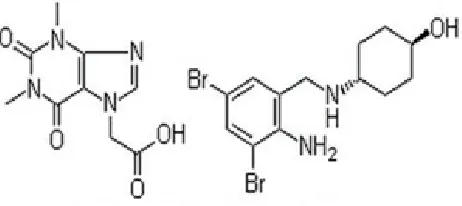
inflammation. Its chemical name is
(1,3-dimethyl-2,6-dioxo-1,2,3,6-tetrahydro-7H-purine_7yl) acetic acid- 4{[(2-amino-3,5-dibromophenyl)methyl]amino} cyclohexanol[2]
having molecular formula C22H28Br2N6O5 with molecular weight 616.311gm/mol. It
[image:2.596.181.412.297.400.2]appears as white crystalline powder.
Figure no.1: structure of Acebrophylline.
Doxofylline: One of the mechanisms of action of is thought to arise from the inhibition of
phosphodiesterase activity thus increasing the levels of cAMP and promoting muscle
relaxation. The interaction of DOXO with beta-2 adreno receptors was demonstrated by a
study using nonlinear chromatography, frontal analysis and molecular docking .serine 169
and serine 173 residues in the receptor are thought to be critical binding sites for DOXO
where hydrogen bonds are formed. Via mediating the actions of beta-2 adreno receptors,
DOXO induces blood vessel relaxation[3] and airway smooth muscle relaxation having
chemical name as:
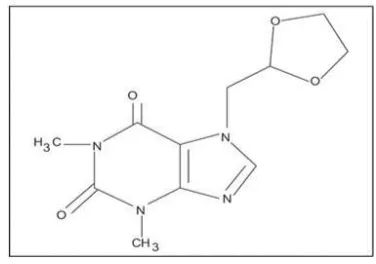
7-(1,3-dioxolan-2-ylmethyl)-3,7-dihydro-1,3-dimethyl2,3,6,7-tetrahydro- 1H-purine-2,6-dione.
Molecular formula C11H14N4O4 with molecular weight 266.25gm/mol. It appears as
Figure no. 2: Structure of Doxofylline.
Literature review revealed that UV- spectrophotometric[5] and HPTLC[6] methods are
reported for the estimation of Acebrophylline alone. It was determined by HPLC [7,8], and
RP- HPLC method with another drug in combination.
RP-HPLC, HPLC, solvent extraction spectrophotometric method is reported for
Doxofylline with another drug.[9-11] A single work reported as stability indicating HPTLC
method for Acebrophylline and Doxofylline in combination.[12]
The present STUDY DEVOLPMED AND VALIDATE a reliable, rapid, sensitive and
accurate method Acebrophylline and Doxofylline in tablet dosage form by RP-HPLC
method in accordance with ICH guidelines.
2. MATERIAL AND METHOD
2.1Equipment
HPLC SYSTEM: The method was performed on UV Spectrophotometer Shimadzu model
(UV245 UV probe v 2.3.3) and HPLC 3000 series. With column CosmosilC18 (250mm x
4.6ID, Particle size: 5µ). UV-3000-M (UV-Visible Detector) has been used for detection and
P-3000- M reciprocating (binary pump) is included in the system.
Balance: All Drug and chemical were weighed on Wensar High Precision Balance (model:
PGB 100).
Sonicator: Wensar Ultra-Sonicator (WUC-4L).
Calibrated glassware’s
2.2Materials
Pharmaceutically pure sample of Acebrophylline was obtained from Alkem Laboratories Ltd.
Doxofylline was taken from Zydus cadila pharmaceutical company. And Spirodin-AB®
2.3.Mobile phase
Mobile phase containing Methanol: 10mM KH2PO4 buffer (70:30).
2.4.Stock solution of Acebrophylline
Accurately weigh 10mg pure drug of ACEBRO and dissolved in sufficient quantity of
solvent and final volume was made upto 100ml of solvent (methanol: 10mM KH2PO4 Buffer
(70:30), this gives 100 ppm solution. From that dilutions was made as 5,10,15,20,25 µg/ml
respectively was taken in 10ml volumetric flask and diluted upto the mark using methanol.
2.5.Stock solution of Doxofylline
Accurately weigh 10mg pure drug of DOXO and dissolved in sufficient quantity of solvent
and final volume was made upto 100ml of solvent (methanol: 10mM KH2PO4 Buffer
(70:30), this gives 100 ppm solution. From that dilutions was made as 20,40,60,80,100 µg/ml
was taken in 10ml volumetric flask and diluted upto the mark using methanol.
2.6.Analysis of marketed formulation:
The marketed formulation, Spirodin-AB® was analyzed using the developed method. 20
tablets were weighed accurately and finely powdered. A quantity of powder equivalent to
10mg of ACEBRO and 40mg of DOXO was weighed and transferred into 10ml volumetric
flask and sonicated for 15min then make up the volume upto 10ml with methanol. The
resulting solution was filtered using 0.45µm filter.
i. Selection of analytical wavelength
Accurately weighed quantity of ACEBRO and DOXO 10mg pure drug dissolved in 10ml of
solvent ( methanol : 10mM KH2PO4 Buffer (70:30), this gives 1000ppm solution. From that
0.25ml was taken in 10ml volumetric flask and diluted upto the mark using methanol.
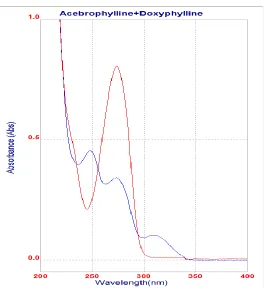
Solution was scanned using UV-Visible Spectrophotometer in the spectrum mode between
Figure no. 3: analytical wavelength graph.
ii. Selection of mobile phase
The pure drug of ACEBRO and DOXO was injected into the HPLC system and run in
different solvent systems. Mixture of different solvents were tried to determine optimum
chromatographic conditions for effective elution of relative drug. After several trial, it was
found that the methanol : 10mM KH2PO4 Buffer (70:30) give good result as compared to
other mobile phase.
System suitability
The column was equilibrated with the mobile phase (indicatedby constant back pressure
at desired flow rate). Working standard solution of drug was injected into the system. The
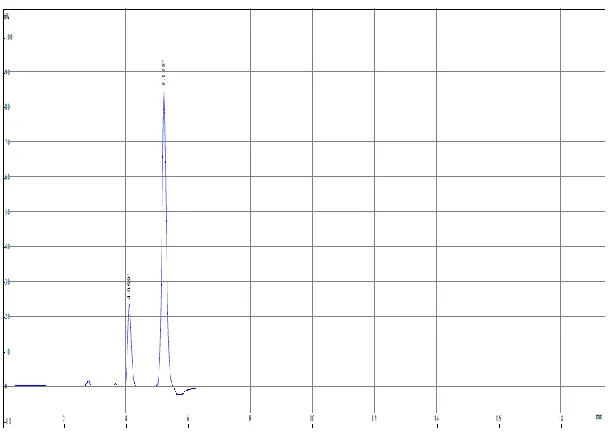
Figure no.4. Chromatogram for System suitability standard.
Table no. 1: System suitability parameter for final optimized chromatographic
condition.
Time Area Resolution Th. plate Asymmetry
4.069 226780 4.70 9666 1.17
5.185 931707 0.00 9822 1.10
3. METHOD VALIDATION
3.1.Assay
By using the standard areas from linearity of reported concentration the % assay was
[image:6.596.145.449.73.293.2]calculated. The data for assay of acebrophylline and Doxofylline os shown in table no. 2.
Table No. 2: Assay result of Tablet formulation.
Drug Concentration
(µg/ml)
Area of standard
Area of sample
% Assay(w/v)
ACEBRO 15 621862 617632 99.319
DOXO 60 2653366 2650653 99.89
3.2.Linearity
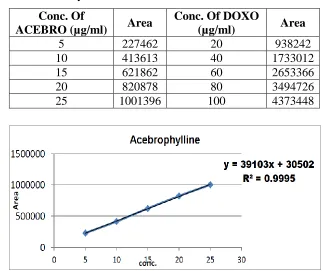
Linear relation was obtained between mean peak area and concentration of the drug in the
range of 5-25µg/ml for Acebrophylline and 20-100µg/ml for Doxofylline. The data of peak
areas obtained with the respective concentrations in µg/ml are shown in table no. 3 for
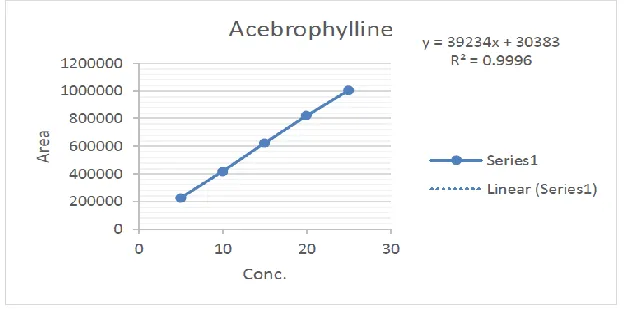
Acebrophylline and Doxofylline. The linearity curve for Acebrophylline is shown in figure
Table no 3: Data of linearity for ACEBRO and DOXO.
Conc. Of
ACEBRO (µg/ml) Area
Conc. Of DOXO
(µg/ml) Area
5 227462 20 938242
10 413613 40 1733012
15 621862 60 2653366
20 820878 80 3494726
25 1001396 100 4373448
[image:7.596.141.454.402.569.2]Figure no. 5: Calibration curve for Acebrophylline.
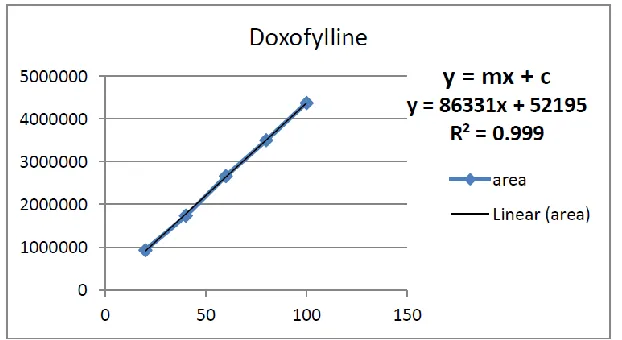
Figure no. 6: Calibration curve for Doxofylline.
3.3.Accuracy
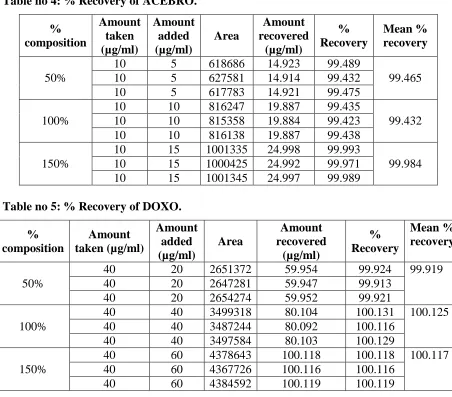
Recovery studies were carried out by addition of standard drug to the solution at 3 different
concentration level (50%, 100%, 150%) taking into consideration percentage purity of added
bulk drug samples. These was analysed and results were calculated the % recovery data is
Table no 4: % Recovery of ACEBRO. % composition Amount taken (µg/ml) Amount added (µg/ml) Area Amount recovered (µg/ml) % Recovery Mean % recovery 50%
10 5 618686 14.923 99.489
99.465
10 5 627581 14.914 99.432
10 5 617783 14.921 99.475
100%
10 10 816247 19.887 99.435
99.432
10 10 815358 19.884 99.423
10 10 816138 19.887 99.438
150%
10 15 1001335 24.998 99.993
99.984
10 15 1000425 24.992 99.971
10 15 1001345 24.997 99.989
Table no 5: % Recovery of DOXO.
% composition Amount taken (µg/ml) Amount added (µg/ml) Area Amount recovered (µg/ml) % Recovery Mean % recovery 50%
40 20 2651372 59.954 99.924 99.919
40 20 2647281 59.947 99.913
40 20 2654274 59.952 99.921
100%
40 40 3499318 80.104 100.131 100.125
40 40 3487244 80.092 100.116
40 40 3497584 80.103 100.129
150%
40 60 4378643 100.118 100.118 100.117
40 60 4367726 100.116 100.116
40 60 4384592 100.119 100.119
3.4. PRECISION
3.4.1. Repeatability
It was performed by 100% test concentration level and %RSD was calculated. The data for
repeatability (intraday) for Acebrophylline is given in table no.6 and for Doxofylline is given
in table no.7.
The data for repeatability (interday) for Acebrophylline is given in table no. 8 and for
Doxofylline is given in table no.9.
Table no. 6: Repeatability (intra-day) result of ACEBRO.
Conc. of Acebro
(µg/ml) Morning Evening Mean %RSD
15
621862 625010
623399.33 0.66%
627529 626488
Table no. 7: Repeatability (intra-day) result of DOXO.
Conc. Of DOXO (µg/ml) Morning Evening Mean %RSD
60
2653366 2644788
2651804.5 0.24% 2655358 2652699
2660396 2644220
Table no. 8: Intermediate (inter-day) result of ACEBRO.
Conc. Of ACEBRO (µg/ml) Day 1 Day 2 Mean %RSD
15
621862 618325
627922 0.58% 627529 623807
623394 627922
Table no. 9. Intermediate (inter-day) result of DOXO.
Conc. Of
DOXO (µg/ml) Day 1 Day 2 Mean %RSD
60
2653366 2646678
2659202 0.19% 2655358 2657469
2660396 2659202
3.5 Ruggedness
The data for ruggedness of Acebrophylline and Doxofylline is shown in table no 10.
Table no. 10: Data of ruggedness for ACEBRO and DOXO.
Conc. Of ACEBRO (µg/ml) Area Conc. Of DOXO (µg/ml) Area
5 226620 20 940468
10 416724 40 1736384
15 624260 60 2659736
20 822012 80 3497753
25 1004814 100 4376358
The ruggedness curve for Acebrophylline and Doxofylline is shown in figure 7 and 8
[image:9.596.143.456.582.737.2]Figure no.8: Ruggedness curve for Doxofylline.
3.6. Robustness
It was calculated by using two methods, i.e. change in flow rate and change in wavelength.
3.6.1. The data for robustness of Acebrophylline and Doxofylline for change in flow rate is
shown in table no. 11 and 12 respectively.
Table No. 11: Result of change in flowrate for ACEBRO.
Conc. (µg/ml) Flowrate(ml/min) Area Mean SD %RSD
5 0.8 413613
413660.7 3002.784 0.725905073
5 0.9 410682
5 0.7 416687
Table No. 12: Result of change in flowrate for DOXO.
Conc. (µg/ml) Flowrate(ml/min) Area Mean SD %RSD
20 0.8 1733012
1735373 2422.157 0.139575566
20 0.9 1737852
20 0.7 1735255
3.6.2. The data for The data for robustness of Acebrophylline and Doxofylline for change
in wavelength is shown in table no. 13 and 14 respectively.
Table no. 13: Result of change in wavelength for ACEBRO.
Conc. (µg/ml)
wavelength
(nm) Area Mean SD %RSD
5 253 411689
411784.3 1782.913 0.432972421
5 257 410051
Table no. 14: Result of change in wavelength for DOXO.
Conc. (µg/ml)
wavelength
(nm) Area Mean SD %RSD
20 253 1735210
1732299 3325.332 0.191960627
20 257 1728675
20 243 1733012
3.7 Limit of Detection (LOD), Limit of Quantification (LOQ).
Limit of Detection: LOD=3.3(SD) S
Where,
SD=standard deviation. S= slope
3.7.1. Limit of quantitation
From the linearity data calculate the limit of quantitation, using the following formula
LOQ= 10(SD)
S
Where,
SD=standard deviation S=slope.
Limit of detection: LOD was found to be 0.1504 for ACEBRO and 0.1271 for DOXO. Limit
of quantitation: LOQ was found to be 0.4559 for ACEBRO and 0.3852 for DOXO.
4. RESULT AND DISCUSSION
Optimized chromatographic condition
The optimize chromatographic condition figure 3. The best peak shape and maximum
separation was achieved with mobile phase Methanol: 10mM KH2PO4 (70:30) with the flow
rate of 0.8ml/min. Column used Cosmosil C18 (250mm x 4.6ID, Particle size: 5 micron) as
stationary phase. Run time was 8.01min and peak was observed at 243nm which was selected
as a wavelength for quantitative estimation. Chromatogram of acebrophylline and doxofylline
is shown in figure 4 and optimized chromatographic condition is shown in table 1.
Assay
The result of assay were found to be 99.319% for ACEBRO and 99.89% for DOXO. Assay
result found close to 100%. The data was shown in table no. 2.
Linearity
curve for ACEBRO and DOXO is shown in figure 5 and 6 respectively.
Accuracy
The % recovery was found to be 99.432% for ACEBRO and 100.125% for DOXO that is
shown in table no. 4 and 5 respectively.
Precision
4.5.1. Intraday
The data for intraday precision for ACEBRO and DOXO is present in table no. 6 and 7. The
% RSD for intraday was found to be 0.66% for ACEBRO and 0.24% for DOXO.
4.5.2. Interday
The data for interday precision for ACEBRO and DOXO is present in table no. 8 and 9. The
% RSD for interday was found to be 0.58% for ACEBRO and 0.19% for DOXO.
Ruggedness
The result of ruggedness curve for ACEBRO and DOXO is shown in figure no. 7 and 8 and
in table no. 10.
Robustness
The result of robustness is shown in table %RSD of change in wavelength was found 0.432%
for ACEBRO and 0.191% for DOXO it is shown in table no. 13 and 14 respectively. %RSD
of change in flow rate was found 0.725% for ACEBRO and 0.139% for DOXO, it is shown
in table no. 11 and 12 respectively.
LOD and LOQ
LOD was found to be 0.150µg/ml for ACEBRO and 0.127µg/ml for DOXO. LOQ was found
to be 0.455µg/ml for ACEBRO and 0.385µg/ml for DOXO.
Retention time
The retention time for Acebrophylline and Doxofylline were obtained as 4.076min and 5.193
min.
5. CONCLUSION
A simple, fast, accurate and precise RP-HPLC analytical method has been developed and
form. The result obtained were within the acceptance criteria as per the ICH guidelines.
REFERENCES
1. Sravani T, Thota S, Venisetty R, Venumadhav N. RP-HPLC analysis of acebrophylline in
API and capsule dosage form. Res J pharm., 2014; 5: 480-486.
2. Jadhav NS, Lalitha KG. Development and validation of spectroscopic method for
simultaneous estimation of acebrophylline and acetylcysteine in capsule dosage form. Int
J Phaem Phytopharmacol Res., 1998; 2: 2249-2265.
3. Tripathi KD. Essential of medical pharmacology. 6th edition, New Delhi : Jaypee Brothers
Medica Publishers Ltd, 2010.
4. Indian Pharmacopoeia, Govt. Of India, Published By Indian Pharmacopoiea Commission,
Gaziabad, 2014: I And II, 7th edition: 1625.
5. Aniket R. Aligave, Harshad S. Dhamne, Shubhangee S. Gaikwad, M.S.Kondawar.
Determination Of Acebrophylline In Bulk And Pharmaceutical Formulation By UV
Spectrophotometer. Current Pharma Research, ISSN: 2230-7842, CPR, 2011; 1(3):
267-270, 267-267-270, 2015.
6. Ajinkya A. Deosthali And Mrinalini C. Damle. Development And Validation Of
Stability- Indicating HPTLC Method For Determination Of Acebrophylline. Wjpmr,
2016; 2(5): 122- 127.
7. Mohini Mittal, Yogesh Upadhyay, Durgadas Anghore, Anshul Kumar, Ravindra K.
Rawal. Simultaneous Estimation of Acebrophylline, Montelukast, And Levocetrizine
Dihydrocloride In Marketed Formulation By High-Performance Liquid Chromatography
Method. Pharm Aspire, 2018; 10(1): 23-28.
8. A.Geetha Susmita, G.Aruna, S. Angalaparameswari, M. Padmavathamma, A
Simultaneous Estimation Of Acebrophylline And Acetylcysteine In Tablet Dosage Form
By RP-HPLC Method. Asian Journal Of Pharmaceutical Research, 2015; 5(3): 143-150.
9. M Bhavani, D Sireesha, M Akiful Haque, S Harshini, Vasudha Bakshi, A Padmanabha
Rao. Analytical Method Development And Validation Of Doxofylline And Terbutaline
Sulphate By RP-HPLC Method. CODEN (USA)-IJPRUR, E-ISSN: 2348-6465, 2014;
2(6): 502-506.
10.Deepali Nanaware, Vidhya Bhusari, Sunil Dhaneshwar. Validated Method For
Simultaneous Quantitation Of Doxofylline And Terbutalline Sulphate In Bulk Drug And
11.Maulik Oza, Jagdish Kakadiya, Chirag Oza. Development And Validation Of Solvent
Extraction Spectrophotometric Method For Simultaneous Estimation Of Doxofylline And
Terbutaline Sulphate In Their Combined Dosage Form. Am. J. Pharmtech Res., 2012;
2(4): 592-604.
12.Ram S. Sakhare, Sanjay S. Pekamwar. Development And Validation Of
Stability-Indicating High-Performance Thin-Layer Chromatography Method For The
Determination Of Acebrophylline And Doxofylline In Bulk And Combined Dosage