SIMULTANEOUS ESTIMATION OF CAFFEINE AND BENZOIC ACID
IN SOFT DRINKS BY USING UV-VISIBLE SPECTROSCOPY
Vasubabu Padarthi*, Dr. K. N. Vidyadhar, Pudi Durgasyam, Yasarapu Manoj, Meka Jhansy Saranya and Mokara Laxmi Priya
Department of Pharmaceutical Analysis, V. J’S College of Pharmacy, Rajahmundry.
ABSTRACT
Five brands of soft drinks were analyzed for benzoic acid and caffeine
content by using simultaneous estimation method. The soft drink
includes Thums up, Limca, Coca cola, Sprite and Mountain dew. The
result shows that the pH of soft drinks ranges from 1.8 to 2.8. The
amount of benzoic acid and caffeine is determined by using
simultaneous estimation method. In this process, it was found that
amount of benzoic acid was low in Mountain dew. The caffeine
content in soft drinks was only found in Thums up, Coca cola and
Mountain dew and remaining other samples the presence of caffeine
absorbance under UV spectrophotometry are not detected.
KEYWORDS: Soft drinks, Benzoic acid, Caffeine, Simultaneous equation, UV Spectrophotometry.
INTRODUCTION
A soft drink is a drink that typically contains carbonated water, a sweetener and a natural or
artificial flavoring. The sweetener may be sugar, high-fructose corn syrup, fruit juice, sugar
substitutes (in the case of diet drinks) or some combination of these. Soft drinks may also
contain caffeine, colorings, preservatives and other ingredients.
Benzoic acid and its salts are used as a preservative, represented by the E-numbers E210,
E211, E212 and E213. Benzoic acid inhibits the growth of mould, yeast and some bacteria. It
is used either directly or as its sodium, potassium or calcium salt.
Volume 6, Issue 5, 749-755. Research Article ISSN 2277–7105
Article Received on 25 Feb. 2017,
Revised on 17 March 2017, Accepted on 06 April 2017
DOI: 10.20959/wjpr20175-8328
*Corresponding Author’
Vasubabu Padarthi
Department of
Pharmaceutical Analysis,
V. J’S College of
Caffeine which is chemically know as 1,3,7-Trimethylpurine-2,6-dione. Caffeine is a central nervous system (CNS) stimulant, having the effect of temporarily warding off drowsiness and
restoring alertness.
It increases calcium permeability in sarcoplasmic reticulum, inhibiting phosphodiesterase
promoting accumulation of cyclic AMP. The most prominent is that it reversibly blocks the
action of adenosine on its receptor and consequently prevents the onset of drowsiness
induced by adenosine. Caffeine also stimulates certain portions of the autonomic nervous
system.
BENZOIC ACID CAFFEINE
MATERIALS AND METHODS
The materials used are Hydrochloric acid (Molychem), Distilled water, Caffeine (Spectrum
% purity: 98.5 %), Benzoic acid (Merck% purity: 99.9%). Which are brought from the local
store of Siri scientific, Rajahmundry.
Preparation of solutions
Preparation of stock solution of benzoic acid
Weigh 0.010 gm of benzoic acid and transferred with DI water in a 500ml volumetric flask. It
may be difficult to get the solid to dissolve, so you may want to start by putting the solid in a
500ml Erlenmeyer flask (not a volumetric flask), adding about 400ml of water, and heating
on a heat plate. You will then have to make a quantitative transfer of the entire solution to the
volumetric flask. Once the solid is dissolved in the volumetric flask, fill the flask to the mark
with DI water.
Preparation of stock solution of caffeine
Prepare a stock solution of caffeine by dissolving 0.022gm caffeine (accurately weighed and
Sonicator to help dissolve the caffeine).Once the solid is dissolved fill the flask to the mark
with DI water.
Preparation of sample solutions: (Thums up, Limca, Sprite, Mountain dew, Coca cola) Pour exactly 20 ml of sample into a 125 ml Erlenmeyer flask, then Sonicator the sample for 5
minutes to remove dissolved CO2 .Using the micro pipette (with a new tip) take 2 ml of
sample in 50 ml volumetric flask and make up the volume with 0.01M Hcl.
[image:3.595.101.491.262.503.2]RESULTS AND DISCUSSIONS THUMS UP
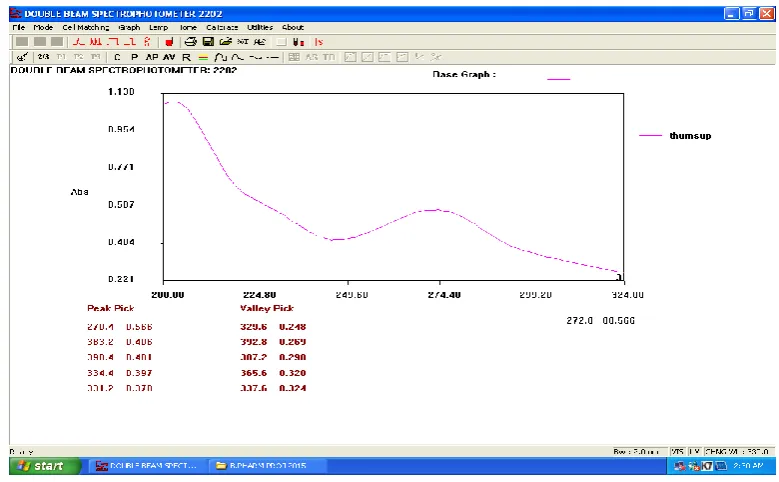
Fig no 1: Determination of caffeine and benzoic acid in Thums up.
λ for benzoic acid : 227 λ for caffeine : 272
Table no 1: λ max an absorbance values for caffeine and benzoic acid in Thums up. WAVELENGTH CAFFEINE BENZOIC
ACID THUMSUP A
1%
1cmCAFFEINE
A1%1cmBENZOIC
ACID
227 0.093 0.311 0.463 93 311
272 0.398 0.016 0.636 398 18
C1= a2λ2A1-a2λ1A2 b(a1λ1a2λ2-aλ1a1λ2)
C1=18 0.463-398 0.636 93 18-398 311
=8.334-253.128 1674-123778 = 0.002 C1= 20 mg
=93 0.636-311 0.463 93 18-398
=840.845 122104 = 0.0069; C2=69mg
[image:4.595.104.491.148.365.2]SPRITE
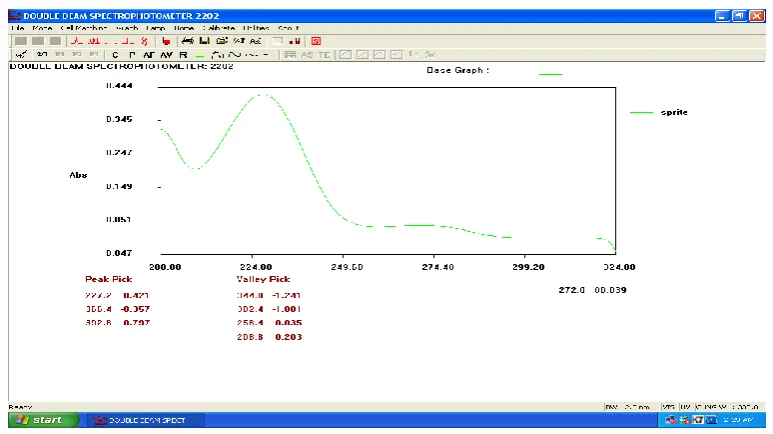
[image:4.595.83.507.423.742.2]Fig no 2: Determination of caffeine and benzoic acid in sprite.
Table no 2: λ max and absorbance value for caffeine and benzoic acid in sprite.
COCO-COLA
Fig no 3: Determination caffeine and benzoic acid in coco-cola. WAVELENGTH CAFFEINE BENZOIC
ACID SPRITE
A1%1cm
CAFFEINE
A1%1cmBENZOIC
ACID
227 0.093 0.311 0.421 93 311
Table no 3: λ max and absorbance values for caffeine and benzoic acid in coco cola.
[image:5.595.52.513.439.760.2]MOUNTAIN DEW
Fig no 4: Determination of benzoic acid and caffeine in mountain dew.
Table no 4: λ max and absorbance values for caffeine and benzoic acid in mountain dew.
WAVELENGTH CAFFEINE BENZOIC ACID
MOUNTAIN DEW
A1%1cm
CAFFEINE
A1%1cm
BENZOIC ACID
227 0.093 0.311 0.625 93 311
272 0.398 0.018 0.346 398 18
LIMCA
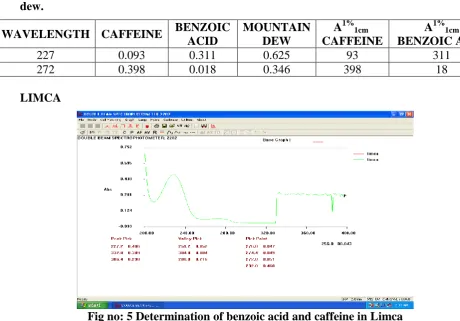
Fig no: 5 Determination of benzoic acid and caffeine in Limca WAVELENGTH CAFFEINE BENZOIC
ACID COCACOLA
A1%1cm
CAFFEINE
A1%1cmBENZOIC
ACID
223 0.093 0.311 1.427 93 311
[image:5.595.122.471.538.748.2]Table no 5: λ max and absorbance values for caffeine and benzoic acid in Limca.
Benzoic acid and Caffeine
Table no 6: Amount of benzoic acid and caffeine in soft drinks.
Company Benzoic acid concentration (mg/l) Caffeine concentration (mg/l) Company standards for benzoic acid(mg/l) Company standards for caffeine (mg/l)
[24 25 26 27 28]
Thumsup 20.0 69 70 52
Mountain dew 10.3 13.2 54 54
Limca 11.9 0.09 70 0
Coca-cola 19.8 31.2 46 46
Sprite 10.6 0.33 70 0
CONCLUSION
The analytical determination of benzoic acid and caffeine is not only important for quality
assurance purpose but also for consumer interest and protection. This work used is simple,
fast, and accurate UV-Visible spectroscopic method for the simultaneous determination of
benzoic acid and caffeine in five marketed samples of soft drinks Coca-cola, Thums up,
Sprite, Mountain dew, Limca. The results showed that the benzoic acid was found in all the
five soft drinks which are within the company standards. Whereas caffeine was found only in
Coca-cola, Thums up and Mountain dew which are also in company standards. So regular
checking of soft drinks should be done.
REFERENCES
1 H. Beckett, J. B. Stenlake. Simultaneous equations method: Practical pharmaceutical
chemistry. 4th edition part 2., New Delhi; CBS Publishers, 2007; 284-286.
2 Sandor Gorog. Multi component systems: Ultraviolet- visible spectrophotometry in
pharmaceutical analysis. Pharma Med press, 2011; 104-105.
3 Amos-Tautua, W. Bamidele Martin and E.R.E. Diepreye. Ultra-violet Spectrophotometric
Determination of Caffeine in Soft and Energy Drinks Available in Yenagoa, Nigeria.
Advance Journal of Food Science and Technology, 2014; 6(2): 155-158.
4 Doreen Amponsah. Determination of the amount of caffeine and benzoic acid in
selected soft drinks. International journal of scientific & engineering research, June 2014;
5: 1375.
WAVELENGTH CAFFEINE BENZOIC
ACID LIMCA
A1%1cm
CAFFEINE
A1%1cmBENZOIC
ACID
230 0.093 0.311 0.486 93 311
5 Zaifa Pan, Lili Wang, Weimin Mo, Wei Hu, Juan juan Zhang. Determination of
benzoic acid in soft drinks by gas chromatography with on-line pyrolytic methylation
technique. Analytica Chimica Acta, 2005; 545: 218–223.
6 M. A. Ford. The quantitative determination of benzoic acid in soft drinks by ion-exchange
chromatography. Analyst, 1966; 91: 15-22.
7 James K. Kusi, Samuel O. Levels of benzoic acid in soft drinks and fruit juices in Ghana.
IOSR Journal of Environmental Science, Toxicology and Food Technology
(IOSR-JESTFT) e-ISSN: 2319-2402, p- ISSN: 2319-2399, Dec 2014; 8: 36-39.
8 C.M. Lino , A. Pena .Occurrence of caffeine, saccharin, benzoic acid and sorbic acid in
soft drinks and nectars in Portugal and subsequent exposure assessment. Food Chemistry,
July 2010; 121: 503–508.
9 Qing-Chuan Chen, Jing Wang. Simultaneous determination of artificial sweeteners,
preservatives, caffeine, theobromine and theophylline in food and pharmaceutical
preparations by ion chromatography. Journal of Chromatography A, Dec 2001; 937: 1–2,
57–64.
10 Igelige Gerald1, David Ebuka Arthur1, Adebiyi Adedayo2. Paper Open Access
Determination of CaffeineIn Beverages. American Journal of Engineering Research
(AJER) e-ISSN : 2320-0847 p-ISSN ; 2320-0936, 2014; 3: 124-137.
11 Kathryn R. Williams, Alejandra Rodriguez Haralambides. Analysis of Soft Drinks: UV
Spectrophotometry, Liquid Chromatography and Capillary Electrophoresis. Journal of
chemical education, Feb 1966; 625: 15-22.
12 Pauline Maes, Yulia B. Monakhova, Thomas Kuballa, Helmut Reusch and Dirk W.
Lachenmeier. Qualitative and Quantitative Control of Carbonated Cola Beverages Using
1H NMR Spectroscopy. JOURNAL OF AGRICULTURAL AND FOOD CHEMISTRY,
2012 Mar 21; 60(11): 2778-2784.
13 Nancy Karreman and Tom Zuzelski. Simultaneous Determination of Benzoic Acid and
Caffeine Concentrations by Single Wavelength. Isocratic High-Pressure Liquid
Chromatography. The Journal of experimental secondary sciences.
14 James k. kusi, Samuel o.Acquaah. Levels of benzoic acid in soft Drinks and Fruit Juices