Organisational phylogenesis : Developing and evaluating a
memetic methodology.
HAWARDEN-LORD, Andrew Sinclair.
Available from Sheffield Hallam University Research Archive (SHURA) at:
http://shura.shu.ac.uk/19772/
This document is the author deposited version. You are advised to consult the publisher's version if you wish to cite from it.
Published version
HAWARDEN-LORD, Andrew Sinclair. (2004). Organisational phylogenesis : Developing and evaluating a memetic methodology. Doctoral, Sheffield Hallam University (United Kingdom)..
Copyright and re-use policy
See http://shura.shu.ac.uk/information.html
101 766 219 3
Sheffield Haliam University Learning and IT Services Adsetts Centre City Campus
Sheffield S1 1WB
ProQuest Number: 10697074
All rights reserved
INFORMATION TO ALL USERS
The quality of this reproduction is dependent upon the quality of the copy submitted.
In the unlikely event that the author did not send a com plete manuscript and there are missing pages, these will be noted. Also, if material had to be removed,
a note will indicate the deletion.
uest
ProQuest 10697074
Published by ProQuest LLC(2017). Copyright of the Dissertation is held by the Author.
All rights reserved.
This work is protected against unauthorized copying under Title 17, United States C ode Microform Edition © ProQuest LLC.
ProQuest LLC.
789 East Eisenhower Parkway P.O. Box 1346
vvS-Organisational Phylogenesis:
Developing and Evaluating a Memetic Methodology
Andrew Sinclair Hawarden-Lord
March 2004
Submitted in partial fulfilment of requirements for the degree of doctor of philosophy at Sheffield Hallam University
Facilities Management Graduate Centre Sheffield Hallam University
Unit 7 Science Park Sheffield UK
Abstract
This research evaluates the unorthodox proposition that organisational development proceeds through the Darwinian processes of variation, selection and inheritance acting upon a non- genetic replicating code. This new replicator represents the fundamental unit of cultural transmission and was termed by evolutionist, Richard Dawkins, as the meme. The memetic position re-introduces many often neglected, sometimes shunned, evolutionary arguments into social and organisational debate by providing a naturalistic and plausible hereditary element upon which socio-cultural adaptation operates.
The popularity of the neologism ‘meme’ initially grew through rather ad-hoc non-scientific usage on the Internet. For some time, this geekish tendency has tarnished the idea of memetics and impeded serious academic investigation into the subject. A more rigorous philosophical treatment has been provided by Daniel Dennett who has argued that, while a science of memetic cladistics may be both desirable and feasible, it remains unlikely. On the other hand one of Dawkins’ most famous critics, Mary Midgley, heralds dark forebodings that one-day memes may be given actual credence.
The present study necessitated the adaptation of conventional genealogical and taxonomic methods, for novel application in confirming congruence between actual organisational phylogeny and hereditary traits. One specific requirement was to develop a means of identifying, capturing and codifying such traits as meme strips for phenetic analysis. In order to handle the computational complexity inherent in the phenetic reconstruction algorithms, proprietary software had to be produced. This was extensively tested upon meme strips generated through simulated evolution. Western Christian denominational families provided a source of empirical evidence and demonstrated that the methods could be successfully applied to real organisational forms. A theological phylogeny was reliably reconstructed thereby upholding the hypothesis of cultural descent with modification based on a memetic replication. Further support for the claim was made in conjunction with the rendering of a facilities management market landscape. More importantly however, the results coming from this research suggest that the potential for formulating a science of memetics may be significantly greater than in Dennett original consideration.
2.1.1 Keywords:
Over memes there is, of course, a nightmare possibility of developing
Dawkins’s case. In a sufficiently depressed mood, a psychologist might
really feel moved to describe the history of human thought in terms of its
progressive infestation by conscious, self-interested, parasitical
bad ideas.
Mary Midgley,
Gene-Juggling
(1979 p458)
... even if memes
do
originate by a process of “descent with
modification,” our chances of cranking out a science that charts that
descent are slim.
Daniel Dennett,
Darwin’s Dangerous Idea
(1995 p356)
2.1.2 Acknowledgements
Thanks to all those who have assisted, supported, motivated, persuaded, threatened, taunted, tricked or kicked me into finally submitting this work particularly to:
Directory of Studies (If Price), supervisors and advisors. Peer reviewers, proofreaders, those who have taken time to answer my questions and SHU’s administrative teams. Numerous friends, Ivan and mum & dad.
Table of Contents
PART 1: BACKGROUND FOR AN ORGANISATIONAL MEMETICS I
PART 2: TOW ARDS THE DEVELOPM ENT OF A M EMETIC METHODOLOGY 63 2.1 Methodology Introduction 64 2.1.1 Objectives and structure o f this section 65 2.2 Premises and assumptions 66 2.2.1 Philosophical Stance 66 2.2.1.1 Metaphysics and epistemology 66 2.2.1.2 Homomorphism 68 2.2.1.3 The isomorphic proposition 69 2.2.2 Organisational theory 70 2.2.3 A model o f evolutionary biology 73 2.2.3.1 Biological principles 74 2.2.3.2 Systematics, Cladistics and Phenetics 79 2.3 Hypothesising organisational “genes” 83 2.3.1 Hypothesis rationale 83 2.3.2 The organisational “gene” hypothesis explained 88 2.4 Methodology development 89 2.4.1 Methodological isomorphism 90 2.4.1.1 In biology, phenotype & diversity have been the basis for systematics90 2.4.1.2 Commercial diversity & traits have biological analogues 90 2.4.1.3 Biota to abiota method translation & existing theoretical arguments 91 2.4.1.4 Methodological difficulties for cladistics 92 2.4.1.5 The methodological hypothesis and phenetics 92 2.4.2 Evaluating the methodological hypothesis 93 2.4.2.1 Iterations between methods 93 2.4.2.2 Diachronic / Synchronic convergence 94 2.4.2.3 Insufficiency o f phenetics alone and methodological criteria 95 2.4.2.4 Outcome matrix 97 2.4.2.5 Using a pilot study 99 2.4.2.6 Limitations and weaknesses o f methodology 102 2.4.3 Translation between domains 103 2.4.3.1 Direct reconstruction o f phylogeny using genealogical methods 103 2.4.3.2 Indirect reconstruction o f phylogeny using phenetics 105 2.4.3.3 Comparison o f direct and indirect reconstructions 108 2.5 Constructing the Method 110 2.5.1 Overview o f method structure 110 2.5.1.1 Method summary 110 2.5.1.2 Method order 112 2.5.2 Common information gathering (A) 112 2.5.2.1 Sector survey (A-i) 112
2.52.2 Operational Taxonomic Unit identification (A-ii) 113
2.5.3 Direct genealogical reconstruction (B l) 116 2.5.3.1 Historical data gathering (B l-i) 116 2.5.3.2 Genealogical reconstruction (B l-ii) 117 2.5.4 Indirect phenetic reconstruction (B2) 118 2.5.4.1 Taxa character matrix assignment - meme mapping (B2-i) 118 2.5.4.2 Phenetic reconstruction (B2-ii) 121 2.5.5 Evaluate congruence (C) 124
2.5.5.1 Problems 125
2.5.5.2 Solution 125
2.5.5.3 Methods 125
2.5.5.4 Result 126
PART 3: TRIAL APPLICATION OF RESEARCH METHOD UPON WESTERN CHRISTIAN
FAITH GROUPS 129
3.1 Application Introduction 130 3.1.1 Objecti ve and structure o f this section 130 3.2 Selection o f a test group 131 3.2.1 Selection criteria 131 3.2.1.1 Sufficient historical records 132 3.2.1.2 Distinguishable characteristics 132 3.2.1.3 Wide ranging diversity within the group 13 2 3.2.1.4 Prominent belief systems > 133 3.2.1.5 An evolutionary bloom 133 3.2.2 Candidates 133 3.2.2.1 Business fashions / fads 133
3.2.2.2 Professional bodies and professions 133
3.2.2.3 Martial arts 134 3.2.2.4 Manufacturing technology 134
3.3 Religion 134
3.3.1 Western Christianity as the target group 135 3.3.1.1 Sufficient historical records 135 3.3.1.2 Distinguishable characteristics 135 3.3.1.3 Wide ranging diversity 135 3.3.1.4 Prominent belief systems 136 3.3.1.5 An evolutionary bloom 136 3.3.2 Omission and inclusion criteria 137 3.3.3 Methodological considerations 137 3.3.3.1 Comparative religion 137 3.3.3.2 Existing typologies and taxonomies 138 3.3.3.3 Scientific & memetic perspectives on religion 140 3.3.3.4 Religion specific considerations 140 3.3.3.5 Expected observations for validating hypothesis 142 3.3.3.6 Expected auxiliaiy observations 143 3.4 Method application to religious bodies 144 3.4.1 Review o f method structure 144 3.4.2 Common information gathering (A) 144 3.4.2.1 Sector survey (A-i) 144 3.4.2.2 OTU identification (A-ii) 146 3.4.3 Direct genealogical reconstruction (B l) 147 3.4.3.1 Historical data gathering (B l-i) 147 3.4.3.2 Genealogical reconstruction (B l-ii) 148 3.4.4 Indirect phylogeny reconstruction (B2) 156 3.4.4.1 TCM assignment-meme mapping (B2-i) . 156 3.4.4.2 Phenetic reconstruction (B2-ii) 158 3.4.5 Evaluate Congruence (C) 159
3.5 Results 160
PART 4: EVALUATION OF A M EM ETIC METHODOLOGY 169 4.1 Evaluation Introduction 170 4.1.1 Objectives and structure o f the evaluation 170 4.2 Evaluating the research 171 4.2.1 Restating the aims: the measure o f success 171 4.2.2 Evaluation of the method 172 4.2.2.1 Common information gathering 173 4.2.2.2 Phylogenealogy: historical iteration 173 4.2.2.3 Phenetics: ahistorical iteration and meme mapping 174 4.2.2.4 Evaluating Congruence 175 4.2.2.5 Overall method review 177 4.2.3 Evaluating the methodology and its hypothesis 178 4.2.3.1 First objective: Establishing rational criteria 178 4.2.3.2 Second Objective: Translation o f processes. 181 4.2.3.3 Third Objective: The pilot study 182 4.2.3.4 Conclusion 183 4.2.4 Organisational memetics & the “gene” hypothesis 183 4.2.4.1 Implications for the organisational “gene” hypothesis 184 4.2.4.2 Implications for related theories o f organisational evolution 185 4.2.5 Contribution to general meme theory 188 4.3 Future research 190 4.3.1 Methodological re-development 191 4.3.1.1 Improving phylogenealogy 191 4.3.1.2 Improving phenetics and meme mapping 192 4.3.1.3 Implementing a metric and method o f dendrogram congruence 192 4.3.2 Future software tools: MENDEL and EDEN-ML 193 4.3.2.1 Implementation o f other association and clustering strategies 193 4.3.2.2 Internet methodologies 194 4.3.2.3 Landscape analysis 194 4.3.3 Other potential fields o f investigation 194 4.3.3.1 Further investigation into faith 194 4.3.3.2 Facilities Management 195 4.3.3.3 Literature analysis 195 4.3.3.4 Venture capital funding preferences 196 4.3.3.5 Other topics for investigation 196 .4.3.4 Speculative organisational application 197 4.3.4.1 Commercial tooling 198 4.3.4.2 Application areas 198 4.4 Personal reflections 199 4.4.1 How I got into this (abridged version) 199 4.4.2 On doing a PhD .201 4.4.2.1 The beginning 201 4.4.2.2 The middle 203
4.4.3 So what? 205
Appendices
A Dendrograms
B Hamming Distance
C MENDEL
D Theological Typologies E Theological Characters
F TCM
G Results
H Some Memetic Definitions
I Emergent Behaviour in a New Market: Facilities Management in the UK J The distant future
K Hertfordshire Presentation: MENDEL & EDEN L Memetic perspectives on religion
M Auxiliary observations
Part 1: Background for an
Organisational Memetics
What is society? I have answered: society is imitation
Tarde, 1903 p74
I think that a new kind of replicator has recently emerged on this planet. It is staring us in the face. It is still in its infancy, still drifting clumsily about in its primeval soup, but already it is achieving evolutionary change at a rate that leaves the old gene panting far behind.
The new soup is the soup of human culture. We need a name for the new replicator, a known that conveys the idea of a unit of cultural transmission, or a unit of imitation. ‘Mimeme’ comes from a suitable Greek root, but I want a monosyllable that sounds a bit like ‘gene’. I hope my classicist friends will forgive me if I abbreviate mimeme to meme.
Dawkins, 1989p i 92
“Ideas are the key you see. Ideas - we call them memes - cause learned behaviour the way genes cause instinctive behaviour”
“Memes.” Something went click. Some of the titles she had read in the Index. “You used to call them ideons, didn’t you?”
He blinked in surprise and looked at her respectfully. “Yes. Elementary ideas. Like elementary particles. Protons, electrons ... and ideons. The analogies were all physical back then. Later, when Darwin’s and Mendel’s works became better known, biological analogies seemed more appropriate. In a way, ideas are like viruses. People ‘catch’ them from each other through communication media. It’s a process very much like epidemics. I could write the equations for you, if you like.”
1.1 Background Introduction
1
.
1.1 Why are organisations?
On the basis that, for most individuals, relationships with various organisations are a cradle to grave affair then we might be justified in asking a few questions about them. One such fundamental question is ‘why do organisations exist in the first place?’ that is - what are they fo ri The answer would seem obvious: those bodies of society that might be called institutions, enterprises, companies, corporations or firms exist in order to do whatever they are put together to achieve. Whether that is to meet needs, solve problems, make widgets, educate students, punish criminals, win trophies, administer holy salvation or simply to make as much money as possible for their owners, organisations would seem to be human creations in which humans participate in order to serve some human purpose.
The word organisation itself is derived from the Greek word organon, meaning tool and it is implicit that organisations are considered as tools designed for the benefit of some section of mankind and in accordance with someone’s will. This is the root of classical organisational thinking and the foundation for the majority of rational managerial models of control, planning, reporting and strategy (Porter, 1980). The apparent problem is that the modem organisational tool is intangible, rather abstract, and has tended towards greatly increasing complexity. Applying the organisation to its intended purpose is far from trivial and has been the source of much management anxiety. The perennial struggle to “get a handle” on the organisation has been met by wave after profitable wave of management fads and fashions devised by innumerable business gums and quacks (Price & Shaw, 1998).
Whether or not this totemic proclivity is deeply rooted in the human collective unconscious, it must be remembered that a distinction must be made between signifier and signified. Confusing the two tends to mislead rather than inform. A metaphor for an organisation is just a way of talking about an elusive concept and not the organisation itself (Morgan, 1986; Lakeoff & Johnson, 1980; Korzybski, 1933).
Why organisations exist, that is the purpose for which people forming into groups, is one matter; perhaps a more personal question needs asking first. ‘ Why are people?’ asks Richard Dawkins, professor for the public understanding of science, in the opening of his controversial book The Selfish Gene (1976). Since the dawn of inquiry this simple yet deeply profound and troubling question has perplexed children and philosophers alike. We look for the clues within our own ingenuity as purposeful, albeit imperfect artisans, manipulating the environment in accordance with our will. If all things bright and beautiful are created for some purpose then it is pertinent to ask : for what and whose intent do humans serve? Clearly, for the oldest epistemology, the mind of our creator must be so immense in comparison to ours that we can only guess as to why we are here.
Evolutionary views of social systems have been proposed since the 19th century; most infamously by Herbert Spencer (1870). Unfortunately previous efforts, having been tainted by misunderstandings and racial bigotry, have left social theorists distasteful and distrusting of applying Darwinism to society. On the other hand, practical management’s chant of “survival of the fittest” vindicates callous, aggressive, and selfish decisions. The prevailing paradigm is still rooted in purpose, as otherwise management’s forethought and self-importance would become undermined. In spite of rejection however, a shift to a Darwinian perspective reveals the congenital origins of many organisational deficiencies (Price & Shaw, 1998; Aldrich, 1999).
For evolution to proceed in organisations, as with organisms, there is a requirement for a replicating structure that is subject to variation & selection (Gabora, 1997). While organic life uses the mechanism of replicating genes, the idea of “corporate DNA” (Baskin, 1998) would seem to overstretch a metaphor. Dawkins has suggested genes are not the whole picture however, and that other replicators may exist. One such non-genetic replicator, he argues, is the fundamental unit of cultural transmission and evolution. Dawkins terms this a meme. More recently, the meme has begun to attract serious academic attention and, to some, has conferred tremendous explanatory power for many cultural phenomena. It has also been offered as a candidate mechanism of organisational inheritance and evolution (Price & Shaw, 1998). The concept of the meme then has potential to take the “organisation as organism” beyond metaphor and into the proper realms of scientific investigation (Tsoukas, 1991). As a foundation for a new science of organisations this is a hypothesis that needs testing.
1.1.2
The question: How are organisations to be classified?
Except for the hermit, organisations have a ubiquitous influence on human experience, yet these abstract social entities have evaded any fully coherent understanding (Burrell, 1997). Organisations are clusters of humans but, although humans are now widely accepted as being products of natural selection, the vast majority of management, organisational and sociological texts (modem and post modern), shy away from reducing organisational complexity down to a naturalistic basis (reviewed in $1.2.1). To reiterate, this separation of the social from the natural has its roots within the notion of organisational purpose - the “why” question. Perhaps much confusion could be resolved through inquiring in the first instance as to what organisations actually are, that is - how are organisations to be classified? Are they natural, supernatural, artificial or something else entirely? Perhaps at a core level and for all our direct experience we might not actually know what organisations are!
An error in misclassification sets false premises, which could lead to overlooking essential properties or misunderstanding a phenomenon’s origins and behaviours. Incorrect placement of organisations therefore preserves confusions as to their origins and activities5. On the other hand, accurate organisational classification, through explicitly mapped characteristics, would enable better knowledge formulation with respect to explaining organisational origins; how their structure develops; and the reason why they behave the way they do.
While academia is wary of the term ‘predict ’, the practice of strategic thinking in anticipating the future is a common organisational trait and is particularly prevalent business enterprises. Clearly it is possible for social systems to blithely persevere, even prosper, in spite of ignorance and superstition; a more probable outcome, in the
absence of a guiding framework, is missed opportunity, lost competitive advantage or organisations leaving themselves wide open to industrial quackery and parasitism. A sound scientifically based classification of organisations, on the other hand, may act as the foundation for better development, change-work, consultancy intervention, problem solving, and workaday management.
The question of what organisations are, of course, is not new; definitions abound mostly employing words like ‘people’, ‘activity’, and ‘objective’. These definitions unfortunately tend to permit the troublesome “why” question backdoor entry. To avoid the implicit presumption of purpose then perhaps the central issue needs rephrasing: can organisations be classified as natural?
While a consistent classification that is descriptive of the phenomenon and lends itself to scientific inquiry is desirable, conventional scientific approaches thus far have failed to do justice to social complexity. This should not be taken to imply that methodological inquiry should be abandoned, but rather that orthodox reductionist approaches6 presently do not perceive the bridging concepts that make organisations amenable to natural science. Establishing the presence of bridging concepts is the first step towards realising consilience between social and natural order (Wilson, 1998) and towards a methodological classification of organisations. The recognised natural kingdoms do share attributes with social institutions and thereby constitute a broader grouping inclusive of organisms, organisations, and possibly other entities. Envisaging this potential super-class7 deconstructs orthodox organisational assumptions and enables us to postulate (and subsequently investigate) organisational properties that are not readily apparent. In particular it presents memetics as a candidate for a bridging principle.
The Trojan task of determining how organisations, in the broadest sense, are to be classified is a big and tremendously important question; clearly way beyond the scope of any single research effort. Nevertheless, methodical refinement into manageable sub-questions that concentrate upon limited sub-sets of organisations, lays the steps
6 In attempting to remove complexity
towards the bigger answers. The question of organisation naturalism provides the context in which the present research operates: devising a methodology for evaluating a naturalistic classification (for specific research objectives see $1.1.4)
1.1.3
The organisational “gene” Hypothesis
In returning to first principles and asking whether or not organisations and organisms belong to the same natural super-class necessitates that they will have shared (possibly derived) characteristics. Potentially, organisations may come into being, less through purpose and design, as through some system of quasi-Darwinian evolution; demonstrating such, in at least one instance, would provide a strong case for pursuing a naturalistic viewpoint.
Evolutionary processes require variation & selection upon a replicating mechanism of inheritance; organically, genes mediate this. So, refining the question of natural organisational classification: can organisations be classified as natural evolutionary products o f some replicator? The present research is a few steps removed from
answering that question but Dawkins’ meme concept, as fundamental unit o f cultural transmission ’ raises possibilities; it is a prime candidate for an organisational replicator. Therefore the present research starts with a proposition, which put succinctly8 suggests that: The meme is the organisational "gene”. To oversimplify, an organisations’ traits such as structure, behaviour, routines, and competences are expressions of some self-copying code, some replicating information. The implications are analogous to those of the “selfish-gene” hypothesis (Dawkins, 1976) and at least as controversial.
Empirically demonstrating the meme’s organisational role is problematic: primarily, the organisational domain is too vast and diverse to be extensively and conclusively investigated; secondly and more pressing is that, while theories abound, there are no established research methods for organisational memetics. Presently the organisational “gene” hypothesis stands irresolvable, and consequently a more immediate methodological consideration is raised that constitutes the hypothesis of the present research: a scientific method for indicating or refuting the presence o f a
mechanism o f organisational inheritance is feasible. In other words: it may be possible to test the organisational “gene” hypothesis scientifically (greater detail will is given in part 2). Rather than performing the test exhaustively, the role of this research is to attempt to provide that test in the first instance, or at least to consider whether or not such a test may exist; doing so is the first step towards answering the bigger questions.
1.1.4 Research objectives
The forgoing considers the possibility of a test for a mechanism of organisational inheritance. Should this test be demonstrable then subsequent field application upon industrial or institutional sectors could be used to determine many evolutionary considerations; ultimately this could contribute towards establishing whether or not organisations can be classified as naturalistic phenomena.
The focus of the research then, is upon the test for a mechanism of organisational inheritance and is reflected by this thesis’ title: Organisational Phylogenesis: Developing and Evaluating a Memetic Methodology. To explain, organisational phylogenesis encapsulates the underlying question of naturalism, implying that
evolutionary processes are instrumental to the shaping of enterprises and institutions. Nature is amenable to natural science but, as there is no established test in the present field, then development and evaluation of a novel methodology is crucial. The term memetic has been woven into the title, both to highlight the appropriateness of this bridging principle for the investigation of social evolution, and also to stake the claim, on behalf of an emerging field, that memetics can be a valid and practical science.
1.1.4.1 Initial objective: Understand the problem
“gene” hypothesis actually mean? Is it rational9? And is it worthwhile bringing conflict against serving organisational theories?
In appreciation of the magnitude and diversity of human social organisation then a key objective is to establish, within the constraints of a research degree, what specific aspect of the problem it should concentrate upon. The knowledge as trees metaphor becomes apt10; in the dark dense forest of theory, a seedling idea strains towards a shaft of light. A discipline that is just germinating has a set of imperatives significantly different to one that has already achieved maturity: Established (and well funded) fields employ tried and tested tools and tend to drill down deeply into narrow and ever increasing detail. For an emerging topic, on the other hand, the crux is to gather maximal contribution from limited recourses, using uncertain (if existent) methods; the important point is in establishing feasibility and potential worth.
For organisational memetics then, the first task is to comprehend the nature of a not- quite-so-straightforward problem11: given the present limits, in what ways does its relative novelty force demands upon methodological development? It is proposed that the greatest contribution can be made at this time by focussing on the groundwork and attempting to construct research instruments however primitive. Such effort paves the way towards establishing specific facts and details and may eventually lead to a new understanding of what organisations are and how they behave.
Another important aspect to understanding the problem is in recounting how prevailing organisational thinking developed: how competing academic agendas & taboos have marginalized Darwinian approaches to social inquiry; and how the meme concept is now re-enabling various theorists (detailed in §1.2.4) explore and propose evolutionary views of organisations. Should methods of organisational memetics prove feasible (and can be subsequently honed) then much needed empirical meat can be added to these theoretical bones.
9 In the sense of being a logical conclusion from stated premises - the argument is presented in part 2 10 Even in the absence memetics’ inferences.
1.1.4.2 Core objective: Assess the methodological hypothesis that a test for organisational inheritance is possible
Arguably, memetics carries the promise of many parsimonious answers. Given the above prerequisites then the core research objective becomes to see whether it is possible to make a method that detects, or at least suggests, trait inheritance12 in real-world organisations^. At this stage a crude test will suffice, as some indication of feasibility would lead to refinement and greater accuracy.
Assessing the methodological hypothesis requires a series of sub-objectives (further detailed in part 2): Having understood the problem, the first task is to establish the rational criteria by which we may know that some method is showing organisational traits are being inherited. The main criterion (argued in §2.4.2) is that: evolutionary patterns independently reconstructed from exhibited traits are comparable to known sequences of descent. Equipped with these gauges of success, the second sub objective becomes to find candidate process to measure against them. In practice, and in keeping with the isomorphic proposition (§2.2.1.3), techniques drawn from biology proved suitable for translation to the organisational domain (§2.5).
The organisational “gene” hypothesis’ intention is not purely theoretical but rather applies to real-world social systems. In recognition of the methodological objective then it would be sufficient and necessary to evaluate the positive case of the proposed process upon one actual sample. Ideally an additional falsifiable test against a negative case would support the methodological hypothesis; the issues, criteria and difficulties are discussed in §2.4.2. The third sub-objective then, is to select, a suitable organisational group that meets criteria for falsifiable evaluation of the methodology (stated in part 3); Western Christian denominations were chosen for the present test. However, before handling any real-world organisational data, it is prudent to validate the candidate procedure against idealised simulations.
Manual testing of the translated biological processes would be impractical owing to their high algorithmic complexity; to make them empirically and operationally amenable, a further sub-objective of constructing instrumentation was required. The
12 and therefore a mechanism: the meme
x U i . V X * X / U V l V ^ l v / U 1 1 U X V X XXX 1 ^ U l l l U U U V l l U l I T l V l l l V V l V J
resulting custom piece of software (called MENDEL) automated the large number of calculations involved and provided graphical representations of inheritance sequences.
1.1.4.3 Auxiliary objectives: towards an organisational memetics
Depending upon the extent to which these core objectives can be met, then there will exist a feasible prototype for a methodology and tool that recognises patterns of organisational phylogenesis; many weaknesses will become apparent which constitute areas for improvement for later implementations. While attempting to meet the methodological objectives, a by-product of evaluation is that it does actually provide a first test for organisational “gene” hypothesis. In doing so it not only lends some much needed experient support to pre-existing memetic theories but also becomes an exemplar to encourage the development of memetics as an empirical science.
The present research is primarily intended to yield academic understandings; invariably such knowledge may hold practicalities. Through understanding the presence and role of replicating patterns in organisational development then it may eventually become possible to engineer, or cultivate, these memes as we see economically or organisationally fit (Price & Shaw, 1998).
1.1.4.4 Limitations: what the research does not intend to show
As noted before, a research degree pursuing methodology in an uncharted field would be struggling against serious constraints; objectives require careful prioritisation meaning that many intriguing avenues must remain unexplored for the time being. Moreover, in the course research, several by-products are thrown into light. Although incidental to the present research objectives, these were chosen deliberately for their general contribution to memetics. Confusion may arise without understanding how the ancillary results sit at a different level to the true methodological objectives (§1.1.4.1). It is worth being explicit about what the research is not about and does not intend to show.
according to methodological criteria. Other candidates such as eastern martial arts and professional associations where also considered but faith groups were the most suitable for the study. The mechanisms of religion are a key theme in memetics however, and it is hoped that one can assist the other without blurring the primary research objectives.
Secondly, the research is not essentially concerned with reconstructing a definitive organisational “family tree” for the case study. Genealogical techniques were employed but these were used to provide a comparison within the method as opposed to attempting a complete canonical history of the house of Christ.
Thirdly, although organisational phylogenesis is argued for, and the meme is implicated, the research is neither aimed at proving any specific organisational form (religion), nor that organisations generally, evolve. As with genealogical techniques, successful application of phylogenic methods to the organisational domain would be consistent with descent and may be used to support the evolutionary arguments of others (Aldrich, 1999).
Furthermore, although modified genealogical and phenetic techniques are used the point is not to produce any definitive phylogeny based on traits; indeed the third criterion (in §2.4.2.3) demands that the phylogeny is reconstructed solely from history without reference to traits. Consequently the vast array of phylogeny techniques and programmes available to biologists, have little benefit to this research.
In close relation to evolution is the matter of establishing a mechanism of inheritance. To reiterate, the present maturity of the field necessitates methodological groundwork before attempting more ambitious demonstrations of the organisational “gene” hypothesis (§1.1.3). However, the case by which the methodology was evaluated provides a first indication of the underlying hypothesis lending support to theoretical arguments.
perfect or complete but rather was meant to enable the test and, subject to feasibility, provide a basis for later development.
Fifthly, the research is concerned with neither contemporary economic nor management arguments (although relevant key texts are reviewed), nor does it make any explicit claims about any organisation: economic, institutional, administrative, or otherwise. However, it remains the researchers contention that social organisations, in the general sense, have a naturalistic basis and evolve through an analogue of phylogenesis acting upon a memetic substrate.
Finally, the research does not provide any grand unifying theory of conciliating social and natural sciences14 though it is hoped that the development of memetics into an acknowledged discipline can contribute towards such a goal.
1.1.4.5 Generalisability
The Western Christian denominations used for the case study were chosen for the purposes of simplifying the core objective of methodology evaluation. Although not a part of the aim, it is anticipated that results could be generalised, with lessening applicability, to wider religious cases, starting with other forms of Christianity, then monotheistic faiths (particularly Islam and Judaism), then to other more esoteric and cultic movements. Other forms of organisation, such as commercial business, economic enterprises and professional bodies are also removed from the ideal case but many do share some essential characters in terms of possessing structures, routines, and competences (McKelvey, 1978)15. It is hoped that a satisfactory memetic methodology will find its way into management research and, based on the promising phenetic reconstructions in the Facilities Management sector (Lord et. al. 2002), appears to have a degree of applicability outside the religious case. In accordance with the maturity of the fields and the research aims however, it is difficult to speculate upon the generalisability of a rough tool developed principally for the purposes of evaluating feasibility.
14 Similar to socio-biology, social Darwinism, evolutionary psychology, evolutionary sociology etc. 15 A cladistic inference might argue that “faith” would be a shared derived characteristic
(synapomorphy) among religious organisations. The more general features of organisations thereby
1.1.5
Note on terminology and style
1.1.5.1 Neologism
Memetics is still in its infancy and is particularly eclectic which means that many of the emerging concepts are products of invention and of a synthesis of ideas drawn from a plethora sources, mainly: philosophy, evolutionary biology, ecology, psychology, sociology, economics, epidemiology and theology. Moreover, its untamed evolution upon net-culture while, enabling creative input from all quarters did so without regulation on quality. The terminology peculiar to memetics reflects its heritage.
Memetics suggests that replicating packets of cultural knowledge, occasionally recombine or mutate into new complexes that have a greater ability to survive. Memetics, indeed, recognises itself as a meme (hence: metameme) and owes its origin and title to Dawkins’ (1976) re-twisting of the concept o f genes to form a novel hybrid with the concept o f culture. Because of its origins and self-referential nature, memetics tends to attract those who are susceptible to conceptual innovation and novelty. These, so-called memeticists perpetuate the meme-line of identifying biological phenomena that have cultural counterparts and trying to interpret what that phenomena could imply sociologically. These recombined concepts are usually conveyed by new, stolen or imitated terminology. A typical trick is to simply replace the word ‘gene’ with *meme’ wherever it appears. Deliberate neologisms are commonly used to provide an intuitive distinction between analogous processes in systems that are biological {biota) and those that are not (abiota).
A few of the examples already seen have been Wilkins’ (1998)16 phemotype (as analogous to the biotic phenotype) and Langrish’s (1999) seletemes, recipemes and expanemes. Glen Grant (19901) has produced an extensive lexicon of memetic terminology.
In an attempt to preserve academic standards, this dissertation treats neologism cautiously. In many cases however, the new terminology conveys a far clearer
meaning than that which previously existed and so will be used where appropriate at other times however, “scare” quotes may be more useful.
1.1.5.2 TheAbiota
The term abiota emanates from ecology17 and is used to provide a counterpart of the biota. A modified meaning is introduced as referring to “non-living” yet “life-like” complex adaptive systems. From this, auxiliary neologisms such as abiote, abiotic, (abiology even!) may be ascribed meaning.
The biota concept suggests aggregation of a rank higher than super-kingdom, which
• //? •
herein will be termed a domain . The biota and abiota would then be seen as separate domains, and together (perhaps with others) would constitute members of some yet higher rank of complex adaptive systems. Such clusters can be proposed as extensions (fig. 1-1) to the classification hierarchy of organisms though their layout and naming remain to be determined.
’Domain’
Super
-Kingdom
Kingdom
Ranks currently unnamed Church
Plants
Com
Animals
Prokaryotes
'Organisations' Eukaryotes
Abiota Biota
Complex Adaptive Systems
Figure 1-1. Possible extended classification to include abiota
Somewhere within the ranks of the abiota we might find commercial enterprises, government departments, church bodies, political parties, professions, and other social entities that are commonly termed as organisations. The abiota therefore encapsulates a more general class of phenomena while avoiding differing claims from sociology, economics, or anthropology (Price & Lord, 2000). Although the details of this
17 Non-living factors which are present in and affect the characteristics of a given ecosystem
4-7 G
1.2 Converging strands of literature
With an increase in the richness of descriptions and experiments, sociology is drawing closer each day to cultural anthropology, social psychology, and economics, and will soon merge with them. These disciplines are fundamental to sociology sensu lato and are most likely to yield its first phenomenological laws. In fact, some viable qualitative laws probably already exist. - [Wilson, 1975 p574]
Knowledge is often depicted as a tree, forever branching as greater detail and deeper insights are made. Specialisms emerge, with their own terminology and assumptions, which build upon previous knowledge in the field. Most research efforts and discoveries can be suitably classified as a component of the particular subject area from which it emerged. However, because different disciplines are tightly focussed on their own narrow band of concerns they become insular and largely inaccessible from outside. They no longer see what others are doing and don’t recognise commonalities and redundancies of knowledge.
In contrast, memetics has no pedigree. Rather than branching out from an established discipline it is a re-unification of many diverse strands of thought. Memetics is a hybrid (or mongrel) of, among other things, philosophy, psychology, sociology, evolution and information theory. Though easy to become distracted by academic territorialism, it is not so easy to identify where or too whom memetics “belongs”. It is perhaps best to abandon boxing memetics into an existing classification and to consider it as an independent and newly “speciated” area of inquiry19.
Emanating from the parochial struggle for recognition against a backdrop of established theories20, a basic question arises ‘what phenomena are meme theory actually attempting to explain?’ The pre-existing knowledge environment has served to shape memetics. Consequently surveying ancestral theories helps to clarify the pastiche of assumptions upon which meme theory draws and provides a benchmark by which to evaluate whether or not meme theory provides a more elegant explanation.
The approach here is chronological, emanating in prehistoric mythology through to the most recent “on-topic” arguments. A summary of the history of related theories is
followed by contemporary views on evolution, complexity and organisations. The scope and maturity level of present memetics is outlined and finally brought together as the organisational memetic theme that forms the basis for the current research.
1.2.1 Historical interlude
An excursion into history is taken in order to distance memetics in general, and this thesis specifically, from potential look-alikes, namely: Social Darwinism, Sociobiology and Evolutionary Psychology. Memetics represents a progression from Darwinism by arguing that para-biological evolutionary strands may exist. Applying ‘Darwinian’ as an adjective to ‘organisational theory’ results in a departure from orthodox business, management, and sociological positions that is reminiscent of the of the Darwinian paradigm shift from prior views.
There are notably emotive objections to “Darwinising” society, owing to its historical justification for social oppression. So while evolutionary views may bring new understandings of society, they also inherit prior “hang-ups” and misunderstandings. Reviewing theories of creation, evolution, society, organisations, management as well as early memetics in their historical context highlights potential errors and misunderstandings that, with reference to contemporary theory, organisational memetics should differentiate itself.
1.2.1.1 From Creation to Darwin
Darwinism’s natural philosophy is fundamentally opposed to pre-Darwinian theories that have a supernatural commonality. A journey into antiquity illuminates the essential philosophical contrast that give rise to arguments on both sides of the evolutionary debate. The ultimate question (by definition) concerns the universe and everything, how did it begin, when and, perhaps more curiously, what is its purpose. Shermer (1997, p i29) suggests that, of the mythical accounts for cosmogenesis, the supernatural being’s spoken edict variety (creationism) prevails21 in large tracts of Western and Middle Eastern culture.
Aristotle classified causes as the aitia (Dennett, 1995; Sproul, 1995), calling the final cause, the purpose for which something is made, the telos. Dennett (1995) raises its philosophical importance:
A teleological explanation is one that explains the existence or occurrence of something by citing a goal or purpose that is served by the thing. Artefacts are obvious cases; the goal or purpose of an artefact is the function it was designed to serve by its creator. -[Dennett, 1995 p24]
Dennett notes the obvious purposefulness of artefacts but the purpose of nature, life, humanity, and the universe are not so immediately apparent. Teleological aetiology, when applied to nature, entails that behind life, the universe and everything lies the intentional, intelligent design of the divine artificer; and in defy natural explanation, are un-amenable to human inquiry. The biblical view contends that since genesis, and excepting man’s fall from grace (Gen 3:7), creation is the perfect product of intelligent design, brought into existence by supernatural forces to meet Gods mysterious purpose; as divine quality assurance was right first time then there is no need for re-work.
Darwin’s Galapagos finch observations, lead him to question the stability of species from which he formulated the controversial theory of evolutionary transformation. Evolution is such a massive paradigm shift that, because it recasts cosmogony in a naturalistic light, it becomes not just a test of, but also a significant threat to faith. Reliance upon an intelligent designer or supernatural conjuring tricks is obviated as biological structures of bewildering complexity can emerge naturally and without any intent whatsoever. As Dennett puts it
One of Darwin’s most fundamental contributions is showing us a new way to make sense of “why” questions. Like it or not, Darwin’s idea offers one way- a clear, cogent, astonishingly versatile way- of dissolving these old conundrums. - [Dennett, 1995 p25]
Religion’s response is that Darwinism equates to materialism (Yahya, 2000) and is accompanied by moral nihilism, lawlessness and anarchic selfish brutality. Darwin gives the appearance of justifying laissez-faire in which anything goes. Greed,
22
cruelty, and sadism are encouraged while pain and suffering are the norm ; a
misconception that continues to tarnish any natural science of society. More recently the evolutionary perspective has been challenged by intelligent design theory (IDT), which downplays dogma in favour of empiricism and rationalism (Behe, 1996). IDT contends that irreducible complexity, stemming from the astronomical improbability of organic self-organisation, indicates that biological order must arise through intention (Behe, 1996). Although a reasonable teleological conjecture, IDT has become a propagandist tool for crypto-creationism and, far from contributing towards knowledge, has become the thin end of wedge towards enforcing some pseudo scientific religious agenda23 (Shermer, 1997).
Fortunately, creationist’s attacks enable science to correct erroneous assumptions as the neo-Darwinian revision: Mendel’s factors, which later lead to the idea of the gene (Margulis, 1995), the molecular structure of which Watson & Crick unravelled; the incomplete fossil record incompatible with gradualism was reconciled by punctuated equilibrium (Eldridge & Gould, 1972); the apparent altruism of symbiosis and socialisation that counter-exemplified the “law of the jungle”24 was bridged by simulations that demonstrated how blind selfishness is sufficient for evolving mutual cooperation (Axelrod, 1986; Dawkins 1989). However, much of neo-Darwinian theory, represented by evolutionary psychology and sociobiology, has been gene- centric, which fails to account for many biological phenomena25. Although Dawkins (1976) argues that The Selfish Gene is the fundamental replicating unit of biological selection, he goes on to suggest that the gene is not alone as a replicator but is accompanied by the meme.
1,2.1.2 Culture, society, organisations and management
The Enlightenment was about rationality; it was the age o f Reason. With reason came the ideal of progress: that greater knowledge would give rise to a superior way of living, and science would solve all problems". It is easy to see how the a progressivist interpretation of Darwin’s theory, the “survival of the fittest26” view, would sit well
theologians (Bob Spooner, private communication) acknowledge memetics’ somewhat paradoxical contribution.
231 would like to rename this ideological hijacking as BTD {belligerent design theory)-, at the same time I would like to see scientific challenges to the new orthodox irrespective of the source. 24 a popular misconception of natural selection
with his Victorian contemporaries of scientists, engineers and politicians. Somehow though teleology seemed to have crept back in to “natural” selection and was compounded by progressivism to suppose that nature’s intention was towards producing the “fittest” species (Dennett, 1995); the “fittest”, being riddled with anthropocentric bias towards anatomical superlatives. In addition, was the naturalistic fallacy whereby what ‘is ’ is confused for what ‘ought to be ’21
Evolutionary enlightened science may debunk holy order, but in stripping humanity of purpose, ethical vacuum in left in its wake. What could science offer in exchange as social, political, cultural, and moral guidance? As the essays of Smith and Malthus had assisted Darwin in consolidating his theory of evolution then it was already conceivable that evolutionary forces also operated in the human world. Herbert Spencer applied the principle to sociological phenomena, race, and class in a view known as Social Darwinism. Owing to the confusions, misunderstandings and prejudices of the time, as descriptive, Social Darwinism may have been flawed, but as a scientific prescription for social progress it became a pathogenic combination. Social Darwinists advocated a laissez-faire political and economic system where the elite had natural right of power justified by a completely selfish ethic known as rational egoism1". Galton’s28 argument for hereditarianism, promoted higher frequencies of desirable character by discouraging dysgenic procreation. Taken to the extreme, eugenic arguments were used infamously to fuel fascist ideology of engineering a “master race”, culminating in genocide in the name of progress. This association has daubed Social Darwinism daubed as “scientific racism” (Hossain, 2000)1V, which has served to cement the irreducibility of the humanities and erect barriers against natural science perspectives on socio-cultural phenomena
While attempting to preserve scientific objectivity both Sociobiology and evolutionary psychology consider natural evolutionary explanations for human social behaviour. However, neither possesses sufficient explanatory power for providing a coherent theory of human society (q.v.). Sociobiology, is a special case of the • adaptionist programv, which states that genetics is the sole factor responsible for the
27 A distinction ironed out by Hume http://www.talkorigins.org/faqs/evolphil/social.html
behaviour in humans and animals. “Pop sociobiology” (Kitcher, ibid), frequently associated Wilson (1975), particularly raises controversy as it forcedly redirects analysis towards people. The entirely endogenic bias upon human behaviour tends to provoke reaction especially as it threatens notions of agency and behavioural choice, usually resulting in hackneyed and distracting old nature versus nurture debates. Closely related is evolutionary psychology, which re-combines the two sciences: evolutionary biology, and cognitive psychology (Evans & Zarate, 2000). In essence, psychological aspects are dependent upon physical brain structures that arose through primitive adaptations. This behaviourist view then contends that action is encoded in, and for the propagation of, the selfish gene.
Extrapolating gene-centricity of both evolutionary psychology and sociobiology, persons are reduced to ‘lumbering robots blindly marching to the orders o f their selfish genes ‘, which presents both denial and abdication of morality, of rights and responsibilities, on the grounds that action, however sophisticated, is innate and fixed. Furthermore, as Wilson’s ladder is a proscription of social engineering, then we are beyond redemption30. Although an entirely molecular evolutionary basis rejects supematuralism or free will, exogenetic factors are discounted. From the gene-centric perspective culture must have an entirely genetic basis - a conclusion that is clearly untrue! Humans are capable of cultural acquisition so, ether culture crosses the Weismann barrier, or the claim that “it’s all in our genes” is wholly insufficient for a theory of society.
In defiance of the modem view and Wilson’s forecast that sociology will yield viable quantitative laws, the post-modemvl abandonment of chasing positive absolute tmths is away from the naturalistic perspective of society; there is no one meta-narrative that pulls everything together''11. Instead relativism is held and knowledge is seen as a construct of society (social constructivism) arising from discourse between participating agents. Such human agency is a teleological perspective of intelligent intentional conduct. So, although neo-Darwinism has made many corrections, the negative connotations of Social Darwinism, combined with the academic popularity of post-modernism, have impeded naturalistic views of society.
29 Paraphrasing Dawkins (1976)
Management perspectives have followed a slightly different path. Economic, technological, and demographic changes that accompanied early 20th century modernity necessitated a change in management style from ad-hoc intuition to rigorous formalisation. The early theorists, Taylor, Fayol (1949) and Weber (1947) focused upon the rational elements of work. Thoughtless workers acted on managerial orders towards some industrial purpose. The famous Hawthorne studies (Roethlisberger & Dickson, 1939) however, revealed that productivity varied in accordance to sociological conditions31. The objective of Mayo (1933)V111 and the human relation school that followed him was in the reintegration of the intraorganisational factors by harmonising the formal and informal organisation. The sociological approach (Warner & Low, 1947), which additionally considers extraorganisational factors, was built upon as the contingency view that rejects Taylor’s “one best way” edict in preference to “it depends” upon the environment (Emery and Trist, 1965), whereupon the organisation as an open system (Merton, 1957).
In difference to the analytical approach, the systems approachlx, emerging from General systems theory (Bertalanffy, 1968; van Gigch, 1978), considers complex interconnections, relationships, dependencies and control between elements that comprise the whole. Contingency theorists began to notionally introduce systems ideas into organisational investigation. Contemporaneously, operational research suggested that lessons learned from cybernetics (Ashby, 1963) could advance management science (Beer, 1967; Johnson, Kast & Rosenzweig, 1967). The practice of systems analysis is the organisational application of GST (Jayaratna, 1994, Burrell & Morgan, 1979; Cutts, 1991; Checkland, 1981; Checkland & Scholes, 1990; Senge 1990). More recent notions of non-linear dynamics have introduced complexity and adaptation into the systems paradigm and are supportive of evolutionary ideas of organisations (as will be seen).
Returning to faith, the teleological essence of Christendom has permeated into much secular and modem management ideology. It will be later argued that neo-Darwinian
31 the workers felt special for being included in the study
x u i v x • x ^ u v i v ^ i v u i i x x x v / x u x v / x ^ u i i i ^ u i i v i i u i i r i v i i i w i i v j
revisions, Complex Adaptive Systems and memetics provide a reducible dysteleological account. The extragenetic replicator may overcome prior difficulties (patched by the elusive notion of agency) and associations with social Darwinism, thereby re-enabling a coherent evolutionary perspectives on culture, society and organisation.
1.2.1.3 The introduction o f memetics
Attempts to introduce evolutionary concepts into social study have been thwarted by ideological baggage. Before discussing how contemporaneous concepts such as neo- Darwinism, complexity and organisational evolution are starting reacquaint sociology with science, the origins of the term meme, as a conceptual bridging device, are noteworthy.
It might be considered that memetics has been through three eras and is now entering a new age. At the outset, {era 0)34 understanding was essentially proto- memetic in that early thinkers could see this thing “out of the comer of their eye” but had no theoretical model to hang their observations or ideas upon. Era 1 are the twenty years following Dawkins’ (1976) coining of the word “meme”. A new word had been cast into the world and exploratative minds were pondering what meaning, if any, it had. This era saw the meme following its own theoretical contagion pattern, which culminated in the mid-nineties with a series of books, a symposium and the launch of an electronic journal35, in the name of an emerging new science. These events signified the dawn of era 2 (and current era) whereby serious academic consideration is being given as to whether memetics constitutes anything worthwhile or is it just a rehash of a tired old ideal. Further, this era has seen attempts at developing memetic research methodologies (of which the current research programme is a constituent). If current research efforts deliver their promise then they may attract favourable selection pressure and enter into era 3. This future time might be where memetic theories gain mainstream acknowledgement, if not acceptance, and
33 this is loose terminology and I employ it in the present context to separate different stages of the development of memetics.
34 These eras are numbered here from 1976 as the beginning of era 1. Before that, the proto-memetic age is era 0 .1 would have liked to have concatenated Meme era into memera, but this may be taking neologism too far.
x a i v x . x jc iu iv g i w u in a x r-xix u i g a i i i a a i i u n a i iv iw /iiiw iiu o
methodologies start to become operationalised particularly in the organisational and institutional domains.
This section will discuss the tender formative years of memetics up until the mid nineties. Contemporary debate (or what has here been proposed as era 2) will be detailed in a later section ($1.2.3). The anticipated emerging era (era 3) and beyond will be speculated in part four and appendix J.
1.2.1.3.1 Proto-memetics (pre-1976)
As with the concept of evolution, there was allusion to the memetic idea even before the term was coined in 1976. Such thinking however wasn’t about natural selection of social systems, as this had been covered by Spencer, but rather with the atomisation of socio-cultural phenomena into fundamental units of analysis. Much of the early thinking predates genetics and metaphors were based on prevailing paradigms of the period.
As early as 1841 Mackay had examined collective delusions & mass hysteria noting that men both think and go mad in herds. Le Bon (1895) built upon this suggesting that the individual, immersed within a crowd’s collective mentality, becomes highly hypnotically suggestible which paves the way for thought contagion; he believed that people literally catch mental illness37 from each other (cf Lynch, 1996). Park (1904) ignores this preferring a sociological explanation of how people imitate & reinforce each other in a circular reaction. Gabriel Tarde (1903) observed how a particular crime appeared to spread like waves through society by the process of imitation (Marsden, 2000x; Williams s.df). Tarde proposed that, instead of the group’s or individual’s perspective, society could be viewed as concepts or behaviours used to classify groups38. To Tarde, there were two forms of imitation, specifically, the logical laws o f imitation that followed a rational basis and extra-logical influences that where imitations independent of truth or utility39. Baldwin was well aware of
36 including economic fads exemplified by tulipomania
37 Although not an academic paper, Lord (2000) suggests certain memes are pathogenic and may be treatable through hypnotherapy.
jl a n i . u a i/iv g iu u iiu i u jt.ii w i g a i ii o a u u i ia i iv ic iiic u i/a
Tarde’s early work and, in what is considered301 to be one of his lesser contributions (1894), makes the statement:
If we grant a phylogenetic development of mind, imitation ... may be considered the law and the only law of the progressive interaction of the organism and its environment ... Morally I am as much a part of society as physically I am a part of the world's fauna; and as my body gets its best explanation from the point of view of its place in a zoological scale, so morally I occupy a place in the social order; and an important factor in the understanding of me is the understanding of it.
Here, Baldwin paraphrases abiotic evolution using imitation as the mechanism of inheritance.
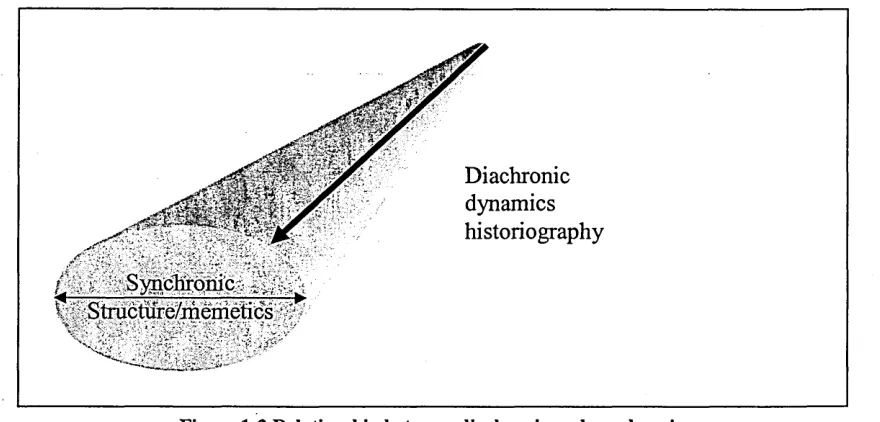
Levi-Straussxin (c. 1950s) application of structuralist ideas (Saussure, 1916) suggests why myths may be structurally similar despite considerable variation in the details of characters and events. Analysis may be performed over two dimensions: the diachronic dynamic (or melodic40) that conveys content; or synchronic static snapshot (or harmonic)41 that denotes structure. In order to analyse a myth’s structure it needs to be reduced into its basic units which Levi-Strauss termed mythemes42. In this sense mytheme has distinct similarities to the meme although there is no inference that the mytheme is a replicator. Bultmann’sxiv structural perspective on the New Testament was an attempt to demythologise scripture to reach the underlying karygma.
The generation of ideas and Darwinian evolution has been noted from the end of the 19th century (e.g. Poincare and William James). Popper (1963) initially developed a full epistemology of science and spoke about conjectures and refutations. Campbell (1960, 1974), who introduced the term ‘Evolutionary Epistemology * (also Popper, 1972, 1984; Hayek, 1973; Lorenz, 1977; Dempsey, 1996xv), generalized Popper's falsificationist philosophy of science to encompass knowledge processes at all biological, psychological and social levels. However, evolutionary processes are refined into blind-variation-and-selective-retention (BVSR) and universal selection theory takes these to their logical extreme (Cziko, 1995, Haylighen, 1997, Edmunds, 2001XV1). Cloak’s (1975) cultural ethology also predated Dawkins in his introduction
40 the musical metaphor can also be considered as the difference between watching a time based oscilloscope trace and a frequency based spectrum analyser. These are related by the Fourier transform. 41 This distinction between the diachronic and synchronic (related to the genealogical and phenetic methods respectively) is important to the development of a memetic methodology as will be discussed in part 2.
X V A • i - / U V l V ^ l V U 1 1 U X V J. XJLX v / i ^ U l l l O U l l V l l U l I Y A V 1 1 I V H V J
of i-culture and m-culture, which Rose (1998) finds less ambiguous ‘meme’. McKelvey (1978) introduced the tech-pool, as organisationally analogous to the gene pool43 (see SI.2.2.3.41.
1.2.1.3.2 Identifying a second replicator
In The Selfish Gene Dawkins (1976) made the point that the gene is the fundamental unit of inheritance, as opposed to the individual or kin; altruism is later substantiated (Dawkins, 1989)44 with reference to Axelrod’s (1986) evolution of cooperation. As noted above gene-centricity fails to account for the culture that makes the human organisms unique (cf. Blackmore, 1999) Dawkins complains:
... I find that they [theories of kin selection and reciprocal altruism] do not begin to square up to the formidable challenge of explaining culture, cultural evolution, and the immense differences between human cultures around the world ... - [Dawkins, 1976 ppl90-191]
In accordance with Campbell’s rule, organic evolution is but one instance of a more general model of evolutionary change (Blackmore, 1999 after Durham, 1991; Cziko,
1995) then Darwinism then isn’t limited to genetics.
... for an understanding of modem man, we