Total E-mail Marketing
Dave Chaffey
An imprint of Elsevier Science
Linacre House, Jordan Hill, Oxford OX2 8DP 200 Wheeler Road, Burlington MA 01803
First published 2003
Copyright#2003 Marketing Insights Ltd. All rights reserved
The right of Marketing Insights Ltd to be identified as the author of this work has been asserted in accordance with the Copyright,
Designs and Patents Act 1988
No part of this publication may be reproduced in any material form (including photocopying or storing in any medium by electronic means and whether or not transiently or incidentally to some other use of this publication) without the written permission of the copyright holder except in accordance with the provisions of the Copyright, Designs and Patents Act 1988 or under the terms of a licence issued by the Copyright Licensing Agency Ltd, 90 Tottenham Court Road, London, England W1T 4LP. Applications for the copyright holder’s written permission to reproduce any part of this publication should be addressed to the publisher
Permissions may be sought directly from Elsevier’s Science and Technology Rights Department in Oxford, UK: phone: (+44) (0) 1865 843830; fax: (+44) (0) 1865 853333; e-mail: [email protected]. You may also complete your request on-line via the Elsevier Science homepage (http://www.elsevier.com), by selecting ‘Customer Support’ and then ‘Obtaining Permissions’
British Library Cataloguing in Publication Data
A catalogue record for this book is available from the British Library
Library of Congress Cataloguing in Publication Data
A catalogue record for this book is available from the Library of Congress
ISBN 0 7506 5754 5
Typeset by Keyword Typesetting Services Ltd Printed and bound in Great Britain
Contents
Preface ix
Why total e-mail marketing? ix
How is the book structured? ix
Who is this book for? x
Learning features xi
Acknowledgements xiii
Chapter 1 Introduction 1
Chapter at a glance 2
Introduction: typical e-mail marketing questions 2
Modelling and measuring e-mail marketing effectiveness 4
Why e-mail marketing matters 6
Why e-mail marketing beats direct mail 7
Why e-mail marketing beats web site-based marketing 10
Why ‘total e-mail marketing’? 11
Meeting the challenges of total e-mail marketing 12
Why e-mail marketing is not so different from direct mail 14
References 18
Web links 18
Chapter 2 E-mail marketing fundamentals 19
Chapter at a glance 20
Introduction 20
Permission marketing 21
Legal constraints 25
Customer relationship management 30
CRM: a health warning 38
Online CRM 38
Personalisation and mass customisation 39
An integrated e-mail marketing approach to CRM 42
References 46
Web links 47
Chapter 3 E-mail campaign planning 48
Chapter at a glance 49
Objective setting 50
E-mail campaign budgeting 56
Campaign design: targeting, offer, timing, creative 59
Campaign integration 68
The creative brief 72
Measurement 73
Continuous improvement of campaigns 78
Testing 80
Campaign management and resourcing 82
References 82
Web links 83
Chapter 4 E-mail for customer acquisition 84
Chapter at a glance 85
Introduction 86
Building a house e-mail list 87
Stage 1: Devising incentives 90
Stage 2: Using online and offline communications to drive traffic to the web site 91
Using a rented list of e-mails to acquire customers via e-mail 98
Placing advertising in third-party e-mail newsletters 106
Usenet 108
Stage 3: Revising web-site design to emphasise offer 110
Stage 4: Defining profiling needs and capture form 111
Stage 5: Selecting permission levels: what does opt-in really mean? 115
Stage 6: Drawing up a privacy statement 118
Stage 7: Defining the opt-out 118
Stage 8: Follow-up registration 119
Other forms of customer acquisition 122
Keeping e-mail addresses current 123
Viral marketing 124
Measuring acquisition effectiveness 129
References 129
Web links 130
Chapter 5 Using e-mail for customer retention 131
Chapter at a glance 132
Introduction 132
Planning retention 133
E-newsletters 140
Virtual communities and discussion lists 151
References 154
Web links 155
Chapter 6 Crafting e-mail creative 156
Introduction 157
E-mail usage constraints 158
The HTML versus text decision 160
E-mail structure 166
E-mail headers 166
E-mail style and personality 169
E-mail body content 169
Copywriting 174
Calls-to-action 177
Landing pages 181
Testing creative 182
E-newsletter design 182
How not to do it 187
References 188
Chapter 7 E-mail marketing management 189
Chapter at a glance 190
Selecting solution providers 190
Managing a campaign 192
Choosing e-mail management software 194
List servers 196
Desktop e-mail management software 197
Application service provider model 198
Managing the house list 199
Managing inbound e-mail 201
References 206
Web links 206
Chapter 8 E-mail marketing innovation 208
Chapter at a glance 209
Solving the SPAM problem 209
Rich media e-mails 215
Messaging through mobile or wireless access devices 217
Picture messaging 221
References 222
Web links 223
Preface
W H Y T O T A L E - M A I L M A R K E T I N G ?
Effective e-mail marketing is not just about great creative. E-mail marketing is becoming an essential, integral part of e-marketing and indeed marketing. So, in writing this book I wanted to create a comprehensive guide that not only covers how to create great campaigns and creative, but also describes a strategic approach to integrate e-mail into the communications mix. Total E-mail Marketingcovers:
. how to use e-mail to support all stages of the customer lifecycle of customer relationship management (CRM): selection, acquisition, retention and extension
. using e-mail for a range of marketing applications: as a promotional tool, regular communica-tions tool (e-newsletters), conversion tool (multistage e-mail), referral tool (viral marketing), research tool and customer support tool
. lists: building and maintaining house lists and selecting rented lists
. campaign design from strategy, through conversion modelling to creative and testing
. how to manage not only outbound e-mail, but also inbound e-mail
. resourcing e-mail, looking at the best options for outsourcing, and in-house management using software packages
. integrated e-mail marketing with the web site, with direct mail, advertising, public relations and word-of-mouth.
To illustrate the power of e-mail marketing I also wanted to draw on a range of examples and experiences from different practitioners. So, in each chapter you will find detailed case studies for business-to-consumer (B2C), business-to-business (B2B) and not-for-profit, and viewpoints from a range of e-mail practitioners. To help you to improve your e-mail marketing I have also included a series of checklists that can be used to plan future campaigns and highlighted key insights that are factors for success.
H O W I S T H E B O O K S T R U C T U R E D ?
C h a p t e r 1 I n t r o d u c t i o n
Chapter 1 highlights the power of e-mail marketing. It looks at the success factors in e-mail marketing and compares it with traditional direct marketing, highlighting its benefits and disad-vantages.
C h a p t e r 2 E - m a i l m a r k e t i n g f u n d a m e n t a l s
Permission marketing, customer relationship management, legal and ethical constraints, and the foundation of e-mail marketing are covered in Chapter 2.
C h a p t e r 3 E - m a i l c a m p a i g n p l a n n i n g
Key stages and issues in developing an e-mail marketing strategy and campaign plans are described in this chapter.
C h a p t e r 4 E - m a i l f o r c u s t o m e r a c q u i s i t i o n
This chapter discusses how to use online marketing to acquire new customers and migrate existing offline customers online. This includes building a house list through the capture of e-mail addresses and profiling and using e-mail to support online customer acquisition.
C h a p t e r 5 U s i n g e - m a i l f o r c u s t o m e r r e t e n t i o n
How to use e-mail to develop customer relationships and techniques to keep visitors returning to a web site and making repeat purchases.
C h a p t e r 6 C r a f t i n g e - m a i l c r e a t i v e
This practical chapter highlights the different options for developing mail creative from the e-mail attributes (message headers), the structure, style and tone of the message body, and its form (HTML and text).
C h a p t e r 7 E - m a i l m a r k e t i n g m a n a g e m e n t
This chapter is about making it happen. It looks at the best way to implement your plans by discussing how to resource e-mail marketing in terms of partners, purchasing software and man-aging inbound enquiries.
C h a p t e r 8 E - m a i l m a r k e t i n g i n n o v a t i o n
This chapter looks at the future of e-mail marketing. Issues covered include combating SPAM, the use of wireless access devices such as personal digital assistants (PDAs) and mobiles, and the opportunities for using rich media such as video streaming.
W H O I S T H I S B O O K F O R ?
M a r k e t i n g a n d b u s i n e s s p r o f e s s i o n a l s
. marketing managersresponsible for defining an e-marketing strategy, implementing strategy or maintaining the company web site alongside traditional marketing activities
. e-marketing specialists such as new media managers, e-marketing managers and e-commerce managers responsible for directing, integrating and implementing their organisation’s e-marketing
. senior managers and directorsseeking to identify the right e-business and e-marketing approaches to support their organisation’s strategy
. information systems managers also involved in developing and implementing e-marketing and e-commerce strategies
. technical project managers or web masterswho may understand the technical details of building a site, but want to enhance their knowledge of e-marketing.
S t u d e n t s
This book will also be of relevance to students studying e-marketing, including professionals studying for awards from professional bodies such as the Chartered Institute of Marketing and the Institute of Direct Marketing; postgraduate students on specialist masters degrees in electronic commerce, electronic business or e-marketing and generic programmes in Marketing Management, MBA, Certificate in Management or Diploma in Management Studies which involve modules or electives for e-business and e-marketing; and undergraduates on business programmes that include marketing modules on the use of the digital marketing.
L E A R N I N G F E A T U R E S
A range of features has been incorporated intoTotal E-mail Marketingto help the reader to get the most from it. They have been designed to assist understanding, reinforce learning and help readers to find information easily. The features are described in the order in which they are found.
A t t h e s t a r t o f e a c h c h a p t e r
. Chapter at a glance, including an overview, main learning points and the chapter topics.
I n e a c h c h a p t e r
. E-mail marketing excellence boxes: real-world examples of best practice approaches referred to in the text.
. Campaign checklist boxes: lists to help you to plan e-mail marketing and campaigns. . E-mail marketing insight boxes: highlight factors critical to effective e-mail marketing.
A t t h e e n d o f e a c h c h a p t e r
. Web links: these include all resource sites mentioned within the chapter and significant sites that provide further information on the concepts and topics of the chapter.
A t t h e e n d o f t h e b o o k
Acknowledgements
This book has been created using insights and case studies provided by many professionals who are closely involved with e-mail marketing. I would like to thank all the following for helping to give the book a range of different viewpoints and opinions:
Jeremiah Budzik, DoubleClick
William Corke and Rory Teeling, Harvest Digital Mark Davies, Context Partners
Maddie Davis, Butterworth-Heinemann, Elsevier Science
Philippa Edwards and Robert Perrin, Anderson Baillie Marketing Stephen Groom, Marketing Law
David Hughes, E-mail Vision Glenn Jones, glue London Bill Kaplan, FreshAddress
Matthew Kelleher, Claritas Interactive
Martin Kiersnowski, Interactive Prospect Targeting Derek Mansfield, Bold Endeavours
Richard Mayer, Befocused David Mill, MediaCo
Ollie Omotosho, Commontime Andrew Petherick, Mailtrack Caroline Piggins, Corpdata
David Reed, European Centre for Customer Strategies Duncan Smith, Ashton Court Consultants
Paul Smith, MultimediaMarketing Consortium Stephen Spelman, Altum
Tara Topliff and Naomi Broad, Virgin Atlantic
Sue Ward, Chartered Institute of Marketing, What’s New in Marketing Rhian Whitehead, Elsevier Science
John Woods, Site Intelligence
Chapter
1
Introduction
C H A P T E R A T A G L A N C E
O v e r v i e w
This chapter highlights the power of e-mail marketing. E-mail marketing is evaluated in compar-ison with traditional direct marketing and its benefits and disadvantages are shown.
C h a p t e r o b j e c t i v e s
By the end of this chapter you will be able to:
. assess the benefits and risks of e-mail marketing;
. describe the typical structure and metrics of an e-mail campaign;
. outline the different types of e-mail marketing and how they integrate with other forms of
marketing and e-marketing.
C h a p t e r s t r u c t u r e
. Introduction: typical e-mail marketing questions
. Modelling and measuring e-mail marketing effectiveness
. Why e-mail marketing matters
. Why e-mail marketing beats direct mail
. Why e-mail marketing beats web site-based marketing
. Why ‘total e-mail marketing’?
. Meeting the challenges of total e-mail marketing
. Why e-mail marketing is not so different from direct mail
I N T R O D U C T I O N : T Y P I C A L E - M A I L M A R K E T I N G Q U E S T I O N S
‘What success rate can I expect for an e-mail-shot to 20 000 prospects from a vendor list rented from a vendor, where the e-mail contains a hyperlink to a web site?’
‘We have collected e-mail addresses for 20% of our customer base. We are looking to start using e-mail newsletters and promotions to encourage repeat business. Which factors will govern the success of our e-mail campaigns?’
These are typical questions from marketers keen to run e-mail campaigns, but unsure of the results that they are likely to achieve. We have all heard campaign success stories with response rates in double figures, but at the same time we all receive an ever-increasing amount of e-mail into our inbox. As Internet users receive thousands of e-mail messages every year, much of it unsolicited, how can we maximise our response rate?
recipients: are the e-mails relevant to the audience? The offer made to encourage clickthrough to the site is another key factor. You may also have considered the quality of the creative: is it enticing in drawing the recipient in? How well does the copy explain the offer? These are very similar to the factors that govern the success of traditional postal mail. You may also have considered some factors that are specific to mail marketing: have the people on the lists agreed or opted in to receive e-mail communications? The characteristics of the message are also important: what is the subject line of the e-mail? At what time and on which day of the week did it arrive? Who is it from? Is it a plain text message or an HTML page including images? Finally, you may have mentioned the importance of the web page to which recipients clickthrough: is the design of this page effective in encouraging further action? So a whole host of factors is involved, some familiar to direct marketers and some new.
Total E-mail Marketingwill give you detailed guidance on all these factors to enable you to devise powerful e-mail campaigns that maximise response. To start this process, the range of critical factors needed to develop successful e-mail promotions may be summarised by using the mnemonic ‘CRITICAL’. CRITICAL is a checklist of questions to ask about your e-mail campaigns. It stands for:
. Creative: this assesses the design of the e-mail, including its layout, use of colour and image and the copy.
. Relevance: do the offer and creative of the e-mail meet the needs of the recipients?
. Incentive(or offer): The WIFM factor or ‘What’s in it for me’ for the recipient. What benefit does the recipient gain from clicking on the hyperlink(s) in the e-mail? For example, a prize draw is a common offer for business-to-consumer (B2C) brands.
. Targeting and timing: targeting is related to the relevance. Is a single message sent to all prospects or customers on the list, or are e-mails with tailored creative, incentive and copy sent to the different segments on the list? Timing refers to when the e-mail is received: the time of day, day of the week, point in the month and even the year; and it may relate to particular events. There is also the relative timing – when is it received compared with other marketing communications – this depends on the integration.
. Integration: are the e-mail campaigns part of your integrated marketing communications? Questions to ask include: are the creative and copy consistent with my brand? Does the message reinforce other communications? Does the timing of the e-mail campaign fit with offline com-munications?
. Copy: this is part of the creative and refers to the structure, style and explanation of the offer together with the location of hyperlinks in the e-mail.
. Attributes(of the e-mail): assess the message characteristics such as the subject line, from address, to address, date/time of receipt and format (HTML or text).
L a n d i n g p a g e s a n d m i c r o s i t e s
E - M A I L M A R K E T I N G I N S I G H T
Don’t focus solely on the e-mail when trying to maximise response – remember that the quality of the landing page(s) or microsite also affects the success of your e-mail campaign.
M O D E L L I N G A N D M E A S U R I N G E - M A I L M A R K E T I N G E F F E C T I V E N E S S
Further common questions from marketers starting out with e-mail marketing are:
‘How do I decide on the size of list used to meet my objectives?’
and
‘How do I assess the success of my campaign?’
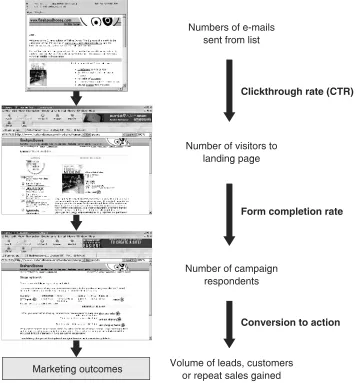
One of the great benefits of e-mail, in common with other forms of direct marketing, is its accountability. This book presents a simple Excel spreadsheet-based model that you can use for setting objectives and comparing the effectiveness of different tests or campaigns. Figure 1.1 shows the framework used for this model.
To evaluate the success of different e-mail campaigns, the following variables may be considered.
. Number of e-mails sent: how many e-mails are sent to list members.
. Clickthrough rate(%): the percentage of recipients that respond to the e-mail by clicking on a link.
. Completion rate on landing page(%): the percentage of the recipients who clickthrough that go on to complete form.
. Conversion rate to action: direct marketing campaigns are always aimed at achieving a response. Those that complete the landing page have responded, but we often have an additional aim, which is to convert this response into an action or a marketing outcome. Such outcomes include gaining a customer through achieving an initial sale or a repeat sale. To achieve these outcomes there will often need to be a follow-up. For example, a sales representative who has used e-mail marketing to gain a qualified lead will aim to convert the recipient into a customer. This could be achieved through follow-up e-mails combined with phone-calls and meetings.
By modelling different combinations of number of e-mails sent, clickthrough rates, completion rates and conversion rates, it is possible to set more realistic objectives for a campaign. Figure 1.2 shows a best and worst case for a typical e-mail campaign which is well targeted and has a relevant, appealing offer. Such scenarios can be discussed with your e-mail marketing agency to help agree a realistic target. The actual results can then also be compared against the forecast, as shown.
O b t a i n i n g t h e s p r e a d s h e e t
of e-mails that need to be sent to achieve the desired number of outcomes with a given click-through, completion rate and conversion rate, as shown in Figure 1.2.
C o n v e r s i o n - b a s e d m o d e l l i n g
E - M A I L M A R K E T I N G I N S I G H T
[image:19.536.84.443.69.452.2]Use conversion-based modelling to set realistic objectives and to help learn for future campaigns.
B u t w h a t a b o u t . . .?
You may well have noticed that we have started with a simplified version of campaign metrics. For instance, it is assumed here that all e-mails sent will be received. In Chapter 3, it will be seen that a fair proportion of mails, perhaps more than 10%, will be bounced back to the sender since the e-mail addresses are no longer valid (‘gone-aways’). Further measures of success, such as the open rate, which can be evaluated for HTML e-mails, are also considered in Chapter 3. The model is also extended to include all the different cost elements of an e-mail campaign and an estimate of campaign value is use to calculate return on investment.
W H Y E - M A I L M A R K E T I N G M A T T E R S
The marketing potential of e-mail can be clearly seen by the way it is rivalling other media as a form of direct communication. In the UK, in January 2002, the number of e-mails being sent and received by UK households exceeded domestic letters by 300 million (550 million e-mails com-pared with 258 million domestic letters, according to NetValue, 2002). E-mail has become an accepted method of communicating for both consumers and businesses. E-mail has now overtaken post in many countries. Think about your own use of e-mail and the web. How much time do you spend reading and responding to business e-mails and how much time do you spend using the web? If you are typical, you will spend more time with your e-mail than using the web.
said: ‘as e-mail use, familiarity and trust increases, consumers will become more comfortable with accepting advertisements through their computer’.
W H Y E - M A I L M A R K E T I N G B E A T S D I R E C T M A I L
E-mail offers many practical benefits over traditional direct mail. Its lower cost means it is possible to send more, better targeted, messages to each recipient as part of the campaign, which can be used to convert more of the audience to respond. E-mail can be used to send reminders about a sales promotion and messages offering further benefits can be sent to those who fail to win. Figure 1.3 gives an example of a campaign structure that achieved double-digit response. It shows that following an initial e-mail (1) with different creative for four segments offering entry into a prize draw, a reminder (2) was sent to those who had not entered. Those entering the prize draw had the oppor-tunity to provide the e-mail addresses and names of friends or colleagues who were sent an e-mail offering them the opportunity to take part in the campaign (3). This is a viral referral (see Chapter 4 for more on viral marketing). Finally, an e-mail was sent to losers (4) which offered participation in a further draw. Clearly, such a campaign structure can achieve a better response than traditional direct marketing where sending this many communications is usually impractical because of cost.
It can be seen that e-mail gives more options for converting the audience to action. It is even possible to follow-up losing contestants with the option of further competition. Finally, the e-mail is not a one-way communication: feedback from customers via the landing page about their buying behaviour and positioning of products was also incorporated into the campaign to inform market research.
The many benefits to e-mail marketing in comparison with traditional direct marketing have been analysed by Gartner G2 (2002). According to these analysts, e-mail marketing offers:
3. E-mail to referred prospect(s) 2. Reminder
First prize draw
Collection of contact details, profiling, product research and
friend's e-mail (viral)
4. Losers e-mail
Second prize draw
Further information collection 1. Initial e-mail
(to segments)
Landing page or microsite
. Higher response rates: on average, response rates are between 6 and 8% for permission-based e-mail, a significantly higher figure than the majority of direct marketing campaigns.
. A shorter duration for campaign creation: Gartner G2 estimates that e-mail campaigns are completed in 7–10 business days on average, compared with 4–6 weeks for direct mail.
. A more rapid response: Gartner G2 reports that responses to e-mail accumulate in an average of 3 days, while direct mail requires an average response time of 3–6 weeks.
. A faster overall cycle–cycle time: Gartner G2 suggests that the overall cycle time of an e-mail campaign from creation to delivery and response is one-tenth the time of traditional direct mail.
. Lower costs: it is estimated that current e-mail costs range from $5 to 7 per 1000, compared with $500 to $700 per 1000 for direct mail.
In addition, we can use viral campaigns effectively to increase response rates further, we can use e-mail for market research and the medium is accountable, in that open rates show how many people respond to the medium.
Claritas estimated the differences between e-mail and direct mail costs for 60 000 prospects as shown in Table 1.1. It is evident that while the list cost may be higher, this is offset by the reduced print, postage and fulfilment costs. A more detailed budget model for campaign planning is pre-sented in Chapter 3. One advantage provided by the lower costs is the opportunity to communicate more frequently with customers. Take the example of a travel company: late-breaking holiday details can be e-mailed to customers who are looking for a last-minute deal. Figure 1.4 shows a weekly newsletter from Advantage Travel Centres.
Table 1.1 Cost estimate comparing a direct mail campaign with an e-mail campaign for 60 000 prospects
Cost item Direct mail campaign E-mail campaign
List cost £5k £15k
Design £5k £5k
Print £6k £0k
Postage £13k £0k
Fulfilment £7.5k £2.5k
Total £35.5k £22.5k
Source: Claritas Interactive (www.claritasinteractive.co.uk)
in defining their targeting, timing, offer and creative such that these can vary dramatically. The data in Table 1.2 suggest that it is never worthwhile e-mailing to a rented list. The Virgin Atlantic case study later in this chapter and many other successful campaigns show that it is still definitely worthwhile to undertake campaigns to an opt-in list. Looking at it the other way, it is still possible to produce a campaign to a house list that is not cost-effective if the campaign planning is wrong.
Table 1.2 Comparative costs and responses for different forms of direct communication
Type of campaign Cost per thousand (CPT)
Clickthrough Conversion to sale
Cost per sale
E-mail to rented list $150 0.4% 3% $1250
Banner ads $10 0.5% 3% $67
Direct mail to rented list
$875 n/a 1.2% $73
Retention e-mail to house list
$5 15% 3.7% $1
Direct mail to house list
$761 n/a 3.9% $20
Source: Cross-industry average from Forrester (2001). n/a: not applicable.
So, to summarise, e-mail offers many advantages as a communications tool: it offers immediacy, targeting and accountability, and is relatively cheap. It is also more cost-effective to target niche groups. For example, a bank could e-mail an 18–25-year-old female customer, who reads a particular newspaper, has a credit card and has responded to an e-mail campaign within the last 6 months. Such precision targeting is known as using multiple selects. For rented lists the cost per thousand is increased for multiple selects.
W H Y E - M A I L M A R K E T I N G B E A T S W E B S I T E - B A S E D M A R K E T I N G
E-mail marketing is a vital part of the e-marketing communications mix. It is arguably as important as or more important than the web site itself. How can we justify this statement? Well, a web site’s greatest strength is also its greatest weakness. A major benefit of the web site is that the audience of the web site is self-selecting. They are mainly attracted, or pulled to the web site, by the content on offer, which is indicated by search engine listings or links from other sites (or pushed using offline media). The problem is that once the visitor leaves the site, they may never return. This is where e-mail wins: it is a push medium. If the visitor’s e-mail can be captured on their visit to the site, the e-mail can be used to remind the visitor about the company and its products, together with incentives to visit the web site. This is part of permission market-ing, which is described in Chapter 2.
Since e-mail is a push medium, this makes it a great medium for time-critical information. E-mail alerts are the obvious application. Time-critical market information available from Newswire services provides up-to-the-minute information about the way in which a company and its compe-titors are featured in the media.
E-mail is also better than the web site for targeted communications. It is superior since you, not the visitor, choose who sees what information. Web site designers have to cater for a range of audiences. This can make it difficult for customers in any segment to find the communications that have been developed for them. Similarly with special offers, which often have to be high-lighted by a space little bigger than a postage stamp: it is better to use the space provided by an e-letter. With e-mail the customers who are to receive the communications are chosen using standard database marketing selects. For example, Boots the Chemist used e-mail to target customers within 30 minutes’ drive time of a new range of opticians: try doing that using a web site!
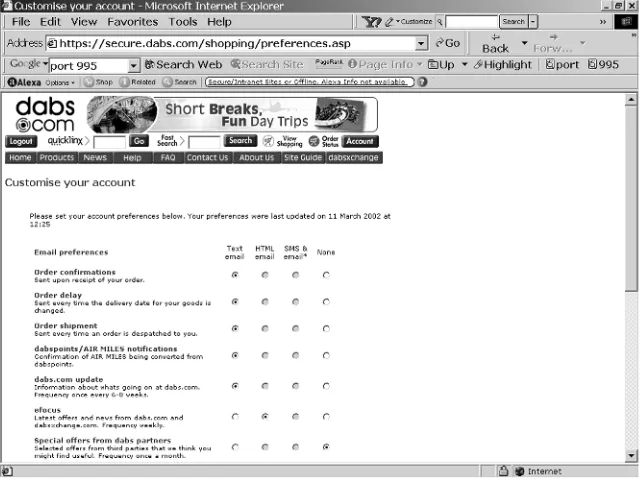
Customers can also choose the information they need and when they need it. Advanced e-mail services give customer choice, over what information is delivered and when it is delivered. This and other forms of personalisation are discussed in more detail in Chapter 2.
The web site does work better in some areas; for example, providing a depth of information is only possible through multiple web pages. Here, the e-mail is best used in combination with the web, to direct customers to the more detailed information.
So, e-mail marketing does not beat web site marketing in all respects; rather, the two are perfect partners.
W H Y ‘ T O T A L E - M A I L M A R K E T I N G ’ ?
Much that has been written about e-mail marketing is limited to creating e-mail campaigns based on buying lists to gain new customers. This misses the value of e-mail in supporting all aspects of the buying process and entire customer lifecycle. Total e-mail marketing:
. Includes building and maintaining house lists as well as renting lists
. Covers using e-mail for the entire customer lifecycle from customer selection, acquisition,
retention and extension
. Is integrated with the web site and other direct communications
. Uses a range of different e-mail types, from e-mail offers and regular e-newsletters, to multistage and viral e-mails
. Includes management of inbound communications to improve customer satisfaction.
The impact of total e-mail marketing on the modern organisation is significant. Iconocast (2001) reported that Dell Computer achieves more than $1 million in revenue per week through e-mail marketing campaigns. Considering inbound communications, each month in 2000, Dell received 50 000 e-mail messages and 100 000 order-status requests.
E - m a i l m a r k e t i n g : i t ’ s n o t j u s t e - n e w s l e t t e r s
. Acquisition tool: here, e-mails are sent to members of a bought-in list to acquire new customers. Alternatively, you could advertise in an established e-newsletter to drive traffic to your web site.
. Conversion tool: many sites use offers to capture leads in the form of e-mail addresses. E-mails can then be sent to customers aimed at converting leads to customers. Multistage e-mails can be automated to encourage conversion to a sale.
. Retention tool: this is the classical e-newsletter or promotional e-mail sent to your house list of customers. It is aimed at keeping your company at ‘front-of-mind’ and achieving repeat pur-chases through offers delivered by e-mail. Automated multistage e-mails can also be used to retain customers at renewal; for example, for insurance or utility services.
. Brand-building tool: e-mail is used to increase the frequency and depth of communications with customers. For example, Pepsi UK use e-mail as their main e-marketing tool to deliver news about celebrity endorsers and the latest competitions and games.
. Research tool: many marketers do not immediately think of e-mail as a way of learning more about prospects and customers, but research is straightforward to build into newsletters and e-promotions. Questionnaires within the e-mail itself do not work well so are not widely used, but using e-mail to encourage customers to participate in a web site survey or focus group does work and is more widespread.
. Viral tool: viral e-mail does not only mean shock videos for the 18–30s. It is more widely applicable for using e-mail to encourage acquisition of new customers by referrals from existing customers: the classical ‘member-get-member’ approach.
. Service delivery tool: many customers prefer queries answered via e-mail as a way of avoiding the ‘our call is important to you’ holding systems of phone support. Many organisations are now receiving tens of thousands of e-mail enquiries. Managing these in a cost-effective manner which improves, rather than damages the brand is a major challenge for e-marketers.
M E E T I N G T H E C H A L L E N G E S O F T O T A L E - M A I L M A R K E T I N G
Although the potential for e-mail marketing is clear, it presents a steep learning curve for market-ers. These are some of the solutions that will be proposed in this book.
P e r m i s s i o n c h a l l e n g e s
Permission marketing is covered in Chapter 2. In Chapter 8 we look at the future of e-mail given the ever-increasing wave of SPAM and measures taken by governments, the industry and consumer organisations to combat it.
E - m a i l m a r k e t i n g s t r a t e g y
Rather than concentrating on individual campaigns which encourage an approach of moving from one campaign to another without focus, we describe an integrated approach to e-mail strategy that links marketing objectives and e-marketing objectives to different forms of e-mail marketing.
C a m p a i g n d e s i g n s t r a t e g i e s
E-mail marketing gives the potential for more complex e-mail campaigns. How can we develop the best form of campaign to achieve our objectives?
Campaign design strategies for customer acquisition are described in Chapter 4 and for customer retention in Chapter 5.
B u y i n g l i s t s
If you are familiar with buying lists for direct marketing, what are the similarities and differences for buying e-mail lists? How can you tell whether a list meets your needs? What are the questions to ask list brokers or list owners when purchasing lists?
E-mail marketing also provides new challenges for marketers. Managing lists, producing a new form of creative, response rates and privacy issues all need to be considered as they do for con-ventional direct marketing.
Buying lists is covered in more detail in Chapter 4.
D e v e l o p i n g c r e a t i v e
The response rates for e-mail campaigns can be impressive, but what is the best design practice to achieve these? What are your different alternatives for the subject line? Why is the ‘From’ address important? How should a promotional e-mail be structured? How do you write compelling copy? Where and how should the call-to-action link to the web site?
Developing creative is covered in Chapter 6.
T e s t i n g a n d m e a s u r e m e n t
E-mail marketing gives the marketer a much clearer view of how their campaigns are performing, but the detail may obscure the critical points. We describe approaches to testing and ask: which are the measures that matter? What options should reporting systems contain?
Testing and measurement are covered in Chapters 2 and 7.
L i s t f u l fi l m e n t a n d e - m a i l m a n a g e m e n t
There are many pitfalls for the unwary when dispatching e-mails. List fulfilment and e-mail management are measured in Chapter 6.
W H Y E - M A I L M A R K E T I N G I S N O T S O D I F F E R E N T F R O M D I R E C T M A I L
We end this chapter by summarising the benefits of e-mail marketing and we find that the e-mail marketing is not so different from direct mail. This is unsurprising given that they are both forms of direct marketing. The trick is either to use them together or to use them selectively where one is better. E-mail marketing builds on many of the benefits of direct mail. E-mail marketing is:
. accountable: unlike advertising or PR we can readily calculate the cost of customer acquisition and return on investment for each campaign; a tool for calculating this is examined in Chapter 5
. precisely targeted: although targeting using segmentation such as age and gender is still possible using e-mail marketing, opt-in offers more
. cheap: costs of acquisition and retention are often cheaper than for direct mail. Table 1.3 summarises the benefits of e-mail discussed in this section.
Table 1.3 E-mail benefits
Characteristic E-mail benefits
Targeting Possible to target smaller niches since cost is lower Cost Cost is lower owing to lower printing and distribution costs Campaign creation Faster
Campaign response Faster Response rate Higher
Accountability Greater: can measure the open rate of messages. Easy to track the response from different parts of the campaign
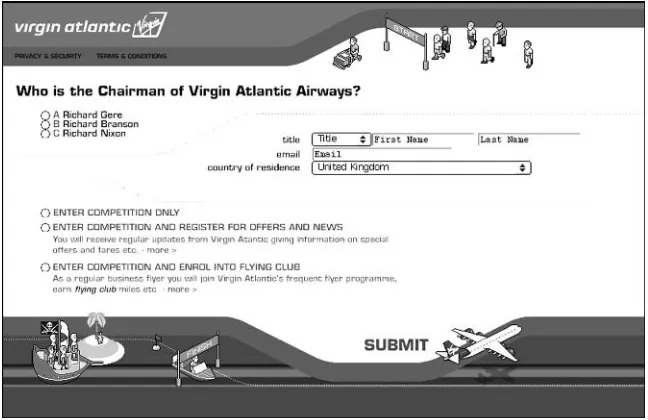
Total e-mail marketingaims to equip you with the background knowledge to make a flying start to exploiting these opportunities for e-mail. The case study below illustrates how a powerful offer and high-impact creative can achieve a successful acquisition campaign. A successful viral element was also included. Finally, it illustrates how e-mail marketing can integrate different forms of offline and online media. Figure 1.5 shows one of the e-mails used in the campaign.
V i r g i n A t l a n t i c F l y F r e e F o r L i f e
E - M A I L M A R K E T I N G E X C E L L E N C E
T h e c a m p a i g n
e-mails to bought-in lists (Figure 1.5), banners on various sites, the flying club news-letter, a radio campaign and poster site driving traffic to a specially built microsite. To maximise exposure, it was expected that the campaign would take off virally (i.e. the game would be forwarded by e-mail to friends to play, and they would forward it on, etc.). The main objective of the campaign was to sign up customers to the site-registered base, to receive e-mail alerts on Virgin Atlantic offers and news.
T h e m i c r o s i t e
Once at the microsite (Figure 1.6), customers had to answer a simple question (Who is the chairman of Virgin Atlantic Airways?) to gain entry into the competition. The microsite offered customers the choice of three types of entry:
. enter the competition only (for people who may already have joined up to the flying club, were already site registered or who were just competition ‘junkies’)
. enter the competition and site register (to receive e-mail alerts on special offers and news)
[image:29.536.122.411.54.358.2]. enter the competition and enrol in the flying club.
To gain a further entry into the competition, entrants also had the opportunity to play the interactive game on the microsite.
This game was called ‘Globetrotter’ and was based on visitors navigating their way around the world (depicted by icons of Virgin’s network, e.g. Statue of Liberty, palm trees) within a time limit and being chased by a pack of ‘wannabe mates’ (who have come out of the woodwork to go on holiday with you now you have won this fantastic prize!). If the players bumped into anything they slowed down and their mates had a chance of catching them up, therefore sending them back to the beginning.
The ability to send the game to a friend was present throughout. If the game was forwarded to a friend, it contained a score to beat (time taken to complete/fail game), to provide a challenge aspect. Once the game was completed users were given the option of playing again and prompted to refer friends. Users were also prompted to visit the new web site.
For each friend who went on to enter the competition, the original entrant (who forwarded the game in the first place) received another entry into the competition, thereby increasing their chances of winning.
[image:30.536.108.432.58.268.2]As well as launching in the UK, the campaign launched in the USA, Hong Kong, India and South Africa, offering free flights for life to London. The ‘Lovin’ London’ game was specific to the UK, with icons and landscapes of the UK to navigate through.
E - m a i l l i s t s
The e-mail lists and the relevant selects used for this campaign were:
TheMutual.net HTML and text 10 000 30+, £40k+, have clicked on travel offers
Doubleclick HTML and text 15 000 Economy, professional
Claritas HTML and text 15 000 Economy travellers, non-European destinations
Guardiannewsletter Text 535 000 Long-haul travellers Virgin Wines database HTML and text 90 000
These lists were selected primarily on the audience being long-haul, leisure economy travellers who had expressed an interest in travel.
R e s u l t s
The total traffic from all online advertising and all e-mail activity was 241 460 visits.
Delivered 190 523
HTML open rate 82 686 43%
Clickthrough 53 939 31%
Clickthrough from opened e-mails 65% Pass along (e-mail referrals) 2932 1.53%
Banner advertising delivered 10 296 clickthroughs with an average clickthrough rate of 0.63%.
In addition to e-mail passalongs, the viral contribution of the campaign was successful with, on average, just under one e-mail per visitor being sent from the site to friends to spread the word about the site. It resulted in 200 000 additional e-mails being delivered from the site: the main source of visitors. Clickthrough for opened e-mails was extremely high, averaging around 80%, suggesting that the offer and creative were compelling.
Over 100 000 registrants with e-mail addresses available for future campaigns were achieved, breaking down as follows:
Registration online Globetrotter Lovin’ London Total Competition only 67 138 29 906 97 044 Site registered 70 508 27 661 98 169
Flying club 8891 4763 13 654
Total 208 867
R E F E R E N C E S
Forrester (2001). E-mail marketing press release, November.
Gartner G2 (2002). Gartner G2 says e-mail marketing campaigns threaten traditional direct mail promotions. Gartner G2 press release, 19 March.
NetValue (2002). Record e-mail usage signals last post for letters. Press release, 13 March. NetValue UK (www.netvalue.com).
W E B L I N K S
Clickz (www.clickz.com) has great columns on e-mail marketing, e-mail marketing optimisation and e-mail marketing case studies.
Conversion Marketing objectives spreadsheet (www.weboutcomes.com).
DM News (www.dmnews.com): updates on e-mail campaigns and new practices.
EMMA – E-Mail Marketing Association (www.emmacharter.org), formed in July 2001 to support best practice amongst agencies and clients; charter gives best practice guidelines on e-mail marketing.
Chapter
2
E-mail marketing
fundamentals
C H A P T E R A T A G L A N C E
O v e r v i e w
This chapter looks at what the concepts of permission marketing and customer relationship man-agement mean in practice. What does permission marketing mean beyond ‘opt-in’? Under what legal constraints do e-mail marketers operate?
C h a p t e r o b j e c t i v e s
By the end of this chapter you will be able to:
. identify all the characteristics of permission marketing
. assess the legal constraints on e-mail and know sources to keep updated
. evaluate how e-mail marketing can be used to support customer relationship management.
C h a p t e r s t r u c t u r e
. Introduction
. Permission marketing
. Legal constraints
. Customer relationship management
. CRM: a health warning
. Online CRM
. Personalisation and mass customisation
. An integrated e-mail marketing approach to CRM
I N T R O D U C T I O N
In this chapter we lay the foundations for detailed guidelines in later chapters which describe approaches for developing and implementing e-mail strategies. The well-established concepts underpinning e-mail marketing described in this chapter are permission marketing and customer relationship management (CRM).
marketing and CRM and also explain how e-mail can be used in conjunction with the web site and traditional communications.
P E R M I S S I O N M A R K E T I N G
Permission marketing is an integral part of e-mail marketing. Permission marketing is a term popularised by Seth Godin, formerly a VP of marketing at Yahoo!. Godin (1999) argues that there is a need for permission marketing since there is an ever-increasing number of marketing communications bombarding consumers. He notes that while research shows that we used to receive 500 marketing messages a day, with the advent of the web and digital TV this has now increased to over 3000 a day! From the marketing organisation’s viewpoint, this leads to a dilution in the effectiveness of the messages: how can the communications of any one company stand out? From the customer’s viewpoint, time is seemingly in ever-shorter supply; customers are losing patience and expect reward for their attention, time and information. Godin refers to the traditional approach as interruption marketing.
The typical, expected reaction to interruption marketing is evident from qualitative research con-ducted by Evans et al. (2000). When consumers were asked about unsolicited mail, these were typical reactions:
‘. . . I would prefer it if I didn’t see anything in the post unless I had specifically requested it’ (Female, 25–34).
‘. . .Personally, if I’ve got something that I want to do financially, I would look into it and go to my own people. I would search them out myself rather than look at something that came through on the carpet because generally you just pick it up and throw it away’ (Female, 25–44).
‘. . .It’s just it’s annoying to be sent things that you are not interested in. Even more annoying when they phone you up. . .If you wanted something you would go and find out about it’ (Female, 45–54).
Such customers want to exert control over communications and this is what permission marketing can provide. Permission marketing involves seeking the customer’s permission before engaging them in a relationship and providing something in exchange for initiating the relationship. The classic exchange is based on incentives such as information, entertainment or monetary value. In a web site context, a business-to-business (B2B) site may offer a free report in exchange for a customer sharing their e-mail address, which will be used to maintain a dialogue, a while a busi-ness-to-consumer (B2C) site may offer access to a game or entry into a prize draw. Further details on the types of offer available are provided in Chapter 3.
Such an approach can reduce the frustrations of consumers referred to above, since communica-tions following opt-in are expected, not unsolicited, and can be better targeted by profiling during and following opt-in.
the large number of direct marketers who start the selling process with an ad offering information and take it from there with a graduated programme of data collection and follow-ups will wonder how it is that they have been practising permission marketing for all this time without knowing.
Ross also notes that in order to achieve permission, it is necessary to gain the attention of prospects, and this is, of course, only possible using. . .interruption marketing.
Although consumers’ perceptions are often negative, research shows that direct mail is continuing to grow in terms of volume and expenditure, even as advertising expenditure falls. For example, in the UK, DMIS (2002) reports that volume increased by 4.5% and expenditure by 5.9% compared to the previous year. This can only be happening if marketers are satisfied with the cost-effective-ness of direct mail. Note that much of this mail is not permission based, but it is still engaging consumers. The same research shows that:
. the average household receives 12.4 items of direct mail every 4 weeks
. business managers receive an average of 14 items of direct mail per week
. 75% of consumer direct mail is opened, 53% is opened and read and 26% is kept to be read later or passed on to somebody else
. business managers open 83%, 9% is redirected to a colleague and 16% is filed or responded to
. response rates for business mailings average 6.2% for product mailing and 6.2% for services
mailings. Over 77% of marketers were satisfied with the results
. overall, 6.2% of direct mail is requested by customers
. the average consumer spends about £440 through direct mail each year.
It seems that interaction with and response to the direct mail medium is significant, and it will be interesting to see whether e-mail marketing can continue to achieve higher response rates for exceptional campaigns, given the ever-increasing tide of SPAM.
A further implication of permission marketing is that by providing choice, you will, in all likelihood, be reaching fewer people with your communications. Research by Evans et al. (2000) found a continuum between consumers who recognised that to receive targeted communications they had to provide their details, and those who felt that there was an invasion of privacy. Typical comments from the former group about collection of personal data include:
‘I’m not particularly bothered about that. I’ve nothing terrible to hide! It doesn’t really bother me, I’m just mildly interested to know how they get hold of your name some-times’ (Female 45–54).
‘It’s more targeted’ (Female 45–54).
‘Don’t mind if a company wants to know more about me’ (Male 18–24).
Comments from those more concerned about their personal details include:
‘. . . Junk mail, God. I give to one charity and the next thing I know I’ve got 10 charities coming in daily. They’ve obviously sold it on for profit’ (Female, 45–54).
Clearly, those consumers in the second group are unlikely to enter into a permission-based rela-tionship unless their privacy concerns and worries about data sharing between organisations are overcome. Advocates of permission marketing argue, however, that if consumers opt out of com-munications, it is not a bad thing. The cost of communications with such consumers is avoided and they may have a low propensity to buy.
I n c e n t i v i s a t i o n
Incentives are not only used at the outset of a relationship, but can be used throughout the customer lifecycle. This process is often likened to dating someone. Godin (1999) suggests that dating the customer involves:
1. offering the prospect anincentiveto volunteer
2. using the attention offered by the prospect, offering a curriculum over time, teaching the consumer about your product or service
3. reinforcing theincentiveto guarantee that the prospect maintains the permission
4. offering additionalincentivesto get even more permission from the consumer
5. over time, leveraging the permission to change consumer behaviour towards profits.
Notice the importance of incentives at each stage. Which incentives have you or your partner offered during your relationship? In the context of e-mail marketing, the incentive is used initially to gain a prospect or customer’s e-mail address and profile them. E-mail is then vital in permission marketing to maintain the dialogue between company and customer, and to offer further incentives and learning about the customer through stages 1–5.
Of course, likening customer relationship building to social behaviour is not new, as O’Malley and Tynan (2001) point out; the analogy of marriage has been used since the 1980s at least, particularly for B2B marketing. They also note that this concept also rests uneasily with the customer. Many do not want a continuous relationship with their supplier. They may prefer a discontinuous relation-ship based more on exchanges. They perceive the B2C relationrelation-ship quite differently from that with friends or family. O’Malley and Tynan debunk much of the relationship marketing mythology by stating that:
They [consumers] continue to trade with organisations that use information about them to get the offer right, but they do not consider this false intimacy an interpersonal relationship. It is not driven primarily by trust, commitment, communication and shared values, but by convenience and self-interest.
O p t - i n a n d o p t - o u t
For many companies this is preferable to opt-out, the situation where a customer must proactively ask not to receive further information, by unchecking a box.
Opt-out has an additional meaning: as described above it refers to the start of a relationship, it means opting out of an e-mail marketing dialogue before it has started. However it can also refer to the end of a relationship: here opting out refers to the customer deciding to end an ongoing e-mail market-ing dialogue. If, for example, you have been receivmarket-ing a monthly mail newsletter or promotional e-mails for a few months, but find that they are not delivering value to you, you can tell the company that you no longer wish to receive further e-mails. The opt-out process is usually referred to as unsubscribing. It can be achieved by replying to an e-mail with the word ‘unsubscribe’ in the subject line of the e-mail or clicking through to an opt-out page. No further e-mails should then be received. I say ‘should’, since many companies are not effective in making this process work. Opt-out is also part of the overall permission marketing concept: you are withdrawing your permission.
See Chapter 4 (page 115) for practical recommendations on how to obtain opt-in from web-site enquirers and a why using an opt-out approach may be better in some circumstances. We also look at some refinements of the technique such as double opt-in and notified opt-in.
P e r m i s s i o n m a r k e t i n g : i t ’ s m o r e t h a n o p t - i n
C A M P A I G N C H E C K L I S T
To summarise this section, a checklist is provided of what permission marketing means in practice. Check it to see to what extent you practise permission marketing:
1. Permission marketing is an alternative approach to interruption marketing&.
2. The prospect or customer agrees to receive information. This is opt-in, i.e. it is not SPAM&.
3. Incentives are usually used to achieve opt-in&.
4. The customer is usually profiled when they opt in, or order to place them in a segment and understand their future needs from the relationship&.
5. Subsequent communications are tailored in-line with customer needs, based on the initial profiling&.
6. Incentives are used for continued dialogue: customer needs are researched as further data is collected throughout the customer lifecycle. The aim is to increase the level of permission by collecting more detailed information and responding accordingly&.
7. The customer can also decline receipt of information, effectively ending the relationship. This is opt-out&.
T h e b a t t l e a g a i n s t S P A M
marketer to avoid the risk of being classified as SPAM. The customer can be reassured that what you are offering is not SPAM. Potential customers can be reassured that they will not be spammed. SPAM is formally referred to by the e-mail industry as unsolicited commercial e-mail (UCE). The term originally refers to the ‘spiced ham’ that US GIs contracted to SPAM during the Second World War. It has been said that today, SPAM stands for ‘Sending Persistent Annoying E-mail’. You will know it as the instantly identifiable ‘Get rich quick’ offers that flood into your e-mail inbox. Later, we will review how to make your e-mail easily distinguishable from SPAM. Fortunately, perhaps incredibly, despite the problem of SPAM, permission-based e-mail marketing still works (see Figure 2.1).
See Chapter 4 (page 115) for a detailed discussion of alternatives for how to obtain opt-in from web site enquirers to avoid SPAM. Here, a discussion of different degrees of SPAM is presented. Chapter 8 also looks at the future for SPAM: is it possible to win the battle against SPAM?
L E G A L C O N S T R A I N T S
Nowhere is the maxim ‘consult a lawyer’ more relevant than for e-mail marketing, since new legislation and case law mean that it is frankly impossible for a marketer to keep up to date with the details of legislation. In fact, the maxim should read ‘consult a specialist lawyer’. Legal con-straints on e-mail marketing naturally vary by country. Here, we concentrate on European legisla-tion, which is arguably the most advanced in the world. E-mail marketers operating in European countries are subject to several existing laws and there are also emerging laws. Of the existing laws, the most pertinent are the EU Data Protection Directive, and local advertising standards and telecommunications laws. Of the new laws the European Union (EU) Electronic Communications
Open somewhat annoyed Eager to read
Curious to read
Indifferent
Delete without reading
0% 10% 20% 30% 40% 50% 60% 70% 80% 90%
Permission
[image:39.536.122.401.397.610.2]UCE
directive, which was being finalised at the time of writing, is the most important. Refer to Marketing Law (www.marketinglaw.co.uk) for updates on the application of the act in different European countries.
L e g a l N o t i c e
This information provides a summary interpretation of current and emerging law. It is not intended as legal advice or counsel, and is not represented as such by the author or publisher. The author or publisher makes no warranties regarding the legal accept-ability of the information provided. It is advised that legal counsel is sought to ensure compliance with legislation.
Data protection legislation is there to protect the individual; to protect their privacy and to prevent misuse of their personal data. Indeed, the first article of EU directive 95/46/EC, on which legisla-tion in individual European countries is based, specifically refers to personal data. It says:
. . .Member states shall protect the fundamental rights and freedoms of natural per-sons, and in particular their right to privacy with respect to the processing of personal data.
So what is personal data, from a marketing point of view? Well, they can simply be the name, address or e-mail address of an individual; or the sales history of the customer, the record of all communications with a person (outbound marketing or inbound e-mails where they ask a question or express an opinion). Personal data can also refer to a person’s use of the web site as found in web-site logs, or to a server placing a cookie on an individual’s PC.
Note that this clause refers to personal data regardless of whether the person is a consumer (B2C) or an individual working for an organisation (B2B). Natural person refers to the individual rather than the organisation for which they work. The implication of this is that e-mailing to generic addresses such as [email protected] or [email protected] is not subject to data protection legislation, but the moment you contact a named individual then data protection legislation does apply. So, an e-mail address ‘[email protected]’ is personal data, as are all the facts, opinions or behaviour that you record about the customer.
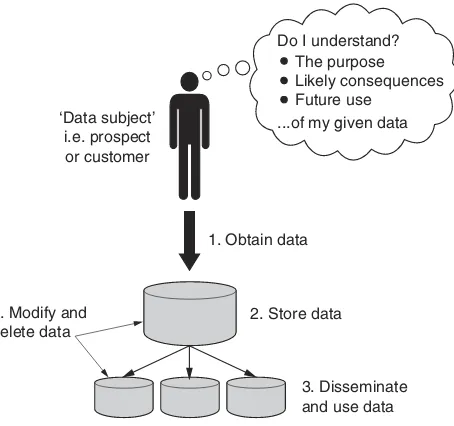
An organisation’s data protection or information management policy must cover all aspects of processing personal data that are shown in Figure 2.2. It shows that we must start by considering the perception of the individual before they have even entered any data. They must be clear about the future uses to which their data will be put, such as whether it will be used for marketing purposes or whether it will be shared with any third parties. Sharing data with third parties is a key concern of the e-mail-receiving public, so you can increase the number of registrants if you explicitly declare: ‘we will not sell your data to third parties under any circumstances’. This may be good, in the short term, but, have you considered all the circumstances? What if an opportunity arises to sell your list to a third party? What if your company is taken over by another company that does have opportunities to pass on to a third party?
this case, there should be an opt-in to the type of information that will be received and the channel through which it will be used.
So, your future use of data statement should cover:
. recipient’s options: opt-in or opt-out for
. form of communication, e.g. newsletter or other promotional e-mail
. channel of communication, e.g. e-mail, phone, fax or direct mail
. whether you will share data with third parties.
It follows that the form of words, position or size of text for an opt-in is vital since this will govern whether the data subject understands the use to which their data will be put. You will want to avoid an expensive reconsenting exercise where it is necessary to contact customers because you are unsure what use of data they have consented to in the past. If you do need to reconsent you will have to do this in such a way that it is not piggy-backing on the back of an existing campaign. If the design of the data collection tool, whether it is on screen, on paper or verbal, is such that the user is being misled, then this breaks the data protection laws. Further issues follow at each of the other stages of processing personal data. For example, we must ensure the data is secure at stage 2, and that if it is disseminated in the organisation (3) it can still be modified or deleted (4) if this is required.
When developing an organisation’s data protection or information management policy, you should assess whether you are using personal data ‘lawfully, ethically and profitably’. Following a strict interpretation of the law may not always be in the customers’ best interests and may not be profitable. For example, the law may indicate an expensive reconsenting exercise to make sure that you have permission from your customers to use their data for direct marketing purposes. If
‘Data subject’ i.e. prospect or customer
1. Obtain data
2. Store data
3. Disseminate and use data 4. Modify and
delete data
Do I understand? The purpose Likely consequences Future use
[image:41.536.150.377.55.268.2]...of my given data
you have regular and transparent dialogue with customers, this allows informed judgements about what they seek from you in a ‘privacy relationship’. Finding this balance will ultimately prove more profitable than ‘blind adherence’ to legislation which is open to interpretation, and which is in a constant state of flux.
The following principles are important to understanding e-mail marketing laws.
. Personal data: the Data Protection Directive and the UK Data Protection Act 1998 were essen-tially created to protect personal data. The Act defines ‘personal data’ as: ‘data which relates to a living individual who can be identified: from those data; or from those data and other informa-tion which is in the possession of, or is likely to come into the possession of, the data controller.’ This begs the question: is an e-mail address personal data? Since personal data is deemed to identify an individual uniquely, the answer is yes even if it is a generic address such as [email protected].
. Sensitive personal data: additional protection is given for these data, which include personal details such as religious beliefs, political affiliations, gender, health information and racial origins. Such data cannot be processed or used in any way on anything other than an ‘opt-in’ basis.
E M M A g u i d a n c e o n e - m a i l m a r k e t i n g
E - M A I L M A R K E T I N G I N S I G H T
In March 2002, the chair of the E-mail Marketing Association (EMMA) attacked the practice of non-members using ‘permission-based’ to refer not to opt-in lists, but to ‘opt-out’ lists where individual members on a list had failed to opt-out of such use being made of their personal details. However, at the time of writing, the UK’s Direct Marketing Association (DMA) allows its members to collect and use e-mail addresses for marketing purposes on an ‘opt-out’ basis. This is consistent with the law provided the data is not sensitive personal data.
Such sensitive personal data, the 1998 Act provides, cannot be processed or used in any way on anything other than an ‘opt-in’ basis. If an organisation has not collected sensitive personal data, therefore, the EMMA position is ‘best practice’ as some might see it, as opposed to strictly required by current laws.
Remember that if you decide to collect data on an ‘opt-out’ basis since it is still legal currently, then if opt-in becomes law in the future, you may not be able to use this data: the opt-in law may be retrospective. For this reason, many companies are deciding to use opt-in now to protect their contact database for the future.
By using opt-in now, you are allowing for future changes in the law to an opt-in-only regime.
S t a y i n g w i t h i n t h e l a w
C A M P A I G N C H E C K L I S T
What are the implications for e-mail marketers arising from these emerging laws? We can make these guidelines:
1. The short-term view is that it is acceptable to use an opt-out approach now provided ‘sensitive personal data’ are not involved. This may result in more business in the short term, but at the risk of alienating some prospects or cus-tomers who believe they have not opted-in to these communications.
2. The longer term view is that when collecting data it may be best to start an opt-in approach now, for when the future law comes into place.
3. When buying e-mail lists, care should be taken to ask exactly how those on the list were asked whether they wished to opt-in or opt-out. This may even require assessing the form of the question (see Chapter 4, page 115).
4. Be aware of and counter the possibility of a spammer using your server for spamming. It can be hijacked if you do not have adequate security measures in place. If this does happen your server could be suspended by the ISP.
5. When devising campaigns, ensure that:
(a) the e-mail is clearly a marketing communication: this should be the case if the offer and sender are clear
(b) the originator of the e-mail is clear: provide a statement of origination for clarity
(c) opt-out lists are respected
(d) there is a clear privacy statement
(e) on-line promotional competitions or discounts are clearly identifiable as such, and conditions easily accessible and presented clearly and unambiguously
(f) all price indications on-line are clear and unambiguous, and indicate whether inclusive of packaging and delivery costs.
Always use a statement of origination so it is clear why the recipient has received the e-mail.
E - M A I L M A R K E T I N G I N S I G H T
1. Individual unknown to organisation. Opt-in required. This is the situation if an e-mail list is purchased from a third-party list owner. It seems likely that only opt-in lists can be used legally, i.e. all individuals on the list must have opted in to receive marketing communica-tions.
2. Individual is a prospect or suspect.Opt-in required. If you have acquired a lead from the web site or through other offline means, then it seems likely that e-mail communications will only be legal on an opt-in basis.
3. Individual is a customer of the organisation. Opt-out required. It is likely that if there is an estab-lished relationship starting with a sale, then e-mail marketing communications will be legal provided the customer is given the opportunity to opt out of future communications.
This situation arises since the new directive distinguishes quite clearly that opt-out will only be acceptable for customers that have previously purchased directly from the company.
To future-proof, you should collect opt-in, but also record the different acceptable forms of communications to the customer (phone, fax, direct mail, e-mail), the date and time the data was collected and the form of consent given, i.e. opt-in or opt-out. The record should even reference the form of privacy statement in force at the time of registration.
Q u e s t i o n s f o r l i s t b r o k e r s
Some list brokers state that their lists are opt-in, when they are not. If you use such a list, you may be breaking data protection laws, have an unsatisfactory response rate and receive complaints that tarnish your brand. So, with all list brokers or vendors, you should initially ask whether the list is opt-in and find out the exact form of the opt-in, what text was used and what the source was. One list vendor in the UK has a privacy statement that states that the recipient’s address was collected at a conference, via a magazine subscription or direct mail. This is not sufficiently specific. Some individuals will want to know exactly where their data was collected.
If the form and source of opt-in are not known then there can be no reassurance that you are not spamming and damage to your brand will result. You should ask that it is written into the contract that the list is warranted for use in direct marketing under current data protection legislation. This will be useful if you later receive a complaint from a recipient. You are unlikely to be prosecuted under the Data Protection Act or Telecommunications Act if you have shown due diligence in checking that your supplier is using an opt-in list.
You can also check whether the list owner is on the List Warranty Register (which was originally developed for direct mail). This is a central database of list owner and list user warranties. There are four types of warranty: consumer list owner, consumer list user, business list owner and business list user. Warranties are renewed every year. By signing a warranty the signee agrees to comply with the DMA’s Code of Practice and in case of a complaint to be bound by the decisions of the DMA.
C U S T O M E R R E L A T I O N S H I P M A N A G E M E N T