ACUTE & SUBACUTE TOXICITY STUDIES OF POLYHERBAL
ANTI ARTHRITIC FORMULATION
Rakesh H.Nikam*, Vaishali R. Undale, Amol A. Rasal, Dr. Ashok V. Bhosale,
Department of Pharmacology, PDEA’s Seth Govind Raghunath Sable College of Pharmacy,
Saswad, India.
ABSTRACT
Plants have always been playing an important role as potential source
of drugs. Herbal medicines have been extensively used in developed
countries as they are natural and relatively safe. Though the Herbal
formulation thought to be safe and effective, WHO has recommended
their evaluation for toxicity. The principle underlying the use of more
than one plant/plant product in the formulations is that they may
produce synergistic and/or additive effects, or one may neutralize the
toxic effect of another. So in this study the developed Polyherbal
formulation was evaluated for its acute and sub acute toxicity. In an
acute toxicity study the Polyherbal antiarthritic formulation was
administered orally at the dose of 2000 mg/kg in mice and observed
closely for mortality and toxicity. In sub acute toxicity studies
Polyherbal formulation at dose of 500mg/kg and its individual
ingredients were administered orally at its individual doses that had been used in formulation
to rats for 28 days. The bodyweight, haematological and biochemical parameters were
evaluated during study. On 29th day rats were sacrificed and histopathological changes in
heart, kidney, liver and spleen were studied. The results of the sub acute toxicity study shows
no any change in the hematological, biochemical parameters and histological changes in vital
organs. So it is concluded that the polyherbal antiarthritic formulation is safe at the
therapeutic dose studied as the components of the formulation modulate effect of each other
to maintain physiological function. The results indicate the safety of the formulation even in
the long term treatment.
Keywords: Arthritis, acute and sub acute toxicity.
Volume 2, Issue 5, 1563-1576. Research Article ISSN 2277 – 7105
Article Received on 19 June 2013,
Revised on 25 July 2013, Accepted on 29 August 2013
*Correspondence for
Author:
Rakesh H.Nikam
Department of Pharmacology, PDEA’s Seth Govind
Raghunath Sable College of Pharmacy, Saswad, India.
1. INTRODUCTION
Plants have always been playing an important role as potential source of drugs. Conventional
drugs sometimes can have serious adverse effects. Herbal medicines have been extensively
used in developed countries as they are natural and relatively safe. The principle underlying
the use of more than one plant/plant product in these formulations is that they may produce
synergistic and/or additive effects, or one may neutralize the toxic effect of another, which is
otherwise therapeutic in the given context. [i] According to World Health Organization,
International regulations relating to human health require that all new pharmaceutical drugs
and plant products are tested for their safety prior to their use in human volunteers and
patients. Herbal formulation are thought to be more safe and efficacious way to treat disease
but WHO indicate assessment of the safety, efficacy and quality of herbal medicines as a
prerequisite for global harmonization so in this project a developed polyherbal anti-arthritic
formulation was evaluated for acute and sub acute toxicity study.
A polyherbal anti arthritic formulation contains powders of Withania somnifera,
Commiphora guggul, Boswellia serrata, Myrica esculenta, Hyoscyamus niger and Vitex
negundo that have clinically been proven effective anti-inflammatory analgesic and anti
arthritic activities when used alone. But their combination is not studied for toxicity as well
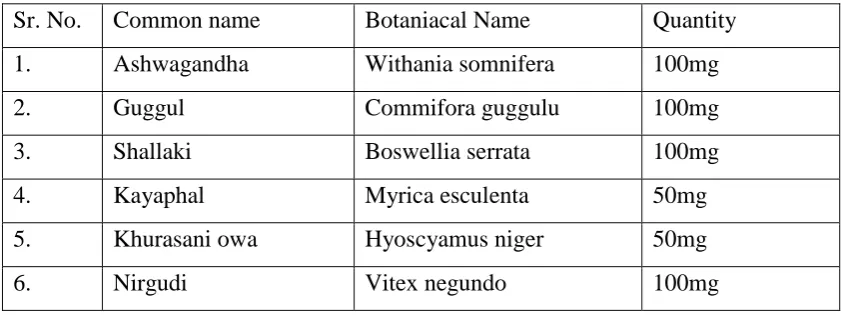
as therapeutic efficacy. Table no. 1 indicates the quantities of each component used to
formulate a 500 mg tablet.
[image:2.595.87.508.581.738.2]2. MATERIAL & METHODS 2.1 Chemicals and Drug
Table no. 1 Composition of polyherbal antiarthritic formulation:
Sr. No. Common name Botaniacal Name Quantity
1. Ashwagandha Withania somnifera 100mg
2. Guggul Commifora guggulu 100mg
3. Shallaki Boswellia serrata 100mg
4. Kayaphal Myrica esculenta 50mg
5. Khurasani owa Hyoscyamus niger 50mg
Table No. 1 Composition of polyherbal anti arthritic formulation
The powder of this formulation was suspended in the 0.5 % Carboxy Methyl Cellulose and
administered to the animals with oral feeding needle.
2.2 Animals
Swiss albino mice and Wistar albino rats bred in the animal house facility of PDEA’s SGRS
College of Pharmacy were used. The animals were maintained under controlled temperature,
humidity and 12 hr dark and 12 hr light cycle as per prescribed by the CPCSEA. The
experimental protocol was approved by the IAEC (SGRS/IAEC/22/2011).
2.3 Acute Toxicity Study
Acute toxicity study was carried out as per the OECD 425 guidelines. Swiss albino mice of
either sex weighing 18-22 gm were administered with the dose of 2000 mg/kg orally of
polyherbal antiarthritic formulation and observed closely for first 4 hours for behavioral and
neurological symptoms and then for 72 hours for mortality. [ii][iii]
2.4 Sub Acute Toxicity Studies
The sub-acute toxicity was carried out as per OECD guidelines. For sub acute and chronic
toxicity studies the Wistar rats of either sex weighing 200-250 gm were divided in eight
groups as follows for 28 days.
Treatment protocol
Wistar rats were divided into eight groups, n=6
Group I: Normal Control- treated with vehicle (0.5% CMC)
Group II: Withania somnifera (100 mg/kg BW ) p.o.
Group III: Commiphora guggulu (100mg/kg BW ) p.o
Group IV: Boswellia serrata (100mg/kg BW ) p.o
Group V: Hyoscyamus niger (50mg/kg BW ) p.o
Group VI: Myrica esculenta (50 mg/kg BW ) p.o
Group VII: Vitex negundo (100mg/kg BW ) p.o
Group VIII: Polyherbal antiarthritic formulation (500 mg/kg BW ) p.o
During this period Body weight, food intake and water intake were monitored. The
haematological parameters were evaluated at 14th and 29th day and biochemical parameters
were evaluated at 29th day. The blood was collected from treated animals by retro-orbital
parameters such as haemoglobin, RBC, [iv] WBC, [v] hematocrit etc and biochemical
parameters such as Serum glutamate oxaloacetate transaminase (SGOT), [vi] Serum glutamate
pyruvate transaminase (SGPT), serum Creatinine, [vii] blood urea nitrogen. [viii] The
parameters were analyzed on autoanalyzer by using Erba Chem diagnostic kits. The heart,
kidney, liver and spleen were isolated for histopathological studies.
2.5. Statistical Analysis
The values are expressed as mean ± standard error of mean (S.E.M.). Statistical analysis
between different groups is done using One-way ANOVA / Two way ANOVA followed by
Dunnet’s testusing Graphpad Prism 5 software.
3. RESULTS
3.1 Acute Toxicity Studies
The acute toxicity study revealed that the Polyherbal anti arthritic formulation is safe up to a
dose of 2000mg/kg of body weight. No any mortality or toxicity was observed in the Limit
and Main Test.
3.2 Sub acute Toxicity Studies
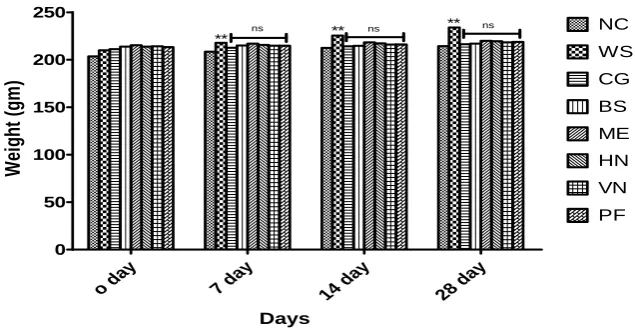
As seen in the Fig. 1 in the sub acute toxicity study the groups treated with Polyherbal anti
arthritic formulation and its individual ingredients did not show any significant changes in
body weight as compared to control group, except Withania somnifera treated group. The
statistically significant increase in (** p <0.01) body weight in Withania somnifera treated
group as compared to normal control group was observed.
Effect of Pol yherbal anti arthri ti c formul ati on and i ts i ndi vi dual i ngredi ents on body wei ght i n normal ani mal s
o da y
7 day 14 day 28 day 0
50 100 150 200 250
NC
WS
CG
BS
ME
HN
VN
PF
ns ns ns
** **
**
Days
W
ei
g
h
t
(g
m
)
[image:4.595.139.457.549.714.2]Values are expressed as mean ± S.E.M., n=6; Statistical analysis by Two-way ANOVA
followed by Dunnet’s testusing Graphpad Prism 5 software; normal control group compared
with all treatment groups where, ns= non significant, ** p <0.01.
Table no. 2 Effect of Polyherbal antiarthritic formulation and its individual ingredients on Haematological parameters at 14th and 29th day
Parameters
Groups
Hemoglobin RBC Total WBC Platelet count
14th day 29th day 14th day 29th day 14th day 29th day 14th day 29th day
Normal
Control
11.3 ± 11.4±
0.17 0.218
6.01 ± 6.29±
0.066 0.0759
5810 ± 5790±
41.9 179
493000 503000
±7470 ± 9810
Withania
somnifera
(100mg/kg)
10.8 ± 10.8±
0.27 0.27
5.74 ± 6.35 ±
0.061 0.0749
5570 ± 5480±
62 135
481000 540000
±7690 ± 6550
Commiphora
guggul
(100mg/kg)
11.4 ± 11.4±
0.23 0.22
5.88 ± 6.11 ±
0.104 0.129
5470 ± 5910±
126 217
503000 527000
±7570 ± 6700
Boswellia
serrata
(100 mg/kg)
10.9 ± 10.8±
0.139 0.16
5.68 ± 6.31 ±
0.066 0.0684
5170 ± 5920 ±
123 111
481000 519000
±7510 ± 6240
Myrica
esculenta
(50mg/kg)
11 ± 10.8±
0.152 0.21
6.18± 6.27 ±
0.034 0.138
5530 ± 5660±
112 51.9
477000 532000
±7510 ± 7470
Hyoscyamus
niger
(50mg/kg)
10.8 ± 10.8±
0.136 0.24
5.79± 6.24 ±
0.135 0.0481
5250 ± 5410±
146 113
500000 524000
±7290 ±7210
Vitex
nigundo
(100 mg/kg)
10.8 ± 11±
0.29 0.034
6.27± 6.01 ±
0.058 0.115
6060 ± 5670±
157 38.3
492000 524000
±6540 ± 7390
Polyherbal
formulation
(500mg/kg)
11 ± 10.6±
0.13 0.18
5.90 ± 6.15 ±
0.162 0.0559
5880 ± 5560±
135 42.7
513000 498000
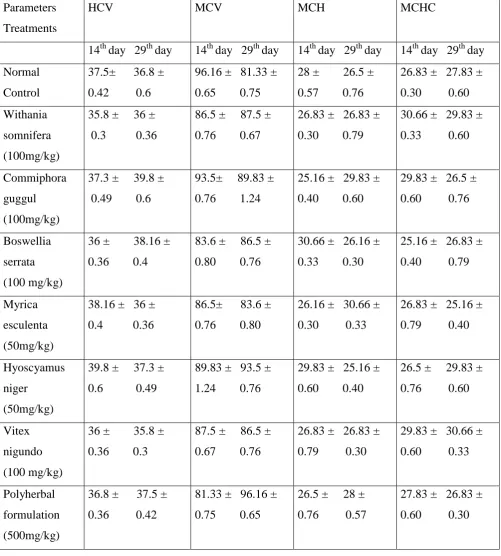
Table no.3 Effect of Polyherbal antiarthritic formulation and its individual ingredients on Blood cell indices at 14th and 29th day
Parameters
Treatments
HCV MCV MCH MCHC
14th day 29th day 14th day 29th day 14th day 29th day 14th day 29th day
Normal
Control
37.5± 36.8 ±
0.42 0.6 96.16 ± 81.33 ±
0.65 0.75
28 ± 26.5 ±
0.57 0.76
26.83 ± 27.83 ±
0.30 0.60
Withania
somnifera
(100mg/kg)
35.8 ± 36 ±
0.3 0.36
86.5 ± 87.5 ±
0.76 0.67
26.83 ± 26.83 ±
0.30 0.79
30.66 ± 29.83 ±
0.33 0.60
Commiphora
guggul
(100mg/kg)
37.3 ± 39.8 ±
0.49 0.6
93.5± 89.83 ±
0.76 1.24
25.16 ± 29.83 ±
0.40 0.60
29.83 ± 26.5 ±
0.60 0.76
Boswellia
serrata
(100 mg/kg)
36 ± 38.16 ±
0.36 0.4
83.6 ± 86.5 ±
0.80 0.76
30.66 ± 26.16 ±
0.33 0.30
25.16 ± 26.83 ±
0.40 0.79
Myrica
esculenta
(50mg/kg)
38.16 ± 36 ±
0.4 0.36
86.5± 83.6 ±
0.76 0.80
26.16 ± 30.66 ±
0.30 0.33
26.83 ± 25.16 ±
0.79 0.40
Hyoscyamus
niger
(50mg/kg)
39.8 ± 37.3 ±
0.6 0.49
89.83 ± 93.5 ±
1.24 0.76
29.83 ± 25.16 ±
0.60 0.40
26.5 ± 29.83 ±
0.76 0.60
Vitex
nigundo
(100 mg/kg)
36 ± 35.8 ±
0.36 0.3
87.5 ± 86.5 ±
0.67 0.76
26.83 ± 26.83 ±
0.79 0.30
29.83 ± 30.66 ±
0.60 0.33
Polyherbal
formulation
(500mg/kg)
36.8 ± 37.5 ±
0.36 0.42
81.33 ± 96.16 ±
0.75 0.65
26.5 ± 28 ±
0.76 0.57
27.83 ± 26.83 ±
Effect of Polyherbal antiarthritic formulation and its individual ingredients on Biochemical parameters
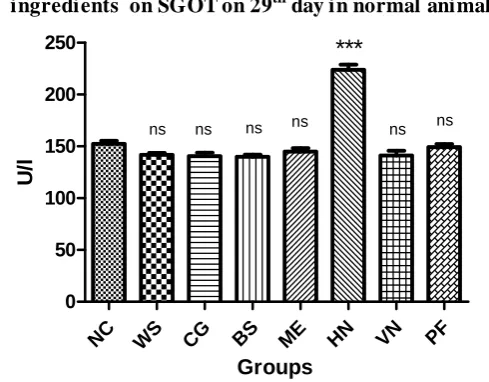
It was observed that Hyoscyamus niger treated group showed significant increase (*** p <
0.001) in SGOT level and polyherbal formulation and its individual ingredients did not show
significant change as compared to Normal Control group.
a) SGOT
Effect of Polyherbal antiarthritic formulation and its individual ingredients on SGOT on 29th day in normal animals
NC WS CG BS ME HN VN PF
0 50 100 150 200 250
ns ns ns ns
***
ns ns
Groups
U
[image:7.595.170.415.259.450.2]/l
Fig. 2 Effect of Polyherbal antiarthritic formulation and its individual ingredients on SGOT on 29th day in normal animals
Values are expressed as mean ± S.E.M., n=6; Statistical analysis by One-way ANOVA
followed by Dunnet’s testusing Graphpad Prism 5 software; normal control group compared
with all treatment groups where, ns= non significant, *** p < 0.001.
b) SGPT
It was observed that Hyoscyamus niger treated group showed significant increase (** p <
0.01) in SGPT level and polyherbal formulation and its individual ingredients did not show
significant change as compared to Normal Control group except Myrica esculenta (* p <
Effect of Pol yherbal anti arthri ti c formul ati on and i ts i ndi vi dual
i ngredi ents on SGPT on 29th day i n normal ani mal s
NC WS CG BS ME HN VN PF
0 50 100 150
ns ns ns
* ***
**
ns
Groups
U
[image:8.595.142.438.89.288.2]/l
Fig. 3 Effect of Polyherbal antiarthritic formulation and its individual ingredients on SGPT on 29th day in normal animals
Values are expressed as mean ± S.E.M., n=6; Statistical analysis by One-way ANOVA
followed by Dunnet’s testusing Graphpad Prism 5 software; normal control group compared
with all treatment groups where, ns= non significant, *** p < 0.001,
** p <0.01, * p < 0.05.
c) Blood urea nitrogen
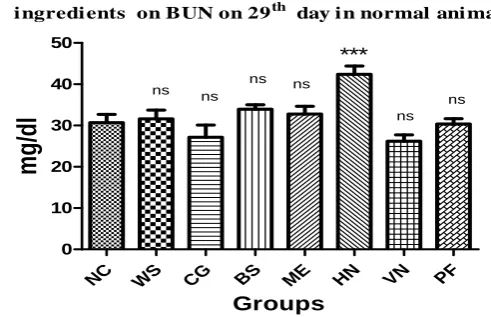
It was observed that Hyoscyamus niger treated group showed significant increase (*** p <
0.001) in BUN level and polyherbal formulation and its individual ingredients did not show
significant change as compared to Normal Control group.
Effect of Pol yherbal anti arthri ti c formul ati on and i ts i ndi vi dual i ngredi ents on BUN on 29th day i n normal ani mal s
NC WS CG BS ME HN VN PF 0
10 20 30 40 50
ns ns ns ns
***
ns ns
Groups
m
g
/dl
[image:8.595.166.412.553.711.2]Values are expressed as mean ± S.E.M., n=6; Statistical analysis by One-way ANOVA
followed by Dunnet’s testusing Graphpad Prism 5 software; normal control group compared
with all treatment groups where,ns= non significant, *** p < 0.001
d) Creatinine
It was observed that Boswellia serrata and Myrica esculenta treated group showed significant
decrease (*** p < 0.001) in Creatinine level and polyherbal formulation and its individual
ingredients did not show significant change as compared to Normal Control group.
Fig. 5 Effect of Polyherbal antiarthritic formulation and its individual ingredients on creatinine on 29th day in normal animals
Values are expressed as mean ± S.E.M., n=6; Statistical analysis by One-way ANOVA
followed by Dunnet’s testusing Graphpad Prism 5 software; normal control group compared
with all treatment groups where, ns= non significant, *** p < 0.001.
HISTOPATHOLOGY
a) Effect of polyherbal anti arthritic formulation and its individual ingredients on histopathology of Heart:
Effect of Pol yherbal anti arthri ti c formul ati on and i ts i ndi vi dual i ngredi ents on creati ni ne on 29th day i n normal ani mal s
NC WS CG BS ME HN VN PF
0.0 0.2 0.4 0.6 0.8 1.0
ns ns
ns ns ns ***
***
Groups
m
g
[image:9.595.78.540.614.752.2]Fig 6: Histopathological sections of heart
b) Effect of polyherbal anti arthritic formulation and its individual ingredients on histopathology of Kidney:
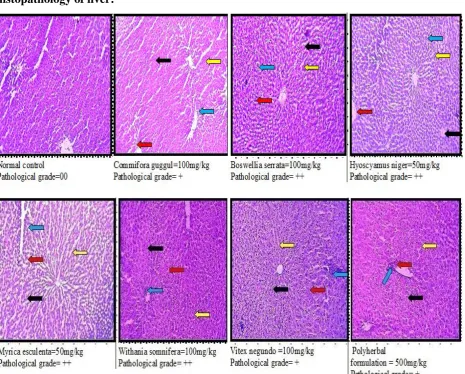
[image:10.595.71.543.323.692.2]c) Effect of polyherbal anti arthritic formulation and its individual ingredients on histopathology of liver:
Fig 8: Histopathological sections of liver
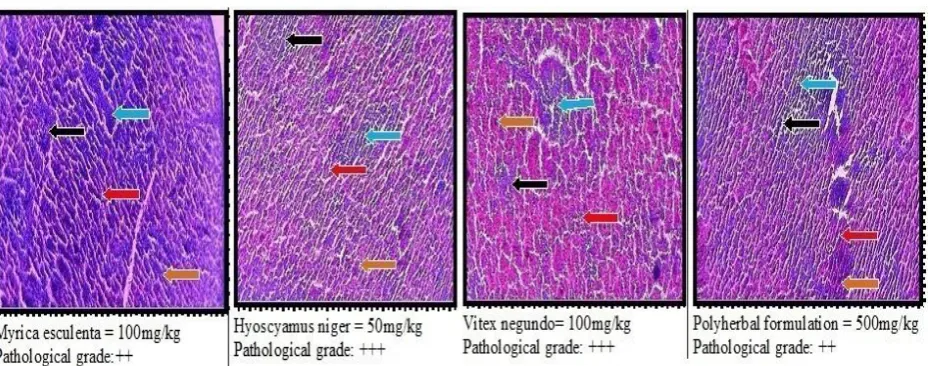
Fig 9: Histopathological sections of spleen
Evaluation of histopathological study as per of pathological grades
0 = no abnormality detected
+ = damage/ active changes up to less than 25 %
++ = damage/ active changes up to less than 50 %
+++ = damage/ active changes up to less 75 %
++++ = damage/ active changes up to more than 75 %
DIS1CUSSION
In acute toxicity studies the polyherbal anti arthritic formulation did not exhibit any lethality
or toxic symptoms at the dose of 2000 mg/kg. According to OECD guidelines 425 the
polyherbal anti arthritic formulation administered at the increasing dose range of 175mg/kg,
550mg/kg, 1000mg/kg, 1750mg/kg and 2000 mg/kg and it did not exhibit any mortality or
behavioural and neurological alteration suggesting the safety of drug in Polyherbal
formulation.
For sub acute toxicity study polyherbal anti arthritic formulation and its individual
ingredients were administered for 28 days to wistar rats. The dose of individual ingredient
was selected from Ayurvedic literature and from the formulation aspect 500mg/kg was
thought to be possible therapeutic dose of Polyherbal formulation.
In sub acute toxicity study body weight, food intake and water intake monitored daily and
evaluated on day 0, day 7, day 14 and day 28 and the hematological and biochemical
In the sub acute toxicity study as shown Fig. 1 in case of Withania somnifera treated group,
showed significant increased in body weight. This is because of the steroidal content of the
Withania somnifera, The major biochemical constituents of Withania somnifera are steroidal
alkaloids such as withanine, somniferine etc. and lactones. This indicates that polyherbal
formulation and other ingredient did not have any untoward effect on the body weight and
food intake. This may be because of counteracting effect of combination of other ingredients
which is important to assess the response to the therapy of drugs.
No any statistically significant change in the haematological parameters on day 14th and 29th
was observed in the groups treated with polyherbal formulation and its individual ingredients
as compared to normal control group. As shown in Table 2 and 3 there were no any
significant changes in the hematological parameters such as Haemoglobin, RBC, WBC
Count, differential leucocytes platelet count, and blood cell indices. This suggests that the test
drug is not toxic to the circulating blood cells and do not interfere process of hematopoeisis.
In case of biochemical parameters as observed from Fig 2, 3 and 4, only Hyoscyamus niger
treated group showed significant increase in SGOT, SGPT and Creatinine. But all other
groups treated with individual ingredients did not show such increase in biochemical
parameters. Even in animals treated with polyherbal formulation no such increase in the liver
and kidney biochemical parameters is observed indicating the physiological modulation by
the constituents of Polyherbal formulation to maintain homeostasis. SGOT and SGPT
increasing effect of Hyoscyamus niger was found to be nullified by other constituents and
thus protecting liver and kidney from physiological abnormality. No any significant increase
in the liver function parameters SGOT and SGPT was observed as compared to normal
control group indicating that Polyherbal anti arthritic formulation and its individual
ingredients is not toxic. Histopathological studies revealed that Polyherbal formulation
protects from cardiac toxicity, nephrotoxicity, hepatotoxicity and spleen toxicity.
CONCLUSION
The present finding suggests that formulated Polyherbal anti arthritic formulation and its
individual ingredients are non toxic since no any marked changes in the hematological,
biochemical and histopathological parameters were observed at the dose levels studied. Thus
ACKNOWLEDGEMENTS
We are thankful to Pune District Education Associations and Seth Govind Raghunath Sable
college of Pharmacy, Saswad, for providing me a platform for research work.
REFERENCES
i). Li XK, Motwani M, Tong W, Bornmann W, Schwartz GK, Huanglian A. Chinese herbal
extract, inhibits cell growth by suppressing the expression of cyclin B1 and inhibiting
CDC2 kinase activity in human cancer cells. Molecular Pharmacology 2000;58(6):1287–
93.
ii). http://iccvam.niehs.nih.gov/SuppDocs/FedDocs/OECD/OECDtg425.pdf.
iii). Ecobichon DJ, The basis of Toxicology testing, New York ;, CRC press , 1991: pp.43
iv). Ghai CL, A Textbook of Practical Physiology, Jaypee Brothers, India, 1995; pp. 119.
v). John MB, Laboratory medicine haematology,4th ed, C.V. Mosby Co. St. Louis, 1972;
pp1198.
vi). King J, The transferase-alanine and Aspartate transaminase, In practical clinical
enzymology, Van D Ed, Nostrand Company Limited,1965; pp.191.
vii). Slot C, Plasma Creatinine determination: a new and specific Jaffe reaction method,
Scand. J. Clin. Invest. 1965;17:381.
viii). Natelson S, Scott ML, Beffa C, A rapid method for the estimation of urea in biological
fluid by means of the reaction between diacetyl monoxime and urea, Am. J.Chem. Pathol,