Core J2EE™ Patterns: Best Practices and Design Strategies Foreword
Preface
Sun Java Center and the J2EE Pattern Catalog
What This Book is About?
What This Book Is Not?
Who Should Read this Book?
How This Book is Organized
Companion Website and Contact Information Acknowledgments
I: PATTERNS AND J2EE 1. INTRODUCTION
What Is J2EE ?
What Are Patterns?
J2EE Pattern Catalog
Patterns, Frameworks, and Reuse
Summary
2. J2EE PLATFORM OVERVIEW
A Brief Perspective
J2EE Platform
J2EE Patterns and J2EE Platform
Summary
II: DESIGN CONSIDERATIONS, BAD PRACTICES, AND REFACTORINGS 3. PRESENTATION TIER DESIGN CONSIDERATIONS AND BAD PRACTICES
Presentation Tier Design Considerations
Presentation Tier Bad Practices
4. BUSINESS TIER DESIGN CONSIDERATIONS AND BAD PRACTICES
Business Tier Design Considerations
Business and Integration Tiers Bad Practices 5. J2EE REFACTORINGS
Presentation Tier Refactorings
Business and Integration Tier Refactorings
Part 3 includes the following four chapters: 6. J2EE PATTERNS OVERVIEW
What Is a Pattern?
Identifying a Pattern
The Tiered Approach
J2EE Patterns
Guide to the Catalog
J2EE Pattern Relationships
Relationship to Known Patterns
Patterns Roadmap
Summary
7. PRESENTATION TIER PATTERNS
Intercepting Filter
Front Controller
View Helper
Consequences
Related Patterns
Composite View
Service to Worker
Dispatcher View
8. BUSINESS TIER PATTERNS
Business Delegate
Value Object
Session Facade
Composite Entity
Value Object Assembler
Value List Handler
Service Locator
9. INTEGRATION TIER PATTERNS
Data Access Object
Service Activator
Epilogue J2EE PATTERNS APPLIED
PSA Overview
Use Case Model
Use Cases, Patterns, and Pattern Frameworks
Create Project Use Case
Reserve Resource Use Case
Foreword
In the world of software, a pattern is a tangible manifestation of an
organization's tribal memory. A pattern provides a common solution
to a common problem and so, within the culture of one specific
organization or within one domain, naming and then specifying a
pattern represents the codification of a common solution, drawn from
proven, prior experience. Having a good language of patterns at your
disposal is like having an extended team of experts sitting at your side
during development: by applying one of their patterns, you in effect
take the benefit of their hard-won knowledge. As such, the best
patterns are not so much invented as they are discovered and then
harvested from existing, successful systems. Thus, at its most mature
state, a pattern is full of things that work, absent of things that don't
work, and revealing of the wisdom and rationale of its designers.
Deep, really useful, patterns are typically ancient: you see one and
will often remark, “Hey, I've done that before.” However, the very
naming of the pattern gives you a vocabulary that you didn't have
previously and so helps you apply that pattern in ways you otherwise
might have not have realized. Ultimately, the effect of such a pattern
will be to make your system simpler.
Patterns not only help you build simpler systems that work, but they
also help you build beautiful programs. In a culture of time starvation,
writing beautiful software is often impossible. That's sad, for as
professionals, we strive to build things of quality. By applying a good
set of patterns, it is possible to bring a degree of elegance in to your
systems that might otherwise have been lacking.
The authors of Core J2EE Patterns have harvested a really useful set
of patterns. Don't get me wrong: J2EE is certainly an important
platform, enabling teams to build some very powerful systems.
However, reality is, there is still a wide semantic gap between the
abstractions and services that J2EE provides and the final application
that a team must build. Patterns such as specified in this book
represent solutions that appear again and again in filling that gap. By
applying these patterns, you thus carry out the primary means of
reducing software risk: you write less software. Rather than
discovering these solutions on your own, apply these patterns, which
have already proven their utility in existing systems.
Additionally, they show you how to apply these patterns and how to
refactor your system to take advantage of them. Again, it's just like
having a team of experts sitting at your side.
Grady Booch
Chief Scientist
Preface
This book is about patterns for the Java 2 platform, Enterprise Edition (J2EE). These J2EE patterns provide solutions for problems typically encountered by designers of software applications for the J2EE platform. All the patterns documented in the catalog have been discovered in the field, where they have been used to create successful J2EE applications for our customers.
This book describes proven solutions for the J2EE platform with a particular emphasis on such key J2EE technologies as: Java Server Pages (JSP), Servlets, Enterprise JavaBeans (EJB) components, Java Message Service (JMS), JDBC, and Java Naming and Directory Interface (JNDI). We offer solutions for recurring problems for the J2EE platform through the J2EE Pattern Catalog and J2EE refactorings. You can apply these ideas when developing new systems or when improving the design of existing systems. The patterns in this book will help you quickly gain the proficiency and skills to build robust, efficient enterprise
applications.
Today, as in the past, many of us naively assume that learning a technology is synonymous with learning to design with the technology. Certainly learning the technology is an important part to being successful in designing with the technology. Many existing Java books are excellent at explaining technology details, such as API specifics and so forth, but at the same time they give no insight on applying the technology. Learning to design comes from experience and from sharing knowledge on best practices and bad practices.
The experiences we have conveyed in this book are derived from the work we have done in the field. We are part of Sun Microsystems, Inc.'s Sun Java Center (SJC) consulting organization. In our work, we often encounter situations where, because technology is moving so quickly, designers and developers are still struggling to understand the technology, let alone how to design with the technology.
It is not good enough to tell designers and developers to write good code, nor is it sufficient to suggest using Servlets and JSP for developing the presentation tier and EJB components[1] for developing the business tier.
[1] If you are new to the J2EE platform, we discuss the platform and these technologies in Chapter 2, “J2EE
Platform Overview”.
Sun Java Center and the J2EE Pattern Catalog
Since its inception, SJC architects have been working with clients all over the world to successfully design, architect, build, and deploy various types of systems based on Java and J2EE. The SJC is a rapidly growing consulting organization constantly adding new hires to its ranks of experienced architects.
Recognizing the need to capture and share proven designs and architectures, we started to document our work on the J2EE platform in the form of patterns in 1999. Although we looked in the existing literature, we could not find a catalog of patterns that dealt specifically with the J2EE platform. We found many books dealing with one or more of the J2EE technologies, and these books do an excellent job of explaining the technology and unraveling the nuances of the specifications. Some books offered extra help by providing some design considerations.
Since we first publicly presented our ideas on J2EE patterns at the JavaOne Conference in June 2000, we have received an overwhelming response from architects and developers. While some individuals expressed great interest in learning more about the patterns, others confirmed that they had applied the patterns, but had never named or documented them. This interest in patterns for the J2EE platform further motivated us to continue our work.
Thus, we put together the J2EE Pattern Catalog., which was initially made available to the entire J2EE community in beta form via the Java Developer Connection in March, 2001. Based largely on community feedback, the beta documentation evolved into the release you see in this book.
We hope these patterns, best practices, strategies, bad practices, and refactorings for the J2EE platform, provide the same benefits to you as they do for us.
What This Book is About?
This book is about:
• Using patterns for the J2EE Platform.
Based on our collective J2EE platform experience, we have assembled the pattern catalog in this book. The J2EE Pattern Catalog describes various best practices related to architecting and designing applications for the J2EE platform. This book focuses on the following four J2EE technologies: Servlets, JSP, EJB components, and JMS.
• Using best practices to design applications that use JSP, Servlet, EJB
It is not sufficient to merely learn the technology and the APIs. It is equally important to learn to design with the technology. We have documented what we have experienced to be the best practices for these technologies.
• Preventing re-inventing-the-wheel when it comes to design and architecture
for the J2EE platform.
Patterns promote design reuse. Reusing known solutions reduces the cycle time for designing and developing applications, including J2EE applications.
• Identifying bad practices in existing designs and refactoring these designs to
move to a better solution using the J2EE patterns.
Knowing what works well is good. Knowing what does not work is equally important. We have documented some of the bad practices we have experienced when designing applications for the J2EE platform.
What This Book Is Not?
This book is not about:
• How to program with Java or J2EE technologies
This book is not about programming. While this book is heavily based on the J2EE technologies, we do not describe the specific APIs. If you wish to learn about programming using Java or using any of the J2EE technologies, there are a number of excellent books and online resources from which to learn. The online tutorials on the official Java home page at http://java.sun.com
are highly recommended if you wish to learn about individual technologies. The official specifications for J2EE technologies are also available from the Java home page.
• What process and methodology to use
We do not suggest any type of process or methodology to use since the material presented in this book is not related to either. Hence, this book does not teach you about a process or methodology to follow in your projects. If you would like to learn more about processes and methodologies, there are a good number of books that deal with various object-oriented
methodologies and new books on lightweight processes, such as Extreme Programming.
This book is not going to teach you about UML. We use UML extensively (specifically class and sequence diagrams) to document the patterns and describe the static and dynamic interactions. If you want to learn more about UML, please refer to the UML User Guide [Booch] and the UML Reference Manual [Rumbaugh] by Grady Booch, Ivar Jacobson and James Rumbaugh.
Who Should Read this Book?
This book is for all J2EE enthusiasts, programmers, architects, developers, and technical managers. In short, anyone who is remotely interested in designing, architecting and developing applications for the J2EE platform.
We have attempted to distinguish this book as a training guide for J2EE architects and designers. We all recognize the importance of good designs and
well-architected projects, and that we need good architects to get there.
The use of well-documented patterns, best practices, and bad practices to share and transfer knowledge and experience can prove invaluable for teams with varied experience levels, and we hope that this book answers some of these needs.
How This Book is Organized
This book is organized into three parts.
Part 1—“Patterns and J2EE”, consists of Chapter 1 and Chapter 2.
Chapter 1: “Introduction” is a brief discussion on various topics, including patterns, J2EE platform, defining a pattern, and pattern categorization. It ends by introducing the J2EE Pattern Catalog.
Chapter 2 : “J2EE Platform Overview” provides a high level overview of the J2EE platform for those readers unfamiliar with J2EE, or who wish to refresh their knowledge of the J2EE platform.
Part 2—“Design Considerations, Bad Practices, and Refactorings” deals with design considerations for JSP, Servlets, and enterprise beans. This part also includes bad practices and refactorings for the J2EE platform. This part is comprised of Chapter 3,
4, and 5.
Chapter 3 “Presentation Tier Design Considerations and Bad Practices” and Chapter 4 “Business Tier Design Considerations and Bad Practices” discuss the design considerations and bad practices for the presentation tier and business/integration tiers respectively. The design considerations are issues that a J2EE
platform. The topics presented in these chapters point the reader to other sources (such as official specifications and well written books on these topics) for more detailed information on these issues.
Chapter 5: “J2EE Refactorings” includes some of the refactorings we have
experienced in our work in the field that has enabled us to move our design from a less optimal solution to a better solution. The refactorings provide another way to think about the material in the rest of the book, providing what we believe to be valuable companion material to the pattern catalog. This chapter shows how we have been influenced by Martin Fowler and his book "Refactoring" [Fowler]. For those readers who are familiar with the Refactoring book, the format of this chapter will be very familiar. However, the content of this chapter is entirely in the context of J2EE technologies, whereas Martin Fowler addresses refactoring at a different level.
Part 3—“J2EE Pattern Catalog” presents the J2EE pattern catalog. The catalog contains the fifteen patterns that form the core of this book. This part is comprised of Chapter 6, 7, 8, and 9.
Chapter 6: “J2EE Patterns Overview” provides an overview of the J2EE pattern catalog. This chapter begins with a high level discussion of the pattern ideas and explains the way the patterns are categorized into tiers. It also explains the J2EE pattern template, which is used to present all patterns in this book. The chapter discusses all the J2EE patterns and uses a diagram to show their inter-relationships. It also provides what we have termed a roadmap to the pattern catalog. This roadmap presents common J2EE design and architecture-related questions with references to patterns or refactorings that provide solutions to these questions. Understanding the pattern relationships and the roadmap is key to using these patterns.
Chapter 7: “Presentation Tier Patterns” presents six patterns that pertain to using Servlets, JSP, JavaBeans, and custom tags to design web-based applications for the J2EE platform. The patterns describe numerous implementation strategies, and address common problems such as request handling, application partitioning, and generating composite displays.
Chapter 8: “Business Tier Patterns” presents seven patterns that pertain to using EJB technology to design business components for the J2EE platform. The patterns in this chapter provide the best practices for using the EJB and JMS technologies. Where relevant, these patterns include discussion on other technologies, such as JNDI and JDBC.
Epilogue: “J2EE Patterns Applied” discusses realizing sample use cases with the patterns. This chapter discusses and demonstrates how patterns are combined and work together. This chapter reinforces the idea that patterns exist in a community, and that each pattern supports, and is supported by, other patterns.
Companion Website and Contact Information
The official companion website where we will provide updates and other material is
http://www.phptr.com/corej2eepatterns.
The J2EE Patterns interest group, [email protected] is available for public subscription and participation. To subscribe to the interest group and review the discussion archives, please visit:
Acknowledgments
We wish to thank Stu Stern, Director of Global Sun Java Center and Mark Bauhaus, VP of .COM Consulting without whose support, vision, and belief in our work this effort would never have been realized.
We wish to thank Ann Betser, without whose support, encouragement and skilled advice, we would have been lost.
We wish to express our sincere thanks to the PSA/iWorkflow reference
implementation team of SJC architects: Fred Bloom, Narayan Chintalapati, Anders Eliasson, Kartik Ganeshan, Murali Kalyanakrishnan, Kamran Khan, Rita El Khoury, Rajmohan Krishnamurty, Ragu Sivaraman, Robert Skoczylas, Minnie Tanglao, and Basant Verma.
We wish to thank the Sun Java Center J2EE Patterns Working Group members: Mohammed Akif, Thorbiörn Fritzon, Beniot Garbinato, Paul Jatkowski, Karim Mazouni, Nick Wilde, and Andrew X. Yang.
We wish to thank Brendan McCarthy, SJC Chief Methodologist for keeping us in balance and for all the advice.
We wish to thank Jennifer Helms and John Kapson for introducing the patterns to customers.
We wish to express our gratitude to the following SJC architects from around the world for their support, feedback, and advice: Mark Cade, Mark Cao, Torbjörn Dahlén, Peter Gratzer, Bernard Van Haecke, Patricia de las Heras, Scott Herndon, Grant Holland, Girish Ippadi, Murali Kaundinya, Denys Kim, Stephen Kirkham, Todd Lasseigne, Sunil Mathew, Fred Muhlenberg, Vivek Pande, John Prentice, Alexis Roos, Gero Vermaas, Miguel Vidal.
We wish to thank our management Hank Harris, Dan Hushon, Jeff Johnson, Nimish Radia, Chris Steel, and Alex Wong for their support and encouragement.
We wish to thank the following Sun colleagues for their collaboration:
Bruce Delagi from Software Systems group; Mark Hapner, Vlada Matena from Java Software Engineering; Paul Butterworth and Jim Dibble from Forte Products Group; Deepak Balakrishna from iPlanet Products Group; Larry Freeman, Cori Kaylor, Rick Saletta, and Inderjeet Singh from the J2EE Blueprints Team; Heidi Dailey; Dana Nourie, Laureen Hudson, Edward Ort, Margaret Ong, and Jenny Pratt from Java Developer Connection.
Martin Fowler and Josh Mackenzie from ThoughtWorks, Inc.; Richard Monson-Haefel; Phil Nosonowitz and Carl Reed from Goldman Sachs; Jack Greenfield, Wojtek Kozaczynski, and Jon Lawrence from Rational Software; Alexander Aptus from TogetherSoft; Kent Mitchell from Zaplets.com; Bill Dudney; David Geary; Hans Bergsten; Members of the J2EE Patterns Interest group
We wish to express our special thanks and gratitude to our lead technical editor Beth Stearns, transforming our manuscripts and making them readable, at the same time keeping us on track, and working with us all the way with a heavily demanding schedule.
We wish to thank the technical editors Daniel S. Barclay, Steven J. Halter, Spencer Roberts, and Chris Taylor for their expertise, meticulous review and feedback.
We wish to thank Greg Doench, Lisa Iarkowski, Mary Sudul, and Debby Van Dijk from Prentice Hall; Michael Alread and Rachel Borden from Sun Microsystems Press, for doing everything it took to produce this book.
We thank Bill Jirsa, John Hathaway, and Darlene Khosrowpour from Sun Educational Services for their effort creating the SunEd J2EE Patterns course (SL-500), John Sharp and Andy Longshaw from Content Master Ltd., as well as all the course reviewers for SL-500.
We wish to thank the patterns and the Java communities on whose work we have built.
The authors wish to thank their families for their support.
Deepak Alur wishes to thank:
Kavya, Shivaba and Samiksha—for your support, understanding, and inspiration; My Parents and Ajay.
John Crupi wishes to thank:
Ellen and Rachel—for your support , understanding and love.
Casey and Smokey—two great dogs will be forever missed.
Dan Malks wishes to thank:
Part I: PATTERNS AND J2EE
Part I includes the following two chapters:
•
Chapter 1—Introduction
•
Chapter 2—J2EE Platform Overview
Chapter 1 presents a high-level discussion on patterns and the J2EE.
The chapter presents numerous pattern definitions, information on
pattern categorization, and some benefits of using patterns. This
chapter sets the context for our J2EE Patterns work and provides the
rationale and motivation behind the J2EE Pattern Catalog.
Chapter 1. INTRODUCTION
Topics in This Chapter
•
What Is J2EE?
•What Are Patterns?
•J2EE Pattern Catalog
The last few years have been extraordinary with respect to the
changing landscape of enterprise software development. At the
center of this change is the Java 2 Platform, Enterprise Edition (J2EE),
which provides a unified platform for developing distributed,
server-centric applications. The widespread adoption of the strategic,
enabling technologies of the J2EE have provided the development
community with open standards on which to build service-based
architectures for the enterprise.
At the same time, learning J2EE technologies is too often confused
with learning to design with J2EE technologies. Many existing Java
books do an excellent job of explaining specific aspects of the
technology, but are not always clear on how to apply it.
A J2EE architect needs to understand more than the relevant APIs,
including
•
What are the best practices?
•What are the bad practices?
•
What are the common recurring problems and proven solutions
to these problems?
•
How is code refactored from a less optimal scenario, or bad
practice, to a better one typically described by a pattern?
That is what this book is all about. Good designs are discovered from
experience. When these designs are communicated as patterns using
a standard pattern template, they become a powerful mechanism for
communication exchange and reuse, and can be leveraged to improve
the way we design and build software.
What Is J2EE?
J2EE is a platform for developing distributed enterprise software
applications. Since the inception of the Java language, it has
undergone tremendous adoption and growth. More and more
technologies have become part of the Java platform, and new APIs
and standards have been developed to address various needs.
Eventually, Sun and a group of industry leaders, under the auspices of
the open Java Community Process (JCP), unified all these
enterprise-related standards and APIs into the J2EE Platform.
The J2EE Platform offers numerous advantages to the enterprise:
•
J2EE establishes standards for areas of enterprise computing
components, message-oriented middleware (MOM),
Web-related components, communication protocols, and
interoperability.
•
J2EE promotes best-of-breed implementations based on open
standards, protecting technological investment.
•
J2EE provides a standard platform for building software
components that are portable across vendor implementations,
avoiding vendor lock-in.
•
J2EE increases time-to-market since much of the infrastructure
and plumbing is provided by the vendors' products that are
implemented according to the standard J2EE specification. IT
organizations can now get out of the middleware business and
concentrate on building applications for their business.
•
J2EE increases programmer productivity, since Java
programmers can relatively easily learn J2EE technologies
based on the Java language. All enterprise software
development can be accomplished under the J2EE platform,
using Java as the programming language.
•
J2EE promotes interoperability within existing heterogenous
environments.
We discuss the J2EE Platform in greater detail in Chapter 2, so refer to
that chapter for more information. Now we will take a brief look at
patterns, their history, and the types of patterns in the J2EE Pattern
Catalog that you will find in Part 3 of this book.
What Are Patterns?
Historical References
In the 1970s, Christopher Alexander [Alex, Alex2] wrote a number of
books documenting patterns in civil engineering and architecture. The
software community subsequently adopted the idea of patterns based
on his work, though there was burgeoning interest in the software
community in these ideas already.
Patterns in software were popularized by the book Design Patterns:
Elements of Reusable Object-Oriented Software by Erich Gamma,
Richard Helm, Ralph Johnson, and John Vlissides (also known as the
Gang of Four, or GoF). Of course, while the Gang of Four work
resulted in patterns becoming a common discussion topic in software
development teams around the world, the important point to
these authors. Instead, having recognized recurring designs in
numerous projects, the authors identified and documented this
collection.
Many software patterns books have been published since the GoF
book, covering patterns for various domains and purposes. We
provide references to a selected list of these titles and encourage you
to investigate the other types of patterns described in these books.
Defining a Pattern
Patterns are about communicating problems and solutions. Simply
put, patterns enable us to document a known recurring problem and
its solution in a particular context, and to communicate this
knowledge to others. One of the key elements in the previous
statement is the word recurring, since the goal of the pattern is to
foster conceptual reuse over time.
We explore this in more detail in Chapter 6, in the section “What Is a
Pattern?”.
Here we examine some well-known definitions of patterns, beginning
with one from Christopher Alexander in A Pattern Language [Alex2]:
Each pattern is a three-part rule, which expresses a relation between
a certain context, a problem, and a solution.
—Christopher Alexander
Alexander expands his definition further, and noted patterns figure
Richard Gabriel [Gabriel] discusses this definition in more detail
[Hillside2]. Gabriel offers his own version of Alexander's definition as
applied to software:
Each pattern is a three-part rule, which expresses a relation between
a certain context, a certain system of forces which occurs repeatedly
in that context, and a certain software configuration which allows
these forces to resolve themselves. [See A Timeless Way of Hacking.]
—Richard Gabriel
A pattern is an idea that has been useful in one practical context and
will probably be useful in others.
—Martin Fowler
As you can see, there are many definitions for a pattern, but all these
definitions have a common theme relating to the recurrence of a
problem/solution pair in a particular context.
Some of the common characteristics of patterns are
•
Patterns are observed through experience.
•
Patterns are typically written in a structured format (see
“Pattern Template”).
•
Patterns prevent reinventing the wheel.
•
Patterns exist at different levels of abstraction.
•Patterns undergo continuous improvement.
•Patterns are reusable artifacts.
•
Patterns communicate designs and best practices.
•
Patterns can be used together to solve a larger problem.
Many great minds have spent a significant amount of time attempting
to define and refine the notion of a software pattern. Suffice it to say,
we do not presume to be great minds, nor do we wish to spend time
expanding these discussions. Instead, we attempt to be true to
aspects of these various definitions, focusing on the most simple and
recurring theme in each.
Categorizing Patterns
Patterns, then, represent expert solutions to recurring problems in a
context and thus have been captured at many levels of abstraction
and in numerous domains. Numerous categories have been
suggested for classifying software patterns, with some of the most
common being
•
design patterns
•
architectural patterns
•analysis patterns
•creational patterns
•structural patterns
•behavioral patterns
taxonomies have been suggested, there is no one right way to
document these ideas.
We refer to the patterns in the catalog simply as “J2EE patterns”. Each
pattern hovers somewhere between a design pattern and an
architectural pattern, while the strategies document portions of each
pattern at a lower level of abstraction. The only scheme we have
introduced is to classify each pattern within one of the following three
logical architectural tiers:
•
presentation tier
•business tier
•integration tier
At some point in the evolution of the pattern catalog, perhaps it will
grow to a size that will warrant its being classified using a more
sophisticated scheme. Currently, however, we prefer to keep things
simple and not to introduce any new terms unnecessarily.
J2EE Pattern Catalog
Continuous Evolution
The J2EE patterns described in this book are based on our collective
experience of working on the J2EE platform with Sun Java Center
clients around the world. The Sun Java Center, a part of Sun
Professional Services, is a consulting organization focused on building
Java technology-based solutions for customers. We have been
creating solutions for the J2EE platform since the platform's inception,
focusing on achieving Quality of Service goals such as scalability,
availability, and performance.
During the early days, as we designed, developed, and implemented
various systems on the J2EE platform, we started documenting our
experiences in an informal way as design considerations, ideas, and
notes. As the knowledge base grew, we recognized a need for a
slightly more formal documentation to capture and communicate this
knowledge. We transitioned to documenting these ideas as patterns,
since patterns are ideally suited to capturing and communicating
knowledge related to recurring problems and solutions.
same, but the solution was implemented in a different manner. To
address this overlap, we had to tackle the issue of the level of
abstraction and the granularity with which we defined each pattern.
As you will see in the J2EE pattern catalog, we eventually settled on a
level of abstraction that hovers somewhere between design pattern
and architectural pattern. The details related to the solutions that deal
with implementation at a lower level of abstraction are addressed in
the “Strategies” sections in our pattern template (see “Pattern
Template”). This allows us to describe each pattern at a higher level of
abstraction and at the same time discuss the implementation details.
Each pattern has been named and renamed many times. Additionally,
each pattern has been rewritten many times, based on community
feedback. Needless to say, these patterns, like all patterns, are
subject to continuous improvement and will certainly evolve as the
technology and specifications change.
The J2EE pattern catalog currently includes 15 patterns and is
presented in three chapters: Chapter 7, “Presentation Tier Patterns,”
Chapter 8, “Business Tier Patterns,” and Chapter 9, “Integration Tier
Patterns.” Each pattern is documented in our pattern template.
Table 1-1 lists the patterns included in the catalog.
Table 1-1. Patterns in the J2EE Pattern Catalog
Tier Pattern Name
Presentation Tier
“Intercepting Filter” “Front Controller” “View Helper” “Composite View” “Service to Worker” “Dispatcher View”
Business Tier “Business Delegate” “Value Object” “Session Facade” “Composite Entity” “Value Object Assembler” “Value List Handler” “Service Locator”
Integration Tier
“Data Access Object” “Service Activator”
How to Use the J2EE Pattern Catalog
One of the challenges when using any set of patterns is understanding
how to best use the patterns in combination. As Christopher
In short, no pattern is an isolated entity. Each pattern can exist in the
world, only to the extent that is supported by other patterns: the
larger patterns in which it is embedded, and the patterns of the same
size that surround it, and the smaller patterns which are embedded in
it.
—Christopher Alexander
The patterns in the J2EE pattern catalog are no exception to this rule.
The pattern relationships diagram, explained in Chapter 6, “J2EE
Patterns Overview,” describes how each pattern is supported by other
patterns in the catalog. Chapter 6 also provides a roadmap to the J2EE
pattern catalog, presented in tabular form, with common J2EE design
and architecture-related questions paired with pattern or refactoring
references, providing solutions to each question. To gain the
maximum benefit from using these patterns, it is recommended that
the pattern relationships and the pattern roadmap be well
understood.
As you study each pattern in detail, you will see the patterns and
strategies that are embedded within it, in which it is contained, and
which it supports. Sometimes the pattern builds on other patterns
from the J2EE pattern catalog or from other patterns described in
well-known literature such as Design Patterns: Elements of Reusable
Object-Oriented Software [GoF] or Patterns of Software Architecture
[POSA1, POSA2].
In an attempt to aid you in further understanding the patterns, their
interrelationships, pattern selection, and pattern usage, we have
provided supporting chapters in Part 2 of the book.
In Part 2 of the book, we present bad practices and refactorings for
the J2EE platform. For each bad practice that has been listed in these
chapters, we provide links to refactorings or patterns that offer
solutions to alleviate the problems created by that bad practice. In
Chapter 5, “J2EE Refactorings,” we present refactorings that describe
the steps involved in moving from a less optimal solution to a
preferred one. The mechanics section of each refactoring provides
references to patterns and design considerations that influence the
direction of the refactoring.
Benefits of Using Patterns
You can use the J2EE patterns in this book to improve your system
design, and you can apply them at any point in a project life cycle. The
patterns in the catalog are documented at a relatively high level of
abstraction and will provide great benefit when applied early in a
project. Alternatively, if you apply a pattern during the
implementation phase, you may have to rework existing code. In this
case, the refactorings in Chapter 5 may prove quite useful.
Patterns are often quite simple to use, though not always easy to
understand. However, patterns can be difficult and time consuming to
document, since this effort requires an examination of the essence of
what constitutes a good practice. Recognizing good practices is
typically a long-term effort. It involves distilling a large volume of
knowledge down to its basics and putting it into words. We have tried
to ensure that our documentation is clear and that it relates well to
real world issues. At the same time, we recognize that this effort will
continue to evolve and to be refined and improved over time.
What are the benefits of using patterns? We describe in the following
sections some of the benefits of using and applying patterns in a
project. In brief, patterns
•
Leverage a proven solution.
•Provide a common vocabulary.
•Constrain solution space.
Leverage a Proven Solution
A pattern is documented based on the fact that the solution it offers
has been used over and over again to solve similar problems at
different times in different projects. Thus, patterns provide a powerful
mechanism for reuse, helping developers and architects to avoid
reinventing the wheel.
Common Vocabulary
A designer who does not rely on patterns needs to expend more effort
to communicate his design to other designers or developers. Software
designers use the pattern vocabulary to communicate effectively. This
is similar to the real world, where we use a common vocabulary to
communicate and exchange ideas. Just as in the real world,
developers can build their vocabulary by learning and understanding
patterns, increasing their design vocabulary as new patterns are
documented.
Once you start to use these patterns, you'll notice that you'll quickly
begin to incorporate the pattern names into your vocabulary—and
that you use the names of the patterns to replace lengthy descriptions.
For example, suppose your problem solution entails use of a Value
Object pattern. At first, you might describe the problem without
putting a label on it. You may describe the need for your application to
exchange data with enterprise beans, the need to maximize
performance given the network overhead with remote invocations,
and so forth. Later, once you've learned how to apply the Value Object
pattern to the problem, you may refer to a similar situation in terms of
a “Value Object” solution and build from there.
To understand the impact of the pattern vocabulary, consider this
exercise after you and another team member are familiar with the
pattern catalog. Without using pattern names, try to explain what can
be conveyed by simple sentences such as the following, in which the
pattern names from the J2EE pattern catalog are italicized:
•
We should use Data Access Objects in our servlets and session
beans.
•
How about using Value Object for transferring data to and from
enterprise beans, and encapsulating all business services with
Business Delegates?
•
Let's use Front Controller and Service to Worker. We may have
to use Composite Views for some complex pages.
Constrains Solution Space
Pattern application introduces a major design
component—constraints. Using a pattern constrains or creates
boundaries within a solution space to which a design and
pattern and design, and may lead to the unwanted introduction of an
anti-pattern.
However, patterns do not stifle creativity. Instead, they describe a
structure or shape at some level of abstraction. Designers and
developers still have many options open to them for implementing the
patterns within these boundaries.
Patterns, Frameworks, and Reuse
We have been chasing the illustrious software reuse goal for years
now and have only had moderate success. In fact, most of the
commercial reuse success has been in the user interface area, not in
business components, which is our focus. As business system
architects, we strive to promote reuse, but have really been
concentrating on reuse at the design and architecture levels. The
pattern catalog has proven a powerful way to promote this level of
reuse.
There are numerous relationships between each of the patterns in the
catalog, and these relationships are sometimes referred to as being
part of a pattern language. We provide a diagram of these
relationships in Chapter 6, Figure 6.2. Another way to describe these
relationships is in terms of a pattern framework, or a collection of
patterns in a united scenario. This concept is key to identifying
end-to-end solutions and wiring components together at the pattern
level.
Developers must understand more than discrete patterns in isolation,
and have been asking for best practices as to how to link patterns
together to form larger solutions. Combining the patterns from the
catalog in this manner is what we refer to as leveraging a J2EE pattern
framework. A framework, in this context, is about linking patterns
together to form a solution to address a set of requirements. We think
that this type of usage will drive the next generation of tools in J2EE
development. Such automation of a pattern-driven process requires
•
Identifying scenarios and offering patterns that apply for each
tier.
•
Identifying pattern combinations, or motifs, to provide pattern
frameworks.
•
Selecting implementation strategies for each role.
Summary
Chapter 2. J2EE PLATFORM OVERVIEW
Topics in This Chapter
•
A Brief Perspective
•J2EE Platform
•
J2EE Patterns and J2EE Platform
This chapter presents a high level overview of the Java™ 2 Platform,
Enterprise Edition (J2EE) and its technologies. If you already
understand the J2EE platform and its technologies and APIs, you may
wish to skip this chapter. However, we suggest at a minimum that you
read the section “J2EE Patterns and J2EE Platform”to understand
what J2EE patterns are all about.
A Brief Perspective
From its introduction to the world in 1994 to current day, the Java™ programming language has revolutionized the software industry. Java has been used in a myriad of ways to implement various types of systems. As Java started becoming more and more ubiquitous, spreading from browsers to phones to all kinds of devices, we saw it gradually hone in on one particular area and establish its strength and value proposition: That area is the use of Java on servers. Over time, Java has become the chosen platform for programming servers.
Java provides its Write Once Run Anywhere™ advantage to IT organizations, application developers, and product vendors. IT organizations leverage the benefits of vendor independence and portability of their applications. The increasing
availability of skilled Java programmers promoted Java's adoption in the industry. Unbelievably, the number of Java programmers has rocketed to 2.5 million
developers in only five years.
The simplicity of the language and the explosive growth of its use on the Internet and the intranet urged numerous developers and IT organizations to embrace Java as the de facto programming language for their projects.
The client-server application architecture, a two-tier architecture, over time evolved to a multitier architecture. This natural progression occurred as additional tiers were introduced between the end-user clients and backend systems. Although a multitier architecture brings greater flexibility in design, it also increases the complexity for building, testing, deploying, administering, and maintaining application
components. The J2EE platform is designed to support a multitier architecture, and thus it reduces this complexity.
During this time, corporate Internet usage changed. Corporations transitioned from providing a simple corporate Web site to exposing some of their not-so-critical applications to the external world. In this first phase of Internet experimentation, IT managers were still skeptical and the security police were adamantly unfriendly to the idea of using the Internet to run and expose business services.
Customers liked using the Web too, as it improved their productivity. Soon, customers started expecting more and more online services from companies, and companies had to step up and provide these services. If they did not, someone else would.
Since then, almost everything has gone online—banking, bill payment, travel, ticketing, auctioning, car buying services, mortgages and loans, pharmacies, and even pet food! New companies were created that had no business model (now we know) other than opening shop online. They thrived and they thrashed. Established companies had to make their online presence felt to face the challenges of these new kids on the block. This tremendous growth fueled the need for a robust, enterprise class, Web-centric application infrastructure.
Application Servers—The New Breed
As the acceptance and adoption of Java on the server side became more established, and the demand for Web-centric application infrastructure rose, we saw an
emergence of a new breed of infrastructure applications—application servers. Application servers provided the basic infrastructure required for developing and deploying multitiered enterprise applications.
These application servers had numerous benefits. One important benefit was that IT organizations no longer needed to develop their proprietary infrastructure to support their applications. Instead, they could now rely on the application server vendor to provide the infrastructure. This not only reduced the cost of their applications, but also reduced the time-to-market.
Each application server had its own benefits and disadvantages. Because there were no standards for application servers, no two application servers were completely alike. Some application servers were based on Java, and these allowed you to write only Java components to run on that server, while others used different languages for development.
Convergence of Java Technologies
In the area of Web applications, there were significant developments in Java as well. The Common Gateway Interface (CGI) approach for developing Web-centric applications was resource-intensive and did not scale well. With the introduction of servlet technology, Java developers had an elegant and efficient mechanism to write Web-centric applications that generated dynamic content. However, writing servlets still took some effort and Java expertise.
JavaScript scripting. JSP technology made it easier for Web front developers to write Web-centric applications. One need not know Java and servlet programming to develop pages in JSP.
JSP technology addresses the need for a scripting language for Web application clients. Web designers skilled at HTML and JavaScript can quickly learn JSP technology and use it to write Web applications. Of course, the Web server translates JSPs into servlets, but that happens “under the wraps.” Effectively, servlets and JSPs separate Web application development roles.
The standard approach for database access in Java applications is Java Database Connectivity (JDBC). The JDBC API (application programming interface) gives programmers the ability to make their Java applications independent of the
database vendor. One can write a JDBC application that accesses a database using standard Structured Query Language (SQL). If the underlying database changes from one vendor's product to another, the JDBC application works without any code change, provided that the code is properly written and does not use any proprietary extensions from the first vendor. JDBC API is offered as part of the core APIs in the Java ™ 2 Platform, Standard Edition (J2SE™).
J2SE (formerly known as Java Development Kit or JDK) is the foundation for all Java APIs. J2SE consists of a set of core APIs that define the Java programming language interfaces and libraries. Java developers use the J2SE as the primary API for developing Java applications. As requirements expand and the Java language matures over the years, the J2SE offers additional APIs as standard extensions.
As Java established its permanent role on the server side, and the adoption of various Java APIs became widespread, Sun put together an initiative to unify standards for various Java technologies into a single platform. The initiative to develop standards for enterprise Java APIs was formed under the open Java Community Process (JCP). Enterprise Java APIs are a collection of various APIs that provide vendor-independent programming interfaces to access various types of systems and services. The enterprise Java APIs emerged as the Java ™ 2 Platform, Enterprise Edition (J2EE™).
The Rise of the J2EE Platform
The Enterprise Java Beans™ (EJB™) technology is one of the prominent, promising technologies in the J2EE platform. The EJB architecture provides a standard for developing reusable Java server components that run in an application server. The EJB specification and APIs provide a vendor-independent programming interface for application servers. EJB components, called enterprise beans, provide for
Various application vendors, having come together with Sun under the open JCP to develop this standard, adopted and implemented the EJB specification into their application server products. Similar to JDBC application portability, EJB applications are portable from one application server vendor to another. Again, this is true if the application does not use any vendor-dependent feature of the application server. J2EE technologies are now a proven and established platform for distributed computing for the enterprise.
Java Message Service (JMS) is another standard API in the J2EE platform. It brings the same kind of standardization to messaging as JDBC brought for databases. JMS provides a standard Java API for using message-oriented middleware (MOM) for point-to-point and publish/subscribe types of enterprise messaging. As with the other technologies, JMS brings vendor independence in the MOM products for Java.
In each of these areas, Sun and other companies collaborated in coming up with an acceptable standard under the auspices of the open JCP. The JCP coordinated the activities to develop these standards. This cooperation is a foundation for the success of these APIs.
J2EE Value Proposition
The J2EE platform, built on the Java programming language and Java technologies, is the application architecture that is best suited for an enterprise-distributed environment. The J2EE platform is a standard that brings the following benefits to IT organizations, application developers, and product vendors:
• Vendors develop products that can run on any system that supports the J2EE platform. With virtually no extra effort, their products are available on a wide range of system platforms.
• Corporate IT developers benefit from the advantages of portable component technology. IT applications become vendor-independent and release the IT organizations from the clutches of vendor lock-in.
• IT developers can focus on supporting business process requirements rather than building in-house application infrastructure. The application servers handle the complex issues of multithreading, synchronization, transactions, resource allocation, and life-cycle management.
• IT organizations can take advantage of the best available products built on a standard platform. They can choose among products and select the most suitable and cost-effective development products, deployment products, and deployment platforms based on their requirements.
• Companies protect their investment by adopting the J2EE platform, since it is an industry-supported standard and not a vendor-defined lock-in
architecture.
• Development teams can build new applications and systems more rapidly. This decreases time-to-market and reduces the cost of development.
• A standard development platform for distributed computing ensures that robust applications are built on a proven platform.
• The J2EE platform provides a clear, logical, and physical partitioning of applications into various tiers, thus naturally addressing multitiered application requirements.
• Developers can either build their own J2EE component or procure it from the rapidly growing third-party components market. Vendors are able to offer their components individually, and customers are able to buy these software parts as needed.
J2EE Platform
The previous section described the core technology components of the J2EE platform, such as servlet, JSP, EJB, JDBC, and JMS. In this section, we take a look at the J2EE architecture model and describe other aspects of the J2EE platform that complete the platform definition.
J2EE Architecture
Figure 2.1. J2EE architecture
The J2EE architecture consists of the following tiers:
• Client tier— The client tier interacts with the user and displays information
from the system to the user. The J2EE platform supports different types of clients, including HTML clients, Java applets, and Java applications.
• Web tier— The Web tier generates presentation logic and accepts user
responses from the presentation clients, which are typically HTML clients, Java applets, and other Web clients. Based on the received client request, The presentation tier generates the appropriate response to a client request that it receives. In the J2EE platform, servlets and JSPs in a Web container implement this tier.
• Business tier— This tier handles the core business logic of the application.
The business tier provides the necessary interfaces to the underlying business service components. The business components are typically implemented as EJB components with support from an EJB container that facilitates the component life cycle and manages persistence, transactions, and resource allocation.
• EIS tier— This tier is responsible for the enterprise information systems,
including database systems, transaction processing systems, legacy
Java 2 Standard Edition
J2SE is the underlying base platform for J2EE, hence a brief discussion on the J2SE platform is relevant to the J2EE platform. The J2SE platform includes two
deliverables:
• Java 2 SDK, Standard Edition (J2SE SDK)
• Java 2 Runtime Environment, Standard Edition (JRE)
J2SE SDK, formerly the JDK, is the Java programming language's core API set. J2SE provides the Java language functionality as well as the core libraries required for Java development. The core libraries are the classes within the java.* packages. In addition, J2SE provides auxiliary interfaces and libraries as extensions. It makes these standard extensions available as javax.* packages.
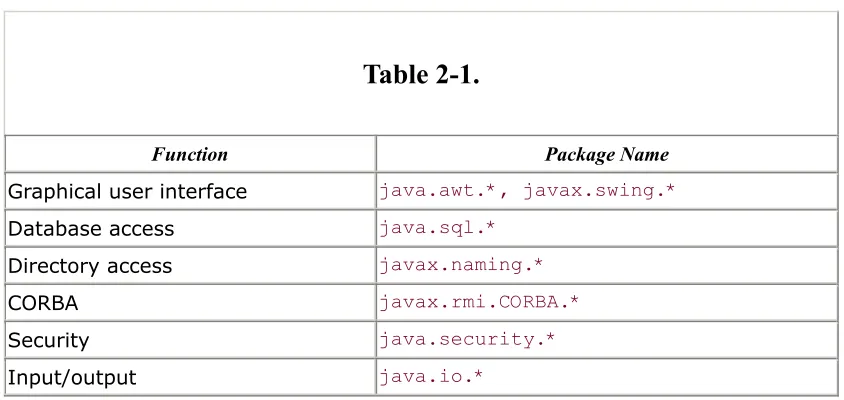
J2SE includes tools and APIs for developing applications with graphical user interfaces (GUIs), database access, directory access, Common Object Request Broker Architecture (CORBA), fine-grained security, input/output functions, and many other functions. See Table 2-1 .
Table 2-1.
Function Package Name
Graphical user interface java.awt.*, javax.swing.*
Database access java.sql.*
Directory access javax.naming.*
CORBA javax.rmi.CORBA.*
Security java.security.*
Input/output java.io.*
[image:34.595.87.509.377.577.2]Figure 2.2. J2SE platform
J2EE Application Components and Containers
The J2EE component container supports application components in the J2EE platform. A container is a service that provides the necessary infrastructure and support for a component to exist and for the component to provide its own services to clients. A container usually provides its services to the components as a Java compatible runtime environment.
The core application components in the J2EE platform are as follows:
• Java application components— standalone Java programs that run
inside an application container.
• Applet components— Java applets that run inside an applet container,
and which are usually supported via a Web browser.
• Servlets and JSPs— Web-tier components that run in a Web container.
Servlets and JSPs provide mechanisms for dynamic content preparation, processing, and formatting related to presentation.
• EJB components— Coarse-grained business components that are run
inside an EJB container (usually bundled in an application server product). EJB components, or enterprise beans, come in two types: session beans and entity beans. Session beans are enterprise beans that are suitable for processing or workflow. Session beans come in two flavors: stateful and stateless. A stateful session bean retains client state between method invocations. A stateless session bean does not retain client-specific state between client-invoked methods. Stateless session beans are used when no state needs to be stored between method invocations, and they may offer performance benefits over stateful session beans, which must be used when some state needs to be retained between invocations. Session bean
Entity beans are used when a business component needs to be persisted and shared among multiple users. Entity bean persistence can be managed in two ways: bean-managed persistence (BMP) and container-managed persistence (CMP). BMP is used when the bean developer implements all mechanisms for persisting the state in the bean. CMP is used when the bean developer does not implement the persistence mechanisms in the bean. Instead, the bean developer specifies the necessary mapping between the bean attributes and the persistent storage and lets the container do the job.
The core focus of the J2EE patterns in this book is the design and architecture of applications using servlets, JSPs, and enterprise bean components.
Standard Services
The J2EE platform specifies the following standard services that every J2EE product supports. These services include APIs, which every J2EE product must also provide to application components so that the components may access the services.
• HTTP— Standard protocol for Web communications. Clients can access
HTTP via the java.net package
• HTTP over Secure Socket Layer (HTTPS)— Same as HTTP, but the
protocol is used over Secure Socket Layer for security.
• JDBC— A standard API to access database resources in a
vendor-independent manner.
• JavaMail— An API that provides a platform-independent and
protocol-independent framework to build mail and messaging applications in Java.
• Java Activation Framework (JAF)— APIs for an activation framework
that is used by other packages, such as JavaMail. Developers can use JAF to determine the type of an arbitrary piece of data, encapsulate access to it, discover the operations available on it, and instantiate the appropriate bean to perform these operations. For example, JavaMail uses JAF to determine what object to instantiate depending on the mime type of the object.
• Remote Method Invocation/Internet Inter-ORB Protocol
(RMI/IIOP)— Protocol that enables Remote Method Invocation (RMI) programmers to combine the benefits of using the RMI APIs and robust CORBA IIOP communications protocol to communicate with
CORBA-compliant clients that have been developed using any language compliant with CORBA.
• Java Interface Definition Language (JavaIDL)— A service that
incorporates CORBA into the Java platform to provide interoperability using standard IDL defined by the Object Management Group. Runtime
• Java Transaction API (JTA)— A set of APIs that allows transaction management. Applications can use the JTA APIs to start, commit, and abort transactions. JTA APIs also allow the container to communicate with the transaction manager, and allow the transaction manager to communicate with the resource manager.
• JMS— An API to communicate with MOM to enable point-to-point and
publish/subscribe messaging between systems. JMS offers vendor independence for using MOMs in Java applications.
• Java Naming and Directory Interface (JNDI)— A unified interface to
access different types of naming and directory services. JNDI is used to register and look up business components and other service-oriented objects in a J2EE environment. JNDI includes support for Lightweight Directory Access Protocol (LDAP), the CORBA Object Services (COS) Naming Service, and the Java RMI Registry.
J2EE Platform Roles
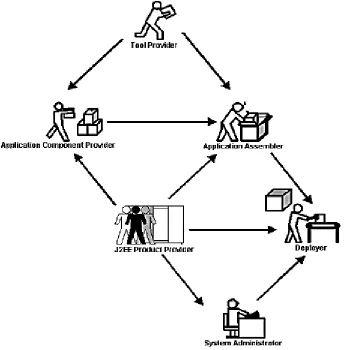
Figure 2.3. J2EE platform roles
The J2EE roles are as follows:
• J2EE product provider— Provides component containers, such as
application servers and Web servers, that are built to conform to the J2EE specification. The product provider must also provide tools to deploy components into the component containers. These tools are typically used by the deployer. In addition, the product provider must provide tools to manage and monitor the applications in the container. The system administrator typically uses these latter tools. This role is fulfilled by the product vendors.
• Application component provider— Provides business components built
using the J2EE APIs. These components include components for Web applications as well as for EJB applications. This role is fulfilled by programmers, developers, Web designers, and so forth.
• Application assembler— Assembles, or puts together, a set of
assembler packages the application and provides the necessary assembly and deployment instructions to the deployer.
• Application deployer— Deploys the assembled application into a J2EE
container. The deployer may deploy Web applications into containers—Web containers, EJB containers, and so on—using the tools provided by the J2EE product provider. The deployer is responsible for installation, configuration, and execution of the J2EE application.
• System administrator— Has the responsibility of monitoring the
deployed J2EE applications and the J2EE containers. The system
administrator uses the management and monitoring tools provided by the J2EE product provider.
• Tool provider— Provides tools used for development, deployment, and
packaging of components.
Deployment Descriptors
An application assembler puts a J2EE application together for deployment, and at the same time provides the assembly and deployment instructions in special files called deployment descriptors. The J2EE specification defines deployment
descriptors as the contract between the application assembler and the deployer. Deployment descriptors are XML documents that include all the necessary configuration parameters required to deploy the J2EE application or J2EE components. Such configuration parameters specify external resource requirements, security requirements, environment parameters, and other
component-specific and application-specific parameters. The deployer may use a deployment tool provided by the J2EE product provider to inspect, modify, customize, and add configuration parameters in these deployment descriptors to tailor the deployment to the capabilities of the deployment environment.
Deployment descriptors offer flexibility for the development and deployment of J2EE application components by allowing changes to configurations and
dependencies as needed during the different application phases: the development, deployment, and administration phases. Much of this flexibility is due to descriptors defining parameters in a declarative fashion, rather than having the parameters be embedded in the program code.
J2EE Patterns and J2EE Platform
the foundation of the J2EE platform, a Java developer can learn the
J2EE technologies with relative ease.
However, there is a belief that learning a new technology by itself is
sufficient to make us adept at designing systems based on that new
technology. We respectfully disagree with this. We believe that in
addition to learning the technology, we need other insights to build
successful systems. Patterns can help facilitate the process of
knowledge accumulation and knowledge transfer. Patterns help us to
document and communicate proven solutions to recurring problems
in different environments. Using patterns effectively, we can prevent
the “re-invent the wheel” syndrome.
Our J2EE patterns are derived from our experience with the J2EE
platform and technologies. The J2EE patterns described in this book
address different requirements spread across all the J2EE tiers. In our
tiered approach (see “The Tiered Approach”), we have modeled the
J2EE multiple tiers as five tiers: client, presentation, business,
integration, and resource tiers. This model allows us to logically
separate responsibilities into individual tiers. In our model, for
example, we separate the EIS tier into an integration tier and a
resource tier. By doing so, we make it easier to separately address the
requirements of integration and resources. Thus, the tiers in our
model are a logical separation of concerns.
We've categorized the J2EE patterns described in this book into three
of these five tiers—presentation, business, and integration. In our
opinion, the client and resource tiers are not direct concerns of the
J2EE platform. The patterns related to servlets and JSP technologies
are described in Chapter 7, “Presentation Tier Patterns.” The patterns
related to enterprise beans and JNDI technologies, and those related
to bridging the presentation and business tier components, are
described in Chapter 8, “Business Tier Patterns.” Finally, the patterns
related to JDBC and JMS technologies, aimed at bridging the business
tier with the resource tier, are described in Chapter 9, “Integration
Tier Patterns.”
We believe that these patterns will prove useful to you as they did to
us and our fellow architects. They may be reused as solutions to the
problems you may encounter during your J2EE design and
architecture experience. We are also aware that patterns evolve over
time, and we expect that our patterns are no exception. The patterns
presented here have been refined many times. They have been
written and rewritten to make them better. This process of evolution
will continue.
Summary
While this chapter provided an overview of the J2EE platform, it also
included a flurry of terminologies and acronyms. If you are interested
in learning more, the following online resources are recommended:
•
The Story of the Java
Platform—http://java.sun.com/nav/whatis/storyofjava.html
•
Java Technology—An Early
History—http://java.sun.com/features/1998/05/birthday.html
•
Java Community
Process—http://java.sun.com/aboutJava/communityprocess/
•
J2SE Platform
Documentation—http://java.sun.com/docs/index.html
•
J2EE home page—http://java.sun.com/j2ee
•J2EE
Blueprints—http://java.sun.com/j2ee/blueprints/index.html
•
EJB home page—http://java.sun.com/products/ejb
•Servlets home
page—http://www.java.sun.com/products/servlet
•
JSP home page—http://www.java.sun.com/products/jsp
•JDBC home page—http://www.java.sun.com/products/jdbc
•JMS home page—http://www.java.sun.com/products/jms
•JNDI home page—http://java.sun.com/products/jndi
Part II: DESIGN CONSIDERATIONS, BAD
PRACTICES, AND REFACTORINGS
Part II includes the following three chapters:
•
Chapter 3—Presentation Tier Design Considerations and
Bad Practices
•
Chapter 4—Business Tier Design Considerations and Bad
Practices
•
Chapter 5—J2EE Refactorings
Chapter 3 and 4, as their names suggest, discuss various design
considerations and bad practices.
When applying the patterns from the catalog, developers will need to
consider numerous adjunct design issues, such as the ones discussed
in these chapters. These include issues affecting numerous aspects of
the system, including security, data integrity, manageability, and
scalability.
Many of these design issues could be captured in pattern form, as well,
although they primarily focus on issues at a lower level of abstraction
than those described in the J2EE Pattern Catalog. Instead of
documenting each as a pattern, we have chosen to document them
more informally, simply describing each as a design issue to be
considered when implementing systems based on the pattern catalog.
While a complete discussion of each issue is outside the scope of this
book, we wanted to mention these concerns, and encourage the
reader to investigate these issues.
Chapter 3 and 4 also highlight less than optimal ways to solve certain
problems—solutions which we term bad practices. Each bad practice
provides a brief problem summary accompanied by a list of solution
references. The solution references are a list of pointers to other
sections of the book with related material, suggesting preferred ways
to solve these problems. Typically, these references are to a pattern
in the catalog, to a refactoring, or to a combination of the two.
Chapter 5 presents refactorings for the J2EE Platform. The