A Cloud-based Student’ Project Supervision and
Allocation System for Nigeria Tertiary Institutions
Ekwonwune Emmenuel,
PhD Head of DepartmentDepartment of Computer Science, School of Science
Imo state University, Owerri, Nigeria
Michael O. Daniel
Department of ICT, School of General Studies Alvan Ikoku Federal college of Education, Owerri,
Imo State Nigeria
ABSTRACT
It is a known fact that Nigeria’s tertiary institutions are stereotyped with the challenge of not adapting quickly to new technological innovations. The research created a system for supervising project of graduating students in Nigeria’s tertiary institutions using cloud technology. Cloud based Technology is a service geared towards providing all round access to a safe and centralized database. Therefore, the inability of the institutions to quickly embrace the cloud based administrations stops the institutions from unlocking it’s potentials that are abound in cloud technology. It also created time limit challenge to result delivering. Based on this, a system of cloud based technology is been built for mobility, easy access and faster delivery output for students project supervision. In an attempt to develop the system, a methodology was employed which is Agile development model. The model was chosen due to its peculiar advantage over other software development models. Also some specialized tools were employed in achieving the system result such as, Input Definition, Output Definition, Data Cement Dictionary and System Flowchart. In the expected result: the system will give supervisors access to supervise their students from any point as the system built and can be downloaded as an app. The supervisors will be able to supervise with the aid of Audio link while the student and supervisors can do intermittently check of their work at any point in time through the periodic plagiarism detection link framework. External Examiners, as well as can search and retrieval of project topics through project allocation roaster.
Keywords
Cloud, supervision, allocation, Plagiarism, graduating students, Nigeria.
1. INTRODUCTION
In this present day, all aspects of human life directly or indirectly are affected by scientific inventions, discovers, and evolution. One of the landmark achievements of science is the discovery of the computer and its subsidiaries. Information and communication technology (ICT) is an offshoot of in-depth research in the field of computer and has come to stay as a part of our daily lives. ICTs have transformed the way we work, learn and live, hence its integration in all spheres of human endeavor. The attaining effect of this integration is that tasks that were hitherto cumbersome and time consuming can now be performed with ease and within the shortest possible runtime.
Bridging geographic divides have always been a major challenge for individuals, corporations and enterprises. The discovery of the internet solves this problem as the internet connects millions of its users across geographic divides
irrespective of distance, location or demographic. Just a few years ago, people carried their documents around the disks, memory sticks and USB devices, these have become history as evolution in computing research have given rise to cloud computing, making it easy, flexible and cost effective to handle computing task.
Cloud computing means that instead of all the computer hardware and software you're using sitting on your desktop, or somewhere inside your company's network, it's provided for you as a service by another company and accessed over the Internet, usually in a completely seamless way. Exactly where the hardware and software is located and how it all works doesn't matter to you, the user—it's just somewhere up in the nebulous "cloud" that the Internet represents [3]. Cloud computing is a buzzword that means different things to different people. For some, it's just another way of describing IT (information technology) "outsourcing"; others use it to mean any computing service provided over the Internet or a similar network; and some define it as any bought-in computer service you use that sits outside your firewall. However we define cloud computing, there's no doubt it makes most sense when we stop talking about abstract definitions and look at some simple, real examples—so let's do just that[3].
According to [3], Cloud computing is a kind of service that means different things to different people. For some, it's just a means of describing IT (information technology) "outsourcing"; others use it to describe any computing service provided over the Internet and some define it as any bought-in computer service you use that sits outside your firewall.
The quality of any student research work is dependent on the following:
1. The originality of the work.
2. The supervision given to the work by the project supervisor.
The need for a system that keeps a comprehensive record of all projects already executed and submitted cannot be over emphasized. An in dept analysis of the present project allocation and monitoring system in Nigeria tertiary institution revealed the following.
1. There is no automated mechanism or system of storing and tracking completed project.
2. Allocations of project are done logically, resulting in repeating of formally completed works.
3. Students do not take proper referencing of data and information sources seriously owing to lack of access to a functional interval or periodic Plagiarism checkers and detector.
4. Awareness in deployment of cloud-based system is at its lowest ebb.
5. Supervision of students projects take a very long time as students and their supervisors are dispersed in space and time.
It is common practice in Nigeria to move with the trends and global best practice. This research thus tries to find out a ways to deal with high rate of repeated projects in Nigeria tertiary education system .This however moved the researcher as a matter of importance to find a lasting solution by developing a cloud-based students project allocation and monitoring system.
The aim of the research is to simplify and ease the students’ project allocation and monitoring process, with the aim of making it more flexible, cost and time effective via the development of a cloud-based students project allocation and monitoring system.
However, the specific objectives of the research include;
a. To develop a system that will be used to effectively to help have a cloud based student project supervision between student and the supervisor with the aid of Audio link.
b. To design an application or link that will help to capture periodic plagiarism detection framework that will enable student and supervisors to intermittently check their work at any point in time.
c. To develop application that will help the external examiner capture both student project activities as well as supervision between the student and the supervisor.
d. To design an application that will generate fast upload and update of student information and projects as well as search and retrieval of project topics through project allocation roaster.
2.RELATED WORK
There are four phases of the research process. The first phase studied the definitions and perceptions of cloud-based testing. The Second phase looked at cloud –based testing in real-life . The third phase analyzed quality in line with cloud application development. [9] The forth phased looked at its activities gaming industry. The research showed how cloud computing is relevant and applicable for testing and application development as well as the other areas, eg game development. The research pointed out the benefits, challenges, requirement and effect of cloud-based testing and developed a blueprint and strategy for adopting cloud-based testing. The research
also x-rayed quality issues in cloud application development. As a matter of fact, the research also included a study on applicability of cloud computing in game development. The results can as well be used by companies to establish the processes for managing cloud-based testing, evaluating practical cloud t-based testing work and assessing the appropriateness of cloud-based testing for specific testing needs [9].
[14] Discovered that there are number of issues that have hampered the complete adoption of M-learning applications through cloud computing services which still needs to be solved. The research outlined an appropriate set of requirement, i.e availability, quick response flexibility and ease of use, long-time strong, elasticity and scalability, integrity, piracy and confidentially and the control of information flow. The diversities of these requirements are geared toward a criteria developed from the literature study, standards for software quality and their guidelines. The study x-rayed the level of importance of each defined requirement for higher educational institution, training centers, research laboratories, infant and Junior schools.
[7] Developed an idea that offers many benefits such as cost reduction in both hardware and software investment for organizations. The study attempts to bridge the gap by offering insight into possible activities that could influence such adoption decision. By integrating the diffusion of innovation theory(DOI) and IT personnel characteristics a conceptual model is developed and tested as a preliminary study to dictate the influencing factors of cloud computing.
[7] The study opined that relative advantage compatibility and IT personnel knowledge are the innovation attributes and the human factors for cloud computing adoption. The study developed the knowledge domain of cloud computing adoption literature on theories of IT adoption particularly in the public sector [7].
[10] Discovered a model for evaluating the quality of SaaS applications. They first looked at SaaS features are (reusability, customizability, pay-per-use, data managed by providers, scalability and availability) and then harnessed a set of SaaS-specific quality characteristics (reusability, efficiency, reliability, scalability and availability) [10]. Then they revealed a metrics that could be used to measure each quality characteristic using specific formulae, value ranges, and relevant interpretations. For example, ‘reliability’ could be measured using the metrics ‘service stability’ and ‘service accuracy’. Their quality model is important for both providers and customers 38 because it focuses on SaaS features and there-fore, provides guidelines for evaluating and assessing SaaS quality. The quality of cloud applications can also be assessed by evaluating the quality of the components that make up an application [15]. The components are ranked based on their past performance while in use by other users. The results enable the user to select the components that would generate optimal performance for the relevant cloud application. In addition, the application designers can use the quality ranking to assess the performance of the components[15].
commercially available tools, ability to work on decentralized artifacts, support multiple databases, support multiple devices and comply with the SLAs [2].
[4] in his article(student project allocation with preference over projects). States that the study of the problem of allocating students to projects, where both students and lecturers have preferences over projects, and both projects and lecturers have capacities. In this context, we seek a stable matching algorithm of students to projects, which upholds the preference and capacity constraints. Here, the stability definition generalizes the corresponding nation in the context of the classical Hospitals/Residents problem. We show that stable matching can have different sizes, which motivates max - spa.p, the problem of maximum cardinality stable matching
[4].
[1]
also in his article (project Allocation with reference list over allocations models (SPA) in which lecturers have preferences over students (projects) has been studied), presented a new method to construct a general student project allocation model (SPA-(SP)) in which the lecturers have preference lists over pairs (student, project), and the students have preference lists over projects SPA- (S, P) is turned out to be very useful combination between the student project allocation models with preference lists over students (or projects). The model proposes several ways to construct the lecturer’s preference lists which give higher efficiency and accurate results[1]
.[13]
Abstract for student project Allocation and management with online testing system project. [13],aimed at an activity which plants at improving an electronic frame work, which operates the movement of “student project management and online testing”. The framework will operate the database and keep up a post of all understudy aggregates that have enrolled test and shortlist these people who have passed the qualification criteria as set by the teachers.A semi Automatic Approach for project Assignment in capstone course, made attempts to reduce the time required to perform the assignment by selectively automating part of the task flow. An automated search uses a canonized greedy algorithm combined with local optimizations to explore a large space of solutions. Candidate “good” solutions are then presented to capstone faculty criteria such as skill set, student capability, and personality compatibility are applied by human evaluators to reduce the candidate solution set
[11]
. These candidate solutions are then distributed to small groups to look for improvement using system generated tables of options. The approach leverages automation at appropriate state while keeping the experts involved in selection process[11]
.The author present a semi automated approach to allocating students into project teams for a senior capstone experience. It demonstrated initial success not only in reducing the time required to perform the allocation, but also improving the quality of the allocation[11]
.Task Allocation in team projects, proposed a system on whether an automated system would help students teams to divide and allocate the project tasks between themselves and what effect it would have upon the maintenance roles of team working by combining quantitative and qualitative results from the tree cycles of the trials[8]. It was possible to build up a picture of overall acceptance levels of co located students for the concept of the team project support system. It was also possible to find out how using the system impacted upon the
team project, from team leaders and team members perspectives
[8]
.Inclusion of project management components in undergraduate information systems curricula.
[12]
Proposed research establishing a baseline for the level adoption of the fundamental project management component as recommended by 1597 into undergraduate information system programs in the United States. The research is useful to information system education as a barometer against which they can measure their own programs. This research is useful to employers interested in the responsiveness of educational community to their calls for the inclusion of project management skills in information systems degree programs. The research is important to curriculum developers needing to know whether how quickly their recommendation are being adopted and integrated into degree programs[12]
.[6]
Proposed the development of a supervisor allocation system for the use in academic institution. The project allocation system is a web application that allows the allocation to take place securely over the internet, independent of the location and the equipment of user. The application is secured so only the people responsible are allowed to perform the allocation and to view the sensitive data.[6]
The front end enables the administrators to configure the system in response to changing project regulations and assignment desiderata. The system can also be used as a report tool regarding project and allocation details. Apart from the administrators, secretarial staff can also use the system. Different privileges are given to them.[6]
As part of the solution, secondary system was produced. It purses the same objectives but it is created in more flexible and general concept[6]
.Plagiarism Detection in Web based Learning Management Systems and Intellectual Property Rights in the Academic Environment. Talked about plagiarism in the academic world as a universal problem and attempted to analyze it and integrate in the Web Based System of the university called SULMS (Customized Model) [5]. It is a detection system for academic activities. This Digital content is research publications and assessment submissions – assignments. It opined that academic Digital content once created needs to be verified for non-violation of IPR issues and compliance to academic plagiarism policies followed by the institutions. This effort will help the academic community in providing healthy practice of research and study among the academicians and students [5].
3.PROPOSED SYSTEM
The existing system is known to be the present system that is been used with no or little computer help or application. Although majority of the university works are done on paper works which involves more of human physical capabilities on student – supervision. The present units involves: students accounts portal, student’s group details, supervisor’s details/grouping and project assignment portal.
b. Student’s group details: This section handles the aspect of student’s group breakdowns according to projects topics and supervisors. This also handles the progress of the different groups involved in the project writing. The information of the groups are also been processed in this section.
c. Supervisor’s details/grouping: this section handles the supervisors concern which involves the students, topics and arrangements under them. This section allows supervisors information such as ranks and social status. The section creates how supervisors can monitor and supervise the activities of their student’s project and allocation.
d. Project assignment portal: this section create the platform to see list of project types assigned to different student’s and groups of students.
e. Administrator: This is the section of the platform which coordinates the entire process of the system. It can be said to be a client that manages the process following a clayed down function and directives on how to link the different entities.
Fig1:SystemContext Diagram
Administrator
Students’ Account
Portal
Students’ Group Details
Students’ Project Allocation Form
Supervisors ’ Details Input
[image:4.595.50.513.108.722.2]Specific ations
Fig 2: Flow chart of the proposed system
Login
Online Reg Academic planning
Student’s
Interval plagiarism
Supervisor
Student
Project topics
Supervisor
Journal Editor
eeeeess
Exit
START
STOP
Examiner Examiner
Project topics
Audio
Interval plagiarism
3.1
Functional And Non-Functional
Requirements
3.1.1
Functional Requirement
Student: the students to be able to register their personal data online
- The students will be able to select topic for approval - The system will enable students to receive approval of topic through correspondence with their supervisor.
- The system will enable students to check for plagiarism at every work interval.
Supervisor
- The supervisor will be able to register their personal data
- The supervisor will be able to supervisor and approve student project.
- The system will enable the supervisor to have access to a plagiarism checker platform.
- Each sub system platform will be able to communicate with other sub systems.
Examiner
- The examiner will be able to login and register personal data.
- The examiner will be able access the students project that is been supervised for remarks.
- The system will enable examiner have access to plagiarism checker.
- The examiner will be able to communicate with supervisor and other sub systems.
Data base:
- The students personal data recorded
- The system will record supervisors personal data - The examiners personal data will be recorded - The system will record all approved and supervised
topics
- All the data’s will be cloud based and can be accessed from any location.
3.1.2
Non-Functional Requirement
1. Operational- The system should be able to upload and display students result.
- The system should be able to run online
- The system should be able to do audio and audio calls to aid supervision.
- The system should be able to give access to journal platform.
2. Performance
- The system should allow a wide range of database.
- The system should support a range of valid values for up to 2000 characters.
- The system should support up to five students per group for a supervisor. Securities
- No entity in the system should be able to access the platform without permission.
- Only the accredited admin can make changes and updates where necessary.
3. Cultural and political
- Only students who have their school fees ID will access the system.
4.SOFTWARE DEVELOPMENT
METHODOLOGY
A software methodology used in a particular project may not be suitable for another project. Each software methodology has its own strengths and drawbacks. Every software development methodology acts as a basis for applying specific frameworks to develop and maintain software. Several software development approaches have been used since the origin of information technology. These include
Agile methodology
Prototyping
Spiral
Rapid application development (RAD)
Object oriented methodology
Waterfall Methodology
4.1
Choice of Methodology.
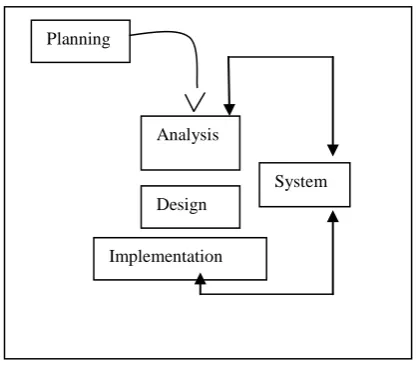
The choice methodology in developing this system is Agile methodology. According to versionone.com “Agile Development” is an umbrella term for several iterative and incremental software development methodologies. The most popular agile methodologies include Extreme Programming (XP), Scrum, Crystal, Dynamic Systems Development Method (DSDM), Lean Development, and Feature-Driven Development (FDD).
5.SYSTEM IMPLEMENTATION.
The implementation process runs from the point when the system design has been completed to the point when the new system is in place and ready to be used. This is a very critical stage in software development because it determines if the software will be accepted or not.
The cloud based student project allocation, supervision and documentation is design with PAP, Java and HTML programming language using Mysql server architecture. The system can be hosted online and once this is done, all FORMS, MODULES and FUNCTIONS that make up the system are activated ready for use. The application is window based, menu driven and highly interactive.
The system has been built around a large body of database that grows as time counts because of the quest for cloud based student project allocation, supervision and documentation which will grow year to year. As such users would go any length to ensure that they manipulate the system, and where it becomes impossible, they would in turn sort every avenue to penetrate the database as to achieve their dubious intentions. It becomes therefore necessary that a sensitive database of this kind should be adequately protected to grant confidence in its applications.
The following are the security feature of this system
a. The database software (MYSQL) has its security feature such as encryption, authentication, security policies, integrity checking, and access restriction on tables which are inherent to database developed in this work and serve as a security to this system.
b. This work has been designed with strong control on access to the database by all users. Users/Administrators can only access forms through which they can submit their data and/or query the database to generate report as in the case of administrator, they do not have the access to manipulate the database and as such, are restricted to total access to the database. This is possible as the C-panel used in hosting the database is having network security provided by the service provider, meaning that, for an access to be granted to the database requesting editing, formatting, or any form of adjustment, the services of the internet service provider hosting the system. It therefore becomes
difficult for an entity to think of manipulating the database.
c. There is a module that monitors and reports any illegal attempt to gain access to the database as one of the security features.
[image:6.595.45.254.69.252.2]Below are pictotal view of the software program application:
[image:6.595.314.549.133.331.2]Fig:3 Project student Registration form page(for project students who have not registered
Fig:4 Project supervisor dashboard(Supervisor gets to this page after successful login . This dashboard contains all
the administrative tasks of the supervisor, such as : approve topics, allocate topics, plagiarism checks, chart
[image:6.595.317.539.359.522.2]with student, respond to student complains)
Fig 6:Faculty dashboard page
Fig 2: Agile Model Methodology
Planning
Analysis
Design
Implementation
[image:6.595.320.539.579.736.2]Fig 8: Supervisor’s list of all project students (This page lists all the students writing projects under a particular supervisor. Actions could be taken on any students entry.
Actions such : view submitted topics and approve, see corrections made and proceed student to next level, reply
[image:7.595.311.551.67.491.2]student charts, respond to students complains)
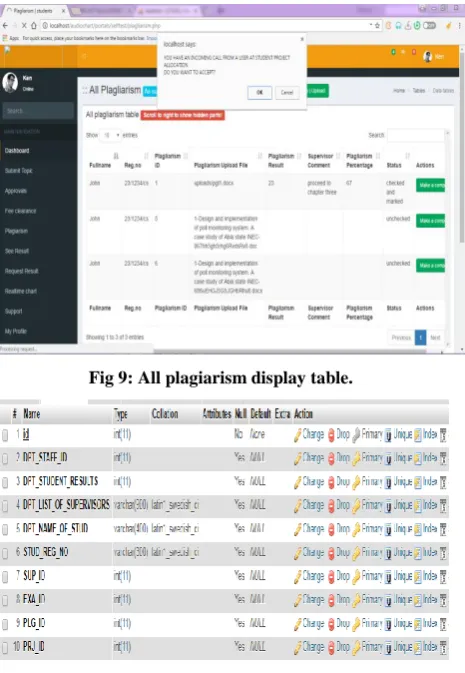
Fig 9: All plagiarism display table.
[image:7.595.49.284.72.229.2]Fig 10: Data Base Table
Fig:14 The text chart pane of users(click on the video icon to start video call)
Fig 15: Caller’s video call window opens…waiting for the other person to accept the call(the number 841 is a randomly harshed number generated the user’s id. it is
used as a temporary phone number for the video call)
6.Performance Evaluation
[image:7.595.56.289.307.644.2]Table 1: The performance evaluation of existing system Student s to select project Supervisor to allocate project Accessibility
List of expected of activities of the
new cloud based students project allocation system/
YES YES YES
Through Cloud based application
in the system
YES YES YES
Availability of project topic
Database
YES YES YES
Accessibility to interval plagiarism
checker
YES YES YES
Availability to proposed students
project
YES
YES YES
Flexible access to Non functional
requirement
YES YES YES
An established platform for an
external moderators input
YES YES YES Availability of
audio link
YES YES YES
Accessibility of journal publication
platform
YES YES YES Access to visual
link
7.SUMMARY
The software performance was very good; very easy to use and with a well documented help file. For real time and embedded system, software that provides required function but does not conform to the performance requirements is accepted. Performance Evaluation is designed to test the run-time performance of software within the context of an integrated system. Performance evaluation occurs through all steps in the testing process. The software evaluation is a successful one, because actual test yielded both design, specification and performance capabilities.
Cloud based student project Allocation, supervision and Documentation was conceived with a high zeal aiming at setting a new standard, powered by Information and Communication Technology (ICT) which that will bring untimely solution to Educational Sector in Nigeria.This research investigated the existing challenges confronting educational institutions in making efficient and effective student project assessment, the associated weaknesses and has come up with student project allocation, supervision an d
documentation system that is cloud based which was tested and confirmed to be functional.
Table 2: The performance evaluation of new system
Students to select
project Supervisor to allocate project
Accessibility
List of expected of activities of the
existing students project allocation
system/
NO NO NO
Through Cloud based application
in the system
YES YES YES
Availability of project topic
Database
NO NO NO
Accessibility to interval plagiarism
checker
YES YES YES
Availability to proposed students
projects
YES
YES YES
Flexible access to Non functional
requirement
YES YES YES
An established platform for an
external moderators input
YES YES YES Availability of
audio link
YES YES YES
Accessibility of journal publication
platform
YES YES YES Access to visual
link
The Research used PHP, HTML and Java script as programming languages for the development this software with Dream weaver as its executable platform. MYSQL server was also used in structuring the database which was executable online instead of the stand alone considering the multi-campus nature of higher institutions in Nigeria.
8.CONCLUSION
[image:8.595.314.543.113.545.2]inordinate amount of time expended in time past. Conclusively, this software has eliminated some of the problems listed in problem statement.
9.SUGGESTION FOR FURTHER STUDY
Efforts have been made to design and implement software that support efficient cloud based student project allocation, supervision and documentation system. But, there are still some areas that may be considered as a further and important areas to improve on, and my suggestions are:a. More Researches should be done on the areas of creating more intermittent plagiarism access to students, so that students can at any point in time check for plagiarism during their final year project.
b. The various departments should create research to enhance network accessibility to schools and departments. This will enhance and encourage students accessibility to network materials as they may be bureaucracy hitches in accessing open air networks.
c. System security and database integrity should be looked into in further studies.
10.
REFERENCES
[1] Ahmed, H. Abu et al 2009,project Allocation with reference list over allocations models (SPA),https://ieeexplore.ieee.org/xpl/mostRecentIssue.js p?punumber=5379502,Print ISBN: 978-1-4244-5365-8,CD-ROM ISBN: 978-0-7695-3925-6
[2] Chauhan, M.A., Babar M.A., 2012. Cloud infrastructure for providing tools as a service: quality attributes and potential solutions. In Proceedings of the WICSA/ECSA 2012 Companion Volume (WICSA/ECSA '12). ACM,
New York, NY, USA, 5-13.
DOI=10.1145/2361999.2362002
[3] Chris Woodford, 2017 Cloud computing https://www.coursehero.com/file/28186034/Cloud-Computing-Woodford-2017pdf/
[4] D F. Manlove 2008,student project allocation with preference over projects Journal of Discrete Algorithms. Elsevier Science Publishers B. V. Amsterdam, The Netherlands, The Netherlands , Volume 6 Issue 4, December, 2008, Pages 553-560.
[5] Dinesh Kumar Saini et al 2012 Plagiarism Detection in Web based Learning Management Systems and Intellectual Property Rights in the Academic Environment. International Journal of Computer Applications (0975 – 8887) Volume 57– No.14, November 2012
[6] Gerasimos. R 2012,Online project allocation system, A dissertation submitted to the University of Manchester for the degree of Master of Science in the Faculty of
Engineering and Physical
Sciences.https://studentnet.cs.manchester.ac.uk/resources
[7] Hashim et al 2015factors that influence the adoption of cloud computing. A comprehensive Review. International journal of education and Research. Vol 3 7th July 2015.
[8] Jarice Whatley (proceeding of 6th international conference on networked learning) in article, Task Allocation in team projects.ISBN No: 978-1-86220-206-1.
[9] Kalliosaari, Leah 2014, Empirical study on the adoption, use and effects of cloud-based testing, Lappeenrannan teknillinen yliopisto, Teknillinen tiedekunta, Tietotekniikka / Lappeenranta University of Technology, Computer Science, http://urn.fi/URN:ISBN:978-952-265-576-9.
[10] Lee, J.Y., Lee, J.W., Cheun, D.W. & Kim, S.D., 2009. A Quality Model for Evaluating Software-as-a-Service in Cloud Computing, In Proceedings of the 7th ACIS International Conference on Software Engineering Research, Management and Applications, pp. 261-266.
[11] Mark Chang, Franklin W. 2008,A semi Automatic Approach for project Assignment in capstone course.American Society for Engineering Education,
2007.Available at
http://markchang.net/publications/asee_allocation_final.p df.
[12] Reif, Harry & Edu, Reifhl@jmu & Mitri, Michel. (2002. The Inclusion of Project Management Components in Undergraduate Information Systems Curricula.IACIS
2002.Available at
https://www.researchgate.net/publication/229042041.
[13] RAMESH GAVA 2012 ,Abstract for student project Allocation and management with online testing system project.
[14] Sarrab et al. 2015 An empirical study on cloud computing requirements for better mobile learning services https://www.inderscienceonline.com/loi/ijmlo https://doi.org/10.1504/IJMLO.2015.069709