Treatment of Uncertainties with Algorithms of the
Paraconsistent Annotated Logic
João Inácio Da Silva Filho1,2
1UNISANTA, Santa Cecília University, Santos City, Brazil; 2Institute for Advanced Studies, University of São Paulo, São Paulo, Brazil. Email: [email protected]
Received September 9th,2011; revised March 21st, 2012; accepted March 31st, 2012
ABSTRACT
The method presented in this work is based on the fundamental concepts of Paraconsistent Annotated Logic with anno-tation of 2 values (PAL2v). The PAL2v is a non-classic Logics which admits contradiction and in this paper we perform a study using mathematical interpretation in its representative lattice. This studies result in algorithms and equations give an effective treatment on signals of information that represent situations found in uncertainty knowledge database. From the obtained equations, algorithms are elaborated to be utilized in computation models of the uncertainty treat- ment Systems. We presented some results that were obtained of analyses done with one of the algorithms that compose the paraconsistent analyzing system of logical signals with the PAL2v Logic. The paraconsistent reasoning system built according to the PAL2v methodology notions reveals itself to be more efficient than the traditional ones, because it gets to offer an appropriate treatment to contradictory information.
Keywords: Algorithm; Non-Classic Logic; Paraconsistent Annotated Logic
1. Introduction
The data processing systems frequently face situations that represent scenes of uncertainties, ambiguities and in- consistencies. These situations appear because the data-base which is to be worked is generally incomplete or inexact [1-2]. For an efficient process data handling the information treatment system must be ready to deal with these adverse situations. Data processing systems which deal with uncertainty knowledge must be able to repre- sent, manipulate and communicate data which is consi- dered imperfect [2-3]. Most of the times, the data which we conventionally call imperfect are within those repre- senting inaccurate, inconsistent, partially ignored and incomplete information.
The Uncertainties in Database
The presence of uncertainty in a system based on know- ledge processing can be occasioned by a variety of infor- mation sources [2-3]. Among these we should mention; the ones we know to be of partial reliability; the ones presenting inaccuracy stemming from the representative language in which the information is shown; the ones not showing completeness of information and those which summarize or aggregate information from multiple sources [4-5]. In the area of treatment of signals extracted from non- exact knowledge there are many formal models available
for the treatment of uncertainties, but in many cases these proceedings have been achieved through approaches based in combinations and representations of rules which are not structured by a well-based theory, as well as well-defined semantics [2,3,5].
An intelligent system for decision making must be ro-bust and well-based to meet theoretical criteria, therefore, it needs to be subsided by an adequate treatment of un-certainties theory which will offer possibilities, within certain limits, at any verification, independently from its application [6,7]. Considering these problems regarding uncertainties the methods for uncertainty treatment in this paper presented use the basic concepts and theoreti-cal foundations of Paraconsistent logics (PL), obtaining a quantitative evaluation through its representative Lattice [8]. All manners of application and results are obtained through Paraconsistent Annotated Logic with annotation of two values (PAL2v) fundaments [9].
2. The Paraconsistent Logics
Within the many ideas in the non-classic logics a family of logics has arise that showed as its main theoretical foundation the revocation of the non-contradiction prin- ciple. These non-classic logics that consider the concepts of contradiction in its structure had been called Paracon- sistent logics (PL) [10]. Paraconsistent Logic is, therefore, a non-classic logic, which repeals the principle of non- contradiction and takes the treatment of contradictory signals in its theoretical structure. A summary of the theoretical principles that sustain paraconsistent logics [3,4,9] may be seen as thus: It is known that the state- ments demonstrated as true in a theory are called theo- rems and if all the sentences formulated in their language are theorems, it is said to be trivial. It is also known that a theory is consistent if among its theorems there aren’t those that affirm something which is the negation of oth-er theorems in the same theory. In case it happened, the theory would be called inconsistent [3,9]. Given a theory (deductive) T, settled on logic L, it is said to be consis-tent if there aren’t such, that one is the negation of the other; in a contrary hypothesis, T denominated in- con-sistent. The theory T is called trivial if all the sen- tences (closed formula) in its language are theorems; if this does not happen, T is non-trivial. If L is one of the common logics like the classical, the theory T is trivial if and only if it is inconsistent. In other words, logics like these do not separate the concepts of inconsistency and triviality, because according to classical logic, an incon- sistent theory is also trivial, and reciprocally, because if a con-tradiction is accepted as valid, then any conclusion would be possible. As this is an undesired result, classi- cal log-ic does not admit the contradlog-iction as an accept- able element without making it trivial. Logic L is called pa-raconsistent if it can work as the basis of inconsistent and non- trivial theories [8,10]. This means that, except in certain specific circumstances that go beyond our study, paraconsistent logic is able to manipulate incon- sistent information systems without the risk of trivialize- tion [9].
[image:2.595.358.492.569.696.2]The pioneers of paraconsistent logics were the Polish logician J. Lukasiewicz [11] and the Russian philosopher N. A. Vasilév, who simultaneously, around 1910, in an independent manner, suggested the possibility of a logic which would restrict the principle of contradiction. The initial systems of Paraconsistent logics, containing all the logical levels, with propositionals, predicates and des- criptions, as well as higher-order logic, are credited to N. C. A. Da Costa (1954 onwards) [9,10]. It happened in an independent manner, and there are, currently, paracon- sistent systems of group theory, strictly stronger than the classic ones considered as paraconsistent subsystems [4,10].
2.1. Lattice Associated with the Paraconsistent Annotated Logic
The Paraconsistent Annotated Logic (PAL) may be re- presented in a particular way through a Hasse diagram in which, intuitively, the constants in the vertices of a lattice will show extreme logical states to the propositions [4,6, 8,9].
The Paraconsistent Annotated Logic with Annotation of Two Values—PAL2v
As seen in [7] and [9] it is possible to obtain a represen-tation on how accurate the annorepresen-tations (or the evidences) are on a proposition P using a lattice formed by ordained pairs, such as: = {(, λ)|, λ [0, 1] }.
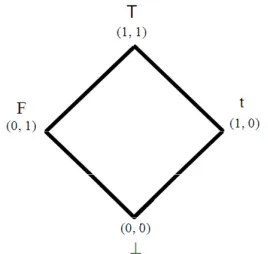
In this case, an operator ~ is introduced: || ||. The operator ~ constitutes the “meaning” of the logical symbol of negation of the system to be considered [9]. This way, a four-vertex lattice associated with the Anno-tated Paraconsistent Logic with annotation of two values (PAL2v) may be presented as in Figure1.
The first element () in the ordained pair (, λ) is the degree in which the favorable evidences support the proposition P, and the second element (λ) represents the degree in which the unfavorable evidences, or contrary, deny or reject the proposition P. Thus, the intuitive idea of the association of a annotation (, λ) to a P proposition means that the degree of favorable evidence in P is , and the degree of unfavorable (or contrary) evidence is λ.
In an intuitive manner [9], in such Lattice we have the annotations:
(1, 0) → indicating existence of total favorable evi-dence and unfavorable zero evievi-dence, attaching a true lo- gical connotation to proposition P.
(0, 1) → indicating existence of zero favorable evi-dence and total unfavorable evievi-dence, attaching a conno-tation of falsity logical to proposition P.
(1, 1) → indicating existence of total favorable evi-dence and total unfavorable evievi-dence, attaching an in-consistency connotation logical to proposition P.
P(, λ): T = Inconsistent = P(1, 1), F = False = P(0, 1), t = True = P(1, 0),
= Indeterminate = P(0, 0)
1), at (0, 0), F at (0, 1) and t at (1, 0). In UQCP the
values of Favorable Evidence Degree are exposed in the axis x, and the values of Unfavorable Evidence Degree λ
in the axis y. (0, 0) → indicating existence of zero favorable
evi-dence and unfavorable zero evievi-dence, attaching an inde-terminate logical connotation to proposition P.
The formula (A) is read “the negation or weak nega-tion of A”; (AB), “the conjunction of A and B”; (AB), “disjunction of A and B”; (AB), “the implication of B
by A”.
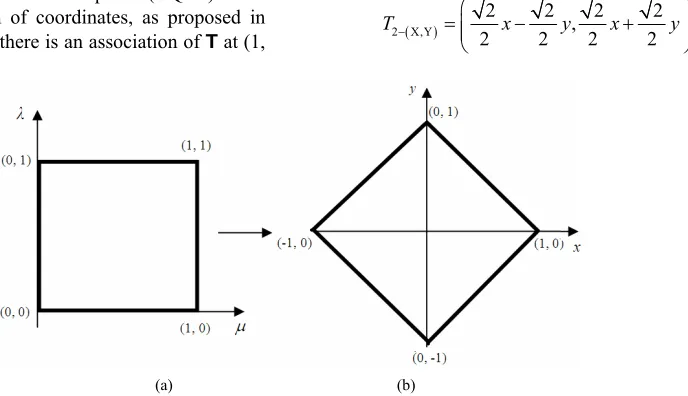
For each adopted system of coordinates, the annota- tions (, λ) of τ are identified by different points in the plane. In the system of Figure 2(a) a given annotation (,
λ) may be identified with the point of the plane in another system, as in Figure 2(b). As a system of coordinates
may be fixed on τ, we then define three transformations. The LPA language, the semantics of a complete set of
connectives, axioms is find with details in [3,6,12].
2.2. Algebraic Interpretations of PAL2v in an
Unitary Quadrant of the Cartesian Plane 2.2.1. Increasing in the Scale of 2 (as in Figure 3(a))
This increase is given by linear transformation: For the better representation of an annotation, and also
for practical uses of the τ Lattice in the Uncertainty treat- ment, some algebraic interpretations involving an unitary quadrant of the Cartesian plane (UQCP) and the repre- sentative diagram of the PAL2v will be made.
1X Y, 2 , 2T x y ; whose matrix is: 2 0
0 2
.
2.2.2. 45˚ Rotation in Relation to the Origin (as in Figure 3(b))
Initially a system of Cartesian coordinates is adopted for the plane, and the annotations of a given proposition
P will be represented by points of the plane [9]. We call unitary quadrant of the Cartesian plane (UQCP) the τ
Lattice with the system of coordinates, as proposed in
Figure 2(a). Therefore, there is an association of T at (1,
This rotation in relation to the origin is given by the li- near transformation:
2 X,Y
2 2 , 2 2
2 2 2 2
T x y x
y
(a) (b)
Figure 2. (a) Unitary quadrant in the Cartesian plane (UQCP); (b) τ diagram supplied with a new system of coordinates.
(a) (b)
[image:3.595.155.499.343.541.2] [image:3.595.147.450.570.723.2]2.2.3. Translation(as in Figure 4)
This translation is given by: T3(X,Y) = (x, y – 1)
Through the composition T3 ө T2 ө T1 we obtain the final transformation represented by the equation:
X Y,
, + 1T x y x y
(1)Combining the components of the transformation T(X,Y)
as the usual PAL2v, we obtain:
xμ → Favorable Evidence Degree
yλ → Unfavorable Evidence Degree
From the first term (X) from the equation of the final transformation, we have: X x y μ λ, which is denominated of Certainty Degree (DC). Therefore, the
Certainty Degree of the PAL2v analysis is obtained:
C
D μ λ (2)
Its values, which belong to the set , vary in the closed interval +1 and –1, and are in the horizontal axis of the Lattice, called “degrees of certainty axis”.
When DC results in +1 it means that the logical state
resulting from the paraconsistent analysis is true t, and when DC results in –1 it means that the logical state re-
sulting from the paraconsistent analysis is false F. From the second term (Y) of the final transformation, we have:
1
Y x y μ λ 1, which is denominated Con- tradiction Degree (Dct). Therefore, the Contradiction De-
gree of the PAL2v analysis is obtained by: 1
ct
D μ λ (3)
Its values, which belong to the set , vary in the closed interval +1 and –1, and are in the vertical axis of the diagram, called “degrees of contradiction axis” [9].
When Dct results in +1 it means that the logical state
resulting from the paraconsistent analysis is inconsistent
T, and when Dct results in –1 it means that the logical
state resulting from the paraconsistent analysis is inde- terminate .
2.3. The Real Certainty Degree Value
A decision system working with information coming from database of uncertain knowledge will be stronger when at the end of the analyses it shows certainty values which consider the effect of the influence of the incon-sistencies coming from conflicting information [1,5,9,12]. The analyses in the lattice of the PAL2v allow us to, after the treatment of uncertain information; obtain a lower Degree of Certainty value due to the effect caused by the contradictions [9]. The value of the Degree of Certainty (DC) to be considered apart from the effect caused by the
contradictions is called Real Certainty Degree (DCR). We
may calculate the value of the Real Certainty Degree (DCR) from the value of the Degree of Certainty (DC)
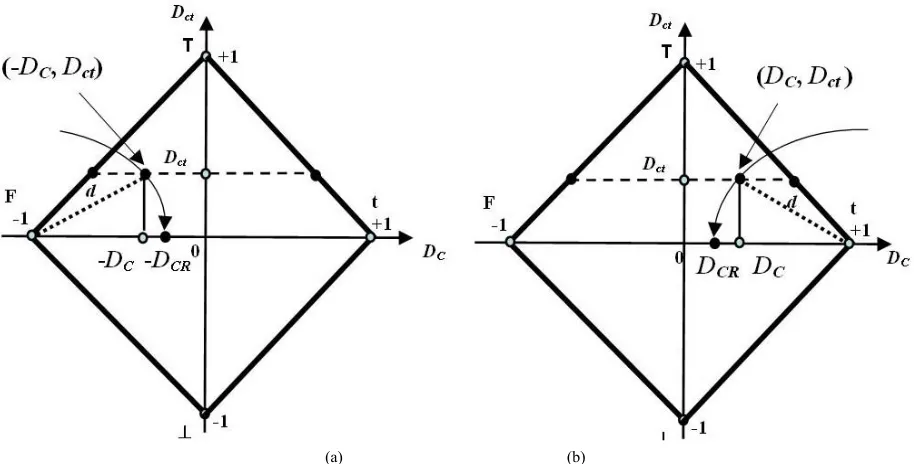
obtained by the analyses of the lattice of the PAL2v— Equation (2). This can be made in the following way: Let us consider that in a paraconsistent analysis the calcula- tions of the Certainty Degrees (DC) and Contradiction
Degrees (Dct) resulted in positive values and are interpo-
lated in the diagram in an internal point (DC, Dct), as in Figure5(a). The point (DC, Dct) is a Paraconsistent lo-
gical state ετ, that it is an only point inside of the PAL2v
Lattice. In the Figure 5(b) the Cartesian distance d, be-
tween the point of the maximum degree of certainty t, represented in the right vertex of the Lattice, and the in-terpolation point (DC, Dct), or local of the Paraconsistent
logical state ετ, is calculated as:
2 21 C c
d D Dt
d
(4) Projecting the distance d in the degrees of certainty axis we can have the point whose value will be consi- dered the Real Certainty Degree value (DCR).
1 CR
D (5) If the calculated Degree of Certainty (DC) result in
nega-tive value, as in Figure 5(a), the distance d will be
ter-polation (–DC, Dct). Therefore, in these conditions,
ob-tained from the point of certainty F, represented in the
[image:4.595.132.466.551.719.2](a) (b)
(a) (b)
Figure 5. Determination of the Real Certainty Degree (DCR)—Resulting value in the Lattice of the PAL2v.
left vertex of the Lattice, to the point of internal inpro-jecting the distance d in the degrees of certainty axis we can have the point whose value will be considered the Real Certainty Degree (DCR).
1 CR
D d (6) After the determination of the Real Certainty Degree the answer of a paraconsistent analysis should present as value of the Interval of Certainty
φ calculated by:1 ct
φ D (7)
Therefore, the output signal of a paraconsistent system of treatment of uncertainties, when receiving the values of evidence in its inputs, will produce an output as such:
1 2 ( )
where: DCR = Resulting Real Certainty Degree, such as: S = DCR and S φ
2 21 1
CR C ct
D D D if: DC> 0 (8)
or
1
2 2CR C ct
D D D 1 if: DC< 0 (9)
( ) Signaled Interval of Certainty, obtained by
Equa-tion (7):
φ
1 C
φ D
where: if Dct> 0 or if Dct < 0
The Real Evidence Degree of the output can be calcu-lated by the equation:
φ φ φ φ
1 2 CR ER
D
μ (10)
With Equations (7) and (10), the system of paracon-sistent analyses will present in its output the value of the Real Evidence Degree (μER) with the signaled Interval of
Certainty (φ(±)) [9].
3. Paraconsistent System for Treatment of
Uncertainties
Using the paraconsistent equations we can compute va- lues that are representative of information signals. There- fore, with the LPA2v algorithms we can construct para- consistent systems able to present satisfactory answers from information searched in a data base of uncertain knowledge [9].
3.1. Extraction of Evidence Degrees
The paraconsistent system for treatment of uncertainties may be used in many fields of knowledge where incom-plete or contradictory information will receive an ade-quate treatment through the equations of the PAL2v. For this, the signals which will represent the evidence in rela-tion to the proposirela-tion in analyses must be normalized and all the processing will be done in real closed interval between 0 and 1 [9]. This process for modelling the evi-dence degrees with linear variation can be made in its simpler form with the algorithm that will be described in the next section [13-15].
3.2. Algorithm for Modelling/Extraction of Evidence Degrees (Inputs of the PAL2v Algorithm)
Algorithm: Extraction of Evidence Degrees-Mode:
variation linear and directly proportional.
Variables
Mi: Double Lambda: Double Begin
Write (“Present the Maximum boundary-value to form the Discourse Universe”)
Read (Vmax)
Write (“Present the Minimum boundary-value to form the Discourse Universe”) Read (Vmin)
Write (“Present the Value Measured of the Physical Quantities”)
Read (Vqtx)
If (Vqtx < Vmin) Then Mi 0
Else If (Vqtx > Vmax) Then Mi 1
Else
Mi ( (Vqtx – Vmin)/(Vmax – Vmin) ) End If
Lambda (1 – Mi)
Write (“Favorable Evidence Degree”) Write (Mi)
Write (“Unfavorable Evidence Degree”) Write (Lambda)
[image:6.595.59.288.540.699.2]End
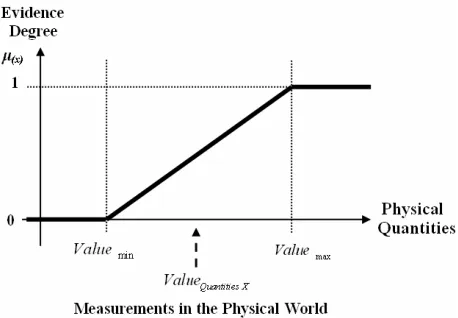
Figure 6 shows the Discourse Universe (or Interval of
Interest) for the extraction of an Evidence Degree using the previous algorithm.
With the change of the equation the extraction of the Evidence Degree can be made with other types of varia-tion. In this manner, the variation type that better repre-sents the analyzed Physical System is chosen for the ex-traction of the Evidence Degree [9]. This procedure will be shown with details in the example of the Section 4 when electric tension is used in the analysis of overload risk.
Figure 6. Graphical representation of the algorithm of ex-traction of the Evidence Degree with characteristics of di-rectly proportional variation.
3.3. Paraconsistent Signal Information Treatment
The main LPA2v Algorithm used in paraconsistent analyses is the PAN-Paraconsistent Analyzer Node. In an Intelli- gent system that works with Paraconsistent Logic some PANs are linked forming uncertainty analysis networks (PANnet) for signal information treatments [14-16]. The PAN Algorithm is shown with details in the next section.
3.4. Algorithm for Paraconsistent Analyses (PAN-Paraconsistent Annotated Node)
The PAL2v algorithm of paraconsistent analyses to find the value of the Real Certainty Degree of and the Interval of Certainty is the PAN-Paraconsistent Annotated Node:
Algorithm: PAN-Paraconsistent Annotated Node Variables
Mi: Double Lambda: Double Dct: Double Dc: Double Fi: Double d: Double S1: Double S2: Double
Begin
Write (“Present the Favorable Evidence Degree”)
Read (Mi)
Write (“Present the Unfavorable Evidence Degree”)
Read (Lambda)
Dct (Mi + Lambda – 1) Fi (1 – Absolute (Dct)) Dc (Mi – Lambda)
d SquareRoot (Power ((1 – Absolute (Dc), 2)) + Power (Dct, 2))
If (d > 1) Then S1 0 S2 Fi Else
If (Dc < 0) Then
Dcr (d – 1)
Else
Dcr (1 – d)
End If
Mier ((Dcr + 1)/2) If (Mi + Lambda > 1) Then Fi Absolute (Fi) ElseIf (Mi + Lambda < 1) Then Fi (Absolute (Fi)* – 1)
Else
Fi 0
From Equation (3), the Contradiction Degree (Dct)
is:Dct 0.87 0.32 1 0.19
D
S1 Mier S2 Fi
End If Therefore: ct .
From Equation (4), the distance d is:
Write (“Outputs”)
Write (S1)
2 21 0.55 + 0.19 0.488466989
d d
Write (S2) End
Since the Certainty Degree (DC)is positive we deter-
mine the Real Certainty Degree from Equation (8):
4. Example of Application of the PAL2v
1 0.488466989 CR
D
0.51153301
D
The methodology used in this paper to make the
mathe-matical treatment of signals from database of uncertainty knowledge is completely based on the concepts of Para-consistent Logics. Therefore, the information that was considered uncertain or contradictory can be represented by annotations.
CR
From Equation (7) the Interval of Certainty is:
1 ct
φ D
1 0.19 1 0.81
φ φ
as Dct is positive, then the Signaled Interval of
Cer-tainty is: The annotation values are represented in the
represen-tative Lattice of the Paraconsistent logics with annotation of two values (PAL2v).
0.81 φ
The Interval of Certainty is the indicative Paraconsis-tent Logical signal for help the decision-making.
From the value of the Real Certainty Degree we cal-culate the value of the Real Evidence Degree through Equation (10): μER
DCR1 2
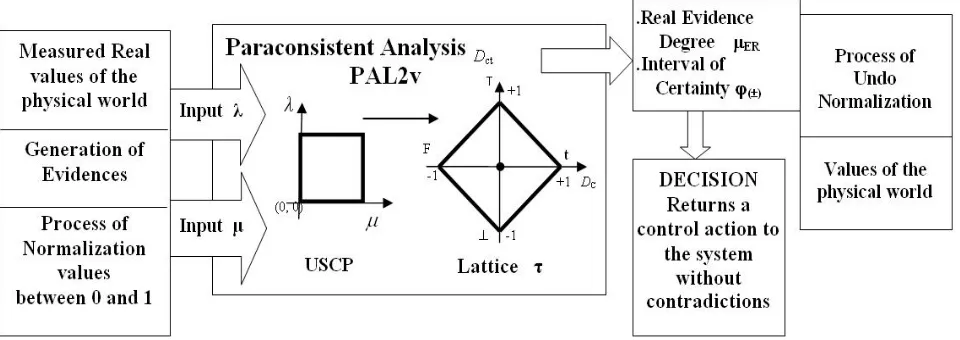
A typical system for uncertainty treatment based in Paraconsistent Annotated Logic with annotation of two values—(PAL2v) may be seen in Figure7 [14-16].
Being: DCR 0.51153301
We consider now a numeric example of the use of the
Paraconsistent Logic in analysis and decision-making: then
0.51153301 1 2 ER
μ
At the beginning we suppose the information source 1 presents a signal to the system valued in 0.87 and the
information source 2 presents a signal valued in 0.68. µER 0.755766505
μ1 = 0.87 and μ2 = 0.68 In Paraconsistent Analysis Systems the Intensity of the
Real Evidence Degree (μER) is used as main value to
de-cision making. With representation of the annotation considering the
information source 2 as the source of the Unfavorable Evidence, then the complement of μ2 is calculated to
ob-tain the value of Unfavorable Evidence Degree: The Paraconsistent Analysis Network—PANnet
2
The annotation (μ, λ) is represented as: .
1 1 0.68 0.32
λ μ λ
A network for treatment of uncertainties can be built with several interlinked PAN-Algorithms. With this process of normalization will exist at each PAN output a Resultant Real Evidence Degree value accompanied by a Resultant Interval of Certainty value.
0.87,0.32Therefore, the Paraconsistent Signal that results from this condition is represented as: 0.87,0.32
From Equation (2), the Certainty Degree (DC) is:
P
0.87 0.32 C
[image:7.595.60.540.549.719.2]D . Therefore: DC 0.55.
The Interval of Certainty value will indicate how the level of contradiction in the analysis is in real time. Thus, besides the information about the certainty in relation to the proposition, the Paraconsistent Analysis Network will also have conditions to estimate the capacity of analysis and control the results by means of feedback.
In this work the PAN algorithms are not used like analyzer Nodes in Neural Artificial Network as seen in [17,18], however they can be adapted for that function. That procedure is possible because the same concepts of PAL2v are used in interlinked learning cells in Paracon-sistent Neural Artificial Networks as it was presented in [9,16].
The real applications of PANnet in Analysis Systems of Artificial Intelligence are described in [13-16] and an example of this application is shown to follow:
Now we show an example of application of the para-consistent analyses to evaluate risks of overloads in an electric circuit [14,15].
The proposition is:
P = The electric System is in Overload Risk state. In this example, initially the Algorithm for Model-ling/Extraction of Evidence Degrees for the inputs of the PAL2v Algorithm is applied to get the two first evidence degrees. From measured values; Temperature T, Electric
Tension V and Electric Current A are obtained the
nor-malized values in the form of Evidence Degrees accord-ing to the linear variation in specified universe discourse.
Temperature T→ Information Source 1
The Universe of Discourse is:
o max 42C
TValue and o
max 25C
TValue
TValue
The measured value is: 38Co.
Quantities X
For an Electrical system, the high Temperature value means high risk of overload.
As: TValueQuantities X min
TValue , TValuemax
,then:min max min 38 25 42 25 Quantities X T TValue TValue μ TValue TValue 8 00 0.764706 T μ
Electric Tension V→ Information Source 2
The Universe of Discourse is: and
max
s 4
Ten ionValue 0 V Ten ionValues min 4 V
The measured value is: s Quantities X 413 V
Ten ionValue
For an Electrical system, the low value of the electric Tension means high risk of overload, therefore the equa- tion of the tension must be for a linear and inversely pro- portional characteristic. In this manner the equation is:
max min max Quantities X x Value Value μ Value Value For:
min max
s
s , s
Quantities X
Ten ionValue
Ten ionValue Ten ionValue
For ValueQuantities X Valuemax Value Value
0
x
μ
For Quantities X min μx 1
As:
s min, s max
Quantities X
Ten ionValue Ten ionValue
s
Ten ionValue
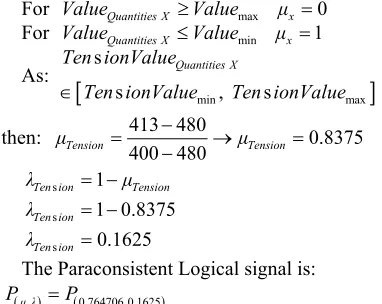
then: 413 480 0.8375
400 480
Tension Tension
μ μ
s 1
Ten ion Tension
λ μ
s 1 0.8375
Ten ion
λ s 0.1625
Ten ion
λ
The Paraconsistent Logical signal is:
μ λ, 0.764706,0.1625 P P
After this initial analysis the PAN Algorithm is ap- plied with the Evidence Degree of the Temperature (Fa- vorable) and Evidence Degree (Unfavorable) of the Electric Tension (TV):
Certainty Degree (DC) is:
0.764706 0.1625
C
D
0.602206
DC
Contradiction Degree (Dct) is:
0.764706 0.1625 1
ct
D
0.072794
Dct
2 21 C ct 0.404399595
d D D d
As DC 0 then: DCR 1 d DCR0.595600405 Resulting in a Real Evidence Degree:
1
1 0.595600405 1
2 2
CR ER
D
μ
1 0.797800202
ER
μ
The Interval of Certainty from Equation (7) is: 1 ct 0.927206
φ D φ
As: (µ + λ) < 1 then Signaled Interval of Certainty is:
0.927206
φ
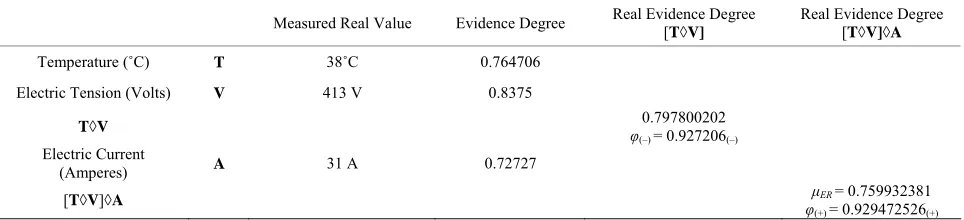
The Real Evidence Degree and Interval of Certainty are in the fifth column of the Table 1.
The extraction of the Evidence Degree of the Electric Current is made using the algorithm:
Electric Current A→ Information Source 3
The Universe of Discourse is:
max 34 A
CurrentValue and CurrentValuemin 23 A
The measured value is: CurrentValueQuantities X 31 A For an electrical system, the high value of the electric Current means high risk of overload.
As: then:
min, max
Quantities X CurrentValue CurrentValue CurrentValue min max min Quantities X Current CurrentValue CurrentValue μ CurrentValue CurrentValue 31 23 0.7272727 34 23 Current Current
μ μ
1
Current Current
[image:8.595.307.498.88.240.2]Table 1. Results of an application example in Electric Power System.
Measured Real Value Evidence Degree Real Evidence Degree [
T◊V]
Real Evidence Degree [T◊V]◊A
Temperature (˚C) T 38˚C 0.764706
Electric Tension (Volts) V 413 V 0.8375
T◊V φ(–) = 0.927206(–) 0.797800202
Electric Current
(Amperes) A 31 A 0.72727
[T◊V]◊A φμER (+) = 0.929472526(+) = 0.759932381
Universe of Discourse: Temperature: 25˚C → 42˚C; Electric Tension: 480 V → 400 V; Electric Current: 23 A → 34 A. Linear Variation: ◊ Logical Paraconsis-tent Analysis.
1 0.7272727 0.272727272
Current
Current
λ λ
After that second analysis the PAN Algorithm is ap-plied with the Real Evidence Degree of the fifth column (Favorable) and the Evidence Degree of the Electric Current (Unfavorable) ((TV)A):
The new Paraconsistent Logical Signal is:
μ λ, 0.797800202,0.272727272 P P
Certainty Degree (DC) is:
0.797800202 0.272727272
C
D
0.525072929
DC
Contradiction Degree (Dct) is:
0.797800202 0.272727272 1
ct
D
0.070527474
Dct
2 21 C ct 0.480135238
d D D d
As DC 0 then: DCR 1 d
0.519864762
CR
D
Resulting in a Real Evidence Degree:
2
1 2
CR ER
D
μ
2
0.519864762 1 2
ER
μ
2 0.759932381
ER
μ
The Interval of Certainty: 1 ct 0.929472526
φ D φ
As: (µ + λ) > 1 then
After the Paraconsistent Analysis between Tempera-ture, Tension Electric and Current Electric the Resulting Evidence Degree (μER) considered as the Overload Risk
Degree of the measured point.
0.929472526
φ
2 0.759932381
ER EOverloadRisk
μ μ
This method of treatment of Uncertainties is being used in Electric Power System of the AES-Eletropaulo Company and EDP Bandeirantes in Brazil [13-15].
5. Conclusions
The algorithms presented in this paper are based in para-
consistent logics, therefore they were conceived to re-ceive uncertain and contradictory information, equate their values and present results, with no restrictions re-garding conflicts that may be present in the information signals. Through the analyses in the lattice, we obtained simple equations, which made easier the construction of PAL2v algorithms for the development of Expert Sys-tems able to work with the treatment of uncertainties.
The obtained PAL2v algorithms may be easily repro-duced by means of any computer language or hardware tool, therefore they are possible of application in several fields of Artificial Intelligence. In the paraconsistent model for the treatment of uncertainties we may cross many nodes—PANs or information system analyses, as the one presented. These PAN configurations will con-stitute paraconsistent networks of decision (PANnet), which, unlike the known systems, the weight of the in-formation conflicts will not bar the answers, but, through a new approach, new conflicting data treatments will be taken, producing information which are relevant for de-cision making.
This new method for treatment of uncertainties differs from the ones previously known, because with this tech-nique we can give a convenient treatment to the contra-dictory signals. The application of the PAL2v presented in this work opens good perspectives for the increase of research that involves decision making systems.
6. Acknowledgements
The author thanks Gilberto A. T. de A. Holms for his assistance during this research.
REFERENCES
[1] A. Motro, “Sources of Uncertainty, Imprecision and In- consistency in Information Systems,” In: A. Motro, P. Smets, Eds., Uncertainty Management in Information Systems: From Needs to Solutions, Kluwer Academic Publishers, Boston, 1997, pp 9-34.
doi:10.1007/978-1-4615-6245-0
telligence, ICSC Academic Press, Rochester, 1998, pp. 191-197.
[3] N. C. A. da Costa, “On the Theory of Inconsistent For- mal Systems,” Notre Dame Journal of Formal Logic, Vol. 15, No. 4, 1974, pp. 497-510.
doi:10.1305/ndjfl/1093891487
[4] N. C. A. da Costa, V. S. Subrahmanian and C. Vago, “The Paraconsistent Logic PT,” Zeitschrift fur Mathe- matische Logik und Grundlagen der Mathematik, Vol. 37, No. 9-12, 1991, pp. 139-148.
doi:10.1002/malq.19910370903
[5] Motro, “Management of Uncertainty in Database Sys- tems,” In W. Kim, Ed., Modern Database Systems: The Object Model, Interoperability and Beyond, Addison- Wesley/ACM Press, New York, 1994, pp. 457-476. [6] V. S. Subrahmanian, “On the Semantics of Quantitative
Lógic Programs,” Computer Society Press, Washington DC, 1987.
[7] J. M. Abe and J. I. da Silva Filho, “Manipulating Conflicts and Uncertainties in Robotics,” Multiple-Valued Logic and Soft Computing, Vol. 9, 2003, pp. 147-169. [8] N. C. A. da Costa, D. Krause, and O. Bueno, “Para-
consistent Logics and Paraconsistency,” 2006.
http://www.cfh.ufsc.br/~dkrause/pg/cursos/20062/18-Cos ta.pdf
[9] J. I. da Silva Filho, G. Lambert-Torres and J. M. Abe, “Uncertainty Treatment Using Paraconsistent Logic— Introducing Paraconsistent Artificial Neural Networks,” IOS Press, Amsterdam, 2010.
[10] H. A. Blair and V. S. Subrahmanian, “Paraconsistent Logic Programming,” 7th Conference on Foundations of Software Technology and Theoretical Computer Science, Pune, 17-19 December 1987, pp. 340-360.
doi:10.1007/3-540-18625-5_59
[11] S. Jaskowski, “Propositional Calculus for Contradictory Deductive Systems,” Studia Logica, Vol. 24, No. 1, 1969, pp. 143-157. doi:10.1007/BF02134311
[12] N. C. A. da Costa and D. Marconi, “An Overview of Paraconsistent Logic in the 80’s,” The Journal of Non- Classical Logic, Vol. 6, 1989, pp. 5-31.
[13] J. I. da Silva Filho and A. Rocco, “Power Systems Outage Possibilities Analysis by Paraconsistent Logic,” IEEE Power and Energy Society General Meeting: Conversion and Delivery of Electrical Energy in the 21st Century, Pittsburgh, 20-24 July 2008, pp. 1-6.
[14] J. I. da Silva Filho, A. Rocco, M. C. Mario and L. F. P. Ferrara, “Annotated Paraconsistent Logic Applied to an Expert System Dedicated for Supporting in an Electric Power Transmission Systems Re-Establishment,” Power System Conference and Exposition, Atlanta, 29 October-1 November 2006, pp. 2212-2220.
[15] J. I. da Silva Filho, G. Lambert-Torres, L. F. P Ferrara, A. M. C. Mário, M. R. Santos, A. S. Onuki, J. M. Camargo and A. Rocco, “Paraconsistent Algorithm Extractor of Contradiction Effects—Paraextrctr,” Journal of Software
Engineering and Applications, 2011, pp. 579-584. [16] J. I. da Silva Filho, M. C Mário, C. D. S. Pereira, A. C.
Angari, L. F. P. Ferrara, O. J. Pitoli and D. V Garcia, “An Expert System Structured in Paraconsistent Annotated Logic for Analysis and Monitoring of the Level of Sea Water Pollutants,” In: P. Vizureanu, Ed., Expert Systems for Human, Materials and Automation, InTech Publishing, Midlothian, 2011, p. 392.
[17] S. Ling, “A New Neural Network Structure: Node-to- Node-Link Neural Network,” Journal of Intelligent Lear- ning Systems and Applications, Vol. 2, No. 1, 2010, pp. 1-11. doi:10.4236/jilsa.2010.21001