SPIRAL STRUCTURE OF ELEMENTARY PARTICLES ANALOGOUS TO SEA SHELLS: A
MATHEMATICAL DESCRIPTION
Flat No. 404, Fourth Floor, Bhagirathi
Navi Mumbai,
ARTICLE INFO ABSTRACT
In this paper we create a self similar analogous image of spiral structure of elementary particles with that of sea shells, using the mathematical description of pigmentation pattern of sea shells, which describes the various potentials of the spiral struc
sea shells analogous parameters for spiral structure of elementary particles for quantising the property of the elementary particles. It applies the Reaction
to produce the ingredient activated potential which once after the formation of the spiral structure of elementary particles is being described by the Activator
Copyright © 2015 Suraj Kumar. This is an open access article
distribution, and reproduction in any medium, provided the original work is properly cited.
INTRODUCTION
The Universe initially was a zero potential field scalar with simultaneous constructive and destructive interference of waves all range of frequencies. The specific snap of the Universe at
waveform for the whole of universe is a stationary wave with wavelength spread across the diameter extent of the universe and spanned by smaller stationary waveforms at all possible scale os
symmetry group of U (1). The series of formation began
induce gravitational potential (the force of the Universe which spa an autocatalytic process of U (1) = SU (1)
induced gravitational potential initiates the Higgs Mechanism
phase shift or horizontal displacement to extract out activated potentials capable of forming spiral structure of elementary from the dark potential (In Quantum Spiral Theory
mass which creates gravitational effect or the curvature in the space time, but instead it’s the gravity itself which curves time to accumulate mass). Thus the end of existing
basic symmetry information is conserved in the trivial object SU (1).
The Universe has never been completely empty but in transition from zero potential to maximum amplitude, const potential initiates the formation of Universe with the information contained in the trivial object
Activator-Inhibitor model of Reaction Diffusion to extract activated potential from dark potential:
The activator and inhibitor waves are part of the dark potential and can only be observed by the
whose spiral structure is formed with the activated potential extracted from corresponding dark potential.
The equation guiding the dynamics of the Activator
1.The rate of change of the concentration of autocatalytic activator waves:
*Corresponding author: Suraj Kumar,
Flat No. 404, Fourth Floor, Bhagirathi Tower, Plot
ISSN: 0975-833X
Vol.
Article History:
Received 14th December, 2014
Received in revised form
29th December, 2014
Accepted 05th January, 2015
Published online 28th February,2015
Key words:
Spiral, Elementary particles, Sea shells, Higgs.
RESEARCH ARTICLE
SPIRAL STRUCTURE OF ELEMENTARY PARTICLES ANALOGOUS TO SEA SHELLS: A
MATHEMATICAL DESCRIPTION
*Suraj Kumar
Flat No. 404, Fourth Floor, Bhagirathi Tower, Plot - E7, Sector - 3, Belpada Village, Kharghar,
Navi Mumbai, Maharashtra- 410210, India
ABSTRACT
In this paper we create a self similar analogous image of spiral structure of elementary particles with that of sea shells, using the mathematical description of pigmentation pattern of sea shells, which describes the various potentials of the spiral structure of elementary particles. It also introduces the sea shells analogous parameters for spiral structure of elementary particles for quantising the property of the elementary particles. It applies the Reaction-Diffusion equation for Activator
to produce the ingredient activated potential which once after the formation of the spiral structure of elementary particles is being described by the Activator- Substrate model.
is an open access article distributed under the Creative Commons Attribution License, which distribution, and reproduction in any medium, provided the original work is properly cited.
The Universe initially was a zero potential field scalar with simultaneous constructive and destructive interference of waves all range of frequencies. The specific snap of the Universe at that instance was dominated by Dark Potential (
waveform for the whole of universe is a stationary wave with wavelength spread across the diameter extent of the universe and spanned by smaller stationary waveforms at all possible scale oscillating in synchronous interference)
symmetry group of U (1). The series of formation began when the decaying wave during destructive interference was capable to induce gravitational potential (the force of the Universe which span across the birth and rebirth cycle) which can be
SU (1) ⋊ U (1) being measured in units of as described in
induced gravitational potential initiates the Higgs Mechanism (Suraj Kumar, 2014) through spontaneous symmetry break by phase shift or horizontal displacement to extract out activated potentials capable of forming spiral structure of elementary
from the dark potential (In Quantum Spiral Theory (Suraj Kumar, 2015) for elementary particles with spiral structure, it’s not the mass which creates gravitational effect or the curvature in the space time, but instead it’s the gravity itself which curves
existing Universe is the initial process for the birth of the basic symmetry information is conserved in the trivial object SU (1).
The Universe has never been completely empty but in transition from zero potential to maximum amplitude, const potential initiates the formation of Universe with the information contained in the trivial object SU (1).
Inhibitor model of Reaction Diffusion to extract activated potential from dark potential:
The activator and inhibitor waves are part of the dark potential and can only be observed by the behavior whose spiral structure is formed with the activated potential extracted from corresponding dark potential.
iding the dynamics of the Activator and Inhibitor waves in the formation stage is given by:
The rate of change of the concentration of autocatalytic activator waves:
Flat No. 404, Fourth Floor, Bhagirathi Tower, Plot - E7, Sector - 3, Belpada Village, Kharghar, Navi Mumbai, Maharashtra
Available online at http://www.journalcra.com
International Journal of Current Research
Vol. 7, Issue, 02, pp.12814-12818, February, 2015
INTERNATIONAL
z
SPIRAL STRUCTURE OF ELEMENTARY PARTICLES ANALOGOUS TO SEA SHELLS: A
3, Belpada Village, Kharghar,
In this paper we create a self similar analogous image of spiral structure of elementary particles with that of sea shells, using the mathematical description of pigmentation pattern of sea shells, which ture of elementary particles. It also introduces the sea shells analogous parameters for spiral structure of elementary particles for quantising the property Diffusion equation for Activator-Inhibitor model to produce the ingredient activated potential which once after the formation of the spiral structure of
Substrate model.
ribution License, which permits unrestricted use,
The Universe initially was a zero potential field scalar with simultaneous constructive and destructive interference of waves with that instance was dominated by Dark Potential (the dark potential waveform for the whole of universe is a stationary wave with wavelength spread across the diameter extent of the universe and cillating in synchronous interference) and satisfied the global when the decaying wave during destructive interference was capable to n across the birth and rebirth cycle) which can be visualized as as described in (Suraj Kumar, 2014). The through spontaneous symmetry break by phase shift or horizontal displacement to extract out activated potentials capable of forming spiral structure of elementary particles for elementary particles with spiral structure, it’s not the mass which creates gravitational effect or the curvature in the space time, but instead it’s the gravity itself which curves the space is the initial process for the birth of the new Universe and the existing
The Universe has never been completely empty but in transition from zero potential to maximum amplitude, constituting dark SU (1).
Inhibitor model of Reaction Diffusion to extract activated potential from dark potential:
behavior of the elementary particle whose spiral structure is formed with the activated potential extracted from corresponding dark potential.
Inhibitor waves in the formation stage is given by:
3, Belpada Village, Kharghar, Navi Mumbai, Maharashtra- 410210, India.
= + − + ∆
Where,
= concentration of activator waves.
∆ = rate of diffusion of activator waves across the x-axis. = decay rate of activator waves.
= coefficient of proportionality.
= a small base production of the activator waves needed to initiate the autocatalytic process for creation of activated potential equivalently known as Vacuum Expectation Value (VEV). This small base production of the activator waves is provided by the autocatalytic process of U (1) = SU (1) ⋊ U (1) where SU (1) responsible for the initial and final state of whole of the Universe, provides the information preserved form the earlier Universe residuals in form of induced gravitation potential. SU (1) provides a localized VEV preserving the global symmetry of the Universe. Being a trivial object (i.e. scalar) is a spatial short lived process during autocatalysis which after the initiation of consecutive process vanishes off similar to the boson interaction where energy is borrowed in regulation of Heisenberg Uncertainty principle for a very short time.
The activator waves catalyses the production of its antagonist, the inhibitor waves ℎ, which in turns decreases the production of activator waves proportionally to .
The dark potential guiding the production of activator waves for autocatalysis can saturate the production of activator waves at higher concentration level where the critical level is denoted by the parameter .
2. The rate of change of the concentration of inhibitor waves:
= +
+ − + ∆
Where,
= concentration of inhibitor waves.
∆ = rate of diffusion of inhibitor waves across the x-axis. = decay rate of inhibitor waves.
= self regulation process that provides negative feedback to the autocatalysis maintaining the number of activated waves at an approximately constant level.
= production rate of newer activated potential.
3. The action of regulation parameter
= ′
( ) − ( ) −
( )
( )
Where,
= negative feedback provided by .
′ = changed proportionality due to self-regulation.
Activator-Substrate model of Reaction Diffusion to frame the constraint for formation of spiral structure of elementary particles
Once the necessary concentration of activated potential are formed, the Activator-Substrate model of Reaction Diffusion provides the necessary dynamical constraints required for formation of spiral structure of elementary particles (Suraj Kumar, 2014). Here the inhibition effect is from the decay of concentration of activated potential (referred here as substrate) required to produce the activator. The decay is due to utilization of the activated potential by formed spiral structure for elementary particles.
1.The rate of change of the concentration of autocatalytic activator waves in presence of activated potential:
=
+ + − + ∆
= concentration of activated potential.
(Rest all parameters hold the same meaning as presented earlier)
2.The rate of change of the concentration of activated potential:
= −
+ + − + ∆
(Rest all parameters hold the same meaning as presented earlier)
The difference between the two stages of formation described by these two models can be expressed as limiting factor of its parameter. The resultant extracted activated potential for formation of spiral structure of elementary particles can be expressed as:
Excitation
( , ) = ′ ( − ′, ) ( ′, − )
Where,
( , ′)
= encompasses the activated potential.
= provides the buffer memory for the autocatalytic process.
= provides the spatial weighing of activator waves for the extraction of the activated potential. = Autocatalysis by activated potential.
, ′ = space coordinates along x-axis.
, = time coordinates during autocatalytic process.
Inhibition
( , ) = ′ ( − ′, ) ( ′, − )
Where,
= provides the spatial weighing of inhibitor waves for the infusion of the activated potential.
[image:3.595.210.385.563.656.2](Rest all parameters hold the same meaning as presented earlier)
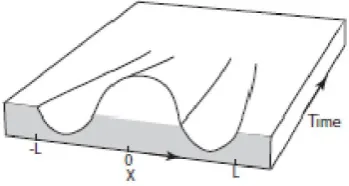
Fig. 1. Activated Potential Substrate
Extracted Activated Potential
( , ) = ( , ) − ( ( , ))
Where,
( , ) = Action of Excitation Process.
( ( , )) = Action of Inhibition Process.
( , ) = Autocatalytic Activated Potential.
Parameters for describing Spiral Structure of Elementary Parti
The final formed spiral structure of elementary particles can be parameterized by nine parameters listed below and illustrate Figures:
Fig. 2. Illustration of parameters for formed spiral structure. (
Table 1. List of nine parameters describing the spiral structure of elementary particles
Parameter Description
A Amplitude of the Activated Potential.
D=1 Diffusion Coefficient (Suraj Kumar, 2014
a, b The horizontal and vertical diameter of spiral arms. In
section of the arm due to formation from an activated stationary wave having the global symmetry of U (1)
Ω, φ, μ Describes the direction of motion of spiral inc
α, β The angles describing the Horizontal and Vertical Curl. It describes the rate of change of activated potential which provides
effect to the particle responsible for its massive behaviour.
Analysis of above parameters for a basic review
or μ can have a non-zero value representing the charge of the
[image:4.595.165.439.620.722.2]non-zero value, then the particle behaves to have representation of Weak Charge.
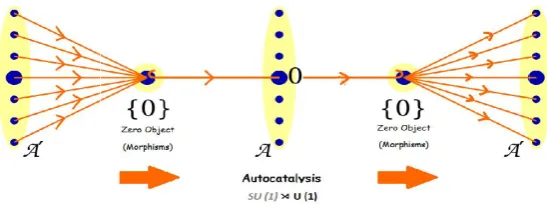
Fig. 3. Morphism of Universe by SU (
Parameters for describing Spiral Structure of Elementary Particles in analogous to Sea Shells
The final formed spiral structure of elementary particles can be parameterized by nine parameters listed below and illustrate
Illustration of parameters for formed spiral structure. (Courtesy (Jorge Picado, 2010
List of nine parameters describing the spiral structure of elementary particles
Suraj Kumar, 2014)
The horizontal and vertical diameter of spiral arms. In our case a=b as the spiral structure of elementary particles is formed with a circular cross section of the arm due to formation from an activated stationary wave having the global symmetry of U (1).
Describes the direction of motion of spiral including its own curl vector as well as the acceleration vector.
The angles describing the Horizontal and Vertical Curl. It describes the rate of change of activated potential which provides effect to the particle responsible for its massive behaviour.
Analysis of above parameters for a basic review, when the particle is stationary at a point in space only one of the angle from Ω, φ zero value representing the charge of the particle (Suraj Kumar, 2014). If more
to have representation of Weak Charge.
Fig. 3. Morphism of Universe by SU (Suraj Kumar, 2014)
cles in analogous to Sea Shells
The final formed spiral structure of elementary particles can be parameterized by nine parameters listed below and illustrated in
Jorge Picado, 2010))
List of nine parameters describing the spiral structure of elementary particles
our case a=b as the spiral structure of elementary particles is formed with a circular cross-.
The angles describing the Horizontal and Vertical Curl. It describes the rate of change of activated potential which provides the gravitational
Conclusion
The self similar image of spiral structure for elementary particles preserves the equiangular spiral leading to decay of photons when it is absorbed by the particle. Also the initial activator waves triggered through autocatalysis of U (1) = SU (1) ⋊ U (1) is the main guiding or generating constraint through the complete formation cycle of spiral structures at both the micro and macro level i.e. at both the particle and cosmos level. The SU (1) universal symmetry acts here as the memory of the Universe and is responsible for the morphism of the Universe.
REFERENCES
Deborah R. 1992. Fowler, Hans Meinhardt and Przemyslaw Prusinkiewicz, “Modeling Seashells”, ACM SIGGRAPH, New York, pp. 379-387, Computer Graphics, 26, 2, (July 1992).
Jorge Picado (Universidade de Coimbra - Portugal), "Seashells: the Plainness and Beauty of Their Mathematical Description," Loci (February 2010) (DOI:10.4169/loci003294)
Suraj Kumar, 2014. “A Spiral Structure for Elementary Particles”. Int. J. Res. Vol. 1, Issue 6, July 2014 (ISSN 2348-6848). Suraj Kumar, 2014. “Journey of the Universe from Birth to Rebirth with insight into the Unified Interaction of Elementary
Particles with Spiral Structure”. Int. J. Res. Vol. 1, Issue 9, October 2014 (ISSN 2348-6848).
Suraj Kumar, 2015. “Quantum Spiral Theory”. Int. J. Res. Vol. 2, Issue 1, January 2015 (ISSN 2348-6848).