THE STUDY OF PHYSICAL PROPERTIES OF THE EUCALYPTUS CELLULOSIC PULP PRODUCED BY
THE KRAFT PROCESS ON WOOD SPECIES
1,*
Elrhayam, Y.
1
Laboratory of Polymers, Radiation and Environment (LPRE) / Team of Organic and Macromolecular
Chemistry (ECOM), Department of Chemistry, Faculty of Sciences, Universi
2
Laboratory of Quality Control, Cellulose Company
ARTICLE INFO ABSTRACTThe cellulose Morocco Produces about 125,000 tons / year of bleached eucalyptus pulp chlorine (ECF) depending on Kraft process of cooking (soda + sulfide), the oxygen bleaching and chlorine dioxide. The eucalyptus wood are Composed of other macromolecular chains of cellulose origin (these macromoleculars are Formed by the repetition of monomer units of
The junction has its effects by the removal of water)
other by in an amorphous way by hemicellulose and lignin. Our work is to study, on the one hand, the effect of the increasing
and on the other, the impact of the increased refining time of the unbleached pulp on the same the physical properties. This is done to the two different species of wood namel
species which gives more opacity and volume to the pulp. The latter is preferred in industries manufacturing all kinds of paper used for printing, writing or hygiene. The GRANDIS species giving more strength to the pulp is rather used by ma
Copyright © 2015 Elrhayam et al. This is an open access article distributed under the Creative Commons Att distribution, and reproduction in any medium, provided the original work is properly cited.
INTRODUCTION
The best known natural polymers originally extracted from vegetables are rubber, starch, glycogen, dolichol and cellulose, the latter is the component that provides protection and support in plant organisms. It is located in the cytoplasmic membrane of cells and is the most abundant organic substance in nature. Indeed it is estimated that a tree produces about 10g of cellulose per day and at the global scale, the production is around 1,310 10 tons per year. (Sjöström Frenger
cellulose which is the raw material for the manufacture of paper pulp is constituted by a sequence pattern of β glucopyranose linked by anglucosidic β link (1
major component of wood, which is the hemicellulose, is a polysaccharide consisting of hexosans (especially mannans) and pentosans (xylans above) which are incorporated into the cellulose chains. The third major component of wood lignin is an amorphous and crosslinked polymer of phenylpropanes units. It is the link between the cellulose fibers. manufacturing process of the paper paste is achieved by the isolation of cellulose fibers, wood boiled with soda to make the lignin soluble in alkali milieu.
*Corresponding author: Elrhayam,
Laboratory of Polymers, Radiation and Environment (LPRE) / Te of Organic and Macromolecular Chemistry (ECOM), Department of Chemistry, Faculty of Sciences, University Ibn Tofail, Kenitra, Morocco
ISSN: 0975-833X
Article History:
Received 15th October, 2014
Received in revised form
06th November, 2014
Accepted 10th December, 2014
Published online 23rd January,2015
Key words: Sulphidity, Boiling, Bleaching, Refining
RESEARCH ARTICLE
THE STUDY OF PHYSICAL PROPERTIES OF THE EUCALYPTUS CELLULOSIC PULP PRODUCED BY
THE KRAFT PROCESS ON WOOD SPECIES
Elrhayam, Y.,
1Akki Ait, S.,
2Mr. Chaoui, and
1Elharfi
Laboratory of Polymers, Radiation and Environment (LPRE) / Team of Organic and Macromolecular
Chemistry (ECOM), Department of Chemistry, Faculty of Sciences, University Ibn Tofail, Kenitra, Morocco
Laboratory of Quality Control, Cellulose Company from Morocco (CDM), Sidi Yahiya, Kenitra, Morocco
ABSTRACT
The cellulose Morocco Produces about 125,000 tons / year of bleached eucalyptus pulp chlorine ) depending on Kraft process of cooking (soda + sulfide), the oxygen bleaching and chlorine dioxide. The eucalyptus wood are Composed of other macromolecular chains of cellulose origin (these macromoleculars are Formed by the repetition of monomer units of
The junction has its effects by the removal of water) associate fibers which are interconnected to each other by in an amorphous way by hemicellulose and lignin. Our work is to study, on the one hand, the effect of the increasing sulphidity at the level of boil on the physical properties of the bleached pulp, and on the other, the impact of the increased refining time of the unbleached pulp on the same the physical properties. This is done to the two different species of wood namel
species which gives more opacity and volume to the pulp. The latter is preferred in industries manufacturing all kinds of paper used for printing, writing or hygiene. The GRANDIS species giving more strength to the pulp is rather used by manufacturers of packaging papers
is an open access article distributed under the Creative Commons Attribution License, which distribution, and reproduction in any medium, provided the original work is properly cited.
The best known natural polymers originally extracted from vegetables are rubber, starch, glycogen, dolichol and cellulose, the latter is the component that provides protection and support in plant organisms. It is located in the cytoplasmic membrane ls and is the most abundant organic substance in nature. Indeed it is estimated that a tree produces about 10g of cellulose per day and at the global scale, the production is Frenger, 1994) .The the raw material for the manufacture of paper pulp is constituted by a sequence pattern of β-D glucopyranose linked by anglucosidic β link (1-4). The second major component of wood, which is the hemicellulose, is a (especially mannans) and pentosans (xylans above) which are incorporated into the cellulose chains. The third major component of wood lignin is an amorphous and crosslinked polymer of phenylpropanes units. It is the link between the cellulose fibers. The manufacturing process of the paper paste is achieved by the isolation of cellulose fibers, wood boiled with soda to make
Laboratory of Polymers, Radiation and Environment (LPRE) / Team of Organic and Macromolecular Chemistry (ECOM), Department of Chemistry, Faculty of Sciences, University Ibn Tofail, Kenitra,
The presence of the latter may split the cellulosic channels and make their features weaker. In addition, certain ki
such as galactose, mannose and xylose which are incorporated in the chains may cause additional fragility especially by the presence of xylose. (Nevell and
CHEMICAL CONSTITUENTS OF WOOD
The proportions of the three major components vary according to different types of wood. Hardwoods are generally richer in cellulose but their lignin contents are lower than softwoods. Cellulose is the main component of the wood
homogeneous and linear polymer, consisting of about 10,000 cellobiose units (the pattern formed by the molecules of β Dglucose). The cellulose chains are oriented in parallel to each other, forming micro fibrils and then fibril.
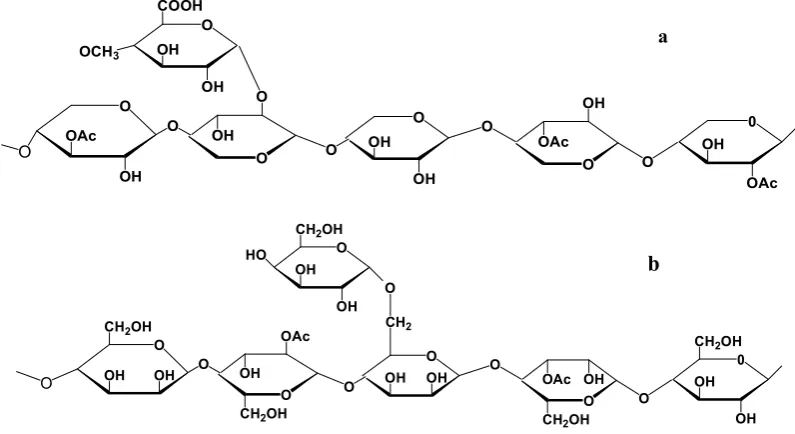
polysaccharides (Figure 2) of a low degree of polymerization (200-500 units). The chains are not linear. There is a wide variety of hemicellulose composed of various sugars ( (monosaccharides), such as pentoses (xylose, arabinose) that are found in large amounts in har
Hemicelluloses are much easier to degrade than cellulose. They are characterized by their ease of hydration, which makes all the fibers swell easily.
International Journal of Current Research
Vol. 7, Issue, 01, pp.11311-11318, January, 2015
INTERNATIONAL
THE STUDY OF PHYSICAL PROPERTIES OF THE EUCALYPTUS CELLULOSIC PULP PRODUCED BY
Elharfi, A.
Laboratory of Polymers, Radiation and Environment (LPRE) / Team of Organic and Macromolecular
ty Ibn Tofail, Kenitra, Morocco
orocco (CDM), Sidi Yahiya, Kenitra, Morocco
The cellulose Morocco Produces about 125,000 tons / year of bleached eucalyptus pulp chlorine-free ) depending on Kraft process of cooking (soda + sulfide), the oxygen bleaching and chlorine dioxide. The eucalyptus wood are Composed of other macromolecular chains of cellulose origin (these macromoleculars are Formed by the repetition of monomer units of the cyclic glucose type. associate fibers which are interconnected to each other by in an amorphous way by hemicellulose and lignin. Our work is to study, on the one hand, the sulphidity at the level of boil on the physical properties of the bleached pulp, and on the other, the impact of the increased refining time of the unbleached pulp on the same the physical properties. This is done to the two different species of wood namely: The ROSTRATA species which gives more opacity and volume to the pulp. The latter is preferred in industries manufacturing all kinds of paper used for printing, writing or hygiene. The GRANDIS species giving
nufacturers of packaging papers
ribution License, which permits unrestricted use,
The presence of the latter may split the cellulosic channels and In addition, certain kinds of sugar, such as galactose, mannose and xylose which are incorporated in the chains may cause additional fragility especially by the
and Zeronian, 1985).
CHEMICAL CONSTITUENTS OF WOOD
proportions of the three major components vary according to different types of wood. Hardwoods are generally richer in cellulose but their lignin contents are lower than softwoods. Cellulose is the main component of the wood (Figure 1). It is a and linear polymer, consisting of about 10,000 cellobiose units (the pattern formed by the molecules of β-Dglucose). The cellulose chains are oriented in parallel to each other, forming micro fibrils and then fibril. Hemicelluloses are igure 2) of a low degree of polymerization 500 units). The chains are not linear. There is a wide variety of hemicellulose composed of various sugars (oses) (monosaccharides), such as pentoses (xylose, arabinose) that are found in large amounts in hardwoods.
Hemicelluloses are much easier to degrade than cellulose. They are characterized by their ease of hydration, which makes
a: O-acetyl-O-methyl-4-glucoronoxylane b: O-acétylgalactoglucomannane
Lignin is the third major component of plants. It is an amorphous and crosslinked polymer of phenylpropane units (Figure 3). This molecule contains aromatic compounds substituted by hydroxyl groupings (OH) and methoxyls (OCH3). Lignin is mostly found around the fibers and in primary fiber wall. It is the cement of the fibrous tissue. This polymer is heterogeneous by the nature of substituents of the monomers and the inter-monomère linkages. In wood, lignins are related to polysaccharides. Lignins of softwood practically consist of only gaiacylpropane patterns (G) while those of hardwoods consist of gaiacylpropane patterns (G) and syringylpropane (S).
MATERIALS AND METHODS
According to the Kraft process, this study is to conduct wood boiling: (Rostrata and Grandis) in different sulphidities (0,10,20 and 30%) to assess the influence of sulfides on the quality of the produced paste. This research is undertaken in a test laboratory equipped with a set of semi-pilot aircraft (digester, disintegrator, classifier (photo 4), the unbleached paste from boils and then bleached. Then we carried out measurements of the physical characteristics of both types of pastes (the bleached and the unbleached).
C C
R
1:H, R
2:
OCH
3Gaiacylpropane (G)
[image:2.595.93.514.57.150.2]R
1:R
2:OCH3Syringylpropane (S)
R
1:R
2:H Parahydroxyphénylpropane (p-OH) [image:2.595.100.498.194.411.2]Figure 3. Structure of lignin monomer (ANNIK VEZZIER, 1996) Figure 1. cellulose Formula (Presentation in perspective) (ANNIK VEZZIER, 1996)
O OAc O O OH O OH O O OH O O COOH OCH3 OH O OH
OH O OAc
OH O 0 OH OAc a O O O O O O O O O O 0 OH OH
CH2OH
OH
CH2OH
OAc CH2 OH OH O OH OH HO
CH2OH
CH2OH
OAc OH OH
OH CH2OH
b
Figure 2. Structure of the main types of hemicelluloses found in wood (ANNIK VEZZIER, 1996)
O
OH HOH2C
OH O
O OH
HOH2C
OH
O
O
OH HOH2C
OH O
O OH
HOH2C
[image:2.595.172.433.622.783.2]Step of semi-pilot boiling
Preparation of shavings
Wood shavings should be homogeneous in terms of size that should be standard. The large and too small shavings are excluded by putting the set in a classifier.
Preparation of the liquor of the boil
The white liquor of the boil is taken of the production circuit. We determine its concentration in active alkali and sulphidity.
Weak black liquor
This liquor is also taken from the production circuit. It is low in active alkali and it serves to bring the relation liquid / wood to 4, which is the major boiling condition.
The boil start
We initially had to determine the load in active alkali in relation to dry wood for each species of wood in order to obtain approximately the same kappa (boiling degree) for all types of boils. This kappa should be 16 ± 1 units.
The paste’s characterization technique
Disintegration: ISO 5263
The paste sample undergoes a mechanical treatment in water, so that the interlaced fibers, which were dispersed in the suspension of the paste, are again separated from each other without substantial changes in structure.
Length and Rupture Index (ISO 1924-1, 1994)
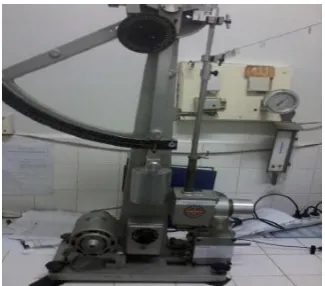
The testing machine is designed to stretch a specimen of given dimensions to a constant and appropriate gradient of elongation and to measure the tensile strength and the produced elongation as well.
Resistance to wrench (wrench Index)
The average force required to continue the wrench caused by an initial cut in a sheet of paper is expressed in millinewtons (mN). This facilitates the measurement of the wrench index (WI). Maximum pressure uniformly distributed is supported by a single paper sample perpendicular to its surface under the conditions of the test.
Resistance to bursts (Burst Index)
Maximum pressure uniformly distributed is supported by a single paper sample perpendicular to its surface under the conditions of the test.
RESULTS AND DISCUSSION
[image:3.595.85.245.54.207.2]In this study, we evaluated the influence of sulphidity for both types of wood (Rostrata and Grandis) on the performance, the bleaching and the physical characteristics of the unbleached paste. As to the bleached paste, we studied the influence of this sulphidity on the consumption in chemical products and on the bleaching.
[image:3.595.330.534.234.393.2]Figure 4. Disintegrator (ADAMEL LHOMARGY)
Figure 6. DechiromètreAdamelLHOMARGY- ED 01 model # 518
Figure 7. ÉclatomètresAdamel LHOMARGY 05.1 EC # 271 B
[image:3.595.340.520.493.648.2] [image:3.595.83.246.616.759.2]Influence of sulphidity (Wood / Rostrata)
The results of Rostrata wood boil of different sulphidities (Table 1) allow to conclude the change of various parameters at different sulphidities. We find that the more sulphidity increases, the more brightness increases and efficiency decreases. This is explained by the fact that at a low sulphidity, there is lignin which increases the output of fibers and decreases the brightness. While at zero sulphidity, the kappa and high residual alkali are indexes of bad delignification (bad boil).
Wood / Grandis
[image:4.595.29.564.79.133.2]The results of wood boiling grown at different sulphidities (Table 2) show the variation of different parameters at different sulphidities. We note that the same phenomenon observed in Rostrata wood boiling occurs for the Grandis wood. The more the sulphidity increases, the more brightness increases and the output decreases. As to the difference between the two types of wood (Grandis and Rostrata) lies in the fact that the performance and whiteness of Grandis wood are higher than those of Rostrata, which is due to the presence of more cellulosic fibers with a degree of high polymerization and less lignin.
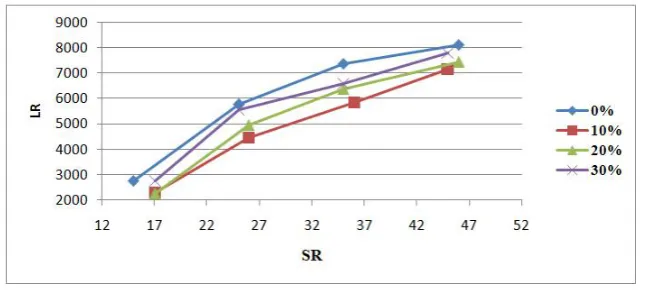
Figure 8. Evolution of the R.L according to sulphidity with different Schopper degrees
[image:4.595.27.566.165.217.2]Figure 9. Evolution of ID according to sulphidity with different Schopper degrees Table 1. Variation of different parameters according to sulphidity
Sulphidity % A.A. Resid. g/l Poids Brut g Siccité % Poids Sec Rend % P. Classifiedg unboiledg unboiled % Kappa % Bleachiso
0 9.7 3466 26.0 901 48.15 830 7.90 0.95 17.6 15.8
10 8.4 3216 25.0 804 47.90 722 6.87 0.95 16.1 21.5
20 9.1 3406 22.7 773 46.90 708 4.63 0.65 15.7 21.8
[image:4.595.138.468.392.540.2]30 8.5 4456 19.8 882 46.50 750 5.50 0.73 16.0 22.5
Table 2. Variation of different parameters depending on sulphidity
Sulphidity % A.A. Resid. g/l Gross Weightg gross Weight % outputg Rend % P.Classifiedg unboileg Unboiled % Kappa Blanchiso
0 10.2 6220 20.5 1275 63.75 1090 40 3.67 23.2 18.6
10 05.8 5783 19.8 1145 57.30 1060 4 0.38 16.0 24.7
20 05.2 5972 19.0 1134 56.70 909 5 0.55 15.7 25.0
[image:4.595.137.469.571.733.2]WOOD ROSTRATA
Mechanical properties
Rupture length (R.L.)
The rupture length values for different sulfidities with different Schopper degrees are represented in Figure 8. We find that the rupture length evolves in upwardly by increasing sulphidity from 10% to 30% except for the values at 0% sulphidity where we see a significant increase which is explained by the fact that there is still the presence of lignin.
Wrench index (I.D.)
Figure 9 shows the values of the wrench index for various sulfidities with various Schopper degrees. We observe an increase in the wrench index from 10 to 30% of sulphidity, with a significant increase in this index of 0% sulphidity; this is due to insufficient delignification which is also due to the absence of sulphur, hence a high resistance to wrench.
Burst index (B.I.)
Figure 10 shows the values of the burst index for various sulfidities with different Schopper degrees. From the results obtained, we see the same phenomenon of evolution as that observed in the WL and ID, namely an increase in B.I from 10 to 30 of sulphidity with a higher ID of zero sulphidity. So we conclude that the mechanical characteristics LR, ID and IE evolve upwardly when we increase the sulphidity from 10 to 30%
OPTICAL CHARACTERISTIC
Hand (H):
[image:5.595.147.455.336.503.2]The values of the hand for different sulfidities with different Schopper degrees are represented in Figure 11. The Hand, which is an optical property that refers to the inverse of the density, increases according to the The Hand, which is an optical property that refers to the inverse of the density, increases according to the sulfidityincrease, except for 0% where we see higher values which are always due to poor delignification.
[image:5.595.144.455.535.732.2]Figure 10. Evolution of the B.I. according to sulphidity with different Schopper degrees
PERMEABILITY
Air resistance (A.R.)
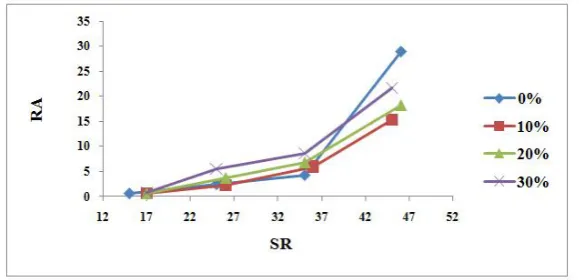
Air resistance values for different sulfidities with different Schopper degrees are shown in Figure 12. We find that air resistance (characteristic of permeability and absorption) follows the same evolution as the previous features for sulfidities from 10 to 30% and takes random values for 0% sulphidity.
MECHANICAL PROPERTIES (GRANDIS WOOD)
Rupture length
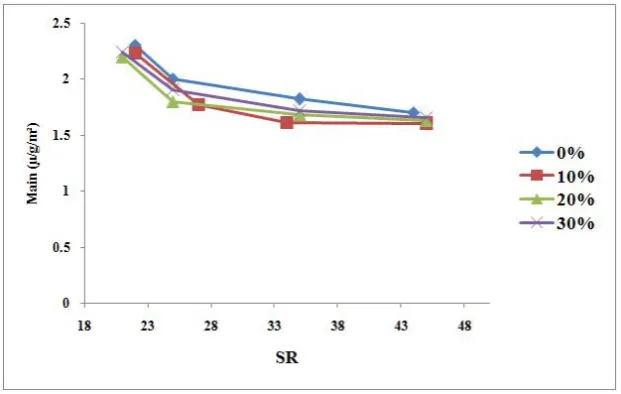
[image:6.595.141.464.51.211.2]The rupture length values for various sulfidities with different Schopper degrees are represented in Figure 13. We notice a rupture length increase from 10 to 30% of sulphidity, and we also see a remarkable increase in this parameter of 0% sulphidity.
[image:6.595.139.462.249.394.2]Figure 12. Evolution of AR according to sulphidity with different Schopper degrees
Figure 13. Evolution of R.L. depending on sulphidity with different Schopper degree
[image:6.595.137.466.432.610.2]Wrench index (I.D.)
The wrench index values for various sulfidities with different Schopper degrees are shown in Figure 14. By analyzing the WI curve, we see an increase in this index from 10 to 30% of sulphidity except for 0% sulphidity where we obtained a remarkable increase.
Burst index (B.I.)
The values of the burst index for different sulfidities with different Schopper degrees are represented in Figure 15.
After analyzing the curve of BI, we note that at 0% of sulphidity there are fluctuations in comparison with the other mechanical properties, while in the sulfidities of 10, 20 and 30% we see an increase ranging from 10 to 30 %.
OPTICAL CHARACTERISTIC
The Hand (H)
[image:7.595.165.443.55.222.2]The hand values for the different sulfidities with different Schopper degrees are represented in Figure 16.
[image:7.595.165.442.252.405.2]Figure 15. Evolution of B.I. according to sulphidity with different Schopper degrees
Figure 16. Evolution of the hand according to sulphidity with different Schopper degrees
[image:7.595.158.448.441.581.2]The hand refers to the ratio of the thickness in microns to the leaf mass in g / cm 2 Hand = E / F E: thousandth of a millimeter in thickness and F: force of the leaf in g / m 2 We find that the more we increase the sulphidity, the more we get a better hand except for 0% where we have higher values
PERMEABILITY
Airresistance
The values of resistance to air for different sulfidities with different Schopper degrees are shown in Figure 17. We note that air resistance increases according to sulphidity of 10 to 30% except for the 0% sulfidity where air resistance takes random values. From the obtained results of the different physical characteristics of Grandis wood, we notice that the same observed phenomenon in Rostrata wood is produced once again in Grandis wood with slightly higher values.
Conclusion
The sulphidity plays an important role in improving the physical characteristics of the pulp.
In fact, the addition of sodium sulphurs in the liquor’s boil increases the rate of delignification without degrading cellulosic chains. HS ion concentration must be maintained at higher levels throughout the boiling process on the one hand, and these ions emanate OH ions on the other hand in order to maintain the pH at its level, and to avoid the reprecipitation of the dissolved lignin.
Therefore, the optimum sulphidity, in order to get a better quality of pupl, should be around 30%.
REFERENCES
Annik Vezzier, 1996. Pulp Bleaching: Application to eucalyptus. Thèse doctoral INP Toulouse.
Nevell and Zeronian, 1985. Cellulose Chemistry and Its Application. New York Ellis Harwood Limited.
Sjostrom and Frenger, 1994. Wood Chemistry: Fundamentals and Application. San Diego, Academic Press, Inc.