Augmentation not Duplication: Considerations for
the Design of Digitally-Augmented Comic Books
Matjaž Kljun* Klen Čopič Pucihar∗
[email protected] [email protected] University of Primorska
Koper, Slovenia
Jason Alexander Lancaster University Lancaster, United Kingdom
Maheshya Weerasinghe† University of Primorska
Koper, Slovenia [email protected]
Cuauhtli Campos Julie Ducasse [email protected]
[email protected] University of Primorska
Koper, Slovenia
Barbara Kopačin University of Primorska
Koper, Slovenia [email protected]
Jens Grubert Coburg University
Coburg, Germany [email protected]
Paul Coulton Lancaster University Lancaster, United Kingdom
Miha Čelar Astral Film Ljubljana, Slovenia [email protected]
ABSTRACT
Digital-augmentation of print-media can provide contex-tually relevant audio, visual, or haptic content to sup-plement the static text and images. The design of such augmentation—its medium, quantity, frequency, content, and access technique—can have a significant impact on the read-ing experience. In the worst case, such as where children are learning to read, the print medium can become a proxy for accessing digital content only, and the textual content is avoided. In this work, we examine how augmented content can change the reader’s behaviour with a comic book. We first report on the usage of a commercially available aug-mented comic for children, providing evidence that a third of all readers converted to simply viewing the digital media when printed content is duplicated. Second, we explore the design space for digital content augmentation in print media. Third, we report a user study with 136 children that exam-ined the impact of both content length and presentation in a digitally-augmented comic book. From this, we report a series of design guidelines to assist designers and editors in the development of digitally-augmented print media.
∗Also with Faculty of information studies, Novo Mesto, Slovenia. †Also with , SACHI, School of CS, University of St Andrews, UK.
Permission to make digital or hard copies of all or part of this work for personal or classroom use is granted without fee provided that copies are not made or distributed for profit or commercial advantage and that copies bear this notice and the full citation on the first page. Copyrights for components of this work owned by others than the author(s) must be honored. Abstracting with credit is permitted. To copy otherwise, or republish, to post on servers or to redistribute to lists, requires prior specific permission and/or a fee. Request permissions from [email protected]. CHI 2019, May 4–9, 2019, Glasgow, Scotland Uk
© 2019 Copyright held by the owner/author(s). Publication rights licensed to ACM.
ACM ISBN 978-1-4503-5970-2/19/05...$15.00 https://doi.org/10.1145/3290605.3300333
CCS CONCEPTS
•Human-centered computing→Mixed / augmented reality.
KEYWORDS
Augmented Reality, Comic Books, Digital Augmentation ACM Reference Format:
Matjaž Kljun*, Klen Čopič Pucihar, Jason Alexander, Maheshya
[image:1.612.352.522.489.680.2]Weerasinghe, Cuauhtli Campos, Julie Ducasse, Barbara Kopačin, Jens Grubert, Paul Coulton, and Miha Čelar. 2019. Augmenta-tion not DuplicaAugmenta-tion: ConsideraAugmenta-tions for the Design of Digitally-Augmented Comic Books. InCHI Conference on Human Factors in Computing Systems Proceedings (CHI 2019), May 4–9, 2019, Glas-gow, Scotland Uk.ACM, New York, NY, USA, 12 pages. https: //doi.org/10.1145/3290605.3300333
1 INTRODUCTION
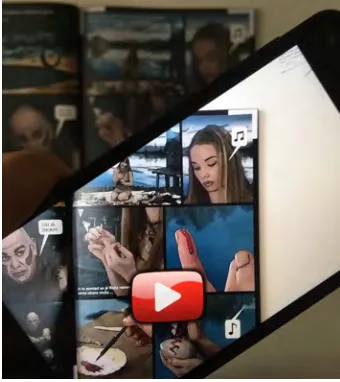
Digitally-augmented comic books (‘AR comics’, Figure 1) combine the traditional paper comic format with Augmented Reality (AR). Typically, the reader can access animated se-quences (audio and video) of the page’s frames or other online content via a mobile device. Comic book writers and illustrators see this as one approach for encouraging young readers to continue to engage with printed comics.
Despite the large body of work into AR [23, 46], and AR Books [14], there is little understanding of how authors and illustrators should design for this combined physical/digital medium. Specifically, it is unclear which storytelling ap-proaches to use (augment, replicate, or add to existing con-tent) or how digital content should be integrated into the reading flow (how much and how often). Further, it is un-known how these design decisions impact the holistic read-ing experience.
In order to better understand this design space, and the implications of these design decisions, this paper provides insights into the design and use of digitally-augmented comic books through real-world deployment statistics, a design-space exploration, and a controlled user study. Overall we saw that duplication in real world usage encouraged 37% of users to stop reading and resort to watching videos. In a controlled study this value drops to 15%. Most participants consumed all available content even if duplicated, which helped them to perform better at retention test. In contrast, when providing shorter exerts to augment the comic, none of the participants ignored the printed medium.
To summarise, this paper contributes: (1) An analysis of the real-world use of an AR comic; (2) A description and discussion of the design space of digitally-augmented comic books; (3) A user study with children (N = 136) to evaluate different aspects of the design space and; (4) A series of design guidelines derived from our findings. These contributions go beyond previous work by providing the first analysis of real-world use of a digitally-augmented comic book, the most extensive design-space exploration to date, and the first large-scale study exploring design decisions in AR comics.
2 RELATED WORK Historical Context
Printed materials have been a mainstream medium for nearly half millennium and are recently changing and adapting to digital technologies. For example, publications often have digital counterparts (e-books, on-line newspapers) or have moved completely on-line. In the case of scientific publica-tions it has been suggested that on-line versions should be augmented with animated figures [16]. Nevertheless, printed materials are often preferred by users since they offer various advantages such as portability, flexibility, and tangibility [28].
It is these advantages that have contributed to augmenta-tion of printed materials with digital elements—mainly with the advances of mobile AR. This mix of printed material’s physicality and interaction possibilities of digital augmen-tation has been used for three often overlapping purposes: education, storytelling and entertainment.
Augmented Reality (AR) in Journalism
AR is regularly used in journalism as a vehicle for story-telling [30]. Various approaches include overlaid simple, in-teractive, and geo-tagged graphics, photographs and videos to provide additional context to news and information, and use of location information available via AR and so-cial media to identify potential sources for stories. Exam-ples include Wire magazine featuring an audiovisual cover (https://www.thewire.co.uk/rewind2017app), The New Yorker (featuring artistic audiovisual 3D video), ELLE (featuring interviews on covers), W magazine (showing music videos), Die Welt (visualising 3D graphs, buildings and similar con-tent), and Metro (showing film trailers, various videos, photo galleries).
Augmented Reality in Education
AR printed materials (and AR in general) provides numer-ous benefits in teaching and learning environments [3] as it enables students to: (i) explore and engage with content from various angles [22]; (ii) interact with content, which is otherwise impossible to be experienced first-hand [34]; (iii) understand spatial relationships and interactions of elements within a 3D space [35]; (iv) seamlessly interact between the real and virtual worlds [3]; (v) enhance creativity and imagi-nation [25] and; (vi) reinforce collaboration [4, 21] discovery-based learning, object modelling and skills training [45].
Book-based Augmented Reality
An early system describing the use of AR in books showed augmented 3D objects pop-up from the pages as early as in 1998 [32]. Since then, various topics and approaches have been used in augmenting school books. The research commu-nity has suggested, developed and explored systems showing AR in books covering for example mathematics (e.g. showing geometric shapes) [24], physics (e.g. depicting complex 3D concepts) [11], astronomy (e.g. exploring the workings of the solar system) [34, 36], engineering [29], and history (e.g. intensify the description of struggles of European settlers in New Zealand) [15]; each exploiting one or more of the aforementioned advantages of AR.
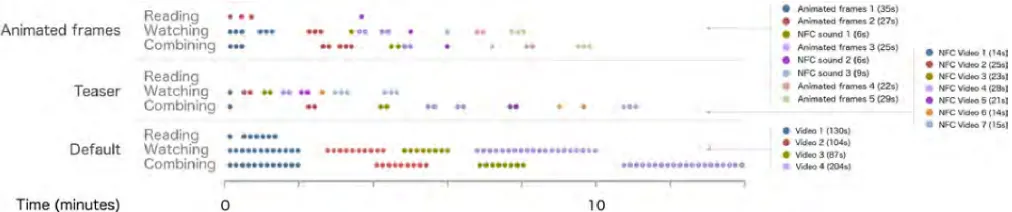
Figure 2: Sequence graph showing examples of AR Comic interaction patterns. Each row represents one user’s engagement and each coloured dot in a row represents 10s of viewed video. Each colour represents a different video. Top: mostlywatching(W)
occurs when users skip pages and watch only the videos in sequence (there are almost no blank spaces between video sessions). Middle: predominatelyreading(R) occurs when users are assumed to be reading (large time gaps between videos), skip videos
and/or stop them early. Bottom: combiningreading and watching(C) occurs when users watch the videos in sequence and
read, which is visible by longer time gaps between the videos.
pop-up book [39], utilising the book’s pictures as markers to show virtual 3D objects, Interactive storybooks [10] aimed at early literacy education and collaboration, and The Haunted Book [33] that animates the illustrations of a poetry book. Outside the research community, publishers have also started to explore the potential of AR in books with the advances in various commercial AR frameworks and SDKs. In 2011 an AR book titledThe Future is Wild: The Living Bookwas presented
at the Frankfurt Book Fair that integrated videos, 3D models and other AR content. Since than, numerous books emerged integrating AR content with physical elements of the books.
Interaction with Augmented Reality
Interaction emerged early as an important factor for ma-nipulating digital elements. Beyond moving and rotating digital objects (e.g. by moving the marker), prototypes have explored how users can move book-based characters around to complete tasks and progress the story. These techniques used controllers with markers attached to them [10], trig-gered events by bringing tangible objects to designated book pages [11, 15, 18, 44], moving interactive parts of the pop-up book to reveal additional information [31], or by interacting with multiple users [10, 15].
Another common augmentation is to play videos on print medium. These are typically played while print medium is in view of the device and stop playing when out of view. As this may lead to arm fatigue previous work explored alternative options such as freezing the real-world view [26] or transitioning to a digital copy of the physical media [17].
Yet another area of interaction is content creation where users “co-create” the book through real-world creative activ-ities. Examples include creating digital notes in a physical book [37], theInteractive AR colouring book[8] that creates
pop-up animated sequences of the children’s colouring, and theAR coloring book App[27, 47] that allows children to
express their creativity through colouring a colouring book page while the animated character is coloured in real-time.
The Impact of AR on End-Users
With the advances of affordable mobile AR hardware and off-the-shelf AR libraries, the focus has shifted from technical development to the effects of the technology on users. Build-ing augmented books has become easier for wider research community and current works describe how such technol-ogy influences its readers. Studies have for example looked at a “positive and measurable” impact an AR book had on the spatial ability of mechanical engineering students [29], the affordances of interacting with physical objects that pro-vide a “desirable naive physics” notion in the context of AR books [19], the impacts on cognitive load and motivation while studying from AR books [7], the effects on the col-laborative experience while reading AR books [1, 13], and the positive effects of augmented books on learning out-comes [43].
The current body of literature has not yet explored the design of comic books as mixed-reality medium despite the fact that comic books are ideal candidates for augmentation as they are based on conveying the story with visual elements. While commercial products that digitally augment/animate comic books are available such as Marvel AR1and Black Eyed
Peas’ Comic Masters2, little is known how people interact
with such digital content ‘in the wild’—this is required to better support design decisions and how these decisions influence the reading experience. To expand the body of knowledge in this area we conducted an ‘in the wild’ study and a controlled study with 136 children with 3 different designs of comic augmentation.
3 REAL WORLD USAGE
To understand how an AR comic book is used ‘in the wild’ we worked with the artists and publishers of the commercially available digitally-augmented comic book “Bobri Voz” to log
C RC WC W RW CW R WR CR M SUM
Only one mode 15 0 2 17 5 5 7 8 6 11 76
% 19.74 0 2.63 22.37 6.58 6.58 9.21 10.53 7.89 14.47
17 27 21 11 76
22.37 35.53 27.63
All finished with this mode %
[image:4.612.51.558.92.156.2]C - Combined W - Watching R - Reading or dropout M - Mixed & could not be defined Two letter combination means the pattern started with one and finished with another pattern (e.g. CW means the pattern started with Combined and finished with Watching)
Table 1: AR Comic interaction pattern summary. The top row shows how many people exercised a particular pattern (combi-nations of C, W, & R show that the pattern transitioned during engagement). The bottom row shows how many people ended reading with one of the three patterns C, W or R.
all accesses to the digital content. This section reports our findings.
The AR Comic, graphical design and video content The comic is based on an animated film and tells the story of the invention of a wheel by people who lived in the area of Ljubljana’s marshes. The story is fictional, but inspired by the real 5200 years old wheel found in the area. At the time of the study the comic was available in book stores around Slovenia and public libraries across the country.
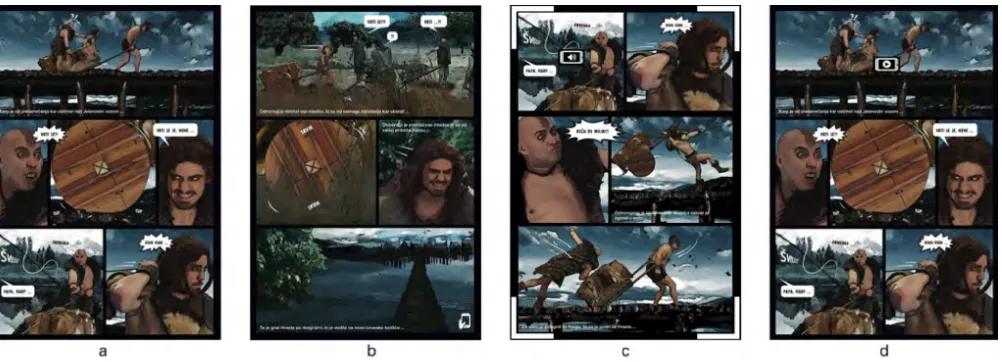
The comic book size is A4, has 39 pages and 167 frames; 10 of these frames are specially marked as being digitally augmented (see Figure 3 b). The digital content is accessed through an augmented-reality application for smartphones. Within the app the user points the phone’s camera at spe-cially marked frames and clicks the scan button. If the frame is recognized as augmented, a play button appears on-screen (see Figure 1) and the user can begin watching the integrated video or proceed to full-screen mode. The embedded videos duplicate the comic book content from previous augmented frame up to the currently scanned frame and thus replicate the whole comic book. The total length of the video content is 24 minutes and 25 seconds.
Data Collection
The primary goal of the study was to uncover how such in-tegration of digital content influences the reading pattern of the user. We hypothesized that duplicating the whole comic with embedded videos visible with mobile AR application will discourage users from reading the book.
To test our hypotheses, we integrated user engagement tracking into the application. The application was distributed through the Google Play store. The tracking system captured usage data over a period of 1 year and recorded 590 minutes of video watching though 2538 video events or sessions. The application also captured 5349 general application events, such as: application start and close events, various button clicks, and tracking error events.
To delineate individual interaction patterns we grouped sessions (video events) into sequences. On each phone we considered a new sequence if more than 25 minutes elapsed
between two interactions (based on the time needed to finish reading the book) or if a sequence exceeded 70 minutes. We also dropped all sequences with less than 4 sessions since it is difficult to draw anything from such short interactions and ended up with 76 sequences made on 62 phones (of which 50 generated just one sequence). We have no means to tell if the same person used a particular phone more than once, multiple people used it simultaneously, or different people in succession (e.g. siblings using parents’ phone) and will thus focus on sequences only.
Results
Sessions per sequence varied based on which and how many videos users watched. Out of 10 videos, users on average opened 5.3 (median 4) videos and watched 10.5 [43%] (me-dian 5.7 [23%]) minutes. To better understand interaction patterns (through which reading patterns could be antici-pated) we visualised the log data on a sequence graph (see Figure 2). Each dot in the graph represents 10 seconds of video watching. The sequences were individually classified by two authors of the paper looking for one of the following patterns:
Watching (W):User omits reading and focuses only on watching videos, Figure 2 (top).
Combining (C):User combines watching videos and reading, Figure 2 (middle).
Reading (R): User predominantly reads and only opens videos for a short period, Figure 2 (bottom).
This suggests that some users realised that the whole story is duplicated and resorted to watching the videos only.
We acknowledge that we do not know if and how much people read before and after they interact with the app. We assume they start as readers as they do not initially know if or how AR is integrated into the book and can observe interaction patterns only when they start using the app. By observing the interaction patterns we can conclude that the evidence supports our hypothesis (total duplication discour-ages reading) for a third of the cases (36%). Moreover, a quarter of cases ended in reading (28%). Such interaction pat-terns defy the purpose of digital content within the printed comic book.
In the following section we explore the design space for digitally augmented comic books to understand how differ-ent design decisions may influence reader engagemdiffer-ent.
4 DESIGN FACTORS FOR DIGITALLY AUGMENTED COMIC BOOKS
The effective augmentation of physical comic books with digital content hinges on four key factors: the storytelling ap-proach; how the digital content is integrated into the reading flow; the presentation medium and; the method for access-ing the digital content. This section explores the design of these factors and the implications of different choices. The design space is derived from our experiences working with media artists who create augmented comic books and our understanding of issues from the real-word deployment. Be-sides the parts that are novel and are not referenced, we added work from the related literature, notably Grasset et al’s taxonomy [14], to present the topic as a whole.
Storytelling Approach
The storytelling approach determines how the digital content changes the story’s narrative and the reading experience. Digital Content Purpose.Digital content can be used to aug-ment, replicate, or provide additional storytelling material not shown in the printed comic.Augmentationadds an
ad-ditional modality or view onto the printed representation. This might include audio to create mood or the 3D render-ing of a printed character. Augmentation is typically used to increase engagement or to better convey the content de-signer’s original intent, but does not change the story deliv-ered.Replicationprovides an identical storyline through a
digital representation. A typical example of augmentation is to turn the frames of a comic book into an animation. Addi-tional Contentprovides new content or storylines that are
not present in the print media.
Presentation Genre.The digital content’s genre can match or contrast the style present in the printed media. This includes the narrative approach (e.g. first-person vs. third-person
narration) and style of audio/visual presentation. When the digital content’s genre matches that of the printed content, it provides the reader with an immersive, flowing experience. When one of the genres change, it encourages the reader to view the story from a different perspective, getting them to reflect on what they have read, seen, and heard. For example, the digital content that accompanies a hand-drawn comic book could be shot as a documentary, providing a factual basis for the story.
Interaction with Content.Digital content may be passive (e.g. a static image, video- or audio- stream) or active (e.g. a 3D model that can be examined from multiple angles [5] or by providing interactions that allow story-line manipula-tion [10]). The addimanipula-tion of interactivity can lead to greater engagement and immersion, but also has the potential to distract away from the main storyline.
Integration of Content into the Reading Flow
The placement and timing of augmented content can sig-nificantly impact on the reading flow of the comic. Poor integration of this content can lead to a bias towards one or the other media or, in the worse case, abandonment of either the printed or digital content. There are two key character-istics to consider: the spatial position of digital content and the properties of individual content clips.
Spatial Position of Content.There are two key considerations for spatial positioning—theaccess position, the physical
posi-tion on the page where the reader must register their interest in digital content (interaction methods for this are discussed below) and theviewing positionwhere any visual content is
shown. These positions can be the same or different, each influencing the reading flow of the comic [40].
The placement of digital registration points (either im-plicit or exim-plicit) directs the reading flow. Registration at the start of a page facilitates mood- and scene-setting, while reg-istration at the end of the page is used for content reflection. Registration that occurs within the page will interrupt the reading flow, breaking immersion, and should be designed to provide context or relevant content that encourages the reader to return to the next frame or block.
The registration position also impacts the spatial position of any visual digital content. Within-page registration typ-ically indicates contextually relevant content and it would be expected that the digital content is presented within that spatial context. Registration points at the start or end of the page may or may not indicate contextual relevance, and digital content can then be placed anywhere on, above, or outside the page [14, 41].
appearance, length of digital augmentation, and the total vol-ume of digital content. Frequently appearing digital content (e.g. every two or three frames/blocks) can lead to signifi-cant context switching between the printed comic and the digital content access device. Short clips may also become ‘unimportant’ for the reader who wishes to focus on the sto-ryline. The overall balance of digital vs. written content is also important to maintain the desired level of engagement with both media [13, 15].
Presentation Medium
Augmented Reality extends beyond the traditional overlay of visual content to include audio and haptic output, and links to other content. This has implications for both the storyline and the reading flow. Visual content will require some ‘removal’ from the physical page (e.g. holding a device to view the digital content), interrupting the flow of reading. Audio and/or haptic augmentation without visual content may remove this barrier to reading, but suffices the fidelity of visual representation. Using all three modalities can enhance the immersion of the augmentation, but moves the reader further away from comic-book experience.
Access Method
In this section we examine the technological approaches for accessing digital media, and how prerequisites can be imposed for accessing the digital augmentations. While this article focuses on access through commodity devices (i.e. mobile phones), head-worn displays [38] and projection [2] provide a different array of content access approaches.
Technological Approaches.There are three main technolog-ical approaches to accessing digital content with a mobile phone: (1) Vision based recognition; (2) Proximity-based dif-ferentiation; (3) Manual content selection. With vision-based approaches, the reader holds their mobile device such that the camera captures the ‘active’ area of the page. Computer Vision can then be used to identify markers. These markers can either be explicit fiducial markers [12] (e.g. QR codes) or implicit, such as the frames in the comic. For implicit markers the reader must still be made aware of the embedded digital content. For short content the mobile device is continuously held in place while the digital media is rendered. For longer content, once activation is complete, the user does not have to continuously hold the phone in place.
Proximity-based approaches (e.g. NFC [42]) typically re-quire the mobile device to be placed on a particular area on the page. This has the disadvantage of covering page content, however this is often more suitable for ‘short‘ augmentation (such as short audio or video clips) that relate to that par-ticular frame of the comic. This is because proximity-based method is faster at accessing digital and more user-friendly if
compared to vision based approaches (e.g. placing the phone on top of the image vs. pointing and focusing the camera at an image).
Accessibility. To encourage engagement with the physical comic, access to digital content can be limited until certain conditions are met. For example, time-out periods may be used to ensure reading of the text occurs between view-ing augmented content (eye-trackview-ing could also be used to achieve the same effect) or rapid-fire questions can track engagement with the textual content.
Summary
The design factors outlined in this section have a significant impact on the value and resulting engagement in the comic reading experience. To begin formalising these impacts, we designed a user study to understand engagement and re-tention when school students read different versions of an augmented comic book.
5 USER STUDY
The goal of the controlled user study is to understand how different approaches of digitally augmenting a comic book impact user engagement and the reading experience. We used the same comic book and video materials as in the real world study. To test different approaches we designed four different augmentation conditions:
Reading (Figure 3a): control condition, where the comic books were not digitally augmented.
Default (Figure 3b):repetition of real world study (for more detail see AR Comic section)
Teaser (Figure 3c): NFC tags were placed on the upper-part of each left hand side page. When a phone was placed on the tag a full-screen short video was launched illustrating the first 20% of the upcoming double-page. Each video acted as a “teaser” to invite users to read the rest of the double-page spread. The NFC tag was marked as a phone icon with a play but-ton in it.
Figure 3: The four study conditions. (a) Reading only condition; (b) Default condition (as per in in-the-wild study) that dupli-cates with video the previously read content, activated by scanning the frame through the phone screen; (c) Animated Frames, where frames ‘come alive’ sequentially, activated by viewing white framed pages through the phone or with NFC tags showing short video snippets with emotional sounds; (d) Teaser condition on top frame of every odd page, when the phone is placed on the NFC tag a ‘teaser’ of the coming pages is shown.
and emotional pages were selected for both methods. As in the Teaser condition, 20% of all frames were augmented.
When designing the conditions Teaser and Animated Frames, we focused on the storytelling approach where the purpose of the digital content is to replicate. Our goal was to use replication in a way that should enhance the user’s ability to comprehend and recall the story while trying to avoid the print medium simply becoming a proxy for access-ing the digital content (as was observed in 36% of the cases in the ‘in the wild’ study).
We hypothesize that this can be achieved with: (i) care-ful placement of the digital content (e.g. Teaser condition invites the reader into the story at the beginning of every two page section); (ii) careful spatial positioning (e.g. in Ani-mated Frames we focus on the context and show short clips or integrate video within the comic frames that have direct relevance to what is integrated/shown); (iii) appropriate fre-quency, and length of the content (e.g. in both designs we opt for approximately 20% of content replication).
For the Default condition, four frames were interactive. For the Teaser condition, seven NFC tags were used (one for each double-page). For the AF condition, there were five augmented pages and three NFC tags.
Participants
Pupils (N = 136, 64 girls and 72 boys) aged 9-14 from a local primary school participated in the study. The median age of participants was 11. The pupils were randomly assigned to
one of the four conditions. The experiment used a between-subject design.
Procedure
The study was conducted on two separate days, with four sessions on the first day, and five sessions on the second day. Each session lasted approximately 45 minutes. The exper-iment took place in a classroom, the tables of which were grouped into four clusters (one for each condition). Each cluster was handled and observed by one researcher. Partici-pants received one instructional sheet, one comic book and, for the three interactive conditions, a pair of headphones and one smartphone.
Participants were welcomed at the beginning of each ses-sion and a brief introduction was made by their teacher and one of the researchers. Participants were told that they could read the comic book as they wanted to, and that they would have to answer a questionnaire afterwards, without using the book. Participants were reminded that they would not be graded and that they should fill in the questionnaire on their own. They were then asked to read the instructional sheet explaining how the interaction technique of their condition works, as well as an example of a comic book page which they could use for training.
Default Teaser
Animated frames Average ratio
(opened / available content) 93% 98% 86%
Median ratio
[image:8.612.319.558.96.175.2](watched minutes / available minutes ) 100% 124% 99%
Table 2: Amount of digital content consumed during the study.
their reading. Finally, each group had a 10-minutes debriefing with one of the researchers.
Data collection
The application logged video sessions, scan events, appli-cation start/stop events, frame rate and other AR specific measures (e.g. tracking errors and camera distance). We also collected the time required to read the first 17 pages, the num-ber of correct answers to the questionnaire (max = 7) and the participants’ preferences (5 questions). Students were also observed while they were reading. In particular, and based on previous pilot studies, we observed: whenever the reading flow seemed disrupted (e.g. talking to others, experiencing technology issues, etc.); how participants handled the books and phones; how participants read the book (e.g. skipping digital content, flipping pages, etc.); whether participants engaged with digital content, and how (e.g. watching a video twice).
6 RESULTS
Opened and Viewed Content
The average ratio of opened digital content ranges from 86– 98% (median 99–124%)—see Table 2. The highest ratio of watched content was recorded in the Teaser condition (124%) indicating users re-watched a quarter of all the videos. This repetition of watching was also observed when analysing reading patterns (see Figure 4).
Reading Pattern Analysis
We analysed the reading patterns in the same manner as we did for the real world study. We constructed a sequence diagram (Figure 4) and classified reading styles as previously (Table 3). The classification results showed a smaller vari-ety of observed patterns and no changes of behaviour were observed. All users are thus classified into the watching, combining, or reading patterns. The confidence of this classi-fication is also higher than that of real world study because users diverted to reading or watching only were observed to do so.
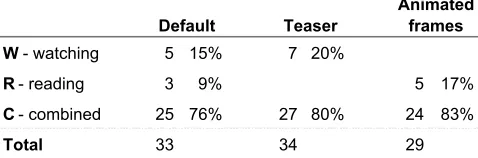
As shown in Table 3 most of participants across all three in-teraction modes demonstrate the ‘combining’ pattern (from 76% to 83%) while Animated Frames is the only condition where the ‘watching’ pattern was not observed. The Table also shows that in the Teaser condition we did not observe
W - watching 5 15% 7 20%
R - reading 3 9% 5 17%
C - combined 25 76% 27 80% 24 83%
Total 33 34 29
Default Teaser
Animated frames
Table 3: Classification of reading patterns based on sequence diagram
Reading 07:30 0 07:30 100%
Default 12:52 08:42 04:10 32.38%
Teaser 08:25 02:48 05:37 66.73%
Animated frames 09:12 02:42 06:30 70.65%
Median time on content (ToC)
Median watching time (WT)
Reading time = ToC - WT
Reading time/ToC
Table 4: Times spent on reading and watching the digital con-tent.
any participants who stopped using the technology (e.g. tech-nology drop-outs). In the Default and Animated Frames con-ditions (AR interface) we observed eight technology drop-outs (3 [9%] and 5 [17%] respectively).
[image:8.612.55.293.99.148.2]Reading Time
Table 4 presents a summary of the interaction time with the comic. The maximum time participants could spend on the comic was limited to 25 minutes. Even though users inter-acted with the comic for the longest in the Default condition (median 12m 52s), they only read for a median of 4m and 10s (33% of the time) as the rest of the time was spent watching digital content (median 8m 42s). The longest reading time was observed in the Animated Frames condition (median 6m 30s [71%]), nevertheless this still falls 1 minute short of the baseline Reading condition (median 7m 30s).
Information Retention
Figure 4: Controlled study reading patterns. For each condition three reading patterns are presented. One row is one user while one dot is 10s of video. Different colours present different augmentations’ interactions and gaps present reading time.
Average score
(of 10 max) 2.9 4 3.41 3.09
Median reading time 3 4 3.5 3
STD 1.45 1.33 1.43 1.3
Animated frames Teaser
Default Reading
Table 5: Results of answering questions about the content of the comic book (10 questions).
User Preference
The questionnaires revealed that users did not consider the length of the digital content as too long for Default, Animated Frames and Teaser conditions. However, only in Teaser (38%) and Animated Frames condition (41%), participants high-lighted that there could be more digital content. This was not expressed as intensely in Default condition (only 20% of participants agreed) with all content duplicated. For all interaction modes participants generally agree that added digital content complements the story rather than duplicates it (Animated Frames condition (90%), Teaser (79%) and De-fault (71%). Surprisingly, only 26% of participants marked the Default condition as a duplicator of the story showing that duplication was better accepted in school study than was an-ticipated based on the outcome of the real world study. Some participants admitted skipping reading due to the digital con-tent: Default (17%), Animated Frames (9%) and Teaser (6%) condition. On contrary, some users expressed the preference for reading although they also watched the augmentations.
Comparing the Real World & Controlled User Study The Default condition from the controlled study served to validate and interpret the results obtained in the real world study. The only difference between the two was the context (e.g. controlled environment of the school vs. uncontrolled ‘in the wild’).
Opened and Viewed Content.The controlled study demon-strates a much higher percent of opened content (92% vs.
53% ‘in-the-wild’) and longer video watching times (medians 7.4 minutes [82%] vs. 5.7 minutes [23%] ‘in-the-wild’).
Frequency of Content Consumption.In controlled study par-ticipants triggered a new video on average every 3.1 minutes (STD 1.24) vs. 2.1 minutes (STD 1.8) ‘in-the-wild’ meaning they spent more time on reading.
Reading Patterns.While the real world study revealed nine different interaction patterns, we observed only three basic patterns in the controlled study and no combination of them. Compared to 36% ‘in the wild‘ in the controlled study only 15% ended in watching interaction pattern. It was observed that while some participants in the controlled study realised that the videos duplicate the story, they did not stop reading.
This all suggests that the context of the school study in-fluenced users since they demonstrated more engagement with both the comic book and digital content.
7 DISCUSSION & CONCLUSION Accessing the Content
The main audience of the comic book in our study is children and this research focuses exclusively on them. As such we cannot generalise the findings outside our target group since different audiences are likely to consume content differently. Despite this, the design factors and augmentation conditions are not limited to a particular audience.
video that directly relates to a particular frame); and (iii) appropriate frequency, and length of the content.
The design decisions had a positive influence on keep-ing readers engaged with printed medium since none of the participants in Animated Frames condition resorted to only watching the video. This conclusion is also supported by reported reading times. Animated Frames condition demon-strated longest reading time (6m 30s) which was only sur-passed by reading only condition (7m 30s). On the other hand, duplication is known to have a positive effect on infor-mation retention [20] and pupils in Default condition scored highest in the questionnaire.
The controlled study also showed that consumer-ready technology we used caused issues. One of the most notable was keeping the augmented frames in camera view because of the short distance between the phone and the comic. While the researchers tried to help children move the comic book further away to capture the augmented content, children pulled it back for reading. We also observed them moving their chair backwards or even standing up to increase the distance between the comic book and the screen. Instead of becoming invisible, the technology became present-at-hand requiring conscious attention from the children [9]. In this respect, the NFC technology was more usable even if sometimes scanning NFC tags was unsuccessful in their first attempt. This observation is also supported by user engagement as none of the users’ in Teaser condition stopped using the technology (3 [9%] in Default and 5 [17%] Animated Frames condition). Other observed technology issues include holding the phones in hands all the time affecting interaction with the book, and problems with headphone’s wires being in the way.
While the initial training helped children to quickly grasp the technology, the comic book offered some false affor-dances. Children were observed to scan frames and pages that were not marked as augmented while some tried to read the whole comic book through the screen in order to not miss any of the augmented content. A notable frame with false affordance was a speech bubble with the music note (see Figure 1) that children thought was augmented even when previously told what marked the augmentation. The false affordance problem is not new to augmented books, showing the gap between expected interaction by designers and ap-plied interaction by children [19]. Designers need to take the balance between constraints, real-world expectations, and previous knowledge the users will apply to interaction [6].
While designing digital augmentation for comic books, au-thors and designers need to find a balance between physical and digital medium. In order to achieve the holistic experi-ence and equal engagement with both mediums (printed and digital) the findings derived from our studies indicate that the experience needs to be carefully designed by: (i) avoiding
or reducing duplication especially when duplication means the reader gets no real benefit from engaging with both medi-ums, (ii) integrating augmented content only if it has high relevance to a particular frame in the comic book, (iii) using appropriate frequency, and length of the augmented content to maintain the interest in both digital and physical medium, and (iv) selecting the technology carefully as it still presents an interaction barrier (e.g. the access method).
Limitations
There are several limitations with our studies that need ex-ploring in future work. First, in the real world study, we did not know the context of use of the comic and so assumed that pauses in between watching digital content were for reading. Asking parental reporting of use in the home would increase the confidence in these reports. Second, the class-room environment, although comfortable for the children, was still more controlled than relaxed reading at home. The children were aware of the researchers (and teachers) watch-ing their progress and so were likely to be more engaged than if left on their own. Finally, as mentioned before, our studies focused solely on children. However, we still believe the study results provide clear insights into the use of the different interaction techniques.
Future Work
Beyond addressing the study limitations, there are several strands of future work we intend to pursue. First, we wish to further examine and study the design space to understand the impact of the remaining design factors not already tested. Second, we wish to confirm how our findings from AR comics generalise to other forms of digitally-augmented print media and other audiences. Finally, more formal studies of reading behaviour (such was with the use of eye-tracking) can char-acterise the reader’s behaviour and provide better measures of engagement and retention with augmented content.
ACKNOWLEDGMENTS
The authors acknowledge the European Commission for funding the InnoRenew CoE project (Grant Agreement 739574) under the Horizon2020 Widespread-Teaming pro-gram and the Republic of Slovenia (Investment funding of the Republic of Slovenia and the European Union of the Eu-ropean regional Development Fund). The research was also supported by Slovenian research agency ARRS (P1–0383 and J1–9186).
REFERENCES
//doi.org/10.1016/j.ijcci.2017.11.005
[2] Hrvoje Benko, Ricardo Jota, and Andrew Wilson. 2012. MirageTable: Freehand Interaction on a Projected Augmented Reality Tabletop. In Proceedings of the SIGCHI Conference on Human Factors in Comput-ing Systems (CHI ’12). ACM, New York, NY, USA, 199–208. https: //doi.org/10.1145/2207676.2207704
[3] M. Billinghurst and A. Duenser. 2012. Augmented Reality in the Classroom. Computer 45, 7 (July 2012), 56–63. https: //doi.org/10.1109/MC.2012.111
[4] Mark Billinghurst and Hirokazu Kato. 2002. Collaborative Aug-mented Reality. Commun. ACM45, 7 (July 2002), 64–70. https: //doi.org/10.1145/514236.514265
[5] M. Billinghurst, H. Kato, and I. Poupyrev. 2001. The MagicBook - moving seamlessly between reality and virtuality. IEEE Com-puter Graphics and Applications 21, 3 (May 2001), 6–8. https: //doi.org/10.1109/38.920621
[6] David J. Chatting. 2008. Action and Reaction for Physical Map Inter-faces. InProceedings of the 2Nd International Conference on Tangible and Embedded Interaction (TEI ’08). ACM, New York, NY, USA, 187–190. https://doi.org/10.1145/1347390.1347432
[7] Kun-Hung Cheng. 2017. Reading an augmented reality book: An exploration of learners’ cognitive load, motivation, and attitudes. Aus-tralasian Journal of Educational Technology33, 4 (2017).
[8] A. Clark and A. Dünser. 2012. An interactive augmented reality color-ing book. In2012 IEEE Symposium on 3D User Interfaces (3DUI). 7–10. https://doi.org/10.1109/3DUI.2012.6184168
[9] Paul Dourish. 2001.Where the action is. MIT press Cambridge. [10] Andreas Dünser and Eva Hornecker. 2007. An Observational Study of
Children Interacting with an Augmented Story Book. InTechnologies for E-Learning and Digital Entertainment, Kin-chuen Hui, Zhigeng Pan, Ronald Chi-kit Chung, Charlie C. L. Wang, Xiaogang Jin, Stefan Göbel, and Eric C.-L. Li (Eds.). Springer Berlin Heidelberg, Berlin, Heidelberg, 305–315.
[11] Andreas Dünser, Lawrence Walker, Heather Horner, and Daniel Bentall. 2012. Creating Interactive Physics Education Books with Augmented Reality. InProceedings of the 24th Australian Computer-Human Inter-action Conference (OzCHI ’12). ACM, New York, NY, USA, 107–114. https://doi.org/10.1145/2414536.2414554
[12] Mark Fiala. 2005. ARTag, a fiducial marker system using digital tech-niques. InComputer Vision and Pattern Recognition, 2005. CVPR 2005. IEEE Computer Society Conference on, Vol. 2. IEEE, 590–596. [13] Hervé Gomez. 2003. Parent and child reading, designing for an
inter-active, dimensional reading experience. InProceedings of Technology for Interactive Digital Storytelling and Entertainment.
[14] Raphael Grasset, Andreas Dunser, and Mark Billinghurst. 2008. The Design of a Mixed-reality Book: Is It Still a Real Book?. InProceedings of the 7th IEEE/ACM International Symposium on Mixed and Augmented Reality (ISMAR ’08). IEEE Computer Society, Washington, DC, USA, 99–102. https://doi.org/10.1109/ISMAR.2008.4637333 [15] Raphaël Grasset, Andreas Dünser, and Mark Billinghurst. 2008.
Edu-tainment with a Mixed Reality Book: A Visually Augmented Illustrative Childrens’ Book. InProceedings of the 2008 International Conference on Advances in Computer Entertainment Technology (ACE ’08). ACM, New York, NY, USA, 292–295. https://doi.org/10.1145/1501750.1501819 [16] Tovi Grossman, Fanny Chevalier, and Rubaiat Habib Kazi. 2016. Bring-ing research articles to life with animated figures. interactions23, 4 (jun 2016), 52–57. https://doi.org/10.1145/2949762
[17] Jens Grubert, Raphaël Grasset, and Gerhard Reitmayr. 2012. Exploring the design of hybrid interfaces for augmented posters in public spaces. InProceedings of the 7th Nordic Conference on Human-Computer Interac-tion Making Sense Through Design - NordiCHI ’12. ACM Press, New York, New York, USA, 238. https://doi.org/10.1145/2399016.2399053
[18] Taejin Ha, Youngho Lee, and Woontack Woo. 2011. Digilog Book for Temple Bell Tolling Experience Based on Interactive Aug-mented Reality. Virtual Real.15, 4 (Nov. 2011), 295–309. https: //doi.org/10.1007/s10055-010-0164-8
[19] Eva Hornecker. 2012. Beyond Affordance: Tangibles’ Hybrid Nature. In Proceedings of the Sixth International Conference on Tangible, Embedded and Embodied Interaction (TEI ’12). ACM, New York, NY, USA, 175–182. https://doi.org/10.1145/2148131.2148168
[20] Jeffrey D. Karpicke and Henry L. Roediger. 2007. Repeated re-trieval during learning is the key to long-term retention. Jour-nal of Memory and Language57, 2 (2007), 151 – 162. https: //doi.org/10.1016/j.jml.2006.09.004
[21] Hannes Kaufmann and Dieter Schmalstieg. 2002. Mathemat-ics and Geometry Education with Collaborative Augmented Re-ality. InACM SIGGRAPH 2002 Conference Abstracts and Applica-tions (SIGGRAPH ’02). ACM, New York, NY, USA, 37–41. https: //doi.org/10.1145/1242073.1242086
[22] Lucinda Kerawalla, Rosemary Luckin, Simon Seljeflot, and Adrian Woolard. 2006. “Making it real”: exploring the potential of augmented reality for teaching primary school science.Virtual Reality10, 3 (01 Dec 2006), 163–174. https://doi.org/10.1007/s10055-006-0036-4 [23] K. Kim, M. Billinghurst, G. Bruder, H. B. Duh, and G. F. Welch. 2018. Revisiting Trends in Augmented Reality Research: A Re-view of the 2nd Decade of ISMAR (2008–2017). IEEE Transac-tions on Visualization and Computer Graphics(2018), 1–1. https: //doi.org/10.1109/TVCG.2018.2868591
[24] T. G. Kirner, F. M. V. Reis, and C. Kirner. 2012. Development of an interactive book with Augmented Reality for teaching and learning geometric shapes. In7th Iberian Conference on Information Systems and Technologies (CISTI 2012). 1–6.
[25] Eric Klopfer and Susan Yoon. 2005. Developing games and simulations for today and tomorrow’s tech savvy youth.TechTrends49, 3 (01 May 2005), 33–41. https://doi.org/10.1007/BF02763645
[26] Gun A. Lee, Ungyeon Yang, Yongwan Kim, Dongsik Jo, Ki-Hong Kim, Jae Ha Kim, and Jin Sung Choi. 2009. Freeze-Set-Go interac-tion method for handheld mobile augmented reality environments. In Proceedings of the 16th ACM Symposium on Virtual Reality Software and Technology - VRST ’09. ACM Press, New York, New York, USA, 143. https://doi.org/10.1145/1643928.1643961
[27] S. Magnenat, D. T. Ngo, F. Zünd, M. Ryffel, G. Noris, G. Rothlin, A. Marra, M. Nitti, P. Fua, M. Gross, and R. W. Sumner. 2015. Live Textur-ing of Augmented Reality Characters from Colored DrawTextur-ings.IEEE Transactions on Visualization and Computer Graphics21, 11 (Nov 2015), 1201–1210. https://doi.org/10.1109/TVCG.2015.2459871 [28] Catherine C Marshall. 2005. Reading and interactivity in the digital
library: Creating an experience that transcends paper. InProceedings of CLIR/Kanazawa institute of technology roundtable, Vol. 5. Citeseer, 1–20.
[29] Jorge Martín-Gutiérrez, José Luís Saorín, Manuel Contero, Mariano Alcañiz, David C. Pérez-López, and Mario Ortega. 2010. Design and validation of an augmented book for spatial abilities development in engineering students. Computers & Graphics34, 1 (2010), 77 – 91. https://doi.org/10.1016/j.cag.2009.11.003
[30] John V. Pavlik and Frank Bridges. 2013. The Emergence of Augmented Reality (AR) as a Storytelling Medium in Jour-nalism. Journalism & Communication Monographs 15, 1 (2013), 4–59. https://doi.org/10.1177/1522637912470819 arXiv:https://doi.org/10.1177/1522637912470819
2018.
[32] J. Rekimoto. 1998. Matrix: a realtime object identification and reg-istration method for augmented reality. InProceedings. 3rd Asia Pa-cific Computer Human Interaction (Cat. No.98EX110). 63–68. https: //doi.org/10.1109/APCHI.1998.704151
[33] Camille Scherrer, Julien Pilet, Pascal Fua, and Vincent Lepetit. 2008. The Haunted Book. In Proceedings of the 7th IEEE/ACM Interna-tional Symposium on Mixed and Augmented Reality (ISMAR ’08). IEEE Computer Society, Washington, DC, USA, 163–164. https: //doi.org/10.1109/ISMAR.2008.4637347
[34] Brett E Shelton and Nicholas R Hedley. 2002. Using augmented real-ity for teaching earth-sun relationships to undergraduate geography students. InAugmented Reality Toolkit, The First IEEE International Workshop, Vol. 8. IEEE.
[35] Brett E Shelton and Nicholas R Hedley. 2004. Exploring a cognitive basis for learning spatial relationships with augmented reality. Tech-nology, Instruction, Cognition and Learning1, 4 (2004), 323.
[36] A. K. Sin and H. B. Zaman. 2010. Live Solar System (LSS): Eval-uation of an Augmented Reality book-based educational tool. In 2010 International Symposium on Information Technology, Vol. 1. 1– 6. https://doi.org/10.1109/ITSIM.2010.5561320
[37] Siddharth Singh, Adrian David Cheok, Guo Loong Ng, and Farzam Far-biz. 2004. 3D Augmented Reality Comic Book and Notes for Children Using Mobile Phones. InProceedings of the 2004 Conference on Interac-tion Design and Children: Building a Community (IDC ’04). ACM, New York, NY, USA, 149–150. https://doi.org/10.1145/1017833.1017864 [38] Thad Starner, Steve Mann, Bradley Rhodes, Jeffrey Levine, Jennifer Healey, Dana Kirsch, Rosalind W Picard, and Alex Pentland. 1997. Aug-mented reality through wearable computing.Presence: Teleoperators & Virtual Environments6, 4 (1997), 386–398.
[39] Nobuko Taketa, Kenichi Hayashi, Hirokazu Kato, and Shogo Noshida. 2007. Virtual Pop-Up Book Based on Augmented Reality. InHuman Interface and the Management of Information. Interacting in Information Environments, Michael J. Smith and Gavriel Salvendy (Eds.). Springer Berlin Heidelberg, Berlin, Heidelberg, 475–484.
[40] Klen Čopič Pucihar, Paul Coulton, and Jason Alexander. 2013. Eval-uating Dual-view Perceptual Issues in Handheld Augmented Re-ality: Device vs. User Perspective Rendering. In Proceedings of
the 15th ACM on International Conference on Multimodal Inter-action (ICMI ’13). ACM, New York, NY, USA, 381–388. https: //doi.org/10.1145/2522848.2522885
[41] Klen Čopič Pucihar, Paul Coulton, and Jason Alexander. 2014. The Use of Surrounding Visual Context in Handheld AR: Device vs. User Perspective Rendering. InProceedings of the SIGCHI Conference on Human Factors in Computing Systems (CHI ’14). ACM, New York, NY, USA, 197–206. https://doi.org/10.1145/2556288.2557125 [42] R. Want. 2011. Near Field Communication.IEEE Pervasive Computing
10 (07 2011), 4–7. https://doi.org/10.1109/MPRV.2011.55 [43] Cathy Weng, Abirami Rathinasabapathi, Apollo Weng, and Cindy
Zagita. First Published March 15, 2018. Mixed Reality in Science Education as a Learning Support: A Revitalized Science Book.Journal of Educational Computing Research(First Published March 15, 2018), 0735633118757017. https://doi.org/10.1177/0735633118757017 arXiv:https://doi.org/10.1177/0735633118757017
[44] Karl D. D. Willis, Takaaki Shiratori, and Moshe Mahler. 2013. HideOut: Mobile Projector Interaction with Tangible Objects and Surfaces. In Proceedings of the 7th International Conference on Tangible, Embedded and Embodied Interaction (TEI ’13). ACM, New York, NY, USA, 331–338. https://doi.org/10.1145/2460625.2460682
[45] Steve Chi-Yin Yuen, Gallayanee Yaoyuneyong, and Erik Johnson. 2011. Augmented reality: An overview and five directions for AR in educa-tion.Journal of Educational Technology Development and Exchange (JETDE)4, 1 (2011), 11.
[46] Feng Zhou, Henry Been-Lirn Duh, and Mark Billinghurst. 2008. Trends in Augmented Reality Tracking, Interaction and Display: A Review of Ten Years of ISMAR. InProceedings of the 7th IEEE/ACM Inter-national Symposium on Mixed and Augmented Reality (ISMAR ’08). IEEE Computer Society, Washington, DC, USA, 193–202. https: //doi.org/10.1109/ISMAR.2008.4637362