Last Planner System
Harsh Shah
1, Karan Asnani
2, Rishabh Shah
3, Aliasgar Chasmawala
41,2,3,4
Post Graduate Student, National Institute of Construction Management and Research, Pune, India.
---***---Abstract : The paper presents the set of information on the particular measures of the Last Planner System (LPS) of Production Control. Then, the system as a whole is described in construction application and the process of last planner system. Paper includescomparison between LPS and traditional project control model (Critical Path Method).
Keywords: Last Planner System, Critical path method, Percent plan complete (PPC), Project Management,
1. INTRODUCTION
Planning and Scheduling is the back-bone for any Construction Project as execution is purely based on the planning and scheduling. If Planning and Scheduling is done haphazardly then execution of the project will be affected and the project would observe time overrun and consecutive cost overrun. Critical Path Method (CPM) and Program Evaluation and Review Technique (PERT) are being used for planning and scheduling in the construction industry since last 5 decades. Over the period of time, certain limitations of CPM and PERT was observed. Though the network representation in CPM and PERT is an integral part of Project, Last Planner System aids in better clarity about the work on executional basis. Last Planner System (LPS) was developed to increase the effectiveness of planning and control by making programs more predictable, thereby improving the chances of delivering them on time.
1.1 Last Planner Theory
In 1993 Ballard introduced Last Planner System based upon studies on how to improve progress in weekly work plans or plans and how to control the work flow of design and various construction projects.
In traditional project management system it talks about what should be done according to master plan. In 2000, Ballade looked forward to schedule that involves the following.
I. Identify the Work Packages that can be completed in the following work period.
II. Consulting with stake holders in order to complete the work within the time constraint so that procurement of materials and equipment will be assigned for the task in the particular week.
III. Identify the work that cannot be completed for the upcoming week as required.
IV. Create a set of activities that are going to be completed prior to delivery of the assigned work.
V. The look forward work for the next 5-10 weeks, depending upon the type of project, it impacts when applied in the Last Planner System.
1.2 Last Planner system in Construction
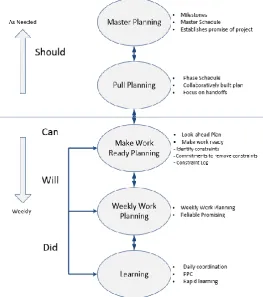
Fig – 1: Last Planner Diagram
[image:2.595.166.430.386.684.2]LPS is a system for project production planning and control to achieve reliable execution by creating a better work flow. It integrates (Should-Can-Will-Do planning). It’s a perfect solution for the construction and the design process, that enables the project managers to improve the quality in accordance of satisfying clients and owner’s needs.
Fig. 2: Creating and maintaining reliable work flow
2. Advantages of Last Planner System
To deliver the projects more safely.
Further betterment to control the cost in the project.
It reduces Stress in the Project Management Staff.
To help to make the project more reliable customer for JUST, IN TIME deliverables.
It works in a way that CPM doesn’t.
3. Application of Last Planner System / Process of Last Planner System
Last Planner System is the tool that connects the lean management and the construction industry.
In today’s dynamic environment we find different production variables, so it is important how we can plan and control the project efficiently. The answer of this question is given by Ballard and Howell in last planner system theory.
The last planner system is applied in five distinct phases.
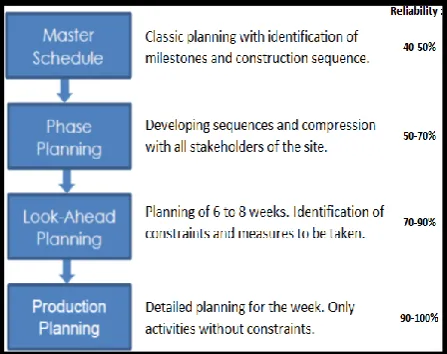
I. Master Schedule (What Should Occur):- It is a mixture of knowledge and Gantt Bar Chart. It is prepared by supervising team of the project.
INPUT OUTPUT Min. Collaboration
Previous Week’s
Schedule Updates Secure Ahead Milestone Look-Planning (4-6 weeks out)
Owner, Designer, General Contractor
100% Accurate
Set Start Dates Ability predictably see to into the future what work needs to be done.
CM (CCMS), Builder
Effective change
control Set the stage for effective pull planning
II. Pull Planning (What Should Occur):- It is prepared to achieve milestones collaboratively. Ideally while developing a phase schedule all the stakeholders should be present.
INPUT OUTPUT Min. Collaboration
Accurate Milestone Schedule (from 4-6 week look-ahead schedule)
Collaboratively built plan that all team members have agreed to
Owner, Designer, General Contractor, CM (CCMS), Builder Segmentation of
work coming in the next 6 weeks
Micro schedule in MSP, P6 or Excel that can effectively be used to assign work and monitor daily/weekly progress Constraint
III. Look Ahead Planning (What can Occur):- All the participants of the project report the progress of assigned area in order to plan for the future.
INPUT OUTPUT Min. Collaboration
6 week-ahead schedule of what work is supposed to be done in the near future
Constraint log is the key output of the Make Ready Plan.
Production Team: Superintendent, Foremen, Project Manager, Direct Project Support Personnel
Six week slice of your overall planning; now focusing
progressively more on the week directly in front of the team. Any necessary schedule revisions (last resort) Confirmation that your pull plan intact.
IV. Production Planning (What will Occur):- It is a fixed daily plan, which is prepared on weekly basis. Once a week each last planner is decided to prepare the work they can perform in coming week.
INPUT OUTPUT Min. Collaboration
Best if held at or as close to the actual work as possible without interrupting the production workers.
Team member
involvement Production Superintendent, Team: Foremen, Project Manager, Direct Project Support Personnel
Raise any issues that might prevent
completion of a task assignment.
Continuous improvement
Compare daily progress to what was in the WWP for that particular day.
Open
communication
V. Percent plan complete-PPC(What did occur):- This is another key feature of the LPS, which tracks what is known as percent plan complete. It is calculated by dividing the number of completed assignments (what “did” get done) by the total number of assignments each week (what was projected “will” get done).
PPC = (Work done / Work Completed)* 100%
INPUT OUTPUT Min. Collaboration
Determine what assignments
Ability to gauge the reliability of the planning
were
completed or not based on the plan.
system. Manager, Direct Project Support Personnel
Reasons for failure to complete planned work (the most important input)
Weekly analysis of PPC results in identifying reasons for the disruption or work.
Focus is on process improvement
Systematic learning shared at the point of work
The meeting should be done in three phases.
I. In the last day of week meeting should be done by analyzing the facts and progress with comparison to previous week planning
II. Each participant will discuss about the work in following week.
III. Every project staff will attend this meeting and identify the problems one week in advance in order to deliver it on time.
Research studies talks on reliability of this method
It is easy to reach a reliability level of more than 70% by implementing last planner system.
[image:5.595.182.406.459.636.2] By the look ahead schedules it is possible to achieve much high reliability.
Fig. 3: Process of Last planner system
4. Critical Path Method V/S Last Planner System
In CPM there is no way to determine which activity indeed can be determined.
As per research 60% Project in UK and 70% Projects in US are running late as per the schedule.
Sr. CPM LPS
1 Logic is Embedded in
3 Managing Critical Path Managing Variability 4 Focus on Managing Work
dates Focus on Managing Work Flow 5 Planning based on
contracts Planning interdependencies based on
5. Stakeholders involved in Last Planner System
Stakeholders can be defined as: (1) who are actively directly or indirectly involved in the Project. (2) Has interest that may be positively or negatively affected by the performance till the completion of the Project. (3) That might exert influence either it’s deliverable or Team members.
Different Stakeholders that involves in Last planner System Environment are:
1. Project Crew members
2. Foreman, Supervisors
3. Construction coordination Management services (CCMS, Construction coordinators, Project Engineers)
4. Project Manager
5. Project Implementation team (PIT)
6. Third-Party support
7. Tool Owner (TO)
8. System Owner (SO)
9. Tool Supplier (Vendor)
10. Site management team
11. Enterprise leadership steering committee (ELSC)
6. Conclusion
The biggest disadvantage of CPM, comparing to the LPS is that in the first method, there is no way to determine which activities indeed can be done. The survey of Alan Mossman showed that as many as 66% UK projects in 2013 and 70% US projects in 2012 based on CPM were delivered late. According to the research of LPS developers, the following weak points of the Critical Path Method have been observed: all plans are forecasts; all forecasts are wrong, the longer the forecast, the more wrong it becomes, the more detailed the forecast, the more wrong it is. On the contrary, the Last Planner System applies the common sense in planning and focuses on the smooth work flow as well as takes into account the independencies between activities. This way, it helps to move from push to pull system and supports logistics planning involving much more just than the due dates and the sequence of prior tasks.
The LPS is a method combining many tools already known and used in the industry, as it allows the MRP II to implement the Lean philosophy for shipbuilding. Nevertheless, a major element differentiates the MRP and LPS: LPS is perfectly adapted to a dynamic environment. “Classic” tools remain the basis of the methods developed for Lean Construction: the real innovation comes fromthe adaptation of these tools to a perpetually changing construction environment.
REFERENCES
1. Ballard, G., "Look-ahead Planning the missing link in production control".
2. A. Mossman, Last Planner®: 5+ 1 crucial & collaborative conversations for predictable design & construction delivery. The Change Business Ltd., UK, 26 (2013).
4. G. Ballard, G. Howell, Implementing lean construction: improving downstream performance. Lean construction, 111-125 (1997).
5. Kim Y. and Jang, J. (2005) Case study: Application of Last Planner to heavy civil construction.
BIOGRAPHIES
Pursuing Post Graduate in Advanced Construction Management from NICMAR (PUNE), having a year experience in Real estate industry with skillset of Primavera and MSP.
Pursuing Post Graduate in Advanced Construction Management from NICMAR (PUNE), having a technical skills in AutoCAD.
Pursuing Post Graduate in Advanced Construction Management from NICMAR (PUNE) having technical skills in AutoCAD and MSP.