A NEW ICI CANCELLATION SCHEME AND PERFORMANCE ANALYSIS OF BIT ERROR RATE FOR
1
II M.E Communication
2
II M.E Communication Systems, DMI College of Engineering, Chennai
ARTICLE INFO ABSTRACT
A joint design of sphere decoding and (MIMO) orthogonal frequency
inter-carrier interference canceller (PPIC) based on factor graph based soft self
in wireless multipath channels for high speed wireless transmission is proposed. This algorithm can suppress inter
progressively. With a proper designed message passing schedule
cycle problem is solved. The proposed PPIC is superior to PIC both in computational complexity and system architecture. It is very suitable for VLSI implementation and it is a potential candidate for data detection/decod
analysis and design optimization of low density parity check (LDPC) coded multipleinput output (MIMO) orthogonal frequency
wireless transmission.
INTRODUCTION
MIMO OFDM is the corner stone of future broadband wireless access .Wide band transmission with high spectral efficiency and high mobility is required for future mobile radio communications. In a MIMO system, as data are transmitted/received through different antennas, many channel impairments need to be dealt with, such as multipath fading, AWGN noise, inter-antenna interference etc. To deal with these channel impairments, many types of MIMO detectors such as MAP detector [1], sphere decoder [2], MMSE detector [1], [3], etc. have been proposed. For OFDM systems, the transmission bandwidth is divided into many narrow subchannels, which are transmitted in parallel. Channel variations during one OFDM symbol leads to loss of subchannel orthogonality known as Inter Sub
Interference (ICI) which degrades the performance, since IC1 can be seen as additional near-Gaussian noise . As delay spread increases, symbol duration should also increase in order to maintain a nearly flat channel in every frequency subband. As a result, the ICI effect becomes more severe as mobile speed, carrier frequency, and OFDM symbol duration increases. If it is not compensated, ICI will result in performance loss and an error floor that increases with Doppler frequency. In some circumstances, the ICI effect may degrade the BER performance significantly [4]
[10], the well-known ICI self-cancellation scheme is proposed. By appropriately mapping symbols to a group of subcarriers,
*Corresponding author:[email protected], [email protected],
ISSN: 0975-833X
Article History:
Received 28th February, 2012
Received in revised form 25th March, 2012
Accepted 19th April, 2012
Published online 30th May, 2012
Key words: MIMO-OFDM, ICI cancellation,
Message passing, factor graph, Channel estimation error, LDPC codes.
RESEARCH ARTICLE
A NEW ICI CANCELLATION SCHEME AND PERFORMANCE ANALYSIS OF BIT ERROR RATE FOR
MIMO-OFDM BASED SYSTEMS
1
Arun, S. and
2Juliet Mercy, S.
II M.E Communication Systems, S.A Engineering College, Chennai
II M.E Communication Systems, DMI College of Engineering, Chennai
ABSTRACT
A joint design of sphere decoding and synchronization algorithms for multiple
(MIMO) orthogonal frequency-division multiplexing (OFDM) systems with progressive parallel carrier interference canceller (PPIC) based on factor graph based soft self
in wireless multipath channels for high speed wireless transmission is proposed. This algorithm can suppress inter-antenna interferences and cancel inter-carrier interferences iteratively and progressively. With a proper designed message passing schedule
cycle problem is solved. The proposed PPIC is superior to PIC both in computational complexity and system architecture. It is very suitable for VLSI implementation and it is a potential candidate for data detection/decoding in future high data rate, and high mobility, We consider the performance analysis and design optimization of low density parity check (LDPC) coded multipleinput
output (MIMO) orthogonal frequency-division multiplexing (OFDM) systems for high wireless transmission.
Copy Right, IJCR, 2012, Academic Journals
is the corner stone of future broadband wireless access .Wide band transmission with high spectral efficiency and high mobility is required for future mobile radio communications. In a MIMO system, as data are nnas, many channel impairments need to be dealt with, such as multipath fading, antenna interference etc. To deal with these channel impairments, many types of MIMO detectors such as MAP detector [1], sphere decoder [2], MMSE-SIC [1], [3], etc. have been proposed. For OFDM-based systems, the transmission bandwidth is divided into many narrow subchannels, which are transmitted in parallel. Channel variations during one OFDM symbol leads to loss of Inter Sub- Carrier Interference (ICI) which degrades the performance, since IC1 Gaussian noise . As delay spread increases, symbol duration should also increase in order to maintain a nearly flat channel in every frequency subband. As a result, the ICI effect becomes more severe as mobile speed, carrier frequency, and OFDM symbol duration increases. If it is not compensated, ICI will result in performance loss and an error floor that increases with In some circumstances, the ICI effect may degrade the BER performance significantly [4]–[6]. In [9] and cancellation scheme is proposed. By appropriately mapping symbols to a group of subcarriers,
the proposed algorithm in [9] makes OFDM transmissions less sensitive to the ICI at the cost of much lower bandwidth efficiency. In [11], it is shown that ICI power comes ma from 12 neighboring subcarriers and based on this observation a low-complexity MMSE equalizer is proposed. Yet, as the MMSE equalizer still exhibits an error floor on BER, a low complexity decision feedback equalizer (DFE) is proposed in [11] .
ICI reduction method is proposed based on a sphere decoding (SD) algorithm. By considering channel information, a new search strategy is developed to reduce the computational complexity of the SD algorithm.In recent years, the message passing data detector/decoder catches the attention of many researchers. One appealing practical aspect of the message passing data detector/decoder is due to that it consists of many small, independent detection/ decoding functions to deal with channel impairments. Hardware could
according to these independent detectors/decoders and operated in parallel, and it potentially leads to a very speed detector/decoder. This aspect is particularly important in data transmissions where data rate requirements are high, a processing delay must be low [14]. some researchers pointed out that message passing algorithms can be realized with simple analog transistor circuits. The attraction of such analog detector/decoder comes from the fact that the iteration operation is actually the transient response
passing algorithm on factor graphs is the
algorithm, which efficiently computes all the marginals of the
International Journal of Current Research
Vol. 4, Issue, 05, pp.187-191, May,2012
INTERNATIONAL
A NEW ICI CANCELLATION SCHEME AND PERFORMANCE ANALYSIS OF BIT ERROR RATE FOR
Systems, S.A Engineering College, Chennai
II M.E Communication Systems, DMI College of Engineering, Chennai
synchronization algorithms for multiple-input–multiple-output division multiplexing (OFDM) systems with progressive parallel carrier interference canceller (PPIC) based on factor graph based soft self-iterative equalization in wireless multipath channels for high speed wireless transmission is proposed. This algorithm can carrier interferences iteratively and progressively. With a proper designed message passing schedule and random interleaver, the short cycle problem is solved. The proposed PPIC is superior to PIC both in computational complexity and system architecture. It is very suitable for VLSI implementation and it is a potential candidate for ing in future high data rate, and high mobility, We consider the performance analysis and design optimization of low density parity check (LDPC) coded multipleinput-
multiple-division multiplexing (OFDM) systems for high speed
, Academic Journals. All rights reserved.
the proposed algorithm in [9] makes OFDM transmissions less sensitive to the ICI at the cost of much lower bandwidth efficiency. In [11], it is shown that ICI power comes mainly from 12 neighboring subcarriers and based on this observation complexity MMSE equalizer is proposed. Yet, as the MMSE equalizer still exhibits an error floor on BER, a low-complexity decision feedback equalizer (DFE) is proposed in
individual variables of the function.Based on Factor Graph ,a joint design of message passing MIMO data detector/decoder with a progressive parallel intercarrier interference canceller (PPIC) for OFDM based wireless communication systems is proposed in this paper.
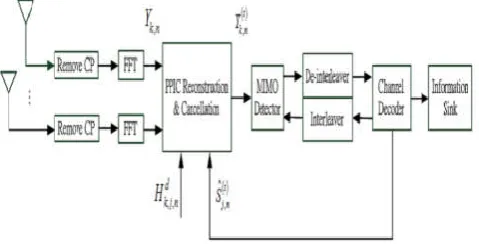
Fig. 1. Block diagram of the proposed message passing data detection/decoding and ICI cancellation scheme
The message type chosen in this work is log-likelihood ratio (LLR) of bit probabilities for the MIMO data detector/decoder and soft data symbols for the PPIC ICI canceller. The proposed algorithm detects the transmitted data iteratively, by jointly dealing with channel fading effects, AWGN noise and interferences in time domain, frequency domain and space domain. With the insertion of cyclic prefix in OFDM, the time domain ISI can be avoided. With the message passing MIMO detector (denoted as MPD in the following sections), the space domain interantenna interference can be suppressed and with the aid of PPIC, the frequency domain ICI can be cancelled. The computational complexity of the proposed PPIC architecture is relatively lower than the standard PIC architecture. The system architecture is also simpler and more suitable for the VLSI implementation. This paper is organized as follows: section II defines the system model of a wireless MIMO-OFDM communication system with ICI effects. The proposed message passing algorithm for LDPC-coded MIMO-OFDM systems is derived in section III. The Progressive PIC architecture is depicted in section IV. In section V, we discuss the schedule of message passing and the method to use interleaving to deal with the short-cycle problem. Section VI
discusses the computational complexity and system
architecture of the proposed algorithm. Simulation results of BER performance are given in section VII, and finally, in section VIII we conclude this paper.
SYSTEM MODEL
The channel state information (CSI) refers to known channel properties of a communication link. The CSI makes it possible to adapt transmissions to current channel conditions, which is crucial for achieving reliable communication with high data rates in multiantenna systems.Here,We assume perfect timing synchronization and both perfect and imperfect channel
estimation in an OFDM-based wireless MIMO
communication system with transmit and receive
antennas. The transmitted time domain signal can be represented by the following equation:
, =
1
, (1)
Where Nc is the FFT size,Sj,ithe symbol transmitted on the ℎ antenna and th subcarrier and belonging to the constellation with size ∣ ∣ = 2m, is the modulation order, S j,i is the
th
sample of the time domain signal transmitted on the th antenna. The cyclic prefix vector can be represented as:
, ( ) = , (2)
The th sample of the received time domain signal at the th antenna can be derived as:
, = ℎ , ,
( )
,(( )) + , (3)
Then, the ICI channel coefficients in the frequency domain can be reformulated as:
, , ( )
= ∑ ( )
( )
(4)
, , ( )
= 1 ℎ( ), ,
= ℎ , , (5)
where , = 0∼ −1, ℎave , , is average of the ℎ channel tap over the useful time duration of an OFDM symbol. Without loss of generality, in the following sections, only the
th
subcarrier of the MIMO-OFDM receiver is considered.
MESSAGE PASSING ALGORITHM AND LDPC
DECODER
A. Message Passing MIMO Detector (MPD)
Without consideration of PPIC , to describe the function of an MPD for a MIMO-OFDM receiver, first, a factor graph for the 2×2 MIMO flat fading channel with QPSK modulation is constructed . The messages passed between variables are log-likelihood ratios of bit probabilities, = ln[ ( = 0)/ ( = 1)]. The transmit variable , defined as bit node on the factor graph, and the receive variable ,, defined as channel node on the factor graph, generate messages using sum-product rule
[15]. Let b represent bits ( 0, ..., ( −1)) . The message
generated by , and passed to , called ( → ) is
( → )= ln
∑ : , ∗ [∑ , , ( → )]
∑ : , ∗ [∑ , , ( → )]
(6)
where ( , ∣b) is Gaussian distributed,7 and ( → ) is the
extrinsic information. Similarly, the term ( → ) in (9) is the message generated by and passed to ,. This message is given by
( → )= , + ∑ , ( → ) (7)
where , = ln[ ( = 0)/ ( = 1)] and ( ) denotes the
- probability of the transmitted bit . Finally, the decision variable, soft decision and hard decision for the ℎ
bit are given in (8), (9) and (10), respectively:
= tanh (0.5. , ) (9)
= 0, , ≥ 0
1, ℎ (10)
A. LDPC Decoder
The message passing algorithm is also used to decode the LDPC code . The messages generated at the th code bit node and passed to the ℎ check nodes are calculated as:
( → ) ∑ ( → ) (11)
The messages generated at the ℎ check node and passed
to the th code bit nodes are calculated as:
( → ) ∏́ , ́ ( ( ́ → )). ∅(∑́ , ́ ∅( ( ́ → ))))
(12) .
where ( ) = −log[tanh( /2)] = log[( + 1)/( − 1)] and
is the row weight of parity check matrix.
IV. MESSAGE PASSING SCHEDULE AND INTERLEAVING
The short cycle problem degrades the BER performance which tends to improve very slowly with the number of iterations, even at very high SNR [14], [17].With message passing algorithms,a cycle free factor graph guarantees an exact solution.The received frequency domain signals are fed forward to PPIC ICI canceller first. After the ICI cancellation, the signal are fed forward to MPD and then to LDPC decoder. As illustrated in Fig. 2 the factor graph of the PPIC canceller has no cycle, however, that of the MIMO detector and LDPC decoder has a lot of short cycles. In this paper, a properly designed frequency domain random interleaver has been used with LDPC code to solve this problem and to improve the system performance.The design criterion is that the coded bits in the same codeword have to be sent to different subcarriers after interleaving. Then, with a properly designed message passing schedule, the bit information is passed both in the space domain and the frequency domain. In this way, the short cycle problem is solved. In summary, seven steps are included in the message passing schedule.
1. The estimated soft data symbols, which are fed back
from LDPC decoder, are exchanged between adjacent subcarrier nodes .
2. The ICI are reconstructed and cancelled from the
received signals and then the ICI cancelled signals are fed forward to the MPD .
3. After the bit messages ( → ) are generated by using
(9) by the channel nodes at every subcarrier, these messages are passed to bit nodes.
4. After the messages ( → ) are generated by using
(14) and de-interleaved, these messages are passed to code bit nodes and then passed to check nodes of every LDPC decoder. Messages generated in a subcarrier are sent to different LDPC decoders.
5. The messages ( → ) generated by check nodes
using (15) are passed to code bit nodes and then
interleaved. The messages generated by every coded bit node of the same LDPC decoder are sent to bit nodes which belong to different subcarriers.
6. The messages ( → )are generated by bit nodes using
(11) and then, passed to channel nodes.
7. Finally, the soft decision of data bits and data symbols are obtained by using (9) and then fed back to the PPIC canceller . By iterative detection, decoding and progressive ICI cancellation, the system performance can be jointly optimized.
V. COMPLEXITY
The order of computational complexity of the proposed MPD
is { 2 }. It is feasible when , , and are
[image:3.595.327.533.273.374.2]small. In a fading channel, the channel gains vary with time; hence the value of the information passed along the edges of the factor graph also varies with time.
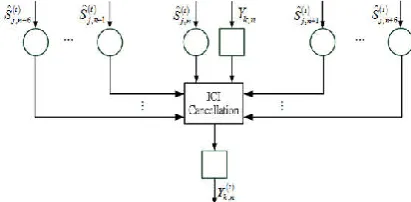
Fig. 2. An architecture of PIC ICI canceller.
The edges with low importance, which is corresponding to the deep-faded channel gain, can be ignored. Since the number of edges of the factor graph is reduced, the computational complexity of the proposed algorithm is also reduced. For PPIC ICI canceller, The computational complexity is in the
order of {( + )}. As the iterative process goes due to
the progressive architecture, the computational complexity of each iteration of PPIC monotonically increases. This is different from the standard PIC architecture which has constant computational complexity in each iteration. Overall, the computation complexity of PPIC is lower than PIC.e The system architecture of PPIC is also much simpler Based on factor graph, the parallel structure of the proposed message passing MIMO data detector/decoder with PPIC ICI canceller is very suitable for VLSI implementation, especially for high speed analog detector/decoder where the iteration operation is actually a transient response and the high demand of computational complexity can be released.
VI.SIMULATION RESULTS OF BER PERFORMANCE
The BER performance of the proposed message passing algorithm on factor graph for data detection/decoding and ICI cancellation in bit-interleaved LDPC-coded MIMO-OFDM
systems are simulated with = = 2 and QPSK
modulation. Gallager code with codeword length 20 is used. The dimension of the parity check matrix of Gallager code is
15×20 with row weight = 4 and column weight = 3
Fig. 3. With interleaving vs. without interleaving.
In the case of imperfect channel estimation, two different models are used to model the variance of channel estimation
error: a) 2 is independent of the SNR. b) 2 is a
decreasing function of SNR [30], [31]. The carrier frequency is 2.5 GHz, bandwidth is 10 MHz, sampling frequency is 11.2MHz, subcarrier spacing is 10.93 kHz, useful OFDM symbol duration is 91.43 s and the length of cyclic prefix is 1/8 [32]. The vehicular speeds are 350 km/h which are corresponding to maximum Doppler frequency 810 Hz and normalized Doppler frequency 0.07. The performances of the proposed algorithm with interleaving and without interleaving are compared in Fig. 3.
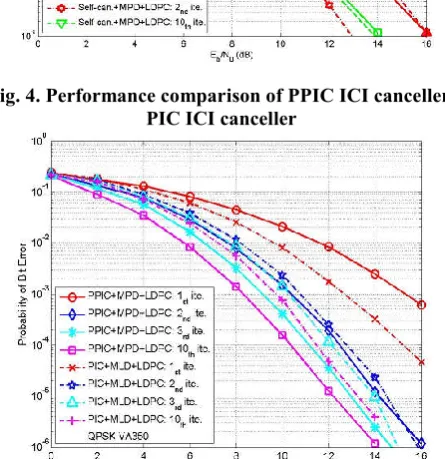
[image:4.595.309.553.54.242.2]Fig. 4. Performance comparison of PPIC ICI canceller, PIC ICI canceller
[image:4.595.52.271.389.550.2]Fig. 5. PPIC+MPD+LDPC vs. PIC+MLD+LDPC.
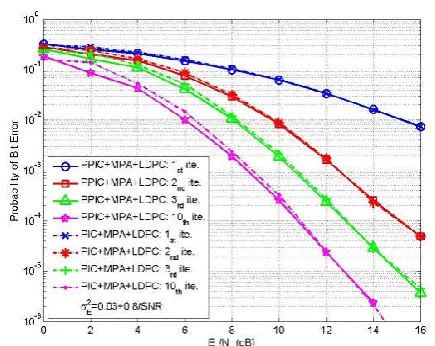
Fig. 6. Imperfect channel estimation: PPIC+MPD+LDPC.
It is obvious that the system performance is not improved with LDPC code without interleaving. This is because the cycle condition of the coded case is more serious than the uncoded case as the cycles not only exist in the space domain but also in the frequency domain. In order to optimize the system performance and deal with the short cycle problem, an -random interleaver is used after the LDPC encoding. The performance comparison of MPD and MMSE-SIC is shown in
Fig. 6.When the / 0 is smaller than 12 dB, the performance
of MPD and MMSE-SIC are almost the same. However, when
the / 0 is larger than 12 dB, MPD outperforms
MMSE-SIC. When the BER is 10−5, the performance of MPD is 1∼2
dB better than MMSE-SIC at the 2 and 3 iteration.
MMSE-SIC still has an error floor when the / 0 is larger than 12 dB. In Fig. 4, the performance of PPIC ICI canceller is compared with a standard PIC ICI canceller, which cancels 12 adjacent interfering subcarriers at every iteration, and an ICI Self-canceller.
The performances of PPIC ICI canceller and PIC ICI canceller are almost the same. Before the 6 ℎ iteration, although the PIC ICI canceller cancels more interfering subcarriers than PPIC ICI canceller, it does not outperform PPIC ICI canceller. The reason is that if the estimated data symbols are not accurate enough, the ICI may be increased instead of reduced after cancellation. For the ICI self-cancellation, a data pair ( ,− ) is modulated onto two adjacent subcarriers where is a complex data symbol. The ICI generated within a group can be self-cancelled on each other. The performance of ICI self-canceller is 2∼3 dB better than PPIC ICI canceller at the price of half bandwidth efficiency. In Fig. 5, the performance of MPD is compared with maximum likelihood MIMO detector (denoted as MLD). It is obvious that PIC+MLD+LDPC performs better
in the 1 iteration. However, after the 2 iteration,
PPIC+MPD+LDPC performs better. This is because MPD can
exploit the fed back - information to approach the
maximum - (MAP) solution but MLD only can
approach the ML solution. The performance of the proposed algorithm with imperfect channel estimation is shown in Fig. 6. The variances of channel estimation error are 0.01, 0.1 and
[image:4.595.51.274.521.751.2]Fig. 7. Imperfect channel estimation: PPIC+MPD+LDPC vs. PIC+MPD+LDPC.
In each iteration, it is assumed that the channel coefficients are re-estimated and the variances of channel estimation error
are assumed to be reduced 3 dB. When = 0.01, the
performance has almost no degradation. Yet, if = 0.03 +
0.8/ , the performance may degrade 4 dB when BER is
10−2 in the 1 iteration. In the 10th iteration, however, the
performances are almost the same since is reduced 3 dB
in each iteration. The performances of PPIC and PIC in the case of imperfect channel estimation are compared in Fig. 7.
VIII. CONCLUSIONS
Based on factor graph, a joint design of message passing MIMO data detector/decoder with PPIC ICI canceller for OFDM-based wireless communication systems is proposed. The proposed algorithm suppresses inter-antenna interferences in space domain and cancels inter-carrier interferences in frequency domain iteratively and progressively. With a proper designed message passing schedule and random interleaver, the short cycle problem is solved. By iterative detection, decoding and progressive ICI cancellation, the system performance can be jointly optimized. ,The computational complexity of PPIC is relatively lower and the system architecture of PPIC is also simpler than PIC. The parallel structure of the proposed message passing MIMO data detector/decoder with PPIC ICI canceller is very suitable for VLSI implementation. In future high data rate, high mobility can be obtained for wireless MIMO-OFDM communication systems.
REFERENCES
[1] E. Biglieri, A. Nordio, and G. Taricco, “EXIT-chart analysis of iterative MIMO interfaces," ISITA2004, Oct. 2004.
[2] A. D. Kora, A. Saemi, J. P. Cances, and V. Meghdadi,
“New list sphere decoding (LSD) and iterative synchronization algorithms for MIMOOFDM detection with LDPC FEC," IEEE Trans. Veh. Technol., vol. 57, no. 6, pp. 3510-3524, Nov. 2008.
[3] L. Ben, G. Yue, and X. Wang, “Performance analysis and design optimization of LDPC-coded MIMO OFDM systems," IEEE Trans. Signal Process., vol. 52, no. 2, pp. 348-361, Feb. 2004.
[4] M. Russell and G. L. Stuber, “Interchannel interference
analysis of OFDM in a mobile environment," in Proc. IEEE VTC, pp. 820-824,vol. 2, July 1995.
[5] K. Sathananthan and C. Tellambura, “Probability of
error calculation of OFDM systems with frequency offset," IEEE Trans. Commun., vol. 49, no. 11, pp. 1884-1888, Nov. 2001.
[6] T. Pollet, M. Van Bladel, and M. Moeneclaey, “BER sensitivity of OFDM systems to carrier frequency offset and Wiener phase noise," IEEE Trans. Commun., vol. 43, no. 234, pp. 191-193, Feb.-Mar.-Apr. 1995.
[7] P. Robertson and S. Kaiser, “The effects of Doppler spreads in OFDM(A) mobile radio systems," in Proc. IEEE VTC Fall, vol. 1, pp. 329-333, Sep. 1999.
[8] Y. Li and L. J. Cimini, Jr., “Bounds on the interchannel
interference of OFDM in time-varying impairments," IEEE Trans. Commun., vol. 49, no. 3, pp. 401-404, Mar. 2001.
[9] Y. Zhao and S. G. Haggman, “Intercarrier interference
self-cancellationn scheme for OFDM mobile
communication systems," IEEE Trans. Commun., vol. 49, no. 7, pp. 1185-1191, July 2001.
[10] Y. Wang, S. Zhu. and Y. Li, “A method to improve the bandwidth efficiency of self ICI cancellation in OFDM systems," in Proc. International Conf. Signal Process., vol. 2, pp. 1633-1636, 2002.
[11] X. Cai and G. B. Giannakis, “Bounding performance and suppressing intercarrier interference in wireless mobile OFDM," IEEE Trans. Commun., vol. 51, no. 12, pp. 2047-2056, Dec. 2003.
[12] Y. Mostofi and D. C. Cox, “ICI mitigation for pilot-aided OFDM mobile systems," IEEE Trans. Wireless Commun., vol. 4, no. 2, pp. 765-774,Mar. 2005. [13] Y. J. Kou, W. S. Lu, and A. Antoniou, “Application of
sphere decoding in intercarrier-interference reduction for OFDM systems," in Proc. IEEE Pacific Rim Conf. Commun., Comput. Signal Process., pp. 360-363, Aug.2005.
[14] B. M. Kurkoski, P. H. Siegel, and J. K. Wolf, “Joint message-passing decoding of LDPC codes and partial-response channels," IEEE Trans. Inf. Theory, vol. 48, no. 6, pp. 1410-1422, June 2002.
[15] H. A. Loeliger, “An introduction to factor graphs," IEEE Signal Process. Mag., vol. 21, no. 1, pp. 28-41, Jan. 2004.
[16] H. A. Loeliger, F. Lustenberger, M. Helfenstein, and F. Tarkoy, “Probability propagation and decoding in analog VLSI," IEEE Trans. Inf. Theory, vol. 47, no. 2, pp. 837-843, Feb. 2001.
[17] M. N. Kaynak, T. M. Duman, and E. M. Kurtas, “Belief propagation over frequency selective fading channels," in Proc. IEEE VTC-Fall, vol.2, pp. 1367-1371, 2004. no. 4, pp. 2083-2088, 2009.