A Position Encoding Convolutional Neural Network Based on Dependency
Tree for Relation Classification
Yunlun Yang Yunhai Tong∗ Shulei Ma Zhi-Hong Deng∗
{incomparable-lun, yhtong, mashulei, zhdeng}@pku.edu.cn Key Laboratory of Machine Perception (Ministry of Education),
School of Electronics Engineering and Computer Science, Peking University, Beijing 100871, China
Abstract
With the renaissance of neural network in re-cent years, relation classification has again become a research hotspot in natural lan-guage processing, and leveraging parse trees is a common and effective method of tack-ling this problem. In this work, we offer a new perspective on utilizing syntactic infor-mation of dependency parse tree and present a position encoding convolutional neural net-work (PECNN) based on dependency parse tree for relation classification. First, tree-based position features are proposed to en-code the relative positions of words in depen-dency trees and help enhance the word repre-sentations. Then, based on a redefinition of “context”, we design two kinds of tree-based convolution kernels for capturing the semantic and structural information provided by depen-dency trees. Finally, the features extracted by convolution module are fed to a classifier for labelling the semantic relations. Experiments on the benchmark dataset show that PECNN outperforms state-of-the-art approaches. We also compare the effect of different position features and visualize the influence of tree-based position feature by tracing back the con-volution process.
1 Introduction
Relation classification focuses on classifying the se-mantic relations between pairs of marked entities in given sentences (Hendrickx et al., 2010). It is a fun-damental task which can serve as a pre-existing sys-tem and provide prior knowledge for information
ex-∗Corresponding authors
traction, natural language understanding, informa-tion retrieval, etc. However, automatic recogniinforma-tion of semantic relation is challenging. Traditional fea-ture based approaches rely heavily on the quantity and quality of hand-crafted features and lexical re-sources, and it is time-consuming to select an op-timal subset of relevant features in order to maxi-mize performance. Though kernel based methods get rid of the feature selection process, they need elaborately designed kernels and are also computa-tionally expensive.
Recently, with the renaissance of neural network, deep learning techniques have been adopted to pro-vide end-to-end solutions for many classic NLP tasks, such as sentence modeling (Socher, 2014; Kim, 2014) and machine translation (Cho et al., 2014). Recursive Neural Network (RNN) (Socher et al., 2012) and Convolutional Neural Network (CNN) (Zeng et al., 2014) have proven powerful in relation classification. In contrast to traditional approaches, neural network based methods own the ability of automatic feature learning and alleviate the problem of severe dependence on human-designed features and kernels.
However, previous researches (Socher et al., 2012) imply that some features exploited by tradi-tional methods are still informative and can help en-hance the performance of neural network in relation classification. One simple but effective approach is to concatenate lexical level features to features ex-tracted by neural network and directly pass the com-bined vector to classifier. In this way, Socher et al. (2012), Liu et al. (2015) achieve better performances when considering some external features produced
by existing NLP tools. Another more sophisticated method adjusts the structure of neural network ac-cording to the parse trees of input sentences. The results of (Li et al., 2015) empirically suggest syn-tactic structures from recursive models might offer useful power in relation classification. Besides rela-tion classificarela-tion, parse tree also gives neural net-work a big boost in other NLP tasks (Mou et al., 2015; Tai et al., 2015).
caused
[Convulsions] are by
occur [fever]
that after a
DTaP
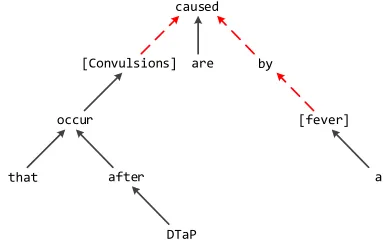
[image:2.612.83.278.192.313.2][Convulsions] that occur after DTaP are caused by a [fever].
Figure 1:A dependency tree example. Words in square brack-ets are marked entities. The red dashed-line arrows indicate the path between two entities.
Dependency parse tree is valuable in relation clas-sification task. According to our observation, depen-dency tree usually shortens the distances between pairs of marked entities and helps trim off redundant words, when comparing with plain text. For exam-ple, in the sentence shown in Figure 1, two marked entities span the whole sentence, which brings much noise to the recognition of their relation. By con-trast, in the dependency tree corresponding to the sentence, the path between two marked entities com-prises only four words and extracts a key phrase “caused by” that clearly implies the relation of enti-ties. This property of dependency tree is ubiquitous and consistent with the Shortest Path Hypothesis which is accepted by previous studies (Bunescu and Mooney, 2005; Xu et al., 2015a; Xu et al., 2015b).
To better utilize the powerful neural network and make the best of the abundant linguistic knowledge provided by parse tree, we propose a position encod-ing convolutional neural network (PECNN) based on dependency parse tree for relation classification. In our model, to sufficiently benefit from the impor-tant property of dependency tree, we introduce the position feature and modify it in the context of parse
tree. Tree-based position features encode the rela-tive positions between each word and marked en-tities in a dependency tree, and help the network pay more attention to the key phrases in sentences. Moreover, with a redefinition of “context”, we de-sign two kinds of tree-based convolution kernels for capturing the structural information and salient fea-tures of sentences.
To sum up, our contributions are:
1) We propose a novel convolutional neural network with tree-based convolution kernels for relation classification.
2) We confirm the feasibility of transferring the po-sition feature from plain text to dependency tree, and compare the performances of different posi-tion features by experiments.
3) Experimental results on the benchmark dataset show that our proposed method outperforms the state-of-the-art approaches. To make the mech-anism of our model clear, we also visualize the influence of tree-based position feature on rela-tion classificarela-tion task.
2 Related Work
Recent studies usually present the task of relation classification in a supervised perspective, and tra-ditional supervised approaches can be divided into feature based methods and kernel methods.
Feature based methods focus on extracting and selecting relevant feature for relation classifica-tion. Kambhatla (2004) leverages lexical, syntactic and semantic features, and feeds them to a maxi-mum entropy model. Hendrickx et al. (2010) show that the winner of SemEval-2010 Task 8 used the most types of features and resources, among all par-ticipants. Nevertheless, it is difficult to find an opti-mal feature set, since traversing all combinations of features is time-consuming for feature based meth-ods.
caused
[image:3.612.85.533.63.215.2][Convulsions] are by
[fever]
softmax
word representation: word embedding +
tree-based position feature tree-based kernelsconvolution with max-pooling fully connected layer + softmax classifier
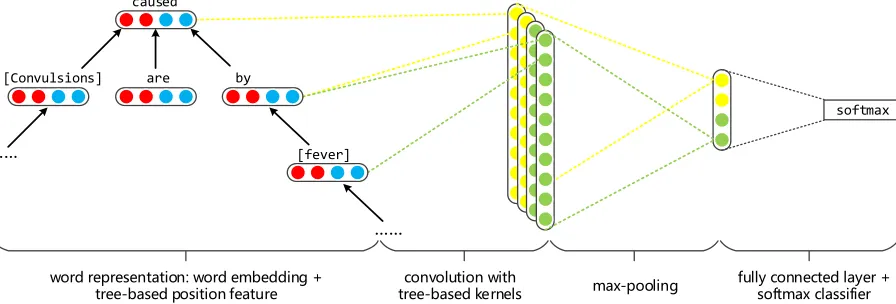
Figure 2:The framework of PECNN. The red and blue circles represent the word embeddings and tree-based position features of words. The yellow and green circles stand for the feature maps extracted by two kinds of convolution kernels respectively.
Mooney (2005) propose a dependency tree kernel and extract information from the Shortest Depen-dency Path (SDP) between marked entities. Since kernel methods require similarity computation be-tween input samples, they are relatively computa-tionally expensive when facing large-scale datasets. Nowadays, deep neural network based ap-proaches have become the main solutions to relation classification. Among them, some handle this task by modifying sentence modeling methods. Socher et al. (2012) build RNN on constituency trees of sen-tences, and apply the model to relation recognition task. Zeng et al. (2014) propose the use of position feature for improving the performance of CNN in relation classification. dos Santos et al. (2015) di-minish the impact of noisy class by using a pairwise ranking loss function based CNN. Meanwhile, in-spired by the ideas of traditional methods, some re-cent researches conre-centrate on mining information from the SDP. Xu et al. (2015b) use a multichan-nel LSTM network to model the SDP in given sen-tences. Liu et al. (2015) reserve the subtrees attached to the SDP and propose an augmented SDP based CNN. Neural network based methods offer the ad-vantage of automatic feature learning and also scale well with large amounts of data.
3 Proposed Model
Given a sentenceswith two marked entitiese1and
e2, we aim to identify the semantic relation between e1 and e2 in relation classification. As the set of
target relations is predefined, this task can be
formu-lated as a multi-class classification problem. In this section, we detailedly describe our proposed model designed for this problem.
3.1 Framework
The schematic illustration of the framework is shown in Figure 2.
First, the dependency tree of a sentence is gen-erated by the Stanford Parser (Klein and Manning, 2003). For each word in the tree, its word embed-ding and tree-based position features are concate-nated as its representation. The position feature of a word is determined by the relative position between the word and marked entities in the dependency tree. Next, with tree-based kernels, convolution opera-tions are conducted on each node of the dependency tree. Compared with plain text, dependency tree could provide a word with more meaningful con-text, thus making tree-based kernel more effective. After convolution, we apply max-pooling over the extracted feature maps to capture the most important features.
At last, the output of max-pooling layer, i.e. the feature vector of input sentence, is fed to a softmax classifier for labelling the semantic relation of enti-ties in each sentence.
3.2 Word Represetation
3.2.1 Word Embedding
Distributed representation of words in a vector space help learning algorithms to achieve better per-formance in NLP tasks (Mikolov et al., 2013). Such representation is usually called word embedding in recent works. High-quality word embedding is able to capture precise syntactic and semantic informa-tion by training unsupervisedly on large-scale cor-pora.
In our model, we initialize the word embeddings by pretraining them on a large corpus and further fine-tune them in training phase.
3.2.2 Tree-based Position Feature
Position Feature (PF) is first proposed by (Col-lobert et al., 2011) for semantic role labeling. (Zeng et al., 2014) exploit position feature as a substitute for traditional structure features in relation classifi-cation. The main idea of position feature is to map each discrete distance to a real-valued vector. It is similar to word embedding, except that words are replaced by discrete distances. For instance, let us examine again the sentence shown in Figure 1, [Convulsions]e1that occur after DTaP are caused by
a [fever]e2.
the relative distances ofcausedtoConvulsions and
fever are respectively6 and−3. Each relative
dis-tance is further mapped to adpf (a hyperparameter) dimensional vector, which is randomly initialized. Supposingpf6andpf−3are the corresponding vec-tors of distance 6 and −3, the position feature of
caused is given by concatenating these two vectors
[pf6,pf−3].
Position feature on plain text proves to be infor-mative (dos Santos et al., 2015), while it may suf-fer from several problems. According to our case study, adverbs or unrelated entities that appear be-tween two entities in a sentence could significantly affect the performance of position feature, as these words only change the relative distance to entities without providing any more useful information for relation classification. Similarly, position feature of-ten fails to handle senof-tences in which marked enti-ties are too far from each other.
On the other hand, dependency tree focuses on the action and agents in a sentence (Socher et al., 2014), which is valuable for relation classification. As we
have mentioned above, dependency tree is able to shorten the distances between pairs of marked enti-ties and help trim off redundant words. Therefore, it is straightforward and reasonable to transfer the position feature from plain text to dependency tree.
We propose two kinds of Tree-based Position Fea-ture which we refer as TPF1 and TPF2.
TPF1 encodes the relative distances of current word to marked entities in dependency trees. The “relative distance” here refers to the length of the shortest dependency path between current word and target entity. The sign of the distance is used to dis-tinguish whether current word is a descendant of tar-get entity. After calculating the relative distances of words in the tree, we can get their TPF1 by mapping relative distances to corresponding vectors, which is the same as the PF in plain text.
To more precisely describe the position of a word, TPF2 incorporates more information given by de-pendency tree. TPF2 represents the relative posi-tions between current word and marked entities by encoding their shortest paths. For a word and an en-tity, the shortest path between them can be separated by their lowest common ancestor, and the lengths of the two sub-paths are sufficient for encoding the shortest path and the relative position between the word and the entity. As a result, we formally rep-resent the relative position using a2-tuple, in which
two elements are the lengths of the two separated sub-paths respectively. Thereafter, each unique rel-ative position is mapped to a real-valued vector.
caused
[Convulsions] are by
occur [fever]
that after a
DTaP
0
-1
-2 -2
-3 1
2 2
3
4 (0,2) (0,2)
(0,3) (0,1)
(0,0) (1,1) (1,0)
(1,1)
(1,2)
[image:4.612.317.534.496.620.2](1,3)
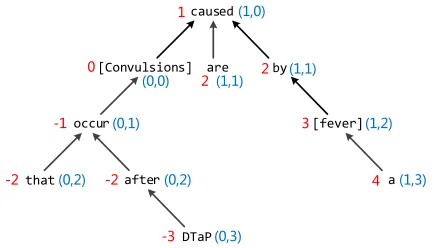
Figure 3: Example of Tree-based Position Features. The red numbers are relative distances in TPF1. The blue 2-tuples are relative positions in TPF2.
TPF1, the relative distance ofbytoConvulsionsis2,
the length of this path. In TPF2, the lowest common ancestorcausedsplits the path into two subpaths of length 1, so the relative position between Convul-sionsandbyis(1,1)(encoded in2-tuple). More
ex-amples of the tree-based position features are shown in Figure 3.
TPF1 and TPF2 both offer good strategies for en-coding word position in dependency tree. TPF2 is more fine-grained than TPF1 and TPF1 is a simpli-fied version of TPF2.
In our model, for each word in dependency trees, its word embedding and tree-based position feature are concatenated to form its representation, which is subsequently fed to the convolutional layer.
3.3 Convolution Methods
In the classic CNN architecture of (Collobert et al., 2011) and its variants (Kim, 2014), a convolution window covers a word and its context, i.e. its neigh-boring words. Thus convolution only captures local features around each word. Words that are not in a same window will not interact, even if they are syn-tactically related.
Compared with plain text, dependency tree could provide a word with more meaningful context. In a dependency tree, words are connected if they are in some dependency relationship. To capitalize on these syntactic information, we regard the parent and children of a word (i.e. nodes neighboring this word) as its new context. Changing the definition of “con-text” leads to modification of convolution kernel. To implement this idea, we design two kinds of tree-based kernels (Kernel-1 and Kernel-2), and apply
them to sentences in dependency tree form.
Formally, for a word x in the dependency tree,
let pbe its parent and c1,· · · , cn be itsnchildren. Their vector representation are respectively denoted byx, p, c1,· · · ,cn ∈Rd. The convolution process of Kernel-1is formulated as
zxi1 =g(Wx1·x+Wp1·p+Wc1·ci)
f or i= 1,· · ·, n (1)
wherezxi1 ∈Rn1 andn
1 is the number of Kernel-1, andW1
x, Wp1, Wc1 ∈ Rn1×d are weight parameters corresponding to the word, its parent and children
respectively. gis the non-linear activation function.
For leaf nodes which have no child, i.e.n = 0, we
assign each of them a child of which the vector rep-resentation is 0. For the root node, p is set to be
0.
Similarly, the output of Kernel-2is given by
zxi2 =g(Wx2·x+Wlc2 ·ci+Wrc2 ·ci+1)
f or i= 1,· · · , n−1 (2)
wherez2
xi ∈ Rn2 andn2 is the number of
Kernel-2, andWx2, Wlc2, Wrc2 ∈ Rn2×dare weight parame-ters associated with the word and its two neighbor-ing children. Ifn≤1, we simply add one or two0
children, just like the zero padding strategy.
Kernel-1 aims at extracting features from words
of multiple levels in dependency tree, while
Kernel-2 focuses on mining the semantic information
be-tween words which share the same parent.
Kernel-1 and Kernel-2 both consider 3 words at a time
because the experimental results of previous re-searches (Zeng et al., 2014; dos Santos et al., 2015) suggest that trigram features are relatively more use-ful in relation classification. And it is also straight-forward to extend these kernels to a larger size and apply them to other tasks.
After convolution with tree-based kernels, we ap-ply a global max-pooling operation over extracted features by taking the maximum value in each di-mension, which is formulated as
h1 = elemax
x,i z 1
xi (3)
h2 = elemax
x,i z 2
xi (4)
whereh1 ∈ Rn1,h2 ∈Rn2, andelemaxis the
op-eration which gives the element-wise maximum of all input vectors. As a consequence, the output of convolution process is[h1,h2], the combination of
features extracted by two kinds of kernels.
3.4 Output and Training Objective
Since we treat the relation classification task as a multi-class classification problem, the training ob-jective is the cross-entropy error. For regularization, we apply dropout (Srivastava et al., 2014) to the fea-ture vector extracted by convolution and penalize the fully connected layer withl2regularizer as well.
Some other dependency tree based methods like (Liu et al., 2015), (Xu et al., 2015a) and (Xu et al., 2015b), all focus on using different kinds of neu-ral networks to model the shortest dependency path (SDP) between entities. By contrast, PECNN ex-tracts features from the whole dependency tree, so that the information out of SDP will be taken into consideration as well. The empirical results of (dos Santos et al., 2015) suggest that when position fea-tures exist, modeling the full sentence yields a bet-ter performance than only using the subsentence be-tween entities. With the help of tree-based position feature, our model is capable of evaluating the im-portance of different parts of dependency trees and tends to pay relatively more attention to SDP.
Some methods enhancing their performances by proposing dataset-specific strategies. dos Santos et al. (2015) treat the classOtheras a special class and omit its embedding. Xu et al. (2015a) take the re-lation dimensionality into account and introduce a negative sampling strategy to double the number of training samples, which can be regarded as data aug-mentation. These strategies do not conflict with our model, but we decide not to integrate them into our methods as we aim to offer a general and effective feature extraction model for relation classification.
4 Experiments
4.1 Dataset and Evaluation Metric
To evaluate our method, we conduct experiments on the SemEval2010 Task 8 dataset which is a widely used benchmark for relation classification. The dataset contains8,000training sentences and2,717
test sentences. In each sentence, two entities are marked as target entities.
The predefined target relations include9directed
relations and an undirected Other class. The 9
directed relations are Cause-Effect, Component-Whole, Content-Container, Entity- Destination,
Entity-Origin, Instrument-Agency, Member-Collection, Message-Topic and Product-Producer.
“Directed” here means, for example, Cause-Effect(e1, e2) and Cause-Effect(e2, e1) are two different relations. In another word, the direction-ality of relation also matters. And sentences that do not belong to any directed relation are labelled asOther. Therefore, relation classification on this dataset is a 19-class classification problem.
Following previous studies, we use the official evaluation metric, macro-averaged F1-score with di-rectionality taken into account and theOther class ignored.
4.2 Training Details
Since there is no official validation set,10%of the
training sentences are taken out for hyperparameter tuning and early stopping.
When converting sentences to dependency trees, we note that some prepositions such as “by”, “in” and “of”, might be important clues to relation clas-sification. To reserve these valuable information, we use the Stanford Parser without the collapsed op-tion.
In the dataset, there are some entities consisting of multiple words, which make the calculation of rela-tive position ambiguous. To solve this problem, we take the last word as the representation of an entity, as the last word is usually the predominant word.
For word embeddings, we initialize them using the300-dimensionalword2vecvectors1. The
vec-tors are trained on 100billion words from Google
News. Words not present in theword2vecvectors are initialized by sampling each dimension from a uniform distribution (Kim, 2014). Tree-based posi-tion features are50-dimensional and initialized ran-domly. Therefore the representation of each word has dimensionality of400.
We use ReLU as the activation function. The number of convolution kernels is500for each kind, 1,000in total. The dropout rate is0.5, and the co-efficient ofl2penalty of fully connected layer is set to10−6. These parameters are selected through grid
search on validation set. The network is trained with the Adadelta update rule (Zeiler, 2012). The net-work is implemented with Theano (Theano Devel-opment Team, 2016).
Classifier Features F1 Without External Lexical Features
MVRNN word embedding, constituency tree 79.1 CNN word embedding, position feature 78.9 CR-CNN word embeddingword embedding, position feature 82.884.1∗∗
depLCNN word embedding, dependency treeword embedding, dependency tree 81.984.0◦ SDP-LSTM word embedding, dependency tree 83.0
PECNN word embedding, dependency tree, tree-based position feature 84.0 With External Lexical Features
SVM
POS, prefixes, morphological, WordNet, dependency parse
82.2 Levin classes, PropBankFrameNet, NomLex-Plus, Google n-gram
paraphrases, TextRunner
MVRNN word embedding, constituency tree, POS, NER, WordNet 82.4 CNN word embedding, position feature, WordNet 82.7 DepNN word embedding, dependency tree, WordNetword embedding, dependency tree, NER 83.083.6
depLCNN word embedding, dependency tree, WordNetword embedding, dependency tree, WordNet 83.785.6◦
SDP-LSTM word embedding, dependency tree, POS embedding 83.7 WordNet embedding, grammar relation embedding
[image:7.612.102.512.53.392.2]PECNN word embedding, dependency tree, tree-based position feature, POSNER, WordNet 84.6
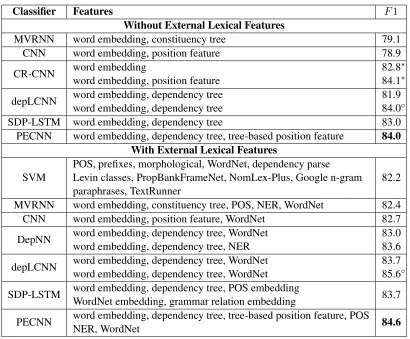
Table 1:Comparison of different relation classification models. The symbol∗indicates the results with special treatment of the
classOther. The symbol◦indicates the results with data augmentation strategy.
4.3 Results
The performances of our proposed model and other state-of-the-art methods are shown in Table 1.
First, we compare PECNN with the following baselines when no external lexical feature is used.
Socher et al. (2012) assign a vector and a matrix to each word for the purpose of semantic composi-tion, and build recursive neural network along con-stituency tree (MVRNN). It is noteworthy that this work is the first one who confirms the feasibility of applying neural network to relation classification.
Following the ideas of (Collobert et al., 2011), Zeng et al. (2014) first solve relation classifica-tion using convoluclassifica-tional neural network (CNN). The position feature introduced by them proves effec-tive. dos Santos et al. (2015) build a similar CNN called CR-CNN but replace the objective function with a pairwise ranking loss. By treating the noisy classOther as aspecialclass, this method achieves
an F1of84.1. The F1score is 82.7if no special
treatment is applied.
The rest two baselines focus on modeling the Shortest Dependency Paths (SDP) between marked entities. Xu et al. (2015a)) (depLCNN) integrate the relation directionality into CNN and achieve anF1
of 84.0 with a data augmentation strategy called
negative sampling. Without such data augmenta-tion, theirF1score is81.9. Xu et al. (2015b)
(SDP-LSTM) represent heterogeneous features as embed-dings and propose a multichannel LSTM based re-current neural network for picking up information along the SDP. Their F1 score is 83.0 when only
word embedding is used as the word representation. Without considering any external lexical feature and dataset-specific strategy, our model achieve an
[Convulsions] that occur after DTaP are caused by a [fever] Word
0.00 0.05 0.10 0.15 0.20 0.25
Proportion
[image:8.612.89.534.61.183.2]No Postion Feature Tree-based Position Feature
Figure 4: Visualization of the effect of tree-based position feature. The proportions of words change with the use of tree-based position feature.
improvement.
When external lexical features are available, we take two more baselines into account. The first one (SVM) is a typical example of traditional feature-based methods which rely largely on hand-crafted features. Benefitting from various features and re-sources, this method won the SemEval 2010 Task 8 by a large margin (Hendrickx et al., 2010). Liu et al. (2015) (DepNN) reserve the subtrees attached to the SDP and propose an augmented SDP based CNN.
Most of these baselines concatenate external lex-ical features to features extracted by neural network and directly pass the combined vector to classifier. SDP-LSTM represents lexical features as embed-dings and enhances its word representation. For fair comparison, we add three features (POS tags, NER tags and WordNet hypernyms of marked entities) to the vector extracted by our model and retrain the net-work. Thus, our model achieves anF1of84.6and
outperforms all existing baselines in a fair condition where no data augmentation strategy is adopted. The enhancement we gain from external features is less, comparing with other baselines. This implies that our model is able to mine useful features from lim-ited resources, even no extra information is avail-able.
4.4 Effect of Different Position Features
Position Feature F1
[image:8.612.118.250.637.692.2]plain text PF 83.21 TPF1 83.99 TPF2 83.90
Table 2:Comparison of different position features.
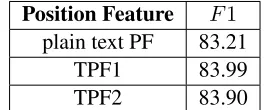
Table 2 summarizes the performances of proposed model when different position features are exploited. To concentrate on studying the effect of position fea-tures, we do not involve lexical features in this sec-tion. As the table shows, the position feature on plain text is still effective in our model and we ac-credit its satisfactory result to the dependency in-formation and tree-based kernels. TheF1scores of
tree-based position features are higher since they are “specially designed” for our model.
Contrary to our expectation, the more fine-grained TPF2 does not yield a better performance than TPF1, and two kinds of TPF give fairly close results. One possible reason is that the influence of a more elaborated definition of relative position is minimal. As most sentences in this dataset are of short length and their dependency trees are not so complicated, replacing TPF1 with TPF2 usually brings little new structural information and thus results in a similar
F1score.
However, though the performances of different position features are close, tree-based position fea-ture is an essential part of our model. TheF1score
is severely reduced to 75.22 when we remove the
tree-based position feature in PECNN.
4.5 Effect of Tree-based Position Feature
For shallow CNN in NLP, visualization offers clear and convincing explanations for the mechanism of neural networks (dos Santos and Gatti, 2014; Mou et al., 2015). Moreover, it is easy to implement.
convolu-tion step, and we regard them as the most relevant words extracted by this kernel, with respect to the sentence . Since there are1,000kernels in total, we
count3,000words (0will be ignored) and calculate
the proportion of each different word. Intuitively, the more important a word is in this task, the larger its proportion will be.
In Figure 4, we compare the proportions of words in the example sentence when tree-based position feature (TPF) is used and not. As we can see, the proportions of two entities, Convulsions and fever, and the phrase caused by all increase visibly with the presence of TPF, suggesting that TPF is effec-tive in helping the neural network pay more atten-tion to the crucial words and phrases in a sentence. The wordoccuris also picked up by our model since it is an important candidate clue to relation classifi-cation. Meanwhile, the influence of irrelevant entity
DTaPis remarkably diminished as expected.
5 Conclusion
This work presents a dependency parse tree based convolutional neural network for relation classifica-tion. We propose tree-based position features to en-code the relative positions of words in a dependency tree. Meanwhile, tree-based convolution kernels are designed to gather semantic and syntactic informa-tion in dependency trees. Experimental results prove the effectiveness of our model. Comparing with plain text based CNN, our proposed kernels and po-sition features boost the performance of network by utilizing dependency trees in a new perspective.
6 Acknowledgements
This work is partially supported by the National High Technology Research and Development Pro-gram of China (Grant No. 2015AA015403) and the National Natural Science Foundation of China (Grant No. 61170091). We would also like to thank the anonymous reviewers for their helpful comments.
References
Razvan C Bunescu and Raymond J Mooney. 2005. A shortest path dependency kernel for relation extrac-tion. InProceedings of the conference on Human Lan-guage Technology and Empirical Methods in Natural
Language Processing, pages 724–731. Association for Computational Linguistics.
Kyunghyun Cho, Bart van Merrienboer, C¸aglar G¨ulc¸ehre, Dzmitry Bahdanau, Fethi Bougares, Holger Schwenk, and Yoshua Bengio. 2014. Learning phrase represen-tations using RNN encoder-decoder for statistical ma-chine translation. InProceedings of the 2014 Confer-ence on Empirical Methods in Natural Language Pro-cessing, EMNLP 2014, October 25-29, 2014, Doha, Qatar, A meeting of SIGDAT, a Special Interest Group of the ACL, pages 1724–1734.
Ronan Collobert, Jason Weston, L´eon Bottou, Michael Karlen, Koray Kavukcuoglu, and Pavel Kuksa. 2011. Natural language processing (almost) from scratch.
The Journal of Machine Learning Research, 12:2493– 2537.
Cıcero Nogueira dos Santos and Maıra Gatti. 2014. Deep convolutional neural networks for sentiment analysis of short texts. InProceedings of the 25th International Conference on Computational Linguistics (COLING), Dublin, Ireland.
C´ıcero Nogueira dos Santos, Bing Xiang, and Bowen Zhou. 2015. Classifying relations by ranking with convolutional neural networks. InProceedings of the 53rd Annual Meeting of the Association for Compu-tational Linguistics and the 7th International Joint Conference on Natural Language Processing of the Asian Federation of Natural Language Processing, ACL 2015, July 26-31, 2015, Beijing, China, Volume 1: Long Papers, pages 626–634.
Iris Hendrickx, Su Nam Kim, Zornitsa Kozareva, Preslav Nakov, Diarmuid ´O S´eaghdha, Sebastian Pad´o, Marco Pennacchiotti, Lorenza Romano, and Stan Szpakow-icz. 2010. Semeval-2010 task 8: Multi-way classi-fication of semantic relations between pairs of nom-inals. InProceedings of the 5th International Work-shop on Semantic Evaluation, pages 33–38. Associa-tion for ComputaAssocia-tional Linguistics.
Nanda Kambhatla. 2004. Combining lexical, syntactic, and semantic features with maximum entropy mod-els for extracting relations. In Proceedings of the ACL 2004 on Interactive poster and demonstration sessions, page 22. Association for Computational Lin-guistics.
Yoon Kim. 2014. Convolutional neural networks for sentence classification. In Proceedings of the 2014 Conference on Empirical Methods in Natural Language Processing, EMNLP 2014, October 25-29, 2014, Doha, Qatar, A meeting of SIGDAT, a Special Interest Group of the ACL, pages 1746–1751.
Computa-tional Linguistics-Volume 1, pages 423–430. Associ-ation for ComputAssoci-ational Linguistics.
Jiwei Li, Thang Luong, Dan Jurafsky, and Eduard H. Hovy. 2015. When are tree structures necessary for deep learning of representations? InProceedings of the 2015 Conference on Empirical Methods in Natural Language Processing, EMNLP 2015, Lisbon, Portu-gal, September 17-21, 2015, pages 2304–2314. Yang Liu, Furu Wei, Sujian Li, Heng Ji, Ming Zhou,
and Houfeng Wang. 2015. A dependency-based neu-ral network for relation classification. In Proceed-ings of the 53rd Annual Meeting of the Association for Computational Linguistics and the 7th International Joint Conference on Natural Language Processing of the Asian Federation of Natural Language Processing, ACL 2015, July 26-31, 2015, Beijing, China, Volume 2: Short Papers, pages 285–290.
Tomas Mikolov, Ilya Sutskever, Kai Chen, Greg S Cor-rado, and Jeff Dean. 2013. Distributed representations of words and phrases and their compositionality. In C.J.C. Burges, L. Bottou, M. Welling, Z. Ghahramani, and K.Q. Weinberger, editors,Advances in Neural In-formation Processing Systems 26, pages 3111–3119. Curran Associates, Inc.
Raymond J Mooney and Razvan C Bunescu. 2005. Sub-sequence kernels for relation extraction. InAdvances in neural information processing systems, pages 171– 178.
Lili Mou, Hao Peng, Ge Li, Yan Xu, Lu Zhang, and Zhi Jin. 2015. Discriminative neural sentence mod-eling by tree-based convolution. In Proceedings of the 2015 Conference on Empirical Methods in Natu-ral Language Processing, EMNLP 2015, Lisbon, Por-tugal, September 17-21, 2015, pages 2315–2325. Richard Socher, Brody Huval, Christopher D Manning,
and Andrew Y Ng. 2012. Semantic compositional-ity through recursive matrix-vector spaces. In Pro-ceedings of the 2012 Joint Conference on Empirical Methods in Natural Language Processing and Com-putational Natural Language Learning, pages 1201– 1211. Association for Computational Linguistics. Richard Socher, Andrej Karpathy, Quoc V Le,
Christo-pher D Manning, and Andrew Y Ng. 2014. Grounded compositional semantics for finding and describing images with sentences. Transactions of the Associa-tion for ComputaAssocia-tional Linguistics, 2:207–218. Richard Socher. 2014. Recursive Deep Learning for
Natural Language Processing and Computer Vision. Ph.D. thesis, Stanford University.
Nitish Srivastava, Geoffrey Hinton, Alex Krizhevsky, Ilya Sutskever, and Ruslan Salakhutdinov. 2014. Dropout: A simple way to prevent neural networks from overfitting. The Journal of Machine Learning Research, 15(1):1929–1958.
Kai Sheng Tai, Richard Socher, and Christopher D. Man-ning. 2015. Improved semantic representations from tree-structured long short-term memory networks. In
Proceedings of the 53rd Annual Meeting of the As-sociation for Computational Linguistics and the 7th International Joint Conference on Natural Language Processing of the Asian Federation of Natural Lan-guage Processing, ACL 2015, July 26-31, 2015, Bei-jing, China, Volume 1: Long Papers, pages 1556– 1566.
Theano Development Team. 2016. Theano: A Python framework for fast computation of mathematical ex-pressions. arXiv e-prints, abs/1605.02688, May. Kun Xu, Yansong Feng, Songfang Huang, and Dongyan
Zhao. 2015a. Semantic relation classification via convolutional neural networks with simple negative sampling. In Proceedings of the 2015 Conference on Empirical Methods in Natural Language Process-ing, EMNLP 2015, Lisbon, Portugal, September 17-21, 2015, pages 536–540.
Yan Xu, Lili Mou, Ge Li, Yunchuan Chen, Hao Peng, and Zhi Jin. 2015b. Classifying relations via long short term memory networks along shortest depen-dency paths. InProceedings of the 2015 Conference on Empirical Methods in Natural Language Process-ing, EMNLP 2015, Lisbon, Portugal, September 17-21, 2015, pages 1785–1794.
Matthew D. Zeiler. 2012. ADADELTA: an adaptive learning rate method. CoRR, abs/1212.5701.