On- and Off-Topic Classification and Semantic Annotation of
User-Generated Software Requirements
Markus Dollmann and Michaela Geierhos Heinz Nixdorf Institute
University of Paderborn
F¨urstenallee 11, 33102 Paderborn, Germany
{dollmann|geierhos}@hni.upb.de
Abstract
Users prefer natural language software re-quirements because of their usability and ac-cessibility. When they describe their wishes for software development, they often provide off-topic information. We therefore present REaCT1, an automated approach for
identify-ing and semantically annotatidentify-ing the on-topic parts of requirement descriptions. It is de-signed to support requirement engineers in the elicitation process on detecting and analyzing requirements in user-generated content. Since no lexical resources with domaspecific in-formation about requirements are available, we created a corpus of requirements writ-ten in controlled language by instructed users and uncontrolled language by uninstructed users. We annotated these requirements re-garding predicate-argument structures, con-ditions, priorities, motivations and semantic roles and used this information to train clas-sifiers for information extraction purposes. REaCT achieves an accuracy of 92% for the on- and off-topic classification task and an F1
-measure of 72% for the semantic annotation.
1 Introduction
“Requirements are what the software product, or hardware product, or service, or whatever you in-tend to build, is meant to do and to be” (Robert-son and Robert(Robert-son, 2012). This intuitive descrip-tion of requirements has one disadvantage. It is as vague as a requirement that is written by an un-trained user. More generally, functional require-ments define what a product, system or process, or
1Requirements Extraction and Classification Tool
a part of it is meant to do (Robertson and Robert-son, 2012; Vlas and RobinRobert-son, 2011). Due to its ex-pressiveness, natural language (NL) became a pop-ular medium of communication between users and developers during the requirement elicitation pro-cess (de Almeida Ferreira and da Silva, 2012; Mich et al., 2004). Especially in large ICT projects, re-quirements, wishes, and ideas of up to thousands of different users have to be grasped (Castro-Herrera et al., 2009). For this purpose, requirement en-gineers collect their data, look for project-relevant concepts and summarize the identified technical fea-tures. However, this hand-crafted aggregation and translation process from NL to formal specifica-tions is error-prone (Goldin and Berry, 1994). Since people are getting tired and unfocused during this monotonous work, the risk of information loss in-creases. Hence, this process should be automated as far as possible to support requirement engineers.
In this paper, we introduce our approach to iden-tify and annotate requirements in user-generated content. We acquired feature requests for open source software from SourceForge2, specified by
(potential) users of the software. We divided these requests into off-topic information and (on-topic) requirements to train a binary text classifier. This allows an automated identification of new require-ments in user-generated content. In addition, we col-lected requirements in controlled language from the NFR corpus3 and from web pages with user-story
explanations. We annotated the semantically
rele-2https://sourceforge.net 3http://openscience.us/repo/ requirements/other-requirements/nfr
vant parts of the acquired requirements for infor-mation extraction purposes. This will support re-quirements engineers on requirement analysis and enables a further processing such as disambiguation or the resolution of incomplete expressions.
This paper is structured as follows: In Section 2, we discuss the notion of requirements. Then we pro-vide an overview of previous work (Section 3), be-fore we introduce lexical resources necessary for our method (Section 4). The approach itself is presented in Section 5 before it is evaluated in Section 6. Fi-nally, we conclude this work in Section 7.
2 The Nature of Requirements
Requirement engineers and software developers have to meet users’ wishes in order to create new software products. Such descriptions of software functionalities can be expressed in different ways: For example, by using controlled languages or formal methods, clarity and completeness can be achieved. But non-experts can hardly apply them and therefore do not belong to the user group. For this reason, users are encouraged to express their in-dividual requirements for the desired software ap-plication in NL in order to improve user accep-tance and satisfaction (Firesmith, 2005). In gen-eral, software requirements are expressed through active verbs such as“to calculate”or“to publish”
(Robertson and Robertson, 2012). In this work, we distinguish requirements expressed in NL between controlled and uncontrolled language.
A controlled language is a subset of NL, which is characterized by a restricted grammar and/or limited vocabulary (Yue et al., 2010). Requirements in con-trolled language do not suffer from ambiguity, re-dundancy and complexity (Yue et al., 2010). That is why these recommendations lead to a desirable input for text processing. Robertson and Robertson (2012) therefore recommend specifying each requirement in a single sentence with one verb. Furthermore, they suggest the following start of record“The [sys-tem/product/process] shall ...”, which focuses on the functionality and keeps the active form of a sen-tence. An example therefore is “The system shall display the Events in a graph by time.”Another type of controlled requirements are user stories. They fol-low the form “As a [role], I want [something] so
that [benefit]”and describe software functionalities from the user’s perspective (Cohn, 2004). Compared to the previous ones, they do not focus on the tech-nical implementation but concentrate on the goals and resulting benefits. An example therefore is“As a Creator, I want to upload a video from my local machine so that any users can view it.”
We also consider uncontrolled language in this work because requirements are usually specified by users that have not been instructed for any type of formulation. Requirements in uncontrolled lan-guage do not stick to grammar and/or orthographic rules and may contain abbreviations, acronyms or emoticons. There is no restriction how to express oneself. An example therefore is “Hello, I would like to suggest the implementation of expiration date for the master password :)”.
In the following, the word “requirement” is used for a described functionality. We assume that its textualization is written within a single English sen-tence. Requirements are specified in documents like theSoftware Requirements Specification(SRS). We refer to SRS and other forms (e.g. e-mails, memos from workshops, transcripts of interviews or entries in bug-trackers) as requirement documentations.
3 Previous Work
method, we plan to identify requirements in user-generated content with a machine learning approach. Since those approaches automatically identify pat-terns for this classification task, we expect a higher recall and more reliable results.
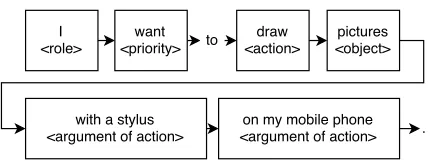
Goldin and Berry (1994) identified so-called ab-stractions (i.e. relevant terms and concepts related to a product) of elicited requirements for a better com-prehension of the domain and its restrictions. Their toolAbstFinderis based on the idea that the signifi-cance of terms and concepts is related to the number of mentions in the text. However, in some cases, there is only a weak correlation between the term frequencies and their relevance in documents. This problem can be reduced by a statistical corpus anal-ysis, when the actual term frequency is similar to the expected (Sawyer et al., 2002; Gacitua et al., 2011). This approach eliminates corpus specific stopwords and misleading frequent terms. In our work, we in-tent to perform a conin-tent analysis of the previously detected requirements. However, instead of only identifying significant terms and concepts, we cap-ture the semantically relevant parts of requirements such as conditions, motivations, roles or actions (cf. Figure 1).
In addition to the identification of abstractions, there are methods to transform NL requirements into graphical models (e.g. in Unified Modeling Lan-guage) (Harmain and Gaizauskas, 2003; Ambriola and Gervasi, 2006; K¨orner and Gelhausen, 2008). A systematic literature review, done by Yue et al. (2010), aims at the modeling of requirements by comparing transformation techniques in such mod-els. Unlike those techniques, we aim to keep the ex-pressive aspect of the original textual requirements and semantically annotate them for filtering pur-poses. These results can be further used for dif-ferent NLP tasks such as disambiguation, resolu-tion of vagueness or the compensaresolu-tion of under-specification.
The semantic annotation task of this work is sim-ilar to semantic role labeling (SLR). According to Jurafsky and Martin (2015), the goal of SLR is un-derstanding events and their participants, especially being able to answer the questionwho did what to whom (and perhaps alsowhen and where). In this work, we seek to adapt this goal to the requirements domain, where we want to answer the questionwhat
actions should be done by which component (and perhaps alsowho wants to perform that action, are there any conditions,what is the motivation for per-forming this actionandis there a priority assigned to the requirement).
4 Gathering and Annotation of Controlled and Uncontrolled Requirements
There are benchmarks comparing automated meth-ods for requirement engineering (Tichy et al., 2015). However, none of the published datasets is sufficient to train a text classifier, since annotated information is missing. For our purposes, we need a data set with annotated predicate-argument structures, conditions, priorities, motivations and semantic roles. We there-fore created a semantically annotated corpus by us-ing the categories shown in Figure 1, which repre-sent all information bits of a requirement. Since the approach should be able to distinguish between (on-topic) requirements and off-topic comments, we ac-quired software domain-specific off-topic sentences, too.
Therefore, we acquired requirements in con-trolled language from the system’s and the user’s perspective. While requirements from the system’s perspective are describing technical software func-tionalities, the requirements from the user’s per-spective express wishes for software, to fulfill user needs. For instance, the NFR corpus4covers the
sys-tem’s perspective of controlled requirements spec-ifications. It consists of 255 functional and 370 non-functional requirements whereof we used the functional subset to cover the system’s perspective. Since we could not identify any requirement corpus that describes a software at user’s request, we ac-quired 304 user stories from websites and books that describe how to write user stories.
However, these requirements in controlled lan-guage have not the same characteristics as uncon-trolled requirements descriptions. For the acquisi-tion of uncontrolled requirements, we adapted the idea of Vlas and Robinson (2011) that is based on feature requests gathered from the open-source soft-ware platform SourceForge5. These feature requests
4https://terapromise.csc.ncsu.edu/repo/ requirements/nfr/nfr.arff
are created by users that have not been instructed for any type of formulation. Since these requests do not only contain requirements, we split them into sen-tences and manually classified them in requirements and off-topic information. Here, we consider social communication, descriptions of workflows, descrip-tions of existing software features, feedback, salu-tations, or greetings as off-topic information. In to-tal, we gathered 200 uncontrolled on-topic sentences (i.e. requirements) and 492 off-topic ones.
Then we analyzed the acquired requirements in order to identify the different possible semantic cat-egories to annotate their relevant content in our re-quirements corpus (cf. Figure 1):
– component
– refinement of component
– action
– argument of action
– condition
– priority
– motivation
– role
– object
– refinement of object
– sub-action
– argument of sub-action
– sub-priority
– sub-role
– sub-object
[image:4.612.317.532.158.239.2]– refinement of sub-object
Figure 1: Semantic categories in our software requirements corpus used for annotation purposes
The categoriescomponentorrole,actionand ob-ject are usually represented by subject, predicate and object of a sentence. In general, a description refers to a component, either to a product or sys-tem itself or to a part of the product/syssys-tem. Ac-tionsdescribe what a component should accomplish and affect. Actions have an effect onObjects. The authors of the requirements can refine the descrip-tion of components and objects, which is covered by the categories refinement of component and re-finement of object. For each action, users can set a certainpriority, describe theirmotivationfor a spe-cific functionality, stateconditions, and/or even de-fine some semanticroles. Apart from the component
and the object, additional arguments of the action (predicate of a sentence) are annotated with argu-ment of action. In some cases, requirements contain sub-requirements in subordinate clauses. The anno-tators took this into account when using the prede-fined sub-categories. An example of an annotated requirement is shown in Figure 2.
Figure 2:Annotated requirement sample
Two annotators independently labeled the cate-gories in the requirements. We define one of the annotation set as gold standard and the other as can-didate set. We will use the gold standard for training and testing purposes in Section 5 and 6 and the can-didate set for calculating an inter-annotator agree-ment. In total, our gold standard consists of 3,996 labeled elements (i.e. clauses, phrases, and even modality). The frequency distribution is shown in Table 1.
Semantic Category CR UR Total
component 241 84 325 refinement of component 6 16 22 action 526 204 730 argument of action 180 104 284 condition 94 39 133 priority 488 209 697 motivation 33 19 52 role 406 42 448 object 540 195 735 refinement of object 155 48 203 sub-action 76 40 116 argument of sub-action 27 14 41 sub-priority 22 16 38 sub-role 22 11 33 sub-object 78 37 115 refinement of sub-object 16 8 24 Total 2,910 1,086 3,996
[image:4.612.70.244.261.473.2]The inter-annotator agreement in multi-token an-notations is commonly evaluated by using F1-score
(Chinchor, 1998). The two annotators achieve an agreement of 80%, whereby the comparison was in-voked from the gold standard.
Many information extraction tasks use the IOB encoding6for annotation purposes. When using the
IOB encoding, the first token of an element is split into its head (first token) and its tail (rest of the ele-ment). That way, its boundaries are labeled with B (begin) and I (inside). This allows separating suc-cessive elements of the same category. Thus, we use the IOB encoding during the annotation step. How-ever, we want to discuss a drawback of this notation: When applying text classification approaches in in-formation extraction tasks with IOB encoding, the number of classes reduplicates and this reduces the amount of training data per class. During our an-notation process, successive elements of the same semantic category only occurred in the case of argu-ment of the actionandargument of the sub-action. When we disregard the IOB encoding, we can eas-ily split up (sub-)actions by keywords such as“in”,
“by”,“from”,“as”,“on”,“to”,“into”,“for”, and
“through”. So if we use IO encoding, it can be eas-ily transformed to the IOB encoding. The only dif-ference between IOB and IO encoding is that it does not distinguish between the head and tail of an el-ement and therefore does not double the number of classes.
5 REaCT – A Two-Stage Approach
Requirement documentations are the input of our system. Figure 3 illustrates the two-stage approach divided in two separate classification tasks. First, we apply an on-/off-topic classification to decide whether a sentence is a requirement or irrelevant for the further processing (cf. Section 5.1). Then, the previously identified requirements were automati-cally annotated (Section 5.2). As a result, we get filtered and semantically annotated requirements in XML or JSON.
The models for on-/off-topic classification and se-mantic annotation are trained on the gathered re-quirements (cf. Section 4). We split up the gold standard on sentence level in a ratio of 4:1 in a
[image:5.612.315.540.59.205.2]train-6I (inside), O (outside) or B (begin) of an element
Figure 3:Processing pipeline of the two-stage approach
ing set of 607 requirements and test set of 152 re-quirements. Furthermore, we used 10-fold cross val-idation on the training set for algorithm configura-tion and feature engineering (cf. Secconfigura-tion 5.1 and Section 5.2). Finally, our approach is evaluated on the test set (cf. Section 6).
5.1 On-/Off-Topic Classification Task
User requirement documentations often contain off-topic information. Therefore, we present a binary text classification approach that distinguishes be-tween requirements and off-topic content. Thus, we trained different classification algorithms and tested them using various features and parameter settings. We compared the results to select the best algorithm together with its best-suited parameter values and features.
5.1.1 Features
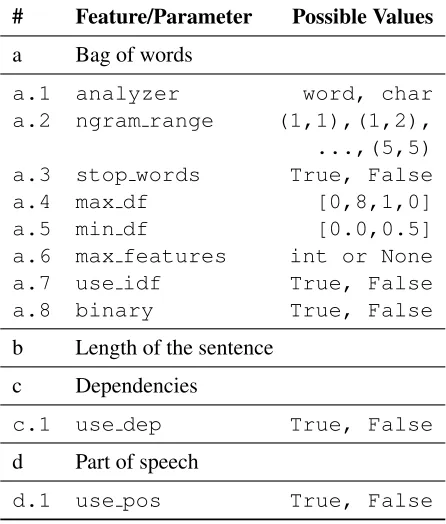
To differentiate requirements from off-topic con-tent, the sentences will be transformed in numerical feature vectors using a bag-of-words approach with different settings7. The features for the
transforma-tion are listed along with their possible parameter settings in Table 2. We can choose whether the fea-ture should be taken from word or character n-grams (a.1). For both versions, the unit can range between
[n, m](a.2), which can be specified by parameters.
Here, we consider all combinations ofn= [1,5]and
m= [1,5](wherem ≥n). If the feature should be
build from word n-grams, stopword detection is pos-sible (a.3). Additionally, terms can be ignored that reach a document frequency below or above a given
threshold (e.g. domain-specific stopwords) (a.4 and a.5). Another threshold can be specified to only consider the top features ordered by term frequency (a.6). Besides, it is possible to re-weight the units in the bag-of-words model in relation to the inverse document frequency (IDF) (a.7). Moreover, the fre-quency vector can be reduced to binary values (a.8), so that the bag-of-words model only contains infor-mation about the term occurrence but not about its calculated frequency. We also consider the length of a sentence as feature (b). Furthermore, the fre-quency of the part-of-speech (POS) tags (c) and the dependencies between the tokens (d) can be added to the feature vector8. These two features are optional
(c.1 and d.1). This set of features covers the domain-specific characteristics and should enable the identi-fication of the requirements.
# Feature/Parameter Possible Values
a Bag of words
a.1 analyzer word, char a.2 ngram range (1,1),(1,2), ...,(5,5) a.3 stop words True, False a.4 max df [0,8,1,0] a.5 min df [0.0,0.5] a.6 max features int or None a.7 use idf True, False a.8 binary True, False
b Length of the sentence c Dependencies
c.1 use dep True, False
d Part of speech
[image:6.612.74.297.304.566.2]d.1 use pos True, False
Table 2:Features for on-/off-topic classification together with their corresponding parameters
5.1.2 Selected Algorithms
We selected the following algorithms from the
scikit-learnlibrary9 for binary classification:
deci-sion tree (DecisionTreeClassifier), Naive
8We use spaCy (https://spacy.io) for POS tagging
and dependency parsing
9http://scikit-learn.org
Bayes (BernoulliNB and MultionmialNB), support vector machine (SVC andNuSVC) as well as ensemble methods (BaggingClassifier,
RandomForestClassifier, ExtraTree-Classifier and AdaBoostClassifier). Finally, after evaluating these algorithms, we chose the best one for the classification task (cf. Section 6).
5.2 Semantic Annotation Task
For each identified requirement, the approach should annotate the semantic components (cf. Figure 1). Here, we use text classification techniques on token level for information extraction purposes. The ben-efit is that these techniques can automatically learn rules to classify data from the annotated elements (cf. Section 4). Each token will be assigned to one of the semantic categories presented in Figure 1 or the additional classO(outside according IOB nota-tion).
We decided in favor of IO encoding during classification to reduce the drawback described in Section 4. We finally convert the classification re-sults into the IOB encoding by labeling the head of each element as begin and the tail as inside. By us-ing the keywords listed in Section 4 as separators, we further distinguish the beginning and the inner parts of arguments.
5.2.1 Features
In the second classification step, we had to adapt the features to token level. The goal of feature en-gineering is to capture the characteristics of the to-kens embedded in their surrounding context. We di-vided the features in four groups: orthographic and semantic features of the token, contextual features, and traceable classification results.
# Feature/Parameter Possible Values
a Graphematic representation
a.1 use lemma True, False
b Token contains a number c Token is capitalized
d Token is somehow uppercased e Length of the token
f Prefix of the token
f.1 length prefix [0,5]
g Suffix of the token
[image:7.612.75.296.58.271.2]g.1 length suffix [0,5]
Table 3:Orthographic features for semantic annotation
Furthermore, we consider the relevance (h), the POS tag (i) and the WordNet ID of a token (j) as its semantic features (cf. Table 4). By checking the stopword status of a token, we can decide about its relevance. Besides, the POS tag of each token is used as feature. When applying the POS informa-tion, we can choose between theUniversal Tag Set10
(consisting of 17 POS tags) and thePenn Treebank Tag Set11(including of 36 POS tags) (i.1). Another
boolean feature tells us whether the token appears inWordNet12. We use this feature as indicator for
component or object identification.
# Feature/Parameter Possible Values
h Relevance
i Part-of-speech tag
i.1 extended tagset True, False
j WordNet ID
Table 4:Semantic features for semantic annotation
As contextual features, we use sentence length (k), index of the token in the sentence (l), as well as the tagging and dependency parsing information of the surrounding tokens (m, n and o) (cf. Table 5). Thus, the POS tags sequences of thenprevious and 10http://universaldependencies.org/u/pos/ 11http://www.ling.upenn.edu/courses/Fall_ 2003/ling001/penn_treebank_pos.html
12https://wordnet.princeton.edu
the nextmtoken are considered, wherenandmare
defined during algorithm configuration (l.1 and n.1). Moreover, it can be specified if each POS tag should be stored as a single feature or should be concate-nated (e.g. NOUN+VERB+NOUN) (l.2 and n.2).
# Feature/Parameter Possible Values
k Sentence length l Index of the token
m Previous part-of-speech tags
l.1 n pos prev [0,15] l.2 conc prev pos True, False
n Subsequent part-of-speech tags
n.1 n pos succ [0,15] n.2 conc succ pos True, False
o Dependencies
Table 5:Contextual features for semantic annotation
The classification task is carried out from left to right in the sentence. This enables the considera-tion of previous classificaconsidera-tion results (cf. Table 6). We implemented two slightly different variants that can be combined on demand: Firstly, we can de-fine a fixed number of previous classification results as independent or concatenated features (i.e. a slid-ing window (p)). Secondly, the number of token al-ready assigned to a particular class may be a valu-able information (q). This is especially of interest for the hierarchical structure of the categories: For instance, asub-objectshould only occur if anobject
has already been identified. These two features are optional (p.1 and q.1). The size of the sliding win-dow will be specified during algorithm configuration (p.2).
# Feature/Parameter Possible Values
p Sliding windows
p.1 conc prev labels True, False p.2 window size [0,10]
q Number of previous labels per category
q.1 use prev labels True, False
5.2.2 Selected Algorithms
In addition to the classifiers we already used in the on-/off-topic classification task, we considered three sequential learning algorithms: conditional random fields (FrankWolfeSSVM) from the PyS-truct-library13, multinomial hidden markov model
(MultinomialHMM) as well as structured percep-tron from theseqlearn-library14. We could not
esti-mate feasible parameter settings for theNuSVC clas-sifier, so that this classifier was ignored. We chose the algorithm with the best results on the test set for annotating the requirements (cf. Section 6).
6 Evaluation
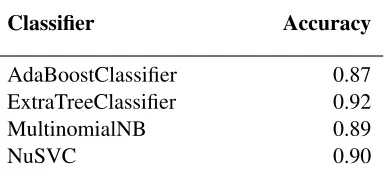
As mentioned in Section 5, the data was separated in a ratio of 4:1 in a training and a test set. We trained all classifiers on the training set with their defined settings from the automated algorithm con-figuration. Subsequently, we evaluated these classi-fiers on the test set. Our results are shown in Table 7 that lists the accuracy for the best classifier per algo-rithm family of the on-/off-topic classification task. The ExtraTreeClassifier performs best on the test data with an accuracy of 92%. The accuracy was calculated with the following formula:
accuracy= #true positives+ #true negatives #classif ied requirements
TheExtraTreeClassifieris an implemen-tation ofExtremely Randomized Trees(Geurts et al., 2006). We achieved the best result when using char-acter n-grams as features in the model with a fixed length of4. Thereby, we considered term occurrence
instead of term frequency and IDF. Before creating the bag-of-words model, the approach removes stop-words. Furthermore, the frequency of the POS tags and their dependencies are used as features. In to-tal, the ExtraTreeClassifierused 167 esti-mators based on entropy in the ensemble (algorithm-specific parameters).
13https://pystruct.github.io
14https://github.com/larsmans/seqlearn
Classifier Accuracy
AdaBoostClassifier 0.87 ExtraTreeClassifier 0.92 MultinomialNB 0.89
[image:8.612.332.527.63.150.2]NuSVC 0.90
Table 7:Accuracy of best classifiers per algorithm family in the on-/off-topic classification task after algorithm configuration
Table 8 shows the values for precision, recall, and F1of the ExtraTreeClassifier. In brief, the
introduced approach detects requirements in user-generated content with an average F1-score of 91%.
Class Precision Recall F1
off-topic info 0.94 0.85 0.89 requirements 0.89 0.96 0.93 Avg. 0.92 0.91 0.91
Table 8: Evaluation results for the on-/off-topic classification with theExtraTreeClassifier
Table 9 provides an overview of the results of the semantic annotation task. To determine the F1-score,
the agreement of the predicted and the a priori given annotations is necessary to count an element as true positive.
Again, the ExtraTreeClassifierachieves the best F1-score of 72%. We gained the best
re-sults by using 171 randomized decision trees based on entropy (algorithm-specific parameters). As fea-tures, we took the POS tags fromUniversal Tag Set
for the twelve previous and the three following to-kens. Traceable classification results are taken into account by a sliding window of size 1. Besides, we validate if a class label has already been assigned. For each considered token, the four prefix and the two suffix characters as well as the graphematic rep-resentation of the token are applied as features.
The sequential learning algorithms (FrankWolfeSSVM, MultinomialHMM and
Bagging-Classifier and ExtraTreeClassifier), perform significantly better.
Classifier F1
AdaBoostClassifier 0.33 ExtraTreeClassifier 0.72 FrankWolfeSSVM 0.50 MultinomialNB 0.64
[image:9.612.85.284.108.214.2]SVC 0.70
Table 9:F1-scores of best classifiers per algorithm family in the
semantic annotation task after algorithm configuration
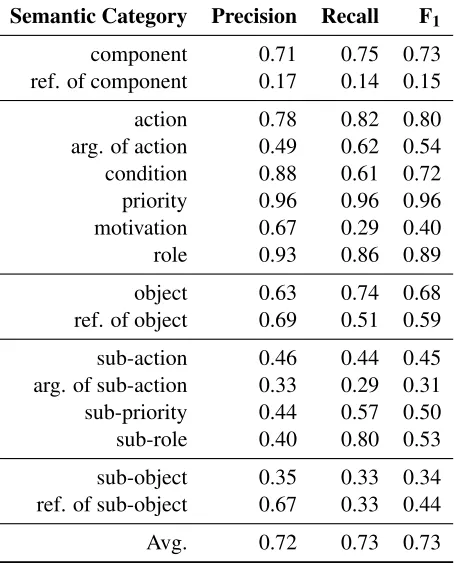
In Table 10, we provide detailed results achieved with theExtraTreeClassifierfor the differ-ent semantic categories. The recognition of main aspects (component, action and object) reached F1
-scores of 73%, 80% and 68%. The semantic cate-gories, that have only a few training examples, are more error-prone (e.g. sub-action or sub-object).
Semantic Category Precision Recall F1
component 0.71 0.75 0.73 ref. of component 0.17 0.14 0.15 action 0.78 0.82 0.80 arg. of action 0.49 0.62 0.54 condition 0.88 0.61 0.72 priority 0.96 0.96 0.96 motivation 0.67 0.29 0.40 role 0.93 0.86 0.89 object 0.63 0.74 0.68 ref. of object 0.69 0.51 0.59 sub-action 0.46 0.44 0.45 arg. of sub-action 0.33 0.29 0.31 sub-priority 0.44 0.57 0.50 sub-role 0.40 0.80 0.53 sub-object 0.35 0.33 0.34 ref. of sub-object 0.67 0.33 0.44 Avg. 0.72 0.73 0.73
Table 10: Evaluation results for the semantic annotation with theExtraTreeClassifier
7 Conclusion and Future Work
Requirement engineers and software developers have to meet users’ wishes to create new software products. The goal of this work was to develop a system that can identify and analyze requirements expressed in natural language. These are written by users unlimited in their way of expression. Our system REaCT achieves an accuracy of 92% in dis-tinguishing between on- and off-topic information in the user-generated requirement descriptions. The text classification approach for semantic annotation reaches an F1-score of 72% – a satisfying result
compared to the inter-annotator agreement of 80%. One possibility to improve the quality of the seman-tic annotation is to expand the training set. Espe-cially the sequential learning techniques need more training data. Besides, this would have a positive im-pact on those semantic categories that only contain a small number of annotated elements.
Developers and requirement engineers can facilely identify requirements written by users for products in different scenarios by applying our approach. Moreover, the semantic annotations are useful for further NLP tasks. User-generated software requirements adhere to the same quality standards as software requirements that are col-lected and revised by experts: They should be complete, unambiguous and consistent (Hsia et al., 1993). Since there was no assistant system to check the quality for many years (Hussain et al., 2007) we plan to extend the provided system in order to provide some quality analysis of the extracted information. We have already developed concepts to generate suggestions for non-experts, how to complete or clarify their requirement descriptions (Geierhos et al., 2015). Based on these insights, we want to implement a system for the resolution of vagueness and incompleteness of NL requirements.
Acknowledgments
[image:9.612.73.300.383.666.2]References
Vincenzo Ambriola and Vincenzo Gervasi. 2006. On the Systematic Analysis of Natural Language Require-ments with CIRCE. Automated Software Engineering, 13(1):107–167.
Ronit Ankori and Ronit Ankori. 2005. Automatic re-quirements elicitation in agile processes. In Pro-ceedings of the 2005 IEEE International Conference on Software - Science, Technology and Engineering, pages 101–109. IEEE.
Carlos Castro-Herrera, Chuan Duan, Jane Cleland-Huang, and Bamshad Mobasher. 2009. A recom-mender system for requirements elicitation in large-scale software projects. In Proceedings of the 2009 ACM Symposium on Applied Computing, pages 1419– 1426. ACM.
Nancy A. Chinchor, editor. 1998. Proceedings of the Seventh Message Understanding Conference (MUC-7) Named Entity Task Definition, Fairfax, VA.
Mike Cohn. 2004. User Stories Applied: For Agile Soft-ware Development. Addison Wesley Longman Pub-lishing Co., Redwood City, CA, USA.
David de Almeida Ferreira and Alberto Rodrigues da Silva. 2012. RSLingo: An information extrac-tion approach toward formal requirements specifica-tions. In Model-Driven Requirements Engineering Workshop, pages 39–48. IEEE.
Donald G. Firesmith. 2005. Are Your Requirements Complete? Journal of Object Technology, 4(2):27–43, February.
Ricardo Gacitua, Pete Sawyer, and Vincenzo Gervasi. 2011. Relevance-based abstraction identification: technique and evaluation. Requirements Engineering, 16(3):251–265.
Michaela Geierhos, Sabine Schulze, and Frederik Simon B¨aumer. 2015. What did you mean? Facing the Chal-lenges of User-generated Software Requirements. In Proceedings of the 7th International Conference on Agents and Artificial Intelligence, pages 277–283, 10 -12 January. Lisbon. ISBN: 978-989-758-073-4. Pierre Geurts, Damien Ernst, and Louis Wehenkel. 2006.
Extremely randomized trees. Machine Learning, 63(1):3–42.
Leah Goldin and Daniel M. Berry. 1994. AbstFinder, A Prototype Abstraction Finder for Natural Language Text for Use in Requirements Elicitation: Design, Methodology, and Evaluation. Automated Software Engineering, 4(4):375–412.
H.M. Harmain and R. Gaizauskas. 2003. CM-Builder: A Natural Language-Based CASE Tool for Object-Oriented Analysis. IEEE International Conference on Software - Science, Technology & Engineering, 10(2):157–181.
Pei Hsia, Alan Davis, and David Kung. 1993. Status Report: Requirements Engineering. IEEE Software, 10(6):75–79, November.
Ishrar Hussain, Olga Ormandjieva, and Leila Kosseim. 2007. Automatic Quality Assessment of SRS Text by Means of a Decision-Tree-Based Text Classifier. In Proceedings of the 7th International Conference on Quality Software, QSIC ’07, pages 209–218. IEEE. Isabel John and J¨org D¨orr. 2003. Elicitation of
Require-ments from User Documentation. InProceedings of the 9th International Workshop on Requirements En-gineering: Foundation of Software Quality, pages 17– 26. Springer.
Daniel Jurafsky and James H Martin. 2015. Semantic role labeling. InSpeech and Language Processing. 3rd ed. draft edition.
Sven J. K¨orner and Tom Gelhausen. 2008. Improving Automatic Model Creation using Ontologies. In Pro-ceedings of the 20th International Conference on Soft-ware Engineering & Knowledge Engineering, pages 691–696. Knowledge Systems Institute.
Jim McCall. 1977. McCall’s Qual-ity Model. http://www.sqa.net/
softwarequalityattributes.html.
Luisa Mich, Mariangela Franch, and Pier Luigi Novi In-verardi. 2004. Market research for requirements anal-ysis using linguistic tools. Requirements Engineering, 9(2):151–151.
Luisa Mich. 1996. NL-OOPS: from natural language to object oriented requirements using the natural lan-guage processing system LOLITA.Natural Language Engineering, 2:161–187.
James Robertson and Suzanne Robertson. 2012. Mas-tering the Requirements Process. Getting Require-ments Right. Addison-Wesley Publishing, New York, NY, USA.
Peter Sawyer, Paul Rayson, and Roger Garside. 2002. REVERE: support for requirements synthesis from documents. Information Systems Frontiers, 4(3):343– 353.
Walter F. Tichy, Mathias Landh¨außer, and Sven J. K¨orner. 2015. nlrpBENCH: A Benchmark for Natural Lan-guage Requirements Processing. In Multikonferenz Software Engineering & Management 2015. GI. Radu Vlas and William N. Robinson. 2011. A
Rule-Based Natural Language Technique for Requirements Discovery and Classification in Open-Source Software Development Projects. In Proceedings of the 44th Hawaii International Conference on System Sciences, pages 1–10. IEEE.