Exploiting Wikipedia as External Knowledge for Named Entity Recognition
Jun’ichi Kazama and Kentaro Torisawa
Japan Advanced Institute of Science and Technology (JAIST) Asahidai 1-1, Nomi, Ishikawa, 923-1292 Japan
{kazama, torisawa}@jaist.ac.jp
Abstract
We explore the use of Wikipedia as external knowledge to improve named entity recog-nition (NER). Our method retrieves the cor-responding Wikipedia entry for each can-didate word sequence and extracts a cate-gory label from the first sentence of the en-try, which can be thought of as a definition part. These category labels are used as fea-tures in a CRF-based NE tagger. We demon-strate using the CoNLL 2003 dataset that the Wikipedia category labels extracted by such a simple method actually improve the accu-racy of NER.
1 Introduction
It has been known that Gazetteers, or entity dic-tionaries, are important for improving the perfor-mance of named entity recognition. However, build-ing and maintainbuild-ing high-quality gazetteers is very time consuming. Many methods have been proposed for solving this problem by automatically extracting gazetteers from large amounts of texts (Riloff and Jones, 1999; Thelen and Riloff, 2002; Etzioni et al., 2005; Shinzato et al., 2006; Talukdar et al., 2006; Nadeau et al., 2006). However, these methods re-quire complicated induction of patterns or statistical methods to extract high-quality gazetteers.
We have recently seen a rapid and successful growth of Wikipedia (http://www.wikipedia.org), which is an open, collaborative encyclopedia on the Web. Wikipedia has now more than 1,700,000 articles on the English version (March 2007) and the number is still increasing. Since Wikipedia aims to be an encyclopedia, most articles are about named entities and they are more structured than raw
texts. Although it cannot be used as gazetteers di-rectly since it is not intended as a machine readable resource, extracting knowledge such as gazetteers from Wikipedia will be much easier than from raw texts or from usual Web texts because of its struc-ture. It is also important that Wikipedia is up-dated every day and therefore new named entities are added constantly. We think that extracting knowl-edge from Wikipedia for natural language process-ing is one of the promisprocess-ing ways towards enablprocess-ing large-scale, real-life applications. In fact, many studies that try to exploit Wikipedia as a knowl-edge source have recently emerged (Bunescu and Pas¸ca, 2006; Toral and Mu˜noz, 2006; Ruiz-Casado et al., 2006; Ponzetto and Strube, 2006; Strube and Ponzetto, 2006; Zesch et al., 2007).
As a first step towards such approach, we demon-strate in this paper that category labels extracted from the first sentence of a Wikipedia article, which can be thought of as thedefinitionof the entity de-scribed in the article, are really useful to improve the accuracy of NER. For example, “Franz Fischler” has the article with the first sentence, “Franz Fischler (born September 23, 1946) is an Austrian politi-cian.” We extract “politician” from this sentence as the category label for “Franz Fischler”. We use such category labels as well as matching informa-tion as features of a CRF-based NE tagger. In our experiments using the CoNLL 2003 NER dataset (Tjong et al., 2003), we demonstrate that we can improve performance by using the Wikipedia fea-tures by 1.58 points in F-measure from the baseline, and by 1.21 points from the model that only uses the gazetteers provided in the CoNLL 2003 dataset. Our final model incorporating all features achieved 88.02 in F-measure, which means a 3.03 point im-provement over the baseline, which does not use any
gazetteer-type feature.
The studies most relevant to ours are Bunescu and Pas¸ca (2006) and Toral and Mu˜noz (2006).
Bunescu and Pas¸ca (2006) presented a method of disambiguating ambiguous entities exploiting inter-nal links in Wikipedia as training examples. The difference however is that our method tries to use Wikipedia features for NER, not for disambiguation which assumes that entity regions are already found. They also did not focus on the first sentence of an article. Also, our method does not disambiguate ambiguous entities, since accurate disambiguation is difficult and possibly introduces noise. There are two popular ways for presenting ambiguous entities in Wikipedia. The first is to redirect users to a dis-ambiguation page, and the second is to redirect users to one of the articles. We only focused on the second case and did not utilize disambiguation pages in this study. This method is simple but works well because the article presented in the second case represents in many cases the major meaning of the ambiguous en-tities and therefore that meaning frequently appears in a corpus.
Toral and Mu˜noz (2006) tried to extract gazetteers from Wikipedia by focusing on the first sentences. However, their way of using the first sentence is slightly different. We focus on the first noun phrase afterbein the first sentence, while they used all the nouns in the sentence. By using these nouns and WordNet, they tried to map Wikipedia entities to ab-stract categories (e.g., LOC, PER ORG, MISC) used in usual NER datasets. We on the other hand use the obtained category labels directly as features, since we think the mapping performed automatically by a CRF model is more precise than the mapping by heuristic methods. Finally, they did not demonstrate the usefulness of the extracted gazetteers in actual NER systems.
The rest of the paper is organized as follows. We first explain the structure of Wikipedia in Section 2. Next, we introduce our method of extracting and using category labels in Section 3. We then show the experimental results on the CoNLL 2003 NER dataset in Section 4. Finally, we discuss the pos-sibility of further improvement and future work in Section 5.
2 Wikipedia
2.1 Basic structure
An article in Wikipedia is identified by a unique name, which can be obtained by concatenating the words in the article title with underscore “ ”. For ex-ample, the unique name for the article, “David Beck-ham”, is David Beckham. We call these unique names “entity names” in this paper.
Wikipedia articles have many useful structures for knowledge extraction such as headings, lists, inter-nal links, categories, and tables. These are marked up by using the Wikipedia syntax in source files, which authors edit. See the Wikipedia entry iden-tified byHow to edit a pagefor the details of the markup language.
We describe two important structures, redirec-tions and disabiguation pages, in the following sec-tions.
2.2 Redirection
Some entity names in Wikipedia do not have a sub-stantive article and are only redirected to an arti-cle with another entity name. This mechanism is called “redirection”. Redirections are marked up as “#REDIRECT [[A B C]]” in source files, where “[[...]]” is a syntax for a link to another article in Wikipedia (internal links). If the source file has such a description, users are automatically redirected to the article specified by the entity name in the brackes (A B C for the above example). Redirections are used for several purposes regarding ambiguity. For example, they are used for spelling resolution such as from “Apples” to “Apple” and abbreviation res-olution such as from “MIT” to “Massachusetts In-stitute of Technology”. They are also used in the context of more difficult disambiguations described in the next section.
2.3 Disambiguation pages
Some authors make a “disambiguation” page for an ambiguous entity name.1 A disambiguation page
typically enumerates possible articles for that name. For example, the page for “Beckham” enumerates “David Beckham (English footballer)”, “Victoria
1
Beckham (English celebrity and wife of David)”, “Brice Beckham (American actor)”, and so on. Most, but not all, disambiguation pages have a name like Beckham (disambiguation) and are some-times used with redirection. For example, Beck-ham is redirected to Beckham (disambiguation)
in the above example. However, it is also possible thatBeckham redirects to one of the articles (e.g,
David Beckham). As we mentioned, we did not utilize the disambiguation pages and relied on the above case in this study.
2.4 Data
Snapshots of the entire contents of Wikipedia are provided in XML format for each language version. We used the English version at the point of Febru-ary 2007, which includes 4,030,604 pages.2 We im-ported the data into a text search engine3and used it for the research.
3 Method
In this section, we describe our method of extracting category labels from Wikipedia and how to use those labels in a CRF-based NER model.
3.1 Generating search candidates
Our purpose here is to find the corresponding en-tity in Wikipedia for each word sequence in a sen-tence. For example, given the sentence, “Rare Jimi Hendrix song draft sells for almost $17,000”, we would like to know that “Jimi Hendrix” is described in Wikipedia and extract the category label, “mu-sician”, from the article. However, considering all possible word sequences is costly. We thus restricted the candidates to be searched to the word sequences of no more than eight words that start with a word containing at least one capitalized letter.4
3.2 Finding category labels
We converted a candidate word sequence to a Wikipedia entity name by concatenating the words with underscore. For example, a word sequence
2The number of article pages is 2,954,255 including
redirec-tion pages
3
We used HyperEstraier available at
http://hyperestraier.sourceforge.net/index.html
4
Words such as “It” and “He” are not considered as capital-ized words here (we made a small list of stop words).
“Jimi Hendrix” is converted toJimi Hendrix. Next, we retrieved the article corresponding to the entity name.5 If the page for the entity name is a redirec-tion page, we followed redirecredirec-tion until we find a non-redirection page.
Although there is no strict formatting rule in Wikipedia, the convention is to start an article with a short sentence defining the entity the article de-scribes. For example, the article forJimi Hendrix
starts with the sentence, “Jimi Hendrix (November 27, 1942, Seattle, Washington - September 18, 1970, London, England) was an American guitarist, singer and songwriter.” Most of the time, the head noun of the noun phrase just afterbeis a good category la-bel. We thus tried to extract such head nouns from the articles.
First, we eliminated unnecessary markup such as italics, bold face, and internal links from the article. We also converted the markup for inter-nal links like[[Jimi Hendrix|Hendrix]]to
Hendrix, since the part after|, if it exists, rep-resents the form to be displayed in the page. We also eliminated template markup, which is enclosed by{{and}}, because template markup sometimes comes at the beginning of the article and makes the extraction of the first sentence impossible.6 We then divided the article into lines according to the new line code, \n, <br> HTML tags, and a very simple sentence segmentation rule for period (.). Next, we removed lines that match regular expres-sion/ˆ\s*:/to eliminate the lines such as:
This article is about the tree and its fruit. For the consumer electronics corporation, see Apple Inc.
These sentences are not the content of the article but often placed at the beginning of an article. Fortu-nately, they are usually marked up using:, which is for indentation.
After the preprocessing described above, we ex-tracted the first line in the remaining lines as the first sentence from which we extract a category label.
5
There are pages for other than usual articles in the Wikipedia data. They are distinguished by anamespace at-tribute. To retrieve articles, we only searched in namespace 0, which is for usual articles.
6
We then performed POS tagging and phrase chunk-ing. TagChunk (Daum´e III and Marcu, 2005)7 was used as a POS/chunk tagger. Next, we extracted the first noun phrase after the first “is”, “was”, “are”, or “were” in the sentence. Basically, we extracted the last word in the noun phrase as the category label. However, we used the second noun phrase when the first noun phrase ended with “one”, “kind”, “sort”, or “type”, or it ended with “name” followed by “of”. These rules were for treating examples like:
Jazz is [a kind]NP[of]PP[music]NPcharacterized by swung and blue notes.
In these cases, we would like to extract the head noun of the noun phrase after “of” (e.g., “music” in instead of “kind” for the above example). How-ever, we would like to extract “name” itself when the sentence was like “Ichiro is a Japanese given name”. We did not utilize Wikipedia’s “Category” sec-tions in this study, since a Wikipedia article can have more than one category, and many of them are not clean hypernyms of the entity as far as we observed. We will need to select an appropriate category from the listed categories in order to utilize the Category section. We left this task for future research.
3.3 Using category labels as features
If we could find the category label for the candidate word sequence, we annotated it using IOB2 tags in the same way as we represent named entities. In IOB2 tagging, we use “B-X”, “I-X”, and “O” tags, where “B”, “I”, and “O” means the beginning of an entity, the inside of an entity, and the outside of en-tities respectively. SuffixXrepresents the category of an entity.8 In this case, we used the extracted cat-egory label as the suffix. For example, if we found that “Jimi Hendrix” was in Wikipedia and extracted “guitarist” as the category label, we annotated the sentence, “Rare Jimi Hendrix song draft sells for al-most $17,000”, as:
RareOJimiB-guitaristHendrixI-guitaristsongOdraftO forOalmostO$17,000O.O
Note that we adopted the leftmost longest match if there were several possible matchings. These IOB2 tags were used in the same way as other features
7
http://www.cs.utah.edu/˜hal/TagChunk/
8
We use bare “B”, “I”, and “O” tags if we want to represent only the matching information.
in our NE tagger using Conditional Random Fields (CRFs) (Lafferty et al., 2001). For example, we used a feature such as “the Wikipedia tag is B-guitarist and the NE tag is B-PER”.
4 Experiments
In this section, we demonstrate the usefulness of the extracted category labels for NER.
4.1 Data and setting
We used the English dataset of the CoNLL 2003 shared task (Tjong et al., 2003). It is a corpus of English newspaper articles, where four entity cate-gories, PER, LOC, ORG, and MISC are annotated. It consists of training, development, and testing sets (14,987, 3,466, and 3,684 sentences, respectively). We concatenated the sentences in the same docu-ment according to the docudocu-ment boundary markers provided in the dataset.9 This generated 964 doc-uments for the training set, 216 docdoc-uments for the development set, and 231 documents for the test-ing set. Although automatically assigned POS and chunk tags are also provided in the dataset, we used TagChunk (Daum´e III and Marcu, 2005)10to assign POS and chunk tags, since we observed that accu-racy could be improved, presumably due to the qual-ity of the tags.11
We used the features summarized in Table 1 as the baseline feature set. These are similar to those used in other studies on NER. We omitted features whose surface part described in Table 1 occurred less than twice in the training corpus.
Gazetteer files for the four categories, PER (37,831 entries), LOC (10,069 entries), ORG (3,439 entries), and MISC (3,045 entries), are also provided in the dataset. We compiled these files into one gazetteer, where each entry has its entity category, and used it in the same way as the Wikipedia feature described in Section 3.3. We will compare features using this gazetteer with those using Wikipedia in the following experiments.
9We used sentence concatenation because we found it
im-proves the accuracy in another study (Kazama and Torisawa, 2007).
10
http://www.cs.utah.edu/˜hal/TagChunk/
11
Table 1: Baseline features. The value of a node fea-ture is determined from the current label, y0, and a
surface feature determined only fromx. The value of an edge feature is determined by the previous la-bel,y−1, the current label,y0, and a surface feature.
Used surface features are the word (w), the down-cased word (wl), the POS tag (pos), the chunk tag (chk), the prefix of the word of lengthn (pn), the suffix (sn), the word form features: 2d - cp (these are based on (Bikel et al., 1999))
Node features:
{””,x−2,x−1,x0,x+1,x+2} ×y0
x=w, wl, pos, chk, p1, p2, p3, p4, s1, s2, s3, s4, 2d, 4d, d&a, d&-, d&/, d&,, d&., n, ic, ac, l, cp
Edge features:
{””,x−2,x−1,x0,x+1,x+2} ×y−1×y0
x=w, wl, pos, chk, p1, p2, p3, p4, s1, s2, s3, s4, 2d, 4d, d&a, d&-, d&/, d&,, d&., n, ic, ac, l, cp
Bigram node features: {x−2x−1,x−1x0,x0x+1} ×y0 x=wl, pos, chk
Bigram edge features:
{x−2x−1,x−1x0,x0x+1} ×y−1×y0 x=wl, pos, chk
We used CRF++ (ver. 0.44)12as the basis of our implementation of CRFs. We implemented scaling, which is similar to that for HMMs (see for instance (Rabiner, 1989)), in the forward-backward phase of CRF training to deal with long sequences due to sentence concatenation.13 We used Gaussian reg-ularization to avoid overfitting. The parameter of the Gaussian,σ2, was tuned using the development set.14 We stopped training when the relative change in the log-likelihood became less than a pre-defined threshold,0.0001, for at least three iterations.
4.2 Category label finding
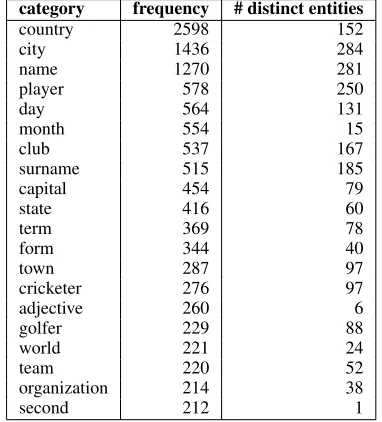
Table 2 summarizes the statistics of category label finding for the training set. Table 3 lists examples of the extracted categories. As can be seen, we could extract more than 1,200 distinct category la-bels. These category labels seem to be useful,
al-12
http://chasen.org/˜taku/software/CRF++
13
We also replaced the optimization module in the original package with that used in the Amis maximum entropy estima-tor (http://www-tsujii.is.s.u-tokyo.ac.jp/amis) since we encoun-tered problems with the provided module in some cases. Al-though this Amis module implements BLMVM (Benson and Mor´e, 2001), which supports the bounding of weights, we did not use this feature in this study (i.e., we just used it as the re-placement for the L-BFGS optimizer in CRF++).
14
We tested 15 points:{0.01,0.02,0.04, . . . ,163.84,327.68}.
Table 2: Statistics of category label finding. search candidates (including duplication) 256,418 candidates having Wikipedia article 39,258 (articles found by redirection) 9,587
first sentence found 38,949
category label extracted 23,885
(skipped “one”) 544
(skipped “kind”) 14
(skipped “sort”) 1
(skipped “type”) 41
(skipped “name of”) 463
[image:5.612.331.522.215.426.2]distinct category labels 1,248
Table 3: Examples of category labels (top 20). category frequency # distinct entities
country 2598 152
city 1436 284
name 1270 281
player 578 250
day 564 131
month 554 15
club 537 167
surname 515 185
capital 454 79
state 416 60
term 369 78
form 344 40
town 287 97
cricketer 276 97
adjective 260 6
golfer 229 88
world 221 24
team 220 52
organization 214 38
second 212 1
though there is no guarantee that the extracted cate-gory label is correct for each candidate.
4.3 Feature comparison
We compared the following features in this experi-ment.
Gazetteer Match (gaz m) This feature represents the matching with a gazetteer entry by using “B”, “I”, and “O” tags. That is, this is the gazetteer version ofwp mbelow.
Gazetteer Category Label (gaz c) This feature represents the matching with a gazetteer entry and its category by using “B-X”, “I-X”, and “O” tags, whereX is one of “PER”, “LOC”, “ORG”, and “MISC”. That is, this is the gazetteer version ofwp cbelow.
Table 4: Statistics of gazetteer and Wikipedia fea-tures. Rows “NEs (%)” show the number of matches that also matched the regions of the named entities in the training data, and the percentage of such named entities (there were 23,499 named entities in total in the training data).
Gazetteer Match (gaz m)
matches 12,397
NEs (%) 6,415 (27.30%)
Wikipedia Match (wp m)
matches 27,779
NEs (%) 16,600 (70.64%)
Wikipedia Category Label (wp c)
matches 18,617
NEs (%) 11,645 (49.56%)
common with gazetteer match 5,664
Wikipedia Category Label (wp c) This feature represents the matching with a Wikipedia entity and its category in the way described Section in 3.3. Note that this feature only fires when the category label is successfully extracted from the Wikipedia article.
For thesegaz m,gaz c,wp m, andwp c, we gener-ate the node features, the edge features, the bigram node features, and the bigram edge features, as de-scribed in Table 1.
Table 4 shows how many matches (the leftmost longest matches that were actually output) were found for gaz m, wp m, and wp c. We omit-ted the numbers for gaz c, since they are same as gaz m. We can see that Wikipedia had more matches than the gazetteer, and covers more named entities (more than 70% of the NEs in the training corpus). The overlap between the gazetteer matches and the Wikipedia matches was moderate as the last row indicates (5,664 out of 18,617 matches). This indicates that Wikipedia has many entities that are not listed in the gazetteer.
We then compared the baseline model (baseline), which uses the feature set in Table 1, with the fol-lowing models to see the effect of the gazetteer fea-tures and the Wikipedia feafea-tures.
(A): + gaz m This uses gaz m in addition to the features inbaseline.
(B): + gaz m, gaz c This usesgaz m andgaz cin addition to the features inbaseline.
(C): + wp m This useswp min addition to the fea-tures inbaseline.
(D): + wp m, wp c This uses wp m and wp c in addition to the features inbaseline.
(E): + gaz m, gaz c, wp m, wp c This uses gaz m,gaz c, wp m, and wp cin addition to the features inbaseline.
(F): + gaz m, gaz c, wp m, wp c (word comb.) This model uses the combination of words (wl) and gaz m, gaz c, wp m, or wp c, in addition to the features of model (E). More specifically, these features are the node feature, wl0 × x0 × y0, the edge feature,
wl0×x0×y−1×y0, the bigram node feature,
wl−1×wl0 ×x−1×x0×y0, and the bigram
edge feature, wl−1×wl0×x−1×x0×y−1×y0,
where x is one of gaz m, gaz c, wp m, and wp c. We tested this model because we thought these combination features could alleviate the problem by incorrectly extracted categories in some cases, if there is a characteristic correlation between words and incorrectly extracted categories.
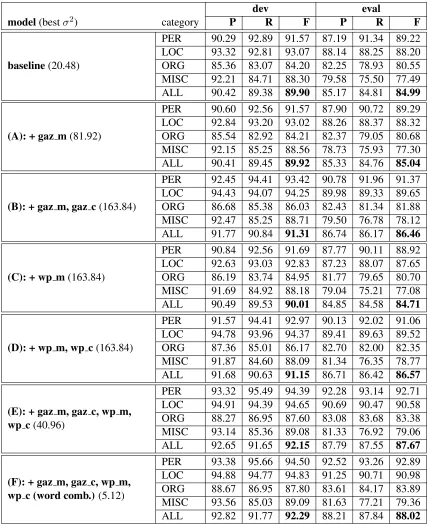
Table 5 shows the performance of these mod-els. The results for (A) and (C) indicate that the matching information alone does not improve ac-curacy. This is because entity regions can be iden-tified fairly correctly if models are trained using a sufficient amount of training data. The category la-bels, on the other hand, are actually important for improvement as the results for (B) and (D) indicate. The gazetteer model, (B), improved F-measure by 1.47 points from the baseline. The Wikipedia model, (D), improved F-measure by 1.58 points from the baseline. The effect of the gazetteer feature,gaz c, and the Wikipedia features, wp c, did not differ much. However, it is notable that the Wikipedia fea-ture, which is obtained by our very simple method, achieved such an improvement easily.
Table 5: Effect of gazetteer and Wikipedia features.
dev eval
model(bestσ2) category P R F P R F
baseline(20.48)
PER 90.29 92.89 91.57 87.19 91.34 89.22
LOC 93.32 92.81 93.07 88.14 88.25 88.20
ORG 85.36 83.07 84.20 82.25 78.93 80.55
MISC 92.21 84.71 88.30 79.58 75.50 77.49
ALL 90.42 89.38 89.90 85.17 84.81 84.99
(A): + gaz m(81.92)
PER 90.60 92.56 91.57 87.90 90.72 89.29
LOC 92.84 93.20 93.02 88.26 88.37 88.32
ORG 85.54 82.92 84.21 82.37 79.05 80.68
MISC 92.15 85.25 88.56 78.73 75.93 77.30
ALL 90.41 89.45 89.92 85.33 84.76 85.04
(B): + gaz m, gaz c(163.84)
PER 92.45 94.41 93.42 90.78 91.96 91.37
LOC 94.43 94.07 94.25 89.98 89.33 89.65
ORG 86.68 85.38 86.03 82.43 81.34 81.88
MISC 92.47 85.25 88.71 79.50 76.78 78.12
ALL 91.77 90.84 91.31 86.74 86.17 86.46
(C): + wp m(163.84)
PER 90.84 92.56 91.69 87.77 90.11 88.92
LOC 92.63 93.03 92.83 87.23 88.07 87.65
ORG 86.19 83.74 84.95 81.77 79.65 80.70
MISC 91.69 84.92 88.18 79.04 75.21 77.08
ALL 90.49 89.53 90.01 84.85 84.58 84.71
(D): + wp m, wp c(163.84)
PER 91.57 94.41 92.97 90.13 92.02 91.06
LOC 94.78 93.96 94.37 89.41 89.63 89.52
ORG 87.36 85.01 86.17 82.70 82.00 82.35
MISC 91.87 84.60 88.09 81.34 76.35 78.77
ALL 91.68 90.63 91.15 86.71 86.42 86.57
(E): + gaz m, gaz c, wp m, wp c(40.96)
PER 93.32 95.49 94.39 92.28 93.14 92.71
LOC 94.91 94.39 94.65 90.69 90.47 90.58
ORG 88.27 86.95 87.60 83.08 83.68 83.38
MISC 93.14 85.36 89.08 81.33 76.92 79.06
ALL 92.65 91.65 92.15 87.79 87.55 87.67
(F): + gaz m, gaz c, wp m, wp c (word comb.)(5.12)
PER 93.38 95.66 94.50 92.52 93.26 92.89
LOC 94.88 94.77 94.83 91.25 90.71 90.98
ORG 88.67 86.95 87.80 83.61 84.17 83.89
MISC 93.56 85.03 89.09 81.63 77.21 79.36
70 72 74 76 78 80 82 84 86 88
100 200 300 400 500 600 700 800 900 1000
F
training size (documents) baseline
+wp_m +wp_m, wp_c
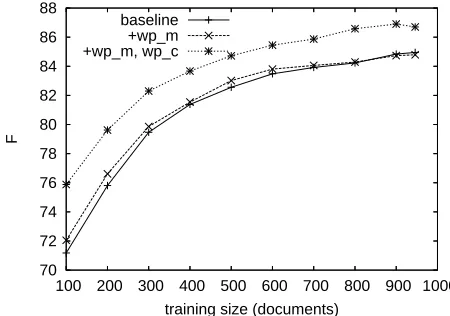
Figure 1: Relation between the training size and the accuracy.
and the Wikipedia feature was not so large. If we consider model (B) a practical baseline, we can say that the Wikipedia features improved the accuracy in F-measure by 1.21 points.
We can also see that the effect of the gazetteer features and the Wikipedia features were consistent irrespective of categories (i.e., PER, LOC, ORG, or MISC) and performance measures (i.e., precision, recall, or F-measure). This indicates that gazetteer-type features are reliable as features for NER.
The final model, (F), achieved 88.02 in F-measure. This is greater than that of the baseline by 3.03 points, showing the usefulness of the gazetteer type features.
4.4 Effect of training size
[image:8.612.74.299.67.225.2]We observed in the previous experiment that the matching information alone was not useful. How-ever, the situation may change if the size of the train-ing data becomes small. We thus observed the effect of the training size for the Wikipedia featureswp m andwp c (we used σ2 = 10.24). Figure 1 shows the result. As can be seen, the matching information had a slight positive effect when the size of training data was small. For example, it improved F-measure by 0.8 points from the baseline at 200 documents. However, the superiority of category labels over the matching information did not change. The effect of category labels became greater as the training size became smaller. Its effect compared with the match-ing information alone was 3.01 points at 200 docu-ments, while 1.91 points at 964 documents (i.e., the whole training data).
Table 6: Breakdown of improvements and errors. (B)→(E) num. g¯∧w¯ g¯∧w g∧w¯ g∧w inc→inc 442 219 123 32 68
inc→cor 102 28 56 3 15
cor→inc 56 28 13 7 8
cor→cor 5,342 1,320 1,662 723 1,637
4.5 Improvement and error analysis
We analyze the improvements and the errors caused by using the Wikipedia features in this section.
We compared the output of (B) and (E) for the de-velopment set. There were 5,942 named entities in the development set. We assessed how the labeling for these entities changed between (B) and (E). Note that the labeling for 199 sentences out of total 3,466 sentences was changed. Table 6 shows the break-down of the improvements and the errors. “inc” in the table means that the model could not label the entity correctly, i.e., the model could not find the en-tity region at all, or it assigned an incorrect category to the entity. “cor” means that the model could label the entity correctly. The column, “inc→cor”, for example, has the numbers for the entities that were labeled incorrectly by (B) but labeled correctly by (E). We can see from the column, “num”, that the number of improvements by (E) exceeded the num-ber of errors introduced by (E) (102 vs. 56). Table 6 also shows how the gazetteer feature, gaz c, and the Wikipedia feature,wp c, fired in each case. We mean that the gazetteer feature fired by using “g”, and that the Wikipedia feature fired by using “w”. “g¯” and “w¯” mean that the feature did not fire. As is the case for other machine learning methods, it is difficult to find a clear reason for each improve-ment or error. However, we can see that the number of¯g∧w exceeded those of other cases in the case of “inc→cor”, meaning that the Wikipedia feature contributed the most.
Finally, we show an example of case inc → cor in Figure 2. We can see that “Gazzetta dello Sport” in the sentence was correctly labeled as an entity of “ORG” category by model (E), because the Wikipedia feature identified it as a newspaper en-tity.15
15
O O O O B-LOC
Sentence No. 584
UEFA came down heavily on Belgian club Standard Liege on Friday for " disgraceful behaviour " in an Intertoto final match against Karlsruhe of Germany .
B-ORG O O O O O O B-ORG O O O O O O O O O O O O O O B-LOC O O O
B-body O O O O
B-country O B-club I-club O O O O O O O O O
B-competition O O O B-city O
B-country O
B-ORG O O O O B-MISC O B-ORG
I-ORG O O O O O O O O O B-MISC O O O B-ORG O B-LOC O
B-ORG O O O O B-MISC O B-ORG
I-ORG O O O O O O O O O B-LOC O O O B-ORG O B-LOC O
B-ORG O O O O B-MISC O B-ORG
I-ORG O O O O O O O O O B-MISC O O O B-ORG O B-LOC O
Sentence No. 591
ATHLETICS - HARRISON , EDWARDS TO MEET IN SARAJEVO .
O O O O O O O O O O
O O O O O O O O O O
O O B-PER O B-PER O O O B-LOC O O O B-PER O B-LOC O O O B-LOC O O O B-PER O B-ORG O O O B-LOC O
Sentence No. 596
Edwards was quoted as saying : " What type of character do we show by going to the IAAF Grand Prix Final in Milan where there is a lot of money to make but refusing to make the trip to Sarajevo as a humanitarian gesture ? "
B-PER O O O O O O O O O O O O O O O O O B-ORG B-MISCMISCI- O O B-PER O O O O O O O O O O O O O O O O B-LOC O O O O O O
O O O O O O O O O O O O O O O O O O B-2003 I-2003 2003I- I-2003 O B-city O O O O O O O O O O O O O O O O B-city O O O O O O
B-PER O O O O O O O O O O O O O O O O O B-MISC I-MISC I-MISC I-MISCO
B-LOC O O O O O O O O O O O O O O O O B-LOC O O O O O O
B-PER O O O O O O O O O O O O O O O O O B-ORG I-ORG I-ORG I-ORG I-ORG
I-ORG O O O O O O O O O O O O O O O O B-LOC O O O O O O
B-PER O O O O O O O O O O O O O O O O O B-ORG I-ORG ORGI- I-ORG O B-LOC O O O O O O O O O O O O O O O O B-LOC O O O O O O
Sentence No. 604
SOCCER - MILAN 'S LENTINI MOVES TO ATALANTA .
O O O O O O O O O
O O B-missile O O O O O O
O O B-ORG O B-PER O O B-ORG O O O B-PER O B-PER O O B-ORG O O O B-ORG O B-PER O O B-ORG O
Sentence No. 607
The Gazzetta dello Sport said the deal would cost Atalanta around $ 600,000 .
O O O B-ORG O O O O O B-ORG O O O O
O B-newspaper I-newspaper I-newspaper O O O O O B-character O O O O O B-ORG I-ORG I-ORG O O O O O B-ORG O O O O O B-LOC O B-ORG O O O O O B-ORG O O O O O B-ORG I-ORG I-ORG O O O O O B-ORG O O O O
Sentence No. 610
The move toBergamo-based Atalanta reunites Lentini , who fell out withex-Milancoach Fabio Capello last season , with his former coach at Torino , Emiliano Mondonico .
O O O O B-ORG O B-PER O O O O O O O B-PER O O O O O O O O O B-LOC O B-PER O O
O O O O B-characterO B-town O O O O O O O coachesB- I-coachesO O O O O O O OB-businessOB-manager I-manager O
O O O B-MISC B-ORG O B-PER O O O O O B-MISCO B-PER I-PER O O O O O O O O B-ORG O B-PER I-PER O
O O O B-MISC B-ORG O B-PER O O O O O O O B-PER I-PER O O O O O O O O B-LOC O B-PER I-PER O
O O O B-MISC B-ORG O B-ORG O O O O O O O B-PER I-PER O O O O O O O O B-LOC O B-PER I-PER O
Sentence No. 653
Did not bat : Dharmasena , Vaas , Muralitharan .
O O O O O O O O O O
O O O O O O B-cricketer O B-cricketer O O O O O B-PER O B-PER O B-PER O O O O O B-PER O B-LOC O B-LOC O
[image:9.612.69.542.60.142.2]- gaz_c
- wp_c
- correct
- (B)
- (C)
- gaz_c - wp_c - correct - (B) - (E)Figure 2: An example of improvement caused by Wikipedia feature.
5 Discussion and Future Work
We have empirically shown that even category la-bels extracted from Wikipedia by a simple method such as ours really improves the accuracy of a NER model. The results indicate that structures in Wikipedia are suited for knowledge extraction. However, the results also indicate that there is room for improvement, considering that the effects of gaz c and wp c were similar, while the matching rate was greater for wp c. An issue, which we should treat, is the disambiguation of ambiguous entities. Our method worked well although it was very simple, presumably because of the following reason. (1) If a retrieved page is a disambiguation page, we cannot extract a category label and critical noise is not introduced. (2) If a retrieved page is not a disambiguation page, it will be the page describ-ing the major meandescrib-ing determined by the agreement of many authors. The extracted categories are use-ful for improving accuracy because the major mean-ing will be used frequently in the corpus. How-ever, it is clear that disambiguation techniques are required to achieve further improvements. In ad-dition, if Wikipedia grows at the current rate, it is possible that almost all entities become ambiguous and a retrieved page is a disambiguation page most of the time. We will need a method for finding the most suitable article from the articles listed in a dis-ambiguation page.
An interesting point in our results is that Wikipedia category labels improved accuracy, al-though they were much more specific (more than 1,200 categories) than the four categories of the CoNLL 2003 dataset. The correlation between a Wikipedia category label and a category label of NER (e.g., “musician” to “PER”) was probably learned by a CRF tagger. However, the merit of using such specific Wikipedia labels will be much
greater when we aim at developing NER systems for more fine-grained NE categories such as proposed in Sekine et al. (2002) or Shinzato et al. (2006). We thus would like to investigate the effect of the Wikipedia feature for NER with such fine-grained categories as well. Disambiguation techniques will be important again in that case. Although the impact of ambiguity will be small as long as the target egories are abstract and an incorrectly extracted cat-egory is in the same abstract catcat-egory as the correct one (e.g., extracting “footballer” instead of “crick-eter”), such mis-categorization is critical if it is nec-essary to distinguish footballers from cricketers.
6 Conclusion
We tried to exploit Wikipedia as external knowledge to improve NER. We extracted a category label from the first sentence of a Wikipedia article and used it as a feature of a CRF-based NE tagger. The experi-ments using the CoNLL 2003 NER dataset demon-strated that category labels extracted by such a sim-ple method really improved accuracy. However, dis-ambiguation techniques will become more impor-tant as Wikipedia grows or if we aim at more fine-grained NER. We thus would like to incorporate a disambiguation technique into our method in future work. Exploiting Wikipedia structures such as dis-ambiguation pages and link structures will be the key in that case as well.
References
S. J. Benson and J. J. Mor´e. 2001. A limited mem-ory variable metric method for bound constraint min-imization. Technical Report ANL/MCS-P909-0901, Argonne National Laboratory.
D. M. Bikel, R. L. Schwartz, and R. M. Weischedel.
1999. An algorithm that learns what’s in a name.
R. Bunescu and M. Pas¸ca. 2006. Using encyclopedic
knowledge for named entity disambiguation. InEACL
2006.
H. Daum´e III and D. Marcu. 2005. Learning as search optimization: Approximate large margin methods for
structured prediction. InICML 2005.
O. Etzioni, M. Cafarella, D. Downey, A. M. Popescu, T. Shaked, S. Soderland, D. S. Weld, and A. Yates. 2005. Unsupervised named-entity extraction from the
web – an experimental study. Artificial Intelligence
Journal.
J. Kazama and K. Torisawa. 2007. A new perceptron al-gorithm for sequence labeling with non-local features. InEMNLP-CoNLL 2007.
J. Lafferty, A. McCallum, and F. Pereira. 2001. Con-ditional random fields: Probabilistic models for
seg-menting and labeling sequence data. In ICML 2001,
pages 282–289.
D. Nadeau, Peter D. Turney, and Stan Matwin. 2006. Unsupervised named-entity recognition: Generating
gazetteers and resolving ambiguity. In19th Canadian
Conference on Artificial Intelligence.
S. P. Ponzetto and M. Strube. 2006. Exploiting semantic role lebeling, WordNet and Wikipedia for coreference
resolution. InNAACL 2006.
L. R. Rabiner. 1989. A tutorial on hidden Markov mod-els and selected applications in speech recognition. Proceedings of the IEEE, 77(2):257–286.
E. Riloff and R. Jones. 1999. Learning dictionaries for information extraction by multi-level bootstrapping. In16th National Conference on Artificial Intelligence (AAAI-99).
M. Ruiz-Casado, E. Alfonseca, and P. Castells. 2006. From Wikipedia to semantic relationships: a
semi-automated annotation approach. In Third European
Semantic Web Conference (ESWC 2006).
S. Sekine, K. Sudo, and C. Nobata. 2002. Extended
named entity hierarchy. InLREC ’02.
K. Shinzato, S. Sekine, N. Yoshinaga, and K. Tori-sawa. 2006. Constructing dictionaries for named en-tity recognition on specific domains from the Web. In Web Content Mining with Human Language Technolo-gies Workshop on the 5th International Semantic Web.
M. Strube and S. P. Ponzetto. 2006. WikiRelate!
com-puting semantic relatedness using Wikipedia. InAAAI
2006.
P. P. Talukdar, T. Brants, M. Liberman, and F. Pereira. 2006. A context pattern induction method for named
entity extraction. InCoNLL 2006.
M. Thelen and E. Riloff. 2002. A bootstrapping method for learning semantic lexicons using extraction pattern
context. InEMNLP 2002.
E. F. Tjong, K. Sang, and F. De Meulder. 2003. Intro-duction to the CoNLL-2003 shared task:
Language-independent named entity recognition. In CoNLL
2003.
A. Toral and R. Mu˜noz. 2006. A proposal to automat-ically build and maintain gazetteers for named entity
recognition by using Wikipedia. InEACL 2006.
T. Zesch, I. Gurevych, and M. M¨ohlh¨auser. 2007. Ana-lyzing and accessing Wikipedia as a lexical semantic
resource. InBiannual Conference of the Society for