Proceedings of the 2012 Joint Conference on Empirical Methods in Natural Language Processing and Computational Natural
A Comparison of Vector-based Representations for Semantic Composition
William BlacoeandMirella Lapata
Institute for Language, Cognition and Computation School of Informatics, University of Edinburgh
10 Crichton Street, Edinburgh EH8 9AB [email protected], [email protected]
Abstract
In this paper we address the problem of modeling compositional meaning for phrases and sentences using distributional methods. We experiment with several possible com-binations of representation and composition, exhibiting varying degrees of sophistication. Some are shallow while others operate over syntactic structure, rely on parameter learn-ing, or require access to very large corpora. We find that shallow approaches are as good as more computationally intensive alternatives with regards to two particular tests: (1) phrase similarity and (2) paraphrase detection. The sizes of the involved training corpora and the generated vectors are not as important as the fit between the meaning representation and compositional method.
1 Introduction
Distributional models of semantics have seen con-siderable success at simulating a wide range of be-havioral data in tasks involving semantic cognition and also in practical applications. For example, they have been used to model judgments of semantic sim-ilarity (McDonald, 2000) and association (Denhire and Lemaire, 2004; Griffiths et al., 2007) and have been shown to achieve human level performance on synonymy tests (Landauer and Dumais, 1997; Griffiths et al., 2007) such as those included in the Test of English as a Foreign Language (TOEFL). This ability has been put to practical use in numer-ous natural language processing tasks such as au-tomatic thesaurus extraction (Grefenstette, 1994),
word sense discrimination (Sch¨utze, 1998), lan-guage modeling (Bellegarda, 2000), and the iden-tification of analogical relations (Turney, 2006).
While much research has been directed at the most effective ways of constructing representations for individual words, there has been far less sensus regarding the representation of larger con-structions such as phrases and sentences. The prob-lem has received some attention in the connection-ist literature, particularly in response to criticisms of the ability of connectionist representations to handle complex structures (Smolensky, 1990; Plate, 1995). More recently, several proposals have been put for-ward for computing the meaning of word combina-tions in vector spaces. This renewed interest is partly due to the popularity of distributional methods and their application potential to tasks that require an un-derstanding of larger phrases or complete sentences. For example, Mitchell and Lapata (2010)
intro-duce a general framework for studying vector
com-position, which they formulate as a function f of
two vectorsu and v. Different composition
mod-els arise, depending on how f is chosen. Assuming
that composition is a linear function of the Cartesian
product ofu andv allows to specifyadditive
mod-els which are by far the most common method of vector combination in the literature (Landauer and Dumais, 1997; Foltz et al., 1998; Kintsch, 2001). Alternatively, assuming that composition is a linear function of the tensor product ofuandv, gives rise
to models based onmultiplication.
One of the most sophisticated proposals for se-mantic composition is that of Clark et al. (2008) and the more recent implementation of Grefenstette and
Sadrzadeh (2011a). Using techniques from logic, category theory, and quantum information they de-velop a compositional distributional semantics that brings type-logical and distributional vector space models together. In their framework, words belong to different type-based categories and different cate-gories exist in different dimensional spaces. The cat-egory of a word is decided by the number and type of adjoints (arguments) it can take and the composition of a sentence results in a vector which exists in sen-tential space. Verbs, adjectives and adverbs act as re-lational functions, are represented by matrices, and modify the properties of nouns, that are represented by vectors (see also Baroni and Zamparelli (2010) for a proposal similar in spirit). Clarke (2012) intro-duces context-theoretic semantics, a general frame-work for combining vector representations, based on a mathematical theory of meaning as context, and shows that it can be used to describe a variety of models including that of Clark et al. (2008).
Socher et al. (2011a) and Socher et al. (2011b) present a framework based on recursive neural net-works that learns vector space representations for multi-word phrases and sentences. The network is given a list of word vectors as input and a binary tree representing their syntactic structure. Then, it
computes ann-dimensional representationpof two
n-dimensional children and the process is repeated at every parent node until a representation for a full tree is constructed. Parent representations are com-puted essentially by concatenating the representa-tions of their children. During training, the model tries to minimize the reconstruction errors between the n-dimensional parent vectors and those repre-senting their children. This model can also compute compositional representations when the tree struc-ture is not given, e.g., by greedily inferring a binary tree.
Although the type of function used for vector composition has attracted much attention, relatively less emphasis has been placed on the basic distri-butional representations on which the composition functions operate. In this paper, we examine three types of distributional representation of increasing sophistication and their effect on semantic composi-tion. These include a simple semantic space, where a word’s vector represents its co-occurrence with neighboring words (Mitchell and Lapata, 2010),
a syntax-aware space based on weighted distribu-tional tuples that encode typed co-occurrence rela-tions among words (Baroni and Lenci, 2010), and word embeddings computed with a neural language model (Bengio, 2001; Collobert and Weston, 2008). Word embeddings are distributed representations, low-dimensional and real-valued. Each dimension of the embedding represents a latent feature of the word, hopefully capturing useful syntactic and se-mantic properties.
Using these representations, we construct several compositional models, based on addition, multipli-cation, and recursive neural networks. We assess the effectiveness of these models using two evalua-tion protocols. The first one involves modeling sim-ilarity judgments for short phrases gathered in hu-man experiments (Mitchell and Lapata, 2010). The second one is paraphrase detection, i.e., the task of examining two sentences and determining whether they have the same meaning (Socher et al., 2011a). We find that shallow approaches are as good as more computationally intensive alternatives. They achieve considerable semantic expressivity without any learning, sophisticated linguistic processing, or access to very large corpora.
Our contributions in this work are three-fold: an empirical comparison of a broad range of composi-tional models, some of which are introduced here for the first time; the use of an evaluation methodology that takes into account the full spectrum of compo-sitionality from phrases to sentences; and the em-pirical finding that relatively simple compositional models can be used to perform competitively on the paraphrase detection and phrase similarity tasks.
2 Modeling
The elementary objects that we operate on are
vec-tors associated with words. We instantiate these
word representations following three distinct seman-tic space models which we describe in Section 2.1
below. Analogously, in Section 2.2 we consider
2.1 Word Representations
For all of our experiments we employ column vec-tors from a Cartesian, finitely-dimensional space. The dimensionality will depend on the source of the vectors involved. Similarly, the component val-ues inside each source’s vectors are not to be inter-preted in the same manner. Nonetheless, they have in common that they originate from distributive cor-pus statistics.
Co-occurence-based Semantic Space Word meaning is commonly represented in a high-dimensional space, where each component corre-sponds to some contextual element in which the
word is found. The contextual elements can be
words themselves, or larger linguistic units such as sentences or documents, or even more complex lin-guistic representations such as the argument slots of predicates. A semantic space that is often employed in studying compositionality across a variety of tasks (Mitchell and Lapata, 2010; Grefenstette and Sadrzadeh, 2011a) uses a context window of five words on either side of the target word, and 2,000 vector dimensions. These are the common context words in the British National Corpus (BNC), a corpus of about 100 million tokens. Their values are set to the ratio of the probability of the context word given the target word to the probability of the context word overall.
More formally, let us consider the BNC as a set of sentences:
BNC={Sen(1BNC), ...,Sen(nBNCBNC)} (1)
where the i-th sentence is a sequence of words
Seni = (w( i)
1 , ...,w
(i)
ni) from the BNC’s vocabulary
VocBNC. Then f reqw is the amount of times
that each word w∈VocBNC appears in the BNC.
Mitchell and Lapata (2010) collect the M most
frequent non-stoplist words in the set ctxttop =
{w(1top), ...,w(Mtop)} and let them consitute the word vectors’ dimensions. Each dimension’s value is ob-tained from a co-occurrence count:
coCountw[j] = nBNC
∑
i=1 ni
∑
t=1
(2)
|{k∈[t−5;t+5]|w(ti)=w,w
(i)
k =w
(top)
j }|
forw∈VocBNCandj=1, ...,M. Using these counts,
they define word vectors component-wise.
wdVec(wr p)[j] =
p(w(jtop)|w)
p(w(jtop))
= (3)
coCountw[j]
f reqw
×totalCount f req
w(jtop)
for j=1, ...,M, wheretotalCount is the total num-ber of words in the BNC.
This space is relatively simple, it has few param-eters, requires no preprocessing other than tokeniza-tion and involves no syntactic informatokeniza-tion or param-eter learning. Despite its simplicity, it is a good start-ing point for studystart-ing representations for composi-tional models as a baseline against which to evaluate more elaborate models.
Neural Language Model Another perhaps less well-known approach to meaning representation is to represent words as continuous vectors of param-eters. Such word vectors can be obtained with an
unsupervisedneural language model(NLM, Bengio
(2001); Collobert and Weston (2008)) which jointly learns an embedding of words into a vector space and uses these vectors to predict how likely a word is, given its context.
We induced word embeddings with Collobert and Weston (2008)’s neural language model. The model is discriminative and non-probabilistic. Each
word i ∈
D
(the vocabulary) is embedded into ad-dimensional space using a lookup tableLTW(·):
LTW(i) =Wi (4)
whereW ∈Rd×|D| is a matrix of parameters to be
learned. Wi∈Rd is the i-th column ofW andd is
the word vector size to be chosen by the user. The
parametersW are automatically trained during the
learning process using backpropagation.
Specifically, at each training update, the model reads an n-gram x = (w1, . . . ,wn) from the
cor-pus. Then-gram is paired with acorrupted n-gram
˜
x= (w1, . . . ,w˜n)where ˜wn6=wnis chosen uniformly
from the vocabulary. The model concatenates the
learned embeddings of the n words and predicts a
score for then-gram sequence using the learned
n-grams that are present in the training corpus must have a score at least some margin higher than the
corruptedn-grams. The model learns via gradient
descent over the neural network parameters and the embedding lookup table. Word vectors are stored in a word embedding matrix which captures syntactic and semantic information from co-occurrence statis-tics. As these representations are learned, albeit in an unsupervised manner, one would hope that they capture word meanings more succinctly, compared to the simpler distributional representations that are merely based on co-occurrence.
We trained the neural language model on the BNC. We optimized the model’s parameters on a word similarity task using 4% of the BNC as de-velopment data. Specifically, we used WordSim353, a benchmark dataset (Finkelstein et al., 2001), con-sisting of relatedness judgments (on a scale of 0 to 10) for 353 word pairs. We experimented with vectors of varying dimensionality (ranging from 50 to 200, with a step size of 50). The size of the target word’s context window was 2, 3 and 4 in turn. The rate at which embeddings were learned ranged from 3.4×10⁻¹⁰ to 6.7×10⁻¹⁰ to 10−9. We ran each training process for 1.1×10⁸to 2.7×10⁸iterations (ca. 2 days). We obtained the best results with 50 dimensions, a context window of size 4, and a
em-bedding learning rate of 10−9. The NLM with these
parameters was then trained for 1.51×10⁹iterations (ca. 2 weeks).
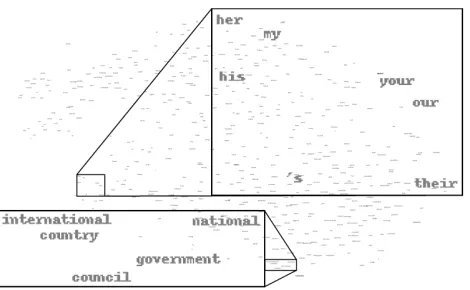
Figure 1 illustrates a two-dimensional projection of the embeddings for the 500 most common words in the BNC. We only show two out of the actual 50 dimensions involved, but one can already begin to see clusterings of a syntactic and semantic na-ture. In one corner, for example, we encounter a grouping of possessive pronouns together with the
possessive clitic’s. The singular onesmy, her and
hisare closely positioned, as are the plural onesour, your andtheir. Also, there is a clustering of
socio-political terms, such as international, country,
na-tional,government, andcouncil.
[image:4.612.312.547.57.202.2]Distributional Memory Tensor Baroni and Lenci (2010) present Distributional Memory, a general-ized framework for distributional semantics from which several special-purpose models can be de-rived. In their framework distributional information
Figure 1: A two-dimensional projection of the word em-beddings we trained on the BNC using Turian et al.’s (2010) implementation of the NLM. Two small sections have been blown up to a legible scale. They show exam-ples of syntactic and semantic clustering, respectively.
wordw linkl co-wordv valuec
1950s-n of essence-n 2.4880
1950s-n during bring-v 16.4636
Anyone-n nmod reaction-n 1.2161
American-n coord-1 athlete-n 5.6485
American-j nmod wasp-n 3.4945
American-n such as-1 country-n 14.4269
[image:4.612.312.537.286.397.2]American-n sbj tr build-v 23.1014
Table 1: Example entries in Baroni and Lenci (2010)’s tensor
is extracted from the corpus once, in the form of a set of weighted word-link-word tuples arranged into a third-order tensor. Different matrices are then gen-erated from the tensor, and their rows and columns give rise to different semantic spaces appropriate for capturing different semantic problems. In this way, the same distributional information can be shared across tasks such as word similarity or analogical learning.
More formally, Baroni and Lenci (2010)
con-struct a 3-dimensional tensorT assigning a valuec
to instances of word pairs w,v and a connecting
link-word l. This representation operates over a
dependency-parsed corpus and the scoresc are
ob-tained via counting the occurrences of tuples, and weighting the raw counts by mutual information. Table 1 presents examples of tensor entries. These
were taken from a distributional memory tensor1
frequency linkl co-wordv
17059 obj include-v
16713 obj use-v
16573 obj call-v
16475 obj see-v
15962 obj make-v
15707 nmod-1 other-j
15554 nmod-1 new-j
15224 obj find-v
15221 nmod-1 more-j
14715 nmod-1 first-j
[image:5.612.103.263.58.227.2]14348 obj give-v
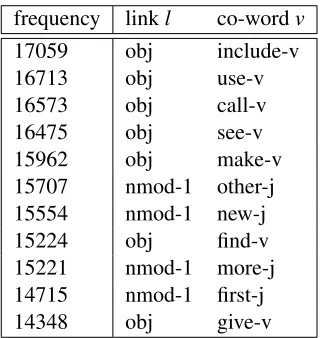
Table 2: The 11 most frequent contexts in Baroni and Lenci (2010)’s tensor (v and j represent verbs and adjec-tives, respectively).
that Baroni and Lenci obtained via preprocessing several corpora: the web-derived ukWac corpus of about 1.915 billion words, a mid-2009 dump of the English Wikipedia containing about 820 million words, and the BNC.
Extracting a 3-dimensional tensor from the BNC alone would create very sparse representations. We therefore extract so-called word-fibres, essen-tially projections onto a lower-dimensional sub-space, from the same tensor Baroni and Lenci (2010) collectively derived from the 3 billion word corpus just described (henceforth 3-BWC). We view the 3-dimensional tensor
T ={(w(1T),l1(T),v(1T),c(1T)), ...} (5)
as a mapping which assigns each target word w a
non-zero valuec, given the context(l,v). All
word-context combinations not listed in T are implicitly
assigned a zero value.
Now we consider two possible approaches for obtaining vectors, depending on their application.
First, we let theDmost frequent contexts
ctxtD={(l1,v1), ...,(lD,vD)} (6)
constitute the D dimensions that each word
vec-tor will have. Table 2 shows the 11 contexts(l,v)
that appear most frequently inT. Thus, each target
word’s vector is defined component-wise as:
wdVecw[j] =
c, if(w,lj,vj,c)∈T
0, otherwise (7)
for j=1, ...,D. This approach is used when a fixed vector dimensionality is necessary.
A more dynamic approach is possible when very few words w1, ...,wn are involved in a test. Their
representations can then have a denser format, that is, with no zero-valued components. For this we identify the set of contexts common to the words in-volved,
ctxtdyn={(l
(dyn)
1 ,v
(dyn)
1 ),(l
(dyn)
2 ,v
(dyn)
2 ), ...} (8)
={(l,v)|(wi,l,v,c)∈T,c∈R,i=1, ...,n}
Each context(l,v)again constitutes a vector dimen-sion. The dimensionality varies strongly
depend-ing on the selection of words, but ifndoes not
ex-ceed 4, the dimensionality|ctxtdyn|will typically be
substantial enough. In this approach, each word’s vector consists of the valuescfound along with that word and its context in the tensor.
wdVecwi[j] =c, (9)
where(wi,l
(dyn)
j ,v
(dyn)
j ,c)∈T, for j=1, ...,|ctxtdyn|.
2.2 Composition Methods
In our experiments we compose word vectors to cre-ate representations for phrase vectors and sentence vectors. The phrases we are interested in consist of
two words each: an adjective and a noun likeblack
hair, a compound noun made up of two nouns such asoil industry, or a verbal phrase with a transitive verb and an object noun, e.g.,pour tea.
Conceiving of a phrasephr= (w1,w2)as a binary
tuple of words, we obtain its vector from its words’ vectors either by addition:
phrVec(w1,w2)=wdVecw1+wdVecw2 (10)
or by point-wise multiplication:
phrVec(w1,w2)=wdVecw1wdVecw2 (11)
In the same way we acquire a vectorsenVeci
rep-resenting a sentence Seni= (w( i)
1 , ...,w
(i)
ni ) from the
vectors forw1, ...,wni. We simply sum the existing
word vectors, that is, vectors obtained via the respec-tive corpus for words that are not on our stoplist:
senVec(+)i [j] =
∑
k=1,...,niwdVecwkexists
And do the same with point-wise multiplication:
senVec(i)[j] =
∏
k=1,...,niwdVecwkexists
wdVecwk[j] (13)
The multiplication model in (13) can be seen as an instantiation of the categorical compositional frame-work put forward by Clark et al. (2008). In fact, a variety of multiplication-based models can be de-rived from this framework; and comparisons against component-wise multiplication on phrase similar-ity tasks yield comparable results (Grefenstette and Sadrzadeh, 2011a; Grefenstette and Sadrzadeh, 2011b). We thus opt for the model (13) as an exam-ple of compositional models based on multiplication due to its good performance across a variety of tasks, including language modeling and prediction of read-ing difficulty (Mitchell, 2011).
Our third method, for creating phrase and sen-tence vectors alike, is the application of Socher et al. (2011a)’s model. They use the Stanford parser (Klein and Manning, 2003) to create a binary parse tree for each input phrase or sentence. This tree is then used as the basis for a deep recursive autoen-coder (RAE). The aim is to construct a vector rep-resentation for the tree’s root bottom-up where the leaves contain word vectors. The latter can in the-ory be provided by any type of semantic space, how-ever Socher et al. use word embeddings provided by the neural language model (Collobert and Weston, 2008).
Given the binary tree input structure, the model
computes parent representations p from their
chil-dren(c1,c2)using a standard neural network layer:
p= f(W(1)[c1;c2] +b(1)), (14)
where [c1;c2] is the concatenation of the two
chil-dren, f is an element-wise activation function such
as tanh, b is a bias term, andW ∈Rn×2n is an
en-coding matrix that we want to learn during training.
One way of assessing how well p represents its
di-rect children is to decode their vectors in a recon-struction layer:
[c01;c02] = f(W(2)p+b(2)) (15)
During training, the goal is to minimize the re-construction errors of all input pairs at
nontermi-nal nodes p in a given parse tree by computing the
square of the Euclidean distance between the origi-nal input and its reconstruction:
Erec([c1;c2]) =
1
2|[c1;c2]−[c
0 1;c
0
2]|2 (16)
Socher et al. (2011a) extend the standard re-cursive autoencoder sketched above in two ways. Firstly, they present an unfolding autoencoder that tries to reconstruct all leaf nodes underneath each node rather than only its direct children. And sec-ondly, instead of transforming the two children di-rectly into a parentp, they introduce another hidden layer inbetween.
We obtained three compositional models per rep-resentation resulting in nine compositional mod-els overall. Plugging different representations into the additive and multiplicative models is relatively straightforward. The RAE can also be used with arbitrary word vectors. Socher et al. (2011a) ob-tain best results with 100-dimensional vectors which
we also used in our experiments. NLM vectors
were trained with this dimensionality on the BNC
for 7.9×10⁸iterations (with window size 4 and an
embedding learning rate of 10−9). We constructed
a simple distributional space withM=100
dimen-sions, i.e., those connected to the 100 most frequent co-occurrence words. In the case of vectors obtained from Baroni and Lenci (2010)’s DM tensor, we dif-ferentiated between phrases and sentences, due to the disparate amount of words contained in them (see Section 2.1). To represent phrases, we used vectors of dynamic dimensionality, since these form a richer and denser representation. The sentences considered in Section 4 are too large for this ap-proach and all word vectors must be members of the same vector space. Hence, these sentence
vec-tors have fixed dimensionalityD=100, consisting
of the “most significant” 100 dimensions, i.e., those reflecting the 100 most frequent contexts.
3 Experiment 1: Phrase Similarity
dim. c.m. Adj-N N-N V-Obj
2000 + 0.37 0.38 0.28
SDS
2000 0.48 0.50 0.35
(BNC)
100 RAE 0.31 0.30 0.28
vary + 0.37 0.30 0.29
DM
vary 0.21 0.37 0.33
(3-BWC)
100 RAE 0.25 0.26 0.09
50 + 0.28 0.26 0.24
NLM
50 0.26 0.22 0.18
(BNC)
[image:7.612.70.300.60.207.2]100 RAE 0.19 0.24 0.28
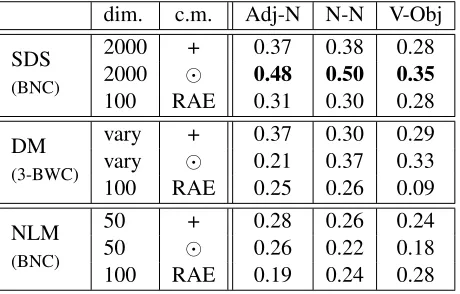
Table 3: Correlation coefficients of model predictions with subject similarity ratings (Spearman’sρ); columns show dimensionality: fixed or varying (see Section 2.1), composition method: +is additive vector composition, is component-wise multiplicative vector composition, RAE is Socher et al. (2011a)’s recursive auto-encoder.
similar manner. Specifically, we used the dataset from Mitchell and Lapata (2010) which contains similarity judgments for adjective-noun, noun-noun and verb-object phrases, respectively.2 Each item is
a phrase pair phr1,phr2 which has a human rating
from 1 (very low similarity) to 7 (very high similar-ity).
Using the composition models described above, we compute the cosine similarity ofphr1andphr2:
phrSimphr1,phr2=
phrVecphr1·phrVecphr2 |phrVecphr1| × |phrVecphr2|
(17)
Model similarities were evaluated against the human similarity ratings using Spearman’sρcorrelation co-efficient.
Table 3 summarizes the performance of the vari-ous models on the phrase similarity dataset. Rows in the table correspond to different vector repre-sentations: the simple distributional semantic space (SDS) from Mitchell and Lapata (2010), Baroni and Lenci’s (2010) distributional memory tensor (DM) and the neural language model (NLM), for each phrase combination: adjective noun (Adj-N),
noun-noun (N-N) and verb object (V-Obj). For each
phrase type we report results for each compositional model, namely additive (+), multiplicative () and recursive autoencoder (RAE). The table also shows
2The dataset is publicly available from http: //homepages.inf.ed.ac.uk/s0453356/share
the dimensionality of the input vectors next to the vector representation.
As can be seen, for SDS the best performing model is multiplication, as it is mostly for DM. With regard to NLM, vector addition yields overall better results. In general, neither DM or NLM in any com-positional configuration are able to outperform SDS with multiplication. All models in Table 3 are sig-nificantly correlated with the human similarity
judg-ments (p<0.01). Spearman’sρ differences of 0.3
or more are significant at the 0.01 level, using a t-test (Cohen and Cohen, 1983).
4 Experiment 2: Paraphrase Detection
Although the phrase similarity task gives a fairly direct insight into semantic similarity and compo-sitional representations, it is somewhat limited in scope as it only considers two-word constructions rather than naturally occurring sentences. Ideally, we would like to augment our evaluation with a task which is based on large quantities of natural data and for which vector composition has practical conse-quences. For these reasons, we used the Microsoft Research Paraphrase Corpus (MSRPC) introduced by Dolan et al. (2004). The corpus consists of sen-tence pairsSeni1,Seni2and labels indicating whether they are in a paraphrase relationship or not. The vec-tor representations obtained from our various com-positional models were used as features for the para-phrase classification task.
The MSRPC dataset contains 5,801 sentence pairs, we used the standard split of 4,076 training pairs (67.5% of which are paraphrases) and 1,725 test pairs (66.5% of which are paraphrases). In order to judge whether two sentences have the same mean-ing we employ Fan et al. (2008)’s liblinear classifier. For each of our three vector sources and three differ-ent compositional methods, we create the following features: (a) a vector representing the pair of input sentences either via concatenation (“con”) or sub-traction (“sub”); (b) a vector encoding which words appear therein (“enc”); and (c) a vector made up of the following four other pieces of information: the cosine similarity of the sentence vectors, the length ofSeni1, the length ofSeni2, and the unigram overlap among the two sentences.
NLM DM SDS
(BNC) (3-BWC) (BNC)
+ 69.04 73.51 72.93
(con, other) (other) (other)
67.83 67.54 73.04
(sub, other) (other) (other)
RAE 70.26 68.29 69.10
[image:8.612.328.521.58.174.2](con, other) (sub, other) (con, other)
Table 4: Paraphrase classification accuracy in %. In-cluded features are in parentheses: “con” is sentence vec-tor concatenation, “sub” is sentence vecvec-tor subtraction, “other” stands for 4 other features (see Section 4)
each sentence and how often, we define a vec-tor wdCounti for sentence Seni and enumerate all
words occuring in the MSRPC:
VocMSRPC={w
(MSRPC)
1 , ...,w
(MSRPC)
nMSRPC } (18)
giving the word count vectors nMSRPC dimensions.
Thus the k-th component of wdCounti is the
fre-quency with which the word w(kMSRPC) appears in
Seni= (w
(i)
1 , ...,w
(i)
ni ):
wdCounti[k] =|{j∈[1;ni]|w( MSRPC)
k =w
(i)
j }| (19)
fork=1, ...,nMSRPC. Even though nMSRPC may be
large, the computer files storing our feature vectors
do not explode in size because wdCount contains
many zeros and the classifier allows a sparse nota-tion of (non-zero) feature values.
Regarding the last four features, we measured the similarity between sentences the same way as we did with phrases in section 3.
senSimi1,i2=
senVeci1 · senVeci2 |senVeci1| × |senVeci2|
(20)
Note that this is the cosine of the angle between senVeci1 andsenVeci2. This enables us to observe the similarity or dissimilarity of two sentences inde-pendent of their sentence length. Even though each contained word increases or decreases the norm of the resulting sentence vector, this does not distort the overall similarity value, due to normalization.
The lengths of Seni1 and Seni2 are simply the
number of words they contain. The unigram over-lap feature value may be viewed as the
cardinal-NLM DM SDS
(BNC) (3-BWC) (BNC)
+ 81.00 82.16 80.76
(con, other) (other) (other)
80.41 80.18 82.33
(sub, other) (other) (other)
RAE 81.28 80.43 80.68
(con, other) (sub, other) (con, other)
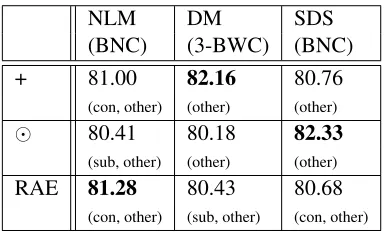
Table 5: Paraphrase classification F1-score in %. The involved features are exactly the same as in Table 4.
ity of the intersection of each sentence’s multiset-bag-of-words. The latter is encoded in the
already-introducedwdCountvectors. Therefore,
uniOverlapi1,i2 = nMSRPC
∑
k=1
min
s=1,2{wdCountis[k]} (21)
In order to establish which features work best for each representation and composition method, we ex-haustively explored all combinations on a develop-ment set (20% of the original MSRPC training set). Tables 4 (accuracy) and 5 (F1) show our results on the test set with the best feature combinations for each model (shown in parentheses). Each row cor-responds to a different type of composition and each column to a different word representation model.
As can be seen, the distributional memory (DM) is the best performing representation for the addi-tive composition model. The neural language model (NLM) gives best results for the recursive autoen-coder (RAE), although the other two representations come close. And finally the simple distributional semantic space (SDS) works best with multiplica-tion. Also note that the best performing models, namely DM with addition and SDS with multipli-cation, use a basic feature space consisting only of the cosine similarity of the composed sentence vec-tors, the length of the two sentences involved, and their unigram word overlap.
[image:8.612.86.279.58.174.2]Model Acc. F1
Baseline 66.5 79.9
Mihalcea et al. (2006) 70.3 81.3
Rus et al. (2008) 70.6 80.5
Qiu et al. (2006) 72.0 81.6
Islam and Inkpen (2007) 72.6 81.3
Mitchell and Lapata (2010) () 73.0 82.3 Baroni and Lenci (2010) (+) 73.5 82.2
Fernando and Stevenson (2008) 74.1 82.4
Wan et al. (2006) 75.6 83.0
Das and Smith (2009) 76.1 82.7
[image:9.612.74.296.59.225.2]Socher et al. (2011a) 76.8 83.6
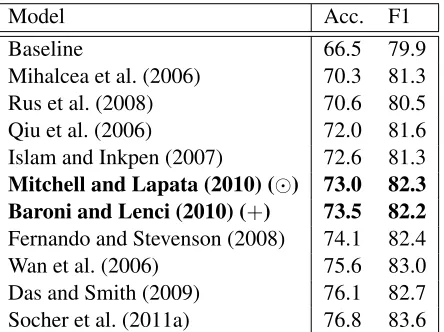
Table 6: Overview of results on the MSRCP (test corpus). Accuracy differences of 3.3 or more are significant at the 0.01 level (using theχ2statistic).
WordNet in conjunction with distributional similar-ity in an attempt to detect meaning conveyed by syn-onymous words (Islam and Inkpen, 2007; Mihalcea et al., 2006; Fernando and Stevenson, 2008). More recently, the addition of syntactic features based on dependency parse trees (Wan et al., 2006; Das and Smith, 2009) has been shown to substantially boost performance. The model of Das and Smith (2009), for example, uses quasi-synchronous depen-dency grammar to model the structure of the sen-tences involved in the comparison and their corre-spondences. Socher et al. (2011a) obtain an accu-racy that is higher than previously published results. This model is more sophisticated than the one we used in our experiments (see Table 4 and 5). Rather than using the output of the RAE as features for the classifier, it applies dynamic pooling, a procedure that takes a similarity matrix as input (e.g., created by sentences with differing lengths) and maps it to a matrix of fixed size that represents more faithfully the global similarity structure.3
Overall, we observe that our own models do as well as some of the models that employ WordNet and more sophisticated syntactic features. With re-gard to F1, we are comparable with Das and Smith (2009) and Socher et al. (2011a) without using elab-orate features, or any additional manipulations over and above the output of the composition functions
3Without dynamic pooling, their model yields an accuracy
of 74.2.
which if added could increase performance.
5 Discussion
In this paper we systematically compared three types of distributional representation and their effect on semantic composition. Our comparisons involved a simple distributional semantic space (Mitchell and Lapata, 2010), word embeddings computed with a neural language model (Collobert and We-ston, 2008) and a representation based on weighted word-link-word tuples arranged into a third-order tensor (Baroni and Lenci, 2010). These represen-tations vary in many respects: the amount of pre-processing and linguistic information involved (the third-order tensor computes semantic representa-tions over parsed corpora), whether the semantic space is the by-product of a learning process (in the neural language model the parameters of the lookup table must be learned), and data requirements (the third-order tensor involves processing billions of words). These representations served as input to three composition methods involving addition, mul-tiplication and a deep recursive autoencoder. Again these methods differ in terms of how they imple-ment compositionality: addition and multiplication are commutative and associative operations and thus ignore word order and, more generally, syntactic structure. In contrast, the recursive autoencoder is syntax-aware as it operates over a parse tree. How-ever, the composed representations must be learned with a neural network.
sophis-ticated recursive autoencoder. The latter performs better on the paraphrase detection task when its out-put is fed to a classifier. The simple semantic space may not take word order or sentence structure into account, but nevertheless achieves considerable se-mantic expressivity: it is on par with the third-order tensor without having access to as much data (3 bil-lion words) or a syntactically parsed corpus.
What do these findings tell us about the future of compositional models for distributional semantics? The problem of finding the right methods of vec-tor composition cannot be pursued independent of the choice of lexical representation. Having tested many model combinations, we argue that in a good model of distributive semantics representation and composition must go hand in hand, i.e., they must be mutually learned.
Acknowledgments We are grateful to Jeff Mitchell for his help with the re-implementation of his models. Thanks to Frank Keller and Micha Elsner for their input on earlier versions of this work and to Richard Socher for technical assistance. We acknowledge the support of EPSRC through project grant EP/I032916/1.
References
Marco Baroni and Alessandro Lenci. 2010. Distribu-tional memory: A general framework for corpus-based semantics. Computational Linguistics, 36(4):673– 721.
Marco Baroni and Roberto Zamparelli. 2010. Nouns are vectors, adjectives are matrices: Representing adjective-noun constructions in semantic space. In Proceedings of the 2010 Conference on Empiri-cal Methods in Natural Language Processing, pages 1183–1193, Cambridge, MA.
Jerome R. Bellegarda. 2000. Exploiting latent seman-tic information in statisseman-tical language modeling. Pro-ceedings of the Institute of of Electrical and Electron-ics Engineers, 88(8):1279–1296.
Yoshua Bengio. 2001. Neural net language models. Scholarpedia, 3(1):3881.
Stephen Clark, Bob Coecke, and Mehrnoosh Sadrzadeh. 2008. A compositional distributional model of mean-ing. InProceedings of the 2nd Quantum Interaction Symposium, pages 133–140, Oxford, UK.
Daoud Clarke. 2012. A context-theoretic framework for compositionality in distributional semantics. Compu-tational Linguistics, 38(1):41–71.
J Cohen and P Cohen. 1983. Applied Multiple Regres-sion/Correlation Analysis for the Behavioral Sciences. Hillsdale, NJ: Erlbaum.
Ronan Collobert and Jason Weston. 2008. A unified ar-chitecture for natural language processing: deep neural networks with multitask learning. InProceedings of the 25th International Conference on Machine Learn-ing, pages 160–167, New York, NY. ACM.
Dipanjan Das and Noah A. Smith. 2009. Paraphrase identification as probabilistic quasi-synchronous recognition. InProceedings of the Joint Conference of the 47th Annual Meeting of the ACL and the 4th International Joint Conference on Natural Language Processing of the AFNLP, pages 468–476, Suntec, Singapore.
G. Denhire and B. Lemaire. 2004. A computational model of children’s semantic memory. InProceedings of the 26th Annual Meeting of the Cognitive Science Society, pages 297–302, Mahwah, NJ. Lawrence Erl-baum Associates.
Bill Dolan, Chris Quirk, and Chris Brockett. 2004. Unsupervised construction of large paraphrase cor-pora: Exploiting massively parallel news sources. In Proceedings of the 20th International Conference on Computational Linguistics, pages 350–356, Geneva, Switzerland. COLING.
Rong-En Fan, Kai-Wei Chang, Cho-Jui Hsieh, Xiang-Rui Wang, and Chih-Jen Lin. 2008. Liblinear: A library for large linear classification. Journal of Ma-chine Learning Research, 9:1871–1874.
Samuel Fernando and Mark Stevenson. 2008. A seman-tic similarity approach to paraphrase detection. Tech-nology.
Lev Finkelstein, Evgeniy Gabrilovich, Yossi Matias, Ehud Rivlin, Zach Solan, Gadi Wolfman, and Eytan Ruppin. 2001. Placing search in context: the concept revisited. InWWW, pages 406–414.
Peter Foltz, Walter Kintsch, and Thomas Landauer. 1998. The measurement of textual coherence with la-tent semantic analysis. Discourse Process, 15:285– 307.
Edward Grefenstette and Mehrnoosh Sadrzadeh. 2011a. Experimental support for a categorical compositional distributional model of meaning. InProceedings of the 2011 Conference on Empirical Methods in Natural Language Processing, pages 1394–1404, Edinburgh, Scotland.
Gregory Grefenstette. 1994. Explorations in Automatic Thesaurus Discovery. Kluwer Academic Publishers, Norwell, MA.
Thomas L. Griffiths, Mark Steyvers, and Joshua B. Tenenbaum. 2007. Topics in semantic representation. Psychological Review, 114(2):211–244.
Aminul Islam and Diana Inkpen. 2007. Semantic sim-ilarity of short texts. In Proceedings of the Interna-tional Conference on Recent Advances in Natural Lan-guage Processing, Borovets, Bulgaria.
Walter Kintsch. 2001. Predication. Cognitive Science, 25(2):173–202.
Dan Klein and Christopher D. Manning. 2003. Accu-rate unlexicalized parsing. InProceedings of the 41st Annual Meeting of the Association for Computational Linguistics, pages 423–430, Sapporo, Japan.
T. K. Landauer and S. T. Dumais. 1997. A solution to Plato’s problem: the latent semantic analysis theory of acquisition, induction and representation of knowl-edge.Psychological Review, 104(2):211–240. Scott McDonald. 2000. Environmental Determinants of
Lexical Processing Effort. Ph.D. thesis, University of Edinburgh.
Rada Mihalcea, Courtney Corley, and Carlo Strapparava, 2006. Corpus-based and knowledge-based measures of text semantic similarity, pages 775–780. AAAI Press.
Jeff Mitchell and Mirella Lapata. 2010. Composition in distributional models of semantics.Cognitive Science, 38(8):1388–1429.
Jeff Mitchell. 2011. Composition in distributional mod-els of semantics. Ph.D. thesis, University of Edin-burgh.
Tony A. Plate. 1995. Holographic reduced repre-sentations. IEEE Transactions on Neural Networks, 6(3):623–641.
Long Qiu, Min-Yen Kan, and Tat-Seng Chua. 2006. Paraphrase recognition via dissimilarity significance classification. InProceedings of the 2006 Conference on Empirical Methods in Natural Language Process-ing, pages 18–26, Sydney, Australia.
Vasile Rus, Philip M. McCarthy, Mihai C. Lintean, Danielle S. McNamara, and Arthur C. Graesser. 2008. Paraphrase identification with lexico-syntactic graph subsumption. In David Wilson and H. Chad Lane, ed-itors, Florida Artificial Intelligence Research Society Conference, pages 201–206. AAAI Press.
Hinrich Sch¨utze. 1998. Automatic word sense discrimi-nation. Computational Linguistics, 24(1):97–124. Paul Smolensky. 1990. Tensor product variable
bind-ing and the representation of symbolic structures in connectionist systems.Artificial Intelligence, 46:159– 216.
Richard Socher, Eric H. Huang, Jeffrey Pennin, An-drew Y. Ng, and Christopher D. Manning. 2011a. Dynamic Pooling and Unfolding Recursive Autoen-coders for Paraphrase Detection. InAdvances in Neu-ral Information Processing Systems 24, pages 801– 809. Granada, Spain.
Richard Socher, Jeffrey Pennington, Eric H. Huang, An-drew Y. Ng, and Christopher D. Manning. 2011b. Semi-supervised recursive autoencoders for predicting sentiment distributions. InProceedings of the 2011 Conference on Empirical Methods in Natural Lan-guage Processing, pages 151–161, Edinburgh, Scot-land.
Joseph Turian, Lev Ratinov, and Yoshua Bengio. 2010. Word representations: a simple and general method for semi-supervised learning. InProceedings of the 48th Annual Meeting of the Association for Computational Linguistics, pages 384–394, Uppsala, Sweden. Peter D. Turney. 2006. Similarity of semantic relations.
Computational Linguistics, 32(3):379–416.