Abstract— The personality and emotion are effective
parameters in learning process. This paper attempts to design an effective intelligent educational model correspond to these parameters. The proposed model uses two agents with personality and emotional filters: Virtual Teacher Agent (VTA) and Virtual Classmate Agent (VCA). VTA employs a suitable learning style for the learner based on his/her personality characteristics. During the learning process and depending on the events that happen in learner’s environment, the learner’s emotions change. In this situation, intelligent educational system will be updated based on learner’s personality and current emotions. To improve the learning process, the system uses VCA in some of the learning steps. The VCA is an intelligent agent and has its own personality. It is basically designed to give the learner a real and attractive interactive learning environment. Finally, the results of system tested in real environments show that considering the human features in interaction with the learner increases learning quality and satisfies the learner.
Index Terms: Learning Style, MBTI Indicator, Personality,
Virtual Education, Virtual Classmate Agent (VCA), Virtual Teacher Agent (VTA).
I. INTRODUCTION
Virtual education is a kind of education that learner and teacher are probably in different geographical places or
teaching is performed through a virtual teacher in a virtual class. Having all its advantages, but this method often
lack needed attraction. It seems that regarding the human characteristics and inserting them in virtual learning environments, it would be possible to show these environments more real.
It goes without saying that learner's emotions change through the education process. Positive emotions has basic role in thought processes whereas negative emotions can interfere process of thinking and prevent ratiocination [12]. As a case students who are tired and stressed can't concentrate on lessons and can't think well [11].
Furthermore, people have different personalities. The differences among people affect their learning style [10]. These two cases (emotion and learner's personality) must be considered in virtual educations and the learning style used for a person must differ from the others. To reach this aim we should make a model of learner and choose a suitable tactic to behave with it. Emotions and personality of learner are considered in some of educational system made so far. In spite of presenting some models in this field none of these models
have scrutiny to these two important parameters [2], [4], [5], [9], [13], [14].
In this paper, section 2 is a review of psychological principles. Section 3 explains the proposed model. Sections 4 state the implementation of model and finally Section 5 presents the conclusion and the future works.
II. PSYCHOLOGICAL PRINCIPALS
Emotion, personality and individual differences are those effective parameters on man's activities such as learning; also everyone needs a special learning style based on his characteristics of personality [19].
There are some ways to evaluate various learning styles to specify learner's learning style. There are a lot of questionnaires that groups the people according to learning styles. One of the most important methods is MBTI questionnaire that is used to identify personality and learning styles. MBTI was contrived by Isabel Mayers Brigs and her mother Katharine Brigs in 1940, and it was used for the first time as a recruitment test. In 1957 this test was used for Educational science [6]. This questionnaire helps to identify personality characteristics and learning priorities of people and teaching styles commensurate to these characteristics are educed [18]. MBTI uses four two-dimensional functions according to the Jung’s theory. Yung's theory specified three dimensions: E/I (Extravert/Introvert), S/N (Sensing/Intuition), and T/F (Thinking/Feeling), but fourth dimension J/P (Judging/Perceiving) is added in MBTI [4], [18].
Irrational mental functions, Sensing (S) or Intuition (N), relate to how an individual perceives information, while rational mental functions, Thinking (T) or Feeling (F), provide insight into how one makes judgments or decisions based upon their perceptions. Mental functions of extrovert/introvert and judgment/perception are related to how individuals interact with the external environment and the around world. Sixteen personality types are resulted from mixing these 4 two-dimensional functions that each learner would be placed in one group [10].
III. PROPOSED MODEL
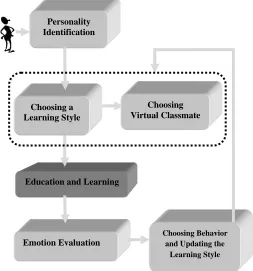
In this paper, a new model presented according to the educational model based on emotion and personality [8] and the model of VCA [15] [16] in previous studies. The outline of the improved model is shown in figure 1.
An Effective Intelligent Educational Model
Using Agent with Personality and Emotional
Filters
Fig. 1 Proposed model
As it shown in figure 1 the model contains six major modules that each is explained below:
Personality identification module: In first step, learner comes
across MBTI questionnaire and his personality will be identified (for example ISFJ, ESTP, INTJ, etc).
Module of choosing a learning style commensurate with learner's personality: Generally, there are three kinds of
learning environment: individual, competitive and collaborative [1]. System based on the identified personality of learner, put him in one of three groups of independence, contribution with VCA or competition with VCA.
Module of choosing VCA: If the learner is put in the
independence group the process of learning and education will be started, otherwise the system at first chooses a VCA that matches the type of learner's personality, then the process of learning and education will get started. The choosing of VCA is so that it helps the learner can make headway through the process of education. According to performed studies the presence of a VCA with apposite personality seemed to be commensurate [15].
Education module: In this module, lesson's points are
presented to learner as exercises.
Module of emotion evaluation: When doing exercises and
evaluating the extend of learning, there are some emotion expressed in learner which are relevant to level of learner's learning and the events happen in the environment (as have liking for VCA, be disappointed in doing exercises, etc). According to the performed studies, we found out only special
emotions are effective in the process of learning [3], [17]. Accordingly, the first and the third branch of emotions in OCC model are used. The first branch of emotions in OCC model are the effective emotions in process of learning and the third branch are those emotions that a person shows them when facing the others (for example VCA).
Module of choosing behavior and updating the learning style:
The module changes the style of education according to the events happen in the environment that cause changes to the learner's emotion and also the learner's personality characteristics.
Based on their knowledgebase, the VTA and VCA express suitable behaviors to improve the process of learning according to the learner's emotional position.
A. Calculating values of emotions
In the proposed model two branches of OCC model are used. The first branch of emotions is relevant to process of learning and the third one that are the person's emotion in front of the others.
B. Emotions of the first branch of OCC model
To calculate the values of emotions the calculating model presented in [7] was used. In this model to calculate the emotions of the first branch of OCC, the value of pleasure must be calculated. According to this model for calculating the value of pleasure the agent's goals, events and the value of an event effect on agent's goals must be specified. The value of pleasure based on the evaluation of event and then agent's emotion are calculated.
C. Learner’s goals
According to MBTI, there are four goals considered for the learner:
1. The learner's goal is to do the exercises alone and receives no help of the VCA.
2. The learner's goal is so much try in doing exercises even he gets nowhere.
3. The learner's goal is to have high speed in replying to the exercises.
4. The learner's goal is participating in group and cooperating with others to do the exercises.
The value of these four goals is obtained on some questions of MBTI questionnaire.
In the proposed model, there are five environmental parameters considered on defined goals for learner:
• Independence
• Potentiality of collaboration • Speed of replying
• Gained grade of doing exercises • Effort
Education and Learning
Emotion Evaluation Personality Identification
Choosing Behavior and Updating the
Learning Style
Choosing Virtual Classmate Choosing a
Independence: Value of this parameter indicates the value of
learner's independence through the process of learning. At the first the value of this parameter is zero for both collaborative and competitive learner’s groups and will be one for independent learners
Over the process of learning the value of this parameter is calculated based on equation (1):
Independency=1-AH (1)
In this equation parameter of Independency is representative of independency value and AH is representative of VTA or VCA's help value. The value of AH is belong to [0 1] interval and its value is obtained by dividing the amount of asking help of VTA or VCA on the total amount of exercise.
Potentiality of Collaboration: The value of this parameter
indicates the extent of learner's interest in collaborative group and is obtained in equation (2):
Collaboration=1-Independency (2)
In this equation, independency indicates the value of independency that is calculated in equation (1).
Response Speed: The value of this parameter can be obtained
through equation (3) and it indicates the learner's speed in giving response to exercises.
Response Speed= 1
–
DT RT
(3)
In equation (3), RT is the learner's response time and DT is the default time by system for responding exercise.
The obtained grade of exercises: It is a number in [0 1]
interval and indicates the extent of the learner's obtained grade in doing the exercises.
Effect: Extent of this parameter is identified by asking the
learner.
D. Calculating the emotions of third branch of OCC model
In [7] model, the third branch of emotions in OCC model, is not considered. When an event happens in the environment, based on being positive or negative, positive or negative emotions are expressed in learner. According to the kind of events and learner's current emotion and value of independence parameter, emotions, like and dislike of learner toward the VCA is concluded. Based on these emotions, the learner's educational group will be changed.
E. Choosing behavior and updating the learning Style
In our educational environment two agents -VTA and VCA- are used. These two agents with identifying the learner's emotions after each event, choose suitable tactics when are face to face with the learner. In this environment the way of
choosing the tactics to face the learner is related to the learner’s type of group. Depending on the point that which groups the learner belongs to, special tactic is chosen. Knowledgebase of this system contains 65 rules: 16 rules are to identify the learner's group, 10 rules for independent learning group, 20 rules for collaborative learning group and 19 rules for competitive group. Four examples of these rules are in the following:
Rule 1:
IF Student S1 has Personality ISFJ
THEN His/Her Group IS Independent
Rule 2:
IF Student Group IS Independent
AND Satisfaction IS High
OR Satisfaction IS Medium
AND Event IS Correct answer
THEN Teacher Tactic1 IS Congratulate Student AND Teacher_Tactic2 IS Change Student
Group to Competitive
Rule3:
IF Student Group IS Collaborative
AND Like IS High
OR Like IS Medium
AND Disappointment IS High
OR Disappointment IS Medium
AND Event IS Wrong Answer
THEN Classmate_Tactic1 IS Increase Student Self ability
AND Classmate_Tactic2 IS Increase Student effort AND Classmate_Tactic3 IS Persuade Student to Think More for Problem
Rule 4:
IF Student Group IS Competitive
AND Like IS High
OR Like IS Medium
AND Fear IS High
OR Fear IS Medium
AND Virtual Classmate's Personality
IS EN
OR Virtual Classmate's Personality
IS ES
AND Event IS While Student is Accomplishing to a task AND Student’s Response
speed
IS Lower Than Threshold
THEN Classmate Tactic1 IS Increase Student effort AND Classmate Tactic2 IS Notify Student for
Deadline
AND Teacher Tactic1 IS Increase Student Self ability
AND Teacher Tactic2 IS Change Student Group to Collaborative AND Classmate Tactic2 IS Notify Student for
Deadline
and fourth rules are examples of situations that the learner is in collaborative and competitive groups respectively. As the rules shows in these two situations relevant to the learner's emotions the VTA and VCA use special tactics in interaction with learner.
IV. IMPLEMENTATION
We have implemented our model in educational environment. The educational domain in this environment is Learning English Language. In this environment exercises are categorized in five levels of difficulty. To show the agents -VTA and VCA- we used two present agents in Microsoft that are Merlin and Peedy respectively (Figure 2).
For better evaluating of the proposed model, this environment is compared with another environment. Two environments to examine are as follows:
• Educational environment without emotions (Environment 1)
[image:4.612.324.572.50.205.2]• Educational environment with emotional VTA and VCA who have emotions and personality (Environment 2)
Fig. 2 GUI of Intelligent educational system
V. RESULTS
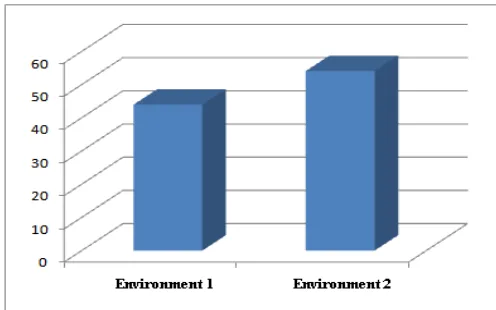
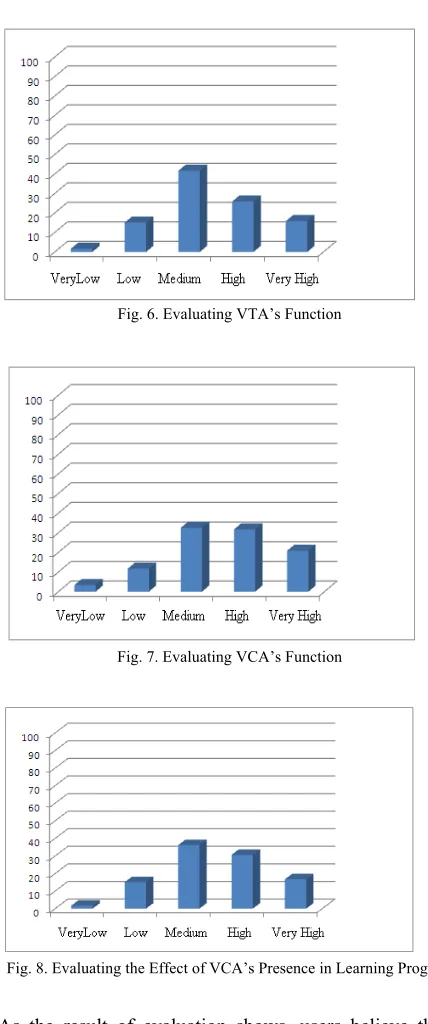
For evaluating educational environment based on the proposed model, two educational environments were shown to thirty users and the users evaluated them. After that, they were asked to answer a questionnaire. According to users’ responses, the following results are given (Fig. 3 - Fig. 8):
Fig. 3. Evaluating of Learning Rate
Fig. 4. Evaluating Attractiveness of Educational Environments
[image:4.612.60.289.297.491.2]Fig. 6. Evaluating VTA’s Function
Fig. 7. Evaluating VCA’s Function
Fig. 8. Evaluating the Effect of VCA’s Presence in Learning Progress
As the result of evaluation shows, users believe that the educational environment 2 is more attractive than the educational environments 1. The result of the evaluation shows that the presence of the intelligent agents with features like human can increase the learning rate, and it has an important role in attracting them for the virtual educational environments. Comparing the educational environment 1 with the educational environment 2 showed that the presence of a VCA increases users’ satisfaction and users’ interaction with the environment. Finally, the results show that VTA and VCA have considerable effect on improvement of learning process.
VI. CONCLUSION AND FUTURE WORKS
In In this paper a model presented for using in virtual education. In this model some modules are considered to identify personality, the styles of learning and emotion. This
model improves the learning process since it uses individual characteristics. It also goes without saying that the presence of VCA beside the learner causes improvement and makes headway in process of learning and the educational environment will be enjoyable and interesting for leaner, too. In the future we will try to improve the system with considering the parameters of culture, case based reasoning and agent’s learning and also makes the VTA and VCA more credible for the user.
REFERENCES
[1] S. Ellis, S. Whalen, (1996). “Cooperative Learning: Getting Started”, Scholastic.
[2] B.F.Marin, A.Hunger, S.Werner, (2006). “Corroborating Emotion Theory with Role Theory and Agent Technology: a Framework for Designing Emotional Agents as Tutoring Entities”, Journal of Networks, vol 1, Pages 29-40.
[3] B.Kort, R.Reilly, and R.W.Picard, (2001). “An Affective Model of Interplay between Emotions and Learning: Reengineering Educational Pedagogy Building a Learning Companion”, Proceedings IEEE International Conference on Advanced Learning Technology, Madison, Pages 43-48.
[4] E.Abrahamian, J.Weinberg, M.Grady, C. Michael Stanton, (2004). “The Effect of Personality-Aware Computer-Human Interfaces on Learning”, Journal of Universal Computer Science, vol 10, Pages 27-37.
[5] H.Maldonado, J.R.Lee, S.Brave, C.Nass, H.Nakajima, R.Yamada, K.Iwamura, Y.Morishima, (2005). “We Learn Better Together: Enhancing eLearning with Emotional Characters”, In Proceedings, Computer Supported Collaborative Learning, Taipei, Taiwan.
[6] M.D.Shermis, D.Lombard, (1998). “Effects of computer-based test administration on test anxiety and performance”. Journal of Computers in Human Behavior, vol 14, Pages 111-123.
[7] M. Kazemifard, N.Ghasem-Aghaee, and T.I. Ören (2006). “An Event-based Implementation of Emotional Agents”. Proceedings of Summer Simulation Conference, Calgary, Canada, Pages 63-67.
[8] N.Ghasem-Aghaee, S.Fatahi, and T.I. Ören (2008). “Agents with Personality and Emotional Filters for an E-learning Environment”, Proceedings of Spring Agent Directed Simulation Conference, Ottawa, Canada.
[9] P.Chalfoun, S.Chaffar, C.Frasson, (2006). “Predicting the Emotional Reaction of the Learner with a Machine Learning Technique”, Workshop on Motivaional and Affective Issues in ITS, International Conference on Intelligent Tutoring Systems, Taiwan.
[10] S.A.Jessee, P.N.ƠNeill, R.O.Dosch, (2006). “Matching Student Personality Types and Learning Preferences to Teaching Methodologies”, Journal of Dental Education, vol 70, Pages 644-651. [11] S.Chaffar, and C.Frasson, “Inducing optimal emotional state for
learning in Intelligent Tutoring Systems”, Lecture notes in computer science, Pages 45-54, 2004.
[12] S.Chaffar, and C.Frasson, “Using an Emotional Intelligent Agent to Improve the Learner’s Performance”, In Social and emotional intelligence in learning Environments workshop, 7th International Conference on Intelligent Tutoring System, Brazil, Pages 37-43, 2004. [13] S.Chaffar, C.Frasson, (2004). “Inducing optimal emotional state for
learning in Intelligent Tutoring Systems”, Lecture notes in computer science, Pages 45-54.
[14] S.Chaffar, G.Cepeda, C.Frasson, (2007). “Predicting the Learner’s Emotional Reaction towards the Tutor’s Intervention”, 7th IEEE International Conference, Japan, Pages 639-641.
[15] S.Fatahi, N.Ghasem-Aghaee, and M.Kazemifard (2008). “Design an Expert System for Virtual Classmate Agent (VCA)”. Proceedings of World Congress Engineering 2008, U.K, London.
[16] S.Fatahi, M. Kazemifard, and N. Ghasem-Aghaee. 2009. "Design and Implementation of an E-Learning Model by Considering Learner's Personality and Emotions". In Advances in Electrical Engineering and Computational Science, Netherlands: Springer, Vol. 39, pp. 423-434. [17] S.M. Al Masum, M.Ishizuka (2007). “An affective role model of
[image:5.612.60.269.141.355.2][18] S.Rushton, J. Morgan, M.Richard, (2007). “Teacher's Myers-Briggs personality profiles: Identifying effective teacher personality traits”, Journal of Teaching and Teacher Education, vol 23, Pages 432-441. [19] Y.S Li, P.S Chen, S.J Tsai, (2007). “A comparison of the learning styles