Mining Scientific Terms and their Definitions:
A Study of the ACL Anthology
Yiping Jin1 Min-Yen Kan1,2 Jun-Ping Ng1 Xiangnan He1∗
1Department of Computer Science 2Interactive and Digital Media Institute
National University of Singapore 13 Computing Drive, Singapore 117417
{yiping, kanmy, junping, xiangnan}@comp.nus.edu.sg
Abstract
This paper presents DefMiner, a supervised sequence labeling system that identifies scien-tific terms and their accompanying definitions.
DefMiner achieves 85% F1 on a Wikipedia
benchmark corpus, significantly improving the previous state-of-the-art by 8%.
We exploit DefMiner to process the ACL An-thology Reference Corpus (ARC) – a large, real-world digital library of scientific
arti-cles in computational linguistics. The
re-sulting automatically-acquired glossary rep-resents the terminology defined over several thousand individual research articles.
We highlight several interesting observations: more definitions are introduced for conference and workshop papers over the years and that multiword terms account for slightly less than half of all terms. Obtaining a list of popular defined terms in a corpus of computational lin-guistics papers, we find that concepts can of-ten be categorized into one of three categories: resources, methodologies and evaluation met-rics.
1 Introduction
Technical terminology forms a key backbone in scientific communication. By coining formalized terminology, scholars convey technical information precisely and compactly, augmenting the dissemi-nation of scientific material. Collectively, scholarly
∗
This research is supported by the Singapore National Re-search Foundation under its International ReRe-search Centre @ Singapore Funding Initiative and administered by the IDM Pro-gramme Office.
compilation efforts result in reference sources such as printed dictionaries, ontologies and thesauri.
While online versions are now common in many fields, these are still largely compiled manually, re-lying on costly human editorial effort. This leads to resources that are often outdated or stale with re-spect to the current state-of-the-art. Another indirect result of this leads to a second problem: lexical re-sources tend to be general, and may contain multi-ple definitions for a single term. For exammulti-ple, the term “CRF” connotes “Conditional Random Fields” in most modern computational linguistics literature; however, there are many definitions for this acronym in Wikipedia. Because only one correct sense ap-plies, readers may need to expend effort to identify the appropriate meaning of a term in context.
We address both issues in this work by automat-ically extracting terms and definitions directly from primary sources: scientific publications. Since most new technical terms are introduced in scientific pub-lications, our extraction process addresses the bottle-neck of staleness. Second, since science is organized into disciplines and sub-disciplines, we can exploit this inherent structure to gather contextual informa-tion about a term and its definiinforma-tion.
Aside from performance improvements, the key contributions of our work are in 1) recasting the problem as a sequence labeling task and exploring suitable learning architectures, 2) our proposal and validation of the the use of shallow parsing and de-pendency features to target definition extraction, and 3) analyzing the ACL Anthology Reference Cor-pus from statistical, chronological and lexical view-points.
2 Related Work
The task of definition mining has attracted a fair amount of research interest. The output of such sys-tems can be used to produce glossaries or answer definition questions. The primary model for this task in past work has been one of binary classifi-cation: does a sentence contain a definition or not? Existing methods can be cast into three main cat-egories, namely rule-based (Muresan and Klavans, 2002; Westerhout and Monachesi, 2007), supervised machine learning (Fahmi and Bouma, 2006; Wester-hout, 2009), and semi-supervised approaches (Nav-igli and Velardi, 2010; Reiplinger et al., 2012).
Rule-based approaches are intuitive and efficient, and were adopted in early research. Here, system performance is largely governed by the quality of the rules. Muresan and Klavans (2002) developed a rule-based system to extract definitions from online medical articles. The system first selects candidates using hand-crafted cue-phrases (e.g. is defined as,
is called; analogous to “IS-A” phrases), further
fil-tering the candidates with grammar analysis. West-erhout and Monachesi (2007) augmented the set of rules with part-of-speech (POS) tag patterns, achiev-ing an F2of 0.43.
While such manually-crafted expert rules have high precision, they typically suffer from low re-call. Definitions can be expressed in a variety of ways, making it difficult to develop an exhaustive set of rules to locate all definition sentences. To ad-dress low recall, later research adopted data-driven machine learning approaches. Fahmi and Bouma (2006) made used of supervised machine learning to extract definitions from a corpus of Dutch Wikipedia pages in the medical domain. They showed that a baseline approach which simply classifies every first sentence as a definition works surprisingly well, achieving an accuracy of 75.9% (undoubtedly due to the regular structure and style for Wikipedia). Their final system, based on the important feature of sen-tence position, was augmented with surface-level features (bag-of-words, bigrams, etc.) and syntac-tic features (type of determiner, position of the sub-ject in the sentence). Their study with three different learners – na¨ıve Bayes, maximum entropy (MaxEnt) and the support vector machine (SVM) – showed that MaxEnt gave the best results (92.2% accurate).
Westerhout (2009) worked on a hybrid approach, augmenting a machine learner to a set of hand-written rules. A random forest classifier is used to exploit linguistic and structural features. Informed by Fahmi and Bouma (2006)’s study, she included article and noun types in her feature set. Lexico-structural cues like the layout of the text are also exploited. She evaluated the performance of dif-ferent cue phrases including the presence of “IS-A” phrases, other verbs, punctuations and pronouns. The highest F2 score of 0.63 is reported for the “IS-A” pattern.
Since 2009 the focus of the research shifted to methods not limited to feature engineering. Borg et al. (2009) implemented a fully automated system to extract and rank definitions based on genetic al-gorithms and genetic programming. They defined two sub-problems including 1) acquiring the rela-tive importance of linguistic forms, and 2) learn-ing of new llearn-inguistic forms. Startlearn-ing with a small set of ten simple hand-coded features, such as hav-ing sequence “FW IS” (F W is a tag for foreign word) or containing keyword identified by the sys-tem, the system is able to learn simple rules such as “NN is a NN”. However, their system is optimized for similar “IS-A” patterns, as was used in (West-erhout, 2009). Their system, achieving an average f-measure of 0.25, also performs poorer than ma-chine learning systems which exploit more specific features.
To cope with the generality of patterns, Navigli and Velardi (2010) proposed the three-step use of directed acyclic graphs, called Word-Class Lattices (WCLs), to classify a Wikipedia dataset of defini-tions. They first replace the uncommon words in the sentences with a wildcard (*), generating a set of “star patterns”. Star patterns are then clustered ac-cording to their similarity. For each cluster, a WCL is generated by aligning the sentences in the cluster to form a generalized sentence. Although they re-ported a higher precision and recall compared with previous work, the result for WCL (F1 of 75.23%) is not significantly better than the baseline system which exploits only star patterns (F1 of 75.05%) without generating the directed graphs.
the ACL Anthology Reference Corpus (ACL ARC) (Bird et al., 2008). Their results show that bootstrap-ping is useful for definition extraction. Starting from a few initial term-definition pairs and hand-written patterns as seeds, their system iteratively acquires new term-definition pairs and new patterns.
We note that these previous systems rely heav-ily on lexico-syntactic patterns. They neither suf-ficiently exploit the intrinsic characteristics of the term and definition, nor invest effort to localize them within the sentence1. Given the significant structure in definitions, we take a more fine-grained approach, isolating the term and its definition from sentences. According to Pearson (1996), a definition can be for-mally expressed as:
X =Y + distinguishing characteristics,
where “X” is the definiendum(defined term; here-after,term), and “Y + distinguishing characteristics” can be understood as thedefiniens(the term’s defini-tion; hereafter,definition). The connector “=” can be replaced by a verb such as “define”, “call”, a punc-tuation mark or other phrase. Our task is thus to find pairs of terms and their associated definitions in in-put scholarly articles. The sentence-level task of de-ciding whether a sentencesis a definition sentence or not, is thus a simplification of our task.
3 Methodology
Our DefMiner system is based on the sequence la-beling paradigm – it directly assigns an annotation
aifromA∈ {(T)erm,(D)efinition,(O)ther}for each
input wordwi. We post-process our labeler’s results
to achieve parity with the simplified definition sen-tence task: When we detect both a term’s and defini-tion’s presence in a sentence, we deem the sentence a definition sentence. To be clear, this is a require-ment; when we detect only either a term or a def-inition, we filter these out as false positives and do not include them as system output – by definition in DefMiner, terms must appear within the same sen-tence as their definitions.
To train our classifier, we need a corpus of defi-nition sentences where all terms and defidefi-nitions are
1
While Navigli and Velardi (2010) taggedtermsand defini-tionsexplicitly in their corpus, their evaluation restricts itself to the task of definition sentence identification.
annotated. While Navigli and Velardi (2010) com-piled the WCL definition corpus from the English Wikipedia pages, we note that Wikipedia has stylis-tic conventions that make detection of definitions much easier than in the general case (i.e., “The first paragraph defines the topic with a neutral point of view”2). This makes it unsuitable for training a gen-eral extraction system from scholarly text.
As such, we choose to construct our own dataset from articles collected from the ACL ARC, follow-ing (Reiplfollow-inger et al., 2012). We compiled a corpus – the W00 corpus, named for its prefix in the ACL Anthology – derived from a total of 234 workshop papers published in 2000. Due to limited resources and time, only one individual (the first author) per-formed the corpus annotation. We built three dis-joint prototype classifiers to further filter the sen-tences. The prototype classifiers are based on sur-face patterns, keyphrases and linguistic phenomena (# of NP, # of VP, etc.). We took all the 2,512 sen-tences marked as definition sensen-tences by at least one of our individual prototypes and proceeded to an-notate all of them. In total, 865 of the total 2,512 sentences were real definition sentences.
The annotation instance is a single token (includ-ing s(includ-ingle word or punctuation mark). Each token
wiwas marked withaifromA∈ {T,D,O}
depend-ing on whether it is part of a term, a definition or neither (other). Therefore, a sentence that is not a definition sentence would have all its tokens marked asO. The corpus and its annotations are available for comparative study3.
We use Conditional Random Fields (CRFs) (Laf-ferty et al., 2001) to extract the term and defini-tion from input. We incorporate evidence (features) drawn from several levels of granularity: from the word-, sentence- and document-levels, not limiting ourselves to the window of previousnwords. CRFs allow us to encode such features which may not be conditionally independent. We use the open source implementation, CRF++ (Kudo, 2005) in our work4. One straightforward approach is to train indepen-dent classifiers for terms and definitions, which we
2http://en.wikipedia.org/wiki/Wikipedia:
Manual_of_Style/Lead_section
3http://wing.comp.nus.edu.sg/downloads/
term_definition_mining/
test in Section 4.1. While simple, this is suboptimal as it ignores the correlation between the presence of the two components. Term identification (in the guise of key-word/-phrase extraction) is well studied and common features such astf.idfand English or-thography achieve satisfactory results (Nguyen and Kan, 2007). In contrast, definitions exhibit more flexible structure and hence are more difficult to dis-tinguish from normal English text.
As such, we further investigate a serial archi-tecture where we perform the classifications in se-quence.I.e., first utilizing the results fromterm clas-sification, and then incorporating them into defini-tionclassification. This two-stage architecture is ex-plored later in Section 4.2
Our expanded feature set is an amalgamation of related works and utilizes a mix of simple lexical, orthography, dictionary lookup and corpus features (here,idf). Note that each feature class may derive more than one feature (e.g., for the POS tag feature, we extract features from not only the current word but the surrounding contextual words as well). We now enumerate the feature classes (FCs) that we exploit, marking whether they apply to the (W)ord, (S)entence or (D)ocument levels:
FC1) Lexical (W): The word, POS tag, stemmed word, and if the word contains a signal suffix5.
FC2) Orthography (W): Whether the word is 1) capital-ized or 2) mixed case; whether the word contains 3) hy-phens or 4) digits.
FC3) Keyphrase List (W): Whether the word is in the keyphrase list of the origin document. We use the open source KEA keyphrase extraction system (Witten et al., 1999) to extract 20 keyphrases for each document. FC4) Corpus (W): Discretized Inverse Document Fre-quency (idf), calculated aslog(Nc), whereN is the total
number of documents andcis the number of occurrences
of the word in all the documents. IDF values are dis-cretize into eight uniform partitions.
FC5) Position (D,S): The 1) Section ID, 2) name and 3) the sentence’s relative position in the document.
FC6) Has acronym (S): Whether the sentence contains an acronym. We use Stanford dependency parser (Cer et al., 2010) to parse the sentences. We deem the sentence to contain an acronym if the dependency type “abbrev” is present in the output of the parser.
FC7) Surface pattern (S): Whether the sentence contain
5The suffixes we extract are
“-ion”,“-ity”,“-tor”,“-ics”,“-ment”,“-ive” and “-ic”.
<term>defined (as|by)<definition>
define(s)?<term>as<definition>
definition of<term> <definition>
<term>a measure of<definition>
<term>is DT<definition>(that|which|where)
<term>comprise(s)?<definition>
<term>consist(s)? of<definition>
<term>denote(s)?<definition>
<term>designate(s)?<definition>
<definition>(is|are|also) called<term>
<definition>(is|are|also) known as<term>
Table 1: Hand-crafted surface patterns used in DefMiner.
one of the hand-crafted pattern, as listed in Table 1. The list is compiled from previous works and augmented based on our observations on the corpus.
Long Distance Features. During
develop-ment, we noticed that the syntactic variation of the definition might benefit from features that identify long-distance dependencies. As such, we further studied the impact of including additional features developed from the shallow (chunk) and dependency parses of the input. Compared to the above features, these features are much more computationally-intensive.
FC8) Shallow tag (W): Shallow parsing tag for each word
(e.g.,np,vp). We used OpenNLP toolkit to shallow parse
the sentences. (Baldridge, 2005)
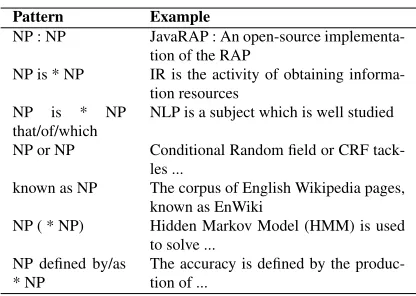
FC9) Shallow pattern (S): If the shallow parsing sequence contains one of the seven parse patterns listed in Table 2. We also give some example sentences which can be de-tected by the patterns.
FC10) Governor (W): The word that the current word de-pends on in a binary dependency relation. (e.g., for the
phrasecomputational linguistics, the governor of the
wordcomputationalislinguistics).
FC11) Dependency path distance (W): Distance from the current word to the root of the sentence in the dependency tree.
Pattern Example
NP : NP JavaRAP : An open-source
implementa-tion of the RAP
NP is * NP IR is the activity of obtaining
informa-tion resources
NP is * NP
that/of/which
NLP is a subject which is well studied
NP or NP Conditional Random field or CRF
tack-les ...
known as NP The corpus of English Wikipedia pages,
known as EnWiki
NP ( * NP) Hidden Markov Model (HMM) is used
to solve ... NP defined by/as
* NP
[image:5.612.81.289.54.202.2]The accuracy is defined by the produc-tion of ...
Table 2: Hand-crafted shallow parsing patterns used in DefMiner.
4 Evaluation
We now assess the overall effectiveness of DefMiner, at both the word and sentence level. Ad-ditionally, we want to ascertain the performance changes as we add features to an informed lexical baseline. We not only benchmark DefMiner’s per-formance over our own W00 collection, but also compare DefMiner against previous published work on the definition sentence identification task on the WCL (English Wikipedia) corpus.
4.1 Single-Pass Extraction from W00
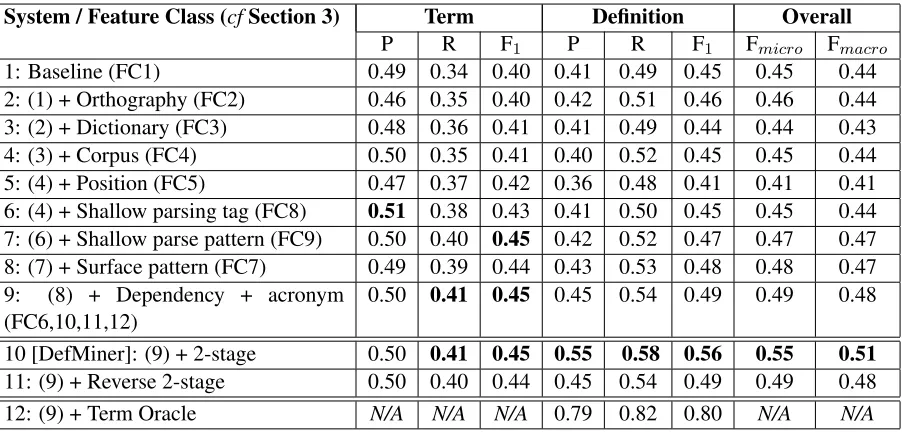
We run ten-fold cross validation on our annotated W00 corpus. We first evaluate our results at word level, calculating the precision, recall, andF1scores for each incrementally enhanced feature set. We present results on the corpus in the top portion of Table 3 (Rows 1–9).
We calculate both micro and macro- (category) averaged F1 scores for term and definition extrac-tion. Fmicro assigns equal weight to every token,
whileFmacrogives equal weight to every category.
As definition tokens greatly outnumber term tokens in our corpus (roughly 6:1), we feel that the macro-average is a better indicator of the balance between term and definition identification.
Our baseline system makes use of basic word and POS tag sequences as features (FC1), which are common to baselines in other sequence labeling works. We can see that most features result in per-formance improvements to the baseline, especially for recall. Interestingly, although the shallow pars-ing and dependency features we use are rather
sim-ple, they effectively improve the performance of the system. In System 7, we only use the seven shallow parsing patterns shown in Table 2, but the Fmacro
measure improves 3%. Our best single-stage sys-tem (Syssys-tem 9 in Table 3) boosts recall for term and definition classification by 7% and 5%, respectively, without sacrificing precision. TheFmacromeasure
is improved from 0.44 to 0.48.
Unexpectedly, the inclusion of the position fea-tures cause performance to drop. One possible rea-son is that the authors of scientific papers have more flexibility to choose the positions to present definitions. This makes the position feature much less indicative (compared to running on a corpus of Wikipedia articles). Due to this observation, we ex-clude the position features when carrying out fol-lowing experiments.
4.2 Serial Term and Definition Classification
We now investigate the two-stage, serial archi-tecture where the system first performs term classification before definition classification (i.e., termdefinition). We provision the second-stage definition classifier with three additional features from the first-stage term classification output: whether the current word (1) is a term, and (2) ap-pears before or (3) after a term.
Row 10 shows this resulting system, which we coin as DefMiner. Interestingly, there is a 10% in-crease in the precision of definition classification. With the two-stage classifier, Fmacro score further
increases from 0.48 to 0.51. The results verify our intuition that term classification does help in defini-tion classificadefini-tion. Pipelining in the opposite direc-tion (definidirec-tionterm; Row 11) does not show any improvement. We posit that since the advantage is only in a single direction, joint inference may be less likely to yield benefits.
System / Feature Class (cfSection 3) Term Definition Overall
P R F1 P R F1 Fmicro Fmacro
1: Baseline (FC1) 0.49 0.34 0.40 0.41 0.49 0.45 0.45 0.44 2: (1) + Orthography (FC2) 0.46 0.35 0.40 0.42 0.51 0.46 0.46 0.44 3: (2) + Dictionary (FC3) 0.48 0.36 0.41 0.41 0.49 0.44 0.44 0.43 4: (3) + Corpus (FC4) 0.50 0.35 0.41 0.40 0.52 0.45 0.45 0.44 5: (4) + Position (FC5) 0.47 0.37 0.42 0.36 0.48 0.41 0.41 0.41 6: (4) + Shallow parsing tag (FC8) 0.51 0.38 0.43 0.41 0.50 0.45 0.45 0.44 7: (6) + Shallow parse pattern (FC9) 0.50 0.40 0.45 0.42 0.52 0.47 0.47 0.47 8: (7) + Surface pattern (FC7) 0.49 0.39 0.44 0.43 0.53 0.48 0.48 0.47 9: (8) + Dependency + acronym
(FC6,10,11,12)
0.50 0.41 0.45 0.45 0.54 0.49 0.49 0.48
10 [DefMiner]: (9) + 2-stage 0.50 0.41 0.45 0.55 0.58 0.56 0.55 0.51
[image:6.612.83.534.56.272.2]11: (9) + Reverse 2-stage 0.50 0.40 0.44 0.45 0.54 0.49 0.49 0.48 12: (9) + Term Oracle N/A N/A N/A 0.79 0.82 0.80 N/A N/A
Table 3: 10-fold cross validation word-level performance over different system configurations on our W00 corpus.
motivates future work as how to improve the perfor-mance of the term classifier so as to reap the benefits possible with our two-stage classifier.
4.3 Comparative results over the WCL Dataset
For most of the related research reviewed, we could neither obtain their source code nor the corpora used in their work, making comparative evaluation diffi-cult. To the best of our knowledge, Reiplinger et al. (2012) is the only attempt to extract definitions from the ACL ARC corpus, which is a superset of our W00 corpus. It would be desirable to have a di-rect comparison with their work, but their evaluation method is mainly based on human judges and their reported coverage of 90% is only for a sample, short list of domain terms they defined in advance.
To directly compare with the previous, more com-plex state-of-the-art system from (Navigli and Ve-lardi, 2010), we evaluate DefMiner on the defini-tion sentence detecdefini-tion task. For the sentence-level evaluation, we calculate theP/R/F1score based on whether the sentence is a definition sentence. We applied DefMiner on their whole WCL annotated corpus, reporting results in Table 4. We random-ized the definition and none-definition sentences in their corpus and applied 10-folds cross validation. In each each iteration we used 90% of the sentences for training and 10% for testing.
Compared to their results reported in (Navigli and
System Token Level Sentence
Term Definition Level
P / R / F1 P / R / F1 P / R / F1
DefMiner .82/.78/.80 .82/.79/.81 .92/.79/.85
N&V ’10 – / – / – – / – / – .99/.61/.77
Table 4: Comparative performance over the WCL.
Velardi, 2010), DefMiner improves overall F1 by 8%. While certainly less precise (precision of 92% versus 99%), recall is improved over their consid-erably more complex WCL-3 algorithm by almost 20%. Even using just the simple heuristic of only classifying sentences that have identified terms as well as definitions as definition sentences, DefMiner serves to competitively identify definition sentences.
4.4 Manual Inspection of DefMiner Output
To gauge the noise from our system outside of our cross-validation experiments, we conducted a man-ual inspection of results over other workshop papers from other years (2001 and 2002), as a sanity check. DefMiner identifies 703 and 1,217 sentences in W01 and W02 as definition sentences separately.
[image:6.612.318.535.309.373.2]4.4.1 Analysis of Common Errors
The P/R/F1 score by itself only gives a hint of the system’s overall performance. We are also interested to study the common errors made by our system, which could help us engineer better features for improving DefMiner. As our two-stage classifier still lags behind the system with oracular term labels by 24% in F1 for definition detection (Sec-tion 4.2), we believe there is still much room for improvement. We show three example misclassified sentences that represent the major types of errors we observed, where DefMiner’s output annotations follow tokens marked as part of terms or definitions.
1)A PSS/TERM thus contains abstract linguistic values for closed features ( tense/DEF ,/DEF mood/DEF ,/DEF voice/DEF ,/DEF number/DEF ,/DEF gender/DEF ,/DEF etc/DEF ./DEF ) .
This first instance shows that DefMiner tends to mark the first several tokens as “TERM” while the real term appears somewhere else in the sentence. The actual term being defined is “closed features” instead of “PSS”. Many terms in the training set appear at the beginning of the sentence and are preceded by a determinant. “PSS” is also likely to receive a high IDF and orthographic shape (capitalized) score and therefore are misclassified as terms. It may be useful to thus model the (usual) distance between the term and its definition in a feature in future work.
2) Similarly , ‘I’/TERM refers to an/DEF interior/DEF
character/DEF and/DEF ‘L’/DEF indicates/DEF
the/DEF last/DEF character/DEF of/DEF a/DEF
word/DEF .
DefMiner is occasionally confused when encoun-tering recursive definition or multiple definitions in a single sentence. Sentence 2 contains two parallel definitions. The classifier fails to classify “L” as a separate term, incorporating it as part of the definition. One possible improvement is to break the original sentence into clauses that are independent from each other, perhaps by using even simple surface cues such as coordinating conjunctions marked by commas or “and”.
3) Again one could argue that the ability to convey
such uncertainty and reliability information to a non-specialist/TERM is a/DEF key/DEF advantage/DEF
of/DEF textual/DEF summaries/DEF over/DEF
graphs/DEF .
Another difficult problem faced by the classifier is the lack of contextual information. In sentence 3), if we just look at part of the sentence “a non-specialist is a key advantage of textual summaries over graphs”, without trying to understand the mean-ing of the sentence, we may well conclude that it is a definition sentence because of the cue phrase “is a”. But clearly, the whole sentence is not a defini-tion sentence. More sophisticated features based on the sentence parse tree have to be exploited to detect such false positive examples.
5 Insights from the Definitions Extracted from the ACL ARC
In this second half of the paper, we apply DefMiner to gain insights on the distributional and lexical properties of terms and definitions that appear in the large corpus of computational linguistics publi-cations represented by the ACL ARC (Bird et al., 2008). The ARC consists of 10,921 scholarly publi-cations from ACL venues, of which our earlier W00 corpus is a subset (n.b., as such, there is a small amount of overlap). We trained a model using the whole of the W00 corpus and used the obtained clas-sifier to identify a list of terms and definitions for each publication in the ACL ARC.
Inspecting such output gives us an understanding of the properties of definition components, eventu-ally helping the community to define better features to capture them, as well as intrinsically deepening our knowledge of the natural language of definitions and the structure of scientific discourse.
5.1 Demographics
From a term’s perspective we can introspect prop-erties of the enclosing paper, the host sentence, the term itself and its definition.
At the sentencelevel, we analyze the position of the sentences that are definition sentences.
Focusing on terms, we want to find out in more detail the technical terminology that is defined. Are they different from general keyphrases? What type of entities are defined? What words do these terms consist of? What structures are common?
We are interested in analogous questions when focusing on the accompanying definitions. How many words or clauses do definition sentences consist of? Do we lose a lot of recall by restricting definitions to a single sentence? Are embedded definitions (definitions embedded with other defini-tions) common?
We highlight some specific findings from our ba-sic analyses here:
Where do definitions occur? As terms are
usu-ally defined on first use, we expect the distribution of definition sentences to skew towards the begin-ning portions of a scientific document as input. We count the occurrences of definition sentences in each of ten equally-sized (by number of sentences) non-overlapping partitions. The results are shown in Fig-ure 1, aligning with our intuition: The first three quantiles contribute almost 40% of all detected def-inition sentences, while the last three quantiles con-tain only 17.8%.
5898 6258 6574 6202 5512 5020 4341 3593
2931 2233
0 2000 4000 6000 8000
1 2 3 4 5 6 7 8 9 10
Fr
eq
ue
nc
y
[image:8.612.320.531.120.372.2]Quan,le (1 = first 10%; 10 = last 10%)
Figure 1: Occurrences of definitions within different seg-ments of an article.
How long are the detected terms and
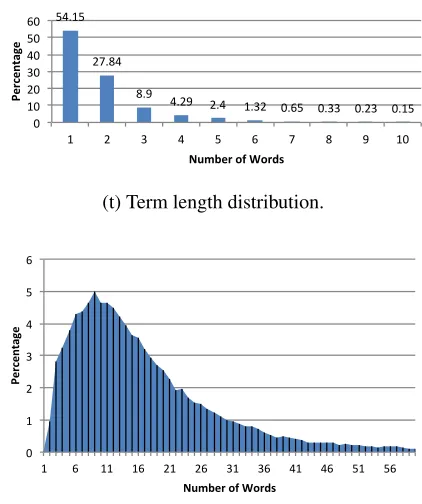
defini-tions? Figure 2 shows the detected aggregate
dis-tributions. Over 54% of the detected terms are sin-gle tokens, where majority of the remaining 45% of terms being multi-word terms of six words or less. Among the single token terms, a further analysis reveals that 17.4% are detected as single-character variables, 34.9% are acronyms (consisting of more than one capitalized letters), while the remaining 47.7% are normal words. Definitions, in contrast,
are longer and more varied, with a peak length of nine words. Slightly over half of the definitions have a length of 5–16 words; 75% have lengths between 3 and 23 words.
54.15
27.84
8.9
4.29 2.4 1.32 0.65 0.33 0.23 0.15 0
10 20 30 40 50 60
1 2 3 4 5 6 7 8 9 10
Percen
ta
ge
Number of Words
(t) Term length distribution.
0 1 2 3 4 5 6
1 6 11 16 21 26 31 36 41 46 51 56
Percen
ta
ge
Number of Words
[image:8.612.85.290.457.518.2](b) Definition length distribution.
Figure 2: Length distributions of (top) terms, (bottom) definitions.
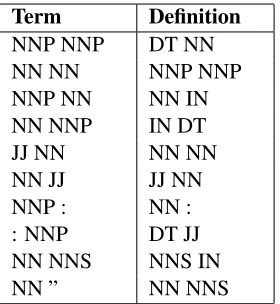
In Table 5, we present the 10 most frequent POS tag bigrams for terms and definitions. We can see that among terms, a sequence of consecutive two nouns is most common, making up four out of the top five bigrams. We notice that determiners and prepositions are absent from the term list but are common in definitions.
5.2 Inspection of Definition over Time
The ACL ARC covers journal articles, conference and workshop proceedings over a few decades. As with other fields in recent years, the amount of computational linguistics literature has steadily in-creased over the number of years.
Term Definition
NNP NNP DT NN
NN NN NNP NNP
NNP NN NN IN
NN NNP IN DT
JJ NN NN NN
NN JJ JJ NN
NNP : NN :
: NNP DT JJ
NN NNS NNS IN
[image:9.612.117.257.56.208.2]NN ” NN NNS
Table 5: Most frequent POS bigrams for terms and defi-nitions.
percentage of sentences that are identified as defini-tion sentences), for these three different categories of publications6.
In Figure 3, the three data series overlap each other, so we cannot conclude definitions appear more often in one type of papers than another. How-ever, as a side effect, we see that while the definition density for journal papers remain relatively constant, for conference and workshop papers the number of definitions extracted per sentence has increased no-ticeably over time. The average number of defini-tions presented in conference papers, for instance, increased more than 100% in the 40 years repre-sented in the ACL ARC.
The increasing number of definitions alone does not show that new knowledge is introduced at a faster rate, as definitions may be repeated. To con-trol for this effect, we also need to know which def-initions are new or defined in previous year(s). We studied this effect in more detail for the relatively smaller set of journal papers (Figure 4). For jour-nal papers, the number of definitions of previously introduced terms in each year against the number of new definitions. We say a definition is new when the detected term was not identified in any article (not limited to journals) in previous years.
We see that the number of new terms being de-fined also increases with the years. But the increase is much slower than that for the total definitions. The area between the two lines denotes the definitions
6
The ACL ARC is organized by the venue of the publication, which is associated to a category. For the assigned category for each venue please refer to Appendix A.
where the same term has been multiply defined from the same or previous years as the current year under investigation.
5.3 Trends
We can use terms and definitions to also intro-spect how the computational linguistics literature has changed over time. Table 6 shows a subset of the most frequently defined terms in the ACL ARC, where we exclude single-character terms (“vari-ables”).
WordNet (292) Part Of Speech (45)
Precision (172) Probablistic CFG (43)
Recall (167) FrameNet (38)
Noun phrase (97) Conditional Random Field (29)
Word sense disambiguation (60) Inverse document frequency (28)
Support Vector Machine (60) PropBank (27)
Hidden Markov Model (54) Context Free Grammar (25)
Latent Semantic Analysis (57) Accuracy (20)
Table 6: Subset of most frequently defined terms. Raw
counts in parentheses. Variations of the same term (e.g.
plurals, acronyms) are collapsed into one instance.
To be expected, these popular terms are mostly specific to computational linguistics. From our observation, we can fit these terms into one of three categories, including 1) resources (WordNet, FrameNet, PropBank), 2) methodologies (SVM, HMM, LSA), and 3) evaluation metrics (Precision, Recall, Accuracy). We feel that the final category of evaluation metrics is more general and would be shared among other scientific disciplines.
[image:9.612.316.545.217.295.2]0.000 0.005 0.010 0.015 0.020 0.025 0.030 0.035
1967 1973 1979 1982 1987 1993 1999 2005
Defin
i&o
n Den
si
ty
Year
[image:10.612.95.520.67.207.2]Conference Papers Journals Workshops
Figure 3: Occurrences of definitions across publication cat-egories.
0 50 100 150 200 250 300 350
1980 1982 1985 1988 1992 1996 2001 2004
#
Co
lle
ct
ed
D
efi
ni
.o
ns
Year
New Terms Previously Defined Terms
Figure 4: Relative proportions of new and recurring defini-tions in journal papers.
Figure 5: The occurrence of definitions for various se-quence labeling methodologies over the years.
6 Conclusions and Future Work
We study the task of identifying definition sentences, as a two-part entity containing a term and its ac-companying definition. Unlike previous work, we propose the harder task of delimiting the component term and definitions, which admits sequence label-ing methodologies as a compatible solution.
Leveraging the current best practice of using con-ditional random fields, we contribute two adcon-ditional ideas that lead to DefMiner, a state-of-the-art schol-arly definition mining system. First, we show that shallow parsing and dependency parse features that may provide additional non-local information, are useful in improving task performance. Second, viewing the problem as two correlated subproblems of term and definition extraction, we measure the tightness and dependency of the correlation. We
find that a two-stage sequential learning architecture (term first, definition second) leads to best perfor-mance. DefMiner outperforms the state of the art, and we feel is fit for macroscopic analysis of scien-tific corpora, despite significant noise.
We thus deployed DefMiner on the ACL
An-thology Reference Corpus. We demonstrate how
DefMiner can yield insights into both the struc-ture and semantics of terms and definitions, in both static and diachronic modes. We think future work could pursue more in-depth analysis of the distribu-tional and demographic properties of automatically extracted lexica. We can use the lexicon obtained from different years to carry out trend prediction, which we have illustrated here. Downstream sys-tems may predict which term will become popular, or could alert an author if their definition of a term significantly differs from the original source.
We hope to tackle the annotation bottleneck in fu-ture work on definition extraction, common in many data-driven learning fields. We plan to explore iter-ative, semi-supervised methods to best manage hu-man effort to maximize the effectiveness of future annotation.
[image:10.612.103.270.268.413.2]References
Jason Baldridge. 2005. The opennlp project.
Steven Bird, Robert Dale, Bonnie J. Dorr, Bryan Gib-son, Mark T. Joseph, Min-Yen Kan, Dongwon Lee, Brett Powley, Dragomir R. Radev, and Yee Fan Tan. 2008. The ACL anthology reference corpus: A ref-erence dataset for bibliographic research in
computa-tional linguistics. In Proceedings of the 6th
Interna-tional Conference on Language Resources and
Evalu-ation Conference (LREC08), pages 1755–1759,
Mar-rakech, Morocco.
Claudia Borg, Mike Rosner, and Gordon Pace. 2009. Evolutionary algorithms for definition extraction. In Proceedings of the 1st Workshop on Definition
Extrac-tion, WDE ’09, pages 26–32, Stroudsburg, PA, USA.
Association for Computational Linguistics.
Daniel Cer, Marie-Catherine de Marneffe, Daniel Juraf-sky, and Christopher D. Manning. 2010. Parsing to stanford dependencies: Trade-offs between speed and
accuracy. In 7th International Conference on
Lan-guage Resources and Evaluation (LREC 2010),
Val-letta, Malta.
Ismail Fahmi and Gosse Bouma. 2006. Learning to
iden-tify definitions using syntactic features. In
Proceed-ings of the EACL workshop on Learning Structured In-formation in Natural Language Applications, Trento, Italy.
Taku Kudo. 2005. Crf++: Yet another crf toolkit.
Soft-ware available at http://crfpp. sourceforge. net. John D. Lafferty, Andrew McCallum, and Fernando C. N.
Pereira. 2001. Conditional random fields: Probabilis-tic models for segmenting and labeling sequence data. In Proceedings of the Eighteenth International Con-ference on Machine Learning, ICML ’01, pages 282– 289, San Francisco, CA, USA.
Smaranda Muresan and Judith Klavans. 2002. A method for automatically building and evaluating dictionary
resources. InProceedings of the Language Resources
and Evaluation Conference (LREC), Las Palmas, Ca-nary Islands, Spain.
Roberto Navigli and Paola Velardi. 2010. Learning
word-class lattices for definition and hypernym
extrac-tion. In Proceedings of the 48th Annual Meeting of
the Association for Computational Linguistics, pages 1318–1327, Uppsala, Sweden.
Thuy Dung Nguyen and Min-Yen Kan. 2007. Keyphrase
extraction in scientific publications. InProceedings of
International Conference on Asian Digital Libraries, pages 317–326, Hanoi, Vietnam.
Jennifer Pearson. 1996. The expression of definitions in
specialised texts: a corpus-based analysis. In
Proceed-ings of Euralex 96.
Melanie Reiplinger, Ulrich Schafer, and Magdalena
Wol-ska. 2012. Extracting glossary sentences from
scholarly articles: a comparative evaluation of pattern
bootstrapping and deep analysis. In Proceedings of
the ACL-2012 Special Workshop on Rediscovering 50 Years of Discoveries, ACL ’12, pages 55–65, Strouds-burg, PA, USA. Association for Computational Lin-guistics.
Eline Westerhout and Paola Monachesi. 2007. Extrac-tion of dutch definitory contexts for elearning
pur-poses. InProceedings of Computational Linguistics
(CLIN 2007).
Eline Westerhout. 2009. Definition extraction using
linguistic and structural features. In Proceedings of
the 1st Workshop on Definition Extraction, WDE ’09, pages 61–67, Stroudsburg, PA, USA. Association for Computational Linguistics.
Ian H Witten, Gordon W Paynter, Eibe Frank, Carl Gutwin, and Craig G Nevill-Manning. 1999. Kea :
Practical automatic keyphrase extraction. Computer,