149
Decipherment for Adversarial Offensive Language Detection
Zhelun Wu, Nishant Kambhatla, Anoop Sarkar School of Computing Science
Simon Fraser University Burnaby, BC , Canada
{zhelunw,nkambhat,anoop}@sfu.ca
Abstract
Automated filters are commonly used by on-line services to stop users from sending age-inappropriate, bullying messages, or asking others to expose personal information. Previ-ous work has focused on rules or classifiers to detect and filter offensive messages, but these are vulnerable to cleverly disguised plaintext and unseen expressions especially in an adver-sarial setting where the users can repeatedly try to bypass the filter. In this paper, we model the disguised messages as if they are produced by encrypting the original message using an invented cipher. We apply automatic decipher-ment techniques to decode the disguised ma-licious text, which can be then filtered using rules or classifiers. We provide experimen-tal results on three different datasets and show that decipherment is an effective tool for this task.
1 Introduction
Under-aged social media users and users of chat rooms associated with software like video games are routinely exposed to offensive language including sexting, profanities, age-inappropriate languages, cyber-bullying, and requests for per-sonal identifying information. A common ap-proach is to have a filter to block such messages. Filters are either rule-based (Razavi et al., 2010) or machine learning classifiers (Yin et al., 2009; Warner and Hirschberg,2012;Williams and Bur-nap, 2015). However, users wishing to bypass such filters can subtly transform messages in novel ways which can be hard to detect.
Since malicious users and spammers can change their attacks to avoid being filtered, an ap-proach to offensive text detection that takes into account this adversarial relationship is what can deal with real-world abusive language detection better. Techniques like spelling correction have
been used to correct misspelled words in user gen-erated content (Kobus et al., 2008), but in an ad-versarial setting it is easy to defeat a spelling cor-rection system trained on predictable errors. Con-text based normalization methods have been pro-posed to convert erroneous user generated text from social media to standard text (Choudhury et al., 2007; Schulz et al., 2016). We, however, treat this problem as follows: we model malicious users trying to bypass a filtering system as having invented a new cipher, and our goal is to decipher their encrypted messages back to plaintext. We use a large space of possible ciphers that could be invented by those seeking to bypass a filter.
This paper addresses the problem of finding and filtering offensive messages as a special case of de-cipherment. In decipherment, a message in plain-text(original text) is converted intociphertext (en-crypted text). Encryption disguises the content of the originalplaintextto aciphertextso that it can-not be filtered out or blocked. Decryption or deci-pherment is the process of recovering theplaintext from theciphertext. We treat disguised inappropri-ate content as ciphertext, and the actual intended content as the plaintext. Then we apply decipher-ment to recover more recognizable plaintext from the ciphertext and apply filters on the plaintext. Conceivably these users may create very complex unbreakable ciphers which cannot be deciphered by our system, but in such cases the ciphers are likely to also be unreadable by other humans who are the intended audience. We do not see many examples of this in our real-world chat messages.
and a state-of-art spelling correction system (As-pell). We discover that our method is immune to many previously unobserved types of changes made by users to disguise the original message.
2 Decipherment for Offensive Language Detection
The goal of decipherment is to uncover the hidden plaintext sequence p1...pn, given a disguised ci-phertext sequencec1...cn. We assume that all
cor-rupted forms of offensive language are originally explicit plaintext encrypted using letter substitu-tion, insersubstitu-tion, or deletion.
2.1 NULL Insertion
A user can hide plaintext by inserting additional letters, or making substitutions and deletions in the plaintext:
Offensive text:you are a B*n@n@ee
Intended Plaintext:you are a bunny
we lowercase the texts and substitute the special symbols and punctuation marks inside the words with NULL, and then map NULL to any letter or
NULL. Thus, the corrupted word B*n@n@ee is changed to
b<NULL>n<NULL>n<NULL>ee
When dealing with insertion of symbols, we treat it as an injective decipherment problem and solve it by addingNULLsymbols in the ciphertext so that the decipherment model could map candi-date letters. We compare two methods: 1) Insert-ing theNULLin a random position of the corrupted offensive key words; 2) Using a character-level n-gram model to segment the ciphertext adapt-ing the technique for unsupervised word segmen-tationAndo and Lee(2003) in order to find where to insertNULLsymbols.
The character-leveln-gram model is trained on an unsegmented corpus (spaces removed between words). At each positionk, we determine whether to insert aNULL symbol or not by calculating an n-gram score using Eqns (1) and (2).
vn(k) =
1
2(n−1)
X
d∈{L,R}
n−1
X
j=1
I>(c(snd), c(tnd))
(1)
vN(k) = 1
N
X
n∈N
vn(k) (2)
where nis the n-gram order, and sare n-grams that straddle the potentialNULLpositionkto the leftLand rightRandtaren-grams that are on ei-ther side of positionkalso on the leftLand right Randc()is then-gram frequency. For a sequence
A B C D W X Y Z, for n = 4 and position
k= 4betweenDandW, Eqn (1) for a particularn compares the frequency of thestypen-grams that straddle positionk= 4(so, in this case frequency
of B C D W, C D W X, D W X Y against the
frequency of thettypen-grams on either side: A
B C DandW X Y Z. Eqn (2) then takes the
av-erage for eachn-gram order (forn=1,2,3,4). The position k that has a score from Eqn (2) higher than a threshold value is chosen as the position for
NULLinsertion.
2.2 Decipherment Model
A decipherment model maximizes the probability of a substitution map that converts the ciphertext sequencecto plaintext sequencep(Eqn3).
P(c) =X
e
P(p)·P(c|p) (3)
whereP(.)is a character-level language model of the plaintext source trained using a monolingual corpus. We modelP(c|p)as the emission prob-ability of a Hidden Markov Model (Knight et al., 2006) with cipher characterscas observations and plaintext characters p as the hidden states of the HMM. We train this using unsupervised learning using the Forward-Backward algorithm (Rabiner, 1989).
We propose our own initialization algorithm (Algorithm 1), based on the assumption that the previous trained table can help us to reach bet-ter local optima with fewer ibet-terations compared to uniform initialization with random perturbations.
Algorithm 1 Initialization with previous trained table
1: Given a set of cipher text sentences with size ofd, a plain text with vocabulary sizev and plain text trigram modelb
2: Randomly initialize thes(c | e) substitution table and normalize
3: fori= 1. . . ddo
4: preprocess thei-th cipher text sequence by removing repeated characters and lower case the text
5: insert NULL based on techniques in Sec.2.1
6: ifi6= 1then
7: initialize s(c | e) using the (i−1)th trained tables(c|e)
8: apply Forward-Backward algorithm to learn parameterss(c|e)
3 Data
3.1 Wiktionary
We created an offensive language dataset from English Wiktionary data. We use Wiktionary la-bels for vulgar, derogatory, etc. and selected ex-ample sentences for words tagged with such la-bels. From the entire English Wiktionary data , us-ing this method, we extracted 2298 offensive sen-tences and 152,770 non-offensive sensen-tences. This data is organized as{key word : example
sentence} as in a dictionary. With the
dupli-cates removed, for each key word, the corre-sponding sentences were split into a 3:1 ratio as training and testing data.
We used 1,532 sentences offensive training set data and sampled 1,532 non-offensive sentences as a balanced dataset for training an offensive tence classifier. We split 716 offensive testing sen-tences into 4 parts in sequence. The first three parts we set as test sets A, B andC and the lat-ter part as development set. Every set has 179 sentences. The three test sets are taken from the same larger corpus to measure the variance in per-formance of the decipherment powered classifica-tion technique.
The Wiktionary dataset is used to train our lan-guage model. The offensive sentences had fewer instances than the non-offensive counterparts. To offset any loss in information, the offensive sen-tences were duplicated until they were as many in number as the non-offensive sentences, resulting
in a balanced training set of 155,251 tokens.
3.2 Other data
Language Model: For the character models we used a combination of Wiktionary and the Eu-ropean Parliament Proceedings Parallel Corpus 1996-2011 (Koehn, 2005). 100K English sen-tences were sampled from the German-English EuroParl Corpus to give us a 2.7M token English plaintext corpus.
Spelling Correction: We use the English Giga-word corpus (Graff et al., 2003) to train the lan-guage model for the noisy channel spelling correc-tion module. The preprocessed corpus has 7.4M lowercase English word tokens. For spelling cor-rection, the Linux system dictionary with 479,829 English words in lower case is used. We used 3,393,741 pairs of human disguised words and original plain text words from the rule-based fil-tering system to train the error model.
3.3 Real World Chat Messages
We obtained 4,713,970 unfiltered, unlabelled chat messages from a provider of filtering services for chat rooms aimed at under-aged users. The data was provided byTwo Hat Securitywhich provides human powered chat room monitoring and filter-ing. Two Hat combines artificial intelligence with human expertise to classify chat room discussions and images on a scale of risk, taking user profiles and context into account. We pre-processed the chat messages to produce a cleaner version of the original message using tokenization rules.
We used 4,700,000 chat messages provided to us by Two Hat Security as a training set to train a letter based language model. To build a more com-prehensive language model, this language model was interpolated with the ones trained on Wik-tionary and Europarl datasets.
Over two years new rules were added to account for user behaviour of trying to bypass the rule-based filtering system. Can decipherment discover these patterns automatically?
4 Experimental Setup
4.1 Language Model
Character Language Model: We used the SRILM toolkit (Stolcke et al., 2002) to train a character language model (LM) from Wiktionary and Europarl data. We trained two LMs and terpolated them using a mixture model. The in-terpolation weights were tuned on the develop-ment set. We usedpy-srilm-interpolator
(Kiso,2012) for the mixture model.
Word Language Model: We trained a word tri-gram language model on English Gigaword data.
4.2 Encipherment
The sentences in the test set are encrypted using different techniques: the Caesar 1:1 substitution cipher, the Leet simple substitution cipher1and re-placing the offensive keywords with real human-disguised versions of curse words obtained from the rule-based filtering system. This was done to mimic the way people disguise their messages on-line.
4.3 Decipherment
HMM: For the HMM based decipherment, we run 100 random restarts (Berg-Kirkpatrick and Klein, 2013), running the EM algorithm to con-vergence 100 times, to find the initialization that leads to the local optima with highest likelihood.
Spelling Correction: We use settings for the noisy channel model based spelling correction as stated in Norvig(2009): pspell error = 0.05, and λ =1. The maximum edit distance limit is set to
3, and the error model is trained on the real chat messages we collected. The error model trained on pairs of misspelled words and the correctly spelled English words from the Linux system dictionary.
4.4 Evaluation
We evaluate our approach in terms of the classifier accuracy and the risk level from the rule-based fil-tering system for the real chat messages. We are using a simple logistic regression classifer from the LibShortText toolkit (Yu et al.,2013) to train
1https://en.wikipedia.org/wiki/Leet
a classifier to classifies offensive and normal sen-tences. After training the classifier, we classify the original test sentences without any encryption.
We do not use a very sophisticated classifier be-cause the goal of classification here is not to cor-rectly classify offensive messages, but rather, to measure how well the decipherment method can recover the original messages containing offensive text back from the encrypted messages. We com-pare the classification accuracy between the origi-nal and deciphered messages. If the classification accuracy gap between the original and deciphered messages is small, the decipherment approach can recover the original user-intended messages from encrypted messages.
Tuning: We have a set of 179 sentences as the development set which is used for tuning the clas-sifier and other hyper-parameters. After tuning, we were able to achieve the highest classification accuracy of 86%.
5 Experiments and Results
On the test setsA, BandC(see Sec.3.1), in both our experiments on Caesar ciphers and Leet code, we first measure the number of offensive instances that were correctly classified by our logistic re-gression classifier. Then, the same classifier is run on the encrypted versions of these messages. The first two columns in the Table1and Table??show the classification accuracy obtained in those set-tings.
In our experiments, we apply Spelling Correc-tion and our Decipherment techniques on the en-crypted messages separately and finally use our classifier to determine the number of offensive in-stances that were correctly classified in decrypted text. The objective here is to measure how well either of the techniques is able to recover the orig-inally intended message from the encrypted ver-sion of the message, simulating a real online user’s behaviour of disguising an offensive text to beat a rule-based filter. In other words, we aim at de-creasing the gap between the classification accu-racies on a test set and its encrypted form.
5.1 Decipherment of Caesar Ciphers
Test Set Original text Caesar cipher encrypted text
Noisy Channel Spelling Correction
Deciphering per line
Deciphering whole set
A 86%
(154/179)
4% (8/179)
28% (51/179)
55% (99/179)
86% (154/179)
B 86%
(154/179)
3% (7/179)
22% (41/179)
51% (92/179)
86% (154/179)
C 84%
(152/179)
5% (10/179)
22% (41/179)
58% (104/179)
[image:5.595.118.479.61.146.2]84% (152/179)
Table 1:Classification Accuracy of Spelling Correction and Decipherment Results in Caesar Cipher Encrypted Text
After being encrypted with a Caesar cipher, all the letters in the original messages are replaced, making the text unreadable. Applying spelling correction on such text sequences is almost fu-tile as the text does not contain lexically correct words. HMM based decipherment approach, how-ever, is capable of handling such obfuscated text sequences by design. We apply both the meth-ods on three separate test sets A,B and C that built from the Wiktionary dataset (see Sec.3.1).
Test Dataset
A
B
C
Classification Accuracy (%)
0 22.5 45 67.5 90
Spelling Correction Decipherment
Original Text: im going to hit the clubs and see if I can get me some cunt
Encryption: lp jrlqj wr klw wkh foxev dqg vhh li l fdq jhr ph vrph fxqw
Decipherment: im going to hit the clubs and see if I can get me some cunt
Spelling Correction: lp rj wr kl with foxe dq hh li l dq jew ph ph few
Figure 1: Decipherment vs. Spelling Correction ap-proaches on Caesar cipher encrypted offensive mes-sages. (Example from Test setA.)
The classification accuracies in Table 1 show that the HMM decipherment approach outper-forms our other baselines.
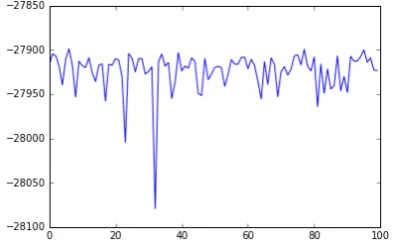
With 100 random restarts on EM during the de-cipherment of the Caesar cipher encrypted dataset A, our system reports a mean loglikelihood of -27923 and a standard deviation of 23. The Figure 2shows every loglikelihood value in 100 random restarts. As the Caesar cipher is relatively easy to decipher, the loglikelihood does not vary greatly. The highest loglikelihood yields a classification accuracy of 86% (154/179), which is the same as the original plain text classification accuracy. The decipherment process seems to recover the whole message that was encrypted by the Caesar cipher.
5.2 Decipherment of Leet Substitution
Leet is a quasi-encryption method which makes use of modified spellings and verbiage primarily used by the Internet community for many
pho-Figure 2:100 Random Restarts Loglikelihood in Caesar Ci-pher DeciCi-pherment
netic languages. For the Leet substitution cipher, we referred to the KoreLogic’s Leet rules (Kore Logic Security,2012) which tagged as “#KoreL-ogicRulesL33t” . We used John the Ripper pass-word cracker (Solar Designer and Community, 2013) to apply the KoreLogic Leet rules encrypt-ing our test sets.
Encrypting a text with a Leet substitution does not change all the letters in the original messages. A spelling correction, therefore, performs better on such text sequences compared to the ones enci-phered with a Caesar cipher. So the noisy channel spelling correction is able to recover the original form of some of the corrupted messages. HMM based decipherment approach, however, still man-ages to outperform spelling correction. For deci-pherment of Leet ciphers, we employ beam search to decode the final results having obtained the pos-terior probabilities from EM training. We apply both the methods on the test sets A,B and C.
[image:5.595.316.513.187.312.2] [image:5.595.75.284.335.433.2]Test Set Original Text
Leet Encryption Set
Noisy Channel Spelling Correction
Deciphering per line
Deciphering whole set
A 86%
(154/179)
59% (107/179)
68% (122/179)
56% (102/179)
82% (147/179)
B 86%
(154/179)
64% (115/179)
60% (108/179)
62% (112/179)
82% (148/179)
C 84%
(152/179)
62% (112/179)
65% (117/179)
67% (121/179)
[image:6.595.123.474.61.147.2]81% (146/179)
Table 2: Classification Accuracy of Spelling Correction and Decipherment Results in Leet Substitution Cipher with Beam Search Width of 5
Test Dataset
A
B
C
Classification Accuracy (%)
0 22.5 45 67.5 90
Spelling Correction Decipherment
Original Text: whats fucker
Encryption: wha+$ Fuck3r
Decipherment: whats fucker
[image:6.595.74.283.193.290.2]Spelling Correction: what a fucker
Figure 3: Decipherment vs. Spelling Correction ap-proaches on Leet cipher encrypted offensive messages. (Example from Test setA.)
messages appear quite close to being as accurate as the original raw test set.
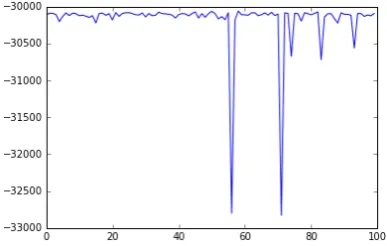
Figure 4:100 Random Restarts Loglikelihood in Leet Sub-stitution Cipher Decipherment
On performing 100 random restarts on EM dur-ing the decipherment of the Caesar cipher en-crypted test datasetA, our system records an aver-age loglikelihood of -30183 and a standard devi-ation of 390. Figure4shows every loglikelihood value in 100 random restarts. The high deviation in the loglikelihood shows that a Leet substitution is harder to solve than a Caesar cipher.
5.3 Decipherment of Real Chat Offensive Words Substitution Dataset
In each of the offensive test setsA, B andC, the offensive keywords in the messages are substi-tuted with real human corrupted words obtained
from real-word chat messages. These chats are transformed versions of these offensive words that are matched using a hand-written rule-based sys-tem. We used enciphered offensive words col-lected from real chat messages and the corre-sponding plain text for this task.
Original Text:hes really bitchy in the morning
Encryption:hes really bitchyou in the morning
Decipherment: hes really bitchy in the morning
Spelling Correction:hes really bitchy in the morning
Since this quasi-encryption is based on real chat messages, it closely mimics the inventive ways users employ to disguise their messages to bypass the filter system, which can involve both insertion and deletion.
It is then imperative that we handle insertion, deletion and substitution in the disguised words to recover the original plain text words. In the insertion case, for example, if the original word
hellois disguised as helo, aNULL symbol is
inserted inside the disguised wordhelo to deci-pher. The ideal position to insert theNULLsymbol ishe<NULL>lobut it is not known during train-ing. To circumvent this, we experiment with two techniques: (1) to insert NULLat random before the beginning of the EM training, and (2) to insert theNULLusing the method in Sec.2.1.
Test Dataset
A
B
C
Classification Accuracy (%)
68 70.5 73 75.5 78
Random NULL Insertion n-gram based NULL insertion
Figure 5:Random vs.n-gram count basedNULLinsertions.
[image:6.595.82.276.404.527.2] [image:6.595.312.515.602.719.2]word-Test Set Wiktionary Encrypted Set
Noisy Channel Spelling Correction
Aspell Spelling
Correction NULLInsertion Decipherment
A 64%
(116/179)
72% (130/179)
77%
(138/179) Random
69% (124/179)
n-gram Count Based 72% (129/179)
B 72%
(129/179)
76% (137/179)
73%
(131/179) Random
72% (130/179)
n-gram Count Based 75% (136/179)
C 75%
(136/179)
77% (138/179)
77%
(138/179) Random
76% (137/179)
[image:7.595.105.491.61.216.2]n-gram Count Based 78% (140/179)
Table 3:Classification Accuracy of Spelling Correction and Decipherment Results in Real Chat Offensive Words Substitution Wiktionary Dataset
level language model 4.1 to learn the n-gram counts.From Table 3 and Figure 7, the n-gram count based insertion decipherment has a higher classification accuracy than the random insertion
NULL decipherment. An advantage of this type of HMM decipherment method is that it tends to not change the words that are already correct since these words have the highest language model score. Rather, it changes the words that are cor-rupted or misspelled. Irrespective of the type of encryption, the HMM decipherment approach al-ways deciphers the messages which fit with the language model we trained.
We conducted an additional experiment to test with the Aspell program. Table3 shows that de-ciphered messages obtain better accuracies than Aspell on test sets B and C while on test set A, it is about 5% less accurate. Note that the noisy channel model was trained on data obtained from a hand-tuned filtering system that was domain spe-cific and created spespe-cifically for these chat mes-sages. What we find in our results is that the deci-pherment system can match this domain expertise using unsupervised learning without any domain specific knowledge.
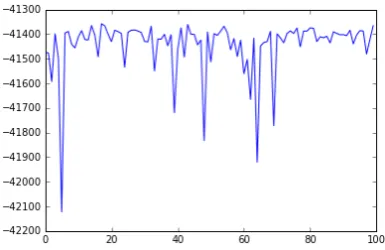
Figure 6 shows every loglikelihood value in 100 random restarts on test-set B. The mean of loglikelihood is -41444.7 and the standard devia-tion was 115.53. The greater diversity among the real chat offensive words renders the decipherment much harder than controlled synthetic-scenarios.
5.4 Decipherment of Real Offensive Chat Messages
We use two versions of a rule-based offensive lan-guage filtering system to evaluate our decipher-ment approach. The first version of the filter
sys-Figure 6: 100 Random Restarts Loglikelihood in De-cipherment of Real Chat Offensive Words Substitution on Test Set B
tem was two years old and the second version of the filter system has benefited from daily updates from humans monitoring the chat room. The ques-tion we want to ask in this evaluaques-tion is if our de-cipherment system can replicate the human effort of two years of rule development in this filtering system.
We use a test set of 500 offensive messages sam-pled from the set of chat room messages which were notflagged as offensive by the first (older) version of the filter system but whichwereflagged as offensive by the second version of the filter sys-tem. This allows us to evaluate how many of those offensive messages can be identified using deci-pherment.
User corrupted text:fvk u
User corrupted text:f2ck u
Deciphered text: fuck you
[image:7.595.318.511.265.390.2]re-main. For example, the textheeeellllooois preprocessed toheelloo. Further, all the special symbols were replaced with<NULL>.
The preprocessed test-set is then deciphered with the HMM based decipherment technique. The deciphered messages are then passed back into the first version of the filtering system. This lets us check if deciphering the user-disguised message into a simpler plaintext message allows the two year old filter to catch it as offensive. The above example shows that decipherment can han-dle substitutions and insertions.
The two year old rule-based filter was able to successfully flag 51.6% of the deciphered mes-sages as offensive text. Thus, the decipherment approach is able to transform about half of the cor-rupted messages into a readable form so that the filter system without the benefit of two years of de-velopment can recognize them as offensive. This shows that decipherment can lead to much faster development of filtering systems for offensive lan-guage.
6 Discussion
We observe that HMM decipherment trained on the whole set is particularly able to recover most encrypted letters (cipher text) into their original letters (plain text). When we decipher each line
Test Dataset
A
B
C
Classification Accuracy (%)
0 22.5 45 67.5 90
[image:8.595.74.282.465.585.2]Random Initialization Previous Table based Initialization
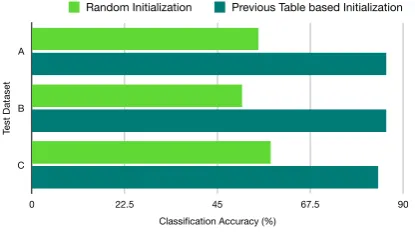
Figure 7:Decipherment per line vs on whole set.
of messages individually, the EM training does not observe enough data to learn the posterior proba-bilities. In contrast, the substitution table trained by previous messages being passed into next mes-sage initialization table will not lose the informa-tion learned from the previous messages. There-fore, the results of whole set decipherment are bet-ter than per line decipherment.
As Tables (1 2, 3) show, HMM decipherment training can recover most of the words in our test
sets compared to the original message classifica-tion accuracy of each set. From the results shown in Table 1 and Table 2, no matter what encryp-tion of substituencryp-tion cipher was used, be it Caesar cipher or Leet substitution cipher, the HMM de-cipherment with language model could always re-cover the original messages.
7 Related Work
For detecting offensive languages, rule-based fil-tering systems and machine learning techniques are widely used. Razavi et al. (2010) lever-aged a variety of statistical models and rule-based patterns and applied multi-level classification for flame detection. Chen et al. (2012) introduced a Lexical Syntactic Feature (LSF) architecture to detect offensive content and identify poten-tial offensive users in social media. Kansara and Shekokar (2015) proposed a framework that de-tects bullying texts and images in using feature ex-traction and classifiers. Djuric et al.(2015) lever-aged word embedding representations (Mikolov et al., 2013) to improve machine learning based classifiers.Nobata et al.(2016) unified predefined linguistic elements and word embeddings to train a regression model. Su et al. (2017) presented a system to detect and rephrase profane words writ-ten in Chinese. samghabadi2017detecting
Previous work on decipherment are often based on noisy-channel frameworks. Knight and Ya-mada (1999) proposed to use EM algorithm to estimate the mapping distribution over the sound to characters, then generated the plaintext using Viterbi algorithm (Forney Jr, 1973). The learn-ing objective is to maximize the probability of the mapping ciphertext phoneme-tokens to plaintext characters. Further, Knight et al. (2006) studied using EM for unsupervised learning of the sub-stitution maps for 1:1 letter subsub-stitution ciphers. Ravi and Knight (2011) proposed to regard for-eign language as ciphertext and English as plain-text, converting a translation problem into one of word substitution decipherment. They employed iterative EM approach and a Bayesian learning ap-proach to build the translation mechanism using monolingual data.
We use the EM based decipherment technique to convert user-disguised offensive text into a filter-recognizable plaintext.
8 Conclusion
The HMM decipherment can decipher disguised text based on the language model regardless of the encryption type. The decipherment approach we proposed can cover more disguised cases than spelling correction methods. However, due to the limitation of edit distance and lack of traning data, the noisy channel spelling correction has its limi-tations and cannot handle high edit distance case. Large edit distances are common in real chat mes-sages, and thus the decipherment approach has its advantages. The difference between the decipher-ment with traditional spelling correction meth-ods like Aspell is that decipherment method only needs a language model to decipher cipher text, and does not need a dictionary to refer to. The lan-guage model has the advantage that we can train a domain specific language model to decipher spe-cific topic messages as real chat messages usually have some sort of topics or domain, such as sports, news and so on. The future work is that we can try different language messages to decipher, as long as we can have the corresponding language model.
Acknowledgments
We would like to thank the anonymous reviewers for their helpful remarks. The research was also partially supported by the Natural Sciences and Engineering Research Council of Canada grants
NSERC RGPIN-2018-06437 and RGPAS-2018-522574 and a Department of National Defence (DND) and NSERC grant DGDND-2018-00025 to the third author. We would also like to thank Ken Dwyer and Michael Harris from the Two Hat Security Company who collected and organized the real-world chat data for us. Thanks also to the Two Hat CEO, Chris Priebe, who supported this research and also provided an internship to the first author where he worked on spelling correction for chats.
References
Rie Kubota Ando and Lillian Lee. 2003. Mostly-unsupervised statistical segmentation of japanese kanji sequences. Natural Language Engineering, 9(2):127–149.
Pinkesh Badjatiya, Shashank Gupta, Manish Gupta, and Vasudeva Varma. 2017. Deep learning for hate speech detection in tweets. In Proceedings of the 26th International Conference on World Wide Web
Companion, pages 759–760. International World
Wide Web Conferences Steering Committee.
Taylor Berg-Kirkpatrick and Dan Klein. 2013. De-cipherment with a million random restarts. In
EMNLP, pages 874–878.
Ying Chen, Yilu Zhou, Sencun Zhu, and Heng Xu. 2012. Detecting offensive language in social me-dia to protect adolescent online safety. InPrivacy, Security, Risk and Trust (PASSAT), 2012 Interna-tional Conference on and 2012 InternaInterna-tional
Con-fernece on Social Computing (SocialCom), pages
71–80. IEEE.
Monojit Choudhury, Rahul Saraf, Vijit Jain, Animesh Mukherjee, Sudeshna Sarkar, and Anupam Basu. 2007. Investigation and modeling of the struc-ture of texting language. International Journal of
Document Analysis and Recognition (IJDAR),
10(3-4):157–174.
Arthur P Dempster, Nan M Laird, and Donald B Rubin. 1977.Maximum likelihood from incomplete data via the EM algorithm. Journal of the royal statistical society. Series B (methodological), page 1-38.
Nemanja Djuric, Jing Zhou, Robin Morris, Mihajlo Gr-bovic, Vladan Radosavljevic, and Narayan Bhamidi-pati. 2015. Hate speech detection with comment embeddings. In Proceedings of the 24th
interna-tional conference on world wide web, pages 29–30.
ACM.
Bj¨orn Gamb¨ack and Utpal Kumar Sikdar. 2017. Us-ing convolutional neural networks to classify hate-speech. In Proceedings of the First Workshop on
Abusive Language Online, pages 85–90.
David Graff, Junbo Kong, Ke Chen, and Kazuaki Maeda. 2003. English gigaword. Linguistic Data Consortium, Philadelphia.
Krishna B Kansara and Narendra M Shekokar. 2015. A framework for cyberbullying detection in social net-work. International Journal of Current Engineering and Technology, 5.
Tetsuo Kiso. 2012. A python wrapper for de-termining interpolation weights with srilm.
https://github.com/tetsuok/
py-srilm-interpolator.
Kevin Knight, Anish Nair, Nishit Rathod, and Kenji Yamada. 2006. Unsupervised analysis for deci-pherment problems. In Proceedings of the
COL-ING/ACL on Main conference poster sessions, pages
499–506. Association for Computational Linguis-tics.
Kevin Knight and Kenji Yamada. 1999. A computa-tional approach to deciphering unknown scripts. In
ACL Workshop on Unsupervised Learning in Natu-ral Language Processing, pages 37–44. 1.
Catherine Kobus, Franc¸ois Yvon, and G´eraldine Damnati. 2008. Normalizing sms: are two metaphors better than one? InProceedings of the 22nd International Conference on Computational
Linguistics-Volume 1, pages 441–448. Association
for Computational Linguistics.
Philipp Koehn. 2005. Europarl: A parallel corpus for statistical machine translation. InMT summit, vol-ume 5, pages 79–86.
Kore Logic Security. 2012. Kore logic custom rules. http://contest-2010.korelogic.
com/rules.txt.
Tomas Mikolov, Ilya Sutskever, Kai Chen, Greg S Cor-rado, and Jeff Dean. 2013. Distributed representa-tions of words and phrases and their compositional-ity. InAdvances in neural information processing systems, pages 3111–3119.
Chikashi Nobata, Joel Tetreault, Achint Thomas, Yashar Mehdad, and Yi Chang. 2016. Abusive lan-guage detection in online user content. In Proceed-ings of the 25th international conference on world
wide web, pages 145–153. International World Wide
Web Conferences Steering Committee.
Peter Norvig. 2009. Natural language corpus data.
Beautiful Data, pages 219–242.
Malte Nuhn, Julian Schamper, and Hermann Ney. 2013. Beam search for solving substitution ciphers. InCiteseer.
Ji Ho Park and Pascale Fung. 2017. One-step and two-step classification for abusive language detection on twitter. In Proceedings of the First Workshop on
Abusive Language Online, pages 41–45.
Lawrence R Rabiner. 1989. A tutorial on hidden markov models and selected applications in speech recognition. Proceedings of the IEEE, 77(2):257– 286.
Sujith Ravi and Kevin Knight. 2011. Deciphering for-eign language. In Proceedings of the 49th Annual Meeting of the Association for Computational
Lin-guistics: Human Language Technologies-Volume 1,
pages 12–21. Association for Computational Lin-guistics.
Amir H Razavi, Diana Inkpen, Sasha Uritsky, and Stan Matwin. 2010. Offensive language detection using multi-level classification. InCanadian Conference on Artificial Intelligence, pages 16–27. Springer.
Sarah Schulz, Guy De Pauw, Orph´ee De Clercq, Bart Desmet, Veronique Hoste, Walter Daelemans, and Lieve Macken. 2016. Multimodular text normaliza-tion of dutch user-generated content. ACM Transac-tions on Intelligent Systems and Technology (TIST), 7(4):61.
Solar Designer and Community. 2013. John the ripper password cracker. http://www.openwall. com/john.
Andreas Stolcke et al. 2002. Srilm-an extensible lan-guage modeling toolkit. InInterspeech.
Hui-Po Su, Zhen-Jie Huang, Hao-Tsung Chang, and Chuan-Jie Lin. 2017. Rephrasing profanity in chi-nese text. InProceedings of the First Workshop on
Abusive Language Online, pages 18–24.
William Warner and Julia Hirschberg. 2012. Detecting hate speech on the world wide web. In Proceed-ings of the Second Workshop on Language in Social
Media, pages 19–26. Association for Computational
Linguistics.
Matthew L Williams and Pete Burnap. 2015. Cyber-hate on social media in the aftermath of woolwich: A case study in computational criminology and big data. British Journal of Criminology, 56(2):211– 238.
Dawei Yin, Zhenzhen Xue, Liangjie Hong, Brian D Davison, April Kontostathis, and Lynne Edwards. 2009. Detection of harassment on web 2.0. In Pro-ceedings of the Content Analysis in the WEBb, pages 1–7.
Ziqi Zhang, David Robinson, and Jonathan Tepper. 2018. Detecting hate speech on twitter using a convolution-gru based deep neural network. In
Eu-ropean Semantic Web Conference, pages 745–760.