165
Self-training improves Recurrent Neural Networks performance for
Temporal Relation Extraction
Chen Lina, Timothy A. Millera, Dmitriy Dligachb, Hadi Amiria, Steven Bethardc,Guergana Savovaa
aBoston Children’s Hospital Informatics Program, Harvard Medical School
{firstname.lastname}@childrens.harvard.edu bLoyola University Chicago
[email protected] cUniversity of Arizona
Abstract
Neural network models are oftentimes re-stricted by limited labeled instances and resort to advanced architectures and features for cut-ting edge performance. We propose to build a recurrent neural network with multiple se-mantically heterogeneous embeddings within a self-training framework. Our framework makes use of labeled, unlabeled, and social media data, operates on basic features, and is scalable and generalizable. With this method, we establish the state-of-the-art result for both in- and cross-domain for a clinical temporal re-lation extraction task.
1 Introduction
Neural network methods have obtained spectacular successes in the fields of computer vision (He et al.,
2016; Krizhevsky et al., 2012), speech recogni-tion (Hinton et al.,2012;Graves and Jaitly,2014), and machine translation (Sutskever et al.,2014), where large datasets are available for training. For extracting information from text, however, perfor-mance gains have been minimal or non-existent, with published work emphasizing that such perfor-mance parity is not obtainable without extensive feature engineering. Unlike other settings that have seen performance gains, information extraction tasks related to text typically have much smaller supervised training sets, and the neural network al-gorithms presumably do not see enough instances to optimally tune the large parameter space.
In this paper, we examine the important informa-tion extracinforma-tion task of temporal relainforma-tion extracinforma-tion from clinical text. The state-of-the-art for this task is a machine learner with a heavily-engineered set of features (Sun et al.,2013;Lin et al.,2016a). The identification of temporal relations from the clini-cal text in the electronic mediclini-cal records has been drawing growing attention because of its potential to provide accurate fine-grained analyses of many
medical phenomena (e.g., disease progression, lon-gitudinal effects of medications), with many clini-cal applications such as question answering (Das and Musen,1995;Kahn et al.,1990), clinical out-comes prediction (Schmidt et al.,2005), and recog-nition of temporal patterns and timelines (Zhou and Hripcsak,2007;Lin et al.,2014). Obtaining large supervised datasets for clinical tasks is expensive and difficult, so it has been challenging to show meaningful improvements from the recent explo-sion of sophisticated neural network methods.
Our hypothesis is that the range of interesting phenomena found in clinical data is much broader than what is covered by available gold standard datasets for temporal information extraction. The results of Clinical TempEval 2017 (Bethard et al.,
2017) strongly support this latter point, as the performance of submitted systems drops severely when trained on gold instances in one domain and tested on a new domain. We are thus in-spired to make use of unlabeled data in addi-tion to gold standard data with a simple semi-supervised learning method–self-training and com-bine it with varieties of pre-trained word embed-dings to overcome gaps in training data coverage. In self-training (Yarowsky,1995;Riloff et al.,2003;
Maeireizo et al.,2004), a classifier is first trained on existing labeled data, and then applied to unla-beled data (typically a much larger amount). The predicted instances above a confidence threshold are added to the training set and the classifier is re-trained. Self-training is especially attractive in a neural network setting because the primitive fea-ture types used by these networks (i.e., tokens) are computationally more efficient to obtain than the sophisticated features typically used by feature en-gineering methods.
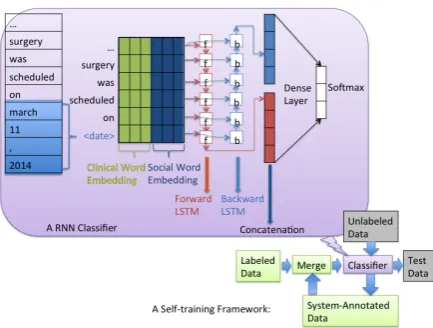
Figure 1: A RNN-based Self-training Framework
task is in the clinical setting, we use available clini-cal data sources, but also experiment with general domain sources trained on much larger datasets.
Besides showing that neural network approaches to information extraction can outperform feature-engineering approaches, we find that self-training works better in the neural network setting than with existing state-of-the-art feature-engineering approaches. Finally, we show that these methods generalize to new clinical domains better than the feature-engineering approaches we compare them to, obtaining state-of-the-art performance in an un-supervised domain adaptation setting.
2 Related Work
In recent years, several shared tasks on temporal relation extraction from clinical text have been or-ganized. Among them, the i2b2 temporal chal-lenge evaluates the i2b2 corpus (Sun et al.,2013), and Clinical TempEval series (Bethard et al.,2015,
2016,2017) evaluate systems using the THYME corpus (Styler IV et al.,2014), which is annotated with time expressions (TIMEX3), events (EVENT), and temporal relations (TLINK) per an extension of the TimeML specifications (Pustejovsky et al.,
2003;Pustejovsky and Stubbs,2011). Challenge participants develop methods to extract EVENT and TIMEX3 entities, CONTAINS relations and document creation time relations. Herein, we focus on CONTAINS relation, which signals an EVENT occurs entirely within the temporal bounds of an
narrative container. Thenarrative container is either another EVENT or TIMEX3.
Conventional learning methods, such as support vector machines (SVM) and conditional random fields (CRF) (Sun et al.,2013), have been
devel-oped for this task. Neural networks used in gen-eral relation extraction (Hashimoto et al., 2013;
Socher et al., 2012), have also been adopted in clinical temporal relation extraction, such as struc-tured perceptron (Leeuwenberg and Moens,2017), convolutional neural networks (CNNs) (Dligach et al.,2017;Lin et al.,2017) and Long Short-Term memory (LSTM) networks (Tourille et al.,2017;
Dligach et al.,2017). Classifiers are usually trained and tested in the same domain for the same med-ical condition, e.g. models are trained and tested on the colon cancer set of the THYME corpus for Clinical TempEval 2015 and 2016 (Bethard et al.,
2015,2016).
Clinical TempEval 2017 introduces the task of domain adaptation, as the most frequent use case would be the application of a model on a do-main different from the dodo-main it was trained on. The source domain of Clinical TempEval 2017 is colon cancer clinical text while the target domain is brain cancer clinical text. Few domain adap-tation techniques are applied by the participants: 1) modeling unknown words to accommodate un-seen vocabulary in the new domain; 2) using pre-trained domain-independent word embeddings; 3) for supervised domain adaptation, assigning higher weights to samples from the new domain during model training. The performance on the domain adaptation task plummetted. Other domain adap-tation methods used in general relation extraction include (Nguyen et al.,2014;Nguyen and Grish-man,2014;Plank and Moschitti,2013).
Semi-supervised learning has been a popular ap-proach for improving coverage and model general-izability for various information extraction tasks by exploring unlabeled data. Besides semi-supervised methods developed for feature-based learners (Le and Kim, 2015; Li and Zhou, 2010), there are such algorithms for deep neural network struc-tures (DNN) (Laine and Aila,2016;Kingma et al.,
as minimizing the reconstruction errors in Genera-tive Adversarial Networks-based semi-supervised learning. With primitive features, DNN-based self-training can effectively and efficiently evaluate a large amount of instances; 2) We hypothesize that not all unlabeled data are useful. Our goal is to use a straightforward method like self-training to study the unlabeled space and help to select the most informative instances.
3 Data
We collect a variety of external data sources, described below, to supplement the THYME dataset (Styler IV et al.,2014).
3.1 Labeled Clinical Data
Our labeled data is the THYME corpus (Styler IV et al.,2014) used for the Clinical TempEval tasks. The corpus contains internal medicine, oncology, pathology, and radiology reports for200colon can-cer patients and200braincancer patients for a total of1200notes. Following the unsupervised domain adaptation setting of Clinical TempEval 2017, we use colon cancer notes for model development, and brain cancer notes for cross-domain validation.
3.2 Unlabeled Clinical Data
We augment the labeled data with additional clini-cal notes for colon cancer patients for a total of
27,157 notes (average length=135 words) from the same medical center as the THYME corpus from Section 3.1. On average, each patient has
125notes of varied types – primary care, specialty care, pathology, radiology, etc. This set includes all electronic medical record notes at a single medical center for the200colon cancer THYME patients. We use it to automatically derive additional train-ing instances, and refer to these generated instances assilverinstances. We do not have access to ad-ditional unlabeled out-of-domain data (i.e. brain cancer clinical notes).
3.2.1 Clinical Word Embeddings
To train word embeddings with good vocabulary coverage and high representational power, we took advantage of the clinical notes from MIMIC-III (Medical Information Mart for Intensive Care) dataset (Johnson et al.,2016). The publicly avail-able MIMIC III contains879million words from Beth Israel Deaconess Medical Center’s Intensive Care Unit. We merged MIMIC-III data with the
unlabeled colon cancer set above and trained300 -dimension embeddings with fastText (Joulin et al.,
2016) and skip-gram (Guthrie et al.,2006) models.
3.2.2 Social Media Word Embeddings
While unlabeled clinical data provides a domain-matched source for training embeddings, additional data can be freely obtained from social media posts about colon cancer. To explore the benefits of extra coverage of such datasets versus the domain speci-ficity of clinical embeddings, we obtain another set of embeddings using user-generated content about colon cancer from two social media plat-forms, namely Twitter and Reddit. For this purpose, we first generate a keyword list from two sources: a) the most frequent medical terms in the unlabeled colon cancer notes, these include any term that maps to the Unified Medical Language System con-cept unique identifiers (UMLS CUIs) (Bodenreider,
2004), b) the most frequent terms that map to ICD-9 billing codes related to colon cancer. These two lists results in a total number of143keywords. We use these keywords as a filter to collect 1.7 million publicly-available tweets about colon cancer. In addition, we collect19K Reddit posts that contain at least one mention of colon cancer. We remove all occurrences of usernames, hash tags, URLs, and non-ASCII characters from the resulting data and employ fastText (Joulin et al.,2016) to obtain social media word embeddings.
In addition to the above embeddings, we uti-lize the Google News embeddings1 trained by word2vec (Mikolov et al.,2013).
4 Methods
We develop a self-training framework to generate additional(silver)instances of CONTAINS relation (see Figure1, lower-right). We focus on within-sentence CONTAINS relations and set aside all cross-sentence relations based on two motivations. First, the majority of the gold standard CONTAINS relations occur within a sentence.2 Second, a sen-tence is a complete semantic and syntactic struc-ture, which makes it an ideal unit for a sequence model, like RNN, to operate on. We therefore ig-nore cross-sentence CONTAINS links and focus on within-sentence CONTAINS relations. In
addi-1https://code.google.com/archive/p/word2vec/
24,3654within-sentence vs. 743cross-sentence
tion, since we use the official Clinical TempEval 2017 scoring tool, our models are penalized for the missed cross-sentence relations.
4.1 Preprocessing
We process the labeled and unlabeled clinical data through the sentence detection and tokeniza-tion modules of Apache cTAKES3. For the la-beled clinical data, we use gold standard event and time expression annotations and their time classes (Styler IV et al.,2014) for both model de-velopment and final validation. For the unlabeled clinical text data, we use the cTAKES event anno-tator (Lin et al.,2016a) and time expression anno-tator (Miller et al.,2015) to automatically annotate event and time expressions along with their time classes (e.g., TIME, DATE, SET). Both labeled and unlabeled corpora are transformed to lower case as shown in Figure2.
4.2 Instance Representation
We first create a dataset of within-sentence CONTAINS-relation candidates from the colon cancer text of the labeled clinical data. Given all gold standard events and time expressions within a sentence, we link every pair of events, and ev-ery event to a time expression (if present) to form CONTAINS candidates.
To mark the position of the relational arguments in a candidate pair, we adopt the same xml-tag marked-up token sequence representation as pre-vious work (Dligach et al.,2017), and encode the time expression with its time class (Lin et al.,2017) for better generalizability. Figure2illustrates the marked-up token sequence representations for all three relational candidates, in which the event in an event-time relation pair is marked byheiand h/eiand the time expression is marked byhtiand h/ti. The time expression is further encoded by its time class,hti hdatei h/ti, which is a gold standard attribute of a time expression annotation (Styler IV et al., 2014). Event-event instances are marked with additional indexes1and2, e.g. ahe1isurgery
h/e1iishe2ischeduledh/e2ion march11.
We also follow previous best practice in apply-ing transitive closure to existapply-ing gold CONTAINS relations on the training data (Mani et al.,2006;Lin et al.,2016a). Depending on the order of the rela-tional arguments, there are three types of gold stan-dard relational labels, CONTAINS,
CONTAINED-3http://ctakes.apache.org
A
EVENT1
surgery was
EVENT2
scheduled on
TIME March 11, 2014 ⇓
Candidate 1: aheisurgeryh/eiwas scheduled on hti hdatei h/ti;
Candidate 2: a surgery washeischeduledh/eion hti hdatei h/ti;
Candidate 3: ahe1isurgeryh/e1iwashe2i scheduledh/e2ion march
Figure 2: Representations of event and event-time relational candidates in a sentence
BY, and NONE.
4.3 Bidirectional RNN Classifier
We use a bi-directional recurrent neural network to model the relational context similar to the state-of-the-art model (Tourille et al.,2017). As shown in Figure1 (upper-left), each token in the token sequence input is represented by one set of clinical embeddings and one set of additional embeddings (either cancer-related social media embeddings or Google news embeddings) to capture the semantics exhibited by clinical and non-clinical terms.
As described in section 3.2.1, the clinical em-beddings are derived from combining the MIMIC III and unlabeled colon cancer datasets. For the unlabeled colon cancer data, we use the extracted relational candidates as shown in Figure2to train embeddings, so that all xml-tag marked-up tokens and time-class tokens, e.g.h/ei,h/e1i,h/ti,h/datei, are represented. For each set of embeddings, an
UNKtoken represents out-of-vocabulary words to accommodate unseen words in a new domain. Ta-ble1shows the coverage of each embedding set and their combinations over the labeled colon cancer training set. We will show the effect of the different embedding combinations in the experiments.
The two sets of embeddings for a given token are concatenated and fed into the two sequences of hidden states of RNN: forward states and backward states. The output of the two states is concatenated and fed into a dense layer and through a softmax layer to predict three relational labels as described in section 4.2. We evaluate two RNN models, Long Short-Term Memory (LSTM) (Hochreiter and Schmidhuber,1997) and Gated recurrent units (GRUs) (Chung et al.,2014).
We implement the network in Keras (Chollet,
2015) with Theano (Theano Development Team,
corpora word# coverage
(1) Clinical 136K 94.66%
(2) Cancer-related social media 60K 76.67%
(3) Google News 3M 83.69%
(1) + (2) 171K 95.69%
(1) + (3) 3M 95.70%
Table 1: Embedding word coverage (percentage of words in the THYME corpus covered by the vocab-ulary in each corpora); Clinical embeddings derived from the combination of MIMIC and unlabeled colon cancer datasets, see section 3.3; Cancer-related embed-ddings derived from the combination of relevant Reddit posts and tweets, see section 3.4
size of 256, Stochastic Gradient Descent using Adam optimizer (Kingma and Ba, 2014), and a learning rate of0.0001, on a GTX TitanX GPU. The hyper-parameters are optimized through a ran-dom search algorithm (Li et al.,2016) and the size of the hidden states of the forward and backward re-current neural networks are set512. We keep10% of the training samples as a validation split, and ap-plied a0.5dropout ratio and0.0001L2-regularized penalties to the embedding layers. For the high-precision model, we increased the weight of the L2-regularizer from0.0001to0.001.
4.4 Self-Training
We apply the high-precision bi-directional RNN model trained on the labeled data to generate CONTAINS predictions on the unlabeled colon cancer data forsilver annotations. We retain in-stances with a confidence score as generated by the
softmaxfunction of greater than0.9 (a higher threshold will result in too few positive instances, a lower threshold will result in disproportionately many negative instances). We find that a lower threshold leads to low quality predictions and a higher threshold generates too few CONTAINS re-lations. The retained silver instances are merged with the gold ones and input into the bi-directional-RNN for a second-round of training.
As a comparison, we use self-training with the state-of-the-art SVM model (Lin et al.,2016a,b) to generatesilverrelations. The SVM-based THYME system is the latest release of Apache cTAKES v4 temporal module. For a comparison with the best setting of RNN-based self-training, we add all positive (CONTAINS, CONTAINED-BY)silver
relations with the confidence threshold of greater than 0.9 to the gold training data of THYME corpus
method all silver positive silver
joint bi-lstm 1.533M 19,441
SVM event-time 1.244M 57,462
[image:5.595.75.294.61.146.2]SVM event-event 2.521M 36,960
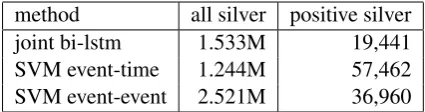
Table 2: Number of generated silver training instances
and then retrain the SVM model.
Table 2 shows the number of silver instances generated by each learning algorithm. The high-precision bi-directional RNN model (joint-bi-lstm) is built upon LSTM networks with clinical and so-cial media embeddings, and trained on the training split of the colon cancer set of THYME corpus.
5 Experiments
We experimented with several combinations of clin-ical and cancer-related social media and Google news embeddings. We tested three modes of merg-ing silver instances with gold annotations (Figure1, lower right): 1) Posi-Merge: merging the positive predictions (i.e. CONTAINS and CONTAINED-BY relations) with the gold relations; 2) sub-Merge: merging a subset of the silver data (a random sam-ple of45K silver samples including CONTAINS, CONTAINED-BY, and NONE relations) with the gold relations; and 3) all-Merge: merging all sil-ver data with the gold relations. After merging, we shuffled gold and silver instances together to balance the batch-wise computation.
Models utilizing self-training were trained on the gold colon cancer training set of the THYME corpus and silver instances predicted from the un-labeled colon cancer data. Models were tested on the gold colon cancer and gold brain cancer de-velopment sets of the THYME corpus, comparing in-domain and cross-domain performance to select the best models for testing. The best models were tested on the gold colon cancer and brain cancer test sets (Clinical TempEval 2017 test sets).
[image:5.595.306.519.62.118.2]6 Results
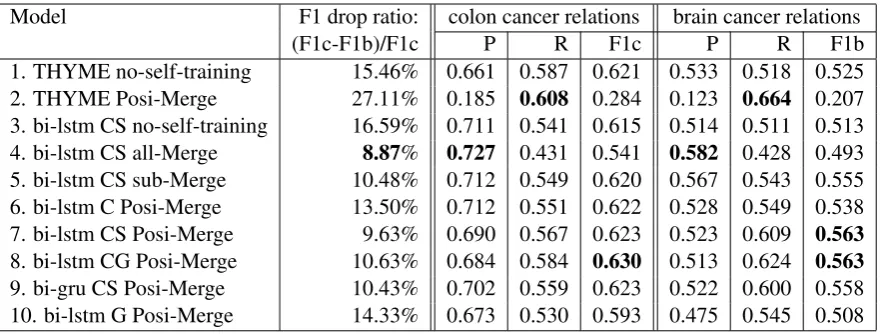
Table 3 shows performance of the THYME sys-tem and various bi-directional RNN methods on the colon cancer and brain cancer development sets. For RNNs, we evaluated both LSTM and GRU models. For embedding combinations, we tested using the clinical embedding alone (C), us-ing both clinical and cancer-related social media embeddings (CS), using both clinical and Google News embeddings (CG), and using Google News Embeddings alone (G). For ways to merge sil-ver samples with gold instances we tested no-self-trainingin which no silver instances were used,
all-Mergein which all silver instances were used,
sub-Mergein which a subset of silver samples were used, andPosi-Mergein which only the positive silver instances were used. Among all settings,
bi-LSTM CG Posi-Mergeand bi-LSTM CS Posi-Merge achieved the best F1-score (F1b) on the brain development set; bi-LSTM CS Posi-Merge
had the best F1-score (F1c) on the colon develop-ment set. These two best performing neural mod-els along with theTHYME no-self-trainingsystem were tested on the Clinical TempEval test splits.
Table 4 shows that the bi-LSTM models out-perform the SVM-based THYME system and the Clinical TempEval 2017 top system, especially on the cross-domain experiments. The THYME sys-tem performance on the colon test set is0.621F1 which is an improvement over previously reported results (Lin et al., 2016b). The THYME system result on the brain cancer test is reported here for the first time. Note that the THYME system was trained on all gold colon cancer annotations (train-ing, development and test), while the bi-LSTM models were trained on gold training colon cancer data and positive silver colon cancer samples. The best Clinical TempEval result on the gold colon cancer test set –0.613F1-score – is reported by the LIMSI-COT system which makes use of cTAKES-generated features (Tourille et al.,2017). The best Clinical TempEval result on the gold brain cancer test set –0.34F1-score – is achieved by the GUIR system (MacAvaney et al., 2017), while LIMSI-COT obtains0.33cross-domain F1-score.
7 Discussion
7.1 Comparison with SVM Self-Training
The top two rows of Table 3 show that the self-training technique did not improve the SVM-based
THYME system. While recall reached its peak with the self-trained SVM, the precision trade-off was disastrous and F1 suffers dramatically. Our in-terpretation of this result is that the SVM is simply adjusting its class priors, labeling more instances as positive, but its fixed feature set and linear model constrain it from learning anything of interest from the silver data. The SVMs we use have extensively-engineered representations that were implicitly fit to the training and development sets of the colon cancer data. These feature sets may not have the representational power to find useful new patterns in the silver data. In contrast, the neural network models learn to extract features in their lower lay-ers, and when given new data (e.g., silver data from self-training), the representation learning parts of the model are able to adapt and potentially find new patterns. This suggests that self-training for neu-ral networks has higher potential than for SVMs, and that in the SVM setting, self-training should be accompanied by additional feature engineering.
Another difference between the models is that the SVM model relies on sophisticated linguistic features (parse trees, event and time expression at-tributes) that cannot be as reliably extracted from silver data. A token-sequence neural model, in con-trast, makes use of very basic features and main-tains a relatively accurate performance on the unla-beled data. It is possible that SVM performance is actually hurt by the lower quality features available from the silver training instances it encounters.
It is also worth noting that extracting additional silver instances for the SVM model is slower as it takes longer to generate the complex features that the SVM models use, while the token-based features of the neural model are extremely fast.
For all these reasons, we believe that neural networks are a more practical solution and better suited for a semi-supervised learning framework such as self-training.
7.2 Impact of Embeddings
be-Model F1 drop ratio: colon cancer relations brain cancer relations
(F1c-F1b)/F1c P R F1c P R F1b
1. THYME no-self-training 15.46% 0.661 0.587 0.621 0.533 0.518 0.525
2. THYME Posi-Merge 27.11% 0.185 0.608 0.284 0.123 0.664 0.207
3. bi-lstm CS no-self-training 16.59% 0.711 0.541 0.615 0.514 0.511 0.513
4. bi-lstm CS all-Merge 8.87% 0.727 0.431 0.541 0.582 0.428 0.493
5. bi-lstm CS sub-Merge 10.48% 0.712 0.549 0.620 0.567 0.543 0.555
6. bi-lstm C Posi-Merge 13.50% 0.712 0.551 0.622 0.528 0.549 0.538
7. bi-lstm CS Posi-Merge 9.63% 0.690 0.567 0.623 0.523 0.609 0.563
8. bi-lstm CG Posi-Merge 10.63% 0.684 0.584 0.630 0.513 0.624 0.563
9. bi-gru CS Posi-Merge 10.43% 0.702 0.559 0.623 0.522 0.600 0.558
[image:7.595.80.521.61.228.2]10. bi-lstm G Posi-Merge 14.33% 0.673 0.530 0.593 0.475 0.545 0.508
Table 3: Model performance ofCONTAINS relation on colon cancer and brain cancer development sets. C: clinical embeddings representation; CS: clinical and social media embeddings representation; CG: clinical and Google News embeddings representations; G: Google News embeddings. all-Merge: all silver instances added to gold training data; Posi-Merge: positive silver instances added to gold training data; sub-Merge: a subset of silver data added to gold training data.
Model F1 drop ratio colon cancer relations brain cancer relations
(F1c-F1b)/F1c P R F1 P R F1
best Clinical TempEval 44.54% 0.657 0.575 0.613 0.52 0.25 0.34
THYME no-self-training 15.46% 0.661 0.587 0.621 0.533 0.518 0.525
bi-lstm CS Posi-Merge 13.14% 0.700 0.563 0.624 0.520 0.566 0.542
[image:7.595.88.513.307.389.2]bi-lstm CG Posi-Merge 13.04% 0.692 0.576 0.629 0.514 0.585 0.547
Table 4: CONTAINSrelations on colon cancer and brain cancer test set
tween these two cancer populations. Cancer-related social media and Google News embeddings come in with additional word coverage and more gen-eral semantic representations and thus help with the cross-domain performance. Word coverage in-crements are shown in Table1. However, using non-clinical (Google News) embeddings on its own (row 10 of table3) decreased both in-domain and cross-domain performance, even worse than the THYME system (row 1). It’s possible that even though Google News embedding have good word coverage, general senses dominate clinical-specific senses, demonstrating the need for some clinical-specific data.
One interesting fact is that the cancer-related social media embedding has a much smaller vo-cabulary size than the Google News embeddings. Still, the CS option achieves the same F1-score as the CG option on the gold development brain set. Because of its better coverage and general semantic representation, CG option performs the best on the colon development set and the test sets of both colon and brain cancer data as shown in Table4. We experimented with concatenating all three embeddings (clinical, cancer-related social
media, and Google News), but did not observe any performance improvements.
7.3 Sampling of Silver Instances
cross-domain performance.
7.4 Analysis of Improvements
We are interested in understanding the different contributions of self-training and pre-trained em-beddings. Embeddings can provide a kind of adap-tation for words in a new domain that are similar to words in the training data (e.g.,brainin the brain cancer corpus may behave similarly tocolonin a colon cancer corpus). However, self-training may still provide benefit if there are words in the test set that do not have correlates in the training data, but that can be found in the silver data. In these cases, confident silver instances provide information to the neural network about how these words should be integrated into the learned representations for predicting the relation category.
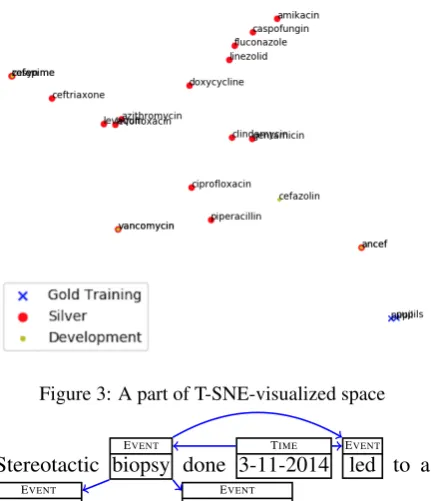
To investigate this possibility, we visualized the embeddings for gold training data, silver data, and development set data, all for colon cancer patients. We hope to find a sub-space in the embedding space where there is overlap between words in the sil-ver data and development, but no nearby words from the training data. Figure3 shows a visual-ized scatter-plot (Maaten and Hinton,2008) of one such space, showing words from gold training set (blue), silver data (red), and the gold development set (yellow), given the clinical embedding. The upper-left cluster of silver words encloses several words occurring in the development set which are not represented or even close to the nearest words from the training set visualized in the lower right corner. Figure3shows that through self-training the vocabulary coverage is extended to less repsented areas thus the model variance error is re-duced which makes the model more generalizable.
7.5 LSTM vs. GRU
[image:8.595.310.526.70.321.2]Given the same settings (rows7and9of Table3), a GRU model performs similarly to a LSTM model for the in-domain task, but differently for the cross-domain task. GRUs are related to LSTMs, both utilize gating mechanisms to manage the vanishing gradient problem, though GRUs have fewer pa-rameters. The performance difference may not be meaningful; we selected the LSTM for the test set evaluation due to its nominally better performance. However, given the small magnitude of these differ-ences, future work may investigate whether GRUs may have advantages in reducing overfitting.
Figure 3: A part of T-SNE-visualized space
Stereotactic
EVENT
biopsy done
TIME 3-11-2014
EVENT led to a
EVENT
diagnosis of grade 4
EVENT astrocytoma .
Figure 4: System annotations for a brain cancer sen-tence. Each arrow represents a CONTAINS relation.
7.6 Error Analysis
By comparing the error outputs of the THYME system and the best self-trained bi-LSTM system of Table3(rows1and8) on the gold brain cancer development set, we find that the THYME system tends to pick up short-distance relation pairs, while the bi-LSTM model performs well on both short-and long- distance relations. One such example is shown in Figure4. It represents a complex set of relations between four events and one time expres-sion. All marked entities are participating in at least one CONTAINS relation, e.g. CONTAINS (3-11
8 Conclusion
We show that neural models for temporal infor-mation extraction are able to take advantage of self-training. Compared with SVM models that leverage sophisticated features, our RNN-based self-training framework for temporal relation ex-traction operates on primitive features, models the sentence structure well, and is highly scalable and generalizable. Our RNN framework establishes a new state-of-the-art result for Clinical TempEval 2017 domain adaptation task. Experiments with externally-trained embeddings suggest that health-related social media or large scale general-domain text data can complement domain-specific text for a domain adaptation task. We will open source our learning framework in the near future.
Acknowledgments
The project is supported by 1U24CA184407-01 from the National Cancer Institute and R01LM010090 from the National Library Of Medicine at the US National Institutes of Health. The content is solely the responsibility of the au-thors and does not necessarily represent the official views of the National Institutes of Health. We thank James H. Martin and the anonymous reviewers for their valuable suggestions and constructive criti-cism. The Titan Xp GPU used for this research was donated by the NVIDIA Corporation.
References
Eugene Agichtein and Luis Gravano. 2000. Snowball: Extracting relations from large plain-text collections. InProceedings of the fifth ACM conference on Digi-tal libraries, pages 85–94. ACM.
Steven Bethard, Leon Derczynski, Guergana Savova, Guergana Savova, James Pustejovsky, and Marc Ver-hagen. 2015. Semeval-2015 task 6: Clinical temp-eval. InProceedings of the 9th International Work-shop on Semantic Evaluation (SemEval 2015), pages 806–814.
Steven Bethard, Guergana Savova, Wei-Te Chen, Leon Derczynski, James Pustejovsky, and Marc Verhagen. 2016. Semeval-2016 task 12: Clinical tempeval. Proceedings of SemEval, pages 1052–1062.
Steven Bethard, Guergana Savova, Martha Palmer, James Pustejovsky, and Marc Verhagen. 2017. Semeval-2017 task 12: Clinical tempeval. Proceed-ings of the 11th International Workshop on Semantic Evaluation (SemEval-2017), pages 563–570.
Olivier Bodenreider. 2004. The unified medical lan-guage system (umls): integrating biomedical termi-nology. Nucleic acids research, 32(suppl 1):D267– D270.
Franc¸ois Chollet. 2015. Keras. https://github. com/fchollet/keras.
Junyoung Chung, Caglar Gulcehre, KyungHyun Cho, and Yoshua Bengio. 2014. Empirical evaluation of gated recurrent neural networks on sequence model-ing.arXiv preprint arXiv:1412.3555.
Amar K Das and Mark A Musen. 1995. A compari-son of the temporal expressiveness of three database query methods. InProceedings of the Annual Sym-posium on Computer Application in Medical Care, page 331. American Medical Informatics Associa-tion.
Dmitriy Dligach, Timothy Miller, Chen Lin, Steven Bethard, and Guergana Savova. 2017. Neural tem-poral relation extraction. EACL 2017, page 746.
Alex Graves and Navdeep Jaitly. 2014. Towards end-to-end speech recognition with recurrent neural net-works. In Proceedings of the 31st International Conference on Machine Learning (ICML-14), pages 1764–1772.
Mark A Greenwood and Mark Stevenson. 2006. Im-proving semi-supervised acquisition of relation ex-traction patterns. InProceedings of the Workshop on Information Extraction beyond the Document, pages 29–35. Association for Computational Linguistics.
David Guthrie, Ben Allison, Wei Liu, Louise Guthrie, and Yorick Wilks. 2006. A closer look at skip-gram modelling. InProceedings of the 5th international Conference on Language Resources and Evaluation (LREC-2006), pages 1–4. sn.
Kazuma Hashimoto, Makoto Miwa, Yoshimasa Tsu-ruoka, and Takashi Chikayama. 2013. Simple cus-tomization of recursive neural networks for semantic relation classification. In Proceedings of the 2013 Conference on Empirical Methods in Natural Lan-guage Processing, pages 1372–1376.
Kaiming He, Xiangyu Zhang, Shaoqing Ren, and Jian Sun. 2016. Deep residual learning for image recog-nition. In Proceedings of the IEEE conference on computer vision and pattern recognition, pages 770– 778.
Geoffrey Hinton, Li Deng, Dong Yu, George E Dahl, Abdel-rahman Mohamed, Navdeep Jaitly, Andrew Senior, Vincent Vanhoucke, Patrick Nguyen, Tara N Sainath, et al. 2012. Deep neural networks for acoustic modeling in speech recognition: The shared views of four research groups.IEEE Signal Process-ing Magazine, 29(6):82–97.
Alistair EW Johnson, Tom J Pollard, Lu Shen, Li-wei H Lehman, Mengling Feng, Mohammad Ghas-semi, Benjamin Moody, Peter Szolovits, Leo An-thony Celi, and Roger G Mark. 2016. Mimic-iii, a freely accessible critical care database. Scientific data, 3.
Armand Joulin, Edouard Grave, Piotr Bojanowski, and Tomas Mikolov. 2016. Bag of tricks for efficient text classification. arXiv preprint arXiv:1607.01759.
Michael G Kahn, Larry M Fagan, and Samson Tu. 1990. Extensions to the time-oriented database model to support temporal reasoning in medical ex-pert systems. Methods of information in medicine, 30(1):4–14.
Diederik Kingma and Jimmy Ba. 2014. Adam: A method for stochastic optimization. arXiv preprint arXiv:1412.6980.
Diederik P Kingma, Shakir Mohamed, Danilo Jimenez Rezende, and Max Welling. 2014. Semi-supervised learning with deep generative models. InAdvances in Neural Information Processing Systems, pages 3581–3589.
Alex Krizhevsky, Ilya Sutskever, and Geoffrey E Hin-ton. 2012. Imagenet classification with deep con-volutional neural networks. In Advances in neural information processing systems, pages 1097–1105.
Samuli Laine and Timo Aila. 2016. Temporal ensem-bling for semi-supervised learning. arXiv preprint arXiv:1610.02242.
Thanh-Binh Le and Sang-Woon Kim. 2015. Modified criterion to select useful unlabeled data for improv-ing semi-supervised support vector machines. Pat-tern Recognition Letters, 60:48–56.
Tuur Leeuwenberg and Marie-Francine Moens. 2017. Structured learning for temporal relation extraction from clinical records. In Proceedings of the 15th Conference of the European Chapter of the Associa-tion for ComputaAssocia-tional Linguistics.
Lisha Li, Kevin Jamieson, Giulia DeSalvo, Afshin Ros-tamizadeh, and Ameet Talwalkar. 2016. Hyperband: A novel bandit-based approach to hyperparameter optimization. arXiv preprint arXiv:1603.06560.
Yu-Feng Li and Zhi-Hua Zhou. 2010. Improving semi-supervised support vector machines through unlabeled instances selection. arXiv preprint arXiv:1005.1545.
Chen Lin, Dmitriy Dligach, Timothy A Miller, Steven Bethard, and Guergana K Savova. 2016a. Multi-layered temporal modeling for the clinical domain. Journal of the American Medical Informatics Asso-ciation, 23(2):387–395.
Chen Lin, Elizabeth W Karlson, Dmitriy Dligach, Monica P Ramirez, Timothy A Miller, Huan Mo, Natalie S Braggs, Andrew Cagan, Vivian Gainer,
Joshua C Denny, and Guergana K Savova. 2014. Au-tomatic identification of methotrexate-induced liver toxicity in patients with rheumatoid arthritis from the electronic medical record. Journal of the Ameri-can Medical Informatics Association.
Chen Lin, Timothy Miller, Dmitriy Dligach, Steven Bethard, and Guergana Savova. 2016b. Improving temporal relation extraction with training instance augmentation. In Proceedings of the 15th Work-shop on Biomedical Natural Language Processing, pages 108–113. Association for Computational Lin-guistics.
Chen Lin, Timothy Miller, Dmitriy Dligach, Steven Bethard, and Guergana Savova. 2017. Repre-sentations of time expressions for temporal rela-tion extracrela-tion with convolurela-tional neural networks. BioNLP 2017, pages 322–327.
Laurens van der Maaten and Geoffrey Hinton. 2008. Visualizing data using t-sne. Journal of Machine Learning Research, 9(Nov):2579–2605.
Sean MacAvaney, Arman Cohan, and Nazli Goharian. 2017. Guir at semeval-2017 task 12: A framework for cross-domain clinical temporal information ex-traction. In Proceedings of the 11th International Workshop on Semantic Evaluation (SemEval-2017), pages 1024–1029, Vancouver, Canada. Association for Computational Linguistics.
Beatriz Maeireizo, Diane Litman, and Rebecca Hwa. 2004. Co-training for predicting emotions with spo-ken dialogue data. InProceedings of the ACL 2004 on Interactive poster and demonstration sessions, page 28. Association for Computational Linguistics.
Inderjeet Mani, Marc Verhagen, Ben Wellner, Chong Min Lee, and James Pustejovsky. 2006. Ma-chine learning of temporal relations. InProceedings of the 21st International Conference on Compu-tational Linguistics and the 44th annual meeting of the Association for Computational Linguistics, pages 753–760. Association for Computational Linguistics.
Tomas Mikolov, Ilya Sutskever, Kai Chen, Greg S Cor-rado, and Jeff Dean. 2013. Distributed representa-tions of words and phrases and their compositional-ity. InAdvances in neural information processing systems, pages 3111–3119.
Timothy A Miller, Steven Bethard, Dmitriy Dligach, Chen Lin, and Guergana K Savova. 2015. Extract-ing time expressions from clinical text. In Proceed-ings of the 2015 Workshop on Biomedical Natural Language Processing (BioNLP 2015), pages 81–91. Association for Computational Linguistics.
Minh Luan Nguyen, Ivor W Tsang, Kian Ming A Chai, and Hai Leong Chieu. 2014. Robust domain adapta-tion for relaadapta-tion extracadapta-tion via clustering consistency.
In Proceedings of the 52nd Annual Meeting of the
Thien Huu Nguyen and Ralph Grishman. 2014. Em-ploying word representations and regularization for domain adaptation of relation extraction. In Pro-ceedings of the 52nd Annual Meeting of the Associa-tion for ComputaAssocia-tional Linguistics (Volume 2: Short Papers), volume 2, pages 68–74.
Patrick Pantel and Marco Pennacchiotti. 2006. Espresso: Leveraging generic patterns for automati-cally harvesting semantic relations. InProceedings of the 21st International Conference on Compu-tational Linguistics and the 44th annual meeting of the Association for Computational Linguistics, pages 113–120. Association for Computational Linguistics.
Barbara Plank and Alessandro Moschitti. 2013. Em-bedding semantic similarity in tree kernels for do-main adaptation of relation extraction. In Proceed-ings of the 51st Annual Meeting of the Association for Computational Linguistics (Volume 1: Long Pa-pers), volume 1, pages 1498–1507.
James Pustejovsky, Jos´e M Castano, Robert Ingria, Roser Sauri, Robert J Gaizauskas, Andrea Set-zer, Graham Katz, and Dragomir R Radev. 2003. Timeml: Robust specification of event and tempo-ral expressions in text. New directions in question answering, 3:28–34.
James Pustejovsky and Amber Stubbs. 2011. Increas-ing informativeness in temporal annotation. In Pro-ceedings of the 5th Linguistic Annotation Workshop, pages 152–160. Association for Computational Lin-guistics.
Ellen Riloff, Janyce Wiebe, and Theresa Wilson. 2003. Learning subjective nouns using extraction pattern bootstrapping. InProceedings of the seventh confer-ence on Natural language learning at HLT-NAACL 2003-Volume 4, pages 25–32. Association for Com-putational Linguistics.
Benjamin Rosenfeld and Ronen Feldman. 2007. Us-ing corpus statistics on entities to improve semi-supervised relation extraction from the web. In Pro-ceedings of the 45th Annual Meeting of the Associa-tion of ComputaAssocia-tional Linguistics, pages 600–607.
Reinhold Schmidt, Stefan Ropele, Christian Enzinger, Katja Petrovic, Stephen Smith, Helena Schmidt, Paul M Matthews, and Franz Fazekas. 2005. White matter lesion progression, brain atrophy, and cog-nitive decline: the austrian stroke prevention study. Annals of neurology, 58(4):610–616.
Richard Socher, Brody Huval, Christopher D Manning, and Andrew Y Ng. 2012. Semantic compositional-ity through recursive matrix-vector spaces. In Pro-ceedings of the 2012 joint conference on empirical methods in natural language processing and com-putational natural language learning, pages 1201– 1211. Association for Computational Linguistics.
William F Styler IV, Steven Bethard, Sean Finan, Martha Palmer, Sameer Pradhan, Piet C de Groen, Brad Erickson, Timothy Miller, Chen Lin, Guergana Savova, et al. 2014. Temporal annotation in the clin-ical domain. Transactions of the Association for Computational Linguistics, 2:143–154.
Weiyi Sun, Anna Rumshisky, and Ozlem Uzuner. 2013. Evaluating temporal relations in clinical text: 2012 i2b2 challenge. Journal of the American Medical Informatics Association, 20(5):806–813.
Ilya Sutskever, Oriol Vinyals, and Quoc V Le. 2014. Sequence to sequence learning with neural networks.
In Advances in neural information processing
sys-tems, pages 3104–3112.
Theano Development Team. 2016. Theano: A Python framework for fast computation of mathematical ex-pressions. arXiv e-prints, abs/1605.02688.
Julien Tourille, Olivier Ferret, Aurelie Neveol, and Xavier Tannier. 2017. Neural architecture for tem-poral relation extraction: A bi-lstm approach for de-tecting narrative containers. In Proceedings of the 55th Annual Meeting of the Association for Compu-tational Linguistics (Volume 2: Short Papers), vol-ume 2, pages 224–230.
Naushad UzZaman and James F Allen. 2011. Tem-poral evaluation. In Proceedings of the 49th An-nual Meeting of the Association for Computational Linguistics: Human Language Technologies: short papers-Volume 2, pages 351–356. Association for Computational Linguistics.
Naushad UzZaman, Hector Llorens, James Allen, Leon Derczynski, Marc Verhagen, and James Pustejovsky. 2012. Tempeval-3: Evaluating events, time ex-pressions, and temporal relations. arXiv preprint arXiv:1206.5333.
Fei-Yu Xu. 2008. Bootstrapping relation extraction from semantic seeds. Saarland Univ., Department of Computational Linguistics and Phonetics.
Feiyu Xu, Hans Uszkoreit, Sebastian Krause, and Hong Li. 2010. Boosting relation extraction with limited closed-world knowledge. InProceedings of the 23rd International Conference on Computational
Linguis-tics: Posters, pages 1354–1362. Association for
Computational Linguistics.
Feiyu Xu, Hans Uszkoreit, and Hong Li. 2007. A seed-driven bottom-up machine learning framework for extracting relations of various complexity. In Pro-ceedings of the 45th annual meeting of the Associa-tion of ComputaAssocia-tional Linguistics, pages 584–591.