Semi-Supervised Learning for Neural Keyphrase Generation
Hai Ye∗and Lu Wang
College of Computer and Information Science Northeastern University
Boston, MA 02115
[email protected] [email protected]
Abstract
We study the problem of generating keyphrases that summarize the key points for a given document. While sequence-to-sequence (seq2seq) models have achieved remarkable performance on this task (Meng et al.,2017), model training often relies on large amounts of labeled data, which is only applicable to resource-rich domains. In this paper, we pro-pose semi-supervised keyphrase generation methods by leveraging both labeled data and large-scale unlabeled samples for learning. Two strategies are proposed. First, unlabeled documents are first tagged with synthetic keyphrases obtained from unsupervised keyphrase extraction methods or a self-learning algorithm, and then combined with labeled samples for training. Furthermore, we investigate a multi-task learning framework to jointly learn to generate keyphrases as well as the titles of the articles. Experimental results show that our semi-supervised learning-based methods outperform a state-of-the-art model trained with labeled data only.
1 Introduction
Keyphrase extraction concerns the task of se-lecting a set of phrases from a document that can indicate the main ideas expressed in the
in-put (Turney, 2000; Hasan and Ng, 2014). It is
an essential task for document understanding be-cause accurate identification of keyphrases can be beneficial for a wide range of downstream-ing natural language processdownstream-ing and information
retrieval applications. For instance, keyphrases
can be leveraged to improve text summarization
systems (Zhang et al., 2004; Liu et al., 2009a;
Wang and Cardie,2013), facilitate sentiment
anal-ysis and opinion mining (Wilson et al., 2005;
Berend, 2011), and help with document
cluster-ing (Hammouda et al.,2005). Though relatively
∗
Work was done while visiting Northeastern University.
Document:
In this paper, we consider an enthalpy formulation for a two-phase Stefan problem arising from the solidification of aluminum during process. We solve this free boundary problem in a time varying three-dimensional domain and consider convective heat transfer in the liquid phase. The resulting equations are discretized using a characteristics method in time and a method in space, and we propose a numerical algorithm to solve the obtained nonlinear discretized problem. Finally, numerical results are given which are compared with industrial experimental measurements.
Keyphrase:
; thermal; conduction; convection;
in document not in document
casting
casting
finite element
finite element
Figure 1: Sample document with labeled keyphrases.
easy to implement, extract-based approaches fail to generate keyphrases that do not appear in the source document, which are frequently pro-duced by human annotators as shown in Figure
1. Recently, Meng et al. (2017) propose to use
a sequence-to-sequence model (Sutskever et al.,
2014) with copying mechanism forkeyphrase
gen-eration, which is able to produce phrases that are
not in the input documents.
While seq2seq model demonstrates good
per-formance on keyphrase generation (Meng et al.,
2017), it heavily relies on massive amounts of
labeled data for model training, which is of-ten unavailable for new domains. To overcome
this drawback, in this work, we investigate
semi-supervised learning for keyphrase generation, by leveraging abundant unlabeled documents along
with limited labeled data. Intuitively, additional
documents, though unlabeled, can provide use-ful knowledge on universal linguistic features and discourse structure, such as context infor-mation for keyphrases and that keyphrases are
likely to be noun phrases or main verbs.
Fur-thermore, learning with unlabeled data can also mitigate the overfitting problem, which is often caused by small size of labeled training data, and thus improve model generalizability and enhance keyphrase generation performance on unseen data.
unlabeled documents are first tagged with syn-thetic keyphrases, then mixed with labeled data for model pre-training. Synthetic keyphrases are acquired through existing unsupervised keyphrase
extraction methods (e.g., TF-IDF or TextRank
(Mihalcea and Tarau,2004)) or a self-learning al-gorithm. The pre-trained model will further be fine-tuned on the labeled data only. For the second approach, we propose a multi-task learning (MTL)
framework1 by jointly learning the main task of
keyphrase generation based on labeled samples,
and an auxiliary task of title generation (Rush
et al., 2015) on unlabeled documents. Here one encoder is shared among the two tasks. Impor-tantly, we test our proposed methods on a seq2seq framework, however, we believe they can be easily adapted to other encoder-decoder-based systems.
Extensive experiments are conducted in
sci-entific paper domain. Results on five
differ-ent datasets show that all of our semi-supervised learning-based models can uniformly significantly
outperform a state-of-the-art model (Meng et al.,
2017) as well as several competitive unsupervised
and supervised keyphrase extraction algorithms
based on F1and recall scores. We further carry out
a cross-domain study on generating keyphrases for
news articles, where our models yield better F1
than a model trained on labeled data only. Finally, we also show that training with unlabeled samples can further produce performance gain even when a large amount of labeled data is available.
2 Related Work
Keyphrase Extraction and Generation. Early work mostly focuses on the keyphrase extrac-tion task, and a two-step strategy is typically
designed. Specifically, a large pool of
candi-date phrases are first extracted according to
pre-defined syntactic templates (Mihalcea and Tarau,
2004; Wan and Xiao, 2008; Liu et al., 2009b,
2011) or their estimated importance scores (Hulth,
2003). In the second step, re-ranking is applied
to yield the final keyphrases, based on supervised
learning (Frank et al., 1999;Witten et al., 1999;
Hulth, 2003;Lopez and Romary, 2010;Kim and
Kan, 2009), unsupervised graph algorithms (
Mi-halcea and Tarau, 2004; Wan and Xiao, 2008;
Bougouin et al., 2013), or topic modelings (Liu et al.,2009c,2010). Keyphrase generation is
stud-1We use “semi-supervised learning” as a broad term to refer to the two methods proposed in this paper.
ied in more recent work. For instance, Liu et al.
(2011) propose to use statistic machine translation
model to learn word-alignments between docu-ments and keyphrases, enabling the model to gen-erate keyphrases which do not appear in the input.
Meng et al.(2017) train seq2seq-based generation
models (Sutskever et al.,2014) on large-scale
la-beled corpora, which may not be applicable to a new domain with minimal human labels.
Neural Semi-supervised Learning. As men-tioned above, though significant success has been achieved by seq2seq model in many NLP
tasks (Luong et al.,2015;See et al.,2017;Dong
and Lapata,2016;Wang and Ling,2016;Ye et al.,
2018), they often rely on large amounts of labeled
data, which are expensive to get. In order to mit-igate the problem, semi-supervised learning has been investigated to incorporate unlabeled data for
modeling training (Dai and Le,2015;
Ramachan-dran et al., 2017). For example, neural machine translation community has studied the usage of source-side or target-side monolingual data to
im-prove translation quality (G¨ulc¸ehre et al., 2015),
where generating synthetic data (Sennrich et al.,
2016; Zhang and Zong, 2016), multi-task
learn-ing (Zhang and Zong, 2016), and
autoencoder-based methods (Cheng et al., 2016) are shown
to be effective. Multi-task learning is also
ex-amined for sequence labeling tasks (Rei, 2017;
Liu et al., 2018). In our paper, we study semi-supervised learning for keyphrase generation based on seq2seq models, which has not been ex-plored before. Besides, we focus on leveraging source-side unlabeled articles to enhance perfor-mance with synthetic keyphrase construction or multi-task learning.
3 Neural Keyphrase Generation Model
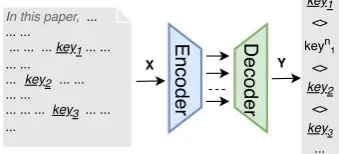
In this section, we describe the neural keyphrase generation model built on a sequence-to-sequence model (Sutskever et al.,2014) as illustrated in
Fig-ure 2. We denote the input source document as
a sequence x = x1· · ·x|x| and its
correspond-ing keyphrase set asa = {ai}|ia=1| , withai as one
keyphrase.
Keyphrase Sequence Formulation. Different
from the setup by Meng et al.(2017), where
in-put article is paired with each keyphrase ai to
consist a training sample, we concatenate the
Encoder Decoder
key1 <> keyn1
<> key2
<> key3
... Y Note
In this paper, ... ... ...
... ... ... key1 ... ...
... ... ... ... ... ... ...
... ... ... key3 ... ... ...
[image:3.595.95.265.68.145.2]X key2
Figure 2: Neural keyphrase generation model built on sequence-to-sequence framework. Input is the docu-ment, and output is the keyphrase sequence consisting of phrases present (keyi) or absent (keyin) in the input.
a1 ♦ a2 ♦ · · · ♦ a|a|, where ♦ is a segmenter
to separate the keyphrases2. With this setup, the
seq2seq model is capable to generate all possible keyphrases in one sequence as well as capture the contextual information between the keyphrases from the same sequence.
Seq2Seq Attentional Model. With source
doc-umentxand its keyphrase sequencey, an encoder
encodesxinto context vectors, from which a
de-coder then generatesy. We set the encoder as
one-layer bi-directional LSTM model and the decoder
as another one-layer LSTM model (Hochreiter and
Schmidhuber, 1997). The probability of
generat-ing target sequencep(y|x)is formulated as:
p(y|x) =
|y|
Y
t=1
p(yt|y<t,x) (1)
wherey<t =y1· · ·yt−1.
Letht= [
− →
ht;
←−
ht]denote the hidden state
vec-tor in the encoder at time step t, which is the
concatenation of forward hidden vector −→ht and
backward hidden vector←h−t. Specifically,
− →
ht =
fLSTMe(xt,
− →
ht−1) and
←−
ht = fLSTMe(xt,
←−
ht+1),
wherefLSTMeis an LSTM unit in encoder.
Decoder hidden state is calculated as st =
fLSTMd(yt−1,st−1), wherefLSTMd is an LSTM unit
in decoder. We apply global attention mechanism (Luong et al.,2015) to calculate the context vec-tor:
ct=
|x|
X
i=1
αt,ihi
αt,i =
exp(Watt[st;hi])
P|x|
k=1exp(Watt[sthk])
(2)
2We concatenate keyphrases following the original keyphrase order in the corpora, and we set♦as “;” in our implementation. The effect of keyphrase ordering will be studied in the future work.
Algorithm 1Keyphrase Ranking
Input: Generated top R keyphrase sequences S = [y1,· · ·,yR]ranked with generation possibility from high to low with beam search
Output: Ranked keyphrase set A with importance from high to low
functionKEY-RANK(S)
A ←list() .setAas a empty list. Q ←dict() .to skip keyword that is already inA.
foryi∈ Sdo
yi←yi.split(“♦”); . splityiby “♦”
fora∈yido
.ifahas not been merged inA, then keep it.
ifnotQ.has key(a)then
A.append(a)
Q.update(dict({a: “”}))
whereαt,i is the attention weight; Watt contains
learnable parameters. In this paper, we omit the bias variables to save space.
The probability to predict yt in the decoder at
time steptis factorized as:
pvocab(yt|y<t,ct) =fsoftmax(Wd1·
tanh(Wd2[st;ct]))
(3)
where fsoftmax is the softmax function and Wd1
andWd2 are learnable parameters.
Pointer-generator Network. Similar to Meng et al. (2017), we utilize copying mechanism via
pointer-generator network (See et al.,2017) to
al-low the decoder to directly copy words from in-put document, thus mitigating out-of-vocabulary
(OOV) problem. At time step t, the generation
probabilitypgenis calculated as:
pgen =fsigmoid(Wcct+Wsst+Wyyt) (4)
wherefsigmoidis asigmoidfunction;Wc,Wsand
Wy are learnable parameters. pgen plays a role of
switcher to choose to generate a word from a fixed
vocabulary with probabilitypvocabor directly copy
a word from the source document with the
atten-tion distribuatten-tionαt. With a combination of a fixed
vocabulary and the extended source document
vo-cabulary, the probability to predictytis:
p(yt) =pgenpvocab(yt|y<t,ct)+(1−pgen)
X
i:yi=yt
αt,i
(5)
where ifytdoes not appear in the fixed vocabulary,
then the first term will be zero; and ifytis outside
Encoder Decoder
Encoder
Decoder Decoder1
Decoder2
X, X(1) Y, Y(1)
X Y
X, X(2) Y
Y(2)
pre-train fine-tune main task
auxiliary task
(a) Synthetic Keyphrase Constrction (b) Multi-task Learning
[image:4.595.76.527.67.217.2]Encoder
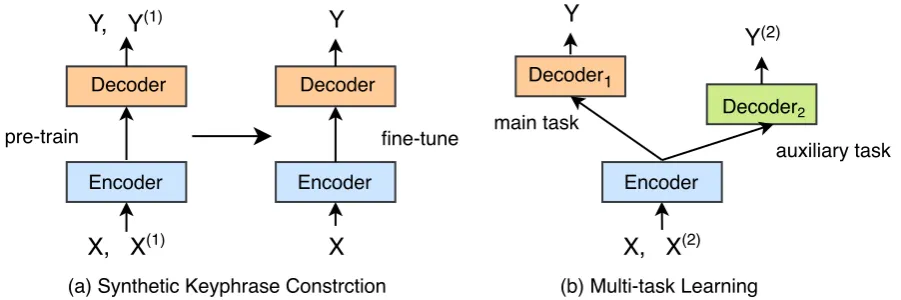
Figure 3: Our two semi-supervised learning methods which are based on (a) synthetic keyphrase construction, and (b) multi-task learning. (X, Y) represents labeled sample. X(1)and X(2)denotes unlabeled documents. Y(1)refers
to synthetic keyphrases of X(1)and Y(2)means the title of X(2). For method of synthetic keyphrase construction, model will be pre-trained on the mixture of gold-standards and synthetic data, then fine-tuned on labeled data. For multi-task learning, model parameters of main task and auxiliary task will be jointly updated. Encoder parameters of the two tasks are shared.
Supervised Learning. With a labeled dataset
Dp ={x(i),y(i)}Ni=1, the loss function of seq2seq model is as follows:
L(θ) =−
N
X
i=1
logp(y(i)|x(i);θ) (6)
whereθcontains all model parameters.
Keyphrase Inference and Ranking Strategy. Beam search is utilized for decoding, and the top
Rkeyphrase sequences are leveraged for
produc-ing the final keyphrases. Here we use a beam size
of50, andRas50. We propose a ranking
strat-egy to collect the final set of keyphrases. Con-cretely, in sequence we collect unique keyphrases from the top ranked beams to lower ranked beams, and keyphrases in the same sequence are ordered as in the generation process. Intuitively, higher ranked sequences are likely of better quality. As for keyphrases in the same sequence, we find that more salient keyphrases are usually generated first. The ranking method is presented in Algo-rithm1.
4 Semi-Supervised Learning for Keyphrase Generation
As illustrated in Figure 3, two methods are
pro-posed to leverage abundant unlabeled data. The first is to provide synthetic keyphrases using un-supervised keyphrase extraction methods or self-learning algorithm, then mixed with labeled data
for model training, which is described in
Sec-tion 4.1. Furthermore, we introduce multi-task
learning that jointly generates keyphrases and
the title of the document (Section 4.2). We
denote the large-scale unlabeled documents as
Du = {x0(i)}Mi=1 and labeled data as Dp =
{x(i),y(i)}Ni=1, whereM N.
4.1 Synthetic Keyphrase Construction
The first proposed technique is to construct syn-thetic labeled data by assigning keyphrases for unlabeled documents, and then mix the synthetic data with human labeled data for modeling train-ing. Intuitively, adding training samples with syn-thetic keyphrases has two potentially benefits: (1) the encoder is exposed to more documents in train-ing, and (2) the decoder also benefit from addi-tional information from identifying contextual in-formation for keyphrases. We propose and com-pare two methods to extract synthetic keyphrases.
Unsupervised Learning Methods. Unsuper-vised learning methods on keyphrase extraction
have been long studied in previous work (
Mihal-cea and Tarau,2004;Wan and Xiao,2008). Here we select two effective and widely used
meth-ods to select keyphrases on unlabeled datasetDu,
which are TF-IDF and TextRank (Mihalcea and
Tarau,2004). We combine the two methods into a hybrid approach, in which we first adopt the
two methods to separately select topKkeyphrases
se-Algorithm 2 Training Procedures for Synthetic Keyphrase Construction
Input: Dp,Ds,θ Output: θ
functionPRE-TRAIN(Dp,Ds,θ)
Dp+s← Dp∪ Ds
ShuffleDp+srandomly
UpdateθonDp+suntil converge functionFINE-TUNE(Dp,θ)
Setθas the best parameters from PRE-TRAIN UpdateθonDpuntil converge
quence, we concatenate the terms from TF-IDF and then from TextRank, following the
corre-sponding ranking order. We setKas5in our
ex-periments.
Self-learning Algorithm. Inspired by prior
work (Zhang and Zong, 2016; Sennrich et al.,
2016), we adopt self-learning algorithm to boost
training data. Concretely, we first build a base-line model by training the seq2seq model on the
labeled corpus Dp. Then the trained baseline
model is utilized to generate synthetic keyphrase
sequence y0 given a unlabeled document x0.
We adopt beam search to generate the synthetic
keyphrase sequences and beam size is set as 10.
The top one beam is selected.
Training Procedure. After the synthetic data
Ds = {x0(i),y0(i)}Mi=1 is obtained by either of the
aforementioned methods, we mix labeled dataDp
withDs to train the seq2seq model. As described
in Algorithm2, we combineDpwithDsintoDp+s
and shuffleDp+srandomly, then we pre-train the
model on Dp+s, in which no network parameters
are frozen during the training process. The best performing model is selected based on validation
set, then fine-tuned onDpuntil converge.
4.2 Multi-task Learning with Auxiliary Task
The second approach to leverage unlabeled doc-uments is to employ a multi-task learning frame-work which combines the main task of keyphrase generation with an auxiliary task through parame-ter sharing strategy. Similar to the model structure inZhang and Zong (2016), our main task and the auxiliary task share an encoder network but have different decoders. Multi-task learning will bene-fit from the source-side information to improve the model generality of encoder.
In most domains such as scientific papers or news articles, a document usually contains a title that summarizes the core topics or ideas, with a
Dataset TRAIN VALID
Small-scale
Document-Keyphrase 40,000 5,000
Document-SyntheticKeyphrase 400,000 N/A
Document-Title 400,000 15,000
Large-scale
Document-Keyphrase 130,000 5,000
Avg. #Tokens in Train LABELED SYN. MTL Small-scale
Document 176.3 175.9 165.5
Keyphrase Sequence 23.3 23.5 N/A
[image:5.595.306.524.61.184.2]Title N/A N/A 10.4
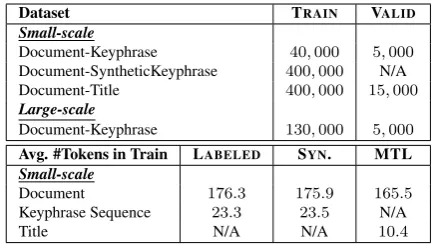
Table 1: Statistics of datasets used in our experiments.
similar spirit as keyphrases. We thus choose ti-tle generation as auxiliary task, which has been
studied as a summarization problem (Rush et al.,
2015; Colmenares et al., 2015). Let Du0 =
{x0(i),q(i)}Mi=1 denote the dataset which is
as-signed with titles for unlabeled dataDu, the loss
function of multi-task learning is factorized as:
L(θe, θ1d, θd2) =−
N
X
i=1
logp(y(i)|x(i);θe, θ1d)
−
M
X
i=1
logp(q(i)|x0(i);θe, θ2d) (7)
whereθeindicates encoder parameters;θ1dandθd2
are the decoder parameters.
Training Procedure. We adopt a simple alter-nating training strategy to switch training between the main task and the auxiliary task. Specifically, we first estimate parameters on auxiliary task with
D0u for one epoch, then train model on the main
task withDp (labeled dataset) for Tepochs. We
follow this training procedure for several times un-til the model of our main task converges. We set
Tas3.
5 Experiments
5.1 Datasets
Our major experiments are conducted on scientific articles which have been studied in previous work (Hulth,2003;Nguyen and Kan,2007;Meng et al.,
2017). We use the dataset fromMeng et al.(2017)
which is collected from various online digital li-braries, e.g. ScienceDirect, ACM Digital Library, Wiley, and other portals.
As indicated in Table 1, we construct a
rel-atively small-scale labeled dataset with 40K
document-keyphrase3 pairs, and a large-scale
Model INSPEC KRAPIVIN NUS SEMEVAL KP20K F1@5 F1@10 F1@5 F1@10 F1@5 F1@10 F1@5 F1@10 F1@5 F1@10
Comparisons
TF-IDF 0.223 0.304† 0.113 0.143 0.139 0.181 0.120 0.184† 0.105 0.130
TEXTRANK 0.229 0.275 0.173 0.147 0.195 0.190 0.172 0.181 0.181 0.150 SINGLERANK 0.214 0.297 0.096 0.137 0.145 0.169 0.132 0.169 0.099 0.124 EXPANDRANK 0.211 0.295 0.096 0.136 0.137 0.162 0.135 0.163 N/A N/A MAUI 0.041 0.033 0.243 0.208† 0.249 0.261† 0.045 0.039 0.265 0.227†
KEA 0.109 0.129 0.120 0.131 0.068 0.081 0.027 0.027 0.180 0.163 SEQ2SEQ-COPY 0.269 0.234 0.274 0.207 0.345 0.282 0.278 0.226 0.291 0.215 Semi-supervised
[image:6.595.77.518.61.202.2]SYN.UNSUPER. 0.326∗ 0.334∗ 0.283 0.239∗ 0.356 0.317∗ 0.306 0.294∗ 0.300∗ 0.245∗ SYN.SELF-LEARN. 0.310∗ 0.301∗ 0.289 0.236∗ 0.339 0.305 0.295 0.282∗ 0.301∗ 0.240∗ MULTI-TASK 0.326∗ 0.309∗ 0.296 0.240∗ 0.354 0.320∗ 0.322 0.289∗ 0.308∗ 0.243∗
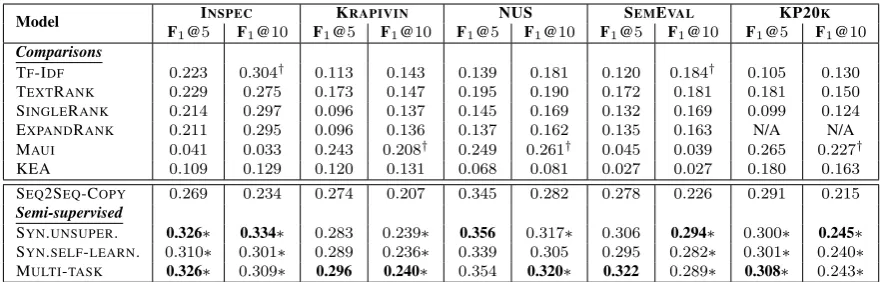
Table 2: Results of present keyphrase generation with metrics F1@5 and F1@10. ∗ marks numbers that are
significantly better than SEQ2SEQ-COPY(p <0.01,F-test). Due to the high time perplexity, no result is reported by ExpandRank on KP20K, as done inMeng et al.(2017).
dataset of400Kunlabeled documents. Each
doc-ument contains an abstract and a title of the pa-per. In multi-task learning setting, the auxiliary task is to generate the title from the abstract.
For the validation set, we collect 5K
document-keyphrase pairs for the process of pre-training and fine-tuning for methods based on synthetic data construction. For multi-task learning, we use the
same5K document-keyphrase pairs for the main
task training, another15Kdocument-title pairs for
the auxiliary task. We further conduct experiments
on a 130K large-scale labeled dataset, which
in-cludes the small-scale labeled data.
Similar to Meng et al. (2017), we test our
model on five widely used public datasets from the
scientific domain: INSPEC (Hulth, 2003), NUS
(Nguyen and Kan, 2007), KRAPIVIN (Krapivin et al.,2009), SEMEVAL-2010 (Kim et al.,2010)
and KP20K(Meng et al.,2017).
5.2 Experimental Settings
Data preprocessing is implemented as in (Meng
et al.,2017). The texts are first tokenized by NLTK (Bird and Loper, 2004) and lowercased, then the
numbers are replaced with<digit>. We set
maxi-mal length of source text as200,40for target text.
Encoder and decoder both have a vocabulary size
of50K. The word embedding size is set to 128.
Embeddings are randomly initialized and learned
during training. The size of hidden vector is512.
Dropout rate is set as0.3. Maximal gradient
nor-malization is 2. Adagrad (Duchi et al., 2011) is
adopted to train the model with learning rate of
0.15and the initial accumulator rate is0.1.
For synthetic data construction, we first use
batch size of64for model ptraining and then
re-duce to32for model fine-tuning. For both training
stages, after8epochs, learning rate be decreased
with a rate of 0.5. For multi-task learning, batch
size is set to32and learning rate is reduced to half
after20training epochs. To build baseline seq2seq
model, we set batch size as32and decrease
learn-ing rate after 8 epochs. For self-learning
algo-rithm, beam size is set to10to generate target
se-quences for unlabeled data and the top one is re-tained.
5.3 Comparisons with Baselines
Evaluation Metrics. Following (Liu et al.,
2011;Meng et al.,2017), we adopt top-N
macro-averagedprecision,recallandF-measure(F1) for
model evaluation.Precisionmeans how many
top-N extracted keywords are correct andrecallmeans
how many target keyphrases are extracted in top-N candidates. Porter Stemmer is applied before comparisons.
Baselines. We train a baseline seq2seq model on the small-scale labeled dataset. We further com-pare with four unsupervised learning methods:
TF-IDF, TextRank (Mihalcea and Tarau, 2004),
SingleRank (Wan and Xiao, 2008), ExpandRank
(Wan and Xiao,2008), and two supervised
learn-ing methods of Maui (Medelyan et al.,2009) and
KEA (Witten et al.,1999). We followMeng et al.
(2017) for baselines setups.
Results. Here we show results for present and
absent keyphrase generation separately4. From
the results of present keyphrase generation as
shown in Table2, although trained on small-scale
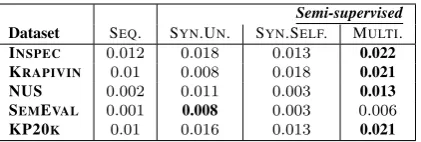
4Recall that
Semi-supervised Dataset SEQ. SYN.UN. SYN.SELF. MULTI.
INSPEC 0.012 0.018 0.013 0.022 KRAPIVIN 0.01 0.008 0.018 0.021
NUS 0.002 0.011 0.003 0.013
SEMEVAL 0.001 0.008 0.003 0.006
[image:7.595.77.288.61.132.2]KP20K 0.01 0.016 0.013 0.021
Table 3: Results ofabsentkephrase generation based on Recall@10.
labeled corpora, our baseline seq2seq model with
copying mechanism still achieves better F1@5
scores, compared to other baselines. This demon-strates that a baseline seq2seq model has learned the mapping patterns from source text to target keyphrases to some degree. However, small-scale labeled data still hinders the potential of seq2seq model according to the poor performance of
F1@10. By leveraging large-scale unlabeled data,
our semi-supervised learning methods achieve sig-inifcant improvement over seq2seq baseline, as
well as exhibit the best performance in both F1@5
and F1@10on almost all datasets.
We further compare seq2seq based models on the task of generating keyphrases beyond input
article vocabulary. Illustrated by Table 3,
semi-supervised learning significantly improves the ab-sent generation performance, compared to the baseline seq2seq. Among our models, the multi-task learning method is more effective at gen-erating absent keyphrases than the two methods
by leveraging synthetic data. The main reason
may lie in that synthetic keyphrases potentially introduce noisy annotations, while the decoder in multi-task learning setting focuses on learn-ing from gold-standard keyphrases. We can also see that the overall performances by all models are low, due to the intrinsic difficulty of absent
keyphrase generation (Meng et al.,2017).
More-over, we only employ40K labeled data for
train-ing, which is rather limited for training. Besides, we believe better evaluation methods should be used instead of exact match, e.g., by considering paraphrases. This will be studied in the future work.
5.4 Effect of Synthetic Keyphrase Quality
In this section, we conduct experiments to further study the effect of synthetic keyphrase quality on model performance. Two sets of experiments are undertaken, one for evaluating unsupervised learn-ing and one for self-learnlearn-ing algorithm.
For self-learning algorithm, we further generate
0 2 4 6 8 10 12 14 16
epoch 35
40 45 50 55 60
ppl. on validation set
Beam-3
Syn.Self-Learn(Beam-10) Trained-Model(Beam-10)
0 2 4 6 8 10 12 14 16
epoch 30
40 50 60 70 80
[image:7.595.303.527.61.147.2]Syn.Unsuper.(top@1) Syn.Unsuper.(top@5) Syn.Unsuper.(top@10)
Figure 4: Pre-trainingcurves with perplexity on vali-dation set with various options for synthetic keyphrases construction. Left is for options for self-learning algo-rithm and right is for unsupervised learning methods.
synthetic keyphrases using following options:
• Beam-size-3: Based on our baseline model
trained with labeled data, we use beam search
with a smaller beam size of3to generate
syn-thetic data5.
• Trained-model: We adopt the model which
has been trained with self-learning algorithm
on 40K labeled data and 400K unlabeled
data, to generate the top one keyphrase
se-quence with beam size of10.
For unsupervised learning method, we
origi-nally merge top-K(K= 5) keyphrases from
TF-IDF and TextRank, here we use options whereK
is set as1or10to extract keyphrases:
• Top@1: Using TF-IDF or TextRank, we only
keep top1extraction from each, then take the
union of the two.
• Top@10: Similarly, we keep top10extracted
terms from TF-IDF or TextRank, then take the union.
As illustrated in Figure4, when models are
pre-trained with synthetic keyphrases of better quality, results by “Trained-model” consistently produce better performance (i.e., lower perplexity).
Sim-ilar phenomenon can be observed when “top@5”
and “top@10” are applied for extraction in
un-supervised learning setting. Furthermore, after
models are ptrained and then fine-tuned, the
re-sults in Figure5 show that the difference among
baselines becomes insignificant—the quality of synthetic keyphrases have limited effect on final scores. The reason might be that though synthetic
Inspec Krapivin NUS SemEval KP20k 25 30 35 F1@N(%) Beam-3 Syn.Self-Learn.(Beam-10) Trained-Model.(Beam-10)
Inspec Krapivin NUS SemEval KP20k
[image:8.595.306.525.61.166.2]25 30 35 F1@N(%) Syn.Unsuper.(top@1) Syn.Unsuper.(top@5) Syn.Unsuper.(top@10)
Figure 5: Effect of synthetic data quality on present
keyphrase generation (models are pre-trained and fine-tuned) based on F1@5(left three columns) and F1@10
(right three columns), on five datasets. The upper is for self-learning algorithm and the bottom is for unsuper-vised learning method.
20 22 24 26 28 30 32 34 F1@10 17 18 19 20 21 22 23 24 24 26 28 30 32 18 20 22 24 26 28 30 18 19 20 21 22 23 24 25
1/8 1/4 1/2 3/4 1
Inspec 20 22 24 26 28 30 F1@10
1/8 1/4 1/2 3/4 1
Krapivin 17 18 19 20 21 22 23 24
1/8 1/4 1/2 3/4 1
NUS 22 24 26 28 30
1/8 1/4 1/2 3/4 1
SemEval 18 20 22 24 26 28
1/8 1/4 1/2 3/4 1
[image:8.595.70.290.62.175.2]KP20k 18 19 20 21 22 23 24 top@10 top@50
Figure 6: Effect of various amounts of unlabeled data for training onpresentkeyphrase generation with F1@10. Upper is for synthetic data construction
method with unsupervised learning. Bottom is for multi-task learning algorithm.
keyphrases potentially introduce noisy informa-tion for decoder training, the encoder is still well trained. In addition, after fine-tuning on labeled data, the decoder acquires additional knowledge, thus leading to better performance and minimal difference among the options.
5.5 Effect of Amount of Unlabeled Data
In this section, we further evaluate whether vary-ing the amount of unlabeled data will affect model performance. We conduct experiments based on methods of synthetic data construction with un-supervised learning and multi-task learning. We further carry out experiments with randomly
se-lected 50K(1/8), 100K(1/4), 200K(1/2) and
300K(3/4)unlabeled documents from the pool of
400Kunlabeled data. After models being trained,
we adopt beam search to generate keyphrase
se-quences with beam size of 50. We keep top N
keyphrase sequences to yield the final keyphrases
using Algorithm1. F1@10is adopted to illustrate
0 2 4 6 8 10 12 14 epoch 21 22 23 24 25 26 27 28 29
ppl. on validation set
Syn.Unsuper(50K) Syn.Unsuper(100K) Syn.Unsuper(200K) Syn.Unsuper(300K) Syn.Unsuper(400K)
5.0 7.5 10.0 12.5 15.0 17.5 20.0 22.5 25.0 epoch 20 22 24 26 28 30 Multi-task(50K) Multi-task(100K) Multi-task(200K) Multi-task(300K) Multi-task(400K)
Figure 7: Perplexity on validation set with varying amounts of unlabeled data for training. Left is for fine-tuning procedure based on models trained with synthetic data constructed with unsupervised learning. Right is for multi-task learning procedure with perfor-mance on the main task.
Model F1 Model F1
Our Models Unsupervised
SEQ2SEQ 0.056 TF-IDF 0.270
[image:8.595.312.519.272.334.2]SYN.UNSUPER. 0.083 TEXTRANK 0.097 SYN.SELF-LEARN. 0.065 SINGLERANK 0.256 MULTI-TASK 0.109 EXPANDRANK 0.269
Table 4: Results of keyphrase generation for news from DUC dataset with F1. Results of unsupervised learning
methods are adopted fromHasan and Ng(2010).
the model performances. N is set as10or50.
The present keyphrase generation results are
shown in Figure 6, from which we can see that
when increasing the amount of unlabeled data,
model performance is further improved. This
is because additional unlabeled data can provide with more evidence on linguistic or context fea-tures and thus make the model, especially the en-coder, have better generalizability. This finding echoes with the training procedure illustrated in
Figure 7, where more unlabeled data uniformly
leads to better performance. Therefore, we believe that leveraging more unlabeled data for model training can boost model performance.
5.6 A Pilot Study for Cross-Domain Test
Up to now, we have demonstrated the effectiveness of leveraging unlabeled data for in-domain exper-iments, but is it still effective when being tested on a different domain? We thus carry out a pi-lot cross-domain test on news articles. The widely
used DUC dataset (Wan and Xiao, 2008) is
uti-lized, consisting of308articles with2,048labeled
keyphrases.
The experimental results are shown in Table 4
[image:8.595.71.292.284.370.2]gener-Model INSPEC KRAPIVIN NUS SEMEVAL KP20K F1@5 F1@10 F1@5 F1@10 F1@5 F1@10 F1@5 F1@10 F1@5 F1@10
SEQ2SEQ-COPY 0.34 0.329 0.308 0.251 0.36 0.327 0.301 0.285 0.318 0.251 Semi-supervised
[image:9.595.77.520.63.132.2]SYN.UNSUPER. 0.338 0.34 0.316 0.255 0.365 0.335 0.337 0.308 0.322 0.261∗ SYN.SELF-LEARN. 0.33 0.326 0.304 0.255 0.359 0.336 0.304 0.304 0.321 0.263∗ MULTI-TASK 0.328 0.318 0.323 0.254 0.365 0.326 0.319 0.312 0.328∗ 0.264∗
Table 5: Results ofpresentkeyphrase generation on large-scale labeled data with F1@5and F1@10. ∗indicates
significant better performance than SEQ2SEQ-COPYwithp <0.01(F-test).
ate keyphrases for news articles, illustrating that our models have learned some universal features between the two domains; and 2) semi-supervised learning by leveraging unlabeled data improves the generation performances more, indicating that our proposed method is reasonably effective when being tested on cross-domain data. Though un-supervised methods are still superior, for future work, we can leverage unlabeled out-of-domain corpora to improve cross-domain keyphrase gen-eration performance, which could be a promising direction for domain adaption or transfer learning.
Semi-supervised Dataset SEQ. SYN.UN. SYN.SELF. MULTI.
INSPEC 0.021 0.024 0.032 0.033 KRAPIVIN 0.02 0.031 0.043 0.047
NUS 0.009 0.026 0.024 0.036
SEMEVAL 0.011 0.014 0.015 0.02 KP20K 0.021 0.034 0.039 0.046
Table 6: Performance onabsentkeyphrase generation by Recall@10with large-scale labeled training data.
5.7 Training on Large-scale Labeled Data
Finally, it would be interesting to study whether unlabeled data can still improve performance when the model is trained on a larger scaled la-beled data. We conduct experiments on a larger
labeled dataset with 130K pairs, along with the
400K unlabeled data. Here the baseline seq2seq
model is built on the130Kdataset.
From the present keyphrase generation results
in Table 5, it can be seen that unlabeled data is
still helpful for model training on a large-scale la-beled dataset. This implies that we can also lever-age unlabeled data to enhance generation perfor-mance even in a resource-rich setting. Referring
to theabsent keyphrase generation results shown
in Table 6, semi-supervised learning also boosts
the scores. From Table6, training on large-scale
labeled data,absentgeneration is significantly
im-proved, compared to being trained on a small-scale
labeled data (see Table3).
6 Conclusion and Future Work
In this paper, we presented a semi-supervised learning framework that leverages unlabeled data for keyphrase generation built upon seq2seq
mod-els. We introduced synthetic keyphrases
con-struction algorithm and multi-task learning to ef-fectively leverage abundant unlabeled documents. Extensive experiments demonstrated the effective-ness of our methods, even in scenario where large-scale labeled data is available.
For future work, we will 1) leverage unlabeled data to study domain adaptation or transfer learn-ing for keyphrase generation; and 2) investigate
novel models to improveabsentkeyphrase
gener-ation when limited labeled data is available based on semi-supervised learning.
Acknowledgements
This research is based upon work supported in part by National Science Foundation through Grants IIS-1566382 and IIS-1813341, and by the Office of the Director of National Intelligence (ODNI), Intelligence Advanced Research Projects Activity (IARPA), via contract # FA8650-17-C-9116. The views and conclusions contained herein are those of the authors and should not be interpreted as necessarily representing the official policies, ei-ther expressed or implied, of ODNI, IARPA, or the U.S. Government. The U.S. Government is authorized to reproduce and distribute reprints for governmental purposes notwithstanding any copy-right annotation therein. We thank three anony-mous reviewers for their insightful suggestions on various aspects of this work.
References
[image:9.595.74.288.358.431.2]Steven Bird and Edward Loper. 2004. NLTK: the natu-ral language toolkit. InProceedings of the 42nd An-nual Meeting of the Association for Computational Linguistics, Barcelona, Spain, July 2126, 2004 -Poster and Demonstration.
Adrien Bougouin, Florian Boudin, and B´eatrice Daille. 2013. Topicrank: Graph-based topic ranking for keyphrase extraction. In Sixth International Joint Conference on Natural Language Processing, IJC-NLP 2013, Nagoya, Japan, October 14-18, 2013, pages 543–551.
Yong Cheng, Wei Xu, Zhongjun He, Wei He, Hua Wu, Maosong Sun, and Yang Liu. 2016. Semi-supervised learning for neural machine translation. InProceedings of the 54th Annual Meeting of the As-sociation for Computational Linguistics, ACL 2016, August 7-12, 2016, Berlin, Germany, Volume 1: Long Papers.
Carlos A. Colmenares, Marina Litvak, Amin Mantrach, and Fabrizio Silvestri. 2015. HEADS: headline generation as sequence prediction using an abstract feature-rich space. InNAACL HLT 2015, The 2015 Conference of the North American Chapter of the Association for Computational Linguistics: Human Language Technologies, Denver, Colorado, USA, May 31 - June 5, 2015, pages 133–142.
Andrew M. Dai and Quoc V. Le. 2015. Semi-supervised sequence learning. InAdvances in Neu-ral Information Processing Systems 28: Annual Conference on Neural Information Processing Sys-tems 2015, December 7-12, 2015, Montreal, Que-bec, Canada, pages 3079–3087.
Li Dong and Mirella Lapata. 2016. Language to logi-cal form with neural attention. InProceedings of the 54th Annual Meeting of the Association for Compu-tational Linguistics, ACL 2016, August 7-12, 2016, Berlin, Germany, Volume 1: Long Papers.
John C. Duchi, Elad Hazan, and Yoram Singer. 2011. Adaptive subgradient methods for online learning and stochastic optimization. Journal of Machine Learning Research, 12:2121–2159.
Eibe Frank, Gordon W. Paynter, Ian H. Witten, Carl Gutwin, and Craig G. Nevill-Manning. 1999. Domain-specific keyphrase extraction. In Proceed-ings of the Sixteenth International Joint Conference on Artificial Intelligence, IJCAI 99, Stockholm, Swe-den, July 31 - August 6, 1999. 2 Volumes, 1450 pages, pages 668–673.
C¸ aglar G¨ulc¸ehre, Orhan Firat, Kelvin Xu, Kyunghyun Cho, Lo¨ıc Barrault, Huei-Chi Lin, Fethi Bougares, Holger Schwenk, and Yoshua Bengio. 2015. On us-ing monolus-ingual corpora in neural machine transla-tion. CoRR, abs/1503.03535.
Khaled M Hammouda, Diego N Matute, and Mo-hamed S Kamel. 2005. Corephrase: Keyphrase ex-traction for document clustering. In International
Workshop on Machine Learning and Data Mining in Pattern Recognition, pages 265–274. Springer.
Kazi Saidul Hasan and Vincent Ng. 2010. Conundrums in unsupervised keyphrase extraction: Making sense of the state-of-the-art. InCOLING 2010, 23rd Inter-national Conference on Computational Linguistics, Posters Volume, 23-27 August 2010, Beijing, China, pages 365–373.
Kazi Saidul Hasan and Vincent Ng. 2014. Automatic keyphrase extraction: A survey of the state of the art. InProceedings of the 52nd Annual Meeting of the Association for Computational Linguistics, ACL 2014, June 22-27, 2014, Baltimore, MD, USA, Vol-ume 1: Long Papers, pages 1262–1273.
Sepp Hochreiter and J¨urgen Schmidhuber. 1997. Long short-term memory. Neural Computation, 9(8):1735–1780.
Anette Hulth. 2003. Improved automatic keyword ex-traction given more linguistic knowledge. In Pro-ceedings of the Conference on Empirical Methods in Natural Language Processing, EMNLP 2003, Sap-poro, Japan, July 11-12, 2003.
Su Nam Kim and Min-Yen Kan. 2009. Re-examining automatic keyphrase extraction approaches in sci-entific articles. In Proceedings of the Work-shop on Multiword Expressions: Identification, Interpretation, Disambiguation and Applications, MWE@IJCNLP 2009, Singapore, August 6, 2009, pages 9–16.
Su Nam Kim, Olena Medelyan, Min-Yen Kan, and Timothy Baldwin. 2010. Semeval-2010 task 5 : Au-tomatic keyphrase extraction from scientific articles. In Proceedings of the 5th International Workshop on Semantic Evaluation, SemEval@ACL 2010, Upp-sala University, UppUpp-sala, Sweden, July 15-16, 2010, pages 21–26.
Mikalai Krapivin, Aliaksandr Autaeu, and Maurizio Marchese. 2009. Large dataset for keyphrases ex-traction. Technical report, University of Trento.
Feifan Liu, Deana Pennell, Fei Liu, and Yang Liu. 2009a. Unsupervised approaches for automatic key-word extraction using meeting transcripts. In Pro-ceedings of human language technologies: The 2009 annual conference of the North American chapter of the association for computational linguistics, pages 620–628. Association for Computational Linguis-tics.
Liyuan Liu, Jingbo Shang, Xiang Ren, Frank Fangzheng Xu, Huan Gui, Jian Peng, and Jiawei Han. 2018. Empower sequence labeling with task-aware neural language model. In Pro-ceedings of the Thirty-Second AAAI Conference on Artificial Intelligence, New Orleans, Louisiana, USA, February 2-7, 2018.
Zhiyuan Liu, Xinxiong Chen, Yabin Zheng, and Maosong Sun. 2011. Automatic keyphrase extrac-tion by bridging vocabulary gap. InProceedings of the Fifteenth Conference on Computational Natural Language Learning, CoNLL 2011, Portland, Ore-gon, USA, June 23-24, 2011, pages 135–144.
Zhiyuan Liu, Wenyi Huang, Yabin Zheng, and Maosong Sun. 2010. Automatic keyphrase extrac-tion via topic decomposiextrac-tion. InProceedings of the 2010 Conference on Empirical Methods in Natu-ral Language Processing, EMNLP 2010, 9-11 Oc-tober 2010, MIT Stata Center, Massachusetts, USA, A meeting of SIGDAT, a Special Interest Group of the ACL, pages 366–376.
Zhiyuan Liu, Peng Li, Yabin Zheng, and Maosong Sun. 2009c. Clustering to find exemplar terms for keyphrase extraction. In Proceedings of the 2009 Conference on Empirical Methods in Natural Lan-guage Processing, EMNLP 2009, 6-7 August 2009, Singapore, A meeting of SIGDAT, a Special Interest Group of the ACL, pages 257–266.
Patrice Lopez and Laurent Romary. 2010. HUMB: au-tomatic key term extraction from scientific articles in GROBID. In Proceedings of the 5th International Workshop on Semantic Evaluation, SemEval@ACL 2010, Uppsala University, Uppsala, Sweden, July 15-16, 2010, pages 248–251.
Thang Luong, Hieu Pham, and Christopher D. Man-ning. 2015. Effective approaches to attention-based neural machine translation. In Proceedings of the 2015 Conference on Empirical Methods in Natural Language Processing, EMNLP 2015, Lisbon, Portu-gal, September 17-21, 2015, pages 1412–1421.
Olena Medelyan, Eibe Frank, and Ian H. Witten. 2009. Human-competitive tagging using automatic keyphrase extraction. In Proceedings of the 2009 Conference on Empirical Methods in Natural Lan-guage Processing, EMNLP 2009, 6-7 August 2009, Singapore, A meeting of SIGDAT, a Special Interest Group of the ACL, pages 1318–1327.
Rui Meng, Sanqiang Zhao, Shuguang Han, Daqing He, Peter Brusilovsky, and Yu Chi. 2017. Deep keyphrase generation. In Proceedings of the 55th Annual Meeting of the Association for Computa-tional Linguistics, ACL 2017, Vancouver, Canada, July 30 - August 4, Volume 1: Long Papers, pages 582–592.
Rada Mihalcea and Paul Tarau. 2004. Textrank: Bring-ing order into text. InProceedings of the 2004 Con-ference on Empirical Methods in Natural Language
Processing , EMNLP 2004, A meeting of SIGDAT, a Special Interest Group of the ACL, held in conjunc-tion with ACL 2004, 25-26 July 2004, Barcelona, Spain, pages 404–411.
Thuy Dung Nguyen and Min-Yen Kan. 2007. Keyphrase extraction in scientific publications. In
Asian Digital Libraries. Looking Back 10 Years and Forging New Frontiers, 10th International Con-ference on Asian Digital Libraries, ICADL 2007, Hanoi, Vietnam, December 10-13, 2007, Proceed-ings, pages 317–326.
Prajit Ramachandran, Peter J. Liu, and Quoc V. Le. 2017. Unsupervised pretraining for sequence to se-quence learning. InProceedings of the 2017 Con-ference on Empirical Methods in Natural Language Processing, EMNLP 2017, Copenhagen, Denmark, September 9-11, 2017, pages 383–391.
Marek Rei. 2017. Semi-supervised multitask learn-ing for sequence labellearn-ing. In Proceedings of the 55th Annual Meeting of the Association for Compu-tational Linguistics, ACL 2017, Vancouver, Canada, July 30 - August 4, Volume 1: Long Papers, pages 2121–2130.
Alexander M. Rush, Sumit Chopra, and Jason Weston. 2015. A neural attention model for abstractive sen-tence summarization. In Proceedings of the 2015 Conference on Empirical Methods in Natural Lan-guage Processing, EMNLP 2015, Lisbon, Portugal, September 17-21, 2015, pages 379–389.
Abigail See, Peter J. Liu, and Christopher D. Manning. 2017. Get to the point: Summarization with pointer-generator networks. InProceedings of the 55th An-nual Meeting of the Association for Computational Linguistics, ACL 2017, Vancouver, Canada, July 30 - August 4, Volume 1: Long Papers, pages 1073– 1083.
Rico Sennrich, Barry Haddow, and Alexandra Birch. 2016. Improving neural machine translation mod-els with monolingual data. In Proceedings of the 54th Annual Meeting of the Association for Compu-tational Linguistics, ACL 2016, August 7-12, 2016, Berlin, Germany, Volume 1: Long Papers.
Ilya Sutskever, Oriol Vinyals, and Quoc V. Le. 2014. Sequence to sequence learning with neural net-works. InAdvances in Neural Information Process-ing Systems 27: Annual Conference on Neural In-formation Processing Systems 2014, December 8-13 2014, Montreal, Quebec, Canada, pages 3104– 3112.
Peter D. Turney. 2000. Learning algorithms for keyphrase extraction. Inf. Retr., 2(4):303–336.
Lu Wang and Claire Cardie. 2013. Domain-Independent Abstract Generation for Focused Meet-ing Summarization. InProceedings of the 51st An-nual Meeting of the Association for Computational Linguistics (Volume 1: Long Papers), pages 1395– 1405, Sofia, Bulgaria. Association for Computa-tional Linguistics.
Lu Wang and Wang Ling. 2016. Neural network-based abstract generation for opinions and argu-ments. InNAACL HLT 2016, The 2016 Conference of the North American Chapter of the Association for Computational Linguistics: Human Language Technologies, San Diego California, USA, June 12-17, 2016, pages 47–57.
Theresa Wilson, Janyce Wiebe, and Paul Hoffmann. 2005. Recognizing contextual polarity in phrase-level sentiment analysis. InProceedings of the con-ference on human language technology and empiri-cal methods in natural language processing, pages 347–354. Association for Computational Linguis-tics.
Ian H. Witten, Gordon W. Paynter, Eibe Frank, Carl Gutwin, and Craig G. Nevill-Manning. 1999. KEA: practical automatic keyphrase extraction. In Pro-ceedings of the Fourth ACM conference on Digital Libraries, August 11-14, 1999, Berkeley, CA, USA, pages 254–255.
Hai Ye, Xin Jiang, Zhunchen Luo, and Wenhan Chao. 2018. Interpretable charge predictions for criminal cases: Learning to generate court views from fact descriptions. In Proceedings of the 2018 Confer-ence of the North American Chapter of the Associ-ation for ComputAssoci-ational Linguistics: Human Lan-guage Technologies, NAACL-HLT 2018, New Or-leans, Louisiana, USA, June 1-6, 2018, Volume 1 (Long Papers), pages 1854–1864.
Jiajun Zhang and Chengqing Zong. 2016. Exploit-ing source-side monolExploit-ingual data in neural machine translation. InProceedings of the 2016 Conference on Empirical Methods in Natural Language Pro-cessing, EMNLP 2016, Austin, Texas, USA, Novem-ber 1-4, 2016, pages 1535–1545.