Exploiting Syntactic and Distributional Information
for Spelling Correction with Web-Scale N-gram Models
Wei Xuc,∗Joel Tetreaulta Martin Chodorowb Ralph Grishmanc Le ZhaodaEducational Testing Service, Princeton, NJ, USA
bHunter College of CUNY, New York, NY, USA
cNew York University, NY, USA
{xuwei,grishman}@cs.nyu.edu
dCarnegie Mellon University, Pittsburgh, PA, USA
Abstract
We propose a novel way of incorporating de-pendency parse and word co-occurrence iformation into a state-of-the-art web-scale n-gram model for spelling correction. The syn-tactic and distributional information provides extra evidence in addition to that provided by a web-scale n-gram corpus and especially helps with data sparsity problems. Experimental results show that introducing syntactic fea-tures into n-gram based models significantly reduces errors by up to 12.4% over the current state-of-the-art. The word co-occurrence in-formation shows potential but only improves overall accuracy slightly.
1 Introduction
The function of context-sensitive text correction is to identify word-choice errors in text (Bergsma et al., 2009). It can be viewed as a lexical disambigua-tion task (Lapata and Keller, 2005), where a system selects from a predefined confusion word set, such as {affect, effect} or {complement, compliment}, and provides the most appropriate word choice given the context. Typically, one determines if a word has been used correctly based on lexical, syntactic and semantic information from the context of the word. One of the top performing models of spelling cor-rection (Bergsma et al., 2010) is based on web-scale n-gram counts, which reflect both syntax and mean-ing. However, even with a large-scale n-gram cor-pus, data sparsity can hurt performance in two ways. ∗This work was done when the first author was an intern for Educational Testing Service.
First, n-gram based methods require exact word and order matches. If there is a low frequency word in the context, such as a person’s name, there will be little, if any, evidence in the n-gram data to sup-port the usage. Second, if the target confusable word is rare, there will not be enough n-gram support or training data to render a confident decision. Because of the data sparsity problem, language modeling is not always sufficient to capture the meaning of the sentence and the correct usage of the word.
Take a sentence from The New York Times (NYT) for example: “‘This fellow’s won a war,’ the dean of the capital’s press corps, David Broder, an-nounced on ‘Meet the Press’ aftercomplimenting the president on the ‘great sense of authority and command’ he exhibited in a flight suit.” Unfortu-nately, neither the phrase “complementing the pres-ident” nor “complimenting the prespres-ident” exists in the web-scale Google N-gram corpus (Brants and Franz, 2006). The n-gram models decide solely based on the frequency of the bi-grams “after com-ple(i)menting” and “comple(i)menting the”, which are common usages for both words. The real ques-tion is whether we are more likely to “compliment” or “complement” a person, the “president”. Several clues could help us answer that question. A de-pendency parser can identify the word “president” as the subject of “compliment” or “complement” which also may be the case in some of the train-ing data. Lexical co-occurrence (Edmonds, 1997) and semantic word relatedness measurements, such as Random Indexing (Sahlgren, 2006), could pro-vide epro-vidence that “compliment” is more likely to co-occur with “president” than “complement”.
thermore, some important clues can be quite distant from the target word, e.g. outside the 9-word context window Bergsma et al. (2010) and Carlson (2007) used. Consider another sentence in the NYT corpus, “GM says the addition of OnStar, which includes a system that automatically notifies an OnStar opera-tor if the vehicle is involved in a collision, comple-ments the Vue’s top five-star safety rating for the driver and front passenger in both front- and side-impact crash tests.” The dependency parser finds the object of “complement” is “rating”, which is outside the 9-word window.
We propose enhancing state-of-the-art web-scale n-gram models for spelling correction with syntac-tic structures and distributional information. For our work, we build on a baseline system that combines n-gram and lexical features (Bergsma et al., 2010). Specifically, this paper makes the following contri-butions:
1. We show that the baseline system can be improved by augmenting it with dependency parse features.
2. We show that the impact of parse features can be further augmented when combined with dis-tributional information, specifically word co-occurrence information.
In the following section, we describe related work and how our approach differs from these ap-proaches. In Sections 3 and 4, we discuss our meth-ods for using parse features and word co-occurrence information. In Section 5, we present experimental results and analysis.
2 Related Work
A variety of approaches have been proposed for context-sensitive spelling correction ranging from semantic methods to machine learning classifiers to large-scale n-gram models.
Some semantics-based systems have been devel-oped based on an intuitive assumption that the in-tended word is more likely to be semantically coher-ent with the context than is a spelling error. Jones and Martin (1997) made use of the semantic simi-larity produced by Latent Semantic Analysis. Bu-danitsky and Hirst (2001) investigated the effective-ness of predicting words based on different semantic
similarity/distance measures in WordNet. Both sys-tems report performance that is lower than syssys-tems developed more recently.
A variety of machine-learning methods have been proposed in spelling correction and preposition and article error correction fields, such as Bayesian clas-sifiers (Golding, 1995; Golding and Roth, 1996), Winnow-based learning (Golding and Roth, 1999), decision lists (Golding, 1995), transformation-based learning (Mangu and Brill, 1997), augmented mix-ture models (Cucerzan and Yarowsky, 2002) and maximum entropy classifiers (Izumi et al., 2003; Han et al., 2006; Chodorow et al., 2007; Tetreault and Chodorow, 2008; Felice and Pulman, 2008). Despite their differences, these approaches mainly use contextual features to capture the lexical, seman-tic and/or syntacseman-tic environment of the target word.
The use of distributional similarity measures for spelling correction has been previously explored in (Mohammad and Hist, 2006). In our work, distribu-tional similarity is not the primary contribution but we show the impact it can have when used in con-junction with a large scale n-gram model and with parse features, which allows the system to select words outside the local window for distributional similarity. In the prior work, the words for distri-butional similarity are constrained to the local win-dow, and positional information of the words is not encoded.
Recent work (Carlson and Fette, 2007; Gamon et al., 2008; Bergsma et al., 2009) has demon-strated that large-scale language modeling is ex-tremely helpful for contextual spelling correction and other lexical disambiguation tasks. These sys-tems make the word choice depending on how fre-quently each candidate word has been seen in the given context in web-scale data. As n-gram data has become more readily available, such as the Google N-gram Corpus, the likelihood of a word being used in a certain context can be better estimated.
confus-able words.”, the method would extract the five 5-gram patterns, shown below in Figure 2, wherew0 can be either word in the confusion set{among, be-tween}in this particular example. Similarly, there are four 4-grams, three 3-grams, and two 2-grams, in total, 14 n-grams for each of the words in the con-fusion set.
system tried to decide w0 tried to decide w0 the
to decide w0 the two
decidew0 the two confusable w0 the two confusable words
We briefly describe three of Bergsma et al.’s (2009; 2010) best systems below, which are reported to achieve state-of-the-art accuracy (NG = n-gram; LEX = lexical).
1. sumLM: For each candidate word, (Bergsma et al., 2009) sum the log-counts of all 14 pat-terns filled with the candidate, and choose the candidate with the highest total.
2. NG: Bergsma et al. (2009) exploit each can-didate’s 14 log-counts of n-gram patterns as features in a Support Vector Machine (SVM) model.
3. NG+LEX: Bergsma et al. (2010) augment the NG model with lexical features (described in detail in Section 3.1).
Bergsma et al. (2009; 2010) restricted their exper-iments to only five confusion sets where the reported performance in (Golding and Roth, 1999) was below 90%:{among, between},{amount, number},{cite, sight, site},{peace, piece}and {raise, rise}. They reported that the SVM model with NG features out-performed its unsupervised version, sumLM. How-ever, the limited confusion word sets they evaluated may not comprehensively represent the word usage errors that writers typically make. In this paper, we test nine additional commonly confused word pairs to expand the scope of the evaluation. These words were selected based on their lower frequencies com-pared to the five pairs in the above work (as shown later in Table 2).
3 Enhanced N-gram Models with Parse Features
To our knowledge, only (Elmi and Evans, 1998) have used parsing for spell correction. They focus on using a parser as a filter to discriminate between possible real-world corrections where the part-of-speech differs. In our work, we show that parse fea-tures are effective when used directly in the classifi-cation mode (as opposed to as a final filter) to select the best correction regardless of whether or not the part-of-speech of the choices differ.
Statistical parsers have also seen limited use in the sister tasks of preposition and article error detec-tion (Hermet et al., 2008; Lee and Knutsson, 2008; Felice and Pulman, 2009; Tetreault et al., 2010) and verb sense disambiguation (Dligach and Palmer, 2008). In those instances where parsers have been used, they have mainly provided shallow analyses or relations involving specific target words, such as a preposition or verb. Unlike preposition errors, spelling errors can occur in any word.
In this paper, we propose a novel way to incor-porate the parse into spelling correction, applying the parser to sentences filled by each candidate word equivalently and extracting salient features. This overcomes two problem in the existing methods: 1) the parse trees of the same sentence filled by differ-ent confusion words can be differdiffer-ent. However, in the test phase, we do not know which word should be put in the sentences to create parse features for test examples. Previous studies (Tetreault et al., 2010) failed to discuss this issue. 2) Some existing work (Whitelaw et al., 2009; Rozovskaya and Roth, 2010) in the text correction field introduced artificial errors into training data to adapt the system to bet-ter handle ill-formed text. But this method will en-counter serious data sparsity problems when facing rare words.
3.1 Baseline System
problem with more than two words in pre-defined confusion sets can be solved similarly by using a one-vs.-all strategy. As we mentioned in Section 2, NG features include log-counts of 3-to-5-gram pat-terns for each candidate word with the given context. LEX features can be broken down into three sub-categories: 1) bag-of-words (words at all positions in a 9-word window around the target word), 2) in-dicators for the words preceding or following the tar-get word, and 3) indicators for all n-grams and their positions. For the sentence “The system tried to de-cide{among, between}the two confusable words.”, examples of bag-of-word features would be “tried”, “two”, etc., the two positional bigrams would be “decide” and “the”, and examples of the n-gram fea-tures would be right-trigram = “among the two” and left-4-gram = “tried to decide between”.
3.2 Parse Features
The benefit of introducing dependency parse fea-tures is that 1) parse feafea-tures capture contextual in-formation in a larger context window; 2) parse fea-tures specify which words in the context are salient to the usage of the target word while purely lexi-cally based approaches treat all words in the context equally. We use the Stanford dependency parser (de Marneffe et al., 2006) to extract six relevant feature classes.
Parse Features (PAR):
1. relation names (target word as head)
2. complement of the target word
3. combination of 1 and 2
4. relation names (target word as complement)
5. head of the target word
6. combination of 4 and 5
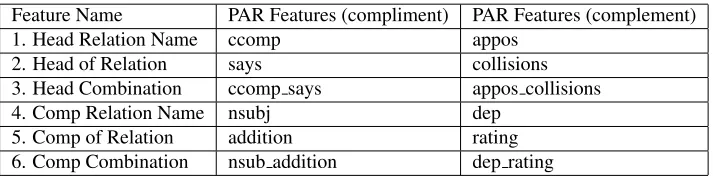
Each of these six classes of PAR features can contain zero to many values, since the target word can be involved in none to multiple grammatical relations and features of different filler words are merged together. The PAR features, like the LEX features, are binary. In Table 1, we present the parse features for an example sentence. The parse fea-tures here are listed as string values, but are later
converted into binary numbers in the vectors for the SVM model.
4 Distributional Word Co-occurrence
Though lexical and parse features are complemen-tary to n-gram models, they are learned from a nor-mal training corpus and may not have enough cov-erage due to data sparsity. Take a sentence from the NYT for example: “An economist, he began his ca-reer as a professor – he is still called ‘the professor,’ by friends as a compliment and by foes as an insult – and taught at Harvard and Stanford .” If the most in-dicative word “friends” does not appear or does not appear enough times in the local context or depen-dencies with “compliment” as compared to “com-plement” in the training corpus, then the classifier may be unable to make the correct selection.
It is impractical and computationally costly to en-large the training corpus without limit to include all possible language phenomena. A good compro-mise is to use word co-occurrence information from web-scale data. The other option is to make use of high-order word co-occurrence, which is included in many semantic word relatedness measures, such as Latent Semantic Analysis (LSA) (Landauer et al., 1998; Deerwester et al., 1990) or Random Indexing, both of which can be estimated from a moderate-size corpus.
Our intuition is to choose the confusion word which is most relevant to a given context. We define the salient words in context as a set M=m1, m2, m3, ..., and the relevance between two words as a func-tion Relevance(w1, w2), which can either be calcu-lated from word co-occurrence or Random Indexing. The score of each candidate word c in the confusion set given a context with meaningful words M is cal-culated by the following formula:
Score(c) = X m∈M
Relevance(c, m)
Feature Name PAR Features (compliment) PAR Features (complement)
1. Head Relation Name ccomp appos
2. Head of Relation says collisions
3. Head Combination ccomp says appos collisions
4. Comp Relation Name nsubj dep
5. Comp of Relation addition rating
[image:5.612.126.483.60.149.2]6. Comp Combination nsub addition dep rating
Table 1: Parse Feature Example for the sentence: “GM says the addition of OnStar, which includes a system that automatically notifies an OnStar operator if the vehicle is involved in a collision,complementsthe Vue’s top five-star safety rating for the driver and front passenger in both front- and side-impact crash tests.”
considerably overlaps with some values of the PAR features, but provides extra evidence from web-scale data rather than a limited amount of training data.
4.1 First-order Word Co-occurrence
The relevance based on first-order word co-occurrence is calculated from the Google Web 5-gram Corpus in a fashion similar to how we dealt with n-gram counts in the previous section. Given two words, w1 and w2, we consider all 8 possible patterns that appear in a local context (5-word win-dow), where we use wildcard (*) to indicate any to-ken:
w1 w2 w1 * w2 w1 * * w2 w1 * * * w2 w2 w1
w2 * w1 w2 * * w1 w2 * * * w1
The relevance is then calculated by summing the logarithm of each of the 8 different counts. Finally, we compare the score of each candidate word and output the one with higher score.
4.2 Random Indexing
The relevance scores based on Random Indexing are provided by a tool FRanI (Higgins, 2004) and a model trained on the Touchstone Applied Science Associates (TASA) corpus which contains 750k sen-tences and covers diverse topics (from a diversity of textbooks up to the college level). Take the sentence at the beginning of this section for example, where only the words “a” and “friends” are related to the
target word (either “complement” or “compliment”) by either relevance measure. The relevance based on Random Indexing for (complement, friends) is 0.08, (compliment, friends) is 0.19 and both (com-pliment, a) and (complement, a) are 0 because “a” is in the stop word list. Meanwhile, the relevance based on first order word co-occurrence for (com-pliment, friends) is 7.39, (complement, friends) is 5.38, (compliment, a) is 13.25, and (complement, a) is 13.42. The system with either kind of relevance outputs “compliment”.
4.3 System Combination
Since the numeric measurement of word co-occurrence is not as specific as the PAR features and less trustworthy, adding word co-occurrence infor-mation as features into the classifier along with n-gram counts, lexical and parse features will hurt the overall performance. It is more practical to combine the two approaches in the following fashion:
1. When the SVM classifier (using NG, LEX and PAR features) has high confidence (over a cer-tain threshold) in the output label, output that label;
2. Otherwise, output the results of the word relatedness/co-occurrence-based system.
5 Evaluation
confusion set in the training corpus, and 2) Bergsma et al.’s (2010) best systems, NG+LEX. We include inflectional variants (“-ing”, “-ed”, “-s”, “-ly”) of confusion words in the evaluation, such as comple-menting, complimenting in addition to complement, compliment, because this better corresponds to the range of errors that may be encountered in actual use and thus increases the scope of the system as a real world application. Also following Bergsma et al. (2010), we use a linear SVM, more exactly, the L2-regularized L2-loss dual SVM in LIBLINEAR (Fan et al., 2008). Unlike Bergsma et al., who used development data to optimize parameters, we always use default parameters, since training data is limited for many of the words we are dealing with.
5.1 Data
Following Bergsma et al. (2009; 2010), the test examples are extracted from The New York Times (NYT) portion of Gigaword1, but constrained to a
9-month publication time frame from October 2005 to July 2006. Unlike Bergsma et al. who use the same source as training data for the lexical features, our training data (for both lexical and parse features) comes from larger and more diverse news sources. We use the very large database from Sekine’s n-gram search engine (Sekine, 2008) as training data, which consists of 1.9B words of newspaper text spanning 89 years from NYT, BBC, WSJ, Xinhua, etc.
We evaluate our systems on 5 confusion sets from Bergsma et al. (2009; 2010) and 9 commonly con-fused word pairs with moderate frequency in daily usage (randomly selected from those listed in En-glish educational resources2). Shown in Table 2,
these 9 sets of words appear much less frequently than the words selected by Bergsma et al., even given the fact that we are using a considerably large training corpus.
For each confusable word pair, sentences that contain either of the words are extracted to form training and test data. The word that appears in the original sentences of the news article is treated as the gold standard. For frequently occurring confu-sion word sets used by Bergsma et al., we extract up to 10k examples for testing, and up to 100k
ex-1Available from the LDC as LDC2003T05
2Such as an English learning blog post at http://elisaenglish.pixnet.net/blog/post/1335194
Word Confusion Set # in Training Corpus adverse / averse 13.5k / 1.8k
[image:6.612.318.529.59.198.2]advice / advise 62.k / 12.9k allusion / illusion 1.0k / 5.4k complement / compliment 6.8k / 3.1k confidant / confident 2.4k / 63.6k desert / dessert 24.7k / 3.7k discreet / discrete 0.7k / 2.4k elicit / illicit 1.9k / 10.0k stationary / stationery 2.5k/2.3k wander / wonder 3.3k / 39.5k
Table 2: Training Data Sizes for Common ESL Confused Words
amples for training. For the 9 less frequent confu-sion word sets, we extract all the unique examples for training and testing from the above sources. The spelling correction system is evaluated by measur-ing its accuracy in comparison to the gold standard in test data. The error rate is the complement of ac-curacy.
Following Carlson et al. (2007) and Bergsma et al. (2009; 2010), we obtain the n-gram counts from the Google Web 1T 5-gram Corpus (Brants and Franz, 2006).
5.2 Experimental Results
We present the results for each set separately be-cause each set may behave very differently, depend-ing upon its frequency, part-of-speech, number of senses and other differences between the words in each confusion set. The overall accuracy across con-fusion sets is also presented to show the effective-ness of different approaches. The results are tested for statistical significance using McNemar’s test of correlated proportions. The performance differences are marked as significant when p<0.05.
5.2.1 Effectiveness of Parse Features
We exploit the n-gram counts (NG), lexical fea-tures (LEX) of Bergsma et al. (2010) and our own parse features (PAR) in linear SVM models.
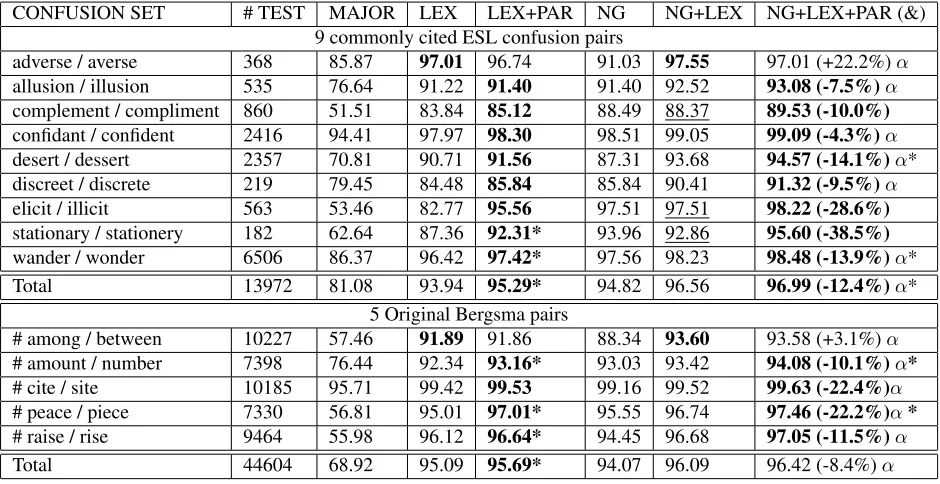
ab-solute 1.35% for our 9 confusion sets and 0.60% for Bergsma et al.’s 5 confusion sets.
The second comparison is to see how parse fea-tures interact with n-gram count feafea-tures in a su-pervised classifier. The best system from (Bergsma et al., 2010) is listed in the table as ”NG+LEX”. As shown in Table 3, the parse features proved to be beneficial when augmenting this baseline, except for the decrease in accuracy on adverse, averse by only 2 cases out of 368, and among, between by 2 cases out of 10227. For all other confusion sets, parse features decrease the error rate by as much as 2.74% (absolute) and as much as 38.5% (relative). Improvements are statistically significant on all con-fusion sets together, although for each separate set, improvements are significant on only 5 sets, in part due to an insufficient number of test cases.
The reason that parse features are occasionally not helpful is because they sometimes include an un-common word in dependencies, which happens to appear once with the wrong word but not with the correct word in the training data; or they sometimes include too common words, which bias the classifier in favor of the more frequent word in the confusion set. We also noticed that lexical features are not al-ways helpful when added to n-gram count features, even for in-domain applications (i.e., with training data and test data coming from the same domain or corpus), as marked by underlines. However, lexical and parse features together show more significant and constant improvement over n-gram count-based models, as marked byα.
Of the six systems, every system that uses parse features gets the example correct in Section 1, “com-plementing the president”; LEX by itself also gets the example correct, but NG and NG+LEX fail.
In summary, our system NG+LEX+PAR outper-forms the state-of-the-art system NG+LEX. It re-duces the error rate by 12.4% across our 9 confusion sets and by 8.4% across Bergsma et al.’s 5 confusion sets. Both improvements are significant (p<0.05)
by the McNemar test. In addition, while NG+LEX is not always better than NG, NG+LEX+PAR is con-sistently better than NG.
5.2.2 Impact of Word Co-occurrence
The LIBLINEAR tool does not provide probabil-ity estimates for SVM models but Logistic
Regres-sion can. In this set of experiments, we train a Logis-tic Regression model with NG+LEX+PAR features and empirically set the confidence threshold at 0.6, as described in Section 4, based on the performance on two word pairs. In the combined system, when the Logistic Regression model estimates a probabil-ity higher than the threshold we output its results, otherwise we output the result of the system based on word co-occurrence.
Surprisingly, although Random Indexing takes into account more information than first-order word co-occurrence, it lowered overall performance sub-stantially. Thus in Table 4, we only present results of using first-order word co-occurrence rather than Random Indexing. For all 12 confusion sets, distri-butional word co-occurrence information improves 9 sets and hurts 5 sets. Overall, it reduces the er-ror rate slightly by 0.2% for our 9 sets and 1.5% for Bergsma et al.’s sets.
We believe there are two reasons why Ran-dom Indexing fared worse than first-order word occurrence: 1) Random Indexing considers co-occurrence on a document level, while our first-order word co-occurrence is limited to a 5-word win-dow context. The latter is more suitable to context-sensitive spelling correction. 2) The model for Ran-dom Indexing is trained on a relatively small size corpus compared to the web-scale data we used to get n-gram count features for the classifier and thus is not able to introduce much new evidence besides the information carried by NG+LEX+PAR features.
CONFUSION SET # TEST MAJOR LEX LEX+PAR NG NG+LEX NG+LEX+PAR (&) 9 commonly cited ESL confusion pairs
adverse / averse 368 85.87 97.01 96.74 91.03 97.55 97.01 (+22.2%)α
allusion / illusion 535 76.64 91.22 91.40 91.40 92.52 93.08 (-7.5%)α
complement / compliment 860 51.51 83.84 85.12 88.49 88.37 89.53 (-10.0%)
confidant / confident 2416 94.41 97.97 98.30 98.51 99.05 99.09 (-4.3%)α
desert / dessert 2357 70.81 90.71 91.56 87.31 93.68 94.57 (-14.1%)α*
discreet / discrete 219 79.45 84.48 85.84 85.84 90.41 91.32 (-9.5%)α
elicit / illicit 563 53.46 82.77 95.56 97.51 97.51 98.22 (-28.6%)
stationary / stationery 182 62.64 87.36 92.31* 93.96 92.86 95.60 (-38.5%)
wander / wonder 6506 86.37 96.42 97.42* 97.56 98.23 98.48 (-13.9%)α*
Total 13972 81.08 93.94 95.29* 94.82 96.56 96.99 (-12.4%)α*
5 Original Bergsma pairs
# among / between 10227 57.46 91.89 91.86 88.34 93.60 93.58 (+3.1%)α
# amount / number 7398 76.44 92.34 93.16* 93.03 93.42 94.08 (-10.1%)α*
# cite / site 10185 95.71 99.42 99.53 99.16 99.52 99.63 (-22.4%)α
# peace / piece 7330 56.81 95.01 97.01* 95.55 96.74 97.46 (-22.2%)α*
# raise / rise 9464 55.98 96.12 96.64* 94.45 96.68 97.05 (-11.5%)α
[image:8.612.71.541.69.311.2]Total 44604 68.92 95.09 95.69* 94.07 96.09 96.42 (-8.4%)α
Table 3: Spelling correction precision (%), impact of adding parse features SVM trained on 1G words of news text, tested on 9-months of NYT data. *: Improvement of (NG+)LEX+PAR vs. (NG+)LEX is statistically significant.
α: Improvement of NG+LEX+PAR vs. NG is statistically significant. &: Relative increase or decrease of error rate compared to ”NG+LEX”
#: As in Bergsma et al. (2009; 2010) no morphological variants of the words are used in evaluation
CONFUSION SET # TEST MAJOR CLASSIFIER COMBINED SYSTEM (&)
9 commonly cited ESL confusion pairs
adverse / averse 368 85.87 97.55 96.74 (+33.3%)
allusion / illusion 535 76.64 92.34 92.34 (- 0.0%)
complement / compliment 860 51.51 89.88 90.81 (-9.2%)
confidant / confident 2416 94.41 99.13 99.05 (+9.5%)
desert / dessert 2357 70.81 93.98 94.23 (-3.7%)
discreet / discrete 219 79.45 90.41 91.78 (-14.3%)
elicit / illicit 563 53.46 98.40 98.76 (-22.2%)
stationary / stationery 182 62.64 93.41 93.96 (-9.1%)
wander / wonder 6506 86.37 98.49 98.36 (+9.2%)
5 Original Bergsma pairs
# among / between 10227 57.46 92.73 92.73 (-0.1%)
# amount / number 7398 76.44 93.44 93.76 (-4.74%)
# cite / site 10185 95.71 99.49 99.47 (+3.8%)
# peace / piece 7330 56.81 96.19 96.38 (-5.0%)
# raise / rise 9464 55.98 96.66 96.59 (+2.2%)
Table 4: Spelling correction accuracy (%), impact of combining word co-occurrence
CLASSIFIER: Logistic Regression trained on 1G words of news text, tested on 9-months NYT data. COMBINED SYSTEM: CLASSIFER plus system based on first-order word co-occurrence.
&: Relative increase or decrease in error rate compared to CLASSIFIER
6 Conclusions
We propose a novel approach that uses parse features and lexical features together to improve the performance of web-scale n-gram models for spelling correction. This method is especially adap-tive when less training data are available, which is the case for confusable words that are not very fre-quently used. We also investigate the effectiveness of incorporating web-scale word co-occurrence and corpus-based semantic word relatedness (Random Indexing).
For future work, we will investigate using seman-tic information (e.g. WordNet) to extend n-gram models. It will be interesting to see if the usage of the word “compliment” in “complimenting the pres-ident” can be estimated by considering similar us-ages in the corpus, such as “complimenting the stu-dent” or by creating an n-gram database of synset patterns. We will investigate extending, to other ap-plications, this general methodology combining dis-tributional, semantic and syntactic information with language models.
Acknowledgments
We wish to thank Michael Flor of Educational Testing Service for his TrendStream tool, which provides fast access and easy manipulation of the Google N-gram Corpus. We also thank Derrick Hig-gins of Educational Testing Service for his Random Indexing support. We also thank Satoshi Sekine of New York University, Matthew Snover of City Uni-versity of New York, and Jing Jiang of Singapore Management University for their advice.
References
Shane Bergsma, Dekang Lin, and Randy Goebel. 2009. Web-scale n-gram models for lexical disambiguation. InIJCAI.
Shane Bergsma, Emily Pitler, and Dekang Lin. 2010. Creating robust supervised classifiers via web-scale n-gram data. InACL.
Thorsten Brants and Alex Franz. 2006. Web 1T 5-gram version 1. Available at http://www.ldc.upenn.edu. Alexander Budanitsky and Graeme Hirst. 2001.
Seman-tic distance in wordnet: An experimental, application-oriented evaluation of five measures. In ACL Work-shop on WordNet and Other Lexical Resources.
Andrew Carlson and Ian Fette. 2007. Memory-based context sensitive spelling correction at web scale. In ICMLA.
Martin Chodorow, Joel Tetreault, and Na-Rae Han. 2007. Detection of grammatical errors involving preposi-tions. In Proceedings of the Fourth ACL-SIGSEM Workshop on Prepositions, pages 25–30.
Silviu Cucerzan and David Yarowsky. 2002. Aug-mented mixture models for lexical disambigua-tion. In EMNLP.
Marie-Catherine de Marneffe, Bill MacCartney, and Christopher D. Manning. 2006. Generating typed de-pendency parses from phrase structure parses. In Pro-ceedings of LREC, Genoa, Italy.
Scott Deerwester, Susan Dumais, George Furmas, Thomas Landauer, and Richar Harshman. 1990. In-dexing by latent semantic analysis. The American So-ciety for Information Science.
Dmitriy Dligach and Martha Palmer. 2008. Novel se-mantic features for verb sense disambiguation. In ACL.
Philip Edmonds. 1997. Choosing the word most typical in context using a lexical co-occurrence network. In EACL.
Mohammed Ali Elmi and Martha Evans. 1998. Spelling correction using context. InCOLING.
Rong-En Fan, Kai-Wei Chang, Cho-Jui Hsieh, Xiang-Rui Wang, and Chih-Jen Lin. 2008. Liblinear: A library for large linear classification. Machine Learning Re-search, 9(1871-1874).
Rachele De Felice and Stephen G. Pulman. 2008. A classifier-based approach to preposition and deter-miner error correction in L2 English. InProceedings of COLING, Manchester, UK.
Rachele De Felice and Stephen G. Pulman. 2009. Auto-matic detection of preposition errors in learner writing. CALICO Journal, 26(3).
Michael Gamon, Jianfeng Gao, Chris Brockett, Alex Klementiev, William B. Dolan, Dmitriy Belenko, and Lucy Vanderwende. 2008. Using contextual speller techniques and language modeling for ESL error cor-rection. InProceedings of the International Joint Con-ference on Natural Language Processing (IJCNLP), pages 449–456, Hyderabad, India.
Andrew Golding and Dan Roth. 1996. Applying Win-now to context-sensitive spelling correction. In Pro-ceedings of the International Conference on Machine Learning (ICML), pages 182–190.
Andrew Golding and Dan Roth. 1999. A winnow-based approach to context-sensitive spelling correction. Ma-chine Learning, 34(1-3):107–130.
of the Third Workshop on Very Large Corpora (WVLC-3), pages 39–53.
Na-Rae Han, Martin Chodorow, and Claudia Leacock. 2006. Detecting errors in English article usage by non-native speakers. Natural Language Engineering, 12(2):115–129.
Matthieu Hermet, Alain D´esilets, and Stan Szpakowicz. 2008. Using the web as a linguistic resource to au-tomatically correct lexico-syntactic errors. In Pro-ceedings of the Sixth International Conference on Lan-guage Resources and Evaluation (LREC), pages 390– 396, Marrekech, Morocco.
Emi Izumi, Kiyotaka Uchimoto, Toyomi Saiga, Thepchai Supnithi, and Hitoshi Isahara. 2003. Automatic er-ror detection in the Japanese learners’ English spoken data. InCompanion Volume to the Proceedings of the 41st Annual Meeting of the Association for Computa-tional Linguistics (ACL), pages 145–148.
Michael Jones and James Martin. 1997. Contextual spelling correction using latent semantic analysis. In ANLC.
Thomas Landauer, Darrell Laham, and Peter Foltz. 1998. Learning human-like knowledge by singular value de-composition: A progress report. Advances in Neural Information Processing Systems, 10:45–51.
Mirella Lapata and Frank Keller. 2005. Web-based mod-els for natural language processing. ACM Transac-tions on Speech and Language Processing, 21:1–31. John Lee and Ola Knutsson. 2008. The role of pp
attach-ment in preposition generation. InCICLING.
Lidia Mangu and Eric Brill. 1997. Automatic rule acqui-sition for spelling correction. InICML.
Saif Mohammad and Graeme Hist. 2006. Distributional measures of concept distance: A task-oriented evalua-tion. InEMNLP.
Alla Rozovskaya and Dan Roth. 2010. Training paradigms for correcting errors in grammar and usage. InACL.
Magnus Sahlgren. 2006. The Word-Space Model: us-ing distributional analysis to represent syntagmatic and paradigmatic relations between words in high-dimensional vector spaces. Ph.D. thesis.
Joel Tetreault and Martin Chodorow. 2008. The ups and downs of prepostion error detection in esl writing. In COLING.
Joel Tetreault, Jennifer Foster, and Martin Chodorow. 2010. Using parse features for preposition selection and error detection. InACL.