Perceptron Reranking for CCG Realization
Michael White and Rajakrishnan Rajkumar Department of Linguistics
The Ohio State University Columbus, OH, USA
{mwhite,raja}@ling.osu.edu
Abstract
This paper shows that discriminative reranking with an averaged perceptron model yields substantial improvements in realization quality with CCG. The paper confirms the utility of including language model log probabilities as features in the model, which prior work on discrimina-tive training with log linear models for HPSG realization had called into question. The perceptron model allows the combina-tion of multiple n-gram models to be opti-mized and then augmented with both syn-tactic features and discriminative n-gram features. The full model yields a state-of-the-art BLEU score of 0.8506 on Sec-tion 23 of the CCGbank, to our knowledge the best score reported to date using a re-versible, corpus-engineered grammar. 1 Introduction
In this paper, we show how discriminative train-ing with averaged perceptron models (Collins, 2002) can be used to substantially improve surface realization with Combinatory Categorial Gram-mar (Steedman, 2000, CCG). Velldal and Oepen (2005) and Nakanishi et al. (2005) have shown that discriminative training with log-linear (maximum entropy) models is effective in realization rank-ing with Head-Driven Phrase Structure Grammar (Pollard and Sag, 1994, HPSG). Here we show that averaged perceptron models also perform well for realization ranking with CCG. Averaged per-ceptron models are very simple, just requiring a decoder and a simple update function, yet despite their simplicity they have been shown to achieve state-of-the-art results in Treebank and CCG pars-ing (Huang, 2008; Clark and Curran, 2007a) as well as on other NLP tasks.
Along the way, we address the question of whether it is beneficial to incorporate n-gram log
probabilities as baseline features in a discrimina-tively trained realization ranking model. On a lim-ited domain corpus, Velldal & Oepen found that including the n-gram log probability of each can-didate realization as a feature in their log-linear model yielded a substantial boost in ranking per-formance; on the Penn Treebank (PTB), however, Nakanishi et al. found that including an n-gram log prob feature in their model was of no benefit (with the use of bigrams instead of 4-grams suggested as a possible explanation). With these mixed results, the utility of n-gram baseline features for PTB-scale discriminative realization ranking has been unclear. In our particular setting, the question is: Do n-gram log prob features improve performance in broad coverage realization ranking with CCG, where factored language models over words, part-of-speech tags and supertags have previously been employed (White et al., 2007; Espinosa et al., 2008)?
We answer this question in the affirmative, con-firming the results of Velldal & Oepen, despite the differences in corpus size and kind of lan-guage model. We show that including n-gram log prob features in the perceptron model is highly beneficial, as the discriminative models we tested without these features performed worse than the generative baseline. These findings are in line with Collins & Roark’s (2004) results with incre-mental parsing with perceptrons, where it is sug-gested that a generative baseline feature provides the perceptron algorithm with a much better start-ing point for learnstart-ing. We also show that discrim-inative training allows the combination of multi-ple n-gram models to be optimized, and that the best model augments the n-gram log prob fea-tures with both syntactic feafea-tures and discrimina-tive n-gram features. The full model yields a state-of-the-art BLEU (Papineni et al., 2002) score of 0.8506 on Section 23 of the CCGbank, which is to our knowledge the best score reported to date
using a reversible, corpus-engineered grammar. The paper is organized as follows. Section 2 re-views previous work on broad coverage realization with OpenCCG. Section 3 describes our approach to realization reranking with averaged perceptron models. Section 4 presents our evaluation of the perceptron models, comparing the results of dif-ferent feature sets. Section 5 compares our results to those obtained by related systems and discusses the difficulties of cross-system comparisons. Fi-nally, Section 6 concludes with a summary and discussion of future directions for research.
2 Background
2.1 Surface Realization with CCG
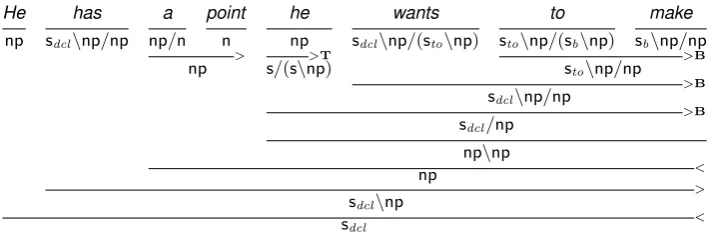
CCG (Steedman, 2000) is a unification-based cat-egorial grammar formalism which is defined al-most entirely in terms of lexical entries that encode sub-categorization information as well as syntactic feature information (e.g. number and agreement). Complementing function application as the stan-dard means of combining a head with its argu-ment, type-raising and composition support trans-parent analyses for a wide range of phenomena, including right-node raising and long distance de-pendencies. An example syntactic derivation ap-pears in Figure 1, with a long-distance depen-dency between point and make. Semantic com-position happens in parallel with syntactic compo-sition, which makes it attractive for generation.
OpenCCG is a parsing/generation library which works by combining lexical categories for words using CCG rules and multi-modal extensions on rules (Baldridge, 2002) to produce derivations. Surface realization is the process by which logical forms are transduced to strings. OpenCCG uses a hybrid symbolic-statistical chart realizer (White, 2006) which takes logical forms as input and pro-duces sentences by using CCG combinators to combine signs. Edges are grouped into equiva-lence classes when they have the same syntactic category and cover the same parts of the input log-ical form. Alternative realizations are ranked us-ing integrated n-gram or perceptron scorus-ing, and pruning takes place within equivalence classes of edges. To more robustly support broad coverage surface realization, OpenCCG greedily assembles fragments in the event that the realizer fails to find a complete realization.
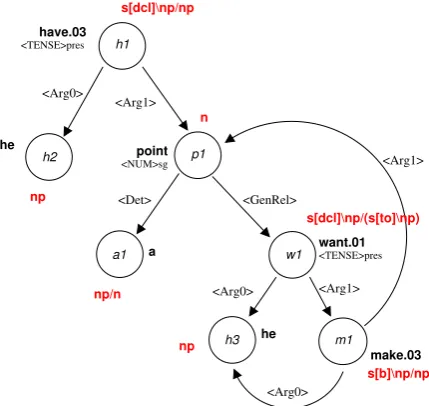
To illustrate the input to OpenCCG, consider the semantic dependency graph in Figure 2. In
a
a1
he
h3
he
h2
<Det> <Arg0>
<Arg1>
<TENSE>pres
<NUM>sg
<Arg0>
w1
want.01
m1
<Arg1>
<GenRel>
<Arg1>
<TENSE>pres
p1
point
h1
have.03
make.03
<Arg0>
s[b]\np/np np/n
np
n s[dcl]\np/np
s[dcl]\np/(s[to]\np)
[image:2.595.308.523.63.266.2]np
Figure 2: Semantic dependency graph from the CCGbank for He has a point he wants to make [. . . ], along with gold-standard supertags (cate-gory labels)
the graph, each node has a lexical predication (e.g. make.03) and a set of semantic features (e.g. hNUMisg); nodes are connected via depen-dency relations (e.g.hARG0i). (Gold-standard su-pertags, or category labels, are also shown; see Section 2.4 for their role in hypertagging.) In-ternally, such graphs are represented using Hy-brid Logic Dependency Semantics (HLDS), a dependency-based approach to representing lin-guistic meaning (Baldridge and Kruijff, 2002). In HLDS, each semantic head (corresponding to a node in the graph) is associated with a nominal that identifies its discourse referent, and relations between heads and their dependents are modeled as modal relations.
He has a point he wants to make
np sdcl\np/np np/n n np sdcl\np/(sto\np) sto\np/(sb\np) sb\np/np
> >T >B
np s/(s\np) sto\np/np
>B
sdcl\np/np
>B
sdcl/np np\np
<
np
>
sdcl\np
<
[image:3.595.119.477.60.177.2]sdcl
Figure 1: Syntactic derivation from the CCGbank forHe has a point he wants to make [. . . ]
particular, the features and unification constraints in the categories related to semantically empty function words such complementizers,
infinitival-to, expletive subjects, and case-marking preposi-tions are adjusted to reflect their purely syntactic status.
In the second step, a grammar is extracted from the converted CCGbank and augmented with log-ical forms. Categories and unary type chang-ing rules (correspondchang-ing to zero morphemes) are sorted by frequency and extracted if they meet the specified frequency thresholds. A separate trans-formation then uses a few dozen generalized tem-plates to add logical forms to the categories, in a fashion reminiscent of (Bos, 2005). As shown in Figure 2, numbered semantic roles are taken from PropBank when available, and more specific rela-tions are introduced in the categories for closed-class items such as determiners.
After logical form insertion, the extracted and augmented grammar is loaded and used to parse the sentences in the CCGbank according to the gold-standard derivation. If the derivation can be successfully followed, the parse yields a log-ical form which is saved along with the corpus sentence in order to later test the realizer. Cur-rently, the algorithm succeeds in creating logical forms for 98.85% of the sentences in the develop-ment section (Sect. 00) of the converted CCGbank, and 97.06% of the sentences in the test section (Sect. 23). Of these, 95.99% of the development LFs are semantic dependency graphs with a gle root, while 95.81% of the test LFs have a sin-gle root. The remaining cases, with multiple roots, are missing one or more dependencies required to form a fully connected graph. Such missing de-pendencies usually reflect remaining inadequacies in the logical form templates.
An error analysis of OpenCCG output by Ra-jkumar et al. (2009) recently revealed that out of
2331 named entities (NEs) annotated by the BBN corpus (Weischedel and Brunstein, 2005), 238 were not realized correctly. For example, multi-word NPs likeTexas Instruments Japan Ltd. were realized asJapan Texas Instruments Ltd. Accord-ingly, inspired by Hogan et al.’s (2007)’s Experi-ment 1, Rajkumar et al. used the BBN corpus NE annotation to collapse certain classes of NEs. But unlike Hogan et al.’s experiment where all the NEs annotated by the BBN corpus were collapsed, Ra-jkumar et al. chose to collapse into single tokens only NEs whose exact form can be reasonably ex-pected to be specified in the input to the realizer. For example, while some quantificational or com-paratives phrases likemore than$10,000are an-notated as MONEY in the BBN corpus, Rajkumar et al. only collapse$ 10,000into an atomic unit,
with more than handled compositionally
accord-ing to the semantics assigned to it by the gram-mar. Thus, after transferring the BBN annotations to the CCGbank corpus, Rajkumar et al. (partially) collapsed NEs which are CCGbank constituents according to the following rules: (1) completely collapse the PERSON, ORGANIZATION, GPE, WORK OF ART major class type entitites; (2) ig-nore phrases like three decades later, which are annotated as DATE entities; and (3) collapse all phrases with POS tags CD or NNP(S) or lexical items%or$, ensuring that all prototypical named entities are collapsed.
in Section 4. A further 4.5 point improvement is obtained from the use of named entity classes in language modeling and hypertagging (Rajkumar et al., 2009), as described next, and from our per-ceptron reranking model, described in Section 3. 2.3 Factored Language Models
As in (White et al., 2007; Rajkumar et al., 2009), we use factored language models (Bilmes and Kirchhoff, 2003) over words, part-of-speech tags and supertags1to score partial and complete
real-izations. The trigram models were created using the SRILM toolkit (Stolcke, 2002) on the standard training sections (02–21) of the CCGbank, with sentence-initial words (other than proper names) uncapitalized. While these models are consider-ably smaller than the ones used in (Langkilde-Geary, 2002; Velldal and Oepen, 2005), the train-ing data does have the advantage of betrain-ing in the same domain and genre. The models employ in-terpolated Kneser-Ney smoothing with the default frequency cutoffs. The best performing model interpolates three component models using rank-order centroid weights: (1) a word trigram model; (2) a word model with semantic classes replac-ing named entities; and (3) a trigram model that chains a POS model with a supertag model, where the POS model (P) conditions on the previous two POS tags, and the supertag model (S) conditions on the previous two POS tags as well as the current one, as shown below:
pP S(~Fi| ~Fii−−21) =p(Pi |Pii−−21)p(Si|Pii−2) (1) Training data for the semantic class–replaced model was created by replacing (collapsed) words with their NE classes, in order to address data spar-sity issues caused by rare words in the same se-mantic class. For example, the Section 00 sen-tencePierre Vinken , 61 years old , will join the
board as a nonexecutive director Nov. 29 .
be-comes PERSON , DATE:AGE DATE:AGE old , will join the ORG DESC:OTHER as a
nonexecu-tive PER DESC DATE:DATE DATE:DATE .
Dur-ing realization, word forms are generated, but are then replaced by their semantic classes for scoring using the semantic class–replaced model, similar to Oh and Rudnicky (2002).
Note that the use of supertags in the factored language model to score possible realizations is
1With CCG, supertags (Bangalore and Joshi, 1999) are
lexical categories considered as fine-grained syntactic labels.
distinct from the prediction of supertags for lexical category assignment: the former takes the words in the local context into account (as in supertag-ging for parsing), while the latter takes features of the logical form into account. This latter process we call hypertagging, to which we now turn.
2.4 Hypertagging
A crucial component of the OpenCCG realizer is
the hypertagger (Espinosa et al., 2008), or
su-pertagger for surface realization, which uses a maximum entropy model to assign the most likely lexical categories to the predicates in the input log-ical form, thereby greatly constraining the real-izer’s search space.2 Figure 2 shows gold-standard
supertags for the lexical predicates in the graph; such category labels are predicted by the hyper-tagger at run-time. As in recent work on using supertagging in parsing, the hypertagger operates in a multitagging paradigm (Curran et al., 2006), where a variable number of predictions are made per input predicate. Instead of basing category as-signment on linear word and POS context, how-ever, the hypertagger predicts lexical categories based on contexts within a directed graph structure representing the logical form (LF) of the sentence to be realized. The hypertagger generalizes Ban-galore and Rambow’s (2000) method of using su-pertags in generation by using maximum entropy models with a larger local context.
During realization, the hypertagger returns a β-best list of supertags in order of decreasing prob-ability. Increasing the number of categories re-turned clearly increases the likelihood that the most-correct supertag is among them, but at a cor-responding cost in chart size. Accordingly, the hy-pertagger begins with a highly restrictive value for β, and backs off to progressively less-restrictive values if no complete realization can be found us-ing the set of supertags returned. Clark and Curran (2007b) have shown this iterative relaxation strat-egy to be highly effective in CCG parsing.
3 Perceptron Reranking
As Collins (2002) observes, perceptron training involves a simple, on-line algorithm, with few it-erations typically required to achieve good perfor-mance. Moreover, averaged perceptrons—which
2The approach has been dubbedhypertaggingsince it
Input:training examples(xi, yi)
Initialization: set α = 0, or use optional input model
Algorithm:
fort= 1. . . T,i= 1. . . N
zi = argmaxy∈GEN(xi)Φ(xi, y)·α
ifzi 6=yi
α=α+ Φ(xi, yi)−Φ(xi, zi)
Output:α =PTt=1PNi=1αti/T N
Figure 3: Averaged perceptron training algorithm
approximate voted perceptrons, a maximum-margin method with attractive theoretical properties—seem to work remarkably well in practice, while adding little further complexity. Additionally, since features only take on non-zero values when they appear in training items requiring updates, perceptrons integrate feature selection with, and often produce quite small models, especially when starting with a good baseline.
The generic averaged perceptron training rithm appears in Figure 3. In our case, the algo-rithm trains a model for reranking the n-best real-izations generated using our existing factored lan-guage model for scoring, with the oracle-best re-alization considered the correct answer. Accord-ingly, the input to the algorithm is a list of pairs
(xi, yi), wherexi is a logical form, GEN(xi) are
the n-best realizations forxi, andyi is the
oracle-best member of GEN(xi). The oracle-best
realiza-tion is determined using a 4-gram precision metric (approximating BLEU) against the reference sen-tence.
We have followed Huang (2008) in using oracle-best targets for training, rather than gold standard ones, in order to better approximate test conditions during training. However, following Clark & Curran (2007a), during training we seed the realizer with the gold-standard supertags, aug-menting the hypertagger’sβ-best list, in order to ensure that the n-best realizations are generally of high quality; consequently, the gold standard real-ization (i.e., the corpus sentence) usually appears in the n-best list.3 In addition, we use a
hyper-tagger trained on all the training data, to improve hypertagger performance, while excluding the
cur-3As in Clark & Curran’s approach, we use a singleβvalue
during training, rather than iteratively loosening theβvalue; the chosenβvalue determines the size of the discrimation space.
rent training section (in jack-knifed fashion) from the word-based parts of the language model, in or-der to make the language model scores more re-alistic. It remains for future work to determine whether using a different compromise between en-suring high-quality training data and remaining faithful to the test conditions would yield better results.
Since realization of the n-best lists for train-ing is the most time-consumtrain-ing part of the pro-cess, in our current implementation we perform this step once, generating event files along the way containing feature vectors for each candidate real-ization. The event files are used to calculate the frequency distribution for the features, and mini-mum cutoffs are chosen to trim the feature alpha-bet to a reasonable size. Training then takes place by iterating over the event files, ignoring features that do not appear in the alphabet. As Figure 3 indicates, training consists of calculating the top-ranked realization according to the current model α, and performing an update when the top-ranked realization does not match the oracle-best realiza-tion. Updates to the model add the feature vec-tor Φ(xi, yi) for the missed oracle-best
realiza-tion, and subtract the feature vectorΦ(xi, zi) for
the mistakenly top-ranked realization. The final model averages the models across theT iterations over the training data, andNtest cases within each iteration.
Note that while training the perceptron model involves n-best reranking, realization with the re-sulting model can be viewed as forest rescoring, since scoring of all partial realizations is integrated into the realizer’s beam search. In future work, we intend to investigate saving the realizer’s packed charts, rather than event files, and integrating the unpacking of the charts with the perceptron train-ing algorithm.
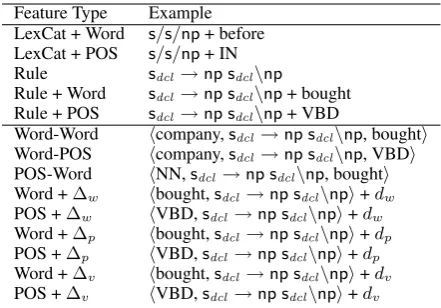
The features we employ in our perceptron mod-els are of three kinds. First, as in the log-linear models of Velldal & Oepen and Nakanishi et al., we incorporate the log probability of the candidate realization’s word sequence according to our fac-tored language model as a single feature in the per-ceptron model. Since our language model linearly interpolates three component models, we also in-clude the log prob from each component language model as a feature, so that the combination of these components can be optimized.
Feature Type Example LexCat + Word s/s/np+ before LexCat + POS s/s/np+ IN Rule sdcl →np sdcl\np
Rule + Word sdcl →np sdcl\np+ bought
Rule + POS sdcl →np sdcl\np+ VBD
Word-Word hcompany,sdcl→np sdcl\np, boughti
Word-POS hcompany,sdcl→np sdcl\np, VBDi
POS-Word hNN,sdcl→np sdcl\np, boughti
Word +∆w hbought,sdcl→np sdcl\npi+dw
POS +∆w hVBD,sdcl→np sdcl\npi+dw
Word +∆p hbought,sdcl→np sdcl\npi+dp
POS +∆p hVBD,sdcl→np sdcl\npi+dp
Word +∆v hbought,sdcl→np sdcl\npi+dv
POS +∆v hVBD,sdcl→np sdcl\npi+dv
Table 1: Basic and dependency features from Clark & Curran’s (2007b) normal form model; distances are in intervening words, punctuation marks and verbs, and are capped at 3, 3 and 2, respectively
model by implementing Clark & Curran’s (2007b) normal form model in OpenCCG.4The features of
this model are listed in Table 1; they are integer-valued, representing counts of occurrences in a derivation. These syntactic features are quite com-parable to the dominance-oriented features in the union of the Velldal & Oepen and Nakanishi et al. models, except that our feature set does not include grandparenting, which has been found to have limited utility in CCG parsing. Our syntac-tic features also include ones that measure the dis-tance between headwords in terms of intervening words, punctuation marks or verbs; these features generalize the ones in Nakanishi et al.’s model. Note that in contrast to parsing, in realization dis-tance features are non-local, since different partial realizations in the same equivalence class typically differ in word order; as we are working in a rerank-ing paradigm though, the non-local nature of these features is unproblematic.
Third, we include discriminative n-gram fea-tures in our model, following Roark et al.’s (2004) approach to discriminative n-gram modeling for speech recognition. By discriminative n-gram fea-tures, we mean features counting the occurrences of each n-gram that is scored by our factored lan-guage model, rather than a feature whose value is the log prob determined by the language model. As Roark et al. note, discriminative training with n-gram features has the potential to learn to
nega-4We have omitted Clark & Curran’s root features, since
the category we use for the full stop ensures that it must ap-pear at the root of any complete derivation.
[image:6.595.71.292.61.215.2]Model #Alph-feats #Feats Acc Time full-model 2402173 576176 96.40% 08:53 lp-ngram 1127437 342025 94.52% 05:19 lp-syn 1274740 291728 85.03% 05:57
Table 2: Perceptron Training Details—number of features in the alphabet, number of features in the model, training accuracy and training time (hours) for 10 iterations on a single commodity server
tively weight n-grams that appear in some of the GEN(xi) candidates, but which never appear in
the naturally occurring corpus used to train a stan-dard, generative language model. Since our fac-tored language model considers words, semantic classes, part-of-speech tags and supertags, our n-gram features represent a considerable generaliza-tion of the sequence-oriented features in Velldal & Oepen’s model, which never contain more than one word and do not include semantic classes. 4 Evaluation
4.1 Experimental Conditions
For the experiments reported below, we used a lexico-grammar extracted from Sections 02–21 of our enhanced CCGbank, a hypertagging model in-corporating named entity class features, and a tri-gram factored language model over words, named entity classes, part-of-speech tags and supertags, as described in the preceding section. BLEU scores were calculated after removing the under-scores between collapsed NEs.
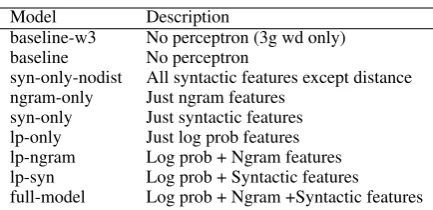
Events were generated for each training section separately. As already noted, the hypertagger and POS/supertag language model was trained on all the training sections, while separate word-based models were trained excluding each of the train-ing sections in turn. Event files for 26530 traintrain-ing sentences with complete realizations were gener-ated in 7 hours and 16 minutes on a cluster us-ing one commodity server per section, with an av-erage n-best list size of 18.2. Perceptron models were trained on single machines; details for three of the models appear in Table 2. The complete set of models is listed in Table 3.
4.2 Results
Model Description
baseline-w3 No perceptron (3g wd only) baseline No perceptron
syn-only-nodist All syntactic features except distance ngram-only Just ngram features
[image:7.595.73.290.60.165.2]syn-only Just syntactic features lp-only Just log prob features lp-ngram Log prob + Ngram features lp-syn Log prob + Syntactic features full-model Log prob + Ngram +Syntactic features
Table 3: Legend for Experimental Conditions
score, with the other models falling well below the baseline (though faring better than the trigram-word LM baseline). This result confirms the im-portance of including n-gram log prob features in discriminative realization ranking models, in line with Velldal & Oepen’s findings, and contra those of Nakanishi et al., even though it was Nakanishi et al. who experimented with the Penn Treebank corpus, while Velldal & Oepen’s experiments were on a much smaller, limited domain corpus. The second block of rows shows that both the discrim-inative n-gram features and the syntactic features provide a substantial boost when used with the n-gram log prob features, with the syntactic features yielding a more than 3 BLEU point gain. The final row shows that the full model works best, though the boosts provided by the syntactic and discriminative n-gram features are clearly not in-dependent. The BLEU point trends are mirrored in the percentage of exact match realizations, which goes up by more than 10% from the baseline. The percentage of complete (i.e., non-fragmentary) re-alizations, however, goes down; we expect that this is due to the time taken up by our current naive method of feature extraction, which does not cache the features calculated for partial realiza-tions. Realization results on the standard test sec-tion appear in Table 5, confirming the gains made by the full model over the baseline.5
We calculated statistical significance for the main results on the development section using bootstrap random sampling.6 After re-sampling
1000 times, significance was calculated using a paired t-test (999 d.f.). The results indicated that only exceeded the baseline, ngram and
lp-5Note that the baseline for Section 23 uses 4-grams and a
filter for balanced punctuation (White and Rajkumar, 2008), unlike the other reported configurations, which would explain the somewhat smaller increase seen with this section.
6Scripts for running these tests are available at
http://projectile.sv.cmu.edu/research/ public/tools/bootStrap/tutorial.htm
Model %Exact %Compl. BLEU Time baseline-w3 26.00 83.15 0.7646 1.8
[image:7.595.308.530.62.166.2]baseline 29.00 83.28 0.7963 2.0 syn-only-nodist 26.02 82.69 0.7754 3.2 ngram-only 27.67 82.95 0.7777 3.0 syn-only 28.34 82.74 0.7838 3.4 lp-only 32.01 83.02 0.8009 2.1 lp-ngram 36.31 80.47 0.8183 3.1 lp-syn 39.47 79.74 0.8323 3.5 full-model 40.11 79.63 0.8373 3.6
Table 4: Section 00 Results (98.9% coverage)— percentage of exact match and grammatically complete realizations, BLEU scores and average times, in seconds
Model %Exact %Complete BLEU baseline 33.74 85.04 0.8173 full-model 40.45 83.88 0.8506
Table 5: Section 23 Results (97.06% coverage)
syn exceeded lp-only, and the full model exceeded lp-syn, withp <0.0001in each case.
4.3 Examples
Table 6 presents four examples where the full model improves upon the baseline. Example sen-tence wsj 0020.10 in Table 6 is a case where the perceptron successfully weights the component ngram models, as the lp-ngram model and those that build on it get it right. Note that here, the mod-ifier ordering insmall video-viewingis not speci-fied in the logical form and either ordering is pos-sible syntactically. In wsj 0024.2, number agree-ment between the conjoined subject noun phrase and verb is obtained only with the full model. This suggests that the full model is more robust to cases where the grammar is insufficiently precise (num-ber agreement is enforced by the grammar in only the simplest cases). Example wsj 0034.9 corrects a VP ordering mismatch, where the corpus sen-tence is clearly preferred to the one where into oblivionis shifted to the end. Finally, wsj 0047.13 corrects an animacy mismatch on thewh-pronoun, in large part due to the high negative weight as-signed to the discriminative n-gram feature PER-SON , which. Note that the full model still dif-fers from the original sentence in its placement of the adverbreportedly, choosing the arguably more natural position following the auxiliary.
4.4 Comparison to Other Systems
Ref-wsj 0020.10 that measure could compel Taipei ’s growing number of small video-viewing parlors to pay ... baseline,syn-only,ngram-only that measure could compel Taipei ’s growing number ofvideo-viewing smallparlors to ... lp-only, lp-ngram, full-model that measure could compel Taipei ’s growing number ofsmall video-viewingparlors to ...
Ref-wsj 0024.2 Esso Australia Ltd. , a unit of new york-based Exxon Corp. , and Broken Hill Pty. operate the fields ... all except full-model Esso Australia Ltd. , a unit of new york-based Exxon Corp. , and Broken Hill Pty.operatesthe fields ... full-model Esso Australia Ltd. , a unit of new york-based Exxon Corp. , and Broken Hill Pty.operatethe fields ...
Ref-wsj 0034.9 they fell into oblivion after the 1929 crash . baseline, lp-ngram they fellafter the 1929 crash into oblivion. lp-only, ngram-only, syn-only, full-model they fellinto oblivion after the 1929 crash.
Ref-wsj 0047.13 Antonio Novello , whom Mr. Bush nominated to serve as surgeon general , reportedly has assured . . . baseline,baseline-w3, lp-syn, lp-only Antonio Novello ,whichMr. Bush nominated to serve as surgeon general , hasreportedlyassured . . . full-model, lp-ngram, syn-only, ngram-syn Antonio Novello ,whomMr. Bush nominated to serve as surgeon general , hasreportedlyassured . . .
Table 6: Examples of realized output
System Coverage BLEU %Exact
Callaway (05) 98.5% 0.9321 57.5
OpenCCG (09) 97.1% 0.8506 40.5
Ringger et al. (04) 100.0% 0.836 35.7 Langkilde-Geary (02) 83% 0.757 28.2 Guo et al. (08) 100.0% 0.7440 19.8 Hogan et al. (07) ≈100.0% 0.6882
OpenCCG (08) 96.0% 0.6701 16.0 Nakanishi et al. (05) 90.8% 0.7733
Table 7: PTB Section 23 BLEU scores and exact match percentages in the NLG literature (Nakan-ishi et al.’s results are for sentences of length 20 or less)
most similar systems to ours are those of Nakan-ishi et al. (2005) and Hogan et al. (2007), as they both involve chart realizers for reversible gram-mars engineered from the Penn Treebank. While direct comparisons across systems cannot really be made when inputs vary in their semantic depth and specificity, we observe that our all-sentences BLEU score of 0.8506 exceeds that of Hogan et al., who report a top score of 0.6882 (though with coverage near 100%), and also surpasses Nakan-ishi et al.’s score of 0.7733, despite their results be-ing limited to sentences of length 20 or less (with 91% coverage). Velldal & Oepen’s (2005) system is also closely related, as noted in the introduc-tion, but as their experiments are on a limited do-main corpus, their results cannot be compared at all meaningfully.
5 Related Work and Discussion
As alluded to above, realization systems cannot be easily compared, even on the same corpus, when their inputs are not the same. This point is dra-matically illustrated in Langkilde-Geary’s (2002) system, where a BLEU score of 0.514 is reported for minimally specified inputs on PTB Section 23, while a score of 0.757 is reported for the
‘Per-mute, no dir’ case (which perhaps most closely resembles our inputs), and a score of 0.924 is re-ported for the most fully specified inputs; note, however, that in the latter case word order is deter-mined by sibling order in the inputs, an assump-tion not commonly made. As another example, Guo et al. (2008) report a competitive result of 0.7440 (with 100% coverage) using a dependency-based approach; however, their inputs, like those of Hogan et al., include more surface syntactic in-formation than ours, as they specify case-marking prepositions, wh-pronouns and complementizers. In a recent experiment to assess the impact of input specificity, we found that including pred-icates for all prepositions in our logical forms boosted our baseline results by more than 3 BLEU points, with complete realizations found in more than 90% of the test cases, indicating that generat-ing from a more surfacy input is indeed an easier task than generating from a deeper representation. Given the current lack of consensus on realizer in-put specificity, we believe it is important to keep in mind that within-system comparisons (such as those in the preceding section) are the ones that should be given the most credence.
Returning to our cross-system comparison, it is perhaps surprising that Callaway (2005) reports the best PTB BLEU score to date, 0.9321, with 98.5% coverage, using a purely symbolic, hand-crafted grammar augmented to handle the most frequent coverage issues for the PTB. While Call-away’s inputs are unordered, word order is often determined by positional features (e.g.front) or by the type of modification (e.g.describervs.
outputs. Nevertheless, his high scores do suggest the potential for precise grammar engineering to improve realization quality.
While we have yet to perform a thorough er-ror analysis, our impression is that although the current set of syntactic features substantially im-proves clausal constituent ordering, a variety of disfluent cases remain. More thorough inves-tigations of features for constituent ordering in English have been performed by Ringger et al. (2004), Filippova and Strube (2009) and Zhong and Stent (2009), all of whom develop classifiers for determining linear order. In future work, we plan to investigate whether features inspired by these approaches can be usefully integrated into our perceptron reranker.
Also related to the present work is discrimina-tive training in syntax-based MT (Turian et al., 2007; Watanabe et al., 2007; Blunsom et al., 2008; Chiang et al., 2009). Not surprisingly, since MT is a harder problem than surface realization, syntax-based MT systems have made use of less precise grammars and more impoverished (target-side) feature sets than those tackling realization rank-ing. With progress on discriminative training with large numbers of features in syntax-based MT, the features found to be useful for high-quality sur-face realization may become increasingly relevant for MT as well.
6 Conclusions
In this paper, we have shown how discriminative reranking with an averaged perceptron model can be used to achieve substantial improvements in re-alization quality with CCG. Using a comprehen-sive feature set, we have also confirmed the util-ity of including language model log probabilities as features in the model, which prior work on discriminative training with log linear models for HPSG realization had called into question. The perceptron model allows the combination of mul-tiple n-gram models to be optimized and then aug-mented with both syntactic features and discrim-inative n-gram features, inspired by related work in discriminative parsing and language modeling for speech recognition. The full model yields a state-of-the-art BLEU score of 0.8506 on Section 23 of the CCGbank, to our knowledge the best score reported to date using a reversible, corpus-engineered grammar, despite our use of deeper, less specific inputs. Finally, the perceptron model
paves the way for exploring the utility of richer feature spaces in statistical realization, including the use of linguistically-motivated and non-local features, a topic which we plan to investigate in future work.
Acknowledgements
This work was supported in part by NSF grant IIS-0812297 and by an allocation of computing time from the Ohio Supercomputer Center. Our thanks also to the OSU Clippers group and the anony-mous reviewers for helpful comments and discus-sion.
References
Jason Baldridge and Geert-Jan Kruijff. 2002. Cou-pling CCG and Hybrid Logic Dependency Seman-tics. InProc. ACL-02.
Jason Baldridge. 2002. Lexically Specified Deriva-tional Control in Combinatory Categorial Gram-mar. Ph.D. thesis, University of Edinburgh.
Srinivas Bangalore and Aravind K. Joshi. 1999. Su-pertagging: An Approach to Almost Parsing. Com-putational Linguistics, 25(2):237–265.
Srinivas Bangalore and Owen Rambow. 2000. Ex-ploiting a probabilistic hierarchical model for gener-ation. InProc. COLING-00.
Jeff Bilmes and Katrin Kirchhoff. 2003. Factored lan-guage models and general parallelized backoff. In
Proc. HLT-03.
Phil Blunsom, Trevor Cohn, and Miles Osborne. 2008. A discriminative latent variable model for statistical machine translation. InProc. ACL-08: HLT.
Johan Bos. 2005. Towards wide-coverage semantic interpretation. InProc. IWCS-6.
Stephen Boxwell and Michael White. 2008. Projecting Propbank roles onto the CCGbank. InProc. LREC-08.
Charles Callaway. 2005. The types and distributions of errors in a wide coverage surface realizer evaluation. In Proceedings of the 10th European Workshop on Natural Language Generation.
David Chiang, Kevin Knight, and Wei Wang. 2009. 11,001 new features for statistical machine transla-tion. InProc. NAACL HLT 2009.
Stephen Clark and James R. Curran. 2007b. Wide-Coverage Efficient Statistical Parsing with CCG and Log-Linear Models. Computational Linguistics, 33(4):493–552.
Michael Collins and Brian Roark. 2004. Incremen-tal parsing with the perceptron algorithm. InProc. ACL-04.
Michael Collins. 2002. Discriminative training meth-ods for hidden Markov models: theory and ex-periments with perceptron algorithms. In Proc. EMNLP-02.
James R. Curran, Stephen Clark, and David Vadas. 2006. Multi-tagging for lexicalized-grammar pars-ing. InProc. COLING/ACL-06.
Dominic Espinosa, Michael White, and Dennis Mehay. 2008. Hypertagging: Supertagging for surface real-ization with CCG. InProc. ACL-08: HLT.
Katja Filippova and Michael Strube. 2009. Tree lin-earization in English: Improving language model based approaches. InProc. NAACL HLT 2009 Short Papers.
Yuqing Guo, Josef van Genabith, and Haifeng Wang. 2008. Dependency-based n-gram models for general purpose sentence realisation. In Proc. COLING-08.
Julia Hockenmaier and Mark Steedman. 2007. CCG-bank: A Corpus of CCG Derivations and Depen-dency Structures Extracted from the Penn Treebank.
Computational Linguistics, 33(3):355–396.
Deirdre Hogan, Conor Cafferkey, Aoife Cahill, and Josef van Genabith. 2007. Exploiting multi-word units in history-based probabilistic generation. In
Proc. EMNLP-CoNLL.
Liang Huang. 2008. Forest reranking: Discriminative parsing with non-local features. InProc. ACL-08: HLT.
Irene Langkilde-Geary. 2002. An empirical verifi-cation of coverage and correctness for a general-purpose sentence generator. InProc. INLG-02. Hiroko Nakanishi, Yusuke Miyao, and Jun’ichi Tsujii.
2005. Probabilistic methods for disambiguation of an HPSG-based chart generator. InProc. IWPT-05. Alice H. Oh and Alexander I. Rudnicky. 2002.
Stochastic natural language generation for spoken dialog systems. Computer, Speech & Language, 16(3/4):387–407.
Martha Palmer, Dan Gildea, and Paul Kingsbury. 2005. The proposition bank: A corpus annotated with se-mantic roles. Computational Linguistics, 31(1). Kishore Papineni, Salim Roukos, Todd Ward, and
Wei-Jing Zhu. 2002. BLEU: a method for automatic evaluation of machine translation. In Proceedings of the 40th Annual Meeting of the Association for Computational Linguistics (ACL), Philadelphia, PA.
Carl Pollard and Ivan Sag. 1994. Head-Driven Phrase Structure Grammar. University Of Chicago Press. Rajakrishnan Rajkumar, Michael White, and Dominic
Espinosa. 2009. Exploiting named entity classes in CCG surface realization. InProc. NAACL HLT 2009 Short Papers.
Eric Ringger, Michael Gamon, Robert C. Moore, David Rojas, Martine Smets, and Simon Corston-Oliver. 2004. Linguistically informed statistical models of constituent structure for ordering in sen-tence realization. InProc. COLING-04.
Brian Roark, Murat Saraclar, Michael Collins, and Mark Johnson. 2004. Discriminative language modeling with conditional random fields and the perceptron algorithm. InProc. ACL-04.
Mark Steedman. 2000. The syntactic process. MIT Press, Cambridge, MA, USA.
Andreas Stolcke. 2002. SRILM — An extensible lan-guage modeling toolkit. InProc. ICSLP-02. Joseph Turian, Benjamin Wellington, and I. Dan
Melamed. 2007. Scalable discriminative learn-ing for natural language parslearn-ing and translation. In
Proc. NIPS 19.
Erik Velldal and Stephan Oepen. 2005. Maximum en-tropy models for realization ranking. InProc. MT Summit X.
Taro Watanabe, Jun Suzuki, Hajime Tsukada, and Hideki Isozaki. 2007. Online large-margin training for statistical machine translation. InProc. EMNLP-CoNLL-07.
Ralph Weischedel and Ada Brunstein. 2005. BBN pro-noun coreference and entity type corpus. Technical report, BBN.
Michael White and Rajakrishnan Rajkumar. 2008. A more precise analysis of punctuation for broad-coverage surface realization with CCG. In Proc. of the Workshop on Grammar Engineering Across Frameworks (GEAF08).
Michael White, Rajakrishnan Rajkumar, and Scott Martin. 2007. Towards broad coverage surface re-alization with CCG. In Proc. of the Workshop on Using Corpora for NLG: Language Generation and Machine Translation (UCNLG+MT).
Michael White. 2006. Efficient Realization of Coor-dinate Structures in Combinatory Categorial Gram-mar. Research on Language and Computation, 4(1):39–75.