Function-based question classification for general QA
Fan Bu, Xingwei Zhu, Yu Hao and Xiaoyan Zhu State Key Laboratory of Intelligent Technology and Systems Tsinghua National Laboratory for Information Science and Technology
Department of Computer Sci. and Tech., Tsinghua University [email protected]
[email protected] [email protected]
Abstract
In contrast with the booming increase of inter-net data, state-of-art QA (question answering) systems, otherwise, concerned data from spe-cific domains or resources such as search en-gine snippets, online forums and Wikipedia in a somewhat isolated way. Users may welcome a more general QA system for its capability to answer questions of various sources, inte-grated from existed specialized sub-QA en-gines. In this framework, question classifica-tion is the primary task.
However, the current paradigms of question classification were focused on some speci-fied type of questions, i.e. factoid questions, which are inappropriate for the general QA. In this paper, we propose a new question clas-sification paradigm, which includes a ques-tion taxonomy suitable to the general QA and a question classifier based on MLN (Markov logic network), where rule-based methods and statistical methods are unified into a single framework in a fuzzy discriminative learning approach. Experiments show that our method outperforms traditional question classification approaches.
1 Introduction
During a long period of time, researches on question answering are mainly focused on finding short and concise answers from plain text for factoid questions driven by annual trackes such as CLEF, TREC and NTCIR. However, people usually ask more complex questions in real world which cannot be handled by these QA systems tailored to factoid questions.
During recent years, social collaborative applica-tions begin to flourish, such as Wikipedia, Facebook, Yahoo! Answers and etc. A large amount of semi-structured data, which has been accumulated from these services, becomes new sources for question answering. Previous researches show that different sources are suitable for answering different ques-tions. For example, the answers for factoid questions can be extracted from webpages with high accuracy, definition questions can be answered by correspond-ing articles in wikipedia(Ye et al., 2009) while munity question answering services provide com-prehensive answers for complex questions(Jeon et al., 2005). It will greatly enhance the overall per-formance if we can classify questions into several types, distribute each type of questions to suitable sources and trigger corresponding strategy to sum-marize returned answers.
Question classification (QC) in factoid QA is to provide constraints on answer types that allows fur-ther processing to pinpoint and verify the answer (Li and Roth, 2004). Usually, questions are classi-fied into a fine grained content-based taxonomy(e.g. UIUC taxonomy (Li and Roth, 2002)). We can-not use these taxonomies directly. To guide tion distribution and answer summarization, ques-tions are classified according to their funcques-tions in-stead of contents.
Motivated by related work on user goal classi-fication(Broder, 2002; Rose and Levinson, 2004) , we propose a function-based question classification category tailored to general QA. The category con-tain six types, namelyFact,List,Reason,Solution, DefinitionandNavigation. We will introduced this
category in detail in Section 2.
To classify questions effectively, we unify rule-based methods and statistical methods into a single framework. Each question is splited into functional words and content words. We generate strict pat-terns from functional words and soft patpat-terns from content words. Each strict pattern is a regular ex-pression while each soft pattern is a bi-gram clus-ter. Given a question, we will evaluate its matching degree to each patterns. The matching degree is ei-ther 0 or 1 for strict pattern and between 0 and 1 for soft pattern. Finally, Markov logic network (MLN) (Richardson and Domingos, 2006) is used to com-bine and evaluate all the patterns.
The classical MLN maximize the probability of an assignment of truth values by evaluating the weights of each formula. However, the real world is full of uncertainty and is unnatural to be repre-sented by a set of boolean values. In this paper, we propose fuzzy discriminative weight learning of Markov logic network. This method takes degrees of confidence of each evidence predicates into ac-count thus can model the matching degrees between questions and soft patterns.
The remainder of this paper is organized as fol-lows: In the next section we review related work on question classification, query classification and Markov logic network. Section 2 gives a detailed introduction to our new taxonomy for general QA. Section 4 introduces fuzzy discriminative weight learning of MLN and our methodology to extract strict and soft patterns. In Section 5 we compare our method with previous methods on Chinese question data from Baidu Zhidao and Sina iAsk. In the last section we conclude this work.
Although we build patterns and do experiments on Chinese questions, our method does not take ad-vantage of the particularity of Chinese language and thus can be easily implemented on other languages.
2 Related Work
Many question taxonomies have been proposed in QA community. Lehnert (1977) developed the sys-tem QUALM based on thirteen conceptual cate-gories which are based on a theory of memory repre-sentation. On the contrary, the taxonomy proposed by Graesser et al. (1992) has foundations both in
the-ory and in empirical research. Both of these tax-onomies are for open-domain question answering.
With the booming of internet, researches on question answering are becoming more practical. Most taxonomies proposed are focused on factoid questions, such as UIUC taxonomy (Li and Roth, 2002). UIUC taxonomy contains 6 coarse classes (Abbreviation, Entity, Description, Human, Lo-cation and Numeric Value) and 50 fine classes. All coarse classes are factoid oriented except De-scription. To classify questions effectively, Re-searchers have proposed features of different levels, such as lexical features, syntactic features (Nguyen et al., 2007; Moschitti et al., 2007) and semantic fea-tures (Moschitti et al., 2007; Li and Roth, 2004). Zhang and Lee (2003) compared five machine learn-ing methods and found SVM outperformed the oth-ers.
In information retrieval community, researchers have described frameworks for understanding goals of user searches. Generally, web queries are classi-fied into four types: Navigational, Informational, Transactional(Broder, 2002) andResource (Rose and Levinson, 2004). Lee et al. (2005) automatically classify Navigational and Informational queries based on past user-click behavior and anchor-link distribution. Jansen and Booth (2010) investigate the correspondence between three user intents and eighteen topics. The result shows that user intents distributed unevenly among different topics.
Inspired by Rose and Levinson (2004)’s work in user goals classification, Liu et al. (2008) describe a three-layers cQA oriented question taxonomy and use it to determine the expected best answer types and summarize answers. Other thanNavigational, Informational and Transactional, the first layer contains a newSocialcategory which represents the questions that do not intend to get an answer but to elicit interaction with other people. Informational contains two subcategoriesConstantandDynamic. Dynamicis further divided intoOpinion, Context-DependentandOpen.
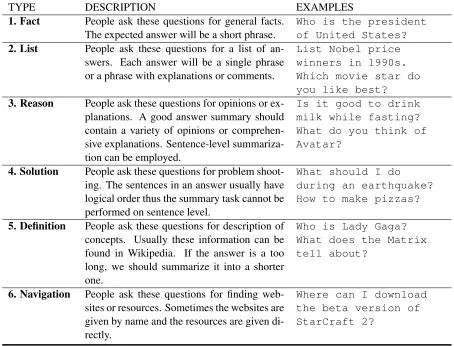
ei-TYPE DESCRIPTION EXAMPLES 1. Fact People ask these questions for general facts.
The expected answer will be a short phrase.
Who is the president of United States? 2. List People ask these questions for a list of
an-swers. Each answer will be a single phrase or a phrase with explanations or comments.
List Nobel price winners in 1990s. Which movie star do you like best? 3. Reason People ask these questions for opinions or
ex-planations. A good answer summary should contain a variety of opinions or comprehen-sive explanations. Sentence-level summariza-tion can be employed.
Is it good to drink milk while fasting? What do you think of Avatar?
4. Solution People ask these questions for problem shoot-ing. The sentences in an answer usually have logical order thus the summary task cannot be performed on sentence level.
What should I do during an earthquake? How to make pizzas?
5. Definition People ask these questions for description of concepts. Usually these information can be found in Wikipedia. If the answer is a too long, we should summarize it into a shorter one.
Who is Lady Gaga? What does the Matrix tell about?
6. Navigation People ask these questions for finding web-sites or resources. Sometimes the webweb-sites are given by name and the resources are given di-rectly.
[image:3.612.79.533.59.405.2]Where can I download the beta version of StarCraft 2?
Table 1: Question Taxonomy for general QA
ther generatively (Richardson and Domingos, 2006) or discriminatively (Singla and Domingos, 2005). Huynh and Mooney (2008) applies 𝐿1-norm regu-larized MLE to select candidate formulas generated by a first-order logic induction system and prevent overfitting. MLN has been introduced to NLP and IE tasks such as semantic parsing (Poon et al., 2009) and entity relation extraction (Zhu et al., 2009).
3 A Question Taxonomy
We suggest a function-based taxonomy tailored to general QA systems by two principles. First, ques-tions can be distributed into suitable QA subsys-tems according to their types. Second, we can employ suitable answer summarization strategy for each question type. The taxonomy is shown in Tab. 1.
At first glance, classifying questions onto this tax-onomy seems a solved problem for English
ques-tions because of interrogative words. In most cases, a question starting with “Why” is for reason and “How” is for solution. But it is not always the case for other languages. From table 2 we can see two questions in Chinese share same function word “怎
么样” but have different types.
In fact, even in English, only using interroga-tive words is not enough for function-based ques-tion classificaques-tion. Sometimes the quesques-tion content is crucial. For example, for question “Who is the current president of U.S. ?”, the answer is “Barak Obama” and the type isFact. But for question “Who is Barak Obama?”, it will be better if we return the first paragraph from the corresponding Wiki article instead of a short phrase “current president of U.S.”. Therefore the question type will beDefinition.
Question 怎么样做宫保鸡丁? How to cook Kung Pao Chicken?
Type Solution
Question 大家觉得阿凡达怎么样?
What do you think of Avatar?
[image:4.612.81.292.55.139.2]Type Reason
Table 2: Two Chinese questions share same function words but have different types
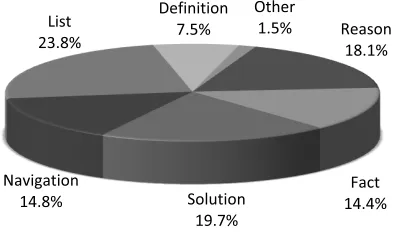
extraction and summarization. Compared to ours, The UIUC taxonomy is too much focused on factoid questions. Apart fromDescription, all coarse types in UIUC can be mapped into Fact. The cQA taxonomy proposed in Liu et al. (2008) has similar goal with ours. But it is hard to automatically classify questions into that taxonomy, especially for typesConstant,DynamicandSocial. Actually the author did not give implementation in the paper as well. To examine reasonableness of our taxonomy, we select and manually annotate 5800 frequent asked questions from Baidu Zhidao (see Section 5.1). The distribution of six types is shown in Fig. 1. 98.5 percent of questions can be categorized into our taxonomy. The proportion of each type is between 7.5% and 23.8%.
The type Navigationwas originally proposed in IR community and did not cause too much concerns in previous QA researches. But from Fig. 1 we can see that navigational questions take a substan-tial proportion in cQA data.
Moreover, we can further develop subtypes for each type. For example, most categories in UIUC
Reason 18.1%
Fact 14.4% Solution
19.7% Navigation
14.8% List 23.8%
Definition 7.5%
Other 1.5%
Figure 1: Distribution of six types in Baidu Zhidao data
taxonomy can be regarded as refinement toFactand Navigationcan be refined intoResourceand Web-site. We will not have further discussion on this is-sue.
4 Methodology
Many efforts have been made to take advantage of grammatical , semantic and lexical features in ques-tion classificaques-tion. Zhang and Lee (2003) proposed a SVM based system which used tree kernel to in-corporate syntactic features.
In this section, we propose a new question clas-sification methodology which combines rule-based methods and statistical methods by Markov logic network. We do not use semantic and syntactic fea-tures for two reasons. First, the questions posted on online communities are casually written which can-not be accurately parsed by NLP tools, especially for Chinese. Second, the semantic and syntactic pars-ing are time consumpars-ing thus unpractical to be used in real systems.
We will briefly introduce MLN and fuzzy dis-criminative learning in section 4.1. The construction of strict patterns and soft patterns will be shown in 4.2 and 4.3. In section 4.4 we will give details on MLN construction, inference and learning.
4.1 Markov Logic Network
A first-order knowledge base contains a set of for-mulas constructed from logic operators and symbols for predicates, constants, variables and functions. Anatomic formula oratom is a predicate symbol. Formulas are recursively constructed from atomic formulas using logical operators. The grounding
of a predicate (formula) is a replacement of all of its arguments (variables) by constants. Apossible worldis an assignment of truth values to all possible groundings of all predicates.
[image:4.612.88.286.548.665.2]follows:
Definition 1 (Richardson & Domingos 2004) A Markov logic network L is a set of pairs (𝐹𝑖, 𝑤𝑖), where𝐹𝑖is a formula in first-order logic and𝑤𝑖is a real number. Together with a finite set of constants C = {𝑐1, 𝑐2, ..., 𝑐∣𝐶∣}, it defines a Markov network 𝑀𝐿,𝐶 as follows:
1. 𝑀𝐿,𝐶 contains one binary node for each pos-sible grounding of each predicate appearing in L. The value of the node is 1 if the ground pred-icate is true, and 0 otherwise.
2. 𝑀𝐿,𝐶 contains one feature for each possible grounding of each formula𝐹𝑖 in L. The value of this feature is 1 if the ground formula is true, and 0 otherwise. The weight of the feature is the𝑤𝑖associated with𝐹𝑖 in L.
There is an edge between two nodes of𝑀𝐿,𝐶 iff the corresponding grounding predicates appear to-gether in at least one grounding of one formula in
𝐿. An MLN can be regarded as a template for con-structing Markov networks. From Definition 1 and the definition of Markov networks, the probability distribution over possible worlds𝑥 specified by the ground Markov network𝑀𝐿,𝐶 is given by
𝑃(𝑋 =𝑥) = 𝑍1 exp
( 𝐹
∑
𝑖=1
𝑤𝑖𝑛𝑖(𝑥)
)
MLN weights can be learnt genera-tively(Richardson and Domingos, 2006) or discriminatively(Singla and Domingos, 2005). In discriminative weight learning, ground atom set 𝐴 is partitioned into a set of evidence atoms 𝑋 and a set of query atoms 𝑌. The goal is to correctly predict the latter given the former. In this paper, we propose fuzzy discriminative weight learning which can take the prior confidence of each evidence atom into account.
Formally, we denote the ground formula set by
𝐹. Suppose each evidence atom𝑥 is given with a prior confidence𝑐𝑥 ∈[0,1], we define a confidence function𝜙:𝐹 →[0,1]as follows. For each ground atom 𝑎, if 𝑎 ∈ 𝑋 then we have 𝜙(𝑎) = 𝑐𝑎, else
𝜙(𝑎) = 1. For each ground non-atomic formulas,𝜙 is defined on standard fuzzy operators, which are
𝜙(¬𝑓) = 1−𝜙(𝑓)
𝜙(𝑓1∧𝑓2) = min(𝜙(𝑓1), 𝜙(𝑓2))
𝜙(𝑓1∨𝑓2) = max(𝜙(𝑓1), 𝜙(𝑓2))
We redefined the conditional likelihood of 𝑌 given𝑋as
𝑃(𝑦∣𝑥) = 𝑍1
𝑥 exp
⎛
⎝ ∑
𝑗∈𝐺𝑌
𝑤𝑗𝜙𝑗(𝑥, 𝑦)
⎞ ⎠
= 𝑍1
𝑥 exp
⎛
⎝∑
𝑖∈𝐹𝑌
𝑤𝑖𝑛′𝑖(𝑥, 𝑦)
⎞ ⎠
Where𝐺𝑌 is the set of ground formulas involving query atoms,𝐹𝑌 is the set of formulas with at least one grounding involving a query atom and𝑛′𝑖(𝑥, 𝑦) is the sum of confidence of the groundings of thei th formula involving query atoms. The gradient of the conditional log-likelihood (CLL) is
∂
∂𝑤𝑖 log𝑃𝑤(𝑦∣𝑥)
= 𝑛′
𝑖(𝑥, 𝑦)−
∑
𝑦′
𝑃𝑤(𝑦′∣𝑥)𝑛′𝑖(𝑥, 𝑦′)
= 𝑛′
𝑖(𝑥, 𝑦)−𝐸𝑤[𝑛′𝑖(𝑥, 𝑦)] (1)
By fuzzy discriminative learning we can incorpo-rate evidences of different confidence levels into one learning framework. Fuzzy discriminative learn-ing will reduce to traditional discriminative learnlearn-ing when all prior confidences equal to 1.
4.2 Strict Patterns
In our question classification task, we find function words are much more discriminative and less sparse than content words. Therefore, we extract strict pat-terns from function words and soft patpat-terns from content words. The definition of content and func-tion words may vary with languages. In this paper, nouns, verbs, adjectives, adverbs, numerals and pro-nouns are regarded as content words and the rest are function words.
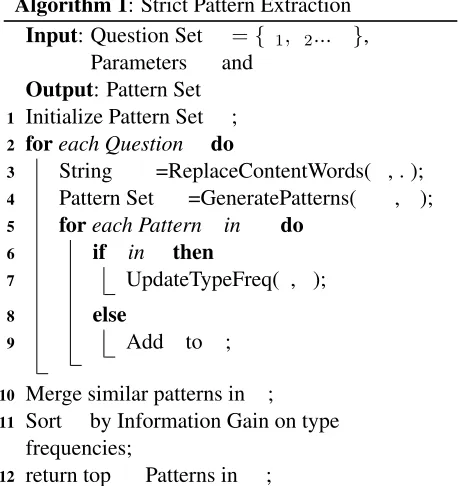
Algorithm 1: Strict Pattern Extraction Input: Question Set𝑄={𝑞1, 𝑞2...𝑞𝑛},
Parameters𝑀 and𝑁 Output: Pattern Set𝑃 Initialize Pattern Set𝑃;
1
foreach Question𝑞𝑖do
2
String𝑡𝑚𝑝=ReplaceContentWords(𝑞𝑖,′.′);
3
Pattern Set𝑃𝑞𝑖=GeneratePatterns(𝑡𝑚𝑝,𝑁);
4
foreach Pattern𝑝in𝑃𝑞𝑖do
5
if𝑝in𝑃 then
6
UpdateTypeFreq(𝑝,𝑃);
7
else
8
Add𝑝to𝑃;
9
Merge similar patterns in𝑃;
10
Sort𝑃by Information Gain on type
11
frequencies;
return top𝑀 Patterns in𝑃 ;
12
𝑡𝑚𝑝during which each dot is treated as a character of zero length. For coverage concern, if a gener-ated n-gram 𝑔 is not start(end) with dot, we build another n-gram𝑔′by adding a dot before(behind)𝑔 and add both𝑔and𝑔′into n-gram set. Then for each n-gram, we replace each consecutive dot sequence by ’.*’ and the n-gram is transformed into a regular expression. A example is shown in Tab. 3. Although generated without exhaustively enumerating all pos-sible word combinations, these regular expressions can capture most long range dependencies between function words.
Each pattern consists of a regular expression as well as its frequency in each type of questions. Still
Question 在网上可以开通网银吗?
Can I launch online banking services on internet?
Template 在..可以....吗
Patterns .*以.*吗 .*以.*吗.* (𝑁=4) .*可以.* .*可以.*吗
.*可以.*吗.* .*在.*可以.* .*在.*可以.*吗.* 在.*可.*
[image:6.612.70.299.63.306.2]在.*可以.* 在.*可以.*吗 .*在.*可.*
Table 3: Strict patterns generated from a question
from Alg. 1, in line 5-9, if a pattern𝑝in question𝑞𝑖 with type 𝑡 is found in 𝑃, we just update the fre-quency of 𝑡 in 𝑝, else 𝑝 is added to 𝑃 with only freq. 𝑡 equals to 1. In line 10, we merge similar patterns in𝑃. two patterns𝑝1 and𝑝2 are similar iff
∀q∈QmatchP(q,p1)⇔matchP(q,p2), in which matchPis defined in Section 4.4.
Since a large number of patterns are generated, it is unpractical to evaluate all of them by Markov logic network. We sort patterns by information gain and only choose top𝑀“good” patterns in line 11-12 of Alg. 1. A “good” pattern should be discriminative and of wide coverage. The information gain IG of a pattern𝑝is defined as
IG(𝑝) =𝑃(𝑝)
𝑚
∑
𝑖=1
𝑃(𝑡𝑖∣𝑝) log𝑃(𝑡𝑖∣𝑝)+
𝑃(𝑝)∑𝑚
𝑖=1
𝑃(𝑡𝑖∣𝑝) log𝑃(𝑡𝑖∣𝑝)− 𝑚
∑
𝑖=1
𝑃(𝑡𝑖) log𝑃(𝑡𝑖)
in which𝑚is the number of question types,𝑃(𝑡𝑖)is the probability of a question having type𝑡𝑖,𝑃(𝑝)(or
𝑃(𝑝)) is the probability of a question matching(or not matching) pattern 𝑝. 𝑃(𝑡𝑖∣𝑝)(or 𝑃(𝑡𝑖∣𝑝)) is the probability of a question having type 𝑡𝑖 given the condition that the question matches(or does not match) pattern𝑝. These probabilities can be approx-imately calculated by type and pattern frequencies on training data. From the definition we can see that information gain is suitable for pattern selec-tion. The more questions a pattern 𝑝 matches and the more unevenly the matched questions distribute among questions types, the higher IG(𝑝)will be.
4.3 Soft Patterns
Apart from function words, content words are also important in function-based question classification. Content words usually contain topic information which can be a good complement to function words. Previous research on query classification(Jansen and Booth, 2010) shows that user intents distribute un-evenly among topics. Moreover, questions given by users may be incomplete and contain not function words. For these questions, we can only predict the question types from topic information.
When we represent topic information by content words (or bi-grams), since the training set are small and less frequent words (or bi-grams) are filtered to prevent over-fitting, those features would be too sparse to predict further unseen questions.
To solve this problem, we build soft patterns on question set. Each question is represented by a weighted vector of content bi-grams in which the weight is bi-gram frequency. Cosine similarity is used to compute the similarity between vectors. Then we cluster question vectors using a simple single-pass clustering algorithm(Frakes and Yates, 1992). That is, for each question, we compute its similarity with each centroid of existing cluster. If the similarity with nearest cluster is greater than a minimum similarity threshold 𝜏1, we assign this question to that cluster, else a new cluster is created for this question.
Each cluster is defined as a soft pattern. Unlike strict patterns, a question can match a soft pattern to some extent. In this paper, the degree of match-ing is defined as the cosine similarity between ques-tion and centroid of cluster. Soft patterns are flexible and could alleviate the sparseness of content words. Also, soft patterns can be pre-filtered by information gain described in 4.2 if necessary.
4.4 Implementation
Currently, we model patterns into MLN as follows. The main query predicate is Type(q,t), which is true iff question q has type t. For strict pat-terns, the evidence predicateMatchP(q,p)is true iff questionq is matched by strict pattern p. The confidence ofMatchP(q,p)is 1 for each pair of (q,p). For soft patterns, the evidence predicate MatchC(q,c)is true iff the similarity of question qand the clustercis greater than a minimum simi-larity requirement𝜏2. IfMatchC(q,c)is false, its confidence is 1, else is the similarity betweenqand c.
We represent the relationship between patterns and types by a group of formulas below.
MatchP(q,+p)∧Type(q,+t) ∧
𝑡′∕=𝑡¬Type(q,t’)
The “+p, +t” notation signifies that the MLN con-tains an instance of this formula for each (pattern,
type) pair. For the sake of efficacy, for each
pattern-type pair (p,t), if the proportion of typetin ques-tions matching p is less than a minimum require-ment 𝜃, we remove corresponding formula from MLN.
Similarly, we incorporate soft patterns by
MatchC(q,+c)∧Type(q,+t) ∧
𝑡′∕=𝑡¬Type(q,t’)
Our weight learner use 𝑙1-regularization (Huynh and Mooney, 2008) to select formulas and prevent overfitting. A good property of𝑙1-regularization is its tendency to force parameters to exact zero by strongly penalizing small terms (Lee et al., 2006). After training, we can simply remove the formulas with zero weights.
Formally, to learn weight for each formula, we iteratively solve 𝑙1-norm regularized optimization problem:
𝑃 :𝑤∗= arg max
𝑤 log𝑃𝑤(𝑦∣𝑥)−𝜆∥𝑤∥1
where∥.∥1 is𝑙1-norm and parameter𝜆controls the penalization of non-zero weights. We implement the Orthant-Wise Limited-memory Quasi-Newton algo-rithm(Andrew and Gao, 2007) to solve this opti-mization.
Since we do not model relations among questions, the derived markov network𝑀𝐿,𝐶 can be broken up into separated subgraphs by questions and the gradi-ent of CLL(Eq. 1) can be computed locally on each subgraph as
∂
∂𝑤𝑖 log𝑃𝑤(𝑦∣𝑥)
= ∑
𝑞
(
𝑛′𝑖(𝑥𝑞, 𝑦𝑞)−𝐸𝑤[𝑛′𝑖(𝑥𝑞, 𝑦𝑞)]) (2)
in which𝑥𝑞and𝑦𝑞are the evidence and query atoms involving question𝑞. Eq. 2 can be computed fast without approximation.
We initialize formula weights to the same posi-tive value 𝑤. Iteration started from uniform prior can always converge to a better local maximum than gaussian prior in our task.
5 Experiments 5.1 Data Preparation
all kinds of questions utilizing data from heteroge-neous sources) released at present. Alteratively, we test our methodology on cQA data based on obser-vation that questions on cQA services are of var-ious length, domain independent and wrote infor-mally(even with grammar mistakes). General QA systems will meet these challenges as well.
In our experiments, both training and test data are from Chinese cQA services Baidu Zhidao and Sina iAsk. To build training set, we randomly select 5800 frequent-asked questions from Baidu Zhidao. A question is frequent-asked if it is lexically simi-lar to at least five other questions. Then we ask 10 native-speakers to annotate these questions accord-ing to question title and question description. If an annotator cannot judge type from question title, he can view the question description. If type can be judged from the description, the question title will be replaced by a sentence selected from it. If not, this question will be labeled asOther.
Each question is annotated by two people. If a question is labeled different types, another annotator will judge it and make final decision. If this annota-tor cannot judge the type, this question will also be labeled asOther. As a result, disagreements show up on eighteen percents of questions. After the third annotator’s judgment, the distribution of each type is shown in Fig. 1.
To examine the generalization capabilities, the test data is composed of 700 questions randomly se-lected from Baidu Zhidao and 700 questions from Sina iAsk. The annotation process on test data is as same as the one on training data.
5.2 Methods Compared and Results
We compare four methods listed as follows.
SVM with bi-grams. We extract bi-grams from questions on training data as features. After filtering the ones appearing only once, we collect 5700 bi-grams. LIBSVM(Chang and Lin, 2001)is used as the multi-class SVM classifier. All parameters are adjusted to maximize the accuracy on test data. We denote this method as “SB”;
MLN with bi-grams. To compare MLN and SVM, we treat bi-grams as strict patterns. If a ques-tion contain a bi-gram, it matches the corresponding pattern. We set𝑤 = 0.01, 𝜃 = 0.3and𝜆 = 0.3. As a result, 5700 bi-grams are represented by 10485
formulas. We denote this method as “MB”;
MLN with strict patterns and bi-grams.We ask two native-speakers to write strict patterns for each type. The pattern writers can view training data for reference and write any Java-style regular expres-sions. Then we carefully choose 50 most reliable patterns. To overcome the low coverage, We also use the method described in Sec. 4.2 to automati-cally extract strict patterns from training set. We first select top 3000 patterns by information gain, merge these patterns with hand-crafted ones and combine similar patterns. Then we represent these patterns by formulas and learn the weight of each formula by MLN. After removing the formula with low weights, we finally retain 2462 patterns represented by 3879 formulas. To incorporate content information, we extract bi-grams from questions with function words removed and remove the ones with frequency lower than two. With bi-grams added, we get 8173 formu-las in total. All parameters here are the same as in “MB”. We denote this method as “MSB”;
MLN with strict patterns and soft patterns.To incorporate content information, We cluster ques-tions on training data with similarity threshold𝜏1 = 0.4 and get 2588 clusters(soft patterns) which are represented by 3491 formulas. We these soft pat-terns with strict patpat-terns extracted in “MSB”, which add up to 7370 formulas. We set𝜏2 = 0.02and the other parameters as same as in “MB”. We denote this method as “MSS”;
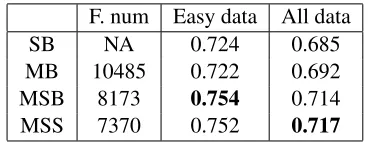
We separate test set into easy set and difficult set. A question is classified into easy set iff it contains function-words. As a result, the easy set contains 1253 questions. We measure the accuracy of these four methods on easy data and the whole test data. The results are shown in Tab 4. From the results we can see that all methods perform better on easy ques-tions and MLN outperforms SVM using same bi-gram features. AlthoughMSSis inferior toMSBon
F. num Easy data All data
SB NA 0.724 0.685
MB 10485 0.722 0.692
MSB 8173 0.754 0.714
[image:8.612.334.519.613.684.2]MSS 7370 0.752 0.717
F L S R D N Prec. 0.63 0.65 0.83 0.76 0.69 0.55 Recall 0.55 0.74 0.86 0.76 0.44 0.58 F1 0.59 0.69 0.84 0.76 0.54 0.56
Table 5: Precision, recall and F-score on each type
easy questions, it shows better overall performance and uses less formulas.
We further investigate the performance on each type. The precision, recall andF1-score of each type by methodMSSare shown in Tab. 5. From the re-sults we can see that the performance on Solution andReasonare significantly better than the others. It is because the strict patterns for this two types are simple and effective. A handful of patterns could cover a wide range of questions with high precision. It is difficult to distinguishFactfromListbecause strict patterns for these two types are partly overlap each other. Sometimes we need content information to determine whether the answer is unique. Since Listappears more frequently thanFact on training set, MLN tend to misclassifyFacttoListwhich lead to low recall of the former and low precision of the latter. The recall ofDefinitionis very low because many definition questions on test set are short and only consists of content words(e.g. a noun phrase). This shortage could be remedied by building strict patterns on POStagging sequence.
fraction lines, college entrance exam
分数,数线,高考,考分,录取,...
Fact: 56.4% List: 33.3% Solu.: 5.5% lose weight, summer, fast
减肥,夏天,快速,速减,方法,...
Reas.: 53.8% Solu.: 42.3% List: 3.8% TV series, interesting, recent
电视,视剧,好看,最近,最新,...
List: 84.0% Fact: 8.0% Navi.: 2.0% converter, format, 3gp
转换,换器,3gp,mp4,格式,...
Navi.: 75% List: 18.8% Solu.: 6.2%
Table 6: Selected soft patterns on training data
5.3 Case Study on Soft Patterns
To give an intuitive illustration of soft patterns, we show some of them clustered on training data in Tab. 6. For each soft pattern, we list five most frequent bi-grams and its distribution on each type(only top 3 frequent types are listed).
From the results we can see that soft patterns are consistent with our ordinary intuitions. For exam-ple, if user ask a questions about “TV series”, he is likely to ask for recommendation of recent TV series and the question have a great chance to beList. If user ask questions about “lose weight”, he probably ask something like “How can I lose weight fast?” or “Why my diet does not work?” . Thus the type is likely to beSolutionorReason.
6 Conclusion and Future Work
We have proposed a new question taxonomy tai-lored to general QA on heterogeneous sources. This taxonomy provide indispensable information for question distribution and answer summarization. We build strict patterns and soft patterns to repre-sent the information in function words and content words. Also, fuzzy discriminative weight learning is proposed for unifying strict and soft patterns into Markov logic network.
Currently, we have not done anything fancy on the structure of MLN. We just showed that under uni-form prior and L1 regularization, the peruni-formance of MLN is comparable to SVM. To give full play to the advantages of MLN, future work will focus on fast structure learning. Also, since questions on online communities are classified into categories by topic, we plan to perform joint question type infer-ence on function-based taxonomy as well as topic-based taxonomy by Markov logic. The model will not only capture the relation between patterns and types but also the relation between types in different taxonomy.
Acknowledgment
[image:9.612.82.291.515.682.2]References
G. Andrew and J. Gao. 2008. Scalable training of
L1-regularized log-linear models. In Proc. of ICML 2007,
pp. 33-40.
A. Broder. 2002. A taxonomy of Web search. SIGIR Forum, 36(2), 2002.
C.C. Chang and C.J. Lin. 2001. LIBSVM: a library
for support vector machines. Software available at
http://www.csie.ntu.edu.tw/ cjlin/libsvm.
W.B. Frakes and R. Baeza-Yates, editors. 1992.
In-formation Retrieval: Data Structures and Algorithms.
Prentice-Hall, 1992.
A.C. Graesser, N.K. Person and J.D. Huber. 1992.
Mech-anisms that generate questions. Questions and
Infor-mation Systems, pp. 167-187), Hillsdale, N.J.: Erl-baum.
T.N. Huynh and R.J. Mooney. 2008. Discriminative Structure and Parameter Learning for Markov Logic
Networks. In Proc. of ICML 2008, pp. 416-423.
B.J. Jansen and D. Booth. 2010. Classifying web queries
by topic and user intent. In Proc. of the 28th
interna-tional conference on human factors in computing sys-tems, pp. 4285-4290.
J. Jeon, W.B. Croft and J.H. Lee. 2005. Finding similar
questions in large question and answer archives. In
Proc. of ACM CIKM 2005,pp. 76-83.
S. Lee, V. Ganapathi and D. Koller. 2005.
Effi-cient structure learning of Markov networks using𝐿1
-regularization.. Advances in Neural Information
Pro-cessing Systems 18.
U. Lee, Z. Liu and J. Cho. 2005.Automatic identification
of user goals in Web search. In Proc. of WWW 2005.
W. Lehnert. 1977. Human and computational question
answering. Cognitive Science, vol. 1, 1977, pp. 47-63.
X. Li and D. Roth. 2002. Learning question classifiers. In Proc. of COLING 2002, pp. 556-562.
X. Li and D. Roth. 2004. Learning question classifiers:
the role of semantic information. Natural Language
Engineering.
Y. Liu, S. Li, Y. Cao, C.Y. Lin, D. Han and Y. Yu. 2008. Understanding and summarizing answers in
community-based question answering services. In
Proc. of COLING 2008.
A. Moschitti, S. Quarteroni, R. Basili and S. Manand-har. 2007. Exploiting Syntactic and Shallow Semantic
Kernels for Question/Answer Classification. In Proc.
of ACL 2007.
M.L. Nguyen, T.T. Nguyen and A. Shimazu. 2007.
Sub-tree Mining for Question Classification Problem. In
Proc. of IJCAI 2007.
H. Poon and P. Domingos. 2009.Unsupervised semantic
parsing. In Proc. of EMNLP 2009, pp. 1-10
D.E. Rose and D. Levinson. 2004. Understanding user
goals in web search. In Proc. of WWW 2004.
M. Richardson and P. Domingos. 2006. Markov logic
networks. Machine Learning 62:107-136.
P. Singla and P. Domingos. 2005. Discriminative
Train-ing of Markov Logic Networks. In Proc. of AAAI
2005.
S. Ye, T.S. Chua and J. Lu. 2009. Summarizing
Defini-tion from Wikipedia. In Proc. of ACL 2009.
D. Zhang and W.S. Lee. 2003. Question classification
using support vector machines. In Proc. of ACM
SI-GIR 2003, pp. 26-32.
J. Zhu , Z. Nie, X. Liu, B. Zhang and J.R. Wen. 2009.
StatSnowball: a Statistical Approach to Extracting
En-tity Relationships. In Proc. of WWW 2009, pp.