ETS: An Error Tolerable System for Coreference Resolution
Hao Xiong , Linfeng Song , Fandong Meng , Yang Liu , Qun Liu and Yajuan L ¨u Key Lab. of Intelligent Information Processing
Institute of Computing Technology Chinese Academy of Sciences P.O. Box 2704, Beijing 100190, China
{xionghao,songlinfeng,mengfandong,yliu,liuqun,lvyajuan}@ict.ac.cn
Abstract
This paper presents our error tolerable sys-tem for coreference resolution in CoNLL-2011(Pradhan et al., 2011) shared task (closed track). Different from most previous reported work, we detect mention candidates based on packed forest instead of single parse tree, and we use beam search algorithm based on the Bell Tree to create entities. Experimental re-sults show that our methods achieve promising results on the development set.
1 Introduction
Over last decades, there has been increasing inter-est on coreference resolution within NLP commu-nity. The task of coreference resolution is to iden-tify expressions in a text that refer to the same dis-course entity. This year, CoNLL1 holds a shared task aiming to model unrestricted coreference in OntoNotes.2 The OntoNotes project has created a large-scale, accurate corpus for general anaphoric coreference that covers entities and events not lim-ited to noun phrases or a limlim-ited set of entity types. And Pradhan et al. (2007) have ever used this corpus for similar unrestricted coreference task.
Our approach to this year’s task could be divided into two steps: mention identification and creation of entities. The first stage is conducted on the anal-ysis of parse trees produced by input data. The of-ficial data have provided gold and automatic parse trees for each sentences in training and development
1http://conll.bbn.com/ 2
http://www.bbn.com/ontonotes/
set. However, according to statistics, almost 3% mentions have no corresponding constituents in au-tomatic parse trees. Since only auau-tomatic parse trees will be provided in the final test set, the effect of parsing errors are inevitable. To alleviate this issue, based on given automatic parse trees, we modify a state-of-the-art parser (Charniak and Johnson, 2005) to generate packed forest, and determine mention candidates among all constituents from both given parse tree and packed forest. The packed forest is a compact representation of all parse trees for a given sentence. Readers can refer to (Mi et al., 2008) for detailed definitions.
Once the mentions are identified, the left step is to group mentions referring to same object into sim-ilar entity. This problem can be viewed as binary classification problem of determining whether each mention pairs corefer. We use a Maximum Entropy classifier to predict the possibility that two mentions refer to the similar entity. And mainly following the work of Luo et al. (2004), we use a beam search algorithm based on Bell Tree to obtain the global optimal classification.
As this is the first time we participate competi-tion of coreference resolucompeti-tion, we mainly concen-trate on developing fault tolerant capability of our system while omitting feature engineering and other helpful technologies.
2 Mention Detection
The first step of the coreference resolution tries to recognize occurrences of mentions in documents. Note that we recognize mention boundaries only on development and test set while generating training
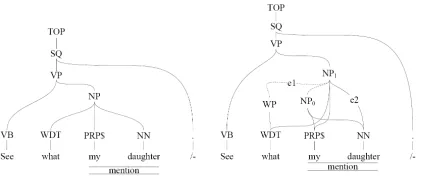
Figure 1: Left side is parse tree extracted from develop-ment set, and right side is a forest. “my daughter” is a mention in this discourse, however it has no correspond-ing constituent in parse tree, but it has a correspondcorrespond-ing constituentN P0in forest.
instances using gold boundaries provided by official data.
The first stage of our system consists of following three successive steps:
• Extracting constituents annotated with NP, NNP,PRP,PRP$ andVBDPOS tagsfrom sin-gle parse tree.
• Extracting constituents with the same tags as the last step from packed forest.
• Extracting Named Entity recognized by given data.
It is worth mentioning that above three steps will produce duplicated mentions, we hence collect all mentions into a list and discard duplicated candi-dates. The contribution of using packed forest is that it extends the searching space of mention candidates. Figure 1 presents an example to explain the advan-tage of employing packed forest to enhance the men-tion detecmen-tion process. The left side of Figure 1 is the automatic parse tree extracted from development set, in which mention “my daughter” has no corre-sponding constituent in its parse tree. Under nor-mal strategy, such mention will not be recognized and be absent in the clustering stage. However, we find that mention has its constituentN P0 in packed
forest. According to statistics, when using packed forest, only 0.5% mentions could not be recognized while the traditional method is 3%, that means the theoretical upper bound of our system reaches 99% compared to baseline’s 97%.
Since the requirement of this year’s task is to model unrestricted coreference, intuitively, we
should not constraint in recognizing only noun phrases but also adjective phrase, verb and so on. However, we find that most mentions appeared in corpus are noun phrases, and our experimental re-sults indicate that considering constituents annotated with above proposed POS tags achieve the best per-formance.
3 Determining Coreference
This stage is to determine which mentions belong to the same entity. We train a Maximum Entropy clas-sifier (Le, 2004) to decide whether two mentions are coreferent. We use the method proposed by Soon, et al.’s to generate the training instances, where a posi-tive instance is formed between current mentionMj and its closest preceding antecedentMi, and a neg-ative instance is created by paringMj with each of the intervening mentions,Mi+1,Mi+2,...,Mj−1.
We use the following features to train our classi-fier.
Features in Soon et al.’s work (Soon et al., 2001) Lexical features
IS PREFIX: whether the string of one mention is prefix of the other;
IS SUFFIX: whether the string of one mention is suffix of the other;
ACRONYM: whether one mention is the acronym of the other;
Distance features
SENT DIST: distance between the sentences con-taining the two mentions;
MEN DIST: number of mentions between two mentions;
Grammatical features
IJ PRONOUN: whether both mentions are pro-noun;
I NESTED: whether mention i is nested in an-other mention;
J NESTED: whether mention j is nested in an-other mention;
Syntax features
HEAD: whether the heads of two mentions have the same string;
HEAD POS: whether the heads of two mentions have the same POS;
Semantic features
WNDIST: distance between two mentions in WordNet;
I ARG0: whether mentionihas the semantic role of Arg0;
J ARG0: whether mentionjhas the semantic role of Arg0;
IJ ARGS: whether two mentions have the seman-tic roles for similar predicate;
In the submitted results, we use the L-BFGS pa-rameter estimation algorithm with gaussian prior smoothing (Chen and Rosenfeld, 1999). We set the gaussian prior to 2 and train the model in 100 itera-tions.
3.1 Creation of Entities
This stage aims to create the mentions detected in the first stage into entities, according to the predic-tion of classifier. One simple method is to use a greedy algorithm, by comparing each mention to its previous mentions and refer to the one that has the highest probability. In principle, this algorithm is too greedy and sometimes results in unreasonable partition (Ng, 2010). To address this problem, we follow the literature (Luo et al., 2004) and propose to use beam search to find global optimal partition.
Intuitively, creation of entities can be casted as partition problem. And the number of partitions equals the Bell Number (Bell, 1934), which has a “closed” formulaB(n) = 1e∑∞k=0kkn!. Clearly, this number is very huge whennis large, enumeration of all partitions is impossible, so we instead designing a beam search algorithm to find the best partition.
Formally, the task is to optimize the following ob-jective,
ˆ
y= arg max
ϕ∈P
∑
e∈ϕ
P rob(e) (1)
whereP is all partitions, P rob(e) is the cost of entitye. And we can use the following formula to calculate theP rob(e),
P rob(e) = ∑
i∈e,j∈e
pos(mi, mj)
+ ∑
i∈e,j /∈e
neg(mi, mj)
(2)
where pos(mi, mj) is the score predicted by clas-sifier that the possibility two mentionsmi and mj group into one entity, andneg(mi, mj)is the score that two mentions are not coreferent.
Theoretically, we can design a dynamic algorithm to obtain the best partition schema. Providing there are four mentions from A to D, and we have ob-tained the partitions of A, B and C. To incorporate D, we should consider assigning D to each entity of every partition, and generate the partitions of four mentions. For detailed explanation, the partitions of three mentions are [A][B][C], [AB][C], [A][BC] and [ABC], when considering the forth mention D, we generate the following partitions:
• [A][B][C][D], [AD][B][C], [A][BD][C], [A][B][CD]
• [AB][C][D], [ABD][C],[AB][CD]
• [A][BC][D], [AD][BC], [A][BCD]
• [ABC][D], [ABCD]
The score of partition [AD][B][C] can be calculated by score([A][B][C]) + pos(A, D) + neg(B, D) +neg(C, D). Since we can computer
pos and neg score between any two mentions in advance, this problem can be efficiently solved by dynamic algorithm. However, in practice, enumer-ating the whole partitions is intractable, we instead exploiting a beam with sizekto store the topk parti-tions of current mention size, according to the score the partition obtain. Due to the scope limitation, we omit the detailed algorithm, readers can refer to Luo et al. (2004) for detailed description, since our ap-proach is almost similar to theirs.
4 Experiments
4.1 Data Preparation
Mention MUC BCUBED CEAFM CEAFE BLANC baseline 58.97% 44.17% 63.24% 45.08% 37.13% 62.44% baseline gold 59.18% 44.48% 63.46% 45.37% 37.47% 62.36% sys forest 59.07% 44.4% 63.39% 45.29% 37.41% 62.41% sys btree 59.44% 44.66% 63.77% 45.62% 37.82% 62.47% sys forest btree 59.71% 44.97% 63.95% 45.91% 37.96% 62.52%
Table 1: Experimental results on development set (F score).
Mention MUC BCUBED CEAFM CEAFE BLANC
sys1 54.5% 39.15% 63.91% 45.32% 37.16% 63.18%
sys2 53.06% 35.55% 59.68% 38.24% 32.03% 50.13%
Table 2: Experimental results on development set with different training division (F score).
take it as our training corpus. We use the sup-plied score toolkit3 to compute MUC, BCUBED, CEAFM, CEAFE and BLANC metrics.
4.2 Experimental Results
We first implement a baseline system (baseline) that use single parse tree for mention detection and greedy algorithm for creation of entities. We also run the baseline system using gold parse tree, namelybaseline gold. To investigate the contribu-tion of packed forest, we design a reinforced sys-tem, namelysys forest. And another system, named assys btree, is used to see the contribution of beam search with beam size k=10. Lastly, we combine two technologies and obtain systemsys forest btree. Table 1 shows the experimental results on devel-opment data. We find that the system using beam search achieve promising improvement over base-line. The reason for that has been discussed in last section. We also find that compared to baseline, sys forestandbaseline gold both achieve improve-ment in term of some metrics. And we are glad to find that using forest, the performance of our sys-tem is approaching the syssys-tem based on gold parse tree. But even using the gold parse tree, the im-provement is slight. 4 One reason is that we used some lexical and grammar features which are
dom-3
http://conll.bbn.com/download/scorer.v4.tar.gz
4Since under task requirement, singleton mentions are
fil-tered out, it is hard to recognize the contribution of packed for-est to mention detection, while we may incorrectly resolve some mentions into singletons that affects the score of mention detec-tion.
inant during prediction, and another explanation is that packed forest enlarges the size of mentions but brings difficulty to resolve them.
To investigate the effect of different genres to de-velop set, we also perform following compared ex-periments:
• sys1: all training corpus + WSJ development corpus
• sys2:WSJ training corpus + WSJ development corpus
Table 2 indicates that knowledge from other genres can help coreference resolution. Perhaps the reason is the same as last experiments, where syntax diver-sity affects the task not very seriously.
5 Conclusion
In this paper, we describe our system for CoNLL-2011 shared task. We propose to use packed for-est and beam search to improve the performance of coreference resolution. Multiple experiments prove that such improvements do help the task.
6 Acknowledgement
References
E.T. Bell. 1934. Exponential numbers. The American Mathematical Monthly, 41(7):411–419.
E. Charniak and M. Johnson. 2005. Coarse-to-fine n-best parsing and maxent discriminative reranking. In Proceedings of the 43rd Annual Meeting on Associ-ation for ComputAssoci-ational Linguistics, pages 173–180. Association for Computational Linguistics.
Stanley F. Chen and Ronald Rosenfeld. 1999. A gaussian prior for smoothing maximum entropy models. Tech-nical report, CMU-CS-99-108.
Liang Huang. 2008. Forest reranking: Discriminative parsing with non-local features. In Proceedings of ACL-08: HLT, pages 586–594, Columbus, Ohio, June. Z. Le. 2004. Maximum entropy modeling toolkit for
Python and C++.
X. Luo, A. Ittycheriah, H. Jing, N. Kambhatla, and S. Roukos. 2004. A mention-synchronous corefer-ence resolution algorithm based on the bell tree. In Proceedings of the 42nd Annual Meeting on Associa-tion for ComputaAssocia-tional Linguistics, pages 135–es. As-sociation for Computational Linguistics.
H. Mi, L. Huang, and Q. Liu. 2008. Forestbased transla-tion. InProceedings of ACL-08: HLT, pages 192–199. Citeseer.
Vincent Ng. 2010. Supervised noun phrase coreference research: The first fifteen years. InProceedings of the 48th Annual Meeting of the Association for Compu-tational Linguistics, pages 1396–1411, Uppsala, Swe-den, July. Association for Computational Linguistics. Sameer Pradhan, Lance Ramshaw, Ralph Weischedel,
Jessica MacBride, and Linnea Micciulla. 2007. Unre-stricted Coreference: Identifying Entities and Events in OntoNotes. Inin Proceedings of the IEEE Inter-national Conference on Semantic Computing (ICSC), September 17-19.
Sameer Pradhan, Lance Ramshaw, Mitchell Marcus, Martha Palmer, Ralph Weischedel, and Nianwen Xue. 2011. Conll-2011 shared task: Modeling unrestricted coreference in ontonotes. InProceedings of the Fif-teenth Conference on Computational Natural Lan-guage Learning (CoNLL 2011), Portland, Oregon, June.