Word Segmentation as General Chunking
Daniel Hewlett and Paul Cohen
Department of Computer Science University of Arizona
Tucson, AZ 85721
{dhewlett,cohen}@cs.arizona.edu
Abstract
During language acquisition, children learn to segment speech into phonemes, syllables, morphemes, and words. We examine word segmentation specifically, and explore the possibility that children might have general-purpose chunking mechanisms to perform word segmentation. The Voting Experts (VE) and Bootstrapped Voting Experts (BVE) algo-rithms serve as computational models of this chunking ability. VE finds chunks by search-ing for a particular information-theoretic sig-nature: low internal entropy and high bound-ary entropy. BVE adds to VE the abil-ity to incorporate information about word boundaries previously found by the algorithm into future segmentations. We evaluate the general chunking model on phonemically-encoded corpora of child-directed speech, and show that it is consistent with empirical results in the developmental literature. We argue that it offers a parsimonious alternative to special-purpose linguistic models.
1 Introduction
The ability to extract words from fluent speech ap-pears as early as the seventh month in human de-velopment (Jusczyk et al., 1999). Models of this ability have emerged from such diverse fields as lin-guistics, psychology and computer science. Many of these models make unrealistic assumptions about child language learning, or rely on supervision, or are specific to speech or language. Here we present an alternative: a general unsupervised model of chunking that performs very well on word segmen-tation tasks. We will examine the Voting Experts,
Bootstrapped Voting Experts, and Phoneme to Mor-pheme algorithms in Section 2. Each searches for a general, information-theoretic signature of chunks. Each can operate in either a fully unsupervised set-ting, where the input is a single continuous se-quence of phonemes, or a semi-supervised setting, where the input is a sequence of sentences. In Sec-tion 4, we evaluate these general chunking methods on phonetically-encoded corpora of child-directed speech, and compare them to a representative set of computational models of early word segmentation. Section 4.4 presents evidence that words optimize the information-theoretic signature of chunks. Sec-tion 5 discusses segmentaSec-tion methods in light of what is known about the segmentation abilities of children.
2 General Chunking
The Voting Experts algorithm (Cohen and Adams, 2001) defines thechunkoperationally as a sequence with the property that elements within the sequence predict one another but do not predict elements out-side the sequence. In information-theoretic terms, chunks have low entropy internally and high entropy at their boundaries. Voting Experts (VE) is a lo-cal, greedy algorithm that works by sliding a rel-atively small window along a relrel-atively long input sequence, calculating the internal and boundary en-tropies of sequences within the window.
The name Voting Experts refers to the two “ex-perts” that vote on possible boundary locations: One expert votes to place boundaries after se-quences that have low internal entropy (also called
surprisal), given by HI(seq) = −logP(seq). The other places votes after sequences that have
high branching entropy, given by HB(seq) =
−P
c∈SP(c|seq) logP(c|seq), where S is the set
of successors toseq. In a modified version of VE, a third expert “looks backward” and computes the branching entropy at locations before, rather than af-ter,seq.
The statistics required to calculateHIandHBare
stored efficiently using an n-gram trie, which is typ-ically constructed in a single pass over the corpus. The trie depth is 1 greater than the size of the slid-ing window. Importantly, all statistics in the trie are normalized so as to be expressed in standard devia-tion units. This allows statistics from sequences of different lengths to be compared.
The sliding window is then passed over the cor-pus, and each expert votes once per window for the boundary location that best matches that expert’s cri-teria. After voting is complete, the algorithm yields an array of vote counts, each element of which is the number of times some expert voted to segment at that location. The result of voting on the string
thisisacat could be represented in the follow-ing way, where the number between each letter is the number of votes that location received, as in
t0h0i1s3i1s4a4c1a0t.
With the final vote totals in place, the boundaries are placed at locations where the number of votes exceeds a chosen threshold. For further details of the Voting Experts algorithm see Cohen et al. (2007), and also Miller and Stoytchev (2008).
2.1 Generality of the Chunk Signature
The information-theoretic properties of chunks upon which VE depends are present in every non-random sequence, of which sequences of speech sounds are only one example. Cohen et al. (2007) explored word segmentation in a variety of languages, as well as segmenting sequences of robot actions. Hewlett and Cohen (2010) demonstrated high performance for a version of VE that segmented sequences of ut-terances between a human teacher and an AI stu-dent. Miller and Stoytchev (2008) applied VE in a kind of bootstrapping procedure to perform a vision task similar to OCR: first to chunk columns of pix-els into letters, then to chunk sequences of these dis-covered letters into words. Of particular relevance to the present discussion are the results of Miller et al. (2009), who showed that VE was able to segment a
continuous audio speech stream into phonemes. The input in that experiment was generated to mimic the input presented to infants by Saffran et al. (1996), and was discretized for VE with a Self-Organizing Map (Kohonen, 1988).
2.2 Similar Chunk Signatures
Harris (1955) noticed that if one proceeds incremen-tally through a sequence of letters and asks speakers of the language to list all the letters that could ap-pear next in the sequence (today called the succes-sor count), the points where the number increases
often correspond to morpheme boundaries. Tanaka-Ishii and Jin (2006) correctly recognized that this idea was an early version of branching entropy, one of the experts in VE, and they developed an algo-rithm called Phoneme to Morpheme (PtM) around it. PtM calculates branching entropy in both directions, but it does not use internal entropy, as VE does. It detects change-points in the absolute branching en-tropy rather than local maxima in the standardized entropy. PtM achieved scores similar to those of VE on word segmentation in phonetically-encoded En-glish and Chinese.
Within the morphology domain, Johnson and Martin’s HubMorph algorithm (2003) constructs a trie from a set of words, and then converts it into a DFA by the process of minimization. HubMorph searches forstretched hubsin this DFA, which are sequences of states in the DFA that have a low branching factor internally, and high branching fac-tor at the edges (shown in Figure 1). This is a nearly identical chunk signature to that of VE, only with successor/predecessor count approximating branch-ing entropy. The generality of this idea was not lost on Johnson and Martin, either: Speaking with re-spect to the morphology problem, Johnson and Mar-tin close by saying “We believe that hub-automata will be the basis of a general solution for Indo-European languages as well as for Inuktitut.”1
2.3 Chunking and Bootstrapping
Bootstrapped Voting Experts (BVE) is an exten-sion to VE that incorporates knowledge gained from prior segmentation attempts when segmenting new input, a process known as bootstrapping. This
1
Figure 1: The DFA signature of ahub(top) andstretched hub in the HubMorph algorithm. Figure from Johnson and Martin (2003).
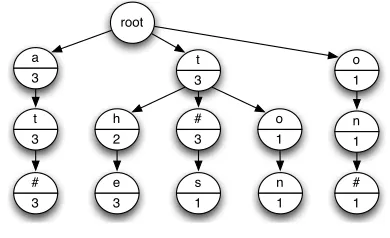
knowledge does not consist in the memorization of whole words (chunks), but rather in statistics de-scribing the beginnings and endings of chunks. In the word segmentation domain, these statistics ef-fectively correspond to phonotactic constraints that are inferred from hypothesized segmentations. In-ferred boundaries are stored in a data structure called a knowledge trie(shown in Figure 2), which is es-sentially a generalized prefix or suffix trie.
a 3
t 3
t 3
h 2
s 1
o 1 root
. . .
a 3
t 3
t 3
h 2
s 1
o 1 root
# 3
# 3
o 1
n 1
# 1 e
3
[image:3.612.87.282.319.438.2]n 1
Figure 2: A portion of the knowledge trie built from #the#cat#sat#on#the#mat#. Numbers within each node are frequency counts.
BVE was tested on a phonemically-encoded cor-pus of child-directed speech and achieved a higher level of performance than any other unsupervised al-gorithm (Hewlett and Cohen, 2009). We reproduce these results in Section 4.
3 Computational Models of Word
Segmentation
While many algorithms exist for solving the word segmentation problem, few have been proposed specifically as computational models of word seg-mentation in language acquisition. One of the most widely cited is MBDP-1 (Model-Based Dynamic Programming) by Brent (1999). Brent describes three features that an algorithm should have to
qual-ify as an algorithm that “children could use for seg-mentation and word discovery during language ac-quisition.” Algorithms should learn in a completely unsupervised fashion, should segment incrementally (i.e., segment each utterance before considering the next one), and should not have any built-in knowl-edge about specific natural languages (Brent, 1999). However, the word segmentation paradigm Brent describes as “completely unsupervised” is actually
semi-supervised, because the boundaries at the be-ginning and end of each utterance are known to be true boundaries. A fully unsupervised paradigm would include no boundary information at all, mean-ing that the input is, or is treated as, a continuous se-quences of phonemes. The MBDP-1 algorithm was not designed for operation in this continuous condi-tion, as it relies on having at least some true bound-ary information to generalize.
MBDP-1 achieves a robust form of bootstrapping through the use of Bayesian maximum-likelihood estimation of the parameters of a language model. More recent algorithms in the same tradition, includ-ing the refined MBDP-1 of Venkataraman (2001), the WordEnds algorithm of Fleck (2008), and the Hierarchical Dirichlet Process (HDP) algorithm of Goldwater (2007), share this limitation. However, infants are able to discover words in a single stream of continuous speech, as shown by the seminal series of studies by Saffran et al. (1996; 1998; 2003). In these studies, Saffran et al. show that both adults and 8-month-old infants quickly learn to extract words of a simple artificial language from a continuous speech stream containing no pauses.
ben-efit from the supervision inherent in the incremental paradigm, BVE has the knowledge trie which serves exactly this purpose. In the incremental paradigm, BVE simply adds each segmented sentence to the knowledge trie, which will inform the segmentation of future sentences. This way it learns from its own decisions as well as the ground truth boundaries sur-rounding each utterance, much like MBDP-1 does. BVE and VE were first tested in the incremental paradigm by Hewlett and Cohen (2009), though only on sentences from a literary corpus, George Orwell’s
1984.
4 Evaluation of Computational Models
In this section, we evaluate the general chunking al-gorithms VE, BVE, and PtM in both the continu-ous, unsupervised paradigm of Saffran et al. (1996) and the incremental, semi-supervised paradigm as-sumed by bootstrapping algorithms like MBDP-1. We briefly describe the artificial input used by Saf-fran et al., and then turn to the broader problem of word segmentation in natural languages by eval-uating against corpora drawn from the CHILDES database (MacWhinney and Snow, 1985).
We evaluate segmentation quality at two levels: boundaries and words. At the boundary level, we compute the Boundary Precision (BP), which is sim-ply the percentage of induced boundaries that were correct, and Boundary Recall (BR), which is the percentage of true boundaries that were recovered by the algorithm. These measures are commonly combined into a single metric, the Boundary F-score (BF), which is the harmonic mean of BP and BR: BF = (2×BP ×BR)/(BP +BR). Gener-ally, higher BF scores correlate with finding cor-rect chunks more frequently, but for completeness we also compute the Word Precision (WP), which is the percentage of induced words that were correct, and the Word Recall (WR), which is the percent-age of true words that were recovered exactly by the algorithm. These measures can naturally be com-bined into a single F-score, the Word F-score (WF): WF= (2×WP×WR)/(WP+WR).
4.1 Artificial Language Results
To simulate the input children heard during Saf-fran et al.’s 1996 experiment, we generated a corpus
of 400 words, each chosen from the four artificial words from that experiment (dapiku, tilado,
burobi, andpagotu). As in the original study, the only condition imposed on the random sequence was that no word would appear twice in succession. VE, BVE, and PtM all achieve a boundary F-score of 1.0 whether the input is syllabified or considered simply as a stream of phonemes, suggesting that a child equipped with a chunking ability similar to VE could succeed even without syllabification.
4.2 CHILDES: Phonemes
To evaluate these algorithms on data that is closer to the language children hear, we used corpora of child-directed speech taken from the CHILDES database (MacWhinney and Snow, 1985). Two cor-pora have been examined repeatedly in prior stud-ies: the Bernstein Ratner corpus (Bernstein Rat-ner, 1987), abbreviated BR87, used by Brent (1999), Venkataraman (2001), Fleck (2008), and Goldwater et al. (2009), and the Brown corpus (Brown, 1973), used by Gambell and Yang (2006).
Before segmentation, all corpora were encoded into a phonemic representation, to better simulate the segmentation problem facing children. The BR87 corpus has a traditional phonemic encoding created by Brent (1999), which facilitates compar-ison with other published results. Otherwise, the corpora are translated into a phonemic representa-tion using the CMU Pronouncing Dicrepresenta-tionary, with unknown words discarded.
bootstrapping algorithms were reported in a semi-supervised condition.
Algorithm BP BR BF WP WR WF PtM 0.861 0.897 0.879 0.676 0.704 0.690 VE 0.875 0.803 0.838 0.614 0.563 0.587 BVE 0.949 0.879 0.913 0.793 0.734 0.762 MBDP-1 0.803 0.843 0.823 0.670 0.694 0.682
HDP 0.903 0.808 0.852 0.752 0.696 0.723
WordEnds 0.946 0.737 0.829 NR NR 0.707
Table 1: Results for the BR87 corpus with unconstrained processing of the corpus. Algorithms in italics are semi-supervised.
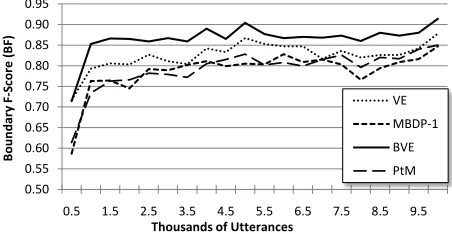
In the incremental setting, the corpus is treated as a series of utterances and the algorithm must seg-ment each one before moving on to the next. This is designed to better simulate the learning process, as a child would normally listen to a series of utterances produced by adults, analyzing each one in turn. To perform this test, we used the incremental versions of PtM, VE, and BVE described in Section 3, and compared them with MBDP-1 on the BR87 corpus. Each point in Figure 3 shows the boundary F-score of each algorithm on the last 500 utterances. Note that VE and PtM do not benefit from the informa-tion about boundaries at the beginnings and endings of utterances, yet they achieve levels of performance not very inferior to MBDP-1 and BVE, which do leverage true boundary information.
0.50 0.55 0.60 0.65 0.70 0.75 0.80 0.85 0.90
0.5 1.5 2.5 3.5 4.5 5.5 6.5 7.5 8.5 9.5
B
o
u
n
d
ar
y
F-Sco
re
(B
F)
Thousands of Utterances
VE
MBDP-1
BVE
PtM
Figure 3: Results for three chunking algorithms and MBDP-1 on BR87 in the incremental paradigm.
We also produced a phonemic encoding of the BR87 and Bloom73 (Bloom, 1973) corpora from CHILDES with the CMU pronouncing dictionary, which encodes stress information (primary, sec-ondary, or unstressed) on phonemes that serve as syllable nuclei. Stress information is known to be
a useful factor in word segmentation, and infants appear to be sensitive to stress patterns by as early as 8 months of age (Jusczyk et al., 1999). Results with these corpora are shown below in Figures 4 and 5. For each of the general chunking algorithms, a window size of 4 was used, meaning decisions were made in a highly local manner. Even so, BVE out-performs MBDP-1 in this arguably more realistic setting, while VE and PtM rival it or even surpass it. Note that the quite different results shown in Fig-ure 3 and FigFig-ure 4 are for the same corpus, under two different phonemic encodings, illustrating the importance of accurately representing the input chil-dren receive.
0.50 0.55 0.60 0.65 0.70 0.75 0.80 0.85 0.90 0.95
0.5 1.5 2.5 3.5 4.5 5.5 6.5 7.5 8.5 9.5
B
o
u
n
d
ar
y
F-Sco
re
(B
F)
Thousands of Utterances
VE
MBDP-1
BVE
[image:5.612.316.542.258.375.2]PtM
Figure 4: Results for chunking algorithms and MBDP-1 on BR87 (CMU) in the incremental paradigm.
0.60 0.65 0.70 0.75 0.80 0.85 0.90 0.95
0.5 1 1.5 2 2.5
B
o
u
n
d
ar
y
F-Sco
re
(B
F)
Thousands of Utterances
VE
MBDP-1
BVE
[image:5.612.316.540.439.556.2]PtM
Figure 5: Results for chunking algorithms and MBDP-1 on Bloom73 (CMU) in the incremental paradigm.
4.3 CHILDES: Syllables
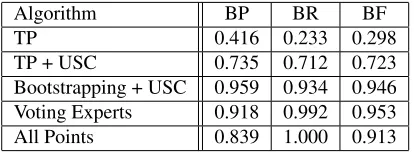
[image:5.612.73.299.456.575.2]phonemic representation, and that word boundaries only occur at syllable boundaries, then word seg-mentation becomes a very different, and potentially much easier, problem. This must be the case, as the process of syllabification removes a high percent-age of the potential boundary locations, and all of the locations it removes would be incorrect choices. Table 2 supports this argument. In the CHILDES corpora examined here, over 85% of the words di-rected to the child are monosyllabic. This means that the trivial All-Locations baseline, which segments at every possible location, achieves an F-measure of
0.913when working with syllabic input, compared to only0.524for phonemic input.
Gambell and Yang (2006) present an algorithm for word segmentation that achieves a boundary F-score of0.946on correctly syllabified input. In or-der to achieve this level of performance, Gambell and Yang use a form of bootstrapping combined with a rule called the “Unique Stress Constraint,” or USC, which simply requires that each word con-tain exactly one stressed syllable. Gambell and Yang developed this algorithm partially as a response to a hypothesis put forward by Saffran et al. (1996) to explain their own experimental results. Saffran et al. concluded that young infants can attend to the transitional probabilities between syllables, and posit word boundaries where transitional probability (TP) is low. The TP from syllableXto syllableY is simply given by:
P(Y|X) =frequency ofXY /frequency ofX (1)
While TP is sufficient to explain the results of Saf-fran et al.’s 1996 study, it performs very poorly on actual child-directed speech, regardless of whether the probabilities are calculated between phonemes (Brent, 1999) or syllables. Because of the dramatic performance gains shown by the addition of USC in testing, as well as the poor performance of TP, Gambell and Yang conclude that the USC is required for word segmentation and thus is a likely candidate for inclusion in Universal Grammar (Gambell and Yang, 2006).
However, as the results in Table 2 show, VE is capable of slightly superior performance on syllable input, without assuming any prior constraints on syl-lable stress distribution. Moreover, the performance of both algorithms is also only a few points above
Algorithm BP BR BF
TP 0.416 0.233 0.298
TP + USC 0.735 0.712 0.723
Bootstrapping + USC 0.959 0.934 0.946 Voting Experts 0.918 0.992 0.953
All Points 0.839 1.000 0.913
Table 2: Performance of various algorithms on the Brown corpus from CHILDES. Other than VE and All Points, values are taken from (Gambell and Yang, 2006).
the baseline of segmenting at every possible bound-ary location (i.e., at every syllable). These results show the limitations of simple statistics like TP, but also show that segmenting a sequence of syllables is a simple problem for more powerful statistical algo-rithms like VE. The fact that a very high percentage of the words found by VE have one stressed syllable suggest that a rule like the USC could be emergent rather than innate.
4.4 Optimality of the VE Chunk Signature
It is one thing to find chunks in sequences, another to have a theory or model of chunks. The question addressed in this section is whether the chunk sig-nature – low internal entropy and high boundary en-tropy – is merely a good detector of chunk bound-aries, or whether it characterizes chunks, them-selves. Is the chunk signature merely a good detec-tor of word boundaries, or are words those objects that maximize the signal from the signature? One way to answer the question is to define a “chunki-ness score” and show that words maximize the score while other objects do not.
The chunkiness score is:
Ch(s) = Hf(s) +Hb(s)
2 −logP r(s) (2)
It is just the average of the forward and backward boundary entropies, which our theory says should be high at true boundaries, minus the internal en-tropy between the boundaries, which should be low.
Ch(s)can be calculated for any segment of any se-quence for which we can build a trie.
possible way (there are2n−1of these for a sequence of lengthn). Every segmentation will produce some chunks, each of which will have a chunkiness score. For each 5-word sequence (usually between 18 and 27 characters long) in the Bloom73 corpus from CHILDES, we generated all possible chunks and ranked them by their chunkiness. The average rank of true words was the 98.7th percentile of the distri-bution of chunkiness. It appears that syntax is the primary reason that true chunks do not rank higher: When the word-order in the training corpus is scram-bled, the rank of true words is the 99.6th percentile of the chunkiness distribution. These early results, based on a corpus of child-directed speech, strongly suggest that words are objects that maximize chunk-iness. Keep in mind that the chunkiness score knows nothing of words: The probabilities and entropies on which it is based are estimated from continuous se-quences that contain no boundaries. It is therefore not obvious or necessary that the objects that maxi-mize chunkiness scores should be words. It might be that letters, or phones, or morphemes, or syllables, or something altogether novel maximize chunkiness scores. However, empirically, the chunkiest objects in the corpus are words.
5 Discussion
Whether segmentation is performed on phonemic or syllabic sequences, and whether it is unsupervised or provided information such as utterance boundaries and pauses, information-theoretic algorithms such as VE, PtM and especially BVE perform segmen-tation very well. The performance of VE on BR87 is on par with other state-of-the-art semi-supervised segmentation algorithms such as WordEnds (Fleck, 2008) and HDP (Goldwater et al., 2009). The performance of BVE on corpora of child-directed speech is unmatched in the unconstrained case, to the best of our knowledge.
These results suggest that BVE provides a sin-gle, general chunking ability that that accounts for word segmentation in both scenarios, and potentially a wide variety of other cognitive tasks as well. We now consider other properties of BVE that are es-pecially relevant to natural language learning. Over time, BVE’s knowledge trie comes to represent the distribution of phoneme sequences that begin and
end words it has found. We now discuss how this knowledge trie models phonotactic constraints, and ultimately becomes an emergent lexicon.
5.1 Phonotactic Constraints
Every language has a set of constraints on how phonemes can combine together into syllables, called phonotactic constraints. These constraints af-fect the distribution of phonemes found at the be-ginnings and ends of words. For example, words in English never begin with/ts/, because it is not a valid syllable onset in English. Knowledge of these constraints allows a language learner to simplify the segmentation problem by eliminating many possi-ble segmentations, as demonstrated in Section 4.3. This approach has inspired algorithms in the litera-ture, such as WordEnds (Fleck, 2008), which builds a statistical model of phoneme distributions at the beginnings and ends of words. BVE also learns a model of phonotactics at word boundaries by keep-ing similar statistics in its knowledge trie, but can do so in a fully unsupervised setting by inferring its own set of high-precision word boundaries with the chunk signature.
5.2 An Emergent Lexicon
VE does not represent explicitly a “lexicon” of chunks that it has discovered. VE produces chunks when applied to a sequence, but its internal data structures do not represent the chunks it has dis-covered explicitly. By contrast, BVE stores bound-ary information in the knowledge trie and refines it over time. Simply by storing the beginnings and endings of segments, the knowledge trie comes to store sequences like #cat#, where # represents a word boundary. The set of such bounded sequences constitutes an emergent lexicon. After segmenting a corpus of child-directed speech, the ten most fre-quent words of this lexicon areyou, the, that, what, is, it, this, what’s, to, and look. Of the 100 most frequent words, 93 are correct. The 7 errors include splitting off morphemes such as ing, and merging frequently co-occurring word pairs such asdo you.
6 Implications for Cognitive Science
Frank et al. (2010) compared the segmentation pre-dictions made by TP and a Bayesian Lexical model against the segmentation performance of adults, and found that the predictions of the Bayesian model were a better match for the human data. As men-tioned in Section 4.3, computational evaluation has demonstrated repeatedly that TP provides a poor model of segmentation ability in natural language. Any of the entropic chunking methods investigated here can explain the artificial language results moti-vating TP, as well as the segmentation of natural lan-guage, which argues for their inclusion in future em-pirical investigations of human segmentation ability.
6.1 Innate Knowledge
The word segmentation problem provides a reveal-ing case study of the relationship between nativism and statistical learning. The initial statistical pro-posals, such as TP, were too simple to explain the phenomenon. However, robust statistical methods were eventually developed that perform the linguis-tic task successfully. With statislinguis-tical learning mod-els in place that perform as well as (or better than) models based on innate knowledge, the argument for an impoverished stimulus becomes difficult to main-tain, and thus the need for a nativist explanation is removed.
Importantly, it should be noted that the success of a statistical learning method is not an argument that nothing is innate in the domain of word segmen-tation, but simply that it is the learningprocedure, rather than any specificlinguistic knowledge, that is innate. The position that a statistical segmentation ability is innate is bolstered by speech segmentation experiments with cotton-top tamarins (Hauser et al., 2001) that have yielded similar results to Saffran’s experiments with human infants, suggesting that the ability may be present in the common ancestor of humans and cotton-top tamarins.
Further evidence for a domain-general chunking ability can be found in experiments where human subjects proved capable of discovering chunks in a single continuous sequence of non-linguistic in-puts. Saffran et al. (1999) found that adults and 8-month-old infants were able to segment sequences of tones at the level of performance previously estab-lished for syllable sequences (Saffran et al., 1996). Hunt and Aslin (1998) measured the reaction time
of adults when responding to a single continuous sequence of light patterns, and found that subjects quickly learned to exploit predictive subsequences with quicker reactions, while delaying reaction at subsequence boundaries where prediction was un-certain. In both of these results, as well as the word segmentation experiments of Saffran et al., humans learned to segment the sequences quickly, usually within minutes, just as general chunking algorithms quickly reach high levels of performance.
7 Conclusion
We have shown that a domain-independent theory of chunking can be applied effectively to the problem of word segmentation, and can explain the ability of children to segment a continuous sequence, which other computational models examined here do not attempt to explain. The human ability to segment continuous sequences extends to non-linguistic do-mains as well, which further strengthens the gen-eral chunking account, as these chunking algorithms have been successfully applied to a diverse array of non-linguistic sequences. In particular, BVE com-bines the power of the information-theoretic chunk signature with a bootstrapping capability to achieve high levels of performance in both the continuous and incremental paradigms.
8 Future Work
Within the CHILDES corpus, our results have only been demonstrated for English, which leaves open the possibility that other languages may present a more serious segmentation problem. In En-glish, where many words in child-directed speech are mono-morphemic, the difference between find-ing words and findfind-ing morphs is small. In some languages, ignoring the word/morph distinction is likely to be a more costly assumption, especially for highly agglutinative or even polysynthetic lan-guages. One possibility that merits further explo-ration is that, in such languages, morphs rather than words are the units that optimize chunkiness.
Acknowledgements
References
Richard N. Aslin, Jenny R. Saffran, and Elissa L. New-port. 1998. Computation of Conditional Probability Statistics by 8-Month-Old Infants. Psychological Sci-ence, 9(4):321–324.
Nan Bernstein Ratner, 1987. The phonology of parent-child speech, pages 159–174. Erlbaum, Hillsdale, NJ. Lois Bloom. 1973.One Word at a Time. Mouton, Paris. Michael R. Brent. 1999. An Efficient, Probabilistically
Sound Algorithm for Segmentation and Word Discov-ery. Machine Learning, (34):71–105.
Roger Brown. 1973. A first language: The early stages. Harvard University, Cambridge, MA.
Paul Cohen and Niall Adams. 2001. An algorithm for segmenting categorical time series into meaning-ful episodes. InProceedings of the Fourth Symposium on Intelligent Data Analysis.
Paul Cohen, Niall Adams, and Brent Heeringa. 2007. Voting Experts: An Unsupervised Algorithm for Segmenting Sequences. Intelligent Data Analysis, 11(6):607–625.
Margaret M. Fleck. 2008. Lexicalized phonotactic word segmentation. In Proceedings of The 49th Annual Meeting of the Association for Computational Linguis-tics: Human Language Technologies, pages 130–138, Columbus, Ohio, USA. Association for Computational Linguistics.
Michael C Frank, Harry Tily, Inbal Arnon, and Sharon Goldwater. 2010. Beyond Transitional Probabilities : Human Learners Impose a Parsimony Bias in Statisti-cal Word Segmentation. In Proceedings of the 32nd Annual Meeting of the Cognitive Science Society. Timothy Gambell and Charles Yang. 2006. Statistics
Learning and Universal Grammar: Modeling Word Segmentation. InWorkshop on Psycho-computational Models of Human Language.
Sharon Goldwater, Thomas L Griffiths, and Mark John-son. 2009. A Bayesian Framework for Word Segmen-tation: Exploring the Effects of Context. Cognition, 112(1):21–54.
Sharon Goldwater. 2007.Nonparametric Bayesian mod-els of lexical acquisition. Ph.D. dissertation, Brown University.
Zellig S. Harris. 1955. From Phoneme to Morpheme.
Language, 31(2):190–222.
Marc D. Hauser, Elissa L. Newport, and Richard N. Aslin. 2001. Segmentation of the speech stream in a non-human primate: statistical learning in cotton-top tamarins. Cognition, 78(3):B53–64.
Daniel Hewlett and Paul Cohen. 2009. Bootstrap Voting Experts. In Proceedings of the Twenty-first Interna-tional Joint Conference on Artificial Intelligence.
Daniel Hewlett and Paul Cohen. 2010. Artificial General Segmentation. In The Third Conference on Artificial General Intelligence.
Ruskin H. Hunt and Richard N. Aslin. 1998. Statisti-cal learning of visuomotor sequences: Implicit acqui-sition of sub-patterns. InProceedings of the Twentieth Annual Conference of the Cognitive Science Society, Mahwah, NJ. Lawrence Erlbaum Associates.
Howard Johnson and Joel Martin. 2003. Unsupervised learning of morphology for English and Inuktitut. Pro-ceedings of the 2003 Conference of the North Amer-ican Chapter of the Association for Computational Linguistics on Human Language Technology (HLT-NAACL 2003), pages 43–45.
Peter W. Jusczyk, Derek M. Houston, and Mary New-some. 1999. The Beginnings of Word Segmentation in English-Learning Infants. Cognitive Psychology, 39(3-4):159–207.
Teuvo Kohonen. 1988.Self-organized formation of topo-logically correct feature maps.
Brian MacWhinney and Catherine E Snow. 1985. The child language data exchange system (CHILDES).
Journal of Child Language.
Matthew Miller and Alexander Stoytchev. 2008. Hierar-chical Voting Experts: An Unsupervised Algorithm for Hierarchical Sequence Segmentation. InProceedings of the 7th IEEE International Conference on Develop-ment and Learning, pages 186–191.
Matthew Miller, Peter Wong, and Alexander Stoytchev. 2009. Unsupervised Segmentation of Audio Speech Using the Voting Experts Algorithm. Proceedings of the 2nd Conference on Artificial General Intelligence (AGI 2009).
Jenny R. Saffran and Erik D. Thiessen. 2003. Pattern induction by infant language learners. Developmental Psychology, 39(3):484–494.
Jenny R. Saffran, Richard N. Aslin, and Elissa L. New-port. 1996. Statistical Learning by 8-Month-Old In-fants.Science, 274(December):926–928.
Jenny R. Saffran, Elizabeth K Johnson, Richard N. Aslin, and Elissa L. Newport. 1999. Statistical learning of tone sequences by human infants and adults. Cogni-tion, 70(1):27–52.
Kumiko Tanaka-Ishii and Zhihui Jin. 2006. From Phoneme to Morpheme: Another Verification Using a Corpus. In Proceedings of the 21st International Conference on Computer Processing of Oriental Lan-guages, pages 234–244.