ULISSE:
an Unsupervised Algorithm for Detecting Reliable Dependency Parses
Felice Dell’Orletta, Giulia Venturi and Simonetta Montemagni
Istituto di Linguistica Computazionale “Antonio Zampolli” (ILC–CNR) via G. Moruzzi, 1 – Pisa (Italy)
{felice.dellorletta,giulia.venturi,simonetta.montemagni}@ilc.cnr.it
Abstract
In this paper we present ULISSE, an unsu-pervised linguistically–driven algorithm to se-lect reliable parses from the output of a de-pendency parser. Different experiments were devised to show that the algorithm is robust enough to deal with the output of different parsers and with different languages, as well as to be used across different domains. In all cases, ULISSE appears to outperform the baseline algorithms.
1 Introduction
While the accuracy of state–of–the–art parsers is in-creasing more and more, this is still not enough for their output to be used in practical NLP–based ap-plications. In fact, when applied to real–world texts (e.g. the web or domain–specific corpora such as bio–medical literature, legal texts, etc.) their accu-racy decreases significantly. This is a real problem since it is broadly acknowledged that applications such as Information Extraction, Question Answer-ing, Machine Translation, and so on can benefit sig-nificantly from exploiting the output of a syntactic parser. To overcome this problem, over the last few years a growing interest has been shown in assessing the reliability of automatically produced parses: the selection of high quality parses represents nowadays a key and challenging issue. The number of stud-ies devoted to detecting reliable parses from the out-put of a syntactic parser is spreading. They mainly differ with respect to the kind of selection algo-rithm they exploit. Depending on whether training data, machine learning classifiers or external parsers
are exploited, existing algorithms can be classified intoi)supervised–based,ii)ensemble–based andiii) unsupervised–based methods.
The first is the case of the construction of a ma-chine learning classifier to predict the reliability of parses on the basis of different feature types. Yates et al. (2006) exploited semantic features derived from the web to create a statistical model to de-tect unreliable parses produced by a constituency parser. Kawahara and Uchimoto (2008) relied on features derived from the output of a supervised de-pendency parser (e.g. dede-pendency lengths, num-ber of unknown words, numnum-ber of coordinated con-junctions, etc.), whereas Ravi et al. (2008) exploited an external constituency parser to extract text–based features (e.g. sentence length, unknown words, etc.) as well as syntactic features to develop a super-vised predictor of the target parser accuracy. The approaches proposed by Reichart and Rappoport (2007a) and Sagae and Tsujii (2007) can be classi-fied as ensemble–based methods. Both select high quality parses by computing the level of agreement among different parser outputs: wheras the former uses several versions of a constituency parser, each trained on a different sample from the training data, the latter uses the parses produced by different de-pendency parsing algorithms trained on the same data. However, a widely acknowledged problem of both supervised–based and ensemble–based meth-ods is that they are dramatically influenced by a) the selection of the training data and b) the accuracy and the typology of errors of the used parser.
To our knowledge, Reichart and Rappoport (2009a) are the first to address the task of high
ity parse selection by resorting to an unsupervised– based method. The underlying idea is that syntactic structures that are frequently created by a parser are more likely to be correct than structures produced less frequently. For this purpose, their PUPA (POS– based Unsupervised Parse Assessment Algorithm) uses statistics about POS tag sequences of parsed sentences produced by an unsupervised constituency parser.
In this paper, we address this unsupervised sce-nario with two main novelties: unlike Reichart and Rappoport (2009a), a) we address the reliable parses selection task using an unsupervised method in a supervised parsing scenario, and b) we operate on dependency–based representations. Similarly to Re-ichart and Rappoport (2009a) we exploit text inter-nal statistics: but whereas they rely on features that are closely related to constituency representations, we use linguistic features which are dependency– motivated. The proposed algorithm has been eval-uated for selecting reliable parses from English and Italian corpora; to our knowledge, this is the first time that such a task has been applied to a less re-sourced language such as Italian. The paper is or-ganised as follows: in Section 2 we illustrate the ULISSE algorithm; sections 3 and 4 are devoted to the used parsers and baselines. Section 5 describes the experiments and discusses achieved results.
2 The ULISSE Algorithm
The ULISSE (Unsupervised LInguiStically–driven Selection of dEpendency parses) algorithm takes as input a set of parsed sentences and it assigns to each dependency tree a score quantifying its reliability. It operates in two different steps: 1) it collects statis-tics about a set of linguistically–motivated features extracted from a corpus of parsed sentences; 2) it calculates a quality (or reliability) score for each an-alyzed sentence using the feature statistics extracted from the whole corpus.
2.1 Selection of features
The features exploited by ULISSE are all linguis-tically motivated and rely on the dependency tree structure. Different criteria guided their selection. First, as pointed out in Roark et al. (2007), we needed features which could be reliably identified
within the automatic output of a parser. Second, we focused on dependency structures that are widely agreed in the literature a) to reflect sentences’ syn-tactic and thus parsing complexity and b) to impose a high cognitive load on the parsing of a complete sentence.
Here follows the list of features used in the exper-iments reported in this paper, which turned out to be the most effective ones for the task at hand.
Parse tree depth: this feature is a reliable indicator of sentence complexity due to the fact that, with sen-tences of approximately the same length, parse tree depth can be indicative of increased sentence com-plexity (Yngve, 1960; Frazier, 1985; Gibson, 1998; Nenkova, 2010).
Depth of embedded complement ‘chains’: this feature is a subtype of the previous one, focusing on the depth of chains of embedded complements, ei-ther prepositional complements or nominal and ad-jectival modifiers. Long chains of embedded com-plements make the syntactic structure more complex and their analysis much more difficult.
Arity of verbal predicates: this feature refers to the number of dependency links sharing the same ver-bal head. Here, there is no obvious relation between the number of dependents and sentence complexity: both a small number and a high number of depen-dents can make the sentence processing quite com-plex, although for different reasons (elliptical con-structions in the former case, a high number of mod-ifiers in the latter).
Verbal roots: this feature counts the number of ver-bal roots with respect to number of all sentence roots in the target corpus.
Subordinate vs main clauses: subordination is gen-erally considered to be an index of structural com-plexity in language. Two distinct features are con-sidered for monitoring this aspect: one measuring the ratio between main and subordinate clauses and the other one focusing on the relative ordering of subordinate clauses with respect to the main clause. It is a widely acknowledged fact that highly com-plex sentences contain deeply embedded subordi-nate clauses; however, subordisubordi-nate clauses are easier to process if they occur in post–verbal rather than in pre–verbal position (Miller, 1998).
accuracy when analysing long distance dependen-cies. This is in line with Lin (1996) and Gibson (1998) who claim that the syntactic complexity of sentences can be predicted with measures based on the length of dependency links, given the memory overhead of very long distance dependencies. Here, the dependency length is measured in terms of the words occurring between the syntactic head and the dependent.
Dependency link plausibility (henceforth, Arc-POSFeat): this feature is used to calculate the plausi-bility of a dependency link given the part–of–speech of the dependent and the head, by also considering the PoS of the head father and the dependency link-ing the two.
2.2 Computation Score
The quality score (henceforth, QS) of parsed sen-tences results from a combination of the weights as-sociated with the monitored features. ULISSE is modular and can use several weights combination strategies, which may be customised with respect to the specific task exploiting the output of ULISSE.
For this study,QSis computed as a simple prod-uct of the individual feature weights. This follows from the necessity to recognize high quality parses within the input set of parsed sentences: the prod-uct combination strategy is able to discard low qual-ity parse trees even in presence of just one low weight feature. Therefore, QS for each sentence i in the set of input parsed sentencesI isQS(Si) =
Qn
y=1W eight(Si, fy), whereSiis the i–th sentence ofI, nis the total number of selected features and W eight(Si, fy)is the computed weight for the y–th
feature.
Selected features can be divided into two classes, depending on whether they are computed with re-spect to each sentence and averaged over all sen-tences in the target corpus (global features), or they are computed with respect to individual dependency links and averaged over all of them (local features). The latter is the case of the ArcPOSFeat feature, whereas the all other ones represent global features. For the global features, theW eight(Si, fy)is
de-fined as:
W eight(Si, fy) = F(V|(rangefy), range(L(S(L(Si), r)) i), r)| ,
(1)
where V(fy) is the value of the y–th feature (ex-tracted from Si), L(Si) is the length of the
sen-tence Si, range(L(Si), r) defines a range
cov-ering values from L(Si) − r and L(Si) + r,
F(V(fy), range(L(Si), r)) is the frequency of
V(fy) in all sentences in I that has a value of
length in range(L(Si), r1) and |range(L(Si), r)|
is the total number of sentences in I with length in range(L(Si), r). For what concerns the
lo-cal feature ArcPOSFeat, ULISSE assigns a weight for each arc in Si: in principle different
strate-gies can be used to compute a unique weight for this feature for Si. Here, the sentence weight
for the feature ArcPOSFeat is computed as the minimum weight among the weights of all arcs of Si. Therefore, W eight(Si, ArcP OSF eat) =
min{weight((P d, P h, t)),∀(P d, P h, t) ∈ Si}, where the triple(P d, P h, t)is an arc inSiin which
P d is the POS of the dependent, P h is the POS of the syntactic head and t is the type of the de-pendency relation and weight((P d, P h, t)) is the weight of the specific arc(P d, P h, t). The individ-ual arc weight is computed as follows:
weight((P d, P h, t)) = F((P d, P h, t))
F((P d, X, t))·
·F((P d, P h, t))
F((X, P h, t))·
·F(((P d, P h, t)(P h, P h2, t2)))
F((P d, P h, t)) ·
·F(((P d, P h, t)(P h, P h2, t2)))
F((P h, P h2, t2)) ·
·F(((P d, P h, t)(P h, P h2, t2)))
F((((P d, X, t))(X, P h2, t2))),
whereF(x)is the frequency ofxinI,X is a vari-able and(arc1arc2)represent two consecutive arcs in the tree.
3 The Parsers
ULISSE was tested against the output of two really different data–driven parsers: the first–order Max-imum Spanning Tree (MST) parser (McDonald et al., 2006) and the DeSR parser (Attardi, 2006) using Support Vector Machine as learning algorithm. The
former is a graph–based parser (following the so– called “all–pairs” approach Buchholz et al. (2006)) where every possible arc is considered in the con-struction of the optimal parse tree and where depen-dency parsing is represented as the search for a max-imum spanning tree in a directed graph. The latter is a Shift–Reduce parser (following a “stepwise” ap-proach, Buchholz et al. (2006)), where the parser is trained and learns the sequence of parsing actions required to build the parse tree.
Although both parser models show a similar accu-racy, McDonald and Nivre (2007) demonstrate that the two types of models exhibit different behaviors. Their analysis exemplifies how different the two parsers behave when their accuracies are compared with regard to some linguistic features of the ana-lyzed sentences. To mention only a few, the Shift– Reduce parser tends to perform better on shorter sentences, while the MST parser guarantees a higher accuracy in identifying long distance dependencies. As regards the identification of dependency types, the MST parser shows a better ability to identify the dependents of the sentences’ roots whereas the Shift–Reduce tends to better recognize specific rela-tions (e.g. Subject and Object).
McDonald and Nivre (2007) describe how the systems’ behavioral differences are due to the dif-ferent parsing algorithms implemented by the Shift– Reduce and the MST parsing models. The Shift Reduce parser constructs a dependency tree by per-forming a sequence of parser actions or transitions through a greedy parsing strategy. As a result of this parsing procedure, a Shift Reduce parser cre-ates shorter arcs before longer arcs. The latter could be the reason for the lower accuracy in identifying longer arcs when compared to the MST parser. This also influences a lower level of accuracy in the anal-ysis of longer sentences that usually contain longer arcs than shorter sentences. The MST parser’s abil-ity to analyze both short and long arcs is invariant as it employs a graph-based parsing method where every possible arc is considered in the construction of the dependency tree.
4 The Baselines
Three different increasingly complex baseline mod-els were used to evaluate the performance of
ULISSE.
The first baseline is constituted by aRandom Se-lection (RS ) of sentences from the test sets. This baseline is calculated in terms of the scores of the parser systems on the test set.
The second baseline is represented by the Sen-tence Length (SL ), starting from the assumption, demonstrated by McDonald and Nivre (2007), that long sentences are harder to analyse using statistical dependency parsers than short ones. This is a strong unsupervised baseline based on raw text features, ranking the parser results from the shortest sentence to the longest one.
Figure 1: Example of dependency tree.
If we consider the subtree rooted by give (in the dotted circle), the resulting POS sequence is as follows: POS2 POS3 POS4 POS5 POS6 NULL, wherePOS3 POS4 POS5 POS6 is the sequence of POS tags in the subtree,POS2 is the left neighbor POS tag and NULL marks the absence of a right neighbor.
5 Experiments and Results
The experiments were organised as follows: a target corpus was automatically POS tagged (Dell’Orletta, 2009) and dependency–parsed; the ULISSE and baseline algorithms of reliable parse selection were run on the POS–tagged and dependency–parsed tar-get corpus in order to identify high quality parses; results achieved by the selection algorithms were evaluated with respect to a subset of the target cor-pus of about 5,000 word–tokens (henceforth referred to as “test set”) for which gold-standard annotation was available. Different sets of experiments were devised to test the robustness of our algorithm. They were performed with respect to i) the output of the parsers described in Section 3, ii) two different lan-guages, iii) different domains.
For what concerns the languages, we chose Italian and English for two main reasons. First of all, they pose different challenges to a parser since they are characterised by quite different syntactic features. For instance, Italian, as opposed to English, is char-acterised by a relatively free word order (especially for what concerns subject and object relations with respect to the verb) and by the possible absence of an overt subject. Secondly, as it is shown in Section 5.1, Italian is a less resourced language with respect to English. This is a key issue, since as demonstrated
by Reichart and Rappoport (2007b) and McClosky et al. (2008), small and big treebanks pose different problems in the reliable parses selection.
Last but not least, we aimed at demonstrating that ULISSE can be successfully used not only with texts belonging to the same domain as the parser train-ing corpus. For this purpose, ULISSE was tested on a target corpus of Italian legislative texts, whose automatic linguistic analysis poses domain–specific challenges (Venturi, 2010). Out–of–domain experi-ments are being carried out also for English.
5.1 The Corpora
The Italian corpora Both parsers were trained on ISST–TANL2, a dependency annotated corpus used in Evalita’093, an evaluation campaign carried out for Italian (Bosco et al., 2009). ISST–TANL in-cludes 3,109 sentences (71,285 tokens) and consists of articles from newspapers and periodicals.
Two different target corpora were used for the in–domain and out–of–domain experiments. For the former, we used a corpus of 1,104,237 sen-tences (22,830,739 word–tokens) of newspapers texts which was extracted from the CLIC-ILC Cor-pus (Marinelli et al., 2003); for the legal domain, we used a collection of Italian legal texts (2,697,262 word–tokens; 97,564 sentences) regulating a vari-ety of domains, ranging from environment, human rights, disability rights, freedom of expression to pri-vacy, age disclaimer, etc. In the two experiments, the test sets were represented respectively by: a) the test set used in the Evalita’09 evaluation campaign, constituted by 260 sentences and 5,011 tokens from newpapers text; b) a set of 102 sentences (corre-sponding to 5,691 tokens) from legal texts.
The English corpora For the training of parsers we used the dependency–based version of Sections 2–11 of the Wall Street Journal partition of the Penn Treebank (Marcus et al., 2003), which was de-veloped for the CoNLL 2007 Shared Task on De-pendency Parsing (Nivre et al., 2007): it includes 447,000 word tokens and about 18,600 sentences.
As target data we took a corpus of news, specif-ically the whole Wall Street Journal Section of the
2http://medialab.di.unipi.it/wiki/SemaWiki
Penn Treebank4, from which the portion of text cor-responding to the training corpus was removed; the English target corpus thus includes 39,285,425 to-kens (1,625,606 sentences). For testing we used the test set of the CoNLL 2007 Shared Task, cor-responding to a subset of Section 23 of the Wall Street Journal partition of the Penn Treebank (5,003 tokens, 214 sentences).
5.2 Evaluation Methodology
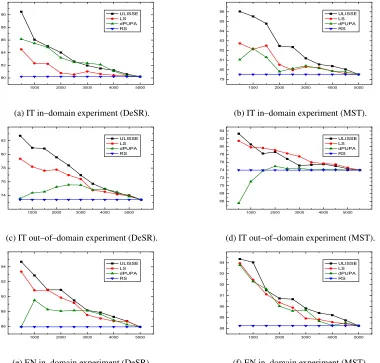
Performances of the ULISSE algorithm have been evaluated i) with respect to the accuracy of ranked parses and ii) in terms of Precision and Recall. First, for each experiment we evaluated how the ULISSE algorithm and the baselines classify the sentences in the test set with respect to the “Labelled Attachment Score” (LAS) obtained by the parsers, i.e. the per-centage of tokens for which it has predicted the cor-rect head and dependency relation. In particular, we computed the LAS score of increasingly wider top lists ofk tokens, wherekranges from 500 word to-kens to the whole size of the test set (with a step size of 500 word tokens, i.e. k=500, k=1000, k=1500, etc.).
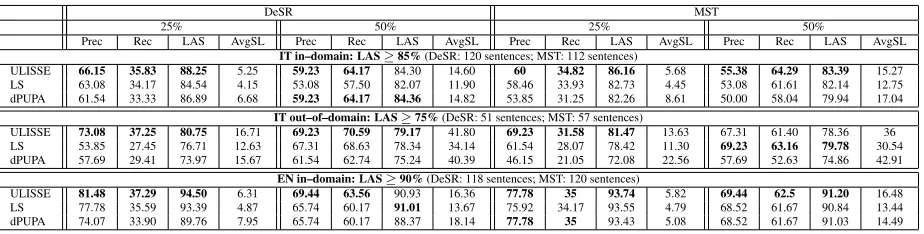
As regards ii), we focused on the set of ranked sentences showing a LAS ≥ α. Since imposing a 100% LAS was too restrictive, for each experi-ment we defined a differentα threshold taking into account the performance of each parser across the different languages and domains. In particular, we took the top 25% and 50% of the list of ranked sen-tences and calculated Precision and Recall for each of them. To this specific end, a parse tree showing a LAS≥ αis considered as atrustworthy analysis. Precision has been computed as the ratio of the num-ber of trustworthy analyses over the total numnum-ber of sentences in each top list. Recall has been computed as the ratio of the number of trustworthy analyses which have been retrieved over the total number of trustworthy analyses in the whole test set.
In order to test how the ULISSE algorithm is able to select reliable parses by relying on parse fea-tures rather than onraw textfeatures, we computed the accuracy score (LAS) of a subset of the top list of sentences parsed by both parsers and ranked by
4This corpus represents to the unlabelled data set distributed for the CoNLL 2007 Shared Task on Dependency Parsing, do-main adaptation track.
ULISSE: in particular, we focused on those sen-tences which were not shared by the MST and DeSR top lists.
5.3 Results
We will refer to the performed experiments as fol-lows: “IT in–domain” and “IT out–of–domain” for the Italian experiments using respectively the ISST– TANL test set (henceforth ISST TS) and the Legal-Corpus test set (henceforth Legal TS); “EN in– domain” for the English experiment using the PTB test set (PTB TS).
As a starting point let us consider the accuracy of DeSR and MST parsers on the whole test sets, reported in Table 1. The accuracy has been com-puted in terms of LAS and of Unlabelled Attach-ment Score (UAS), i.e. the percentage of tokens with a correctly identified syntactic head. It can be no-ticed that the performance of the two parsers is quite similar for Italian (i.e. wrt ISST TS and Legal TS), whereas there is a 2.3% difference between the MST and DeSR accuracy as far as English is concerned.
[image:6.612.328.518.367.401.2]ISST TS Legal TS PTB TS Parser LAS UAS LAS UAS LAS UAS DeSR 80.22 84.96 73.40 76.12 85.95 87.25 MST 79.52 85.43 73.99 78.72 88.25 89.55
Table 1: Overall accuracy of DeSR and MST parsers.
1000 2000 3000 4000 5000 80
82 84 86 88
90 ULISSE
LS dPUPA RS
(a) IT in–domain experiment (DeSR).
1000 2000 3000 4000 5000 79
80 81 82 83 84 85 86
ULISSE LS dPUPA RS
(b) IT in–domain experiment (MST).
1000 2000 3000 4000 5000 74
76 78 80 82
ULISSE LS dPUPA RS
(c) IT out–of–domain experiment (DeSR).
1000 2000 3000 4000 5000 66
68 70 72 74 76 78 80 82 84
ULISSE LS dPUPA RS
(d) IT out–of–domain experiment (MST).
1000 2000 3000 4000 5000 86
88 90 92 94
ULISSE LS dPUPA RS
(e) EN in–domain experiment (DeSR).
1000 2000 3000 4000 5000 88
89 90 91 92 93
94 ULISSE
LS dPUPA RS
(f) EN in–domain experiment (MST).
Figure 2: LAS of parses ranked by ULISSE algorithm and by the three baselines.
LAS accuracy of 93.36% and 93.96% respectively for DeSR and MST: even in this case, ULISSE out-performs all baselines. This is also the case in the IT out–of–domain experiment. As reported in Table 1, parsing legal texts is a quite challenging task due to a number of domain–specific peculiarities at the level of syntax: this is testified by the average sen-tence length which in the Legal TS is 56 word to-kens. Nevertheless, ULISSE is able also in this case to highly rank long sentences showing a high LAS. For example, while in the first top list of 500 word tokens the sentences parsed by DeSR and ordered by SL have an average sentence length of 24 words and a LAS of 79.37%, ULISSE includes in the same top list longer sentences (with average sentence length =
29) with a higher LAS (82.72%). Also dPUPA ranks in the same top list quite long sentences (with 27 av-erage sentence length), but compared to ULISSE it shows a lower LAS (i.e. 73.56%).
IT in–domain IT out–of–domain EN in–domain DeSR MST DeSR MST DeSR MST MST top–list 80.93 80.27 68.84 74.58 83.37 90.39
[image:7.612.112.492.83.446.2]DeSR top–list 82.46 77.82 75.47 74.88 86.50 86.74
Table 3: LAS of not–shared sentences in the DeSR and MST top–lists.
DeSR MST
25% 50% 25% 50%
Prec Rec LAS AvgSL Prec Rec LAS AvgSL Prec Rec LAS AvgSL Prec Rec LAS AvgSL
IT in–domain: LAS≥85%(DeSR: 120 sentences; MST: 112 sentences)
ULISSE 66.15 35.83 88.25 5.25 59.23 64.17 84.30 14.60 60 34.82 86.16 5.68 55.38 64.29 83.39 15.27 LS 63.08 34.17 84.54 4.15 53.08 57.50 82.07 11.90 58.46 33.93 82.73 4.45 53.08 61.61 82.14 12.75 dPUPA 61.54 33.33 86.89 6.68 59.23 64.17 84.36 14.82 53.85 31.25 82.26 8.61 50.00 58.04 79.94 17.04
IT out–of–domain: LAS≥75%(DeSR: 51 sentences; MST: 57 sentences)
ULISSE 73.08 37.25 80.75 16.71 69.23 70.59 79.17 41.80 69.23 31.58 81.47 13.63 67.31 61.40 78.36 36 LS 53.85 27.45 76.71 12.63 67.31 68.63 78.34 34.14 61.54 28.07 78.42 11.30 69.23 63.16 79.78 30.54 dPUPA 57.69 29.41 73.97 15.67 61.54 62.74 75.24 40.39 46.15 21.05 72.08 22.56 57.69 52.63 74.86 42.91
EN in–domain: LAS≥90%(DeSR: 118 sentences; MST: 120 sentences)
[image:8.612.74.536.56.173.2]ULISSE 81.48 37.29 94.50 6.31 69.44 63.56 90.93 16.36 77.78 35 93.74 5.82 69.44 62.5 91.20 16.48 LS 77.78 35.59 93.39 4.87 65.74 60.17 91.01 13.67 75.92 34.17 93.55 4.79 68.52 61.67 90.84 13.44 dPUPA 74.07 33.90 89.76 7.95 65.74 60.17 88.37 18.14 77.78 35 93.43 5.08 68.52 61.67 91.03 14.49
Table 2:In all Tables: the number of sentences with a LAS≥αparsed by DeSr and MST parsers (first row); Precision (Prec), Recall (Rec), the corresponding parser accuracy (LAS) of the top 25% and 50% of the list of sentences and ranked by the ULISSE algorithm, Length of Sentence (LS) and dependency PUPA (dPUPA) and the corresponding average length in tokens of ranked sentence (AvgSL).
the fact that PUPA is based on constituency–specific features that once translated in terms of dependency structures may be not so effective.
In order to show that the ranking of sentences does not follow from raw text features but rather from parse features, we evaluated the accuracy of parsed sentences that are not–shared by MST and DeSR top–lists selected by ULISSE. For each test set we selected a different top list: a set of 100 sentences in the IT and EN in–domain experiments and of 50 sentences in the IT out–of–domain exper-iment. For each of them we have a different number of not–shared sentences: 24, 15 and 16 in the IT in–domain, IT out–of–domain and EN in–domain experiments respectively. Table 3 reports the LAS of DeSR and MST for these sentences: it can be observed that the LAS of not–shared sentences in the DeSR top list is always higher than the LAS assigned by the same parser to the not–shared sen-tences in the MST top list, and viceversa. For in-stance, in the English experiment the LAS achieved by DeSR on the not–shared top list is higher (86.50) than the LAS of DeSR on the not–shared MST top list (83.37); viceversa, the LAS of MST on the not– shared DeSR top list is higher (86.74) than the LAS of MST on the not–shared MST top list (90.39). The unique exception is MST in the IT out–of–domain experiment, but the difference in terms of LAS be-tween the parses is not statistically relevant (p–value <0.05). These results demonstrate that ULISSE is able to select parsed sentences on the basis of the reliability of the analysis produced by each parser.
6 Conclusion
References
Giuseppe Attardi. 2006. Experiments with a
multilan-guage non-projective dependency parser. In Proceed-ings of the Tenth Conference on Computational Nat-ural Language Learning (CoNLL-X ’06), New York City, New York, pp. 166–170.
Cristina Bosco, Simonetta Montemagni, Alessandro Mazzei, Vincenzo Lombardo, Felice Dell’Orletta and Alessandro Lenci. 2009. Parsing Task: comparing dependency parsers and treebanks. In Proceedings of Evalita’09, Reggio Emilia.
Sabine Buchholz and Erwin Marsi. 2006. CoNLL-X
shared task on multilingual dependency parsing. In Proceedings of CoNLL.
Felice Dell’Orletta. 2009. Ensemble system for Part-of-Speech tagging. In Proceedings of Evalita’09, Eval-uation of NLP and Speech Tools for Italian, Reggio Emilia, December.
Lyn Frazier. 1985. Syntactic complexity. In D.R.
Dowty, L. Karttunen and A.M. Zwicky (eds.),Natural Language Parsing, Cambridge University Press, Cam-bridge, UK.
Edward Gibson. 1998. Linguistic complexity: Locality
of syntactic dependencies. InCognition, 68(1), pp. 1-76.
Daisuke Kawahara and Kiyotaka Uchimoto. 2008.
Learning Reliability of Parses for Domain Adaptation of Dependency Parsing. In Proceedings of IJCNLP 2008, pp. 709–714.
Dekan Lin. 1996. On the structural complexity of nat-ural language sentences. In Proceedings of COLING 1996, pp. 729–733.
Ryan McDonald, Kevin Lerman, and Fernando Pereira.
2006. Multilingual dependency analysis with a
two-stage discriminative parser. In Proceedings of CoNLL 2006.
Ryan McDonald and Joakim Nivre. 2007.
Character-izing the Errors of Data-Driven Dependency Parsing Models. In Proceedings of EMNLP-CoNLL, 2007, pp. 122-131.
Mitchell P. Marcus, Mary Ann Marcinkiewicz and Beat-rice Santorini. 1993. Building a large annotated cor-pus of English: the penn treebank. In Comput. Lin-guist.,vol. 19, issue 2, MIT Press, pp. 313–330.
Rita Marinelli, et al. 2003. The Italian PAROLE
cor-pus: an overview. In A. Zampolli et al. (eds.), Compu-tational Linguistics in Pisa, XVI–XVII, Pisa–Roma, IEPI., I, 401–421.
David McClosky, Eugene Charniak and Mark Johnson.
2006. Reranking and self–training for parser
adap-tation. In Proceedings of ICCL–ACL 2006, pp. 337– 344.
David McClosky, Eugene Charniak and Mark Johnson. 2008. When is Self–Trainig Effective for parsing?. In Proceedings of COLING 2008, pp. 561–568.
Jim Miller and Regina Weinert. 1998. Spontaneous spo-ken language. Syntax and discourse. Oxford, Claren-don Press.
Ani Nenkova, Jieun Chae, Annie Louis, and Emily Pitler. 2010.Structural Features for Predicting the Linguistic Quality of Text Applications to Machine Translation, Automatic Summarization and Human–Authored Text.
In E. Krahmer, M. Theune (eds.),Empirical Methods
in NLG, LNAI 5790, Springer-Verlag Berlin Heidel-berg, pp. 222241.
Joakim Nivre, Johan Hall, Sandra K¨ubler, Ryan Mc-Donald, Jens Nilsson, Sebastian Riedel, Deniz Yuret.
2007. The CoNLL 2007 Shared Task on Dependency
Parsing. In Proceedings of the EMNLP-CoNLL, pp. 915–932.
Sujith Ravi, Kevin Knight and Radu Soricut. 2008. Auto-matic Prediction of Parser Accuracy. In Proceedings of the EMNLP 2008, pp. 887–896.
Roi Reichart and Ari Rappoport. 2007a. An ensemble
method for selection of high quality parses. In Pro-ceedings of ACL 2007, pp. 408–415.
Roi Reichart and Ari Rappoport. 2007b. Self–Training
for Enhancement and Domain Adaptation of Statisti-cal Parsers Trained on Small Datasets. In Proceedings of ACL 2007, pp. 616–623.
Roi Reichart and Ari Rappoport. 2009a. Automatic
Se-lection of High Quality Parses Created By a Fully Un-supervised Parser. In Proceedings of CoNLL 2009, pp. 156–164.
Roi Reichart and Ari Rappoport. 2009b. Sample
Selec-tion for Statistical Parsers: Cognitively Driven Algo-rithms and Evaluation Measures. In Proceedings of CoNLL 2009, pp. 3–11.
Roi Reichart and Ari Rappoport. 2010. Improved Fully
Unsupervised Parsing with Zoomed Learning. In Pro-ceedings of EMNLP 2010.
Brian Roark, Margaret Mitchell and Kristy Hollingshead.
2007. Syntactic complexity measures for detecting
Mild Cognitive Impairment. In Proceedings of ACL Workshop on Biological, Translational, and Clinical Language Processing (BioNLP’07), pp. 1–8.
Kenji Sagae and Junichi Tsujii. 2007. Dependency
Parsing and Domain Adaptation with LR Models and Parser Ensemble. In Proceedings of the EMNLP– CoNLL 2007, pp. 1044–1050.
Giulia Venturi. 2010.Legal Language and Legal Knowl-edge Management Applications. In E. Francesconi, S.
Montemagni, W. Peters and D. Tiscornia (eds.),
Alexander Yates, Stefan Schoenmackers and Oren
Et-zioni. 2006. Detecting Parser Errors Using Web–
based Semantic Filters. In Proceedings of the EMNLP 2006, pp. 27–34.
Victor H.A. Yngve. 1960.A model and an hypothesis for language structure. In Proceedings of the American Philosophical Society, pp. 444-466.