CoNLL-2011 Shared Task:
Modeling Unrestricted Coreference in OntoNotes
Sameer Pradhan
BBN Technologies, Cambridge, MA 02138
Lance Ramshaw
BBN Technologies, Cambridge, MA 02138
Mitchell Marcus
University of Pennsylvania, Philadelphia, 19104
Martha Palmer
University of Colorado, Boulder, CO 80309
Ralph Weischedel
BBN Technologies, Cambridge, MA 02138
Nianwen Xue
Brandeis University, Waltham, MA 02453
Abstract
The CoNLL-2011 shared task involved pre-dicting coreference using OntoNotes data. Re-sources in this field have tended to be lim-ited to noun phrase coreference, often on a
restricted set of entities, such as ACE
enti-ties. OntoNotes provides a large-scale corpus of general anaphoric coreference not restricted to noun phrases or to a specified set of en-tity types. OntoNotes also provides additional layers of integrated annotation, capturing ad-ditional shallow semantic structure. This pa-per briefly describes the OntoNotes annota-tion (coreference and other layers) and then describes the parameters of the shared task including the format, pre-processing informa-tion, and evaluation criteria, and presents and discusses the results achieved by the partic-ipating systems. Having a standard test set and evaluation parameters, all based on a new resource that provides multiple integrated an-notation layers (parses, semantic roles, word senses, named entities and coreference) that could support joint models, should help to en-ergize ongoing research in the task of entity and event coreference.
1 Introduction
The importance of coreference resolution for the entity/event detection task, namely identifying all mentions of entities and events in text and clustering them into equivalence classes, has been well recog-nized in the natural language processing community. Automatic identification of coreferring entities and events in text has been an uphill battle for several decades, partly because it can require world knowl-edge which is not well-defined and partly owing to the lack of substantial annotated data. Early work on corpus-based coreference resolution dates back
to the mid-90s by McCarthy and Lenhert (1995) where they experimented with using decision trees and hand-written rules. A systematic study was then conducted using decision trees by Soon et al. (2001). Significant improvements have been made in the field of language processing in general, and improved learning techniques have been developed to push the state of the art in coreference resolu-tion forward (Morton, 2000; Harabagiu et al., 2001; McCallum and Wellner, 2004; Culotta et al., 2007; Denis and Baldridge, 2007; Rahman and Ng, 2009; Haghighi and Klein, 2010). Various different knowl-edge sources from shallow semantics to encyclo-pedic knowledge are being exploited (Ponzetto and Strube, 2005; Ponzetto and Strube, 2006; Versley, 2007; Ng, 2007). Researchers continued finding novel ways of exploiting ontologies such as Word-Net. Given that WordNet is a static ontology and as such has limitation on coverage, more recently, there have been successful attempts to utilize in-formation from much larger, collaboratively built resources such as Wikipedia (Ponzetto and Strube, 2006). In spite of all the progress, current techniques still rely primarily on surface level features such as string match, proximity, and edit distance; syntac-tic features such as apposition; and shallow seman-tic features such as number, gender, named entities, semantic class, Hobbs’ distance, etc. A better idea of the progress in the field can be obtained by read-ing recent survey articles (Ng, 2010) and tutorials (Ponzetto and Poesio, 2009) dedicated to this sub-ject.
Corpora to support supervised learning of this task date back to the Message Understanding Con-ferences (MUC). These corpora were tagged with coreferring entities identified by noun phrases in the text. The de facto standard datasets for current coref-erence studies are the MUC (Hirschman and
chor, 1997; Chinchor, 2001; Chinchor and Sund-heim, 2003) and the ACE1 (G. Doddington et al., 2000) corpora. The MUC corpora cover all noun phrases in text, but represent small training and test sets. TheACEcorpora, on the other hand, have much more annotation, but are restricted to a small subset of entities. They are also less consistent, in terms of inter-annotator agreement (ITA) (Hirschman et al., 1998). This lessens the reliability of statistical ev-idence in the form of lexical coverage and seman-tic relatedness that could be derived from the data and used by a classifier to generate better predic-tive models. The importance of a well-defined tag-ging scheme and consistent ITA has been well rec-ognized and studied in the past (Poesio, 2004; Poe-sio and Artstein, 2005; Passonneau, 2004). There is a growing consensus that in order for these to be most useful for language understanding applications such as question answering or distillation – both of which seek to take information access technology to the next level – we need more consistent anno-tation of larger amounts of broad coverage data for training better automatic techniques for entity and event identification. Identification and encoding of richer knowledge – possibly linked to knowledge sources – and development of learning algorithms that would effectively incorporate them is a neces-sary next step towards improving the current state of the art. The computational learning community, in general, is also witnessing a move towards eval-uations based on joint inference, with the two pre-vious CoNLL tasks (Surdeanu et al., 2008; Hajiˇc et al., 2009) devoted to joint learning of syntactic and semantic dependencies. A principle ingredient for joint learning is the presence of multiple layers of semantic information.
One fundamental question still remains, and that is – what would it take to improve the state of the art in coreference resolution that has not been attempted so far? Many different algorithms have been tried in the past 15 years, but one thing that is still lacking is a corpus comprehensively tagged on a large scale with consistent, multiple layers of semantic infor-mation. One of the many goals of the OntoNotes project2(Hovy et al., 2006; Weischedel et al., 2011)
is to explore whether it can fill this void and help push the progress further – not only in coreference, but with the various layers of semantics that it tries to capture. As one of its layers, it has created a corpus for general anaphoric coreference that
cov-1http://projects.ldc.upenn.edu/ace/data/ 2http://www.bbn.com/nlp/ontonotes
ers entities and events not limited to noun phrases or a limited set of entity types. A small portion of this corpus from the newswire and broadcast news genres (∼120k) was recently used for a SEMEVAL task (Recasens et al., 2010). As mentioned earlier, the coreference layer in OntoNotes constitutes just one part of a multi-layered, integrated annotation of shallow semantic structure in text with high inter-annotator agreement, which also provides a unique opportunity for performing joint inference over a substantial body of data.
The remainder of this paper is organized as follows. Section 2 presents an overview of the OntoNotes corpus. Section 3 describes the coref-erence annotation in OntoNotes. Section 4 then de-scribes the shared task, including the data provided and the evaluation criteria. Sections 5 and 6 then de-scribe the participating system results and analyze the approaches, and Section 7 concludes.
2 The OntoNotes Corpus
The OntoNotes project has created a corpus of large-scale, accurate, and integrated annotation of multi-ple levels of the shallow semantic structure in text. The idea is that this rich, integrated annotation cov-ering many layers will allow for richer, cross-layer models enabling significantly better automatic se-mantic analysis. In addition to coreference, this data is also tagged with syntactic trees, high cov-erage verb and some noun propositions, partial verb and noun word senses, and 18 named entity types. However, such multi-layer annotations, with com-plex, cross-layer dependencies, demands a robust, efficient, scalable mechanism for storing them while providing efficient, convenient, integrated access to the the underlying structure. To this effect, it uses a relational database representation that captures both the inter- and intra-layer dependencies and also pro-vides an object-oriented API for efficient, multi-tiered access to this data (Pradhan et al., 2007a). This should facilitate the creation of cross-layer fea-tures in integrated predictive models that will make use of these annotations.
1.3M words which has been annotated with all the layers. It comprises∼450k words from newswire, ∼150k from magazine articles,∼200k from broad-cast news,∼200k from broadcast conversations and ∼200k web data.
OntoNotes comprises the following layers of an-notation:
• Syntax – A syntactic layer representing a
re-vised Penn Treebank (Marcus et al., 1993; Babko-Malaya et al., 2006).
• Propositions – The proposition structure of
verbs in the form of a revised PropBank(Palmer et al., 2005; Babko-Malaya et al., 2006).
• Word Sense – Coarse grained word senses
are tagged for the most frequent polysemous verbs and nouns, in order to maximize cov-erage. The word sense granularity is tailored to achieve 90% inter-annotator agreement as demonstrated by Palmer et al. (2007). These senses are defined in the sense inventory files and each individual sense has been connected to multiple WordNet senses. This provides a direct access to the WordNet semantic struc-ture for users to make use of. There is also a mapping from the word senses to the PropBank frames and to VerbNet (Kipper et al., 2000) and FrameNet (Fillmore et al., 2003).
• Named Entities –The corpus was tagged with
a set of 18 proper named entity types that were well-defined and well-tested for inter-annotator agreement by Weischedel and Burn-stein (2005).
• Coreference – This layer captures general
anaphoric coreference that covers entities and events not limited to noun phrases or a limited set of entity types (Pradhan et al., 2007b). We will take a look at this in detail in the next sec-tion.
3 Coreference in OntoNotes
General anaphoric coreference that spans a rich set of entities and events – not restricted to a few types, as has been characteristic of most coreference data available until now – has been tagged with a high degree of consistency. Attributive coreference is tagged separately from the more common identity coreference.
Two different types of coreference are distin-guished in the OntoNotes data: Identical (IDENT),
and Appositive (APPOS). Appositives are treated separately because they function as attributions, as described further below. The IDENT type is used for anaphoric coreference, meaning links between pronominal, nominal, and named mentions of spe-cific referents. It does not include mentions of generic, underspecified, or abstract entities.
Coreference is annotated for all specific entities and events. There is no limit on the semantic types of NP entities that can be considered for coreference, and in particular, coreference is not limited toACE types.
The mentions over whichIDENT coreference ap-plies are typically pronominal, named, or definite nominal. The annotation process begins by auto-matically extracting all of the NP mentions from the Penn Treebank, though the annotators can also add additional mentions when appropriate. In the fol-lowing two examples (and later ones), the phrases notated in bold form the links of anIDENTchain.
(1) She had a good suggestionanditwas
unani-mously accepted by all.
(2) Elco Industries Inc.saiditexpects net income
in the year ending June 30, 1990, to fall below a recent analyst’s estimate of $ 1.65 a share.The Rockford, Ill. maker of fastenersalso saidit
expects to post sales in the current fiscal year that are “slightly above” fiscal 1989 sales of $ 155 million.
3.1 Verbs
Verbs are added as single-word spans if they can be coreferenced with a noun phrase or with an-other verb. The intent is to annotate the VP, but we mark the single-word head for convenience. This in-cludes morphologically related nominalizations (3) and noun phrases that refer to the same event, even if they are lexically distinct from the verb (4). In the following two examples, only the chains related to
thegrowthevent are shown.
(3) Sales of passenger carsgrew22%. The strong growthfollowed year-to-year increases.
(4) Japan’s domestic sales of cars, trucks and buses in October rose 18% from a year earlier to
500,004 units, a record for the month, the Japan Automobile Dealers’ Association said. The stronggrowthfollowed year-to-year increases
3.2 Pronouns
All pronouns and demonstratives are linked to any-thing that they refer to, and pronouns in quoted speech are also marked. Expletive or pleonastic pro-nouns (it, there) are not considered for tagging, and
genericyouis not marked. In the following
exam-ple, the pronounyouanditwould not be marked. (In
this and following examples, an asterisk (*) before a
boldface phrase identifies entity/event mentions that wouldnotbe tagged as coreferent.)
(5) Senate majority leader Bill Frist likes to tell a story from his days as a pioneering heart sur-geon back in Tennessee. A lot of times, Frist re-calls,*you’dhave a critical patient lying there
waiting for a new heart, and *you’d want to
cut, but*you couldn’t start unless *youknew
that the replacement heart would make *it to
the operating room.
3.3 Generic mentions
Generic nominal mentions can be linked with refer-ring pronouns and other definite mentions, but are not linked to other generic nominal mentions. This would allow linking of the bracketed mentions in (6) and (7), but not (8).
(6) Officialssaidtheyare tired of making the same
statements.
(7) Meetings are most productive when they are
held in the morning.Those meetings, however,
generally have the worst attendance.
(8) Allergan Inc. said it received approval to sell the PhacoFlex intraocular lens, the first foldable silicone lens available for *cataract surgery. The lens’ foldability enables it to be
inserted in smaller incisions than are now pos-sible for *cataract surgery.
Bare plurals, as in (6) and (7), are always consid-ered generic. In example (9) below, there are two generic instances of parents. These are marked as
distinct IDENT chains (with separate chains distin-guished by subscriptsX,YandZ), each containing
a generic and the related referring pronouns.
(9) ParentsX should be involved withtheirX chil-dren’s education at home, not in school.TheyX should see to it thattheirXkids don’t play tru-ant;theyXshould make certain that the children spend enough time doing homework; theyX should scrutinize the report card.ParentsYare
too likely to blame schools for the educational limitations oftheirY children. IfparentsZare dissatisfied with a school, theyZ should have the option of switching to another.
In (10) below, the verb “halve” cannot be linked to “a reduction of 50%”, since “a reduction” is in-definite.
(10) Argentina said it will ask creditor banks to
*halve its foreign debt of $64 billion – the
third-highest in the developing world . Ar-gentina aspires to reach*a reduction of 50%
in the value of its external debt.
3.4 Pre-modifiers
Proper pre-modifiers can be coreferenced, but proper nouns that are in a morphologically adjecti-val form are treated as adjectives, and not corefer-enced. For example, adjectival forms of GPEs such
as Chinese in “the Chinese leader”, would not be
linked. Thus we could coreferenceUnited Statesin
“the United States policy” with another referent, but
notAmerican“the American policy.” GPEs and
Na-tionality acronyms (e.g. U.S.S.R.orU.S.). are also
considered adjectival. Pre-modifier acronyms can be coreferenced unless they refer to a nationality. Thus in the examples below,FBI can be coreferenced to
other mentions, butU.S.cannot.
(11) FBIspokesman
(12) *U.S.spokesman
Dates and monetary amounts can be considered part of a coreference chain even when they occur as pre-modifiers.
(13) The current account deficit on France’s balance of payments narrowed to 1.48 billion French francs ($236.8 million) in August from a re-vised 2.1 billion francs in July, the Finance
Ministry said. Previously, theJulyfigure was
estimated at a deficit of 613 million francs.
(14) The company’s $150 offer was unexpected.
The firm balked atthe price.
3.5 Copular verbs
(15) JohnX is a linguist. PeopleY are nervous around JohnX, because heX always corrects
theirY grammar.
Copular (or ’linking’) verbs are those verbs that function as a copula and are followed by a sub-ject complement. Some common copular verbs are:
be, appear, feel, look, seem, remain, stay, become,
end up, get. Subject complements following such
verbs are considered attributes, and not linked. Since
Calledis copular, neitherIDENTnorAPPOS corefer-ence is marked in the following case.
(16) Called Otto’s Original Oat Bran Beer, the brew costs about $12.75 a case.
3.6 Small clauses
Like copulas, small clause constructions are not marked. The following example is treated as if the copula were present (“John considers Fred to be an idiot”):
(17) John considers*Fred *an idiot. 3.7 Temporal expressions
Temporal expressions such as the following are linked:
(18) John spentthree yearsin jail. Inthat time...
Deictic expressions such as now, then, today,
to-morrow, yesterday, etc. can be linked, as well as
other temporal expressions that are relative to the time of the writing of the article, and which may therefore require knowledge of the time of the writ-ing to resolve the coreference. Annotators were al-lowed to use knowledge from outside the text in re-solving these cases. In the following example, the end of this periodandthat timecan be coreferenced,
as can this period and from three years to seven years.
(19) The limit could range from three years to seven yearsX, depending on the composition of the management team and the nature of its strategic plan. At(the end of (this period)X)Y, the poison pill would be eliminated automati-cally, unless a new poison pill were approved by the then-current shareholders, who would have an opportunity to evaluate the corpora-tion’s strategy and management team at that timeY.
In multi-date temporal expressions, embedded dates are not separately connected to to other men-tions of that date. For example inNov. 2, 1999,Nov.
would not be linked to another instance ofNovember
later in the text.
3.8 Appositives
Because they logically represent attributions, appos-itives are tagged separately from Identity corefer-ence. They consist of a head, or referent (a noun phrase that points to a specific object/concept in the world), and one or more attributes of that referent. An appositive construction contains a noun phrase that modifies an immediately-adjacent noun phrase (separated only by a comma, colon, dash, or paren-thesis). It often serves to rename or further define the first mention. Marking appositive constructions allows us to capture the attributed property even though there is no explicit copula.
(20) Johnhead,a linguistattribute
The head of each appositive construction is distin-guished from the attribute according to the following heuristic specificity scale, in a decreasing order from top to bottom:
Type Example
Proper noun John
Pronoun He
Definite NP the man Indefinite specific NP a man I know Non-specific NP man
This leads to the following cases:
(21) Johnhead,a linguistattribute
(22) A famous linguistattribute,heheadstudied at ...
(23) a principal of the firmattribute,J. Smithhead
In cases where the two members of the appositive are equivalent in specificity, the left-most member of the appositive is marked as the head/referent. Defi-nite NPs include NPs with a defiDefi-nite marker (the) as
well as NPs with a possessive adjective (his). Thus the first element is the head in all of the following cases:
(24) The chairman, the man who never gives up
(25) The sheriff, his friend
(26) His friend, the sheriff
In the specificity scale, specific names of diseases and technologies are classified as proper names, whether they are capitalized or not.
Type Description
Annotator Error An annotator error. This is a catch-all category for cases of errors that do not fit in the other categories.
Genuine Ambiguity This is just genuinely ambiguous. Often the case with pronouns that have no clear an-tecedent (especially this & that)
Generics One person thought this was a generic mention, and the other person didn’t Guidelines The guidelines need to be clear about this example
Callisto Layout Something to do with the usage/design of Callisto
Referents Each annotator thought this was referring to two completely different things Possessives One person did not mark this possessive
Verb One person did not mark this verb Pre Modifiers One person did not mark this Pre Modifier Appositive One person did not mark this appositive
Extent Both people marked the same entity, but one person’s mention was longer Copula Disagreement arose because this mention is part of a copular structure
[image:6.612.135.491.61.213.2]a) Either each annotator marked a different half of the copula b) Or one annotator unnecessarily marked both
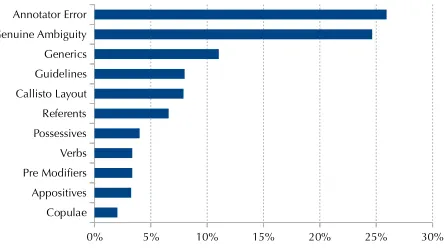
Figure 1: Description of various disagreement types Figure 1: The distribution of disagreements across the various types in Table 2
Sheet1
Page 1
Copulae 2%
Appositives 3% Pre Modifiers 3%
Verbs 3%
Possessives 4% Referents 7% Callisto Layout 8% Guidelines 8% Generics 11% Genuine Ambiguity 25% Annotator Error 26%
Copulae Appositives Pre Modifiers Verbs Possessives Referents Callisto Layout Guidelines Generics Genuine Ambiguity Annotator Error
[image:6.612.194.417.245.371.2]0% 5% 10% 15% 20% 25% 30%
Figure 2: The distribution of disagreements across the various types in Table 1
When the entity to which an appositive refers is also mentioned elsewhere, only the single span con-taining the entire appositive construction is included in the larger IDENT chain. None of the nested NP spans are linked. In the example below, the en-tire span can be linked to later mentions toRichard
Godown. The sub-spans are not included separately
in theIDENTchain.
(28) Richard Godown, president of the Indus-trial Biotechnology Association
Ages are tagged as attributes (as if they were el-lipses of, for example,a 42-year-old):
(29) Mr.Smithhead,42attribute,
3.9 Special Issues
In addition to the ones above, there are some special cases such as:
• No coreference is marked between an organi-zation and its members.
Genre ANN1-ANN2 ANN1-ADJ ANN2-ADJ
Newswire 80.9 85.2 88.3
Broadcast News 78.6 83.5 89.4
Broadcast Conversation 86.7 91.6 93.7
Magazine 78.4 83.2 88.8
Web 85.9 92.2 91.2
Table 1: Inter Annotator and Adjudicator agreement for the Coreference Layer in OntoNotes measured in terms of the MUC score.
• GPEs are linked to references to their govern-ments, even when the references are nested NPs, or the modifier and head of a single NP.
3.10 Annotator Agreement and Analysis
[image:6.612.321.536.429.492.2]seen that genuine ambiguity and annotator error are the biggest contributors – the latter of which is usually captured during adjudication, thus showing the increased agreement between the adjudicated version and the individual annotator version.
4 CoNLL-2011 Coreference Task
This section describes the CoNLL-2011 Corefer-ence task, including itsclosed andopen track
ver-sions, and characterizes the data used for the task and how it was prepared.
4.1 Why a Coreference Task?
Despite close to a two-decade history of evaluations on coreference tasks, variation in the evaluation cri-teria and in the training data used have made it dif-ficult for researchers to be clear about the state of the art or to determine which particular areas require further attention. There are many different parame-ters involved in defining a coreference task. Looking at various numbers reported in literature can greatly affect the perceived difficulty of the task. It can seem to be a very hard problem (Soon et al., 2001) or one that is somewhat easier (Culotta et al., 2007). Given the space constraints, we refer the reader to Stoy-anov et al. (2009) for a detailed treatment of the issue.
Limitations in the size and scope of the available datasets have also constrained research progress. The MUC and ACE corpora are the two that have been used most for reporting comparative results, but they differ in the types of entities and corefer-ence annotated. The ACE corpus is also one that evolved over a period of almost five years, with ferent incarnations of the task definition and dif-ferent corpus cross-sections on which performance numbers have been reported, making it hard to un-tangle and interpret the results.
The availability of the OntoNotes data offered an opportunity to define a coreference task based on a larger, more broad-coverage corpus. We have tried to design the task so that it not only can support the current evaluation, but also can provide an ongoing resource for comparing different coreference algo-rithms and approaches.
4.2 Task Description
The CoNLL-2011 shared task was based on the En-glish portion of the OntoNotes 4.0 data. The task was to automatically identify mentions of entities and events in text and to link the coreferring men-tions together to form entity/event chains. The target
coreference decisions could be made using automat-ically predicted information on the other structural layers including the parses, semantic roles, word senses, and named entities.
As is customary for CoNLL tasks, there were two tracks, closedandopen. For the closedtrack,
sys-tems were limited to using the distributed resources, in order to allow a fair comparison of algorithm per-formance, while theopentrack allowed for almost
unrestricted use of external resources in addition to the provided data.
4.2.1 Closed Track
In theclosedtrack, systems were limited to the
pro-vided data, plus the use oftwo pre-specified external
resources: i) WordNet and ii) a pre-computed
num-ber and gender table by Bergsma and Lin (2006). For the training and test data, in addition to the underlying text,predictedversions of all the
supple-mentary layers of annotation were provided, where those predictions were derived using off-the-shelf tools (parsers, semantic role labelers, named entity taggers, etc.) as described in Section 4.4.2. For the training data, however, in addition to predicted val-ues for the other layers, we also provided manual
gold-standardannotations for all the layers.
Partici-pants were allowed to use either the gold-standard or predicted annotation for training their systems. They were also free to use the gold-standard data to train their own models for the various layers of annota-tion, if they judged that those would either provide more accurate predictions or alternative predictions for use as multiple views, or wished to use a lattice of predictions.
More so than previous CoNLL tasks, corefer-ence predictions depend on world knowledge, and many state-of-the-art systems use information from external resources such as WordNet, which can add a layer that helps the system to recognize se-mantic connections between the various lexical-ized mentions in the text. Therefore, the use of WordNet was allowed, even for the closed track. Since word senses in OntoNotes are predominantly3
coarse-grained groupings of WordNet senses, sys-tems could also map from the predicted or gold-standard word senses provided to the sets of under-lying WordNet senses. Another significant piece of knowledge that is particularly useful for coreference but that is not available in the layers of OntoNotes is that ofnumberandgender. There are many different
3There are a few instances of novel senses introduced in
ways of predicting these values, with differing accu-racies, so in order to ensure that participants in the
closedtrack were working from the same data, thus
allowing clearer algorithmic comparisons, we spec-ified a particular table of number and gender predic-tions generated by Bergsma and Lin (2006), for use during both training and testing.
Following the recent CoNLL tradition, partici-pants were allowed to use both the training and the development data for training the final model.
4.2.2 Open Track
In addition to resources available in theclosedtrack,
theopentrack, systems were allowed to use external
resources such as Wikipedia, gazetteers etc. This track is mainly to get an idea of a performance ceil-ing on the task at the cost of not gettceil-ing a compar-ison across all systems. Another advantage of the
opentrack is that it might reduce the barriers to
par-ticipation by allowing participants to field existing research systems that already depend on external re-sources – especially if there were hard dependen-cies on these resources. They can participate in the task with minimal or no modification to their exist-ing system.
4.3 Coreference Task Data
Since there are no previously reported numbers on the full version of OntoNotes, we had to create a train/development/test partition. The only por-tion of OntoNotes that has a previously determined, widely used, standard split is theWSJportion of the newswire data. For that subcorpus, we maintained the same partition. For all the other portions we cre-ated stratified training, development and test parti-tions over all the sources in OntoNotes using the pro-cedure shown in Algorithm 1. The list of training, development and test document IDs can be found on the task webpage.4
4.4 Data Preparation
This section gives details of the different annota-tion layers including the automatic models that were used to predict them, and describes the formats in which the data were provided to the participants.
4.4.1 Manual AnnotationGoldLayers
We will take a look at the manually annotated, or
goldlayers of information that were made available
for the training data.
4http://conll.bbn.com/download/conll-train.id
http://conll.bbn.com/download/conll-dev.id http://conll.bbn.com/download/conll-test.id
Algorithm 1 Procedure used to create OntoNotes
training, development and test partitions.
Procedure:GENERATEPARTITIONS(ONTONOTES)returnsTRAIN,
DEV, TEST
1: TRAIN← ∅
2: DEV← ∅
3: TEST← ∅
4: for allSOURCE∈ONTONOTESdo
5: ifSOURCE=WALLSTREETJOURNALthen
6: TRAIN←TRAIN∪SECTIONS02 – 21 7: DEV←DEV∪SECTIONS00, 01, 22, 24
8: TEST←TEST∪SECTION23
9: else
10: ifNumber of files in SOURCE≥10then
11: TRAIN←TRAIN∪FILEIDSending in 1 – 8
12: DEV←DEV∪FILEIDSending in 0
13: TEST←TEST∪FILEIDSending in 9
14: else
15: DEV←DEV∪FILEIDSending in 0
16: TEST←TEST∪FILEID ending in the highest number
17: TRAIN←TRAIN∪Remaining FILEIDSfor the SOURCE
18: end if
19: end if
20: end for
21: return TRAIN, DEV, TEST
Coreference The manual coreference annotation
is stored as chains of linked mentions connecting multiple mentions of the same entity. Coreference is the only document-level phenomenon in OntoNotes, and the complexity of annotation increases non-linearly with the length of a document. Unfortu-nately, some of the documents – especially ones in the broadcast conversation, weblogs, and telephone conversation genre – are very long which prohib-ited us from efficiently annotating them in entirety. These had to be split into smaller parts. We con-ducted a few passes to join some adjacent parts, but since some documents had as many as 17 parts, there are still multi-part documents in the corpus. Since the coreference chains are coherent only within each of these document parts, for this task, each such part is treated as a separate document. Another thing to note is that there were some cases of sub-token annotation in the corpus owing to the fact that to-kens were not split at hyphens. Cases such as pro-WalMarthad the sub-spanWalMartlinked with another
instance of the same. The recent Treebank revision which split tokens atmosthyphens, made a majority
of these sub-token annotations go away. There were still some residual sub-token annotations. Since subtoken annotations cannot be represented in the CoNLL format, and they were a very small quantity – much less than even half a percent – we decided to ignore them.
differ-Corpora Words Documents
Total Train Dev Test Total Train Dev Test
MUC-6 25K 12K 13K 60 30 30
MUC-7 40K 19K 21K 67 30 37
ACE(2000-2004) 1M 775K 235K - -
-OntoNotes5 1.3M 1M 136K 142K 2,083
(2,999)
1,674
(2,374)
202 (303)
[image:9.612.173.441.56.123.2]207 (322)
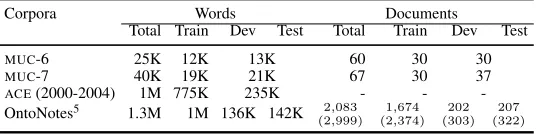
Table 2: Number of documents in the OntoNotes data, and some comparison with theMUCandACEdata sets. The
numbers in parenthesis for the OntoNotes corpus indicate the total number ofpartsthat correspond to the documents.
Each part was considered a separate document for evaluation purposes.
Syntactic category Train Development Test Count % Count % Count % NP 60,345 59.71 8,463 59.31 8,629 53.09 PRP 25,472 25.21 3,535 24.78 5,012 30.84 PRP$ 8,889 8.80 1,208 8.47 1,466 9.02 NNP 2,643 2.62 468 3.28 475 2.92
NML 900 0.89 151 1.06 118 0.73
Vx 1,915 1.89 317 2.22 314 1.93
[image:9.612.73.318.185.283.2]Other 893 0.88 126 0.88 239 1.47 Overall 101,057 100.00 14,268 100.00 16,253 100.00
Table 3: Distribution of mentions in the data by their syn-tactic category.
[image:9.612.104.268.333.378.2]Train Development Test Entities/Chains 26,612 3,752 3,926 Links 74,652 10,539 12,365 Mentions 101,264 14,291 16,291
Table 4: Number of entities, links and mentions in the OntoNotes 4.0 data.
ent layers of annotation, with full coverage.6 There
is a core portion, however, which is roughly 1.3M words which has been annotated with all the layers. This is the portion that we used for the shared task.
The number of documents in the corpus for this task, for each of the different genres, are shown in Table 2. Tables 3 and 4 shows the distribution of mentions by the syntactic categories, and the counts of entities, links and mentions in the corpus respec-tively. All of this data has been Treebanked and PropBanked either as part of the OntoNotes effort or some preceding effort.
For comparison purposes, Table 2 also lists the number of documents in the MUC-6, MUC-7, and ACE (2000-2004) corpora. The MUC-6 data was taken from the Wall Street Journal, whereas the MUC-7 data was from the New York Times. The ACE data spanned many different genres similar to
6Given the nature of word sense annotation, and changes in
project priorities, we could not annotate all the low frequency verbs and nouns in the corpus. Furthermore, PropBank annota-tion currently only covers verb predicates.
the ones in OntoNotes.
Parse Trees This represents the syntactic layer
that is a revised version of the Penn Treebank. For purposes of this task, traces were removed from the syntactic trees, since the CoNLL-style data format, being indexed by tokens, does not provide any good means of conveying that information. Function tags were also removed, since the parsers that we used for the predicted syntax layer did not provide them. One thing that needs to be dealt with in conversa-tional data is the presence of disfluencies (restarts, etc.). In the original OntoNotes parses, these are marked using a specialEDITED7phrase tag – as was the case for the Switchboard Treebank. Given the frequency of disfluencies and the performance with which one can identify them automatically,8a
prob-able processing pipeline would filter them out be-fore parsing. Since we did not have a readily avail-able tagger for tagging disfluencies, we decided to remove them using oracle information available in the Treebank.
Propositions The propositions in OntoNotes
con-stitute PropBank semantic roles. Most of the verb predicates in the corpus have been annotated with their arguments. Recent enhancements to the Prop-Bank to make it synchronize better with the Tree-bank (Babko-Malaya et al., 2006) have enhanced the information in the proposition by the addition of two types ofLINKs that represent pragmatic corefer-ence (LINK-PCR) and selectional preferences (LINK-SLC). More details can be found in the addendum to the PropBank guidelines9 in the OntoNotes 4.0
re-7There is another phrase type –EMBEDin the telephone
con-versation genre which is similar to theEDITEDphrase type, and
sometimes identifies insertions, but sometimes contains logical continuation of phrases, so we decided not to remove that from the data.
8A study by Charniak and Johnson (2001) shows that one
can identify and remove edits from transcribed conversational speech with an F-score of about 78, with roughly 95 Precision and 67 recall.
lease. Since the community is not used to this rep-resentation which relies heavily on the trace struc-ture in the Treebank which we are excluding, we de-cided tounfoldtheLINKs back to their original
rep-resentation as in the Release 1.0 of the Proposition Bank. This functionality is part of the OntoNotes DB Tool.10
Word Sense Gold word sense annotation was
supplied using sense numbers as specified in the OntoNotes list of senses for each lemma.11
The sense inventories that were provided in the OntoNotes 4.0 release were not all mapped to the lat-est version 3.0 of WordNet, so we provided a revised version of the sense inventories, containing mapping to WordNet 3.0, on the task page for the participants.
Named Entities Named Entities in OntoNotes
data are specified using a catalog of 18 Name types.
Other Layers Discourse plays a vital role in
coreference resolution. In the case of broadcast con-versation, or telephone conversation data, it partially manifests in the form of speakers of a given utter-ance, whereas in weblogs or newsgroups it does so as the writer, or commenter of a particular article or thread. This information provides an important clue for correctly linking anaphoric pronouns with the right antecedents. This information could be au-tomatically deduced, but since it would add addi-tional complexity to the already complex task, we decided to provide oracle information of this meta-data both during training and testing. In other words, speaker and author identification was not treated as an annotation layer that needed to be predicted. This information was provided in the form of an-other column in the.conlltable. There were some
cases of interruptions and interjections that ideally would associate parts of a sentence to two different speakers, but since the frequency of this was quite small, we decided to make an assumption of one speaker/writer per sentence.
4.4.2 Predicted Annotation Layers
The predicted annotation layers were derived using automatic models trained using cross-validation on other portions of OntoNotes data. As mentioned ear-lier, there are some portions of the OntoNotes corpus that have not been annotated for coreference but that have been annotated for other layers. For training
10http://cemantix.org/ontonotes.html
11It should be noted that word sense annotation in OntoNotes
is note complete, so only some of the verbs and nouns have word sense tags specified.
Senses Lemmas 1 1,506 2 1,046
[image:10.612.395.457.53.103.2]>2 1,016
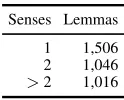
Table 6: Word sense polysemy over verb and noun lem-mas in OntoNotes
models for each of the layers, where feasible, we used all the data that we could for that layer from the training portion of the entire OntoNotes release.
Parse Trees Predicted parse trees were produced
using the Charniak parser (Charniak and Johnson, 2005).12 Some additional tag types used in the
OntoNotes trees were added to the parser’s tagset, including theNMLtag that has recently been added to capture internalNPstructure, and the rules used to determine head words were appropriately extended. The parser was then re-trained on the training por-tion of the release 4.0 data using 10-fold cross-validation. Table 5 shows the performance of the re-trained Charniak parser on the CoNLL-2011 test set. We did not get a chance to re-train the re-ranker, and since the stock re-ranker crashes when run onn -best parses containingNMLs, because it has not seen that tag in training, we could not make use of it.
Word Sense We trained a word sense tagger
us-ing a SVM classifier and contextual word and part of speech features on all the training portion of the OntoNotes data. The OntoNotes 4.0 corpus com-prises a total of 14,662 sense definitions across 4877 verb and noun lemmas13. The distribution of senses
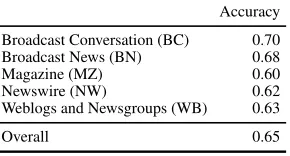
per lemma is as shown in Table 6. Table 7 shows the performance of this classifier overboth the verbs
and nounsin the CoNLL-2011 test set. Again this
performance is not directly comparable to any re-ported in the literature before, and it seems lower then performances reported on previous versions of OntoNotes because this is over all the genres of OntoNotes, and aggregated over both verbs and nouns in the CoNLL-2011 test set.
Propositions To predict propositional structure,
ASSERT14 (Pradhan et al., 2005) was used,
re-trained also on all the training portion of the release
12
http://bllip.cs.brown.edu/download/reranking-parserAug06.tar.gz
13The number of lemmas in Table 6 do not add up to this
number because not all of them have examples in the training data, where the total number of instantiated senses amounts to 7933.
All Sentences Sentence len<40
N POS R P F N R P F
[image:11.612.142.470.56.146.2]Broadcast Conversation (BC) 2,194 95.93 84.30 84.46 84.38 2124 85.83 85.97 85.90 Broadcast News (BN) 1,344 96.50 84.19 84.28 84.24 1278 85.93 86.04 85.98 Magazine (MZ) 780 95.14 87.11 87.46 87.28 736 87.71 88.04 87.87 Newswire (NW) 2,273 96.95 87.05 87.45 87.25 2082 88.95 89.27 89.11 Telephone Conversation (TC) 1,366 93.52 79.73 80.83 80.28 1359 79.88 80.98 80.43 Weblogs and Newsgroups (WB) 1,658 94.67 83.32 83.20 83.26 1566 85.14 85.07 85.11 Overall 9,615 96.03 85.25 85.43 85.34 9145 86.86 87.02 86.94
Table 5: Parser performance on the CoNLL-2011 test set
[image:11.612.130.482.188.274.2]Frameset Total Total % Perfect Argument ID + Class Accuracy Sentences Propositions Propositions P R F Broadcast Conversation (BC) 0.92 2,037 5,021 52.18 82.55 64.84 72.63 Broadcast News (BN) 0.91 1,252 3,310 53.66 81.64 64.46 72.04 Magazine (MZ) 0.89 780 2,373 47.16 79.98 61.66 69.64 Newswire (NW) 0.93 1,898 4,758 39.72 80.53 62.68 70.49 Weblogs and Newsgroups (WB) 0.92 929 2,174 39.19 81.01 60.65 69.37 Overall 0.91 6,896 17,636 46.82 81.28 63.17 71.09
Table 8: Performance on the propositions and framesets in the CoNLL-2011 test set.
Accuracy Broadcast Conversation (BC) 0.70 Broadcast News (BN) 0.68
Magazine (MZ) 0.60
Newswire (NW) 0.62
Weblogs and Newsgroups (WB) 0.63
Overall 0.65
Table 7: Word sense performance over both verbs and nouns in the CoNLL-2011 test set
4.0 data. Given time constraints, we had to per-form two modifications: i) Instead of a single model that predicts all arguments including NULL argu-ments, we had to use the two-stage mode where the NULLarguments are first filtered out and the
remain-ingNON-NULLarguments are classified into one of
the argument types, and ii) The argument identifi-cation module used an ensemble of ten classifiers – each trained on a tenth of the training data and performed an unweighted voting among them. This should still give a close to state of the art mance given that the argument identification perfor-mance tends to start to be asymptotic around 10k training instances. At first glance, the performance on the newswire genre is much lower than what has been reported for WSJ Section 23. This could be attributed to two factors: i) the fact that we had to compromise on the training method, but more im-portantly because ii) the newswire in OntoNotes not only contains WSJ data, but also Xinhua news. One
could try to verify using just the WSJ portion of the data, but it would be hard as it is not only a sub-set of the documents that the performance has been reported on previously, but also the annotation has been significantly revised; it includes propositions for be verbs missing from the original PropBank,
and the training data is a subset of the original data as well. Table 8 shows the detailed performance numbers.
In addition to automatically predicting the argu-ments, we also trained a classifier to tag PropBank framesetIDs in the data using the same word sense module as mentioned earlier. OntoNotes 4.0 con-tains a total of 7337 framesets across 5433 verb lemmas.15 An overwhelming number of them are
monosemous, but the more frequent verbs tend to be polysemous. Table 9 gives the distribution of num-ber of framesets per lemma in the PropBank layer of the OntoNotes 4.0 data.
During automatic processing of the data, we tagged all the tokens that were tagged with a part of speechVBx. This means that there would be cases
where the wrong token would be tagged with propo-sitions. The CoNLL-2005 scorer was used to gener-ate the scores.
Named Entities BBN’s IdentiFinderTMsystem
was used to predict the named entities. Given the
15The number of lemmas in Table 9 do not add up to this
[image:11.612.115.260.321.399.2]Framesets Lemmas 1 2,722 2 321
[image:12.612.148.222.55.101.2]>2 181
Table 9: Frameset polysemy across lemmas
Overall BC BN MZ NW TC WB
F F F F F F F
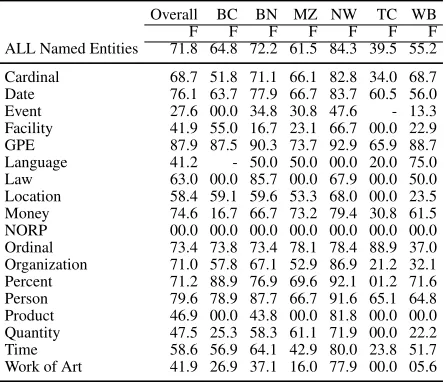
ALL Named Entities 71.8 64.8 72.2 61.5 84.3 39.5 55.2 Cardinal 68.7 51.8 71.1 66.1 82.8 34.0 68.7 Date 76.1 63.7 77.9 66.7 83.7 60.5 56.0 Event 27.6 00.0 34.8 30.8 47.6 - 13.3 Facility 41.9 55.0 16.7 23.1 66.7 00.0 22.9 GPE 87.9 87.5 90.3 73.7 92.9 65.9 88.7 Language 41.2 - 50.0 50.0 00.0 20.0 75.0 Law 63.0 00.0 85.7 00.0 67.9 00.0 50.0 Location 58.4 59.1 59.6 53.3 68.0 00.0 23.5 Money 74.6 16.7 66.7 73.2 79.4 30.8 61.5 NORP 00.0 00.0 00.0 00.0 00.0 00.0 00.0 Ordinal 73.4 73.8 73.4 78.1 78.4 88.9 37.0 Organization 71.0 57.8 67.1 52.9 86.9 21.2 32.1 Percent 71.2 88.9 76.9 69.6 92.1 01.2 71.6 Person 79.6 78.9 87.7 66.7 91.6 65.1 64.8 Product 46.9 00.0 43.8 00.0 81.8 00.0 00.0 Quantity 47.5 25.3 58.3 61.1 71.9 00.0 22.2 Time 58.6 56.9 64.1 42.9 80.0 23.8 51.7 Work of Art 41.9 26.9 37.1 16.0 77.9 00.0 05.6
Table 10: Named Entity performance on the CoNLL-2011 test set
time constraints, we could not re-train it on the OntoNotes data and so an existing, pre-trained model was used, therefore the results are not a good indicator of the model’s best performance. The pre-trained model had also used a somewhat different catalog of name types, which did not include the OntoNotesNORPtype (for nationalities, organizations, religions, and political parties), so that category was never predicted. Table 10 shows the overall performance of the tagger on the CoNLL-2011 test set, as well as the performance broken down by individual name types. IdentiFinder performance has been reported to be in the low 90’s on WSJ test set.
Other Layers As noted above, systems were
al-lowed to make use of gender and number predic-tions for NPs using the table from Bergsma and Lin (Bergsma and Lin, 2006).
4.4.3 Data Format
In order to organize the multiple, rich layers of anno-tation, the OntoNotes project has created a database representation for the raw annotation layers along with a Python API to manipulate them (Pradhan et al., 2007a). In the OntoNotes distribution the data is
organized as one file per layer, per document. The API requires a certain hierarchical structure with documents at the leaves inside a hierarchy of lan-guage, genre, source and section. It comes with var-ious ways of cleanly querying and manipulating the data and allows convenient access to the sense in-ventory and propbank frame files instead of having to interpret the raw.xmlversions. However,
main-taining format consistency with earlier CoNLL tasks was deemed convenient for sites that already had tools configured to deal with that format. Therefore, in order to distribute the data so that one could make the best of both worlds, we created a new file type called.conllwhich logically served as another layer
in addition to the .parse, .prop, .name and .coref
layers. Each.conll file contained a merged
repre-sentation of all the OntoNotes layers in the CoNLL-style tabular format with one line per token, and with multiple columns for each token specifying the input annotation layers relevant to that token, with the fi-nal column specifying the target coreference layer. Because OntoNotes is not authorized to distribute the underlying text, and many of the layers contain inline annotation, we had to provide a skeletal form (.skel of the.conll file which was essentially the .conllfile, but with the word column replaced with
a dummy string. We provided an assembly script that participants could use to create a.conllfile
tak-ing as input the.skelfile and the top-level directory
of the OntoNotes distribution that they had sepa-rately downloaded from the LDC16Once the.conll
file is created, it can be used to create the individual layers such as.parse, .name,.coref etc. using
an-other set of scripts. Since the propositions and word sense layers are inherently standoff annotation, they were provided as is, and did not require that extra merging step. One thing thing that made this data creation process a bit tricky was the fact that we had dissected some of the trees for the conversation data to remove theEDITED phrases. Table 11 describes the data provided in each of the column of the.conll
format. Figure 3 shows a sample from a.conllfile.
4.5 Evaluation
This section describes the evaluation criteria used. Unlike for propositions, word sense and named en-tities, where it is simply a matter of counting the correct answers, or for parsing, where there are sev-eral established metrics, evaluating the accuracy of coreference continues to be contentious. Various
al-16OntoNotes is deeply grateful to the Linguistic Data
[image:12.612.75.298.141.332.2]Column Type Description
1 Document ID This is a variation on the document filename
2 Part number Some files are divided into multiple parts numbered as 000, 001, 002, ... etc. 3 Word number This is the word index in the sentence
4 Word The word itself
5 Part of Speech Part of Speech of the word
6 Parse bit This is the bracketed structure broken before the first open parenthesis in the parse, and the word/part-of-speech leaf replaced with a *. The full parse can be created by substituting the asterix with the([pos] [word])string (or leaf) and concatenating the items in the rows of that column.
7 Predicate lemma The predicate lemma is mentioned for the rows for which we have semantic role informa-tion. All other rows are marked with a
-8 Predicate Frameset ID This is the PropBank frameset ID of the predicate in Column 7. 9 Word sense This is the word sense of the word in Column 3.
10 Speaker/Author This is the speaker or author name where available. Mostly in Broadcast Conversation and Web Log data.
11 Named Entities These columns identifies the spans representing various named entities.
12:N Predicate Arguments There is one column each of predicate argument structure information for the predicate mentioned in Column 7.
[image:13.612.105.511.86.269.2]N Coreference Coreference chain information encoded in a parenthesis structure.
Table 11: Format of the.conllfile used on the shared task
#begin document (nw/wsj/07/wsj_0771); part 000 ...
...
nw/wsj/07/wsj_0771 0 0 ‘‘ ‘‘ (TOP(S(S* - - - - * * (ARG1* * * -nw/wsj/07/wsj_0771 0 1 Vandenberg NNP (NP* - - - - (PERSON) (ARG1* * * * (8|(0) nw/wsj/07/wsj_0771 0 2 and CC * - - - - * * * * * -nw/wsj/07/wsj_0771 0 3 Rayburn NNP *) - - - - (PERSON) *) * * *(23)|8) nw/wsj/07/wsj_0771 0 4 are VBP (VP* be 01 1 - * (V*) * * * -nw/wsj/07/wsj_0771 0 5 heroes NNS (NP(NP*) - - - - * (ARG2* * * * -nw/wsj/07/wsj_0771 0 6 of IN (PP* - - - - * * * * * -nw/wsj/07/wsj_0771 0 7 mine NN (NP*)))) - - 5 - * *) * * * (15) nw/wsj/07/wsj_0771 0 8 , , * - - - - * * * * * -nw/wsj/07/wsj_0771 0 9 ’’ ’’ *) - - - - * * *) * * -nw/wsj/07/wsj_0771 0 10 Mr. NNP (NP* - - - - * * (ARG0* (ARG0* * (15 nw/wsj/07/wsj_0771 0 11 Boren NNP *) - - - - (PERSON) * *) *) * 15) nw/wsj/07/wsj_0771 0 12 says VBZ (VP* say 01 1 - * * (V*) * * -nw/wsj/07/wsj_0771 0 13 , , * - - - - * * * * * -nw/wsj/07/wsj_0771 0 14 referring VBG (S(VP* refer 01 2 - * * (ARGM-ADV* (V*) * -nw/wsj/07/wsj_0771 0 15 as RB (ADVP* - - - - * * * (ARGM-DIS* * -nw/wsj/07/wsj_0771 0 16 well RB *) - - - - * * * *) * -nw/wsj/07/wsj_0771 0 17 to IN (PP* - - - - * * * (ARG1* * -nw/wsj/07/wsj_0771 0 18 Sam NNP (NP(NP* - - - - (PERSON* * * * * (23 nw/wsj/07/wsj_0771 0 19 Rayburn NNP *) - - - - *) * * * * -nw/wsj/07/wsj_0771 0 20 , , * - - - - * * * * * -nw/wsj/07/wsj_0771 0 21 the DT (NP(NP* - - - - * * * * (ARG0* -nw/wsj/07/wsj_0771 0 22 Democratic JJ * - - - - (NORP) * * * * -nw/wsj/07/wsj_0771 0 23 House NNP * - - - - (ORG) * * * * -nw/wsj/07/wsj_0771 0 24 speaker NN *) - - - - * * * * *) -nw/wsj/07/wsj_0771 0 25 who WP (SBAR(WHNP*) - - - - * * * * (R-ARG0*) -nw/wsj/07/wsj_0771 0 26 cooperated VBD (S(VP* cooperate 01 1 - * * * * (V*) -nw/wsj/07/wsj_0771 0 27 with IN (PP* - - - - * * * * (ARG1* -nw/wsj/07/wsj_0771 0 28 President NNP (NP* - - - - * * * * * -nw/wsj/07/wsj_0771 0 29 Eisenhower NNP *))))))))))) - - - - (PERSON) * *) *) *) 23) nw/wsj/07/wsj_0771 0 30 . . *)) - - - - * * * * *
-nw/wsj/07/wsj_0771 0 0 ‘‘ ‘‘ (TOP(S* - - - - * * * -nw/wsj/07/wsj_0771 0 1 They PRP (NP*) - - - - * (ARG0*) * (8) nw/wsj/07/wsj_0771 0 2 allowed VBD (VP* allow 01 1 - * (V*) * -nw/wsj/07/wsj_0771 0 3 this DT (S(NP* - - - - * (ARG1* (ARG1* (6 nw/wsj/07/wsj_0771 0 4 country NN *) - - 3 - * * *) 6) nw/wsj/07/wsj_0771 0 5 to TO (VP* - - - - * * * -nw/wsj/07/wsj_0771 0 6 be VB (VP* be 01 1 - * * (V*) (16) nw/wsj/07/wsj_0771 0 7 credible JJ (ADJP*))))) - - - - * *) (ARG2*) -nw/wsj/07/wsj_0771 0 8 . . *)) - - - - * * *
-#end document
[image:13.612.72.544.369.640.2]ternative metrics have been proposed, as mentioned below, which weight different features of a proposed coreference pattern differently. The choice is not clear in part because the value of a particular set of coreference predictions is integrally tied to the con-suming application.
A further issue in defining a coreference metric concerns the granularity of the mentions, and how closely the predicted mentions are required to match those in the gold standard for a coreference predic-tion to be counted as correct.
Our evaluation criterion was in part driven by the OntoNotes data structures. OntoNotes coreference distinguishes between identity coreference and ap-positive coreference, treating the latter separately because it is already captured explicitly by other lay-ers of the OntoNotes annotation. Thus we evaluated systems only on the identity coreference task, which links all categories of entities and events together into equivalent classes.
The situation with mentions for OntoNotes is also different than it was for MUC or ACE. OntoNotes data does not explicitly identify the minimum ex-tents of an entity mention, but it does include hand-tagged syntactic parses. Thus for the official evalua-tion, we decided to use the exact spans of mentions for determining correctness. The NP boundaries for the test data were pre-extracted from the hand-tagged Treebank for annotation, and events trig-gered by verb phrases were tagged using the verbs themselves. This choice means that scores for the CoNLL-2011 coreference task are likely to be lower than for coref evaluations based onMUC, where the mention spans are specified in the input,17 or those
based on ACEdata, where an approximate match is often allowed based on the specified head of the NP mention.
4.5.1 Metrics
As noted above, the choice of an evaluation met-ric for coreference has been a tmet-ricky issue and there does not appear to be any silver bullet approach that addresses all the concerns. Three metrics have been proposed for evaluating coreference performance over an unrestricted set of entity types: i) Thelink
basedMUCmetric (Vilain et al., 1995), ii) The men-tion based B-CUBED metric (Bagga and Baldwin,
1998) and iii) TheentitybasedCEAF (Constrained Entity Aligned F-measure) metric (Luo, 2005). Very recently BLANC (BiLateral Assessment of Noun-Phrase Coreference) measure (Recasens and Hovy,
17as is the case in this evaluation with Gold Mentions
2011) has been proposed as well. Each of the met-ric tries to address the shortcomings or biases of the earlier metrics. Given a set of key entitiesK, and a set of response entitiesR, with each entity com-prising one or more mentions, each metric generates its variation of a precision and recall measure. The MUCmeasure if the oldest and most widely used. It focuses on thelinks (or, pairs of mentions) in the
data.18 The number of common links between
en-tities in K and R divided by the number of links inK represents the recall, whereas, precision is the number of common links between entities inKand Rdivided by the number of links inR. This met-ric prefers systems that have more mentions per en-tity – a system that creates a single enen-tity of all the mentions will get a 100% recall without signifi-cant degradation in its precision. And, it ignores re-call for singleton entities, or entities with only one mention. The B-CUBED metric tries to addresses
MUCS’s shortcomings, by focusing on thementions
and computes recall and precision scores for each mention. IfKis the key entity containing mentionM, andR is the response entity containing mentionM, then recall for the mentionMis computed as |K|K∩R|| and precision for the same is is computed as |K∩R|
|R| .
Overall recall and precision are the average of the individual mention scores. CEAF aligns every re-sponse entity with at mostonekey entity by finding
the best one-to-one mapping between the entities us-ing an entity similarity metric. This is a maximum bipartite matching problem and can be solved by the Kuhn-Munkres algorithm. This is thus aentity
based measure. Depending on the similarity, there are two variations –entitybasedCEAF–CEAFeand amentionbased CEAF– CEAFe. Recall is the total similarity divided by the number of mentions inK, and precision is the total similarity divided by the number of mentions in R. Finally, BLANC uses a variation on the Rand index (Rand, 1971) suitable for evaluating coreference. There are a few other measures – one being the ACEvalue, but since this is specific to a restricted set of entities (ACEtypes), we did not consider it.
4.5.2 Official Evaluation Metric
In order to determine the best performing system in the shared task, we needed to associate a single number with each system. This could have been one of the metrics above, or some combination of more than one of them. The choice was not sim-ple, and while we consulted various researchers in
the field, hoping for a strong consensus, their con-clusion seemed to be that each metric had its pros and cons. We settled on the MELAmetric by Denis and Baldridge (2009), which takes a weighted av-erage of three metrics: MUC, B-CUBED, andCEAF. The rationale for the combination is that each of the three metrics represents a different important dimen-sion, the MUC measure being based on links, the
B-CUBED based on mentions, and the CEAF based
on entities. For a given task, a weighted average of the three might be optimal, but since we don’t have an end task in mind, we decided to use the un-weighted mean of the three metrics as the score on which the winning system was judged. We decided to useCEAFeinstead ofCEAFm.
4.5.3 Scoring Metrics Implementation
We used the same core scorer implementation19that
was used for the SEMEVAL-2010 task, and which implemented all the different metrics. There were a couple of modifications done to this scorer after it was used for the SEMEVAL-2010 task.
1. Only exact matches were considered cor-rect. Previously, for SEMEVAL-2010 non-exact matches were judged partially correct with a 0.5 score if the heads were the same and the mention extent did not exceed the gold men-tion.
2. The modifications suggested by Cai and Strube (2010) were incorporated in the scorer.
Since there are differences in the version used for CoNLL and the one available on the download site, and it is possible that the latter would be revised in the future, we have archived the version of the scorer on the CoNLL-2011 task webpage.20
5 Systems and Results
About 65 different groups demonstrated interest in the shared task by registering on the task webpage. Of these, 23 groups submitted system outputs on the test set during the evaluation week. 18 groups sub-mitted only closed track results, 3 groups only open track results, and 2 groups submitted both closed and open track results. 2 participants in the closed track, did not write system papers, so we don’t use their re-sults in the discussion. Their rere-sults will be reported on the task webpage.
19http://www.lsi.upc.edu/ esapena/downloads/index.php?id=3 20http://conll.bbn.com/download/scorer.v4.tar.gz
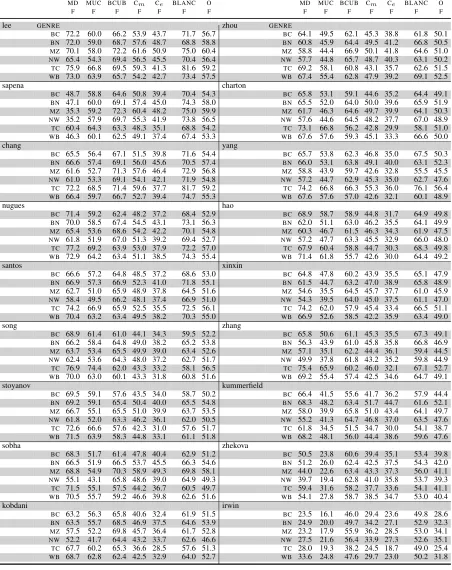
The official results for the 18 systems that submit-ted closed track outputs are shown in Table 12, with those for the 5 systems that submitted open track results in Table 13. The official ranking score, the arithmetic mean of the F-scores of MUC, B-CUBED andCEAFe, is shown in the rightmost column. For convenience, systems will be referred to here using the first portion of the full name, which is unique within each table.
For completeness, the tables include the raw pre-cision and recall scores from which the F-scores were derived. The tables also include two additional scores (BLANCandCEAFm) that did not factor into the official ranking score. Useful further analysis may be possible based on these results beyond the preliminary results presented here.
As discussed previously in the task description, we will consider three different test input conditions: i) Predicted only (Official), ii) Predicted plus gold mention boundaries, and iii) Predicted plus gold mentions
5.1 Predicted only (Official)
For the official test, beyond the raw source text, coreference systems were provided only with the predictions from automatic engines as to the other annotation layers (parses, semantic roles, word senses, and named entities).
In this evaluation it is important to note that the mention detection score cannot be considered in iso-lation of the coreference task as has usually been the case. This is mainly owing to the fact that there are no singleton entities in the OntoNotes data. Most systems removed singletons from the response as a post-processing step, so not only will they not get credit for the singleton entities that they correctly re-moved from the data, but they will be penalized for the ones that they accidentally linked with another mention. What this number does indicate is the ceil-ing on recall that a system would have got in absence of being penalized for making mistakes in corefer-ence resolution. A close look at the Table 12 indi-cates a possible outlier in case of thesapenasystem.
The recall for this system is very high, and precision way lower than any other system. Further investi-gations uncovered that the reason for this aberrant behavior was that fact that this system opted tokeep
singletons in the response. By design, the scorer re-moves singletons that might be still present in the system, but it does so after the mention detection
accuracy is computed.
erence evaluations, that is as expected, given that the task here includes predicting the underlying men-tions and mention boundaries, the insistence on ex-act match, and given that the relatively easier appos-itive coreference cases are not included in this mea-sure. The top-performing system (lee) had a score
of 57.79 which is about 1.8 points higher than that of the second (sapena) and third (chang) ranking
systems, which scored 55.99 and 55.96 respectively. Another 1.5 points separates them from the fourth best score of 54.53 (nugues). Thus the performance
differences between the better-scoring systems were not large, with only about three points separating the top four systems.
This becomes even clearer if we merge in the re-sults of systems that participated only in the open track but that made relatively limited use of outside resources.21 Comparing that way, the cai system
scores in the same ball park as the second rank sys-tems (sapenaandchang). Theuryupinasystem
sim-ilarly scores very close tonugues’s 54.53
Given that our choice of the official metric was somewhat arbitrary, if is also useful to look at the individual metrics, including the mention-based
CEAFm and BLANC metrics that were not part of
the official metric. The lee system which scored
the best using the official metric does slightly worse thansongon theMUCmetric, and also does slightly worse thanchangon theB-CUBEDandBLANC met-rics. However, it does much better than every other group on the entity-basedCEAFe, and this is the pri-mary reason for its 1.8 point advantage in the offi-cial score. If the CEAFe measure does indicate the accuracy of entities in the response, this suggests that theleesystem is doing better on getting
coher-ent coher-entities than any other system. This could be partly due to the fact that that system is primarily a precision-based system that would tend to create purer entities. TheCEAFemeasure also seems to pe-nalize other systems more harshly than do the other measures.
We cannot compare these results to the ones ob-tained in the SEMEVAL-2010 coreference task using a small portion of OntoNotes data because it was only using nominal entities, and had heuristically added singleton mentions to the OntoNotes data22
21Thecaisystem specifically mentions that, and the only
re-source that theuryupinasystem used outside of the closed track
setting was the Stanford named entity tagger.
22The documentation that comes with the SEMEVAL data
package from LDC (LDC2011T01) states: “Only nominal mentions and identical (IDENT) types were taken from the OntoNotes coreference annotation, thus excluding coreference
5.2 Predicted plus gold mentionboundaries
We also explored performance when the systems were provided with the gold mention boundaries, that is, with the exact spans (expressed in terms of token offsets) for all of the NP constituents in the human-annotated parse trees for the test data. Sys-tems could use this additional data to ensure that the output mention spans in their entity chains would not clash with those in the answer set. Since this was a secondary evaluation, it was anoptionalelement,
and not all participants ran their systems on this task variation. The results for those systems that did par-ticipate in this optional task are shown in Tables 14 (closed track) and 15 (open track).
Most of the better scoring systems did supply these results. While all systems did slightly better here in terms of raw scores, the performance was not much different from the official task, indicating that mention boundary errors resulting from prob-lems in parsing do not contribute significantly to the final output.23
One side benefit of performing this supplemental evaluation was that it revealed a subtle bug in the automatic scoring routine that we were using that could double-count duplicate correct mentions in a given entity chain. These can occur, for example, if the system considers a unit-productionNP-PRP com-bination as two mentions that identify the exact same token in the text, and reports them as separate men-tions. Most systems had a filter in their processing that selected only one of these duplicate mentions, but thekobdanisystem considered both as potential
mentions, and its developers tuned their algorithm using that flawed version of the scorer.
When we fixed the scorer and re-evaluated all of the systems, the kobdani system was the only one
whose score was affected significantly, dropping by about 8 points, which lowered that system’s rank from second to ninth. It is not clear how much of this was owing to the fact that the system’s
param-relations with verbs and appositives. Since OntoNotes is only annotated with multi-mention entities, singleton referential ele-ments were identified heuristically: all NPs and possessive de-terminers were annotated as singletons excluding those func-tioning as appositives or as pre-modifiers but for NPs in the possessive case. In coordinated NPs, single constituents as well as the entire NPs were considered to be mentions. There is no reliable heuristic to automatically detect English expletive pro-nouns, thus they were (although inaccurately) also annotated as singletons.”
23It would be interesting to measure the overlap between the