Proceedings of the 2019 Conference on Empirical Methods in Natural Language Processing and the 9th International Joint Conference on Natural Language Processing, pages 5002–5011,
5002
Modeling the Relationship between User Comments
and Edits in Document Revision
Xuchao Zhang†∗, Dheeraj Rajagopal‡∗, Michael Gamon§, Sujay Kumar Jauhar§ and Chang-Tien Lu†
†Discovery Analytics Center, Virginia Tech, Falls Church, VA, USA ‡Carnegie Mellon University, Pittsburgh, PA, USA
§Microsoft Research, Redmond, WA, USA
†{xuczhang, ctlu}@vt.edu,‡[email protected],§{mgamon, sjauhar}@microsoft.com
Abstract
Management of collaborative documents can be difficult, given the profusion of edits and comments that multiple authors make during a document’s evolution. Reliably modeling the relationship between edits and comments is a crucial step towards helping the user keep track of a document in flux. A number of au-thoring tasks, such as categorizing and sum-marizing edits, detecting completed to-dos, and visually rearranging comments could ben-efit from such a contribution. Thus, in this pa-per we explore the relationship between com-ments and edits by defining two novel, related tasks: Comment Ranking and Edit Anchoring. We begin by collecting a dataset with more than half a million comment-edit pairs based on Wikipedia revision histories. We then pro-pose a hierarchical multi-layer deep neural-network to model the relationship between ed-its and comments. Our architecture tackles both Comment Ranking and Edit Anchoring tasks by encoding specific edit actions such as additions and deletions, while also accounting for document context. In a number of evalu-ation settings, our experimental results show that our approach outperforms several strong baselines significantly. We are able to achieve a precision@1 of 71.0% and a precision@3 of 94.4% for Comment Ranking, while we achieve 74.4% accuracy on Edit Anchoring.
1 Introduction
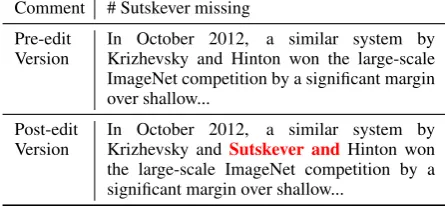
Comments are widely used in collaborative docu-ment writing as a natural way to suggest and track changes, annotate content and explain the intent of edits. Table1shows an example of a comment left by an editor in a Wikipedia revision. The com-ment explains the intent of adding a missing re-searcher’s name (Sutskever) to a citation.
∗
The work was done while these authors interned in Microsoft Research.
This example demonstrates that user comments closely relate to the intent of an edit, the actual edit operation, and the content and location in the document that underwent change. However, dur-ing collaborative document authordur-ing, the trackdur-ing and maintenance of comments becomes increas-ingly more challenging due to the large number of edits and comments that authors make. For example, structurally refactoring a document can significantly change the order of paragraphs and sentences, stranding comments in confusing and contextually inappropriate locations. Or, com-ments may have already been addressed but con-tinue to linger in the document without having been marked as completed. These issues, among others, are exacerbated when multiple authors col-laborate on a document, often asynchronously. It becomes difficult to know which tasks have been completed and which haven’t, especially if authors are not proactive about marking comments as ad-dressed. This situation stands to benefit from an intelligent system capable of marking changes as completed, by understanding the relationship be-tween edits and comments.
lan-guage comments, before it could learn to gener-ate them. Therefore, automatic solutions to these challenges stand to benefit from an ability to fun-damentally model the relationship between edits and comments.
Yet, most existing studies on document re-visions focus on modeling the document edits (Bronner and Monz,2012) or comments (Shaver, 2016) separately; or using comments as a supple-mentary source of information to study the edits (Yatskar et al.,2010). To the best of our knowl-edge, no prior work focuses on jointly modeling the relationship between comments and edits.
Thus, in this paper we tackle two novel tasks.
Comment Ranking considers a document edit operation and seeks to rank a set of candidate comments in order of their relevance to the edit.
Edit Anchoring seeks to identify the locations in a document that are most likely to have un-dergone change as the result of a specific com-ment. Crucially, both tasks require jointly mod-eling comment-edit relationship.
We start by collecting a dataset of 780K Wikipedia revisions, each with their associated comment and edits. We then build a hierarchi-cal multi-layer deep neural network, a model we call CmntEdit, which is capable of learning the relationship between comments and edits from this data. Our approach addresses both Comment Ranking and Edit Anchoring by sharing many of the model’s components and parameters across tasks. Since edits can apply to discontiguous quences of text, which pose a challenge for se-quence modeling approaches, we explore novel ways to represent a document both before and af-ter an edit, while also accounting for contextual in-formation surrounding an edit. To differentiate the context from edit words, we also explore a novel mechanism to encode edit operations such as ad-ditions and deletions explicitly in the model.1
Finally, we evaluate our model on both tasks and in a number of experimental settings, demon-strating that our solution is significantly better than several strong baselines on jointly capturing the relationship between edits and comments. Our model outperforms the best baseline by 34.6% on NDCG for Comment Ranking and achieves a best score of 0.687 F1 for Edit Anchoring.
Addition-1We are making the code for the CmntEdit model, and
generation of our dataset publicly available to the research community at https://github.com/microsoft/
WikiCommentEdit.
Comment # Sutskever missing
Pre-edit Version
In October 2012, a similar system by Krizhevsky and Hinton won the large-scale ImageNet competition by a significant margin over shallow...
Post-edit Version
[image:2.595.306.529.67.170.2]In October 2012, a similar system by Krizhevsky and Sutskever and Hinton won the large-scale ImageNet competition by a significant margin over shallow...
Table 1:Example of an edit and its associated comment. The added words “Sutskever and” in post-edit version is marked in red.
ally, in an ablation study we demonstrate that our various modeling choices, which tackle the in-herent challenges of comment-edit understanding, each contribute positively to empirical results.
2 Related Work
Document revisions have been the subject of sev-eral studies in recent years (Nunes et al.,2011; Fis-cher,2013). Most prior work focuses on modeling document edits only. For instance, Bronner and Monz (2012) build a classifier to distinguish flu-ency edits from factual edits. Zhu et al. (2017) study the semantic distance between the content in different versions of documents to detect doc-ument revisions. Grossman et al. (2013) propose a hierarchical navigation method to display docu-ment revision histories.
Some work utilizes comments associated with document edits as supplementary information to study the document revisions. For example, Yatskar et al. (2010) consider both comment and document revision for lexical simplification. However, they use comments as meta-data to iden-tify trusted revisions, rather than directly model-ing the relationship between comments and edits. Yang et al.(2017) featurize both comments and re-visions to classify edit intent, but without explic-itly modeling edit-comment relationship.
meth-ods directly consider or model the relationship be-tween comments and edits.
At a basic level, modeling the connection be-tween comments and edits can be seen as a text matching problem, with superficial similarity to other common NLP tasks, such as Question An-swering (Seo et al.,2016;Yu et al.,2018), docu-ment search (Burges et al.,2005;Nalisnick et al., 2016), and textual entailment (Androutsopoulos and Malakasiotis, 2010), among others. Note however, that edits are a (possibly discontinuous and non-trivial) delta between two versions of a text, making their representation and understand-ing more challengunderstand-ing than that of a simple strunderstand-ing. We demonstrate this in our evaluation in Sec-tion 5.2, where we compare against several com-peting models that were designed for other text matching challenges.
3 Dataset
Our dataset – which we call WikiCmnt – is gen-erated from Wikipedia revision histories. In the absence of publicly available document data, Wikipedia is a particularly rich resource: (i) It maintains full revision histories of every Wikipedia page, along with associated editor com-ments as meta-data. (ii) It is a large-scale instance of multi-author collaboration, with many editors contributing to and maintaining pages.
The specific historical dump we use is from May 1, 2018. It contains approximately 52.7 mil-lion pages, and 755.5 milmil-lion unique revisions made by 300.8 million users. WikiCmnt is a sub-sample of 786,866 Wikipedia page revisions along with their associated metadata. Revisions are fil-tered out before sampling, if they violate any one of the following criteria: (i) The length of the com-ment is longer than 8 words. (ii) The edits made to the Wikipedia page span more than one section2. (iii) The Wikipedia page has an edit history con-taining fewer than 10 unique revisions.
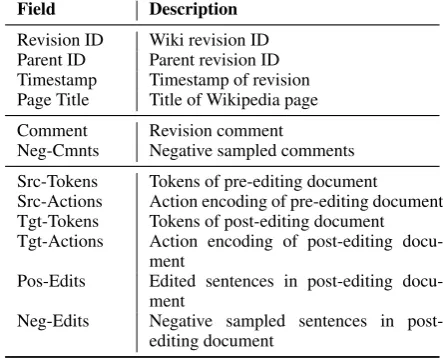
We extract and store a number of data fields from the Wikipedia revision history as summa-rized in Table 2. For each specific revision of a page, we not only retrieve the text of the comment and edit but also sample 10 non-related comments (Neg-Cmnts) and 10 non-related edits (Neg-Edits) from the same page’s history. Finally we also en-code the individual edit operations in both pre-edit
2https://en.wikipedia.org/wiki/Help:
Section
l cooked
Edit:
0 0 -1 -1 0 0 0 1 0
chicken wingsalmon
Actions
before-editing version after-editing version Tokens
yesterday
[image:3.595.309.526.78.119.2]l cookedsalmonyesterday l cookedchicken wingyesterday
Figure 1:An example of the action encoding associated with changing the phrase “chicken wing” to “salmon”. Specifi-cally, the values -1, 1 and 0 are used to represent deletions, additions and unchanged tokens, respectively.
Field Description
Revision ID Wiki revision ID Parent ID Parent revision ID Timestamp Timestamp of revision Page Title Title of Wikipedia page
Comment Revision comment
Neg-Cmnts Negative sampled comments
Src-Tokens Tokens of pre-editing document Src-Actions Action encoding of pre-editing document Tgt-Tokens Tokens of post-editing document Tgt-Actions Action encoding of post-editing
docu-ment
Pos-Edits Edited sentences in post-editing docu-ment
Neg-Edits Negative sampled sentences in post-editing document
Table 2: Data Fields inWikiCmntDataset
and post-edit versions of a text. For example, con-sider Figure 1, which shows the edit action en-coding associated with an change from “chicken wing” to “salmon”.
4 Proposed Model
To model the relationship between edits and com-ments, we first formulate the problem with respect to the two tasks of Comment Ranking and Edit Anchoring; we then provide details of the neural architecture used to solve these problems; finally we provide some implementation details. We be-gin with preliminary notation.
Let us definecas a comment consisting of word tokens{w1, ..., wq}. Minimally, let us also define
a pre-edites, as the contiguous sequence of words
spanning the first to the last edited token (with possibly intervening tokens that are not edited) in a document’s pre-edit version. The edit es may
optionally also contain some surrounding context. Formally this can be defined as:
{ wi−k, ...wi−1
| {z }
context before edit
,wi, ...wi+p
| {z }
edit words
,wi+p+1, ...wi+p+k
| {z }
context after edit }
[image:3.595.305.527.186.365.2]context window size. If there is more than one contiguous block of edited tokens, these blocks are concatenated to form the set of edit words with their context words.
We define a document edit as the pair e = {es, et}, whereetis similarly defined over edited
tokens and their context words in a document’s
post-edit version.
4.1 Problem Formulation
Comment Ranking is the task of finding the most relevant comment among a list of potential candidates, given a document edit. The inputs of the comment ranking task are some set of user comments C = {c1, c2, . . . cm} pertaining to a
document, and an edit e = {es, et} in the same
document.The goal of the task is to produce a ranking onC, such that the true commentciwith
respect to the edit e = {es, et} is ranked above
all the other comments (i.e. distractors). We use standard ranking metrics to evaluate model per-formance: Precision@K (P@K), Mean Reciprocal Rank (MRR) and Normalized Discounted Cumu-lative Gain (NDCG).
Edit Anchoring is the task of finding the sen-tences in a document that most likely underwent change, given a specific user comment. The inputs to the task are a user commentcand a list of can-didate sentencesS = {s1, s2, . . . sn}in the
post-edit documentet. Unlike with Comment Ranking,
we operate under the assumption that an edit has already been completed, and therefore discard the information from the pre-edit version es. In the
ground truth, at least one (but possibly more) of the sentences is an edit location for the comment
c. The expected output is a list of binary classifi-cationsR ={ri}ni=1, whereri = 1indicates that
the sentencesiis a likely edit location, given
com-mentc. We use Accuracy and F1 score to evaluate performance on this task.
4.2 Model Overview
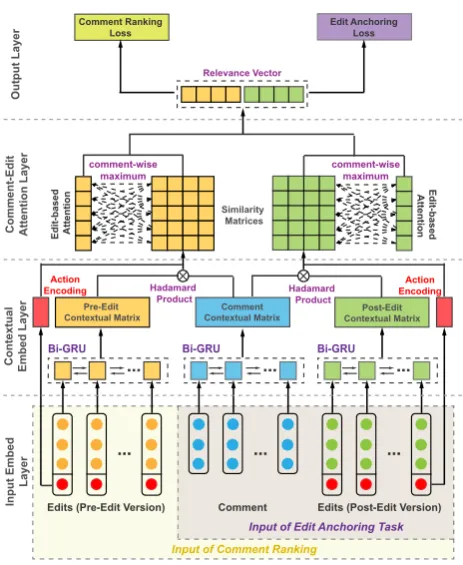
For both tasks, our models are hierarchical deep neural networks with four layers: an input em-bedding layer, a contextual emem-bedding layer, a comment-edit attention layer, and an output layer. The overall architecture is shown in Figure2. We describe each of the four layers in what follows. Since both models share many components we will describe the more general case that covers all inputs for Comment Ranking; for Edit Anchoring
Edits (Pre-Edit Version) Comment Ranking
Loss Edit AnchoringLoss
Edits (Post-Edit Version) Comment
Input of Edit Anchoring Task
Input of Comment Ranking
Input Embed
Layer
Contextual Embed Layer Comment-Edit Attention Layer
Output Layer
Bi-GRU Bi-GRU Bi-GRU
. . .
. . .
Similarity Matrices
Action
Encoding Hadamard EncodingAction
Product Hadamard Product Relevance Vector
Edit-based Attention
Edit-based
Attention
comment-wise maximum comment-wise
maximum
Pre-Edit
Contextual Matrix Contextual MatrixComment Contextual MatrixPost-Edit
. . .
. . . . . .
[image:4.595.299.531.59.342.2]. . .
Figure 2:Overall Architecture of Proposed Model
those components that correspond to the pre-edit input are suitably omitted.
Input Embedding Layer. The input embedding layer maps each word in user comments c and edits e = {es, et} to a high-dimensional vector
space. The output of the input embedding layer are matrices: U ∈ Rd×M representing the
pre-edit document,V ∈Rd×M representing the
post-edit document, and Q ∈ Rd×J representing the
comment. HereM is the length of edits andJ is the length of the comment, while d is the fixed-length dimension of word vectors.
Contextual Embedding Layer. We use a bi-directional Gated Recurrent Unit (GRU) (Chung et al., 2014) to model the sequential interaction between words. Operating over the output of the previous layer we obtain the contextual embed-ding matrices Uc ∈ R2d×M andVc ∈ R2d×M
for both pre- and post-edit versions. Also, we ob-tainQc∈R2d×Jfrom the comment word vectors.
Note that the row dimension of contextual matri-cesUc,VcandQcare2dbecause of the concate-nation of the GRU’s output in both forward and backward directions.
comprehension (Seo et al.,2016;Yu et al.,2018), the comment-edit attention layer is designed to capture relationships between document edit and comment words. The attention layer maintains and processes both pre- and post-edit documents separately. This is to reduce the information loss that would have occurred if their representations were fused before the attention layer. Addition-ally, this layer incorporates an action encoding vector, which is designed to reflect the three kinds of edit operations: adding a word, deleting a word, or leaving it unchanged.
The inputs to the layer are the contextual matri-cesUcandVcof the pre- and post-edit documents respectively, the matrixQcrepresenting the com-ment, and the supplemental action encoding vec-torsa†,a‡∈ZM which encode the edit operation
each token undergoes in the pre- and post-edit doc-uments, respectively. The output is the comment-aware concatenated vector representations of the edit words in both pre- and post-edit documents,
h∈R2J.
Internally, we first calculate the shared similar-ity matrixS†∈RM×J between the commentQc
and contextual matrixUc of pre-edit documents, while also accounting for the action encoding vec-tora†. The elements of this shared similarity ma-trix are defined as follows:
Sij† =G(U:ci,Qc:j,a†i) (1)
whereG is a trainable function that generates the similarity between the word-level representations of comments and edits with respect to an edit op-eration.
Here U:ci ∈ R2d×1 is the vector
representa-tion of thei-th word in the pre-edit document and
Qc:j ∈ R2d×1 is the vector representation of j-th
word in the comment. a†i ∈ {−1,0,1}is the ac-tion encoding for the edit operaac-tion performed on thei-th word in the pre-edit document. We choose the trainable functionG(u,q, a) =wT[u⊗q;a], wherew ∈ R(2d+1)×1 is a trainable weight
vec-tor,⊗is the element-wise multiplication operator and[; ] represents the vector concatenation across the row dimension. Similarly, we can calculate the shared similarity matrixS‡∈RM×J between the
comment and contextual matrix of the post-edit document asSij‡ =G(V:ci,Qc:j,a‡i). Note that the weight vectors in functionGare different for pre-and post-edit versions, pre-and both are trained simul-taneously in the model.
After the similarity matrices are computed, we use them to generate the Comment-to-Edit Atten-tion (C2E) weights. C2E is used to represent the relevance of words in the edit to those that ap-pear in the comment. This is critical for model-ing the relationship between comments and edits. We obtain the C2E attention weights c† ∈ RM
for edit words in the pre-edit document by taking
c† = softmax(maxcol(S†)), where themaxcol(·)
operator finds the column-wise maximum value from a matrix. Similarly, for the post-edit docu-ment, we havec‡= softmax(maxcol(S‡)).
Finally we multiply the attention vectors to the previously computed similarity matrices for both pre- and post-edit documents, and concatenate the results to obtain the relevance vectorh∈R2J:
h=
c†TS†; c‡TS‡ T
(2)
The vectorh intuitively captures the weighted sum of the relevance of the comment with respect to the edits in both pre- and post-edit documents.
Output Layer and Loss Function. The output layer and loss function of the network is task-specific. Comment Ranking requires ranking the relevance of candidate comments given a docu-ment edit. Broadly we obtain a ranked list by com-puting the relevance score between comments and edits by the outputr =βTh, whereβis a train-able weight vector.
A data sampleiin Comment Ranking consists of one true comment-edit pair and ni negative
comment-edit distractors. We denote r+i as the relevance score of the true pair, and r−ij as the relevance score of the j-th distractor pair (with
1 ≤ j ≤ ni). The goal of our task is to make ri+ > r−ij for allj. We therefore set the loss func-tion to be a pairwise hinge loss between true and distractor relevance scores.
Lc(Θ) = N X
i=1
ni
X
j=1
max(0,1−r+i +rij−) (3)
whereΘ is the set of all trainable weights in the model andN is the number of training samples in the dataset.
probability of predicting the positive class. Here
γis a trainable weight vector.
Given the binary nature of the classification problem we can use the cross entropy loss:
Le(Φ) =− 1 N
N X
i=1
mi
X
j=1
yijlogpij+
1−yij
log 1−pij
,
(4)
where Φis the set of all trainable weights in the model,N is the number of data samples,miis the
number of sentences in thei-th data sample,pijis
the predicted label of thej-th sentence in thei-th data sample, andyij is the corresponding ground
truth label.
4.3 Implementation Details
The CmntEdit model described in this section is implemented using the Pytorch3 framework and trained on a single Tesla P100 GPU with 16GB memory. The word vectors are initialized with pre-trained Glove embeddings (Pennington et al., 2014) using the default dimensionality of 100. We set the number of training epochs to 5, the max-imum length of a comment to 30 tokens and the maximum length of an edit to 300 tokens. For the Comment Ranking task, we set the batch size to 10 and consider 5 candidate comments in each data sample: one true comment and 4 distractors. We thus have 5 comment-edit pairs for each data sample and 50 pair-wise samples for each train-ing batch. For the Edit Anchortrain-ing task, we also set the batch size to 10 and consider 5 candidate sentences, which yields an identical 50 training in-stances per batch.
It should be noted that while we train our model with only 5 candidate comments or sentences (for Comment Ranking or Edit Anchoring respec-tively), the models – once trained – can be applied to any number of candidates at test time for either task.
5 Experiment
In this section, we show evaluation results of our model on the previously collected Wikipedia dataset 3. We begin by introducing the experi-mental settings in Section 5.1. We then compare the performance achieved by the proposed method against several baseline models in Section5.2. We
3https://pytorch.org/
also conduct an ablation study to evaluate the var-ious components of our model, as well as provide some qualitative results to demonstrate it’s effec-tiveness in practise.
5.1 Experimental Setup
We begin by introducing the evaluation setting, metrics and baselines we use in our experiments.
5.1.1 Datasets and Labels
We use theWikiCmntdataset described in Section 3for training and evaluation. The dataset contains 786,886 data samples in total. We reserve 70% of the data for training and split the remainder be-tween 10% for validation and 20% for testing.
For the Comment Ranking task, we always have a single true comment, but in our test we experi-ment with both 4 and 9 distractors, yielding a total of 5 and 10 candidate comments. Similarly for the Edit Anchoring task, we also test with both 5 and 10 candidate sentences.
5.1.2 Evaluation Metrics
We use common ranking evaluation metrics from the literature to evaluate models on the task of Comment Ranking. These include: (i) Preci-sion@K. The proportion of predicted instances where the true comment appears in the ranked top-K result, withK = 1,3,5. (ii)Mean Recip-rocal Rank (MRR). The average multiplicative inverse of the rank of the correct answer, repre-sented mathematically asMRR = N1 PNi=1 ranki1 , where N is the number of samples andranki is
the rank assigned to the true comment by a model. (iii) Normalized Discounted Cumulative Gain (NDCG). the normalized gain of each comment based on its ranking position in the results. We set the relevance score of the true comment to one and those of the distractors to zero.
For the Edit Anchoring task, we useAccuracy
and F1 Score as evaluation metrics. These are computed based on a model’s classification of can-didate sentences in the post-edit version of the document.
5.1.3 Baseline Methods
For the Comment Ranking task, we compare our approach to the following baselines:
Candidates=5 Candidates=10
P@1 P@3 MRR NDCG P@1 P@3 P@5 MRR NDCG
Cosine-TfIdf 0.266 0.519 0.470 0.597 0.137 0.291 0.444 0.296 0.453 Cosine-InferSent 0.228 0.597 0.471 0.600 0.115 0.305 0.497 0.302 0.461
RankNet 0.257 0.658 0.503 0.620 0.034 0.055 0.061 0.139 0.320
LambdaMART 0.310 0.726 0.549 0.661 0.152 0.384 0.593 0.352 0.502 Gated RNN 0.283 0.716 0.531 0.647 0.158 0.411 0.628 0.363 0.511
CmntEdit-MT 0.674 0.930 0.804 0.853 0.529 0.780 0.896 0.680 0.758 CmntEdit-CR 0.710 0.944 0.828 0.871 0.593 0.830 0.924 0.730 0.796
Table 3: Performance on Comment Ranking
comment and edit vectors generated by the state-of-the-art sentence embedding method In-ferSent (Conneau et al., 2017). (iii) RankNet
(Burges et al., 2005) minimizes the number of inversions in ranking by optimizing a pair– wise loss function. We use a previous neu-ral network implementation4 with default set-tings. (iv) LambdaMART(Burges,2010) lever-ages gradient boosted decision trees with a cost function derived from LambdaRank (Burges et al., 2007) for solving a ranking task. We use an exist-ing python implementation5, with a learning rate of 0.02 and 10 max leaf nodes. (v)Gated Recur-rent Neural Network(Chung et al.,2014) models the sequence of words in comments and edits us-ing pre-trained GloVe vectors as embeddus-ing units. Three fully-connected layers compute a final rele-vance score between comments and edits.
For the Edit Anchoring task, we chose the fol-lowing popular classifiers as baselines: (i) Ran-dom Forest (Liaw et al., 2002) (ii) Adaboost
(R¨atsch et al.,2001) (iii)Passive Aggressive clas-sifiers (Crammer et al., 2006) (iv) Gated Recur-rent Neural Network. The features used in these models are based on both TfIdf scores, as well as sentence embedding features generated by In-ferSent. The Gated RNN model is trained with a task-specific fully connect layer for Edit Anchor-ing to compute the classification probability.
5.1.4 Model Variants
We train and evaluate several different variants of our neural architecture. They include: (i) Cm-ntEdit-CR, a variant of our model only trained with data samples for the Comment Ranking task. (ii) CmntEdit-EA, a variant of our model only trained with data samples for the Edit Anchoring
4
https://github.com/shiba24/ learning2rank
5https://github.com/jma127/pyltr
Candidates=5 Candidates=10
Acc F1 Acc F1
Passive-Aggr 0.581 0.533 0.716 0.262 RandForest 0.639 0.290 0.743 0.112 Adaboost 0.657 0.398 0.751 0.207 Gated RNN 0.696 0.651 0.665 0.539
CmntEdit-MT 0.635 0.587 0.619 0.468 CmntEdit-EA 0.744 0.687 0.726 0.583
Table 4: Performance on Edit Anchoring
task. (iii)CmntEdit-MT, a variant of our model jointy trained on data samples of both Comment Ranking and Edit Anchoring tasks. Unless other-wise specified, all models use a standard context window size of 5 tokens6.
5.2 Experimental Results
We now present and discuss the empirical results of our evaluation on both Comment Ranking and Edit Anchoring.
5.2.1 Comment Ranking
Table3summarizes results of the Comment Rank-ing task. Our models significantly outperform all the baselines in every setting and on all metrics. The results are statistically significant atp <0.01
using the Wilcoxon signed-rank test (Smucker et al., 2007). Since the Comment Ranking task only has one true comment, the other comments being distractors, the P@1 result becomes espe-cially important for practical applications. Our ap-proach achieves 71% precision, which is signif-icantly better than the 31% precision of the best baseline method (LambdaMART) with 5 candi-date comments. Our model similarly outperforms the best baseline with 10 candidate comments,
ob-6We performed an extensive evaluation of context size
Comment Ranking
Candidates=5 Candidates=10
P@1 MRR P@1 MRR
w/o Action 0.630 0.778 0.495 0.659 w/o Attention 0.625 0.775 0.488 0.655 w/o Hadamard 0.624 0.774 0.483 0.652 CmntEdit-CR 0.710 0.828 0.593 0.730
Edit Anchoring
Candidates=5 Candidates=10
Acc F1 Acc F1
[image:8.595.72.300.64.215.2]w/o Action 0.713 0.668 0.684 0.556 w/o Attention 0.723 0.670 0.701 0.562 w/o Hadamard 0.722 0.660 0.706 0.558 CmntEdit-EA 0.744 0.687 0.726 0.583
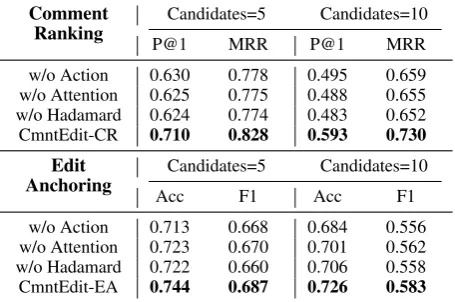
Table 5: Ablation study
taining a P@1 score of 59.3%. Additionally, the higher scores on MRR and NDCG indicate that our approach consistently ranks the true comment higher than the baseline methods.
The performance of CmntEdit-MT is 2% and 5.3% worse than CmntEdit-CR on NDCG and P@1, respectively. Surprisingly, this suggests that training our model in a multi-task fashion leads to slightly lower scores, and a model specifically trained for the individual task of Comment Rank-ing is to be preferred.
5.2.2 Edit Anchoring
Table4shows the results for Edit Anchoring. Our method, CmntEdit-EA, outperforms the best base-line method, Gated-RNN, by 5.5% on F1 and 6.9% on accuracy. The improvements over all the baselines are statistically significant at a p-value of 0.01. The baseline classifiers including Passive-Aggressive, Random Forest and Adaboost have high accuracies, but low F1 scores. This is be-cause of the imbalance between positive and neg-ative samples in our data. Specifically, the num-ber of negative samples is 4 times greater than the number of positive samples when the size of the candidate set is 5 – and even greater when it is 10. Therefore, the baseline classifiers tend to naively predict a negative label, which artificially boosts precision to the detriment of recall. In fact, Ad-aboost actually outperforms our models on accu-racy when the candidate set size is 10, but yields a much lower F1 score.
As with Comment Ranking, the performance of MT is slightly worse than CmntEdit-EA. Within the scope of our problem space, this reinforces the finding that targeted training seems to work better than joint training.
5.2.3 Ablation Study
To verify the effectiveness of our modeling choices, we evaluate performance in the absence of each of the following model components: 1. w/o Action: we remove the action encoding from the trainable function G and instead simply useG(u,q) = wT[uTq]. 2. w/o Attention: we remove the edit-based attention from Equation (2). Instead, we generate the relevance vectorhas fol-lows:h=meancol(S†); meancol(S‡)T. 3.w/o Hadamard: we use the inner product instead of the Hadamard product in the trainable functionG
as follows:G(u,q, a) =wT[uTq;a].
Results in Table 5 show that each compo-nent improves the overall performance on both Comment Ranking and Edit Anchoring tasks, across our evaluation metrics. This indicates that our modeling choices are particularly suited to tackle the inherent challenges involved in model-ing comment-edit relationship.
5.2.4 Qualitative Evaluation
Table6provides a few output examples from our model on the Comment Ranking task, demonstrat-ing its ability to learn abstract connections be-tween comments and edits. Due to space con-straints, only one illustrative distractor is shown.
The first example shows an edit summarized by the high-level comment “date and capitalization corrections”. This comment is correctly assigned the highest relevance score by our model, despite the fact that no words are shared between the com-ment and edit. Meanwhile, one of the distractors has a lower score even though it shares the lexical item “Walgreens” with the context of the edit.
In the second example an entire sentence is re-moved by the editor. Again, although no words are shared between the comment and the edit, our model is correctly able to identify the delete oper-ation, possibly by learning the common Wikipedia shorthand for deletions “rm”. Meanwhile, one of the distractors contains the phrase “St Helens”, which also appears in the edit, but is still assigned a lower score.
6 Conclusion and Future Work
Fur-Case 1: Grammar fixing
Pre-Edits In Decemberof2012,Ajudge ordered Walgreens to pay $16.57 million to settle a lawsuit claiming... Post-Edits In December 2012,ajudge ordered Walgreens to pay $16.57 million to settle a lawsuit claiming...
Comment Date and capitalization corrections [Relevance Score: 4.050]
Distractor Dane Cook’s comments about Walgreens do not belong in ”Facts” [Relevance Score: 3.028]
Case 2: Sentence removal
Pre-Edits [http://www.pilkington.co.uk/energikare Pilkington energiKare] - Pilkington product from St Helens helping the environment...
Post-Edits (whole sentence removed)
Comment rm advertising, other link to major employer noted in text seems ok at first glance. [Relevance Score: 5.192]
Distractor Fixing link to Kevin Brown - You know I never knew he was from St Helens [Relevance Score: 3.479]
Table 6: Example of the edits and comments matched by the proposed model with one more deceptive distractor for each case. The scores for each comment/distractor are presented after the comment/distractor. The addition and removal in edit are highlighted in bold.
ther we proposed a hierarchical multi-layer neu-ral network capable of tackling both our proposed tasks by encoding specific edit actions, such as ad-ditions and deletions, as well as document context. In our experiments we show that our approach out-performs several baselines by significant margins on both tasks, yielding a best score of 71% pre-cision@1 for Comment Ranking and 74.4% accu-racy for Edit Anchoring.
In future work we plan to explore sequences of revisions through the lifecycle of a document from creation to completion, with the ultimate goal of modeling document evolution. We also hope to apply our modeling approach to practical down-stream applications, including: i) detecting com-pleted to-dos based on related edits; ii) localizing the paragraphs that could be edited to address a given comments; iii) summarizing document revi-sions.
Acknowledgement
We thank the anonymous reviewers and members of the Knowledge Technologies and Intelligent Experiences group in Microsoft Research for help-ful feedback. We also thank Ryen W. White for the thoughtful feedback on the statistical hypothe-sis testing.
References
Ablimit Aji, Yu Wang, Eugene Agichtein, and Ev-geniy Gabrilovich. 2010. Using the past to score the present: Extending term weighting models through revision history analysis. InProceedings of the 19th ACM international conference on Information and knowledge management, pages 629–638. ACM.
Ion Androutsopoulos and Prodromos Malakasiotis. 2010. A survey of paraphrasing and textual entail-ment methods. Journal of Artificial Intelligence Re-search, 38:135–187.
Amit Bronner and Christof Monz. 2012. User edits classification using document revision histories. In Proceedings of the 13th Conference of the European Chapter of the Association for Computational Lin-guistics, EACL ’12, pages 356–366, Stroudsburg, PA, USA. Association for Computational Linguis-tics.
Chris Burges, Tal Shaked, Erin Renshaw, Ari Lazier, Matt Deeds, Nicole Hamilton, and Greg Hullender. 2005. Learning to rank using gradient descent. In Proceedings of the 22nd international conference on Machine learning, pages 89–96. ACM.
Christopher J Burges, Robert Ragno, and Quoc V Le. 2007. Learning to rank with nonsmooth cost func-tions. InAdvances in neural information processing systems, pages 193–200.
Christopher JC Burges. 2010. From ranknet to lamb-darank to lambdamart: An overview. Learning, 11(23-581):81.
Junyoung Chung, Caglar Gulcehre, KyungHyun Cho, and Yoshua Bengio. 2014. Empirical evaluation of gated recurrent neural networks on sequence model-ing.arXiv preprint arXiv:1412.3555.
Alexis Conneau, Douwe Kiela, Holger Schwenk, Lo¨ıc Barrault, and Antoine Bordes. 2017. Supervised learning of universal sentence representations from natural language inference data. InProceedings of the 2017 Conference on Empirical Methods in Nat-ural Language Processing, pages 670–680, Copen-hagen, Denmark. Association for Computational Linguistics.
Stephen E Fischer. 2013. Automated document re-vision markup and change control. US Patent 8,381,095.
Viola Ganter and Michael Strube. 2009. Finding hedges by chasing weasels: Hedge detection using wikipedia tags and shallow linguistic features. In Proceedings of the ACL-IJCNLP 2009 Conference Short Papers, pages 173–176. Association for Com-putational Linguistics.
Tovi Grossman, Justin Frank Matejka, and George Fitzmaurice. 2013. Hierarchical display and nav-igation of document revision histories. US Patent 8,533,593.
Andy Liaw, Matthew Wiener, et al. 2002. Classifi-cation and regression by randomforest. R news, 2(3):18–22.
Aur´elien Max and Guillaume Wisniewski. 2010. Min-ing naturally-occurrMin-ing corrections and paraphrases from wikipedia’s revision history. InLREC.
Eric Nalisnick, Bhaskar Mitra, Nick Craswell, and Rich Caruana. 2016. Improving document ranking with dual word embeddings. InProceedings of the 25th International Conference Companion on World Wide Web, pages 83–84. International World Wide Web Conferences Steering Committee.
S´ergio Nunes, Cristina Ribeiro, and Gabriel David. 2008. Wikichanges: exposing wikipedia revision activity. In Proceedings of the 4th International Symposium on Wikis, page 25. ACM.
S´ergio Nunes, Cristina Ribeiro, and Gabriel David. 2011. Term weighting based on document revision history. Journal of the American Society for Infor-mation Science and Technology, 62(12):2471–2478.
Jeffrey Pennington, Richard Socher, and Christo-pher D. Manning. 2014. Glove: Global vectors for word representation. InEmpirical Methods in Nat-ural Language Processing (EMNLP), pages 1532– 1543.
Gunnar R¨atsch, Takashi Onoda, and K-R M¨uller. 2001. Soft margins for adaboost. Machine learning, 42(3):287–320.
Minjoon Seo, Aniruddha Kembhavi, Ali Farhadi, and Hannaneh Hajishirzi. 2016. Bidirectional attention flow for machine comprehension. arXiv preprint arXiv:1611.01603.
Robert Shaver. 2016. Document comment manage-ment. US Patent 9,418,054.
Mark D. Smucker, James Allan, and Ben Carterette. 2007. A comparison of statistical significance tests for information retrieval evaluation. In Proceed-ings of the Sixteenth ACM Conference on Confer-ence on Information and Knowledge Management, CIKM ’07, pages 623–632, New York, NY, USA. ACM.
Elif Yamangil and Rani Nelken. 2008. Mining wikipedia revision histories for improving sentence compression. In Proceedings of the 46th Annual Meeting of the Association for Computational Lin-guistics on Human Language Technologies: Short Papers, pages 137–140. Association for Computa-tional Linguistics.
Diyi Yang, Aaron Halfaker, Robert Kraut, and Eduard Hovy. 2017. Identifying semantic edit intentions from revisions in wikipedia. InProceedings of the 2017 Conference on Empirical Methods in Natural Language Processing, pages 2000–2010.
Mark Yatskar, Bo Pang, Cristian Danescu-Niculescu-Mizil, and Lillian Lee. 2010. For the sake of sim-plicity: Unsupervised extraction of lexical simplifi-cations from wikipedia. InHuman Language Tech-nologies: The 2010 Annual Conference of the North American Chapter of the Association for Computa-tional Linguistics, pages 365–368. Association for Computational Linguistics.
Adams Wei Yu, David Dohan, Minh-Thang Luong, Rui Zhao, Kai Chen, Mohammad Norouzi, and Quoc V Le. 2018. Qanet: Combining local convolution with global self-attention for reading comprehen-sion.arXiv preprint arXiv:1804.09541.
Fabio Massimo Zanzotto and Marco Pennacchiotti. 2010. Expanding textual entailment corpora fromwikipedia using co-training. InProceedings of the 2nd Workshop on The People’s Web Meets NLP: Collaboratively Constructed Semantic Resources, pages 28–36.
Torsten Zesch. 2012. Measuring contextual fitness us-ing error contexts extracted from the wikipedia revi-sion history. InProceedings of the 13th Conference of the European Chapter of the Association for Com-putational Linguistics, pages 529–538. Association for Computational Linguistics.