Complexity of Word Collocation Networks:
A Preliminary Structural Analysis
Shibamouli Lahiri
Computer Science and Engineering University of North Texas
Denton, TX 76207, USA
Abstract
In this paper, we explore complex work properties of word collocation net-works (Ferret, 2002) from four different genres. Each document of a particular genre was converted into a network of words with word collocations as edges. We analyzed graphically and statistically
how the global properties of these
net-works varied across different genres, and among different network types within the same genre. Our results indicate that the distributions of network properties are vi-sually similar but statistically apart across different genres, and interesting variations emerge when we consider different net-work types within a single genre. We fur-ther investigate how the global properties change as we add more and more collo-cation edges to the graph of one partic-ular genre, and observe that except for the number of vertices and the size of the largest connected component, network properties change inphases, via jumps and drops.
1 Introduction
Word collocation networks (Ferret, 2002; Ke, 2007), also known as collocation graphs (Heyer et al., 2001; Choudhury and Mukherjee, 2009), are networks of words found in a document or a doc-ument collection, where each node corresponds to a uniqueword type, and edges correspond toword collocations(Ke and Yao, 2008). In the simplest case, each edge corresponds to a unique bigram in the original document. For example, if the words
wA and wB appeared together in a document as
a bigram wAwB, then the word collocation
net-work of that particular document will contain an
edgewA → wB. Note that edges can be directed
(wA → wB) or undirected (wA−wB).
Further-more, they can be weighted (with the frequency of
the bigramwAwB) or unweighted.
It is interesting to note that word collocation networks display complex network structure, in-cluding power-law degree distribution and small-world behavior (Matsuo et al., 2001a; Matsuo et al., 2001b; Masucci and Rodgers, 2006; Liang et al., 2012). This is not surprising, given that nat-ural language generally shows complex network properties at different levels (Ferrer i Cancho and Sol´e, 2001; Motter et al., 2003; Biemann et al., 2009; Liang et al., 2009). Moreover, researchers have used such complex networks in applications ranging from text genre identification (Stevanak et al., 2010) and Web query analysis (Saha Roy et al., 2011) to semantic analysis (Biemann et al., 2012) and opinion mining (Amancio et al., 2011). In Section 2, we will discuss some of these appli-cations in more detail.
The goal of this paper is to explore some key structural properties of these complex net-works (cf. Table 1), and study how they vary across different genres of text, and also across different network types within the same genre.
We chose global network properties like
di-ameter, global clustering coefficient, shrinkage exponent (Leskovec et al., 2007), and small-worldliness (Walsh, 1999; Matsuo et al., 2001a), and experimented with four different text collec-tions – blogs, news articles, academic papers, and digitized books (Section 4.1). Six different types of word collocation networks were constructed on each document, as well as on the entire collections – two with directed edges, and four with undi-rected edges (Section 3). We did not take into ac-count edge weights in our study, and kept it as a part of our future work (Section 5).
Tracking the variation of complex network properties on word collocation networks yielded several important observations and insights. We
noted in particular that different genres had con-siderable visual overlap in the distributions of global network properties like diameter and clus-tering coefficient (cf. Figure 2), although sta-tistical significance tests indicated the distribu-tions were sufficiently apart from each other (Sec-tion 4.2). This calls for a deeper analysis of com-plex network properties and their general applica-bility to tasks like genre identification (Stevanak et al., 2010).
We further analyzed distributions of global word network properties across six different
net-work types within the same genre (Section 4.2).
This time, however, we noted a significant amount of separation – both visually as well as statistically – among the distributions of different global prop-erties (cf. Figure 3 and Table 5).
In our final set of experiments, we analyzed how global network properties change as we start with an empty network, and gradually add edges to that network. For this experiment, we chose the news genre, and tracked the variation of 17 different global network properties on four types of networks. We observed that all global net-work properties (except the number of vertices and edges, number of connected components and the size of the largest connected component) show
un-predictability and spikes when the percentage of
added edges is small. We also noted that most global properties showed at least onephase transi-tionas the word collocation networks grew larger. Statistical significance tests indicated that the pat-terns of most global property variations were non-random and positively correlated (Section 4.3).
2 Related Work
That language shows complex network structure at the word level, was shown more than a decade ago by at least two independent groups of re-searchers (Ferrer i Cancho and Sol´e, 2001; Mat-suo et al., 2001a). MatMat-suo et al. (2001b) went further ahead, and designed an unsupervised key-word extraction algorithm using the small-world property of word collocation networks. Motter et al. (2003) extended the collocation network idea to
conceptsrather than words, and observed a small-world structure in the resulting network. Edges between concepts were defined as entries in an English thesaurus. Liang et al. (2009) compared word collocation networks of Chinese and English text, and pointed out their similarities and
differ-ences. They further constructedcharacter
collo-cation networks in Chinese, showed their small-world structure, and used these networks in a follow-up study to accurately segregate Chinese essays from different literary periods (Liang et al., 2012).
Word collocation networks have also been suc-cessfully applied to the authorship attribution
task.1 Antiqueira et al. (2006) were among the
first to apply complex network features like
clus-tering coefficient, component dynamics deviation
and degree correlation to the authorship attribu-tion problem.
Biemann et al. (2009) constructed syntactic and semantic distributional similarity networks (DSNs), and analyzed their structural differences using spectral plots. Biemann et al. (2012) further usedgraph motifson collocation networks to dis-tinguish real natural language text from generated natural language text, and to point out the short-comings of n-gram language models.
Word collocation networks have been used by Amancio et al. (2011) for opinion mining, and by Mihalcea and Tarau (2004) for keyword extrac-tion. While the former study used complex net-work properties as features for machine learning algorithms, the latter ran PageRank (Page et al., 1998) on word collocation networks to sieve out most important words.
While all the above studies are very important, we found none that performed a thorough and systematic exploration of different global network properties on different network types across gen-res, along with statistical significance tests to as-sess the validity of their observations. Stevanak et al. (2010), for example, used word collocation networks to distinguish between novels and news articles, but they did not perform a distributional analysis of the different global network properties they used, thereby leaving open how good those properties truly were as features for genre classifi-cation, and whether there exist a better and simpler set of global network properties for the same task. On the other hand, Masucci and Rodgers (2006), Ke (2007), and Ke and Yao (2008) explored sev-eral global network properties on word collocation networks, but they did not address the problem of analyzing within-genre and cross-genre variations of those properties.
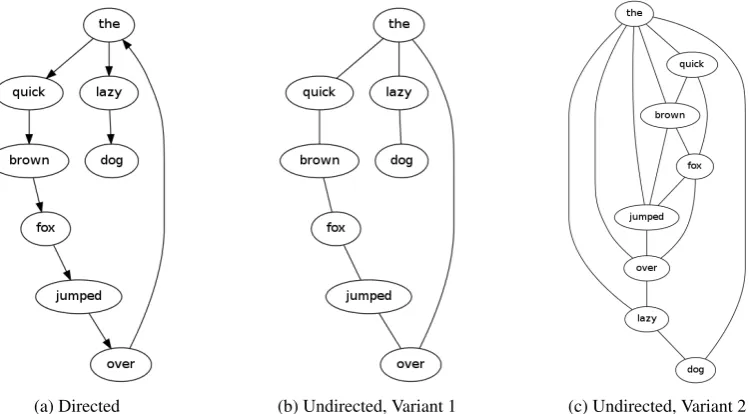
(a) Directed (b) Undirected, Variant 1 (c) Undirected, Variant 2
Figure 1: Word collocation networks of the sentence“the quick brown fox jumped over the lazy dog”.
Note that for all three network types, the word “the” appeared as the most central word. It is in general the case that stop words like “the” are the most central words in collocation networks, especially since they act asconnectorsbetween other words.
Network Property Mathematical Expression
Number of vertices |V|
Number of edges |E|
Shrinkage exponent (Leskovec et al., 2007) log|V||E|
Global clustering coefficient C
Small-worldliness (Walsh, 1999; Matsuo et al., 2001a) µ= ( ¯C/L)/( ¯Crand/Lrand)
Diameter (directed) d
Diameter (undirected) d
Power-law exponent of degree distribution α
Power-law exponent of in-degree distribution αin
Power-law exponent of out-degree distribution αout
p-value for the power-law exponent of degree distribution N/A
p-value for the power-law exponent of in-degree distribution N/A
p-value for the power-law exponent of out-degree distribution N/A
Number of connected components* N/A
Size of the largest connected component* N/A
Number of strongly connected components* N/A
[image:3.595.92.504.382.628.2]Size of the largest strongly connected component* N/A
In addition to addressing these problems, in this paper we introduce a new analysis - how the global network properties change as we gradually add more collocation edges to a network (Sec-tion 4.3).2
3 Collocation Networks of Words
Before constructing collocation networks, we low-ercased the input text and removed all punctuation, but refrained from performing stemming in order to retain subtle distinctions between words like “vector” and “vectorization”. Six different types of word collocation networks were constructed on each document (used in Section 4.2) as well as on document collections (used in Section 4.3), where nodes are unique words, and an edge appears be-tween two nodes if their corresponding words ap-peared together as a bigram or in a trigram in the original text. All the network types have the
samenumber of vertices (i.e., words) for a partic-ular document or a document collection, and they are only distinguished from each other by the type (and potentially, number) of edges, as follows:
Directed– Directed edgewA → wB ifwAwBis a bigram in the given text.
Undirected, Variant 1 – Undirected edgewA− wBifwAwBis a bigram in the given text.
Undirected, Variant 2– Undirected edgeswA− wB,wB−wCandwA−wC, ifwAwBwCis a
tri-gram in the given text.
Directed Simplified – Same as the directed ver-sion, withself-loopsremoved.3
Undirected Variant 1, Simplified– Same as the undirected variant 1, with self-loops removed.
Undirected Variant 2, Simplified– Same as the undirected variant 2, with self-loops removed.
We did not take into account edge weights in our study, and all our networks are therefore un-weighted networks. Furthermore, since we
re-moved all punctuation information before
con-structing collocation networks, sentence bound-aries were implicitly ignored. In other words, the
2All code, data, and supplementary material are avail-able at https://drive.google.com/file/d/ 0B2Mzhc7popBgODFKZVVnQTFMQkE/edit?usp= sharing. The data includes – among other things – the corpora we used (cf. Section 4.1), and code to construct the networks and analyze their properties.
3Note that self-loops may appear in word collocation net-works due to punctuation removal in the pre-processing step. An example of such a self-loop is: “The airplane took off. Off we go to Alaska.” Here the word “off” will contain a self-loop.
last word of a sentencedoeslink to the first word of the next sentence in our collocation networks. An example of the first three types of networks (di-rected, undirected variant 1, and undirected vari-ant 2) is shown in Figure 1. Here we considered
a sentence“the quick brown fox jumped over the
lazy dog”as our document. Note that all the col-location networks in Figure 1 contain at least one cycle, and the directed version contains a directed cycle. In a realistic document network, there can be many such cycles.
We constructed word collocation networks on
document collectionsas well. In this case, the six network types remain as before, and the only dif-ference comes from the fact that now the whole collection is considered a singlesuper-document. Words in this super-document are connected ac-cording to bigram and trigram relationships. We respected document boundaries in this case, so the last word of a particular documentdoes notlink to
the first word of the next document. The
collec-tion networkshave only been used in Section 4.3 of this paper, to show how global network proper-ties change as we add edges to the network.
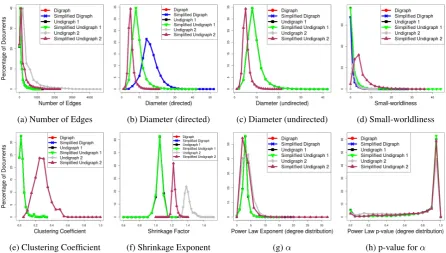
With the networks now constructed, we went ahead and explored several of their global prop-erties (cf. Table 1). Propprop-erties were measured on each type of network on each document, thereby giving us property distributions across different genres of documents for a particular network type (cf. Figure 2), as well as property distributions across different network types for a particular genre (cf. Figure 3). We used theigraphsoftware package (Csardi and Nepusz, 2006) for computing global network properties.
Among the properties in Table 1, number of vertices (|V|) and number of edges (|E|) are self-explanatory. Theshrinkage exponent(log|V||E|) is motivated by the observations that the number of edges (|E|) follows a power-law relationship with the number of vertices (|V|), and that as a net-work evolves, both|V|and|E|continue to grow, but the diameter of the network either shrinks or plateaus out, thereby resulting in a densified net-work (Leskovec et al., 2007). We explored two versions of graph diameter (d) in our study - a di-rected version (considering didi-rected edges), and an undirected version (ignoring edge directions).4
The global clustering coefficient(C) is a
sure of how interconnected a graph’s nodes are among themselves. It is defined as the ratio between the number of closed triplets of ver-tices (i.e., the number of ordered triangles or
transitive triads), and the number of connected vertex-triples (Wasserman and Faust, 1994). The
small-worldliness orproximity ratio(µ) of a net-work measures to what extent the netnet-work ex-hibits small-world behavior. It is quantified as the amount of deviation of the network from an equally large random network, in terms of av-erage local clustering coefficient (C¯) and aver-age shortest path length (L)5. The exact ratio is
µ = ( ¯C/L)/( ¯Crand/Lrand), whereC¯ andLare
the average local clustering coefficient and the av-erage shortest path length of the given network, andC¯randandLrandare the average local
cluster-ing coefficient and the average shortest path length of an equally large random network (Walsh, 1999; Matsuo et al., 2001a).
Since collocation networks have been found to display scale-free (power-law) degree distribution in several previous studies (see, e.g., (Ferrer i Cancho and Sol´e, 2001; Masucci and Rodgers, 2006; Liang et al., 2009)), we computed power-law exponents of in-degree, out-degree, and de-gree distributions on each of our collocation
net-works.6 We also computed the corresponding
p-values, following a procedure outlined in (Clauset et al., 2009). These p-values help assess whether the distributions are power-law or not. If a p-value is< 0.05, then there is statistical evidence to be-lieve that the corresponding distribution is not a power-law distribution.
Finally, we computed the number of connected components, size of the largest (“giant”) con-nected component, number of strongly concon-nected components, and size of the largest strongly con-nected component, to be used in Section 4.3.
4 Analysis of Network Properties 4.1 Datasets
We used four document collections from four dif-ferent genres – blogs, news articles, academic pa-pers, and digitized books. For blogs, we used the
Blog Authorship Corpuscreated by (Schler et al., 2006). It consists of 19,320 blogs from authors
5Also called “characteristic path length” (Watts and Strogatz, 1998).
6For undirected graphs, the exponents on all three distri-butions are the same.
of different age groups and professions. The un-processed corpus has about 136.8 million word to-kens.
Our news articles come from the
Reuters-21578, Distribution 1.0collection.7 This
collec-tion contains 19,043 news stories, and about 2.6 million word tokens (unprocessed).
For the academic paper dataset, we usedNIPS
Conference Papers Vols 0-12.8 This corpus
com-prises 1,740 papers and about 4.8 million unpro-cessed word tokens.
Finally, we created our own corpus of 3,036 digitized books written by 142 authors from the
Project Gutenberg digital library.9 After
re-moving metadata, license information, and tran-scribers’ notes, this dataset contains about 210.9 million word tokens.
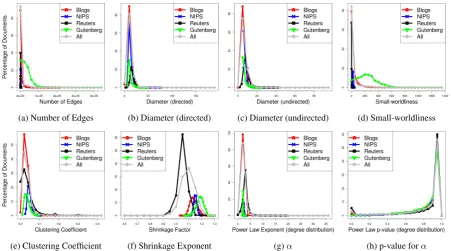
That the word collocation networks of individ-ual documents are indeed scale-free and small-world, is evident from Tables 2, 3, and 4, and Figure 2h. Irrespective of network type, a
major-ity of the median α (power-law exponent of
de-gree distribution) values hovers in the range[2,3], with low dispersion. This corroborates with ear-lier studies (Ferrer i Cancho and Sol´e, 2001; Liang et al., 2009; Liang et al., 2012). Similarly, the medianµ (small-worldliness) is high for all
gen-res except news (irrespective of network type),
thereby indicating the document networks are in-deed small-world. This finding is in line with pre-vious studies (Matsuo et al., 2001a; Matsuo et al., 2001b). Moreover, Figure 2h shows that a major-ity of documents in different genres have a very high p-value, indicating that the networks are
sig-nificantly power-law. The news genre poses an
interesting case. Since many news stories in the Reuters-21578 collection are small, their colloca-tion networks are not very well-connected, thereby resulting in very low small-worldliness values, as well as higher estimates of the power-law expo-nentα(cf. Tables 2, 3, and 4).
4.2 Distribution of Global Network Properties
We plotted the histograms of eight important global network properties on directed collocation networks in Figure 2. All histograms were
plot-7Available fromhttp://www.daviddlewis.com/ resources/testcollections/reuters21578/.
8Available from http://www.cs.nyu.edu/ ˜roweis/data.html.
Dataset on DigraphMedianα on Undigraph 1Medianα on Undigraph 2Medianα on DigraphMedianµ on Undigraph 1Medianµ on Undigraph 2Medianµ (quartile deviations are in parentheses) (quartile deviations are in parentheses) Blog 2.34 (0.17) 2.34 (0.17) 2.41 (0.19) 16.63 (17.16) 22.50 (22.01) 14.93 (9.49) News 3.38 (0.42) 3.38 (0.42) 4.35 (0.98) 0.63 (0.50) 0.95 (0.76) 1.75 (0.71) Papers 2.35 (0.09) 2.35 (0.09) 2.45 (0.11) 20.69 (2.96) 27.87 (3.93) 14.95 (1.80) Digitized Books 2.12 (0.04) 2.12 (0.04) 2.16 (0.05) 244.31 (98.62) 296.73 (116.98) 88.46 (31.78) All together 2.58 (0.53) 2.58 (0.53) 2.70 (0.90) 5.03 (11.93) 7.27 (15.85) 7.31 (8.47)
Table 2: Power-law exponent of degree distribution (α) and small-worldliness (µ) of word collocation networks. Here we report the median across documents in a particular dataset (genre), and also the median across all documents in all datasets (last row).
Dataset Simplified DigraphMedianαon Simplified Undigraph 1Medianαon Simplified Undigraph 2Medianαon Simplified DigraphMedianµon Simplified Undigraph 1Medianµon Simplified Undigraph 2Medianµon
(quartile deviations are in parentheses) (quartile deviations are in parentheses)
[image:6.595.71.530.221.286.2]Blog 2.34 (0.17) 2.34 (0.16) 2.36 (0.18) 16.67 (17.18) 23.28 (22.98) 39.13 (24.03) News 3.39 (0.42) 3.40 (0.42) 3.88 (0.77) 0.63 (0.50) 0.96 (0.77) 4.96 (1.93) Papers 2.36 (0.09) 2.37 (0.09) 2.40 (0.11) 20.78 (2.98) 29.18 (4.09) 38.81 (4.75) Digitized Books 2.12 (0.04) 2.13 (0.04) 2.14 (0.05) 244.53 (98.81) 317.49 (127.14) 218.77 (78.02) All together 2.58 (0.53) 2.58 (0.54) 2.65 (0.72) 5.04 (11.97) 7.45 (16.52) 19.64 (21.82)
Table 3: Power-law exponent of degree distribution (α) and small-worldliness (µ) of word collocation networks. Here we report the median across documents in a particular dataset (genre), and also the median across all documents in all datasets (last row).
Network Type Medianon Blogsα Medianon Papersα Medianon Newsα Medianon Booksα Medianon Allα Medianon Blogsµ on PapersMedianµ Medianon Newsµ Medianon Booksµ Medianon Allµ
(quartile deviations are in parentheses) (quartile deviations are in parentheses)
Digraph 2.34 (0.17) 2.35 (0.09) 3.38 (0.42) 2.12 (0.04) 2.58 (0.53) 16.63 (17.16) 20.69 (2.96) 0.63 (0.50) 244.31 (98.62) 5.03 (11.93) Undigraph 1 2.34 (0.17) 2.35 (0.09) 3.38 (0.42) 2.12 (0.04) 2.58 (0.53) 22.50 (22.01) 27.87 (3.93) 0.95 (0.76) 296.73 (116.98) 7.27 (15.85) Undigraph 2 2.41 (0.19) 2.45 (0.11) 4.35 (0.98) 2.16 (0.05) 2.70 (0.90) 14.93 (9.49) 14.95 (1.80) 1.75 (0.71) 88.46 (31.78) 7.31 (8.47) Simplified Digraph 2.34 (0.17) 2.36 (0.09) 3.39 (0.42) 2.12 (0.04) 2.58 (0.53) 16.67 (17.18) 20.78 (2.98) 0.63 (0.50) 244.53 (98.81) 5.04 (11.97) Simplified Undigraph 1 2.34 (0.16) 2.37 (0.09) 3.40 (0.42) 2.13 (0.04) 2.58 (0.54) 23.28 (22.98) 29.18 (4.09) 0.96 (0.77) 317.49 (127.14) 7.45 (16.52) Simplified Undigraph 2 2.36 (0.18) 2.40 (0.11) 3.88 (0.77) 2.14 (0.05) 2.65 (0.72) 39.13 (24.03) 38.81 (4.75) 4.96 (1.93) 218.77 (78.02) 19.64 (21.82)
Table 4: Power-law exponent of degree distribution (α) and small-worldliness (µ) of word collocation networks. Here we report the median across documents for a particular network type.
(a) Number of Edges (b) Diameter (directed) (c) Diameter (undirected) (d) Small-worldliness
(e) Clustering Coefficient (f) Shrinkage Exponent (g)α (h) p-value forα
[image:6.595.70.551.351.422.2] [image:6.595.72.524.474.725.2](a) Number of Edges (b) Diameter (directed) (c) Diameter (undirected) (d) Small-worldliness
[image:7.595.73.520.74.327.2](e) Clustering Coefficient (f) Shrinkage Exponent (g)α (h) p-value forα
Figure 3: Distributions of eight global network properties across different network types on the news
genre. Y-axes represent the percentage of documents for different network types.
Test |E| Directedd Undirectedd µ C Shrinkage α p-value forα ANOVA <0.001 <0.001 <0.001 <0.001 <0.001 <0.001 <0.001 <0.001
Kruskal-Wallis <0.001 <0.001 <0.001 <0.001 <0.001 <0.001 <0.001 <0.001
ANOVA <0.001 <0.001 <0.001 <0.001 <0.001 <0.001 <0.001 <0.001
Kruskal-Wallis <0.001 <0.001 <0.001 <0.001 <0.001 <0.001 <0.001 <0.001
Table 5: p-values from ANOVA and Kruskal-Wallis tests. The top two rows are p-values for Figure 2, and the bottom two rows are p-values for Figure 3. Each column corresponds to one subfigure of Figure 2 and Figure 3. p-values in general were extremely low - close to zero in most cases.
(a)|V| (b)d(directed) (c)d(undirected) (d)µ (e)C (f) Shrinkage
(g)α (h) p-value forα (i) Number of SCCs (j) Number of CCs (k) Giant SCC Size (l) Giant CC Size
Figure 4: Change of global network properties with incremental addition of edges to the directed network
ofnewsgenre. SCC = Strongly Connected Component, CC = Connected Component. By “giant” CC
[image:7.595.75.521.531.702.2]ted with 20 bins. Figure 2e, for example, shows the global clustering coefficient (C) on the X-axis, divided into 20 bins, and the percentage of
doc-ument networks (directed) with C values falling
into a particular bin, on the Y-axis. Histograms from different genres are overlaid. Note from Fig-ure 2e that most distributions are highly overlap-ping across different genres, thereby putting into question if they are indeed suitable for genre iden-tification. But when we performed ANOVA and Kruskal-Wallis tests to figure out if the distribu-tions were similar or not across different gen-res, we observed that the corresponding p-values were all < 0.001 (cf. Table 5, top two rows), thereby showing that at least a pair of mean values were significantly apart. Follow-up experiments using unpaired t-tests, U-tests, and Kolmogorov-Smirnov tests (all with Bonferroni Correction for multiple comparisons) showed that indeed almost all distributions across different genres were sig-nificantly apart from each other. Detailed results are in the supplementary material. This, we think, is an important and interesting finding, and needs to be delved deeper in future work.
Figure 3 shows histograms of the eight proper-ties from Figure 2, but this time on asingle genre
(news articles), across different network types. This time we observed that many histograms are significantly apart from each other (see, e.g., Fig-ures 3b, 3c, 3e, and 3f). ANOVA and Kruskal-Wallis tests corroborated this finding (cf. Table 5, bottom two rows). Detailed results, including t-tests, U-t-tests, and Kolmogorov-Smirnov tests are in the supplementary material.
4.3 Change of Global Network Properties with Gradual Addition of Edges
To see how global network properties change as we gradually add edges to a network, we took the whole news collection, and constructed a di-rected word collocation network on the whole col-lection, essentially considering the collection as a
super-document(cf. Section 3). We studied how properties change as we consider topk%of edges
in this super-network, with k ranging from 1 to
100 in steps of 1. The result is shown in Fig-ure 4. Note that the number of connected compo-nents and the number of strongly connected com-ponents increase first, and then decrease. The number of vertices, size of the largest strongly connected component, and size of the largest
con-nected component increase monotonically as we consider more and more collocation edges. For other properties, we see a lot of unpredictability and spikes (see, e.g., Figures 4d, 4e, 4g, and 4h), especially when the percentage of added edges is small. We performed Runs Test, Bartels Test, and Mann-Kendall Test to figure out if these trends are random, and the resulting p-values indicate that they are not random, and in fact positively corre-lated (i.e., increasing). Details of these tests are in the supplementary material. Note also that all figures except Figures 4a, 4k, and 4l show at least onephase transition(i.e., a “jump” or a “bend”).
5 Conclusion
We performed an exploratory analysis of global properties of word collocation networks across four different genres of text, and across different network types within the same genre. Our analy-ses reveal that cross-genre and within-genre vari-ations are statistically significant, and incremental construction of collocation networks by gradually adding edges leads to non-random and positively correlated fluctuations in many global properties,
some of them displaying single or multiplephase
transitions. Future work consists of the inclusion of edge weights; exploration of other datasets, net-work properties, and netnet-work types; and applying those properties to the genre classification task.
Acknowledgments
We would like to acknowledge Dr Rada Mihalcea for her support. This work emerged from a class project in a graduate course on Network Science, given by Prof R´eka Albert at Penn State. Sagnik Ray Choudhury provided us with the primary in-spiration to do the hard work and write the paper. Finally, we thank the anonymous reviewers whose comments greatly improved this draft. All results, discussions, and comments contained herein are the sole responsibility of the author, and in no way associated with any of the above-mentioned peo-ple. The errors and omissions, if any, should be addressed to the author, and will be gratefully ac-knowledged.
References
Lu-ciano F. Costa, Alexandre Evsukoff, Giuseppe
Man-gioni, and Ronaldo Menezes, editors,Complex
Net-works, volume 116 ofCommunications in Computer and Information Science, pages 154–162. Springer Berlin Heidelberg.
Lucas Antiqueira, Thiago Alexandre Salgueiro Pardo, Maria das Grac¸as Volpe Nunes, Osvaldo Novais Oliveira Jr., and Luciano da Fontoura Costa. 2006. Some issues on complex networks for author charac-terization. In Solange Oliveira Rezende and Antonio
Carlos Roque da Silva Filho, editors,Fourth
Work-shop in Information and Human Language Tech-nology (TIL’06) in the Proceedings of International Joint Conference IBERAMIA-SBIA-SBRN, Ribeiro Preto, Brazil, October 23-28. ICMC-USP.
Chris Biemann, Monojit Choudhury, and Animesh Mukherjee. 2009. Syntax is from Mars while Semantics from Venus! Insights from Spectral Analysis of Distributional Similarity Networks. In ACL/IJCNLP (Short Papers), pages 245–248. Chris Biemann, Stefanie Roos, and Karsten Weihe.
2012. Quantifying Semantics Using Complex
Net-work Analysis. InProceedings of COLING.
Monojit Choudhury and Animesh Mukherjee. 2009. The Structure and Dynamics of Linguistic
Net-works. InDynamics on and of Complex Networks,
pages 145–166. Springer.
Aaron Clauset, Cosma Rohilla Shalizi, and Mark E. J. Newman. 2009. Power-Law Distributions in
Empir-ical Data. SIAM Review, 51(4):661–703, November.
Gabor Csardi and Tamas Nepusz. 2006. The igraph
software package for complex network research.
In-terJournal, Complex Systems:1695.
Ramon Ferrer i Cancho and Ricard V. Sol´e. 2001. The
Small World of Human Language. Proceedings:
Bi-ological Sciences, 268(1482):pp. 2261–2265. Olivier Ferret. 2002. Using collocations for topic
segmentation and link detection. In Proceedings
of the 19th international conference on Computa-tional linguistics - Volume 1, COLING ’02, pages 1–7, Stroudsburg, PA, USA. Association for Com-putational Linguistics.
Gerhard Heyer, Martin L¨auter, Uwe Quasthoff, Thomas Wittig, and Christian Wolff. 2001. Learn-ing Relations usLearn-ing Collocations. InProceedings of the IJCAI Workshop on Ontology Learning, Seattle, USA.
Patrick Juola. 2006. Authorship Attribution. Found.
Trends Inf. Retr., 1(3):233–334, December.
Jinyun Ke and Yao Yao. 2008. Analysing Language
Development from a Network Approach. Journal of
Quantitative Linguistics, 15(1):70–99.
Jinyun Ke. 2007. Complex networks and human
lan-guage. CoRR, abs/cs/0701135.
Moshe Koppel, Jonathan Schler, and Shlomo Arga-mon. 2009. Computational methods in authorship attribution. J. Am. Soc. Inf. Sci. Technol., 60(1):9– 26, January.
Jure Leskovec, Jon Kleinberg, and Christos Faloutsos. 2007. Graph Evolution: Densification and
Shrink-ing Diameters. ACM Trans. Knowl. Discov. Data,
1(1), March.
Wei Liang, Yuming Shi, Chi K. Tse, Jing Liu, Yanli Wang, and Xunqiang Cui. 2009. Comparison of co-occurrence networks of the Chinese and English languages. Physica A: Statistical Mechanics and its Applications, 388(23):4901 – 4909.
Wei Liang, YuMing Shi, Chi K. Tse, and YanLi Wang. 2012. Study on co-occurrence character networks
from Chinese essays in different periods. Science
China Information Sciences, 55(11):2417–2427. Adolfo Paolo Masucci and Geoff J. Rodgers. 2006.
Network properties of written human language. Physical Review E, 74(2):026102+, August. Yutaka Matsuo, Yukio Ohsawa, and Mitsuru Ishizuka.
2001a. A Document as a Small World. In
Proceed-ings of the Joint JSAI 2001 Workshop on New Fron-tiers in Artificial Intelligence, pages 444–448, Lon-don, UK, UK. Springer-Verlag.
Yutaka Matsuo, Yukio Ohsawa, and Mitsuru Ishizuka. 2001b. KeyWorld: Extracting Keywords from a
Document as a Small World. InProceedings of the
4th International Conference on Discovery Science, DS ’01, pages 271–281, London, UK, UK. Springer-Verlag.
Rada Mihalcea and Paul Tarau. 2004. TextRank: Bringing Order into Texts. In Dekang Lin and Dekai
Wu, editors, Proceedings of EMNLP 2004, pages
404–411, Barcelona, Spain, July. Association for Computational Linguistics.
Adilson E. Motter, Alessandro P. S. de Moura, Ying-Cheng Lai, and Partha Dasgupta. 2003. Topology of the conceptual network of language. Physical Re-view E, 65.
Lawrence Page, Sergey Brin, Rajeev Motwani, and Terry Winograd. 1998. The PageRank Citation
Ranking: Bringing Order to the Web. In
Proceed-ings of the 7th International World Wide Web Con-ference, pages 161–172, Brisbane, Australia. Rishiraj Saha Roy, Niloy Ganguly, Monojit
Choud-hury, and Naveen Kumar Singh. 2011. Complex Network Analysis Reveals Kernel-Periphery
Struc-ture in Web Search Queries. In Proceedings of
SI-GIR Workshop on Query Understanding and Repre-sentation.
Jonathan Schler, Moshe Koppel, Shlomo Argamon, and James Pennebaker. 2006. Effects of Age and
Gender on Blogging. InProc. of AAAI Spring
Efstathios Stamatatos. 2009. A survey of modern au-thorship attribution methods. J. Am. Soc. Inf. Sci. Technol., 60(3):538–556, March.
J. T. Stevanak, David M. Larue, and Lincoln D. Carr. 2010. Distinguishing Fact from Fiction: Pattern Recognition in Texts Using Complex Networks.
CoRR, abs/1007.3254.
Toby Walsh. 1999. Search in a Small World. In
Thomas Dean, editor, IJCAI, pages 1172–1177.
Morgan Kaufmann.
Stanley Wasserman and Katherine Faust. 1994.
So-cial Network Analysis: Methods and Applications. Cambridge University Press, November.
Duncan J. Watts and Steven H. Strogatz. 1998.
Collec-tive dynamics of ‘small-world’ networks. Nature,