Data Driven Language Transfer Hypotheses
Ben Swanson
Brown University Providence, RI
Eugene Charniak
Brown University Providence, RI [email protected]
Abstract
Language transfer, the preferential second language behavior caused by similarities to the speaker’s native language, requires considerable expertise to be detected by humans alone. Our goal in this work is to replace expert intervention by data-driven methods wherever possible. We define a computational methodology that produces a concise list of lexicalized syntactic pat-terns that are controlled for redundancy and ranked by relevancy to language trans-fer. We demonstrate the ability of our methodology to detect hundreds of such candidate patterns from currently available data sources, and validate the quality of the proposed patterns through classifica-tion experiments.
1 Introduction
The fact that students with different native lan-guage backgrounds express themselves differ-ently in second language writing samples has been established experimentally many times over (Tetreault et al., 2013), and is intuitive to most people with experience learning a new language. The exposure and understanding of this process could potentially enable the creation of second language (L2) instruction that is tailored to the na-tive language (L1) of students.
The detectable connection between L1 and L2 text comes from a range of sources. On one end of the spectrum are factors such as geographic or cul-tural preference in word choice, which are a pow-erful L1 indicator. On the other end lie linguistic phenomena such as language transfer, in which the preferential over-use or under-use of structures in
the L1 is reflected in the use of corresponding pat-terns in the L2. We focus on language transfer in this work, based on our opinion that such effects are more deeply connected to and effectively uti-lized in language education.
The inherent challenge is that viable language transfer hypotheses are naturally difficult to con-struct. By the requirement of contrasting different L1 groups, hypothesis formulation requires deep knowledge of multiple languages, an ability re-served primarily for highly trained academic lin-guists. Furthermore, the sparsity of any particular language pattern in a large corpus makes it diffi-cult even for a capable multilingual scholar to de-tect the few patterns that evidence language trans-fer. This motivates data driven methods for hy-pothesis formulation.
We approach this as a representational problem, requiring the careful definition of a class of lin-guistic features whose usage frequency can be de-termined for each L1 background in both L1 and L2 text (e.g. both German and English written by Germans). We claim that a feature exhibiting a sufficiently non-uniform usage histogram in L1 that is mirrored in L2 data is a strong language transfer candidate, and provide a quantified mea-sure of this property.
We represent both L1 and L2 sentences in a universal constituent-style syntactic format and model language transfer hypotheses with con-tiguous syntax sub-structures commonly known as Tree Substitution Grammar (TSG) fragments (Post and Gildea, 2009)(Cohn and Blunsom, 2010). With these features we produce a concise ranked list of candidate language transfer hypothe-ses and their usage statistics that can be automati-cally augmented as increasing amounts of data be-come available.
2 Related Work
This work leverages several recently released data sets and analysis techniques, with the primary contribution being the transformations necessary to combine these disparate efforts. Our analy-sis methods are closely tied to those described in Swanson and Charniak (2013), which con-trasts techniques for the discovery of discrimina-tive TSG fragments in L2 text. We modify and extend these methods to apply to the universal de-pendency treebanks of McDonald et al. (2013), which we will refer to below to as the UTB. Bilin-gual lexicon construction (Haghighi et al., 2008) is also a key component, although previous work has focused primarily on nouns while we focus on stopwords. We also transform the UTB into con-stituent format, in a manner inspired by Carroll and Charniak (1992).
There is a large amount of related research in Native Language Identification (NLI), the task of predicting L1 given L2 text. This work has culmi-nated in a well attended shared task (Tetreault et al., 2013), whose cited report contains an excellent survey of the history of this task. In NLI, however, L1 data is not traditionally used, and patterns are learned directly from L2 text that has been anno-tated with L1 labels. One notable outlier is Brooke and Hirst (2012), which attempts NLI using only L1 data for training using large online dictionar-ies to tie L2 English bigrams and collocations to possible direct translations from native languages. Jarvis and Crossley (2012) presents another set of studies that use NLI as a method to form language transfer hypotheses.
3 Methodology
The first of the four basic requirements of our pro-posed method is the definition of a class of features
F such that a single feature F ∈ F is capable of capturing language transfer phenomenon. The second is a universal representation of both L1 and L2 data that allows us to count the occurrences of anyF in an arbitrary sentence. Third, as any suf-ficiently expressiveF is likely to be very large, a method is required to propose an initial candidate listC ⊂ F. Finally, we refineCinto a ranked list
H of language transfer hypotheses, where H has also been filtered to remove redundancy.
In this work we define F to be the set of Tree Substitution Grammar (TSG) fragments in our data, which allows any connected syntactic
struc-ture to be used as a feastruc-ture. As such, our universal representation of L1/L2 data must be a constituent tree structure of the general form used in syntactic parsing experiments on the Penn Treebank. The UTB gets us most of the way to our goal, defining a dependency grammar with a universal set of part of speech (POS) tags and dependency arc labels.
Two barriers remain to the use of standard TSG induction algorithms. The first is to define a map-ping from the dependency tree format to con-stituency format. We use the following depen-dency tree to illustrate our transformation.
ROOT DT NN VBZ PRP
The poodle chews it root
det nsubj dobj
Under our transformation, the above dependency parse becomes
ROOT root
VBZ-L nsubj NN-L
det DT the
NN poodle
VBZ chews
VBZ-R dobj PRP it
We also require a multilingual lexicon in the form of a function ML(w) for each language L that maps words to clusters representing their meaning. In order to avoid cultural cues and reduce noise in our mapping, we restrict ourselves to clusters that correspond to a list of L2 stopwords. Any L2 words that do not appear on this list are mapped to the unknown “UNK” symbol, as are all for-eign words that are not good translations of any L2 stopword. Multiple words from a single lan-guage can map to the same cluster, and it is worth noting that this is true for L2 stopwords as well.
or from one of the L2 stopwords. The edges in this graph exist only between L2 and L1 words, and are directed with weight equal to the IBM model’s translation probability of the edge’s target given its source. We construct ML by removing edges with weight below some threshold and calculating the connected components of the resulting graph. We then discard any cluster that does not contain at least one word from each L1 and at least one L2 stopword.
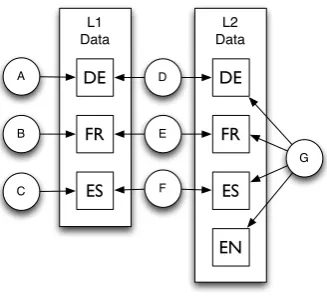
To propose a candidate listC, we use the TSG induction technique described in Swanson and Charniak (2013), which simultaneously induces multiple TSGs from data that has been partitioned into labeled types. This method permits linguisti-cally motivated constraints as to which grammars produce each type of data. For an experimental setup that considersndifferent L1s, we use2n+1
data types; Figure 1 shows the exact layout used in our experiments. Besides the necessaryndata types for each L1 in its actual native language form andn in L2 form, we also include L2 data from L2 native speakers. We also define2n+ 1 gram-mars. We begin with n grammars that can each be used exclusively by one native language data type, representing behavior that is unique to each native language (grammars A-C in Figure 1) . This is done for the L2 as well (grammar G). Finally, we create an interlanguage grammar for each of our L1 types that can be used in derivation of both L1 and L2 data produced by speakers of that L1 (grammars D-F).
The final step is to filter and rank the TSG frag-ments produced inC, where filtering removes re-dundant features and ranking provides some quan-tification of our confidence in a feature as a lan-guage transfer hypothesis. Swanson and Char-niak (2013) provides a similar method for pure L2 data, which we modify for our purposes. For re-dundancy filtering no change is necessary, and we use their recommended Symmetric Uncertainty method. For a ranking metric of how well a frag-ment fits the profile of language transfer we adopt the expected per feature loss (or risk) also de-scribed in their work. For an arbitrary feature F, this is defined as
R(F) = 1
|TF|
X
t∈TF
PF(L6=L∗t)
whereTF is the subset of the test data that contains the featureF, andL∗
t is the gold label of test
da-L2 Data L1
Data
DE DE
FR FR
ES ES
EN A
B
C
D
E
F
[image:3.595.335.499.67.215.2]G
Figure 1: The multi-grammar induction setup used in our experiments. Squares indicate data types, and circles indicate grammars. Data type labels indicate the native language of the speaker, and all L2 data is in English.
tumt. While in their work the predictive distribu-tionPF(L)is determined by the observed counts of F in L2 training data, we take our estimates directly from the L1 data of the languages under study. This metric captures the extent to which the knowledge of a featureF’s L1 usage can be used to predict its usage in L2.
The final result is a ranked and filtered list of hy-pothesesH. The elements ofH can be subjected to further investigation by experts and the accom-panying histogram of counts contains the relevant empirical evidence. As more data is added, the uncertainty in the relative proportions of these his-tograms and their corresponding Ris decreased. One additional benefit of our method is that TSG induction is a random process, and repeated runs of the sampling algorithm can produce different features. Since redundancy is filtered automati-cally, these different feature lists can be combined and processed to potentially find additional fea-tures given more computing time.
4 Results
Fi-nally, we use the Penn Treebank as our source of native English data, for a total of seven data types; four in English, and one in each L1.
When calculating metrics such as redundancy and R(F) we use all available data. For TSG sampling, we balance our data sets to 4000 sen-tences from each data type and sample using the Enbuske sampler that was released with Swanson and Charniak (2013). To construct word clusters, we use Giza++ (Och and Ney, 2003) and train on the Europarl data set (Koehn, 2005), using .25 as a threshold for construction on connected compo-nents.
We encourage the reader to peruse the full list of results1, in which each item contains the infor-mation in the following example.
advcl
VERB-L
mark
VERB
110
VERB-R
ES DE FR L1 4.2 0.0 0.0 L2 2.3 0.3 0.3
This fragment corresponds to an adverbial clause whose head is a verb in the cluster 110, which contains the English word “is” and its vari-ous translations. This verb has a single left depen-dent, a clause marker such as “because”, and at least one right dependent. Its prevalence in Span-ish can explained by examining the translations of the English sentence “I like it because it is red”.
ES Me gusta porque es rojo.
DE Ich mag es, weil es rot ist.
FR Je l’aime parce qu’il est rouge.
Only in the Spanish sentence is the last pronoun dropped, as in “I like it because is red”. This observation, along with the L1/L2 profile which shows the count per thousand sentences in each language provides a strong argument that this pat-tern is indeed a form of language transfer.
Given our setup of three native languages, a fea-ture withR(F) < .66is a candidate for language transfer. However, several members of our filtered list have R(F) > .66, which is to say that their
1bllip.cs.brown.edu/download/interlanguage corpus.pdf
0.34 0.36 0.38 0.4 0.42 0.44
0 10 20 30 40 50 60 70 80 90
Classification Accuracy (%)
[image:4.595.314.514.66.166.2]Sentences Per Test Case
Figure 2: Creating test cases that consist of sev-eral sentences mediates feature sparsity, providing clear evidence for the discriminative power of the chosen feature set.
L2 usage does not mirror L1 usage. This is to be expected in some cases due to noise, but it raises the concern that our features withR(F)< .66are also the result of noise in the data. To address this, we apply our features to the task of cross language NLI using only L1 data for training. If the varia-tion ofR(F)around chance is simply due to noise then we would expect near chance (33%) classifi-cation accuracy. The leftmost point in Figure 2 shows the initial result, using boolean features in a log-linear classification model, where a test case involves guessing an L1 label for each individual sentence in the L2 corpus. While the accuracy does exceed chance, the margin is not very large.
One possible explanation for this small margin is that the language transfer signal is sparse, as it is likely that language transfer can only be used to correctly label a subset of L2 data. We test this by combining randomly sampled L2 sentences with the same L1 label, as shown along the horizontal axis of Figure 2. As the number of sentences used to create each test case is increased, we see an in-crease in accuracy that supports the argument for sparsity; if the features were simply weak predic-tors, this curve would be flat. The resulting margin is much larger, providing evidence that a signifi-cant portion of our features withR(F) < .66are not selected due to random noise inRand are in-deed connected to language transfer.
References
Daniel Blanchard, Joel Tetreault, Derrick Higgins, Aoife Cahill, and Martin Chodorow. 2013. Toefl11: A corpus of non-native english. Technical report, Educational Testing Service.
Julian Brooke and Graeme Hirst. 2012. Measur-ing Interlanguage: Native Language Identification with L1-influence Metrics. In Proceedings of the Eighth International Conference on Language Re-sources and Evaluation (LREC-2012), pages 779– 784, Istanbul, Turkey, May. European Language Re-sources Association (ELRA). ACL Anthology Iden-tifier: L12-1016.
Glenn Carroll and Eugene Charniak. 1992. Two exper-iments on learning probabilistic dependency gram-mars from corpora. Technical Report CS-92-16, Brown University, Providence, RI, USA.
Trevor Cohn and Phil Blunsom. 2010. Blocked infer-ence in bayesian tree substitution grammars. pages 225–230. Association for Computational Linguis-tics.
Aria Haghighi, Percy Liang, Taylor Berg-Kirkpatrick, and Dan Klein. 2008. Learning bilingual lexicons from monolingual corpora. InACL, pages 771–779.
Scott Jarvis and Scott Crossley, editors. 2012. Ap-proaching Language Transfer Through Text Classi-fication: Explorations in the Detection-based Ap-proach, volume 64. Multilingual Matters Limited, Bristol, UK.
Philipp Koehn. 2005. Europarl: A parallel corpus for statistical machine translation. MT Summit.
Ryan T. McDonald, Joakim Nivre, Yvonne Quirmbach-Brundage, Yoav Goldberg, Dipan-jan Das, Kuzman Ganchev, Keith Hall, Slav Petrov, Hao Zhang, Oscar T¨ackstr¨om, Claudia Bedini, N´uria Bertomeu Castell´o, and Jungmee Lee. 2013. Universal dependency annotation for multilingual parsing. InACL (2), pages 92–97.
Franz Josef Och and Hermann Ney. 2003. A sys-tematic comparison of various statistical alignment models. Comput. Linguist., 29(1):19–51, March.
Matt Post and Daniel Gildea. 2009. Bayesian learning of a tree substitution grammar. InProceedings of the ACL-IJCNLP 2009 Conference Short Papers, pages 45–48. Association for Computational Linguistics.
Ben Swanson and Eugene Charniak. 2013. Extracting the native language signal for second language ac-quisition. InProceedings of the 2013 Conference of the North American Chapter of the Association for Computational Linguistics: Human Language Tech-nologies, pages 85–94, Atlanta, Georgia, June. As-sociation for Computational Linguistics.