P P - A t t a c h m e n t :
A C o m m i t t e e M a c h i n e A p p r o a c h
M a r t h a A. Alegre D e p a r t a m e n t de LSI
U n i v e r s i t a t P o l i t h c n i c a de C a t a l u n y a m a l e g r e © l s i , u p c . e s
Agusti Lloberas
Josep M. S o p e n a Lab. de N e u r o c o m p u t a c i 6
U n i v e r s i t a t de B a r c e l o n a p e p ~ a x o n , p s i . u b . e s
Lab. de N e u r o c o m p u t a c i d U n i v e r s i t a t de B a r c e l o n a a g u s t i ¢ a x o n , p s i . u b . e s
Abstract
In this paper we use various methods for multiple neural network combination in tasks of prepo- sitional phrase attachment. Experiments with aggregation functions such as unweighted and weighted average, OWA operator, Choquet inte- gral and stacked generalization demonstrate t h a t combining multiple networks improve the esti- mation of each individual neural network. Using the Ratnaparkhi d a t a set (the complete training set and the complete test set) we obtained an ac- curacy score of 86.08%. In spite of the high cost in computational time of neural net training, the response time in test mode is faster than others methods.
1 Introduction
Structural ambiguity is one of the most seri- ous problems t h a t Natural Language Processing (NLP) systems face. This ambiguity takes place because the syntactic information alone does not suffice to make an assignment decision. Con-
structions such as Prepositional Phrase (PP), co- ordination, or relative clauses are affected. An exhaustive study about the information needed to deal with this particular structural ambiguity has not been carried out as of yet; nevertheless, in the current literature we can find several pro- posals.
• In certain cases, it seems t h a t the informa- tion needed to solve the a t t a c h m e n t comes from the general context.
(1.a) John has a telescope.
(1.b) He saw the girl with the telescope.
In this particular case, a correct a t t a c h m e n t would require a model representing the sit- uation in which the different entities are in- volved. If this were true for all of the cases, determining P P assignment would require highly complex computation.
decision-making on the relationships ex- isting between predicates and a r g u m e n t s - w h a t [Katz and Fodor, 1963] called selec-
tional restrictions. Cases belonging to this group seem to be easier to handle c o m p u t a - tionally than the former ones.
Regarding these different cases we can speak of two kinds of disambiguation mechanisms. One t h a t can be called a low level mechanism which uses mainly information regarding selectional re- strictions between predicates and arguments. This mechanism uses a local context in order to solve syntactic disambiguation: t h a t which is c o n s t i t u t e d by the predicate and its arguments. The second mechanism uses higher level infor- mation such as situation models. If the low level mechanism does not solve the ambiguity, the high level mechanism, which would be acti- vated later, should be able to do it. There are empirical d a t a t h a t seem to s u p p o r t the fact t h a t human beings use these two mechanisms both for word sense disambiguation and syntactic disam- biguation. For a review see [Sopena et al. 1998].
1.1 L o c a l d i s a m b i g u a t i o n
The low level disambiguation for the P P is one task t h a t has been s o m e w h a t successfully treated using statistical methods. Not all of the m e t h o d s use the selectional restrictions mechanism since they d o n ' t make use of semantic classes. We will use the term local disambiguation to encompass the m e t h o d s based on selectional restrictions as well as those based on lexical association.
1 . 2 S e l e c t i o n a l r e s t r i c t i o n s a n d P P - a t t a c h m e n t
A system t h a t correctly uses the information of semantic classes must first choose the correct sense of each word. If a hierarchy is used, an a d e q u a t e level of abstraction must be deter- mined. In Figure 1 it is shown how the level of a b s t r a c t i o n can change depending on the verb. Considering the following examples :
(3.a) Give access to documents (3.b) Give a present to the driver
In W o r d N e t (WN) give has 27 senses, driver 4 senses and present 3 senses. W i t h the co- occurrence of give, driver, present, the senses "give something to someone", "vehicle o p e r a t o r " and "gift" respectively are selected. The other senses not selected can be considered as noise. On the other hand, the a d e q u a t e level of abstrac- tion of driver is P E R S O N . The a d e q u a t e level of abstraction of present is O B J E C T .
(2.a) To eat the strawberry with pleasure
ENTITY OBJECT SUBSTANCE FOOD
GREEN GOODS EDIBLE FRUIT
Adequate level of abstraction
of strawberry in (2.a)
(2.b) To take a strawberry from the box.
ENTITY OBJECT
SUBSTANCE - - - FOOD
GREEN GOODS EDIBLE FRUIT
Adequate level of abstraction
of strawberry in (2.b)
F i g u r e 1.
Most of the statistical methods that have used classes do not carry out a prior disambiguation of the words [Brill, Resnick 1994], [Ratnaparkhi et. al 1994] and others, nor do they determine the adequate level of abstraction. Some that do make the determination have a poor level of efficiency.
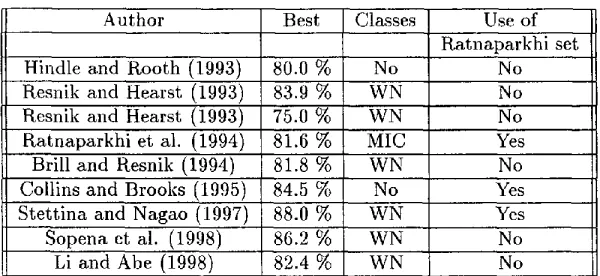
Table 1 shows the accuracy of the results reported in previous work. The worst results were obtained when only classes were used.
Stettina and N a g a o used the R a t n a p a r k h i data set but they eliminated 3,224 4-tuples (15~) from the training set containing contra- dicting examples.
For reasons of complexity, the complete 4- tuple has not been considered simultaneously ex- cept in [Ratnaparkhi et. al 1994].
Classes of a given sense and classes of differ- ent senses of different w o r d s can have c o m p l e x interactions and the preceding m e t h o d s cannot take such interactions into account.
Author Best
Hindle and Rooth (1993) 80.0 % Resnik and Hearst (1993) 83.9 %
WN Resnik and Hearst (1993) 75.0 %
Ratnaparkhi et al. (1994) 81.6 % Brill and Resnik (1994) 81.8 Collins and Brooks (1995) 84.5 Stettina and Nagao (1997) 88.0 Sopena et al. (1998) 86.2 Li and Abe (1998) 82.4
Table 1: Test and accuracy results % % % % %
Classes Use of Ratnaparkhi set
No No
WN No
No
MIC Yes
WN No
No Yes
WN Yes
WN No
WN No
reported in previous works.
tant characteristic of NNs is their capacity to deal with multidimensional inputs. T h e y need much fewer p a r a m e t e r s to achieve the same re- sult than traditional numerical methods. Re- cently [Barton, 1993] has shown t h a t feedfor- ward networks with one layer of sigmoidal non- linearities achieve an integrated squared error of order O(¼) for input spaces of dimension d, where n is the number of units of the network. Traditional m e t h o d s (series expansions) with n terms can only achieve an integrated squared er-
0 ( (1~2d~
ror of order ~ j j, for functions satisfying the same smoothness assumption. NNs are sur- prisingly advantageous in high dimensional in- puts since the integrated squared error is inde- pendent of the input dimension. T h e y can com- pute very complex statistical functions, they are model free, and compared to the current meth- ods used by the statistical approach to NLP, NNs offer the possibility of dealing with a more com- plex (non-linear and multivariant) approach.
In the next section we describe a P P attach- ment disambiguation system based on neural networks t h a t takes b e t t e r advantage of the use of classes.
2
A neural n e t w o r k a p p r o a c h
to P P - a t t a c h m e n t
The use of classes is fundamental when working with neural networks. Using words alone with- out their classes in real texts, floods the m e m o r y capacity of a neural network. It is well known
t h a t the use of words creates huge probabilis- tic tables. In Mdition, the use of classes suc- cessfully deals with problems of invariance re- lated to compositionality and binding t h a t neu- ral networks have [Sopena, 1996]. P P attach- ment can be considered as a classification prob- lem were 4-tuples are classified in two classes: as to whether it is attached to the noun or to the verb [Sopena et al. 1998].
These classes are represented in the o u t p u t units. W h e n a local representation for classes is used (one class per unit) the o u t p u t a c t i w t i o n of each unit can be interpreted as the Bayesian posterior probability t h a t the p a t t e r n in the in- put belongs to the class represented by this unit. In our case we have two units: one represent- ing the class " a t t a c h e d to noun" and the other the class " a t t a c h e d to verb". The activitation of these units will represent the respective proba- bility of a t t a c h m e n t given the 4-tuple encoded in the input.
Given the set of words in the 4-tuple we have to determine a way to represent senses and se- mantic class information. P o l y s e m y represents a problem when using word classes. In order to
use class information, two different procedures are possible. The first one consists in presenting all the classes of each sense of each word serially. The second one consists in the simultaneous pre- sentation of all the senses of all the words. In previous works we have found t h a t parallel pre- sentation improve results.
[image:3.612.66.366.64.202.2]to others within the same slot or among different slots.
Presenting all of the classes simultaneously (including verb classes) allows us to detect com- plex interactions among t h e m (either the classes of a particular sense or the classes of different senses of a particular word) t h a t cannot be de- tected in most of the m e t h o d s used so far. We have been able to detect their existence in our studies on word sense disambiguation currently being carrying out. If we present simultaneously all the classes of all the senses of each word in the 4-tuple we will have a very complex input. A system capable of dealing with such an input would be able to select classes (and consequently senses) which are compatible with other ones.
Finally, and related to the above, most of the statistical m e t h o d s used in Natural Language Processing are linear. Multilayer feedforward networks are non linear. One of the objectives of experiments is to see if introducing non-linearity improves the results.
2.1
Test and training data
We used the same d a t a set (the complete training set and the complete test set) as [Ratnaparkhi et. al 1994] for purposes of com- parison. In this d a t a set the 4-tuples of the test and training sets were extracted from Penn Tree- bank Wall Street Journal [Marcus et al. 1993]. The test d a t a consisted of 3,097 4-tuples with 20,801 4-tuples for the training data.
The following process was run over both test and training data:
All numbers were replaced by the string "whole_number"
- All verbs and nouns were reduced to their mor- phological stem using WordNet.
275 nouns which had not been found in WordNet[Miller et. a1.,1993] were replaced by s y n o n y m s using WordNet.
- The remaining nouns and verbs which had not been found in W o r d N e t were left uncoded.
P r o p e r nouns were replaced by WordNet classes like "person", "business_organization', "social_group".
- Prepositions found fewer t h a n 20 times either
were not represented.
2.2
Codification
The input was divided into eight slots. T h e first four slots represented 'verb', ' n l ' , 'prep', and 'n2' respectively. In slots ' n l ' and 'n2' each sense of the corresponding noun was encoded using all the classes within the IS-A branch of the Word- Net hierarchy. This was done from the corre- sponding hierarchy root node to its b o t t o m - m o s t node. In the verb slot, the verb was encoded us- ing the IS-A-WAY-OF branches. Each node in the hierarchy received a local encoding. T h e r e was a unit in the input for each node of the WordNet subset. This unit was ON if it rep- resented a semantic class to which one of the senses of the encoded word belonged.
Using a local representation we needed a unit for each class-synset. T h e n u m b e r class-synsets in WordNet is too large for a neural network. In order to reduce the n u m b e r of input units we did not use WordNet directly, but c o n s t r u c t e d a new hierarchy (a subset of WordNet) including only the classes t h a t corresponded to the words t h a t belonged to the training and test sets.
A feedforward neural network can make good use of class information if there is a sufficient n u m b e r of examples belonging to each class. For t h a t reason we also counted the n u m b e r of times the different semantic classes a p p e a r e d in the training and test sets. The hierarchy was pruned taking these statistics into account. Given a threshold h, classes which appeared less t h a n h% were not included. In all the experiments of this paper, we used tree cut thresholds of 2% . Re- garding prepositions, only the 36 most fl'equent ones were represented (those found more t h a n 20 times). For those, a local encoding was used. The rest of the prepositions were left uncoded.
The fifth slot represented the prepositions t h a t the verb subcategorized. By representing the prepositions, [Sopena et al. 1998] had obtained improved results. The reason for this improve- ment being t h a t English verbs with semantic similarity m a y take on different prepositions (for example, accuse with of and blame with for).
classified on the basis of the kind of prepositions they make use of.
The prepositions t h a t the verbs subcatego- rize were initially extracted from C O M L E X [Wolff et al., 1995]. Upon observation t h a t COMMLEX does not consider all the subcatego- rized prepositions, we complemented C O M L E X with information extracted from training data. The prepositions of all the 4-tuples assigned to the verb were considered. The distinction be- tween P P adjuncts and P P close-related were not available in the R a t n a p a r k h i d a t a set. Therefore, we grouped the subcategorized prepositions by their verbs as well as those that govern P P ad- juncts. Only the 36 most frequent prepositions were represented.
The sixth slot represented the prepositions t h a t were governed by 'nl'. Again, only the 36 most frequent prepositions were represented. These prepositions were extracted from the 4- tuples of the training d a t a whose a t t a c h m e n t s were to the noun.
The next slot represented 15 units for the lex- icography verb files of WordNet. W o r d N e t has a large number of verb root nodes, some of which are not frequent. Due to this fact, in some cases the pruning t h a t was carried out on the tree made root nodes disappear. This lead to some of the verbs t h a t belonged to this class not be- ing coded. In order to avoid these cases, we used the names of the W o r d N e t verb lexicographical files to add a new top level in the W o r d N e t verb class hierarchy. Finally, in the last slot there are 2 units to indicate whether or not the N1 or N2 respectively were proper nouns .
Regarding the o u t p u t , there were only two units representing whether the P P was attached to the verb or to the noun.
Feedforward networks with one hidden layer and full interconnectivity between layers were used in all the experiments. The networks were trained with the backpropagation learning algo- rithm. The activation function was the hyper- bolic tangent function. The number of hidden units used was 0, 50 and 100. For all simu- lations the m o m e n t u m was 0, and the initial weight range 0.1.
A validation set was constructed using 12,029
4-tuples extracted from the Brown Corpus. In each run the networks were trained for 60 epochs storing the epoch weights with the small- est error regarding the validation set, as well as the weights of the 60th epoch (without the vali- dation set).
3
Experiments
Table 2 shows the results of 24 training simula- tions obtained in the test d a t a using 0, 50 and 100 hidden units respectively. We show the best results by the networks acting individually.
Methods Perceptron
50 Hidden 100 Hidden Backed-Off
Best Results
83.08%
85.18% 85.37% 84.50%
60th epoch Seconds 82.67 % 16
84.21% 44
84.50 % 78
230
Table 2: Results obtained with Backed-Off, 0, 50 and 100 hidden units and time in seconds to disambiguate 3,097 4-tuples.
In spite of the high cost in c o m p u t a t i o n a l time of neural net training, the response time in test mode is up 3 times faster than Backed-Off model. This is shown in Table 2 where the time taken to disambiguate 3,097 4-tuples is given.
In this problem we had a high level of noise: on one hand the inadequate senses of each word in the 4-tuple. Words in English have a high number of senses thus, in the input, the level of noise (inadequate sense) can reach 5 times t h a t of signal (correct sense). In addition, the Rat- naparkhi d a t a set contains m a n y errors, some of them due to errors originating from the Penn Treebank I. This level of noise deteriorates the generalizing capacity of the neural network.
[image:5.612.306.547.249.321.2]3 . 1
E x p e r i m e n t s w i t h C o m m i t t e e s
o fnetworks:
T h e performance of a c o m m i t t e e machine [Perrone, Cooper, 1993], [Perrone, 1994] and [Bishop C., 1995] can o u t p e r f o r m t h a t of the best single network used in isolation.
As [Kuncheva et al. 1998] points out, the pro- cess of combining multiple classifiers to achieve higher accuracy is given different names in the literature a p a r t from committee machines: com- bination, classifier fusion, mixture of experts, consensus aggregation, classifier ensembles, etc. We have applied the following algorithms: aver- age, weighted average, OWA operator, Choquet integral and stacked generalization.
3.1.1 A v e r a g e :
Suppose we have a set of N trained network models yi(x) where i = 1, ..., N.
We can then write the mapping function of each network as the desired function t(x) plus an error function [Bishop C., 1995]:
= t(x) + e (x)
The average sum-of-squares error for model
y~(x) can be w r i t t e n as
Ei = E[(yi(x) - t(x)) 2] = E[e~]
The o u t p u t of t h e c o m m i t t e e is the average of the o u t p u t s of the N networks t h a t integrates the c o m m i t t e e , in the form
1 N
YCOM(X) =
N
yi(x).
If we make t h e assumption t h a t the errors
ei(x) have zero m e a n and are uncorrelated, we have
1
ECOM = ~ E A v
where ECOM is the average error m a d e by the c o m m i t t e e and EAV is the average error made by the networks acting individually.
In general, the errors ei(x) are highly cor- related but even then it is easy to show t h a t [Bishop C., 1995]:
ECOM ~_ EAV
As some members of the c o m m i t t e e will invari- ably give better results t h a n others, it is of inter- est to give more weight to some of the m e m b e r s t h a n to others taking the form:
N
ya N(x) =
i----1
here wi is based on the error of the validation and learning set.
3.1.2
The Ordered Weighted Averaging
( O W A ) O p e r a t o r sIf w is a weighting vector of dimension n, then a mapping O W A w : R" ~ R is an Ordered
Weighted Averaging (OWA) operator of dimen- sion n [Yager, 1993] :
n O W A ( y l , . . . , y n ) =
i----1
where { a ( 1 ) , - . - , a ( n ) } is a p e r m u t a t i o n of { 1 , . . - , n ) such t h a t y a ( i - 1) >_ ya(i) for all i = 2 , . . . , n .
The OWA o p e r a t o r permits weighting the val- ues in relation to their ordering.
Results are show in Tables 3, 4 and 5.
3.1.3 C h o q u e t
integral:
The fuzzy integral introduced by [Choquet G, 1954] and the associated fuzzy measures, provide a useful way for aggregation information. A fuzzy measure u defined on the measurable space (X,X) is a set function u : X -+ [0, 1] satisfying the following axioms:
(i)u(Q) = O, u ( X ) = 1 (boundary conditions)
(ii)A C_ B --+ u(A) < u(B) (monotonicity)
If u is a fuzzy measure on X, then the
Choquet
integral
of a function f : X --+ R with respect to u is defined by:f fdu
~-~(f(y~(i))
-f(y~(i
-1)))u(A.s(i))
i=1
where
f(y~(i))
indicates t h a t the indices have been p e r m u t e d so t h a t0 < f(ys(1)) < ... < f(y~(n)) < 1,
As(i) = ys(i),...,ys(n)
andf(ys(O)) =
0
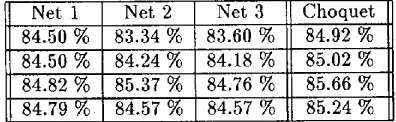
One characteristic p r o p e r t y of Choquet inte- grals is monotonicity, i.e., increases of the input lead to higher integral values. Results are shown in Table 6 and Table 7.
Nets 6 12 18 24
Average Weighted Average OWA 84.92 % 85.34 % 85.18 % 85.18 % 85.63 % 85.28 %
85.21% 85.89 % 85.60 %
85.31% 85.76 % 85.63 %
Table 3: Results Committee machines. 50 hidden layers
Nets
6 85.53 % 12 85.34 % 18 85.41% 24 85.76 %
Average Weighted Average OWA 85.53 % 85.53 % 85.53 % 85.76 % 85.73 %
85.92 %
85.89 % 86.02 %
Table 4: Results Committee machines. 100 hidden layers
Nets 6 12 18 24
Average Weighted Average OWA
84.98 % 85.11% 84.98 %
84.85 % 85.15 % 85.02 % 84.89 % 85.28 % 85.24 % 85.24 % 85.41% 84.92 %
Table 5: Results Committee machines in 60th epoch. 100 hidden layers
Net 1 Net 2 Net 3 Choquet 84.50 % 83.34 % 83.60 % 84.92 % 84.50 % 84.24 % 84.18 % 85.02 % 84.82 % 85.37 % 84.76 % 85.66 % 84.57 % 84.57 % 85.24 % 84.79 %
Table 6: Results Choquet integral.
3.2
Stacked generalization:
[Wolpert, 1992] provides one way of combining trained networks which partitions the d a t a set in order to find an overall system which usually improves generalization. The idea is to train the level-0 networks first and then examine their be- havior when generalizing. This provides a new training set which is used to train the level-1 network. The inputs consist of the o u t p u t s of all the level-0 networks, and the target value is the corresponding target value from the original full d a t a set. Our experiments using this m e t h o d did not give improved results (85.35%).
Net 1 Net 2 Net 3 Net 4 Choquet 84.24 % 84.05 % 84.50 % 83.66 % 85.28 % 84.18 % 84.11% 84.50 % 84.24 % 85.60 % 85.37 % 84.76 % 84.79 % 84.63 % 85.79 % 84.79 % 84.76 % 85.37 % 84.82 % i 86.08 %
Table 7: Results Choquet integral.
4
C o n c l u s i o n s
[image:7.612.62.282.396.461.2] [image:7.612.60.286.509.579.2] [image:7.612.74.272.621.682.2]which will allow us to improve our results even more. Provisional results place us in the envi- r o n m e n t of 88% with R a t n a p a r k h i ' s d a t a set.
R e f e r e n c e s
[Barron, 1993] Universal Approximation Bounds for Superposition of a Sigmoidal Function. IEEE Transactions on Information Theory, 39:930- 945
[Bishop C., 1995] Neural Networks for pattern recog- nition.
[Boguraev, 1979] Automatic resolution of linguistic ambiguities. Ph.D. Computer Laboratory, Uni- versity of Cambridge.
[Brill, Resnick 1994] A Rule-Based Approach to Prepositional Phrase Attachment Disambigua- tion. In Proceedings of the Fifteenth Interna- tional Conferences on Computational Linguis- tics (COLING-94).
[Choquet G, 1954] Theory of capacities. Annales de L'Institut Fourier, 5, 1953-54, pp. 131-295
[Katz and Fodor, 1963] . The Structure of Semantic Theory. Language, 39: 170-210.
[Kuncheva et al. 1998] On Combining Multiple Clas- sifters by Fuzzy Templates, Proc. NAFIPS'98. Pensacola. Florida, pp. 193-197.
[Marcus et al. 1993] Building a Large Annotated Corpus of English: The Penn Treebank. Com- putational Linguistics,19:313-330
[Miller et. a1:,1993] Introduction to WordNet: An Online Lexical Database. Anonymous FTP, in- ternet:clarity.princeton.edu.
[Moliner, 1998] Un enfoque neuronal de la desam- biguacion del sentido de las palabras (A Neural Network approach to word sense disambigua- tion), Technical University of Catalonia. LSI Dept. Ph.D. Thesis. 1998.
[Perrone, 1994] General averaging results for con- vex optimization. In M. C. mozer et al. (Eds.), Proceedings 1993 Connectionist Models Summer School, pp. 364-371. Hillsdale, N J: Lawrence Erlbaum.
[Perrone, Cooper, 1993] When networks disagree: ensemble methods for hybrid neural networks. In R. J. Mammone (Ed.), Artificial Neural Net- works for Speech and Vision,, pp. 126-142. Lon- don: Chapman ~z Hall.
[Ratnaparkhi et. al 1994] A Maximum Entropy Model for Prepositional Phrase Attachment. In Proceedings of the ARPA Workshop on Human Language Technology.
[Sopena, 1996] Word sense disambiguation: a neu- ral network approach. Technical report 3-96. Laboratori de Neurocomputacio. University of Barcelona.
[Sopena et al. 1998] A Connectionist Approach to Prepositional Phrase Attachment for Real World Texts. In COLING-ACL'98. pp. 1233- 1237
[Wolff et al., 1995] Comlex Word Classes. C.S. Dept., New York U., Feb. prepared for the Linguistic Data Consortium, U. Pennsylvania.
[Wolpert, 1992] Stacked generalization. Neural Net- works 5 (2), pp. 241-259.
[Woods et al, 1972] The Lunar Sciences Natural Language Information System: Final report Re- port 2378, Bolt, Beranek and Newman,Inc., Cambridge, MA.