Proceedings of NAACL-HLT 2019, pages 762–772 762
OpenKI: Integrating Open Information Extraction and Knowledge Bases
with Relation Inference
Dongxu Zhang1∗, Subhabrata Mukherjee2, Colin Lockard2, Xin Luna Dong2, Andrew McCallum1
1University of Massachusetts Amherst
{dongxuzhang,mccallum}@cs.umass.com
2Amazon
{subhomj,clockard,lunadong}@amazon.com
Abstract
In this paper, we consider advancing web-scale knowledge extraction and alignment by integrating OpenIE extractions in the form of (subject, predicate, object) triples with Knowl-edge Bases (KB). Traditional techniques from universal schema and from schema mapping fall in two extremes: either they perform instance-level inference relying on embedding for (subject, object) pairs, thus cannot handle pairs absent in any existing triples; or they per-form predicate-level mapping and completely ignore background evidence from individual entities, thus cannot achieve satisfying quality.
We proposeOpenKIto handle sparsity of Ope-nIE extractions by performing instance-level inference: for each entity, we encode the rich information in its neighborhood in both KB and OpenIE extractions, and leverage this in-formation in relation inference by exploring different methods of aggregation and attention. In order to handle unseen entities, our model is designed without creating entity-specific pa-rameters. Extensive experiments show that this method not only significantly improves state-of-the-art for conventional OpenIE ex-tractions like ReVerb, but also boosts the performance on OpenIE from semi-structured data, where new entity pairs are abundant and data are fairly sparse.
1 Introduction
Web-scale knowledge extraction and alignment has been a vision held by different communities for decades. The Natural Language Processing (NLP) community has been focusing on
knowl-edge extraction from texts. They apply either
closed information extraction according to an
on-tology (Mintz et al.,2009;Zhou et al.,2005),
re-stricting to a subset of relations pre-defined in the ontology, or open information extraction (OpenIE)
∗
This work was performed while at Amazon.
to extract free-text relations (Banko et al., 2007;
Fader et al.,2011), leaving the relations unaligned
and thus potentially duplicated. The Database
(DB) community has been focusing on aligning
re-lational data or WebTables (Cafarella et al.,2008)
by schema mapping (Rahm and Bernstein,2001),
but the quality is far below adequate for assuring correct data integration.
We propose advancing progress in this
direc-tion by applyingknowledge integrationfrom
Ope-nIE extractions. OpeOpe-nIE extracts SPO (subject, predicate, object) triples, where each element
is a text phrase, such as E1: (“Robin Hood”,
“Full Cast and Crew”, “Leonardo Decaprio”)
and E2: (“Ang Lee”, “was named best direc-tor for”, “Brokeback”). OpenIE has been
stud-ied for text extraction extensively (Yates et al.,
2007; Fader et al., 2011; Mausam et al., 2012),
and also for semi-structured sources (Bronzi et al.,
2013), thus serves an effective tool for web-scale
knowledge extraction. The remaining problem is
to align text-phrase predicates1 from OpenIE to
knowledge bases (KB). Knowledge integration an-swers the following question: given an OpenIE
ex-traction(s, p, o), how can one populate an existing
KB using relations in the pre-defined ontology? The problem of knowledge integration is not completely new. The DB community has been solving the problem using schema mapping tech-niques, identifying mappings from a source schema (OpenIE extractions in our context) to a
target schema (KB ontology in our context) (Rahm
and Bernstein,2001). Existing solutions consider
predicate-level(i.e., attribute) similarity on names, types, descriptions, instances, and so on, and gen-erate mappings like “email” mapped to
“email-1We also need to align text-phrase entities, which falls in
address”; “first name” and “last name” together mapped to “full name”. However, for our example “Full Cast and Crew”, which is a union of multiple KB relations such as “directed by”, “written by”, and “actor”, it is very hard to determine a mapping at the predicate level.
On the other hand, the NLP community has
pro-posed Universal Schema (Riedel et al., 2013) to
apply instance-levelinference from both OpenIE
extractions and knowledge in existing knowledge bases: given a set of extractions regarding an
en-tity pair(s, o)and also information of each entity,
infer new relations for this pair. One drawback of this method is that it cannot handle unseen enti-ties and entity pairs. Also, the technique tends to overfit when the data is sparse due to large num-ber of parameters for entities and entity pairs. Un-fortunately, in the majority of the real extractions we examined in our experiments, we can find only 1.4 textual triples on average between the subject
and object. The latest proposalRowless Universal
Schema (Verga et al., 2017) removes the entity-specific parameters and makes the inference di-rectly between predicates and relations, thereby allowing us to reason about unseen entity pairs. However, it completely ignores the entities
them-selves, so in a sense falls back topredicate-level
decisions, especially when only one text predicate is observed.
In this paper we propose a solution that lever-ages information about the individual entities whenever possible, and falls back to predicate-level decisions only when both involved entities
are new. Continuing with our exampleE1– if we
know from existing knowledge that “Leonardo” is a famous actor and has rarely directed or written a movie, we can decide with a high confidence that this predicate maps to @film.actor in this triple, even if our knowledge graph knows nothing about the new movie “Robin Hood”. In particular, we make three contributions in this paper.
1. We design an embedding for each entity by ex-ploring rich signals from its neighboring rela-tions and predicates in KB and OpenIE. This embedding provides a soft constraint on which relations the entities are likely to be involved in, while keeping our model free from creating new entity-specific parameters so allowing us to handle unseen entities during inference. 2. Inspired by predicate-level mapping from
schema mapping and instance-level inference
from universal schema, we design a joint model that leverages the neighborhood embedding of entities and relations with different methods of aggregation and attention.
3. Through extensive experiments on various OpenIE extractions and KB, we show that our method improves over state-of-the-arts by 33.5% on average across different datasets.
In the rest of the paper, we define the problem
formally in Section2, present our method in
Sec-tion3, describe experimental results in Section4,
and discuss related work in Section5.
2 Problem Overview
Problem Statement. Given (i) an existing knowl-edge base KB of triples(s, p, o) – wheres, o ∈ EKB (set of KB entities) and p ∈ RKB (set of KB relations), and (ii) a set of instances(s0, p0, o0)
from OpenIE extraction (s0 and o0 may not be-long toEKB, andp0 are text predicates)2: predict
score(s0, p, o0)– wherep∈RKB.
For example, givenE1andE2as OpenIE
extrac-tions and background knowledge bases (KB) like IMDB, we want to predict “@film.actor” relation given E1 and “@film.directed by” relation given E2 as the target KB relations between the partic-ipating entities. Particularly, we want to perform
this relation inference atinstance-level, which can
be different for different entities sharing the same
predicate. Table1 introduces important notations
used in this paper.
s Subject
o Object
p KB relation or text predicate
vs, vp, vo, vs,o Embedding vectors ofs, p, oand(s, o) S(s, p, o) Scoring function for(s, p, o)to be true
Aggp∈R(s,o)(vp) Aggregation function over embeddings
(vp) ofpshared bysando.
Table 1: Notation table.
2.1 Existing Solution and Background Universal Schema (F-Model) (Riedel et al.,
2013) is modeled as a matrix factorization task
where entity pairs, e.g., (RobinHood, Leonardo
Decaprio)form the rows, and relations from Ope-nIE and KB form the columns (e.g., @film.actor, “Full Cast and Crew”). During training, we ob-serve some positive entries in the matrix and the objective is to predict the missing cells at test time.
2In this paper, a ‘relation’ always refers to a KB relation,
Each (subject, predicate, object) triple is scored as:
SF(s, p, o) =vs,o·vpT
where,vs,o ∈ Rd is the embedding vector of the
entity pair (subject, object), vp is the embedding
vector of a KB relation or OpenIE predicate, and the triple score is obtained by their dot product.
The parameters vp andvs,o are randomly
initial-ized and learned via gradient descent.
One of the drawbacks of universal schema is the explicit modeling of entity pairs using free
param-etersvs,o. Therefore, it cannot model unseen
en-tities. This also makes the model overfit on our data as the number of OpenIE text predicates ob-served with each entity pair is rather small (1.4 on average in our datasets).
Universal Schema (E-Model) (Riedel et al.,
2013) considersentity-level information, thus
de-composing the scoring function from the F-model as follows:
SE(s, p, o) =Ssubj(s, p) +Sobj(p, o)
=vs·vsubj T
p +vo·vobj
T
p (1)
where each relation is represented by two vectors corresponding to its argument type for a subject or an object. The final score is an additive
summa-tion over the subject and object scoresSsubj and
Sobj that implicitly contain the argument type
in-formation of the predicatep. Thus, a joint F- and
E-model ofSF+E = SF +SE can perform
rela-tion inference atinstance-levelconsidering the
en-tity information. Although the E-model captures rich information about entities, it still cannot deal with unseen entities due to the entity-specific free
parametersvsandvo.
Rowless Universal Schema (Rowless) (Verga et al., 2017) handles new entities as follows. It considers all relations in KB and OpenIE that the
subjectsand objectoco-participates in (denoted
byR(s, o)), and represents the entity pair with an
aggregation over embeddings of these relations.
vs,oRowless=Aggp0∈R(s,o)(vp0)
SRowless(s, p, o) =vRowlesss,o ·vTp (2)
Agg(.) is an aggregation function like average
pooling, max pooling, hard attention (Rowless MaxR) or soft attention given query relations
(Rowless Attention) (Verga et al., 2017). The
Rowless model ignores the individual informa-tion of entities, and therefore falls back to mak-ingpredicate-leveldecisions in a sense, especially when there are only a few OpenIE predicates for an entity pair.
3 Our Approach
We proposeOpenKIforinstance-levelrelation
in-ference such that it (i) captures rich information about each entity from its neighborhood KB rela-tions and text predicates to serve as background knowledge and generalizes to unseen entities by
not learning any entity-specific parameters (only
KB relations and OpenIE predicates are parame-terized) (ii) considers both shared predicates and entity neighborhood information to encode entity
pair information. Figure1shows the architecture
of our model.
3.1 Entity Neighborhood Encoder (ENE)
The core of our model is the Entity Neighborhood Encoder. Recall that Rowless Universal Schema represents each entity pair with common relations shared by this pair. However, it misses critical in-formation when entities do not only occur in the current entity pair, but also interact with other
en-tities. Thisentity neighborhoodcan be regarded as
a soft and fine-grained entity type information that could help infer relations when observed text pred-icates are ambiguous (polysemous), noisy (low quality of data source) or low-frequency (sparsity
of language representation).3
Our aim is to incorporate this entity
neighbor-hood information into our model forinstance-level
relation inference while keeping it free of entity-specific parameters. To do this, for each entity, we
leverage all itsneighboring KB relations and
Ope-nIE predicates for relation inference. We aggre-gate their embeddings to obtain two scores for the subject and object separately in our ENE model.
The subject score SEN E
subj for an entity considers
the aggregated embedding of its participating KB relations and OpenIE predicates where it serves as
a subject (similar for the object scoreSEN E
obj ):
3
w1
( ) exp
Aggregation Function
Aggregation Function
"Life of Pi"
IMDB:”Cast" Rottentomato: ”Rating:"
IMDB: "Director:"
Rottentomato: “Cast" "Ang Lee"
@film.directed_by @film.directed_by
Neighborhood of Subject Neighborhood of Object Weighted
Averaging
(”Life of Pi"
, "Ang Lee")
IMDB:"Full Cast & Crew"
@film.directed_by
Score("life of Pi",
@film.directed_by,"Ang Lee") =
Predicates between the Entity Pair
IMDB: "Excecutive Director"
w2 =
Aggregation Function
"Life of Pi (2012)"
IMDB:"Executive Director"
"Ang Lee"
Aggregation Function
IMDB:"Executive Director" ( )
f
α1 α2f( ) α3f( )
"Ang Lee" "Life of Pi"
IMDB:”Full Cast & Crew"
IMDB:"Executive Director"
?
IMDB:“Cast" Rottentomato: ”Cast"
IMDB:”Director:" Sub-graph
w1, w2
Input sub-graph
Attention
@film.directed_by
( ) exp
Query dependent attention Entity neighbor attention
Rottentomato:“Rating:"
IMDB:"Executive Director"
allmovie:”Director"
[image:4.595.95.504.64.244.2]Embedding with free parameters Intermediate layer
Figure 1: Architecture of the proposed method. In this example, the ENE model uses “Ang Lee’s” neighboring predicates “IMDB:Director” and “allmovie:Director” for predicting the target KB relation “@film.directed by”. The attention mechanism assigns a larger weight over “IMDB:Executive Director” for generating entity pair em-bedding. Different colors of vectors represent different sets of parameters. The Entity Neighborhood Encoder (ENE) (square & triangle fillers) model contributes the following components to the final scoring function: (1) en-tity neighborhood scoresSEN E
subj andS
EN E
obj of the subject and object respectively; (2) neighborhood signal for the
attention module to calculate the weight of each text predicate and the attention scoreSAtt(s, p, o)(circle filler).
vsubjagg =Aggp0∈R(s,·)(vsubj
p0 )
SsubjEN E(s, p) =vsubjagg ·vpsubj T
vobjagg =Aggp0∈R(·,o)(vobj
p0 )
SobjEN E(p, o) =vobjagg·vpobj T (3)
R(s, .)denotes all neighboring relations and
pred-icates of the subject s (similar for the object).
vpsubjandvobjp are the only free parameters in ENE.
These are randomly initialized and then learned via gradient descent. We choose average pooling as our aggregation function to capture the propor-tion of different relapropor-tion and predicate types within the target entity’s neighborhood.
3.2 Attention Mechanism
Given multiple predicates between a subject and an object, only some of them are important for pre-dicting the target KB relation between them. For
example, in Figure1, the predicate “Executive
Di-rector” is more important than “Full Cast & Crew” to predict the KB relation “@film.directed by” be-tween “Life of Pi” and “Ang Lee”.
We first present a query-based attention mecha-nism from earlier work, and then present our own solution with a neighborhood attention and com-bining both in a dual attention mechanism.
3.2.1 Query Attention
The first attention mechanism uses a query relation
q(i.e., the target relation we may want to predict)
to find out the importance (weight)wp|qof
differ-ent predicatespwith respect toqwithvpandvqas
the corresponding relation embeddings.
wp|q=
exp(vq·vpT)
P
p0exp(vq·vTp0)
Thus, given each query relationq, the model tries
to find evidence from predicates that are most rel-evant to the query. Similar techniques have been
used in (Verga et al.,2017). We can also use hard
attention (referred as MaxR) instead of soft atten-tion where the maximum weight is replaced with one and others with zero. One potential shortcom-ing of this attention mechanism is its sensitivity to noise, whereby it may magnify sparsely observed predicates between entities.
3.2.2 Neighborhood Attention
In this attention mechanism, we use the subject and object’s neighborhood information as a filter to remove unrelated predicates. Intuitively, the en-tity representation generated by the ENE from its neighboring relations can be regarded as a soft and fine-grained entity type information.
Consider the embedding vectorsvaggsubjandvobjagg
in Equation 3 that are aggregated from the
an aggregation function. We compute the
simi-laritywp|N bbetween an entity’s neighborhood
in-formation given by the above embeddings and a
text predicatepto enforce a soft and fine-grained
argument type constraint over the text predicate:
wp|N b=
exp(vaggsubj·vsubjp T +vobjagg·vobj T
p )
P
p0exp(vsubjagg ·vsubj
T
p0 +vaggobj ·vobj
T
p0 )
Finally, we combine both the query-dependent
and neighborhood-based attention into aDual
At-tentionmechanism:
wp|q+N b=wp|q·wp|N b
wp =
wp|q+N b
P
p0wp0|q+N b
And the score function is given by:
SAtt(s, q, o) =Aggp∈R(s,o)(vp)·vqT
= X
p wpvp
·vqT (4)
3.3 Joint Model: OpenKI
All of the above models capture different types of
features. Given a target triple(s, p, o), we
com-bine scores from Eq. 3 and Eq. 4 in our final
OpenKI model. It aggregates the neighborhood
information ofsandoand also uses an attention
mechanism to focus on the important predicates
betweensando. Refer to Figure1for an
illustra-tion. The final score of(s, p, o)is given by:
score(s, p, o) =f1(SAtt(s, p, o))∗ReLU(α1)
+f2(SsubjEN E(s, p))∗ReLU(α2)
+f3(SobjEN E(p, o))∗ReLU(α3)
wherefi(X) =σ(aiX+bi)normalizes different
scores to a comparable distribution. ReLU(αi)
enforces non-negative weights that allow scores to only contribute to the final model without
cancel-ing each other. ai, bi, αi are free parameters that
are learned during the back propagation gradient descent process.
3.4 Training Process
Our task is posed as a ranking problem. Given an entity pair, we want the observed KB relations between them to have higher scores than the unob-served ones. Thus, a pair-wise ranking based loss function is used to train our model:
L(s, ppos, pneg, o) = max(0, γ−score(s, ppos, o)
+score(s, pneg, o))
wherepposrefers to a positive relation,pnegrefers
to a uniformly sampled negative relation, and γ
is the margin hyper-parameter. We optimize the
loss function using Adam (Kingma and Ba,2014).
The training process uses early stop according to the validation set.
3.5 Explicit Argument Type Constraint
Subject and object argument types of relations help in filtering out a large number of candidate relations that do not meet the argument type, and therefore serve as useful constraints for relation
in-ference. Similar to (Yu et al.,2017), we identify
the subject and object argument type of each rela-tion by calculating its probability of co-occurrence with subject / object entity types. During infer-ence, we select candidate relations by performing a post-processing filtering step using the subject and object’s type information when available.
4 Experiments
4.1 Data
We experiment with the following OpenIE datasets and Knowledge Bases.
(i) Ceres (Lockard et al., 2019) works on
semi-structured web pages (e.g., IMDB) and exploits
the DOM Tree and XPath (Olteanu et al., 2002)
structure in the page to extract triples like
(Incred-ibles 2, Cast and Crew, Brad Bird) and (Incredi-bles 2, Writers, Brad Bird). We apply Ceres on
the SWDE (Hao et al.,2011) movie corpus to
gen-erate triples. We align these triples to two differ-ent knowledge bases: (i) IMDB and (ii) subset of
Freebase with relations under /film domain. The
average length of text predicates is1.8tokens for
Ceres extractions.
(ii) ReVerb (Fader et al.,2011) works at sentence
level and employs various syntactic constraints like part-of-speech-based regular expressions and lexical constraints to prune incoherent and unin-formative extractions. We use 3 million ReVerb extractions from ClueWeb where the subject is
al-ready linked to Freebase (Lin et al., 2012) 4. We
align these extractions to (i) entire Freebase and
(ii) subset of Freebase with relations under /film
domain. The average length of text predicates is
3.4tokens for ReVerb extractions.
4Extractions are downloadable at http:
ReVerb + ReVerb + Ceres + Ceres + Freebase Freebase(/film) Freebase(/film) IMDB
Training set
# entity pairs for model training 40,878 1,102 23,389 64,539
# KB relation types 250 64 54 66
# OpenIE predicate types 124,836 35,366 124 178
Test set
# test triples 4938 402 986 998
[image:6.595.102.496.64.222.2]Avg./Med. # text edges per entity pair 1.74 / 1 1.49 / 1 1.35 / 1 1.23 / 1 Avg./Med. # edges for each subj 95.71 / 9 100.27 / 23 48.80 / 44 121.06 / 110 Avg./Med. # kb edges for each subj 61.41 / 4 8.30 / 6 7.00 / 7 30.77 / 29 Avg./Med. # edges for each obj 699.89 / 62 24.81 / 8 558.33 / 9 775.74 / 12 Avg./Med. # kb edges for each obj 325.70 / 23 10.11 / 6 340.96 / 3 606.31 / 6
Table 2: Data Statistics (Avg: Average, Med: Median).
Models ReVerb + ReVerb + Ceres + Ceres +
Freebase Freebase(/film) Freebase (/flim) IMDB
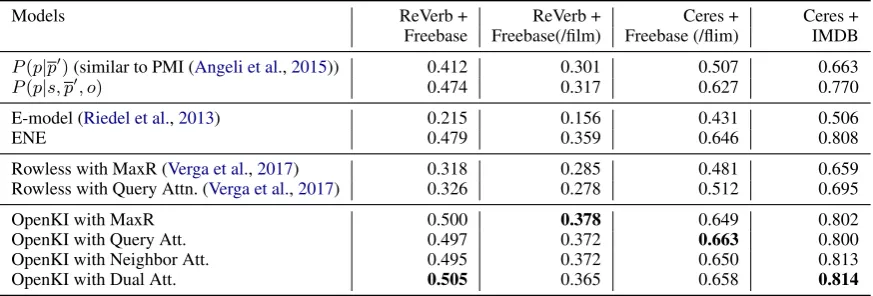
P(p|p0)(similar to PMI (Angeli et al.,2015)) 0.412 0.301 0.507 0.663
P(p|s, p0, o) 0.474 0.317 0.627 0.770
E-model (Riedel et al.,2013) 0.215 0.156 0.431 0.506
ENE 0.479 0.359 0.646 0.808
Rowless with MaxR (Verga et al.,2017) 0.318 0.285 0.481 0.659 Rowless with Query Attn. (Verga et al.,2017) 0.326 0.278 0.512 0.695
OpenKI with MaxR 0.500 0.378 0.649 0.802
OpenKI with Query Att. 0.497 0.372 0.663 0.800
OpenKI with Neighbor Att. 0.495 0.372 0.650 0.813
OpenKI with Dual Att. 0.505 0.365 0.658 0.814
Table 3: Mean average precision (MAP) of different models over four data settings.
In order to show the generalizability of our ap-proach to traditional (non OpenIE) corpora, we also perform experiments in the New York Times
(NYT) and Freebase dataset (Riedel et al.,2010),
which is a well known benchmark for distant su-pervision relation extraction. We consider the
sen-tences (average length of18.8tokens) there to be
a proxy for text predicates. These results are
pre-sented in Section4.5.
Data preparation: We collect all entity mentions
Mfrom OpenIE text extractions, and all candidate
entities EKB from KB whose name exists in M.
We retain the sub-graphGKB of KB triples where
the subject and object belongs to EKB. Similar
to (Riedel et al.,2013), we use string match to col-lect candidate entities for each entity mention. For each pair of entity mentions, we link them if two
candidate entities inEKB share a relation in KB.
Otherwise, we link each mention to the most com-mon candidate. For entity mentions that cannot be linked to KB, we consider them as new entities and link together mentions that share same text .
For validation and test, we randomly hold-out a
part of the entity pairs fromGKBwhere text
pred-icates are observed. Our training data consists of
the rest of GKB and all the OpenIE text
extrac-tions. In addition, we exclude direct KB triples from training where corresponding entity pairs ap-pear in the test data (following the data setting of (Toutanova et al., 2015)). Table 2 shows the
data statistics5.
We adopt a similar training strategy as Univer-sal Schema for the Ceres dataset – that not only learns direct mapping from text predicates to KB relations, but also clusters OpenIE predicates and KB relations by their co-occurrence. However, for the ReVerb data containing a large number of text predicates compared to Ceres, we only learn the direct mapping from text predicates to KB rela-tions that empirically works well for this dataset.
4.2 Verifying Usefulness of Neighborhood Information: Bayesian Methods
To verify the usefulness of the entity’s neigh-borhood information, we devise simple Bayesian methods as baselines. The simplest method counts
5Our datasets with train, test, validation split are
down-loadable at https://github.com/zhangdongxu/
[image:6.595.81.518.251.399.2]the co-occurrence of text predicates and KB rela-tions (by applying Bayes rule) to find the
condi-tional probability P(p|p0) of a target KB relation
pgiven a set of observed text predicates p0. This
performs relation inference atpredicate-level.
Then, we can include the entity’s relational neighbors in the Bayesian network by adding the neighboring predicates and relations of the
sub-ject (given by pNs ) and object (given by pNo ) to
find P(p|s, p0, o), which performs relation
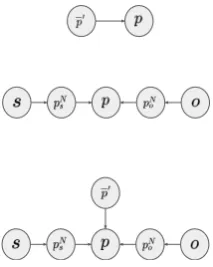
infer-ence at theinstance-level. The graph structures of
these three Bayesian methods are shown in
Fig-ure2. For detailed formula derivation, please refer
toAppendixA.1.
Figure 2: Structures ofP(p|p0),P(p|s, o),P(p|s, p0, o)
are listed from top to bottom.
4.3 Baselines and Experimental Setup
Angeli et al.(2015) employ point-wise mutual in-formation (PMI) between target relations and ob-served predicates to map OpenIE predicates to KB relations. This is similar to our Bayes
con-ditional probability P(p|p0). This baseline
op-erates at predicate-level. To indicate the
useful-ness of entity neighborhood information, we also
compare with P(p|s, p0, o) as mentioned in
Sec-tion4.2. For the advanced embedding-based
base-lines, we compare with the E-model and the Row-less model (with MaxR and query attention)
intro-duced in Section2.1.
Hyper-parameters: In our experiments, we use 25 dimensional embedding vectors for the Row-less model, and 12 dimensional embedding vec-tors for the E- and ENE models. We use a batch-size of 128, and 16 negative samples for each posi-tive sample in a batch. Due to memory constraints, we sample at most 8 predicates between entities and 16 neighbors for each entity during training.
We use γ = 1.0 and set the learning rate to 5e-3
for ReVerb and 1e-3 for Ceres datasets.
Evaluation measures: Our task is a multi-label
task, where each entity pair can share multiple KB relations. Therefore, we consider each KB relation as a query and compute the Mean Average Preci-sion (MAP) – where entity pairs sharing the query relation should be ranked higher than those
with-out the relation. In Section 4.4 we report MAP
statistics for the 50 most common KB relations for ReVerb and Freebase dataset, and for the 10 most common relations in other domain specific datasets. The left out relations involve few triples to report any significant statistics. We also report the area under the precision recall curve
(AUC-PR) for evaluation in Section4.5.
4.4 Results
Table 3 shows that the overall results. OpenKI
achieves significant performance improvement over all the baselines. Overall, we observe 33.5% MAP improvement on average across different datasets.
From the first two rows of Table 3, we
ob-serve the performance to improve as we incorpo-rate neighborhood information into the Bayesian method. This depicts the strong influence of the entity’s neighboring relations and predicates for relation inference.
The results show that our Entity Neighbor En-coder (ENE) outperforms the E-Model signifi-cantly. This is because the majority of the entity
pairs in our test data haveat least one unseen
en-tity (refer to Table 4), which is very common in
the OpenIE setting. The E-model cannot handle unseen entities because of its modeling of entity-specific parameters. This demonstrates the benefit of encoding entities with their neighborhood in-formation (KB relations and text predicates) rather than learning entity-specific parameters. Besides, ENE outperforms the Rowless Universal Schema model, which does not consider any information surrounding the entities. This becomes a disad-vantage in sparse data setting where only a few predicates are observed between an entity pair.
Finally, the results also show consistent im-provement of OpenKI model over only-Rowless
and only-ENE models. This indicates that the
models are complementary to each other. We fur-ther observe significant improvements by applying different attention mechanisms over the OpenKI MaxR model – thus establishing the effectiveness of our attention mechanism.
[image:7.595.128.235.262.396.2]of unseen entity pairs in our test data. The most common scenario is that only one of the entity in a pair is observed during training, where our model benefits from the extra neighborhood information of the observed entity in contrast to the Rowless model.
Dataset Both One Both
seen unseen unseen
ReVerb + Freebase 864 3232 842 ReVerb + Freebase(/film) 27 147 228 Ceres + Freebase(/film) 383 561 42
Ceres + IMDB 462 533 3
Table 4: Statistics for unseen entities in test data. “Both seen” indicates both entities exist in training data; “One unseen” indicates only one of the entities in the pair exist in training data; “Both unseen” indicates both entities were unobserved during training.
Models All data At least one seen
Rowless Model 0.278 0.282 OpenKI with Dual Att. 0.365 0.419
Table 5: Mean average precision (MAP) of Rowless and OpenKI on ReVerb + Freebase (/film) dataset.
Table5 shows the performance comparison on
test data where at least one of the entity is known at test time. We choose ReVerb+Freebase(/film) for analysis because it contains the largest pro-portion of test triples where both entities are un-known during training. From the results, we ob-serve that OpenKI outperforms the Rowless model by 48.6% when at least one of the entity in the triple is observed during training. Overall, we ob-tain 31.3% MAP improvement considering all of the test data. This validates the efficacy of encod-ing entity neighborhood information where at least one of the entities is known at test time. In the sce-nario where both entities are unknown at test time, the model falls back to the Rowless setting.
Models MAP
Rowless Model 0.695
+Type Constraint 0.769 ↑10.6%
ENE Model 0.808 +Type Constraint 0.818 ↑1.2%
OpenKI with Dual Att. 0.814 +Type Constraint 0.828 ↑1.7%
Table 6: MAP improvement with argument type con-straints on Ceres + IMDB dataset.
Explicit Argument Type Constraint: As
dis-cussed in Section3.5, incorporating explicit type
constraints can improve the model performance.
However, entity type information and argument type constraints are not always available
espe-cially for new entities. Table6shows the
perfor-mance improvement of different models with en-tity type constraints. We observe the performance improvement of the ENE model to be much less than that of the Rowless model with explicit type constraint. This shows that the ENE model already captures soft entity type information while model-ing the neighborhood information of an entity in contrast to the other methods that require explicit type constraint.
4.5 Results on NYT + Freebase Dataset
Prior works (Surdeanu et al., 2012; Zeng et al.,
2015;Lin et al., 2016;Qin et al., 2018) on dis-tantly supervised relation extraction performed evaluations on the New York Times (NYT) +
Free-base benchmark data developed by Riedel et al.
(2010)6. The dataset contains sentences whose
entity mentions are annotated with Freebase enti-ties as well as relations. The training data consists of sentences from articles in 2005-2006 whereas the test data consists of sentences from articles in 2007. There are 1950 relational facts in our
test data7. In contrast to our prior experiments in
the semi-structured setting with text predicates, in this experiment we consider the sentences to be a proxy for the text predicates.
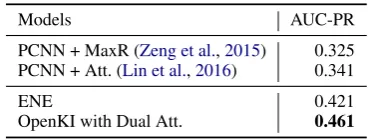
Models AUC-PR
PCNN + MaxR (Zeng et al.,2015) 0.325 PCNN + Att. (Lin et al.,2016) 0.341
ENE 0.421
[image:8.595.323.512.464.534.2]OpenKI with Dual Att. 0.461
Table 7: Performances on NYT + Freebase data.
Table7compares the performance of our model
with two state-of-the-art works (Zeng et al.,2015;
Lin et al.,2016) on this dataset using AUC-PR as the evaluation metric.
Overall, OpenKI obtains 35% MAP improve-ment over the best performing PCNN baseline. In contrast to baseline models, our approach lever-ages the neighborhood information of each entity from the text predicates in the 2007 corpus and predicates / relations from the 2005-2006 corpus. This background knowledge contributes to the sig-nificant performance improvement.
6This data can be downloaded from http://iesl.
cs.umass.edu/riedel/ecml/
7Facts of ‘NA’ (no relation) in the test data are not
Note that, our model uses only the graph in-formation from the entity neighborhood and does not use any text encoder such as Piecewise
Convo-lutional Neural Nets (PCNN) (Zeng et al.,2015),
where convolutional neural networks were applied with piecewise max pooling to encode textual sentences. This further demonstrates the impor-tance of entity neighborhood information for rela-tion inference. It is possible to further improve the performance of our model by incorporating text encoders as an additional signal. Some prior
works (Verga et al.,2016;Toutanova et al.,2015)
also leverage text encoders for relation inference.
5 Related Work
Relation Extraction: Mintz et al. (2009) utilize the entity pair overlap between knowledge bases and text corpus to generate signals for automatic supervision. To avoid false positives during train-ing, many works follow the at-least-one assump-tion, where at least one of the text patterns be-tween the entity pair indicate an aligned
predi-cate in the KB (Hoffmann et al.,2011;Surdeanu
et al., 2012; Zeng et al., 2015;Lin et al., 2016). These works do not leverage graph information.
In addition, Universal Schema (Riedel et al.,2013;
Verga et al., 2017) tackled this task by low-rank
matrix factorization. Toutanova et al.(2015)
ex-ploit graph information for knowledge base com-pletion. However, their work cannot deal with un-seen entities since entities’ parameters are explic-itly learned during training.
Schema Mapping: Traditional schema mapping
methods (Rahm and Bernstein, 2001) involve
three kinds of features, namely, language (name or description), type constraint, and instance level co-occurrence information. These methods usu-ally involve hand-crafted features. In contrast, our model learns all the features automatically from OpenIE and KB with no feature engineering. This makes it easy to scale to different domains with little model tuning. Also, the entity types used in traditional schema mapping is always pre-defined and coarse grained, so cannot provide precise con-straint of relations for each entity. Instead, our ENE model automatically learns soft and fine-grained constraints on which relations entities are likely to participate in. It is also compatible with pre-defined type systems.
Relation Grounding from OpenIE to KB: In-stead of modeling existing schema, open
informa-tion extracinforma-tion (OpenIE) (Banko et al.,2007;Yates
et al., 2007; Fader et al., 2011; Mausam et al.,
2012) regards surface text mentions between
en-tity pairs as separate relations, and do not require entity resolution or linking to KB. Since they do not model KB, it is difficult to infer KB relations
only based on textual observations. Soderland
et al.(2013) designed manual rules to map
rela-tional triples to slot types. Angeli et al. (2015)
used PMI between OpenIE predicates and KB re-lations using distant-supervision from shared
en-tity pairs for relation grounding. Yu et al. (2017)
used word embedding to assign KB relation labels to OpenIE text predicates without entity align-ment. These works do not exploit any graph in-formation.
Entity Modeling for Relation Grounding: Peo-ple leveraged several entity information to help
relation extraction. Zhou et al.(2005) employed
type information and observed 8% improvement
of F-1 scores. Ji et al.(2017) encoded entity
de-scription to calculate attention weights among dif-ferent text predicates within an entity pair. How-ever, entity type and description information is not commonly available. Instead, the neighborhood information is easier to obtain and can also be re-garded as entities’ background knowledge.
Uni-versal Schema (Riedel et al., 2013) proposed an
E-Model to capture entity type information. How-ever, it can easily overfit in the OpenIE setting with large number of entities and a sparse knowl-edge graph.
6 Conclusion
In this work we jointly leverage relation mentions from OpenIE extractions and knowledge bases (KB) for relation inference and aligning OpenIE extractions to KB. Our model leverages the rich information (KB relations and OpenIE predicates) from the neighborhood of entities to improve the performance of relation inference. This also al-lows us to deal with new entities without using any entity-specific parameters. We further explore several attention mechanisms to better capture en-tity pair information. Our experiments over sev-eral datasets show 33.5% MAP improvement on average over state-of-the-art baselines.
References
Gabor Angeli, Melvin Jose Johnson Premkumar, and Christopher D Manning. 2015. Leveraging linguis-tic structure for open domain information extraction. In Proceedings of the 53rd Annual Meeting of the Association for Computational Linguistics and the 7th International Joint Conference on Natural Lan-guage Processing (Volume 1: Long Papers), vol-ume 1, pages 344–354.
Michele Banko, Michael J Cafarella, Stephen Soder-land, Matthew Broadhead, and Oren Etzioni. 2007. Open information extraction from the web. In IJ-CAI, volume 7, pages 2670–2676.
Mirko Bronzi, Valter Crescenzi, Paolo Merialdo, and Paolo Papotti. 2013. Extraction and integration of partially overlapping web sources. Proceedings of the VLDB Endowment, 6(10):805–816.
Michael J Cafarella, Alon Halevy, Daisy Zhe Wang, Eugene Wu, and Yang Zhang. 2008. Webtables: ex-ploring the power of tables on the web.Proceedings of the VLDB Endowment, 1(1):538–549.
Mark Dredze, Paul McNamee, Delip Rao, Adam Ger-ber, and Tim Finin. 2010. Entity disambiguation for knowledge base population. In Proceedings of the 23rd International Conference on Computa-tional Linguistics, pages 277–285. Association for Computational Linguistics.
Anthony Fader, Stephen Soderland, and Oren Etzioni. 2011. Identifying relations for open information ex-traction. InProceedings of the 2011 Conference on Empirical Methods in Natural Language Process-ing, EMNLP 2011, 27-31 July 2011, John McIntyre Conference Centre, Edinburgh, UK, A meeting of SIGDAT, a Special Interest Group of the ACL, pages 1535–1545.
Qiang Hao, Rui Cai, Yanwei Pang, and Lei Zhang. 2011. From one tree to a forest: a unified solution for structured web data extraction. InProceedings of the 34th international ACM SIGIR conference on Research and development in Information Retrieval, pages 775–784. ACM.
Raphael Hoffmann, Congle Zhang, Xiao Ling, Luke Zettlemoyer, and Daniel S Weld. 2011. Knowledge-based weak supervision for information extraction of overlapping relations. InProceedings of the 49th Annual Meeting of the Association for Computa-tional Linguistics: Human Language Technologies-Volume 1, pages 541–550. Association for Compu-tational Linguistics.
Guoliang Ji, Kang Liu, Shizhu He, Jun Zhao, et al. 2017. Distant supervision for relation extraction with sentence-level attention and entity descriptions. InAAAI, pages 3060–3066.
Heng Ji, Joel Nothman, Ben Hachey, et al. 2014. Overview of tac-kbp2014 entity discovery and link-ing tasks. In Proc. Text Analysis Conference (TAC2014), pages 1333–1339.
Diederik P Kingma and Jimmy Ba. 2014. Adam: A method for stochastic optimization. arXiv preprint arXiv:1412.6980.
Thomas Lin, Oren Etzioni, et al. 2012. Entity linking at web scale. InProceedings of the Joint Workshop on Automatic Knowledge Base Construction and Web-scale Knowledge Extraction, pages 84–88. Associa-tion for ComputaAssocia-tional Linguistics.
Yankai Lin, Shiqi Shen, Zhiyuan Liu, Huanbo Luan, and Maosong Sun. 2016. Neural relation extraction with selective attention over instances. In Proceed-ings of the 54th Annual Meeting of the Association for Computational Linguistics (Volume 1: Long Pa-pers), volume 1, pages 2124–2133.
Colin Lockard, Prashant Shiralkar, and Xin Luna Dong. 2019. When open information extraction meets the semi-structured web. InNAACL-HLT. As-sociation for Computational Linguistics.
Mausam, Michael Schmitz, Stephen Soderland, Robert Bart, and Oren Etzioni. 2012. Open language learn-ing for information extraction. In Proceedings of the 2012 Joint Conference on Empirical Methods in Natural Language Processing and Computational Natural Language Learning, EMNLP-CoNLL 2012, July 12-14, 2012, Jeju Island, Korea, pages 523– 534.
Mike Mintz, Steven Bills, Rion Snow, and Dan Juraf-sky. 2009. Distant supervision for relation extrac-tion without labeled data. In Proceedings of the Joint Conference of the 47th Annual Meeting of the ACL and the 4th International Joint Conference on Natural Language Processing of the AFNLP: Vol-ume 2-VolVol-ume 2, pages 1003–1011. Association for Computational Linguistics.
Dan Olteanu, Holger Meuss, Tim Furche, and Franc¸ois Bry. 2002. Xpath: Looking forward. In XML-Based Data Management and Multimedia Engineer-ing - EDBT 2002 Workshops, EDBT 2002 Work-shops XMLDM, MDDE, and YRWS, Prague, Czech Republic, March 24-28, 2002, Revised Papers, pages 109–127.
Pengda Qin, Weiran Xu, and William Yang Wang. 2018. Robust distant supervision relation extrac-tion via deep reinforcement learning. arXiv preprint arXiv:1805.09927.
Erhard Rahm and Philip A Bernstein. 2001. A survey of approaches to automatic schema matching. the VLDB Journal, 10(4):334–350.
Sebastian Riedel, Limin Yao, and Andrew McCallum. 2010. Modeling relations and their mentions with-out labeled text. In Joint European Conference on Machine Learning and Knowledge Discovery in Databases, pages 148–163. Springer.
matrix factorization and universal schemas. In Pro-ceedings of the 2013 Conference of the North Amer-ican Chapter of the Association for Computational Linguistics: Human Language Technologies, pages 74–84.
Stephen Soderland, John Gilmer, Robert Bart, Oren Et-zioni, and Daniel S Weld. 2013. Open information extraction to kbp relations in 3 hours. InProc. Text Analysis Conference (TAC2013).
Mihai Surdeanu, Julie Tibshirani, Ramesh Nallapati, and Christopher D Manning. 2012. Multi-instance multi-label learning for relation extraction. In Pro-ceedings of the 2012 joint conference on empirical methods in natural language processing and compu-tational natural language learning, pages 455–465. Association for Computational Linguistics.
Kristina Toutanova, Danqi Chen, Patrick Pantel, Hoi-fung Poon, Pallavi Choudhury, and Michael Gamon. 2015. Representing text for joint embedding of text and knowledge bases. InEmpirical Methods in Nat-ural Language Processing (EMNLP).
Patrick Verga, David Belanger, Emma Strubell, Ben-jamin Roth, and Andrew McCallum. 2016. Multi-lingual relation extraction using compositional
uni-versal schema. In Proceedings of the 2016
Con-ference of the North American Chapter of the As-sociation for Computational Linguistics: Human Language Technologies, pages 886–896, San Diego, California. Association for Computational Linguis-tics.
Patrick Verga, Arvind Neelakantan, and Andrew Mc-Callum. 2017. Generalizing to unseen entities and
entity pairs with row-less universal schema. In
Pro-ceedings of the 15th Conference of the European Chapter of the Association for Computational Lin-guistics: Volume 1, Long Papers, pages 613–622, Valencia, Spain. Association for Computational Lin-guistics.
Alexander Yates, Michele Banko, Matthew Broadhead, Michael J. Cafarella, Oren Etzioni, and Stephen Soderland. 2007. Textrunner: Open information ex-traction on the web. InHuman Language Technol-ogy Conference of the North American Chapter of the Association of Computational Linguistics, Pro-ceedings, April 22-27, 2007, Rochester, New York, USA, pages 25–26.
Dian Yu, Lifu Huang, and Heng Ji. 2017. Open re-lation extraction and grounding. InProceedings of the Eighth International Joint Conference on Natu-ral Language Processing (Volume 1: Long Papers), volume 1, pages 854–864.
Daojian Zeng, Kang Liu, Yubo Chen, and Jun Zhao. 2015. Distant supervision for relation extraction via piecewise convolutional neural networks. In Pro-ceedings of the 2015 Conference on Empirical Meth-ods in Natural Language Processing, pages 1753– 1762.
Guodong Zhou, Jian Su, Jie Zhang, and Min Zhang. 2005. Exploring various knowledge in relation ex-traction. InProceedings of the 43rd annual meeting on association for computational linguistics, pages 427–434. Association for Computational Linguis-tics.
A Appendices
A.1 Derivation of Bayesian Inference Baselines
P(p|p0) = max
p0∈R(s,o)P(p|p
0
) = max
p0∈R(s,o)
P(p, p0)
P(p0)
= max
p0∈R(s,o)
#(p, p0)/#entity pair
#p0/#entity pair
≈ max
p0∈R(s,o)
#(p, p0) + ∆ #(p0) +|Rtext∪RKB|∆
R(s, o) is the set of observed predicates
be-tween subject s and objecto. ∆is a smoothing
factor which we choose 1e-6 in our implementa-tion. Using conditional independence assumptions
(refer to Figure2):
P(p|s, o) = P(p, s, o)
P(s, o) =
P(p|s)P(s)P(p|o)P(o)
P(s)P(o)
= X
pN
s∈R(s,·)
P(pNs|s)P(p|p N
s )
· X
pN
o∈R(·,o)
P(pNo |o)P(p|p N
o)
P(p|s, p0, o) = P(p, s, p
0
, o)
P(s, p0, o)
=P(p|s)P(s)P(p|p
0
)P(p0)P(p|o)P(o)
P(s)P(p0)P(o)
=P(p|p0) X
pN
s∈R(s,·)
P(pNs|s)P(p|p N
s)
· X
pN
o∈R(·,o)
P(pNo |o)P(p|p N