Proceedings of NAACL-HLT 2019, pages 940–950 940
Integration of Knowledge Graph Embedding into Topic Modeling with
Hierarchical Dirichlet Process
Dingcheng Li, Siamak Zamani Dadaneh, Jingyuan Zhang, Ping Li
Cognitive Computing Lab (CCL) Baidu Research USA
10900 NE Eighth St, Bellevue, WA 98004, USA 1195 Bordeaux Dr, Sunnyvale, CA 94089, USA
[email protected], [email protected]
[email protected], [email protected]
Abstract
Leveraging domain knowledge is an effective strategy for enhancing the quality of inferred low-dimensional representations of documents by topic models. In this paper, we develop topic modeling with knowledge graph em-bedding (TMKGE), a Bayesian nonparamet-ric model to employ knowledge graph (KG) embedding in the context of topic modeling, for extracting more coherent topics. Specifi-cally, we build a hierarchical Dirichlet process (HDP) based model to flexibly borrow infor-mation from KG to improve the interpretabil-ity of topics. An efficient online variational in-ference method based on a stick-breaking con-struction of HDP is developed for TMKGE, making TMKGE suitable for large document corpora and KGs. Experiments on three pub-lic datasets illustrate the superior performance of TMKGE in terms of topic coherence and document classification accuracy, compared to state-of-the-art topic modeling methods. 1 Introduction
Topic models, such as Probabilistic Latent
Seman-tic Analysis (PLSA) (Hofmann, 2017) and
La-tent Dirichlet Allocation (LDA) (Blei et al.,2003), play significant roles in helping machines inter-pret text documents. Topic models consider doc-uments as a bag of words. Given the word in-formation, topic models formulate documents as mixtures of latent topics, where these topics are generated via the multinomial distributions over words. Bayesian methods are utilized to extract topical structures from the document-word fre-quency representations of the text corpus. With-out supervision, however, it is found that the top-ics generated from these models are often not interpretable (Chang et al., 2009; Mimno et al., 2011). In recent studies, incorporating knowledge of different forms as a supervision has become a powerful strategy for discovering meaningful top-ics (Andrzejewski et al.,2009).
president male born wife
Barack Obama United States
Honolulu Michelle Obama
wasBornIn hasGender livesIn locatedIn
Word Co-occurrence Entity Embeddings Relation Embeddings
Latent Topics
Words Entities Relations
Documents Knowledge Graphs Online stochastic
[image:1.595.293.520.207.343.2]Optimization with Natural gradients for varitional inferences
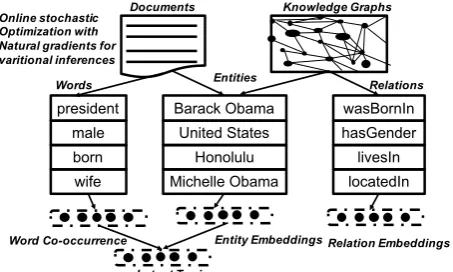
Figure 1: An overview of the proposed TMKGE frame-work. Entities are shared by both documents and knowledge graphs. Entity embeddings generated by TransE a knowledge graph embedding package are passed into TMKGE to generate hidden topics.
Most conventional approaches take prior do-main knowledge into account to improve the topic coherence (Andrzejewski et al., 2009;
Andrze-jewski and Zhu, 2009; Hu et al., 2014;
Knowledge graph (KG) embedding (Bordes et al.,2013) learns a low-dimensional continuous vector space for entities and relations to preserve the inherent structure of KGs. Yao et al. (2017) proposes KGE-LDA to incorporate embeddings of KGs into topic models to extract better topic rep-resentations for documents and shows promising performance. However, KGE-LDA forces words and entities to have identical latent representa-tions, which is a rather restrictive assumption that prevents the topic model from recovering correct underlying latent structures of the data, especially in scenarios where only partial KGs are available. This paper developstopic modeling with knowl-edge graph embedding(TMKGE), a hierarchical Dirichlet process (HDP) based model to extract more coherent topics by taking advantage of the KG structure. Unlike KGE-LDA, the proposed TMKGE allows for more flexible sharing of in-formation between words and entities, by using a multinomial distribution to model the words and a multivariate Gaussian mixture to model the enti-ties. With this approach, we introduce two propor-tional vectors, one for words and one for entities. In contrast, KGE-LDA only uses one, shared by both words and entities. Similar to HDP, TMKGE includes a collection of Dirichlet processes (DPs) at both corpus and document levels. The atoms of corpus-level DP form the base measure for doc-ument levels DPs of words and entities. There-fore, the atoms of corpus-level DP can represent word topics, entity mixture components, or both of them. Figure1provides an overview of TMKGE, where two sources of inputs, bag of words and KG embedding, extracted from corpus and KGs respectively, are passed into TMKGE.
As a nonparametric model, TMKGE does not assume a fix number of topics or entity mixture components as constraints. Instead, it learns the number of topics and entity mixture components automatically from the data. Furthermore, an ef-ficient online variational inference algorithm is developed, based on Sethuraman’s stick-breaking construction of HDP (Sethuraman, 1994). We in fact construct stick-breaking inference in a mini-batch fashion (Wang et al., 2011; Bleier, 2013), to derive a more efficient and scalable coordinate-accent variational inference for TMKGE.
Summary of contributions: TMKGE is a Bayesian nonparametric model to extract more co-herent topics by taking advantage of knowledge
graph structures. We introduce two proportional vectors for more flexible sharing of information between words and entities. We derive an efficient and scalable parameter estimation algorithm via online variational inference. Finally, we empiri-cally demonstrate the effectiveness of TMKGE in topic discovering and document classification.
2 Background and Related Work
Latent Dirichlet Allocation (LDA) (Blei et al., 2003) is a popular probabilistic model that learns latent topics from documents and words, by us-ing Dirichlet priors to regularize the topic distri-butions. The generated topics from LDA mod-els, however, are often not interpretable (Chang et al.,2009;Mimno et al., 2011), in part because LDA models are unsupervised without using prior knowledge or external resources.
In recent years, prior knowledge are leveraged to guide the process of topic modeling
(Andrze-jewski and Zhu, 2009; Hu et al., 2014;
Jagar-lamudi et al., 2012; Doshi-Velez et al., 2015). For example, the deep forest LDA (DF-LDA) model (Andrzejewski et al., 2009) is proposed to incorporatemust-linksandcannot-linksamong
words into topic modeling. One weakness of
the DF-LDA model is that the link information is domain-dependent. Later, general knowledge based LDA is introduced to leverage must-links from multiple domains (Chen et al.,2013). More recently, MetaLDA (Zhao et al.,2017) proposes to improve topic modeling by incorporating diverse meta information as priors for both document hy-perparameterαand word hyperparameterβ.
learns embedding representations for topics (Li et al.,2016). Gaussian-LDA goes further to im-prove topic modeling (Das et al.,2015) by taking into considerations the continuous nature of word embeddings. Shi et al. (2017) constructs a more unified framework, STE (skip-gram topic
embed-ding) to address the problem of polysemy. Li
et al.(2019) proposes a unified framework TMSA (Topic Modeling and Sparse Autoencoder) to im-prove topic discovery and word embedding simul-taneously via a mutual learning mechanism.
Hu et al. (2016) proposes topic-based embed-dings for learning from large knowledge graphs (KGE). KGE learns low-dimensional continuous vector space for both entities and relations to pre-serve the inherent structure of knowledge graphs. A Bayesian method is introduced by considering the embeddings of entities and relations as top-ics. Later,Yao et al. (2017) proposes knowledge graph embedding LDA (KGE-LDA) to encode en-tity embeddings learned from knowledge graphs into LDA and show that knowledge graph em-beddings boost topic discoveries. Inspired by this work, we explore to utilize entity embeddings to encode prior knowledge for topic modeling.
3 Method
This section presents the TMKGE model and an efficient online variational inference for learning its parameters. We first provide a review of hierar-chical Dirichlet process (HDP) (Teh et al.,2005).
3.1 Preliminaries of HDP
Dirichlet process(DP) (MacEachern and M¨uller, 1998)G ∼ DP(γ0, G0), with a base measureG0
and a concentration parameterγ0 > 0, is the
dis-tribution of a random probability measureGover a measurable space(Ω,B), such that for any mea-surable disjoint partition(A1, ..., AQ)ofΩ,
(G(A1), ..., G(AQ))∼Dir(γ0G0(A1), ..., γ0G0(AQ))
where “Dir” denotes a Dirichlet distribution.
Hierarchical Dirichlet process(HDP) (Teh et al., 2005), introduced for dealing with multiple (D) groups of data, is a distribution over a set of ran-dom probability measures over(Ω,B): one prob-ability measureGd ∼DP(α0, G0)for each group d ∈ {1,2, ..., D}, and a global probability mea-sureG0 ∼DP(γ0, H)with a base measureH.
Stick-breaking construction Teh et al. (2005)
shows that the draws fromG0 andGd can be
ex-pressed as weighted sums of point masses:
G0 =
∞ X
k=0
βkδφk, Gd=
∞ X
k=0
πdkδφk.
A more convenient stick-breaking construction, especially for deriving closed-form variational
inference (Wang et al., 2011), is Sethuraman
(1994)’s construction, which proceeds as follows. First, the global-level DP draw is represented as
β0k∼Beta(1, γ0), βk=β
0
k k−1
Y
`=1
(1−β`0),
Note that the distribution for β = {βk}∞k=1 is
also commonly written as β ∼ GEM(γ0)
(Pit-man,2002). Subsequently, the group-level draws are constructed as
ψdt∼G0, πdt0 =Beta(1, α0),
πdt=π
0
dt t−1
Y
`=1
(1−πd`0 ), Gd=
∞ X
t=1
πdtδψdt. (1)
Alternatively, the group-level atoms{ψdt}∞t=1 can
be represented asψdt =φcdt, where the auxiliary
indicator variables cdt are independently drawn
from a multinomial Mult(β).
Teh et al. (2008) also proposes a collapsed in-ference method as an alternative of stick-breaking inference. However, followingFox et al. (2011), we stick to the uncollapsed HDP model consider-ing our truncated Dirichlet process has more com-putational efficiency and is simple to implement.
3.2 The TMKGE Model
𝒑𝟎
𝒎𝟎
𝝊𝟎 𝓦𝟎 𝜶𝟎
𝝓𝒌 𝝁𝒌
𝜦𝒌
𝑫 𝑵𝒅𝒘
𝑴𝒅𝒆
𝑲 𝒘𝒏
𝒆𝒎
𝒖𝒎
𝒅
𝑮𝒅(𝒆)
𝑮𝒅(𝒘) 𝑮𝟎
𝜸𝟎
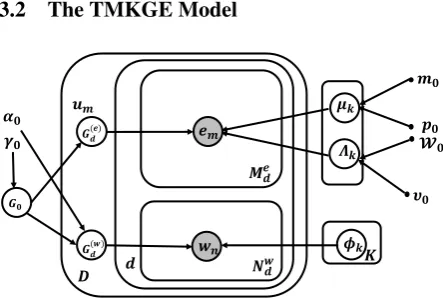
[image:3.595.308.530.513.662.2]Figure 2 is the graphical representation of
TMKGE. Let D denote the number of
docu-ments in the corpus, where each document d ∈
{1,2, ..., D}containsNd(w) words andNd(e) enti-ties. Throughout this work, superscripts (w) and
(e)indicate word and entity related parameters, re-spectively. In each documentd, then-th word is represented bywdn, where each word belongs to
a vocabulary of sizeV, i.e.,wdn ∈ {1,2, ..., V}.
Furthermore, theP-dimensional embedding of the
m-th entity is edm, where the total number of
unique entities in the corpus isE. We assume that entity embeddings are obtained from the “com-plete” knowledge graph, and hence they contain information independent of the corpus. In this pa-per, we use TransE (Bordes et al.,2013), a simple and effective tool for knowledge encoding, to cal-culate the embeddings of entities extracted from the documents. We should mention that we re-move the normalization step of TransE and thus the output vectors (edm) do not have unit`2norm.
TMKGE builds upon HDP for joint modeling of word topics and entity mixtures. At the corpus level, word topics and entity mixtures correspond to atoms of a Dirichlet processG0 ∼DP(γ0, H). At the document level, word topics and entity mix-ture components are atoms of independent DPs, with shared base measureG0. Mathematically, for documentd, we have
G(dw)∼DP(α0, G0), G(de)∼DP(α0, G0),
whereG(dw) andG(de) are word and entity related DPs. Sethuraman’s construction in (1) yields
G(dw)= ∞ X
t=1
πdt(w)δ
ψ(dtw), G
(e)
d =
∞ X
t=1
πdt(e)δ
ψ(dte). (2)
These DPs are then used to assign words and en-tities to topics and mixture components, respec-tively. In documentd, letzdn(w)denote the topic
as-signed to then-th word, andzdm(e) denote the mix-ture component assigned to them-th entity. Using the mixing proportions of DPs in (2), we have
p(z(dnw)=t) =πdt(w), p(zdn(e)=t) =πdt(e).
For simplicity, we use indextto denote both word and entity related atoms, although they can corre-spond to different atoms of the global DPs.
The mixing proportions of corpus-level DP are used to map the document atoms to the shared global atoms. More precisely, we introduce the word and entity atoms mapping auxiliary variables
cd(w)={cdt(w)}∞t=1andc(de)={c(dte)}∞t=1. The map-ping probabilities then can be expressed as
p(c(dtw)=k) =βk, p(c
(e)
dt =k) =βk.
TMKGE allows flexible sharing of information between knowledge graphs and documents. This is an important advantage, as in practice only par-tial relational information are available, and thus strictly forcing the topics and entity mixtures to share components may lead to reducing the power of model to correctly recover the latent structure of the data. Furthermore, the nonparametric na-ture of the model enables the automatic discovery of number of atoms for both words and entities, at document and corpus levels.
Each atom of corpus DP (G0) corresponds to
a set of parameters for both words and entities. Atomkcontains topic-word Dirichlet distribution φk = (φk1, ..., φkV)T, and entity Gaussian
mix-ture parameters{µk,Λk}. Givenφkand topic
as-signment variables, the generative process forn-th word of documentdis
zdn(w) ∼ Mult(π(dw)), (wdn|z
(w)
dn =t, c
(w)
dt =k,φk) ∼ Mult(φk).
In a similar fashion, the generative process ofm-th entity of documentdis
z(dme) ∼ Mult(π(de)), (edm|z
(e)
dm=t, c
(e)
dt =k,µk,Λk) ∼ N(µk,Λ
−1
k ),
whereµkandΛk are the mean vector and
preci-sion matrix of multivariate Gaussian distribution. Furthermore, we impose conjugate priors on both word and entity components parameters as:
φk ∼ Dir(η, ..., η), µk∼N m0,(ρ0Λk)−1,
Λk ∼ Wishart(ν0,W0).
3.3 Online Variational Inference
In this section, inspired by (Wang et al.,2011), we propose an online variational inference algorithm for efficient learning of TMKGE model parame-ters. We use a fully factorized variational distri-bution based on stick-breaking construction, and perform online mean-field variational inference.
In addition to topic parameters φk and en-tity mixture parameters {µk,Λk}, other
param-eters of interest are corpus-level stick propor-tionsβ0 ={β0k}∞k=1, document-level stick propor-tions for words π0(dw) = {πdt0(w)}∞t=1 and entities π0(de) = {πdt0(e)}∞
z(dw) = {zdn(w)}N
(w)
d
n=1 , mixture assignments for
en-tities z(de) = {z(dme)}N
(e)
d
m=1, and mapping variables
c(dw)andc(de). DenoteΘ(w) andΘ(e)respectively the word and entity related parameters. Then the variational distribution factorizes as
q(β0,Θ(w),Θ(e)) =q(β0)q(Θ(w))q(Θ(e)).
For corpus-level stick proportions, we assume a Beta distribution:
q(β0) =
K−1
Y
k=1
Beta(βk0|uk, vk),
where the number of global atoms is truncated at
K, therebyq(βK0 = 1) = 1. For the word related parametersΘ(w), we have
q(Θ(w)) =q(c(w))q(z(w))q(π0(w))q(φ),
q(c(w)) =
D
Y
d=1
T−1
Y
t=1
Mult(ϕ(dtw)),
q(z(w)) =
D
Y
d=1
Nd(w)
Y
n=1
Mult(ς(dtw)),
q(π0(w)) =
D
Y
d=1
T−1
Y
t=1
Beta(πdt0 |a
(w)
dt , b
(w)
dt ),
q(φ) =
K
Y
k=1
Dir(λk).
The variational distributions for entity related parameters have a similar form to the above distri-butions, except the Gaussian mixture parameters, which are expressed as follows:
q(µk) =N mk,(ρkΛk)
−1
, q(Λk) =Wishart(νk,Wk).
In standard variational inference theory, the ev-idence lower bound (ELBO), which is the lower bound to the marginal log likelihood of the ob-served data, is maximized to find the best varia-tional approximation to the true intractable poste-rior. Given the modeling framework of TMKGE, the ELBO can be written as
L(q) =X
d
(
E h
logp(wd|c
(w)
d ,z
(w)
d ,φ)p(c
(w)
d |β
0 )
×p(z(dw)|π0(dw))p(ed|c(de),zd(e),µ,Λ)
×p(c(de)|β0)p(zd(e)|π0(de))p(π
0(w)
d |α0)p(π0 (e)
d |α0)
i
+H q(c(dw))
+H q(z(dw))
+H q(π0(dw))
+H q(c(de))
+H q(z(de))
+H q(π0(de))
)
+E h
logp(β0)p(φ)p(µ,Λ)i+H q(β0)
+H q(φ)
+H q(µ,Λ) ,
where H(·) is the entropy term for variational distribution. By taking derivatives of this lower bound with respect to each variational parameter, we derive the coordinate ascent update steps.
We develop an online variational inference for TMKGE, to process large datasets (Wang et al., 2011;Hoffman et al., 2010). Given the existing corpus-level parameters, first a documentdis sam-pled and then its optimal document-level varia-tional parameters are computed. For word related variational parameters, these updates include
a(dtw)= 1 +X
n
ςdnt(w),
b(dtw)=α0+
X
n T
X
s=t+1
ςdns(w),
ϕ(dtkw)∝exp X
n
ςdns(w)Eq
logp(wdn|φk)
Eq
logβk
,
ςdnt(w)∝exp X
k
ϕ(dtkw)Eq
logp(wdn|φk)
Eq
logπdt(w)
(3)
where expectations are with respect to variational distributions and have closed forms. For entity re-lated variational parameters, similar updates can be derived, with the termEq
logp(edm|µk,Λk)
replacing Eq
logp(wdn|φk)
. Following Wang
et al. (2011), for the corpus-level variational pa-rameters, we use the following gradients:
∂λkv=−λkv+η+D
X
t
ϕ(dtkw) X
n
ςdnt(w)I[wdn=v]
,
∂mk=−mk+
DP
m,tϕ
(e)
dtkς
(e)
dmtedm+ρ0m0
Drk+ρ0
,
∂ρk=−ρk+ρ0+Drk,
∂νk=−νk+ν0+Drk,
∂Wk=−Wk+
W−01+D
X
m,t
ϕ(dtke)ςdmt(e) edmeTdm
−1
,
∂uk=−uk+ 1 +D
X
t
ϕ(dtkw)+ϕ(dtke) ,
∂vk=−vk+γ0+D
X
t K
X
`=k+1
ϕ(dt`w)+ϕ(dt`e), (4)
where rk is defined as Pm,tϕ
(e)
dtkς
(e)
dmt. The
corpus-level parameters are then updated using these gradients (among them, the first, the fifth and the sixth are natural gradients while the other four are approximations from the posterior of Gaus-sian Wishart scale matrixW. It appears difficult to obtain natural gradients for those four.) and a learning rate parametert. For instance, for
topic-words distribution parameters we have
number of top words and PMI scores
model parameters data source 5 10 15 20 25 30 TMKGE K=300, T=20
20 Newsgroups
20.8 91.1 210.0 380.0 602.0 876.0
HDP K=300, T=20 20.0 91.6 212.6 384.1 598.4 868.7 LDA K=100 13.5 64.6 163.4 285.0 455.2 671.1 KGE-LDA K=30 18.9 69.8 187.5 320.6 482.7 616.5 TMKGE K=300, T=20
NIPS
16.6 97.1 160.3 299.6 474.5 685.5
HDP K=300, T=20 16.7 66.8 157.2 280.2 444.0 643.1 LDA K=100 13.9 67.6 161.9 297.0 471.2 681.1 KGE-LDA K=30 14.3 97.2 163.4 285.3 453.3 645.4 TMKGE K=300, T=20
Ohsumed
21.6 123.3 237.3 407.7 624.2 895.5
[image:6.595.89.510.61.205.2]HDP K=300, T=20 15.6 70.7 168.2 338.9 582.9 864.9 LDA K=100 11.9 65.6 131.9 257.0 481.2 691.1 KGE-LDA K=30 15.6 116.5 185.4 354.2 585.4 795.6
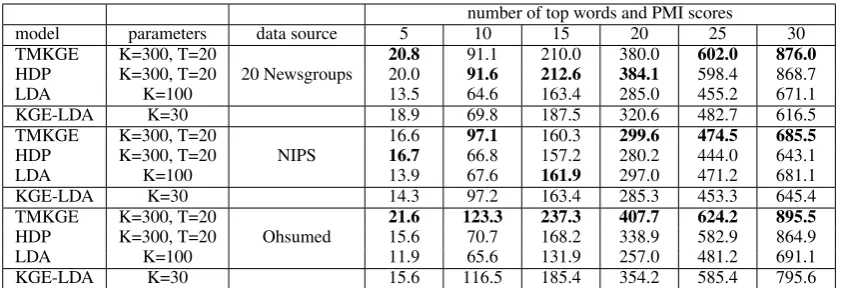
Table 1: Topic Coherence of all models on three datasets with different number of top words. A higher PMI score implies a more coherent topic. Improvements of TMKGE over other methods are significant.
The rest of corpus-level variational parameters in (4) can be similarly updated. To ensure that the parameters converge to a stationary point, the learning rate satisfies (Hoffman et al.,2010;Sato,
2001)P∞
t0=1t0 =∞and
P∞ t0=1
2
t0 <∞.
Following Wang et al. (2011), we use t0 =
(τ0+t0)−κ, whereκ ∈ (0.5,1]andτ0 > 0. To
improve the stability of online variational infer-ence, we use a mini-batch of documents to com-pute the natural gradients. That is, the contribu-tion of the single document d in (4) is replaced by sum of contributions of documents in the mini-batch S, and the factor D is replaced by D/|S|. The overall scheme of online variational inference for TMKGE is shown in Algorithm 1.
Algorithm 1 Online variational inference for the proposed TMKGE framework.
Initialize corpus-level variational parameters.
whileStopping criterion is not metdo
Sample a random documentdfrom the corpus. Updatea(dw),b(dw),ϕ(dw)andς(dw)using (3). Updatea(de),b(de),ϕ(de)andς(de)similar to (3). Compute the natural gradients using (4). Sett0 = (τ0+t0)
−κandt0←t0+ 1.
Update all corpus-level parameters as (5).
end
4 Experiments
We evaluate TMKGE on two experimental tasks and compare its performance to those of LDA, HDP and KGE-LDA. For LDA and HDP, we use the online variational inference implementations. More precisely, we will evaluate our framework by the test whether it finds coherent and
meaning-ful topics and the test whether it can achieve good performance in document classification.
We run our experiments on three popular datasets; 20 Newsgroups, NIPS and the Ohsumed
corpus. The 20 Newsgroups dataset contains
18,846 documents evenly categorized into 20 dif-ferent categories.
The NIPS dataset contains 1,740 papers from
the NIPS conference. The Ohsumed corpus is
from the MEDLINE database. We consider the 13,929 unique Cardiovascular diseases abstracts in the first 20,000 abstracts of the year 1996. Each document in the set has one or more associated categories from the 23 disease categories. The documents belonging to multiple categories are eliminated so that 7,400 documents belonging to only one category remain. The datasets are tok-enized with Stanford CoreNLP (Manning et al.,
2014). After standard pre-processing (such as
removing stop words), there are 20,881 distinct words in the 20 Newsgroups dataset, 14,482 dis-tinct words in the NIPS dataset and 8,446 disdis-tinct words in the Ohsumed dataset.
4.1 External knowledge source
The knowledge graph we employ is Word-Net (Miller, 1995). WordNet is a large lexical knowledge graph. Entities in WordNet are syn-onyms which express distinct concepts. Relations in WordNet mainly involve conceptual-semantic and lexical relations. We use a subset of Word-Net (WN18) introduced inBordes et al.(2011) and employed inYao et al.(2017) as well. WN18 con-tains 151,442 triplets with 40,943 entities and 18 relations. We link tokenized words to entities in
20 Newsgroups NIPS Ohsumed
lord tcp/ip kuwait distribution network tube vietnam hemagglutinin shbg God drive iraq gaussian learning regression veterans anti-tumor patients elohim system kuwaiti posterior model svs mthfr mthfr globulin jesus computer sabah covariance neural support income tumor testicular subject information abdulla ensemble data fraction white pbl hormone israel space gulf matrix figure erros proportion antibody levels armenian windows amir KL information vapnik drinking meh group christ data ahmed divergence units algorithm era ab test sex john message sheikh approximate problem smola lifetime verapamil binding group software saudi algorithm recognition vector interview radioactivity treatment 101.2 98.5 119.3 152.6 91.1 106.3 105.4 135.4 152.2
20 Newsgroups NIPS Ohsumed
[image:7.595.75.524.47.294.2]internet drive car distribution control kernel gene cancer treatment mail windows cars bayesian trajectory support dna tumor therapy email dos engine gaussian robot xi protein survival dose list card oil prior controller vector region tumors drug message disk miles posterior arm margin genetic carcinoma effects address mac dealer probability model examples analysis breast placebo fax scsi speed variables forward set mutation stage trial network memory buy markov motor kernels sequence malignant oral send system ford distribution trajectories svm molecular chemotherapy mg e-mail apple drive approximation inverse machines mrna primary effective 89.2 84.4 63.6 154.8 86.2 88.3 149.9 107.7 106.5
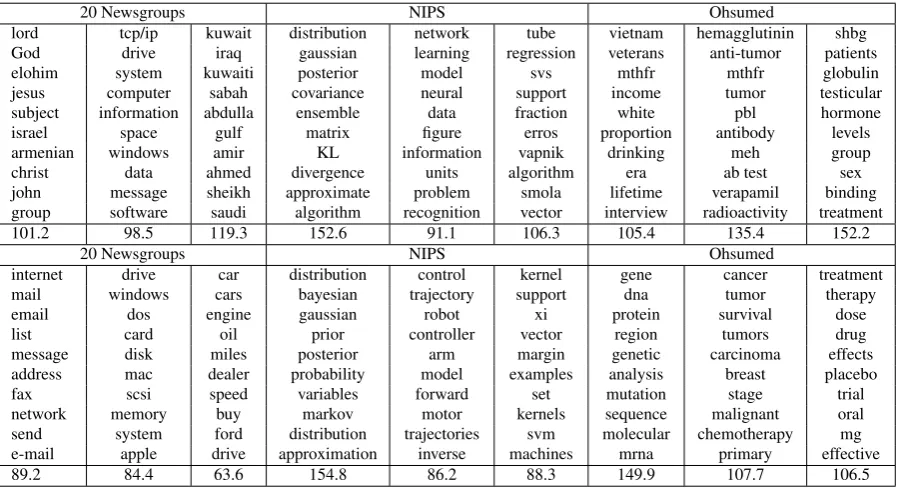
Table 2: Example topics learned from three datasets by TMKGE withK= 300andT = 20, and KGE-LDA with
K= 30. The last row for each model is the topic coherence computed using the 4,776,093 Wikipedia documents as reference. Some medical short words: pbl = Peripheral blood leucocyte, meh = Mean erythrocyte hemoglobin.
4.2 Model parameters
In the experiments, for each method, we report the results based on the hyperparameter settings that obtain the best performances. For TMKGE and HDP, we report the results forK = 300,T = 20
and K = 100, T = 10 cases. For LDA and
KGE-LDA, respectively, we haveK = 100 and
K = 30. Throughout this work we fix the
di-mension of entity embedding as P = 5. For on-line variational inference, we run the algorithms for 1000 iterations, with mini-batch size of 100.
4.3 Topic Coherence
We assess the performance of the proposed TMKGE model based on topic coherence. Topic coherence has been shown to be more consis-tent with human judgment than other typical topic model metrics such as perplexity (Chang et al.,
2009; Newman et al., 2010). We perform both
quantitative and qualitative analysis of the topics discovered by TMKGE, and compare its perfor-mance to those of LDA, HDP and KGE-LDA.
4.3.1 Quantitative Analysis
We evaluate the coherence of discovered topics by the point-wise mutual information (PMI) Topic Coherence metric. The PMI Topic Coherence is implemented followingNewman et al.(2010):
P M I(k) =
N
X
j=2
j−1
X
i=1
log p(wi, wj) p(wi)p(wj)
wherekrefers to a topic,N refers to the number of top words ofk,p(wi)is the probability thatwi
appears in a document,p(wi, wj)is the probability
thatwi andwj co-occur in the same document. A
higher PMI score implies a more coherent topic. Following KGE-LDA, 4,776,093 Wikipedia arti-cles are employed for obtaining topic coherence scores. Different from Yao et al. (2017), which used a fixed value ofN (the number of top words,
e.g. N = 5orN = 10), we varyN in a range
from 5 to30. (Lau and Baldwin, 2016) suggests that calculating topic coherence over several dif-ferent cardinalities and averaging results in a sub-stantially more stable evaluation.
4.3.2 Qualitative Analysis
Table 2 shows example topics with their PMI
scores learned from the three corpora by KGE-LDA and our TMKGE model. For comparison, we report similar topics to those listed in the KGE-LDA paper. It can be seen that TMKGE finds quite closely related words in a topic. For example, for the second column of 20 Newsgroups, topic words from both TMKGE and KGE-LDA are related to computers. However, it can be noted that words from TMKGE focus more on the core words of computer science. In contrast, words from the same topic in KGE-LDA seems to be closer to the brand, such as windows, mac or apple. In addition, topics found from TMKGE are more diverse than those found in KGE-LDA. For 20 Newsgroups, the three topics we list here refer to theology, com-puter science and middle east respectively while the three topics from KGE-LDA refer to inter-net, computer and car respectively. Both TMKGE and KGE-LDA discover probability-related and machine learning topics with different top words
from NIPS dataset. Roughly speaking,
KGE-LDA discovers gene-related, cancer-related and treatment-related topics from Ohsumed corpus. TMKGE discovers more diverse and more specific topics. For example, one topic TMKGE discov-ers is about Vietnamese veterans, cancer-related and sexual-disease topics. From the perspective of topic coherence, we can also see that TMKGE obtains higher PMI score in most of those top-ics. The whole trend is consistent with the average PMI score reported in the last section. Overall, TMKGE performs better than other topic models, including LDA, HDP and KGE-LDA in terms of average PMI and also in qualitative case studies.
4.4 Document Classification
We evaluate our proposed method through docu-ment classification, we follow the approach in (Li and McCallum,2006) for document classification. We have conducted a five-way classification on the comp subject of 20 Newsgroups dataset and on the top five most frequent labels of Ohsumed dataset (no labels for nips dataset), where each class of documents is divided into 75% training and 25% testing. For each class, the LDA, HDP and TMKGE models are trained on the training documents, and then the predictive likelihood for the test documents is calculated using the E-step in the variational inference procedure of LDA. A
document is classified correctly if its correspond-ing model produces the highest likelihood.
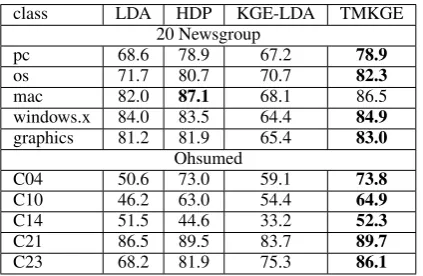
class LDA HDP KGE-LDA TMKGE 20 Newsgroup
pc 68.6 78.9 67.2 78.9
os 71.7 80.7 70.7 82.3
mac 82.0 87.1 68.1 86.5 windows.x 84.0 83.5 64.4 84.9
graphics 81.2 81.9 65.4 83.0
Ohsumed
C04 50.6 73.0 59.1 73.8
C10 46.2 63.0 54.4 64.9
C14 51.5 44.6 33.2 52.3
C21 86.5 89.5 83.7 89.7
C23 68.2 81.9 75.3 86.1
Table 3: Document classification accuracy a five-way classification on the comp subject of 20 Newsgroups dataset and on the top five most frequent labels of ohsumed dataset (no labels for NIPS dataset).
Table 3 presents the average classification ac-curacy for TMKGE, HDP and LDA over five re-peated simulations. The table includes the classifi-cation accuracy for KGE-LDA, where the learned topic proportions are used as features for SVM classifier. For the majority of document classes, TMKGE has the best classification accuracy, ex-cept for the classmac. As shown, the SVM clas-sifier based on KGE-LDA has significantly worst
performance. For more complete comparisons,
we run experiments on all subjects of 20 News-groups and also report experimental results pub-lished in Shi et al. (2017) in Table 4. TMKGE achieves the best performance on all models.
Model Acc (%) Model Acc (%) BOW 79.7 STE-Diff 82.9 Skip-Gram 75.4 LDA 77.5 TWE 81.5 TMSA 83.5
PV 75.4 HDP 82.4
GPU-DMM 48.0 KGE-LDA 70.5 STE-Same 80.4 TMKGE 88.8
Table 4: Document classification: all subjects of 20 Newsgroups dataset for more complete comparisons. Clearly shown is the best performances of TMKGE
[image:8.595.312.524.100.238.2]even much better performances than STE-Diff, TWE and TMSA, all of which involve the integra-tion of word embedding and topic modeling. Im-pressively, TMKGE shows its supremacy over the state of the art model, TMSA with high margins. This shows that the knowledge graph structure cluded into the entity embedding conveys more in-formation than pure word embedding. Meanwhile, this also shows that the two proportional vectors generated with online HDP enables the flexible sharing of information between words and entities. Accordingly, more coherent topics are extracted and the classification result are boosted as well.
5 Conclusion
This paper presents TMKGE, a Bayesian nonpara-metric model based on hierarchical Dirichlet pro-cess for incorporation of entity embeddings from external knowledge graphs into topic modeling. The proposed method allows for flexible sharing of information between documents and knowl-edge graph. Specifically, TMKGE avoids forcing the words and entities to identical latent factors, thus making it a suitable framework for scenarios where only partial relational information are avail-able. Furthermore, as a Bayesian nonparameteric model, TMKGE learns the number of word top-ics and entity mixture components automatically from the data. We have derived an efficient and scalable online variational inference for TMKGE. Comprehensive experiments on three different datasets suggest that TMKGE significantly outper-forms SOA methods in terms of both topic coher-ence and document classification accuracy.
References
David Andrzejewski and Xiaojin Zhu. 2009. Latent dirichlet allocation with topic-in-set knowledge. In SemiSupLearn ’09 Proceedings of the NAACL HLT 2009 Workshop on Semi-Supervised Learning for Natural Language Processing, pages 43–48, Boul-der, Colorado.
David Andrzejewski, Xiaojin Zhu, and Mark Craven. 2009. Incorporating domain knowledge into topic modeling via dirichlet forest priors. In Proceed-ings of the 26th annual international conference on machine learning (ICML), pages 25–32, Montreal, Canada.
Kayhan Batmanghelich, Ardavan Saeedi, Karthik Narasimhan, and Sam Gershman. 2016. Nonpara-metric spherical topic modeling with word embed-dings. In Proceedings of the 54th Annual
Meet-ing of the Association for Computational LMeet-inguistics (ACL), Berlin, Germany.
Yoshua Bengio, R´ejean Ducharme, Pascal Vincent, and Christian Jauvin. 2003. A neural probabilistic lan-guage model. Journal of machine learning research, 3(Feb):1137–1155.
Steven Bird and Edward Loper. 2004. NLTK: the nat-ural language toolkit. In Proceedings of the ACL 2004 on Interactive poster and demonstration ses-sions, page 31. Association for Computational Lin-guistics.
David M Blei, Andrew Y Ng, and Michael I Jordan. 2003. Latent dirichlet allocation. Journal of ma-chine Learning research, 3(Jan):993–1022.
Arnim Bleier. 2013. Practical collapsed stochas-tic variational inference for the HDP. CoRR, abs/1312.0412.
Antoine Bordes, Nicolas Usunier, Alberto Garcia-Duran, Jason Weston, and Oksana Yakhnenko. 2013. Translating embeddings for modeling multi-relational data. InAdvances in Neural Information Processing Systems (NIPS), pages 2787–2795, Lake Tahoe, NV.
Antoine Bordes, Jason Weston, Ronan Collobert, Yoshua Bengio, et al. 2011. Learning structured em-beddings of knowledge bases. InProceedings of the Twenty-Fifth AAAI Conference on Artificial Intelli-gence (AAAI), San Francisco, CA.
Jonathan Chang, Sean Gerrish, Chong Wang, Jordan L Boyd-Graber, and David M Blei. 2009. Reading tea leaves: How humans interpret topic models. In Advances in Neural Information Processing Systems (NIPS), pages 288–296, Vancouver, Canada.
Chaitanya Chemudugunta, America Holloway, Padhraic Smyth, and Mark Steyvers. 2008. Mod-eling documents by combining semantic concepts with unsupervised statistical learning. In Pro-ceedings of the 7th International Semantic Web Conference (ISWC), pages 229–244, Karlsruhe, Germany.
Zhiyuan Chen and Bing Liu. 2014. Mining topics in documents: standing on the shoulders of big data. In Proceedings of the 20th ACM SIGKDD Inter-national Conference on Knowledge Discovery and Data Mining (KDD), pages 1116–1125, New York, NY.
Zhiyuan Chen, Arjun Mukherjee, Bing Liu, Meichun Hsu, Malu Castellanos, and Riddhiman Ghosh. 2013. Discovering coherent topics using general knowledge. In Proceedings of the 22nd ACM in-ternational conference on Information & Knowledge Management (CIKM), pages 209–218, San Fran-cisco, CA.
embed-dings. In Proceedings of the 53rd Annual Meet-ing of the Association for Computational LMeet-inguistics and the 7th International Joint Conference on Nat-ural Language Processing of the Asian Federation of Natural Language Processing (ACL), pages 795– 804, Beijing, China.
Finale Doshi-Velez, Byron C Wallace, and Ryan Adams. 2015. Graph-sparse LDA: A topic model with structured sparsity. In Proceedings of the Twenty-Ninth AAAI Conference on Artificial Intelli-gence (AAAI), pages 2575–2581, Austin, TX.
Emily B Fox, Erik B Sudderth, Michael I Jordan, and Alan S Willsky. 2011. A sticky HDP-HMM with ap-plication to speaker diarization. The Annals of Ap-plied Statistics, pages 1020–1056.
Yoav Goldberg and Omer Levy. 2014. word2vec ex-plained: deriving mikolov et al.’s negative-sampling word-embedding method.CoRR, abs/1402.3722.
Matthew Hoffman, Francis R Bach, and David M Blei. 2010. Online learning for latent dirichlet allocation. InAdvances in Neural Information Processing Sys-tems (NIPS), pages 856–864, Vancouver, Canada.
Thomas Hofmann. 2017. Probabilistic latent semantic indexing. In ACM SIGIR Forum, pages 211–218. ACM.
Changwei Hu, Piyush Rai, and Lawrence Carin. 2016. Topic-based embeddings for learning from large knowledge graphs. In Proceedings of the 19th International Conference on Artificial Intelligence and Statistics (AISTATS), pages 1133–1141, Cadiz, Spain.
Yuening Hu, Jordan Boyd-Graber, Brianna Satinoff, and Alison Smith. 2014. Interactive topic modeling. Machine learning, 95(3):423–469.
Jagadeesh Jagarlamudi, Hal Daum´e III, and Raghaven-dra Udupa. 2012. Incorporating lexical priors into topic models. In Proceedings of the 13th Confer-ence of the European Chapter of the Association for Computational Linguistics (EACL), pages 204–213, Avignon, France.
Jey Han Lau and Timothy Baldwin. 2016. The sensitiv-ity of topic coherence evaluation to topic cardinalsensitiv-ity. InProceedings of the 2016 Conference of the North American Chapter of the Association for Computa-tional Linguistics: Human Language Technologies (NAACL HLT), pages 483–487, San Diego, CA.
Dingcheng Li, Jingyuan Zhang, and Ping Li. 2019. Tmsa: A mutual learning model for topic discov-ery and wordembedding. In Proceedings of the SIAM conference on Data Mining (SDM), Calgary, Canada.
Shaohua Li, Tat-Seng Chua, Jun Zhu, and Chunyan Miao. 2016. Generative topic embedding: a contin-uous representation of documents. InProceedings of the 54th Annual Meeting of the Association for Computational Linguistics (ACL), pages 666–675, Berlin, Germany.
Wei Li and Andrew McCallum. 2006. Pachinko al-location: Dag-structured mixture models of topic correlations. In Proceedings of the 23rd inter-national conference on Machine learning (ICML), pages 577–584, Pittsburgh, PA.
Steven N MacEachern and Peter M¨uller. 1998. Esti-mating mixture of dirichlet process models. Jour-nal of ComputatioJour-nal and Graphical Statistics, 7(2):223–238.
Christopher Manning, Mihai Surdeanu, John Bauer, Jenny Finkel, Steven Bethard, and David McClosky. 2014. The Stanford CoreNLP natural language pro-cessing toolkit. In Proceedings of 52nd annual meeting of the association for computational lin-guistics (ACL): system demonstrations, pages 55– 60, Baltimore, MD.
Tomas Mikolov, Ilya Sutskever, Kai Chen, Greg S Cor-rado, and Jeff Dean. 2013. Distributed representa-tions of words and phrases and their compositional-ity. InAdvances in Neural Information Processing Systems (NIPS), pages 3111–3119, Lake Tahoe, NV.
George A Miller. 1995. Wordnet: a lexical database for english. Communications of the ACM, 38(11):39– 41.
David Mimno, Hanna M Wallach, Edmund Talley, Miriam Leenders, and Andrew McCallum. 2011. Optimizing semantic coherence in topic models. In Proceedings of the 2011 Conference on Em-pirical Methods in Natural Language Processing (EMNLP), pages 262–272, Edinburgh, UK.
David Newman, Jey Han Lau, Karl Grieser, and Tim-othy Baldwin. 2010. Automatic evaluation of topic coherence. InHuman Language Technologies: The 2010 Annual Conference of the North American Chapter of the Association for Computational Lin-guistics (NAACL), pages 100–108, Los Angeles, LA.
Dat Quoc Nguyen, Richard Billingsley, Lan Du, and Mark Johnson. 2015. Improving topic models with latent feature word representations. Transactions of the Association for Computational Linguistics, 3:299–313.
Jeffrey Pennington, Richard Socher, and Christopher Manning. 2014. Glove: Global vectors for word representation. InProceedings of the 2014 confer-ence on empirical methods in natural language pro-cessing (EMNLP), pages 1532–1543, Doha, Qatar.
Jim Pitman. 2002. Poisson–dirichlet and gem invari-ant distributions for split-and-merge transformations of an interval partition. Combinatorics, Probability and Computing, 11(5):501–514.
Jayaram Sethuraman. 1994. A constructive definition of dirichlet priors. Statistica sinica, pages 639–650. Bei Shi, Wai Lam, Shoaib Jameel, Steven Schockaert, and Kwun Ping Lai. 2017. Jointly learning word embeddings and latent topics. In Proceedings of the 40th International ACM SIGIR Conference on Research and Development in Information Retrieval (SIGIR), pages 375–384, Shinjuku, Tokyo.
Yee W Teh, Michael I Jordan, Matthew J Beal, and David M Blei. 2005. Sharing clusters among re-lated groups: Hierarchical dirichlet processes. In Advances in neural information processing systems (NIPS), pages 1385–1392, Vancouver, Canada.
Yee W Teh, Kenichi Kurihara, and Max Welling. 2008. Collapsed variational inference for HDP. In Ad-vances in neural information processing systems (NIPS), pages 1481–1488, Vancouver, Canada.
Chong Wang, John Paisley, and David Blei. 2011. On-line variational inference for the hierarchical dirich-let process. InProceedings of the Fourteenth Inter-national Conference on Artificial Intelligence and Statistics (AISTATS), pages 752–760, Fort Laud-erdale, FL.
Liang Yao, Yin Zhang, Baogang Wei, Zhe Jin, Rui Zhang, Yangyang Zhang, and Qinfei Chen. 2017. Incorporating knowledge graph embeddings into topic modeling. InProceedings of the Thirty-First AAAI Conference on Artificial Intelligence (AAAI), pages 3119–3126, San Francisco, CA.