i
A M a x i m u m
E n t r o p y M o d e l f o r P a r t - O f - S p e e c h
T a g g i n g
Adwait Ratnaparkhi
U n i v e r s i t y o f P e n n s y l v a n i a
D e p t . o f C o m p u t e r a n d I n f o r m a t i o n S c i e n c e a d w a i t ~ g r a d i e n t , c i s . u p e n n ,
edu
A b s t r a c t
This paper presents a statistical model which trains from a corpus annotated with Part-Of- Speech tags and assigns them to previously unseen text with state-of-the-art accuracy(96.6%). The
model can be classified as a Maximum Entropy
model and simultaneously uses many contextual "features" to predict the POS tag. Furthermore, this paper demonstrates the use of specialized fea- tures to model difficult tagging decisions, discusses the corpus consistency problems discovered during the implementation of these features, and proposes a training strategy that mitigates these problems.
I n t r o d u c t i o n
Many natural language tasks require the accurate assignment of Part-Of-Speech (POS) tags to pre- viously unseen text. Due to the availability of large corpora which have been manually annotated with POS information, many taggers use anno- tated text to "learn" either probability distribu- tions or rules and use them to automatically assign POS tags to unseen text.
The experiments in this paper were conducted on the Wall Street Journal corpus from the Penn Treebank project(Marcus et al., 1994), although the model can trai~n from any large corpus anno- tated with POS tags. Since most realistic natu- ral language applications must process words that were never seen before in training data, all exper- iments in this paper are conducted on test data that include unknown words.
Several recent papers(Brill, 1994,
Magerman, 1995) have reported 96.5% tag- ging accuracy on the Wall St. Journal corpus. The experiments in this paper test the hy-
pothesis that better use of context will improve
the accuracy. A Maximum Entropy model is
well-suited for such experiments since it corn-
bines diverse forms of contextual information in a principled manner, and does not impose any distributional assumptions on the train-
ing data. Previous uses of this model include
language modeling(Lau et al., 1993), machine
translation(Berger et al., 1996), prepositional
phrase attachment(Ratnaparkhi et al., 1994), and word morphology(Della Pietra et al., 1995). This paper briefly describes the m a x i m u m entropy and maximum likelihood properties of the model, features used for POS tagging, and the experi- ments on the Penn Treebank Wall St. Journal corpus. It then discusses the consistency problems discovered during an a t t e m p t to use specialized features on the word context. Lastly, the results
in
this paper are compared to those from previouswork on POS tagging.
The Probability M o d e l
The probability model is defined over 7-/x 7-, where 7t is the set of possible word and tag contexts, or "histories", and T is the set of allowable tags. The model's probability of a history h together with a tag t is defined as:
k
p(h, t) =
Ill -J-
jj(h,t)
j = l(1)
where ~" is a normalization constant,
{tt, ~1,..., ak} are the positive model parameters and { f l , . . - , f k } are known as "features", where fj(h,t) E {O, 1}. Note that each parameter a j
corresponds to a feature fj.
Given a sequence of words { w l , . . . , Wn} and
tags {tl,...t,~} as training data, define hi as the
the likelihood of the training d a t a using p:
r(p)
= 1-[
p(h.t,)
=
1-[
i = 1 i = 1 j = l
This model also can be interpreted under the M a x i m u m Entropy formalism, in which the goal is to maximize the entropy of a distribution subject to certain constraints. Here, the entropy of the distribution p is defined as:
H(p) = -
E
p(h,t) logp(h,t)
hE74,tET
and the constraints are given by:
Efj = Efj,
l < j _< k
(2)where the model's feature expectation is
E f j =
E
p(h,t)fj(h,t)
hET.l,tET
and the observed feature expectation is
i = 1
and where iS(hi, ti) denotes the observed probabil-
ity of
(hi,ti)
in the training data. Thus the con-straints force the model to m a t c h its feature expec- tations with those observed in the training data. In practice, 7-/ is very large and the model's ex- pectation
Efj
cannot be c o m p u t e d directly, so the following a p p r o x i m a t i o n ( L a u et al., 1993) is used:n
E fj ,~ E15(hi)p(tilhi)fj(hi,ti)
i = 1
where
fi(hi)
is the observed probability of the his-tory hi in the training set.
It can be shown (Darroch and Ratcliff, 1972) t h a t if p has the form (1) and satisfies the k constraints (2), it uniquely maximizes the en- tropy
H(p)
over distributions t h a t satisfy (2), anduniquely maximizes the likelihood
L(p)
over dis-tributions of the form (1). T h e model p a r a m e t e r s
for the distribution p are obtained via
Generalized
Iterative Scaling(Darroch
and Ratcliff, 1972).F e a t u r e s f o r P O S T a g g i n g
T h e joint probability of a history h and tag t is determined by those p a r a m e t e r s whose corre- sponding features are active, i.e., those o~j such
that
fj(h,t)
= 1. A feature, given(h,t),
m a y ac- tivate on any word or tag in the history h, and must encode any information t h a t might help pre- dict t, such as the spelling of the current word, or the identity of the previous two tags. T h e specific word and tag context available to a feature is given in the following definition of a history hi:hi • {wi, w i + I , wi-}-2, w i - 1 , w i - 2 , t i - 1 , t i - 2 }
For example,
1 if suffix(w/) = " i n g " & ti = VBG
fj(hl,ti)=
0 otherwiseIf the above feature exists in the feature set of the model, its corresponding model p a r a m e t e r will
contribute towards the joint probability
p(hi,ti)
when
wi
ends with "±ng" and whenti
=VBG 1.Thus a model p a r a m e t e r
aj
effectively serves as a "weight" for a certain contextual predictor, in this case the suffix " i n g " , towards the probability of observing a certain tag, in this case a VBG.The model generates the space of features by scanning each pair
(hi, ti)
in the training d a t a with the feature "templates" given in Table 1. Givenhi as
the current history, a feature always asks some yes/no question abouthi,
and f u r t h e r m o r e constrains ti to be a certain tag. T h e instantia- tions for the variables X , Y, and T in Table 1 are obtained automatically from the training data.The generation of features for tagging un- known words relies on the hypothesized distinction t h a t "rare" words 2 in the training set are similar to unknown words in test data, with respect to how their spellings help predict their tags. T h e rare word features in Table 1, which look at the word spellings, will apply to b o t h rare words and unknown words in test data.
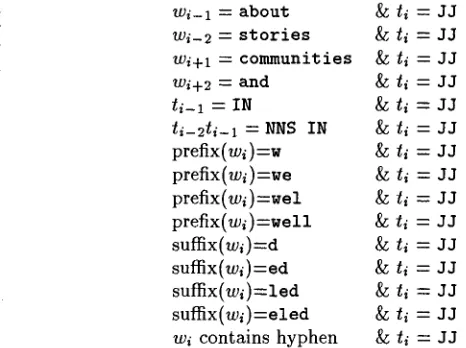
For example, Table 2 contains an excerpt from training d a t a while Table 3 contains the features generated while scanning (ha, t3), in which the cur- rent word is a b o u t , and Table 4 contains features generated while scanning (h4, t4), in which the cur- rent word, w e l l - h e e l e d , occurs 3 times in train- ing d a t a and is therefore classified as "rare".
The behavior of a feature t h a t occurs very sparsely in the training set is often difficult to pre- dict, since its statistics m a y not be reliable. There- fore, the model uses the heuristic t h a t any feature
Condition Features
w i is not rare w i = X & t i = T
w i is rare
¥ w i
X is prefix of w i ,
IXI ~
4 & t i = T X is suffix of w i , IXI < 4 & l i • T wi c o n t a i n s n u m b e r ~z ti = T wi c o n t a i n s u p p e r c a s e c h a r a c t e r ~ ti = Tw i contains hyphen ~ t i = T
t i - 1 = X & t i = T
t i _ 2 t i _ t = X Y ~ ti = T
w i - 1 = X & li = T
w i - 2 = X ~ ti = T
w i + 1 = X ~s t i = T w i + 2 = X & t i = T
Table h Features on the current history hi
Word:
Tag: P o s i t i o n :
t h e s t o r i e s a b o u t w e l l - h e e l e d c o m m u n i t i e s a n d d e v e l o p e r s
D T N N S IN JJ N N S CC N N S
1 2 3 4 5 6 7
Table 2: Sample Data
wi ---- a b o u t
wi-i -~ s t o r i e s
wi-2 ---- the
Wi+l = w e l l - h e e l e d
wi+2 ---- c o m m u n i t i e s
t i - I = NNS
t i - 2 t i - 1 = D T N N S Table 3: Features Generated From h3 (for
& ti = I N
g5 ti = I N
& ti = I N
ti = I N
~2 ti = I N
~: ti = I N
ti = I N
tagging a b o u t ) from Table 2
Wi-1 -~ a b o u t • ti = J J
w i - 2 = s t o r i e s ~z ti = J J
Wi+l = c o m m u n i t i e s & ti = J J
wi+2 = a n d ~ ti = J J
t i - 1 = I N ~ ti = JJ
ti-2ti-I ---- I~IS IN ~z ti = JJ
p r e f i x ( w i ) = w ~ ii = J J p r e f i x ( w i ) - - - - w e & ti = J J p r e f i x ( w i ) = w e l ~z li = J J
prefix(wi)=well & ti = JJ
s u l f f i x ( w i ) = d ~ ti = JJ
s u f f i x ( w i ) = e d & ti = J J s u f x ( w i ) = l e d ~ ti = JJ suffix(wi)=eled & ti = JJ wi c o n t a i n s h y p h e n & ti = JJ
[image:3.612.139.436.83.245.2] [image:3.612.143.376.505.679.2]which occurs less t h a n 10 times in the d a t a is un- reliable, and ignores features whose counts are less than 10. 3 While there are m a n y smoothing algo- rithms which use techniques more rigorous than a simple count cutoff, they have not yet been inves- tigated in conjunction with this tagger.
T e s t i n g t h e
Model
The test corpus is tagged one sentence at a time. The testing procedure requires a search to enumer- ate the candidate tag sequences for the sentence, and the tag sequence with the highest probability is chosen as the answer.
S e a r c h A l g o r i t h m
T h e search algorithm, essentially a " b e a m search", uses the conditional tag probability
p(h,t)
p ( t l h ) - p(h,t')
and maintains, as it sees a new word, the N highest probability tag sequence candidates up to t h a t point in the sentence. Given a sentence
a t a g sequence c a n d i d a t e has conditional probability:
P(tl . .tnlwl ..wn) = I I p(tilh,) i = l
In addition the search procedure optionally
consults a Tag Dictionary, which, for each known
word, lists the tags t h a t it has appeared with in the training set. If the Tag Dictionary is in effect, the search procedure, for known words, generates only tags given by the dictionary entry, while for unknown words, generates all tags in the tag set. W i t h o u t the Tag Dictionary, the search procedure generates all tags in the tag set for every word.
Let W = { w l . . . w , ~ } be a test sentence, and let sij be the j t h highest probability tag sequence up to and including word wi. T h e search is de- scribed below:
1. Generate tags for wl, find top N, set 81j , 1 _< j < N, accordingly.
2. Initialize i = 2
(a) Initialize j = 1
3Except for features that look only at the cur- rent word, i.e., features of the form wl ----<word> and tl :<TAG>. The count of 10 was chosen by inspection of Training and Development data.
(b) Generate tags for wi, given s(i-1)j as previous
tag context, and append each tag to s(i-1)j to
make a new sequence
(c) j = j + 1, Repeat from (b) i f j _< g
3. Find N highest probability sequences generated by above loop, and set sij, 1 < j _< N, accord- ingly.
4. i = i + 1, Repeat from (a) if i _< n
5. Return highest probability sequence, s~l
Experiments
In order to conduct tagging experiments, the Wall St. Journal d a t a has been split into three contiguous sections, as shown in Table 5. T h e feature set and search algorithm were tested and debugged only on the Training and Development sets, and the official test result on the unseen Test set is presented in the conclusion of the paper. T h e performances of the "baseline" model on the Development Set, b o t h with and without the Tag Dictionary, are shown in Table 6.
All experiments use a b e a m size of N = 5; further increasing the b e a m size does not signifi- cantly increase performance on the Development Set but adversely affects the speed of the tagger. Even though use of the Tag Dictionary gave an ap- parently insignificant (. 12%) i m p r o v e m e n t in accu- racy, it is used in further experiments since it sig- nificantly reduces the number of hypotheses and thus speeds up the tagger.
T h e running time of the p a r a m e t e r estimation
algorithm is O(NTA), where N is the training set
size, T is the n u m b e r of allowable tags, and A is the average n u m b e r of features t h a t are active for a given event (h, t). T h e running time of the search procedure on a sentence of length N is O ( N T A B ) , where T, A are defined above, and B is the b e a m size. In practice, the model for the experiment shown in Table 6 requires a p p r o x i m a t e l y 24 hours to train, and 1 hour to test 4 on an IBM RS/6000 Model 380 with 256MB of RAM.
Specialized
F e a t u r e s a n d C o n s i s t e n c yT h e M a x i m u m Entropy model allows arbitrary binary-valued features on the context, so it can use additional specialized, i.e., word-specific, features
DataSet Sentences Words Unknown Words
Training 40000 962687
Development 8000 192826 6107
Test 5485 133805 3546
Table 5: W S J D a t a Sizes
Tag DictiOnary No Tag Dictionary
Total Word Accuracy Unknown Word Accuracy
96.43% 86.23%
96.31% 86.28%
Table 6: Baseline Performance on Development Set
Sentence Accuracy 47.55% 47.38%
Table 7: Word about t h a t more up that
a s
up more t h a t about t h a t
o u t
t h a t much yen chief up
a g o
much
o u t
Correct Tag Model's Tag Frequency
RB IN 393
D T IN 389
R B R J J R 221
IN R B 187
W D T IN 184
RB IN 176
IN RP 176
J J R R B R 175
IN W D T 159
IN i RB 144
IN D T 127
RP D T
IN W D T
126 123
J J RB 118
NN NNS 117
NN I J J 116
RP IN 114
IN RB 112
RB ! J J 111
IN R P 109
[image:5.612.184.406.397.659.2]to correctly tag the "residue" t h a t the baseline features cannot model. Since such features typ- ically occur infrequently, the training set consis- tency m u s t be good enough to yield reliable statis- tics. Otherwise the specialized features will model noise and p e r f o r m poorly on test data.
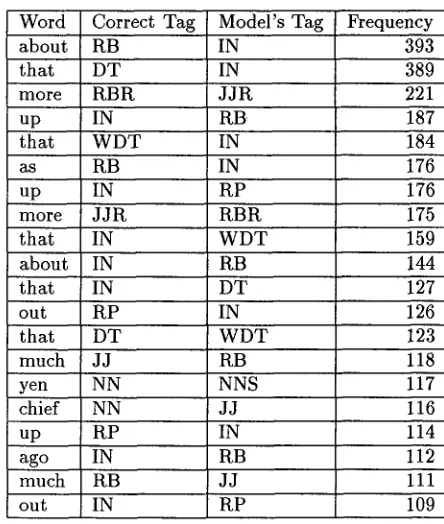
Such features can be designed for those words which are especially problematic for the model. T h e top errors of the model (over the training set) are shown in Table 7; clearly, the model has trou- ble with the words t h a t and a b o u t , among others. As hypothesized in the introduction, better fea- tures on the context surrounding t h a t and a b o u t should correct the tagging mistakes for these two words, assuming t h a t the tagging errors are due to an impoverished feature set, and not inconsistent data.
Specialized features for a given word are con- structed by conjoining certain features in the base- line model with a question about the word itself. T h e features which ask a b o u t previous tags and surrounding words now additionally ask about the identity of the current word, e.g., a specialized fea- ture for the word a b o u t in Table 3 could be:
1 if wi : a b o u t ~ t i - 2 t i - 1 = DT NNS
fj (hi, ti) = & ti = IN 0 otherwise
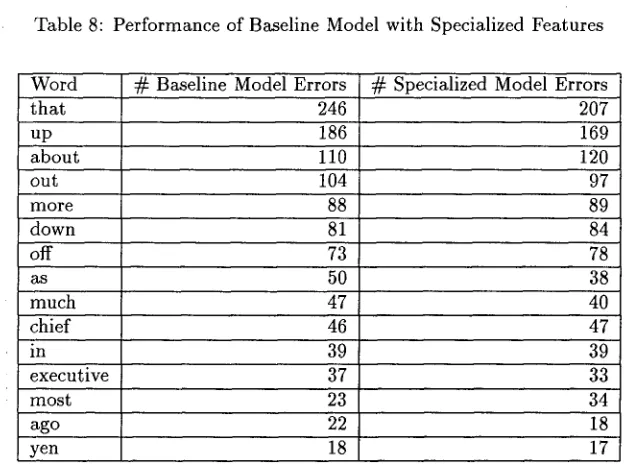
Table 8 shows the results of an experiment in which specialized features are constructed for "difficult" words, and are added to the baseline feature set. Here, "difficult" words are those t h a t are mistagged a certain way at least 50 times when the training set is tagged with the baseline model. Using the set of 29 difficult words, the model per- forms at 96.49% accuracy on the Development Set, an insignificant i m p r o v e m e n t from the baseline ac- curacy of 96.43%. Table 9 shows the change in er- ror rates on the Development Set for the frequently occurring "difficult" words. For most words, the specialized model yields little or no improvement, and for some, i.e., more and a b o u t , the specialized model performs worse.
T h e lack of i m p r o v e m e n t implies t h a t either the feature set is still impoverished, or t h a t the training d a t a is inconsistent. A simple consistency test is to graph the POS tag assignments for a given word as a function of the article in which it occurs. Consistently tagged words should have roughly the same tag distribution as the article numbers vary. Figure 1 represents each POS tag with a unique integer and graphs the POS annota- tion of a b o u t in the training set as a function of the
a r t i c l e s (the points are "scattered" to show den- sity). As seen in figure 1, a b o u t is usually anno- tated with t a g # l , which denotes IN (preposition), or t a g # 9 , which denotes RB (adverb), and the ob- served probability of either choice depends heavily on the current article-~. Upon further examina- tion 5, the tagging distribution for a b o u t changes
precisely when the a n n o t a t o r changes. Figure 2, which again uses integers to denote POS tags, shows the tag distribution of a b o u t as a function of annotator, and implies t h a t the tagging errors for this word are due mostly to inconsistent data. The words ago, c h i e f , down, e x e c u t i v e , o f f , o u t , up and yen also exhibit similar bias.
Thus specialized features m a y be less effective for those words affected by inter-annotator bias. A simple solution to eliminate inter-annotator in- consistency is to train and test the model on d a t a
that has been created by the same annotator. T h e
results of such an experiment 6 are shown in Ta- ble 10. The total accuracy is higher, implying t h a t the singly-annotated training and test sets are more consistent, and the i m p r o v e m e n t due to the specialized features is higher t h a n before (.1%) but still modest, implying t h a t either the features need further i m p r o v e m e n t or t h a t intra-annotator
inconsistencies exist in the corpus.
C o m p a r i s o n W i t h P r e v i o u s W o r k
Most of the recent corpus-based POS taggers in the literature are either statistically based, and
use Markov Model(Weischedel et al., 1993,
Merialdo, 1994) or Statistical Decision
Tree(Jelinek et al., 1994, Magerman, 1995)(SDT)
techniques, or are primarily rule based,
such as Drill's T r a n s f o r m a t i o n Based
Learner(Drill, 1994)(TBL). T h e M a x i m u m
Entropy (MaxEnt) tagger presented in this p a p e r combines the advantages of all these methods. It uses a rich feature representation, like T B L and SDT, and generates a tag probability distribution for each word, like Decision Tree and Markov Model techniques.
5The mapping from article to annotator is in the file doc/wsj .wht on the Treebank CDROM.
Number of "Difficult" Words I Development Set Performance
29 ] 96.49%
Table 8: Performance of Baseline Model with Specialized Features
Word ~ Baseline Model Errors # Specialized Model Errors
that 246 207
up 186 169
about 110 120
out 104 97
more 88 89
down 81 84
off 73 78
as 50 38
much 47 40
chief 46 47
in 39 39
executive 37 33
most 23 34
ago 22 18
yen 18 17
Table 9: Errors on Development Set with Baseline and Specialized Models
35
30
25
20 POS Tag
15
10
5
• I
I I I I I I I I I
. , , . . o ,
'~$1r~. . • m m L . u p ~ ~ .'mNNmn~. ~ g t P d l = |&.allm~WI.Lqlf
I D W , t ~ l I O , r I ~ " 1 ~ ~ ~ II, M l m u l m , • IP, i l ~ ,,lllb, l ~ ~
I I I I I I I I I
0 200 400 600 800 1000 1200 1400 1600 1800
Article#
2000
Figure 1: Distribution of Tags for the word "about" vs. Article#
Training Size(w°rds)I T e s t 5 7 1 1 9 0 Size(w°rds) I B a s e l i n e 4 4 4 7 8 97.04% Specialized 197.13%
[image:7.612.138.451.116.349.2] [image:7.612.111.467.389.612.2]POS Tag 35
30
25
2O
15
10
5
0 1
I o. O h o °
m
I I
I
B ~ m M
I I I
2 3 4
A n n o t a t o r
Figure 2: Distribution of Tags for the word "about" vs. A n n o t a t o r
(Weischedel et al., 1993) provide the results from a b a t t e r y of "tri-tag" Markov Model exper-
iments, in which the probability
P(W,T)
of ob-serving a word sequence W =
{wl,w2,...,wn}
together with a tag sequence T =
{tl,t2,...,tn}
is given by:
P ( T I W ) P ( W )
p(tl)p(t21tl) ×
H P(tilti-lti-2)
p(wilti
i=3
Furthermore,
p(wilti)
for unknown words is com-puted by the following heuristic, which uses a set of 35 pre-determined endings:
p(wilti)
p(unknownwordlti ) x
p(capitalfeature[ti) x
p(endings, hypenationlti )
This a p p r o x i m a t i o n works as well as the
MaxEnt model, giving 85% unknown word
accuracy(Weischedel et al., 1993) on the Wall St. Journal, but cannot be generalized to handle more diverse information sources. Multiplying together all the probabilities becomes less convincing of an a p p r o x i m a t i o n as the information sources be-
come less independent. In contrast, the Max-
Ent model combines diverse and non-local infor- m a t i o n sources without making any independence assumptions.
A POS tagger is one c o m p o n e n t in the S D T based statisticM parsing system described
in (Jelinek et al., 1994, Magerman, 1995). T h e
total word accuracy on Wall St. Jour-
nal data, 96.5%(Magerman, 1995), is similar to
t h a t presented in this paper. However, the
aforementioned S D T techniques require word classes(Brown et al., 1992) to help prevent d a t a fragmentation, and a sophisticated smoothing al- g o r i t h m to mitigate the effects of any fragmenta- tion t h a t occurs. Unlike SDT, the M a x E n t train- ing procedure does not recursively split the data, and hence does not suffer f r o m unreliable counts due to d a t a fragmentation. As a result, no word classes are required and a trivial count cutoff suf- rices as a smoothing procedure in order to achieve roughly the same level of accuracy.
T B L is a non-statistical approach to POS tagging which also uses a rich feature repre- sentation, and performs at a total word accu- racy of 96.5% and an unknown word accuracy of 85%.(Bri11, 1994). T h e T B L representation of the surrounding word context is almost the same 7 and the T B L representation of unknown words is a superset s of the unknown word representation in this paper. However, since T B L is non-statistical, it does not provide probability distributions and
7(Brill, 1994) looks at words ±3 away from the cur- rent, whereas the feature set in this paper uses a win- dow of ±2.
[image:8.612.122.477.77.293.2]!
unlike MaxEnt, cannot be used as a probabilis- tic component in a larger model. MaxEnt can provide a probability for each tagging decision, which can be used in the probability calculation of any structure that is predicted over the POS tags, such as noun phrases, or entire parse trees, as in (Jelinek et al., 1994, Magerman, 1995).
Thus MaxEnt has at least one advantage over each of the reviewed POS tagging techniques. It is better able to use diverse information than Markov Models, requires less supporting techniques than SDT, and unlike TBL, can be used in a prob- abilistic framework. However, the POS tagging accuracy on the Penn Wall St. Journal corpus is roughly the same for all these modelling tech-
niques. The convergence of the accuracy rate
implies that either all these techniques are miss- ing the right predictors in their representation to get the "residue", or more likely, that any corpus based algorithm on the Penn Treebank Wall St. J o u r n a l corpus will not perform much higher than 96.5% due to consistency problems.
C o n c l u s i o n
The Maximum Entropy model is an extremely flexible technique for linguistic modelling, since it can use a virtually unrestricted and rich feature set in the framework of a probability model. The implementation in this paper is a state-of-the-art POS tagger, as evidenced by the 96.6% accuracy on the unseen Test set, shown in Table 11.
The model with specialized features does not perform much better than the baseline model, and further discovery or refinement of word-based fea- tures is difficult given the inconsistencies in the training data. A model trained and tested on data from a single annotator performs at .5% higher accuracy than the baseline model and should pro- duce more consistent input for applications that require tagged text.
R e f e r e n c e s
[ARP, 1994] ARPA. 1994. Proceedings of the Hu-
man Language Technology Workshop.
[Berger et al., 1996] Adam Berger, Stephen
A. Della Pietra, and Vincent J. Della Pietra.
1996. A Maximum Entropy Approach to
Natural Language Processing. Computational
Linguistics, 22(1):39-71.
[Brill, 1994] Eric Brill. 1994. Some Advances in Transformation-Based Part of Speech Tagging.
In Proceedings off the Twelfth National Confer-
ence on Artificial Intelligence, volume 1, pages 722-727.
[Brown et al., 1992] Peter F Brown, Vincent Del- laPietra, Peter V deSouza, Jennifer C Lai, and Robert L Mercer. 1992. Class-Based n-gram
Models of Natural Language. Computational
Linguistics, 18(4).
[Darroch and Ratcliff, 1972] J. N. Darroch and D. Ratcliff. 1972. Generalized Iterative Scaling
for Log-Linear Models. The Annals of Mathe-
matical Statistics, 43(5) :1470-1480.
[Della Pietra et al., 1995] Steven Della Pietra, Vincent Della Pietra, and John Lafferty. 1995. Inducing Features of Random Fields. Techni- cal Report CMU-CS95-144, School of Computer Science, Carnegie-Mellon University.
[Jelinek et al., 1994] F Jelinek, J Lafferty,
D Magerman, R Mercer, A Ratnaparkhi, and S Roukos. 1994. Decision Tree Parsing using
a Hidden Derivational Model. In Proceedings
of the Human Language Technology Workshop (ARP, 1994), pages 272-277.
[Lau et al., 1993] Ray Lau, Ronald Rosenfeld, and Salim Roukos. 1993. Adaptive Language Modeling Using The Maximum Entropy Prin-
ciple. In Proceedings of the Human Language
Technology Workshop, pages 108-113. ARPA.
[Magerman, 1995] David M. Magerman. 1995.
Statistical Decision-Tree Models for Parsing. In Proceedings of the 33rd Annual Meeting of the ACL.
[Marcus et al., 1994] Mitchell P. Marcus, Beatrice Santorini, and Mary Ann Mareinkiewicz. 1994. Building a large annotated corpus of English:
the Penn Treebank. Computational Linguistics,
19(2):313-330.
[Merialdo, 1994] Bernard Merialdo. 1994. Tag- ging English Text with a Probabilistic Model.
Computational Linguistics, 20(2):155-172.
[Ratnaparkhi et al., 1994] Adwait Ratnaparkhi, Jeff Reynar, and Salim Roukos. 1994. A Maxi- mum Entropy Model for Prepositional Phrase
Attachment. In Proceedings of the Human
Language Technology Workshop (ARP, 1994),