Edit Machines for Robust Multimodal Language Processing
Srinivas Bangalore
AT&T Labs-Research 180 Park Ave Florham Park, NJ 07932
Michael Johnston
AT&T Labs-Research 180 Park Ave Florham Park, NJ 07932
Abstract
Multimodal grammars provide an expres-sive formalism for multimodal integra-tion and understanding. However, hand-crafted multimodal grammars can be brit-tle with respect to unexpected, erroneous, or disfluent inputs. Spoken language (speech-only) understanding systems have addressed this issue of lack of robustness of hand-crafted grammars by exploiting classification techniques to extract fillers of a frame representation. In this paper, we illustrate the limitations of such clas-sification approaches for multimodal in-tegration and understanding and present an approach based on edit machines that combine the expressiveness of multimodal grammars with the robustness of stochas-tic language models of speech recognition. We also present an approach where the edit operations are trained from data using a noisy channel model paradigm. We eval-uate and compare the performance of the hand-crafted and learned edit machines in the context of a multimodal conversational system (MATCH).
1 Introduction
Over the years, there have been several mul-timodal systems that allow input and/or output to be conveyed over multiple channels such as speech, graphics, and gesture, for example, put that there (Bolt, 1980), CUBRICON (Neal and Shapiro, 1991), QuickSet (Cohen et al., 1998), SmartKom (Wahlster, 2002), Match (Johnston et al., 2002). Multimodal integration and interpre-tation for such interfaces is elegantly expressed using multimodal grammars (Johnston and Ban-galore, 2000). These grammars support com-posite multimodal inputs by aligning speech in-put (words) and gesture inin-put (represented as se-quences of gesture symbols) while expressing the relation between the speech and gesture input and their combined semantic representation. In (Ban-galore and Johnston, 2000; Johnston and
Banga-lore, 2005), we have shown that such grammars can be compiled into finite-state transducers en-abling effective processing of lattice input from speech and gesture recognition and mutual com-pensation for errors and ambiguities.
However, like other approaches based on hand-crafted grammars, multimodal grammars can be brittle with respect to extra-grammatical, erro-neous and disfluent input. For speech recognition, a corpus-driven stochastic language model (SLM) with smoothing or a combination of grammar-based and -gram model (Bangalore and John-ston, 2004; Wang et al., 2002) can be built in order to overcome the brittleness of a grammar-based language model. Although the corpus-driven lan-guage model might recognize a user’s utterance correctly, the recognized utterance may not be assigned a semantic representation by the multi-modal grammar if the utterance is not part of the grammar.
An alternative to these approaches is to edit the recognized string to match the closest string that can be accepted by the grammar. Essentially the idea is that, if the recognized string cannot be parsed, then we determine which in-grammar string it is most like. For example, in Figure 1, the recognized string is mapped to the closest string in the grammar by deletion of the wordsrestaurants
andin.
ASR: show cheap restaurants thai places in in chelsea Edits: show cheap thai places in chelsea
Grammar: show cheap thai places in chelsea
Figure 1: Editing Example
In this paper, we develop further this edit-based approach to finite-state multimodal language un-derstanding and show how when appropriately tuned it can provide a substantial improvement in concept accuracy. We also explore learning ed-its from data and present an approach of model-ing this process as a machine translation problem. We learn a model to translate from out of grammar or misrecognized language (such as ‘ASR:’ above) to the closest language the system can understand (‘Grammar:’ above). To this end, we adopt tech-niques from statistical machine translation (Brown et al., 1993; Och and Ney, 2003) and use statistical alignment to learn the edit patterns. Here we eval-uate these different techniques on data from the MATCH multimodal conversational system (John-ston et al., 2002) but the same techniques are more broadly applicable to spoken language systems in general whether unimodal or multimodal.
The layout of the paper is as follows. In Sec-tions 2 and 3, we briefly describe the MATCH application and the finite-state approach to mul-timodal language understanding. In Section 4, we discuss the limitations of the methods used for robust understanding in spoken language un-derstanding literature. In Section 5 we present our approach to building hand-crafted edit ma-chines. In Section 6, we describe our approach to learning the edit operations using a noisy channel paradigm. In Section 7, we describe our experi-mental evaluation.
2 MATCH: A Multimodal Application
MATCH (Multimodal Access To City Help) is a working city guide and navigation system that en-ables mobile users to access restaurant and sub-way information for New York City and Washing-ton, D.C. (Johnston et al., 2002). The user inter-acts with an interface displaying restaurant list-ings and a dynamic map showing locations and street information. The inputs can be speech, drawing/pointing on the display with a stylus, or
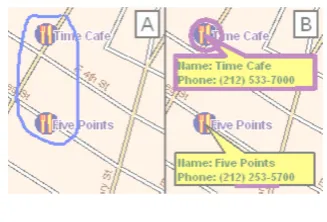
[image:2.595.333.497.225.336.2]synchronous multimodal combinations of the two modes. The user can ask for the review, cui-sine, phone number, address, or other informa-tion about restaurants and subway direcinforma-tions to lo-cations. The system responds with graphical la-bels on the display, synchronized with synthetic speech output. For example, if the user saysphone numbers for these two restaurantsand circles two restaurants as in Figure 2 [A], the system will draw a callout with the restaurant name and number and say, for exampleTime Cafe can be reached at 212-533-7000, for each restaurant in turn (Figure 2 [B]).
Figure 2: MATCH Example
3 Finite-state Multimodal Understanding
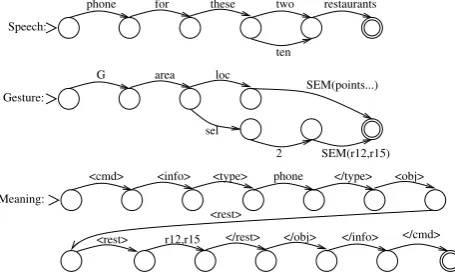
Our approach to integrating and interpreting mul-timodal inputs (Johnston et al., 2002) is an exten-sion of the finite-state approach previously pro-posed in (Bangalore and Johnston, 2000; John-ston and Bangalore, 2005). In this approach, a declarative multimodal grammar captures both the structure and the interpretation of multimodal and unimodal commands. The grammar consists of a set of context-free rules. The multimodal as-pects of the grammar become apparent in the ter-minals, each of which is a tripleW:G:M, consist-ing of speech (words, W), gesture (gesture sym-bols,G), and meaning (meaning symbols,M). The multimodal grammar encodes not just multimodal integration patterns but also the syntax of speech and gesture, and the assignment of meaning, here represented in XML. The symbol SEMis used to abstract over specific content such as the set of points delimiting an area or the identifiers of se-lected objects (Johnston et al., 2002). In Figure 3, we present a small simplified fragment from the MATCH application capable of handling informa-tion seeking requests such asphone for these three restaurants. The epsilon symbol ( ) indicates that
a stream is empty in a given terminal.
CMD :: cmd INFO : : /cmd INFO :: type TYPE :: /type
for:: :: obj DEICNP: : /obj TYPE phone::phone review::review
DEICNP DDETPL :area::sel: NUM HEADPL DDETPL these:G: those:G:
HEADPL restaurants:rest: rest :SEM:SEM
:: /rest
NUM two:2:three:3: ... ten:10:
Figure 3: Multimodal grammar fragment
Speech:
sel loc area G
Gesture:
2
<rest> Meaning:
<rest>
</type> <obj>
</cmd> </info> </obj> </rest> r12,r15
phone two these for phone
SEM(r12,r15) restaurants
<type> <info> <cmd>
[image:3.595.73.301.186.326.2]SEM(points...) ten
Figure 4: Multimodal Example
is either a selection of two restaurants or a ge-ographical area. In Figure 4 (Gesture) the spe-cific content is indicated in parentheses afterSEM. This content is removed before multimodal pars-ing and integration and replaced afterwards. For detailed explanation of our technique for abstract-ing over and then re-integratabstract-ing specific gestural content and our approach to the representation of complex gestures see (Johnston et al., 2002). The multimodal grammar (Figure 3) expresses the re-lationship between what the user said, what they drew with the pen, and their combined ing, in this case Figure 4 (Meaning). The mean-ing is generated by concatenatmean-ing the meanmean-ing symbols and replacing SEM with the appropri-ate specific content: cmd info type
phone /type obj rest [r12,r15] /rest
/obj /info /cmd .
For use in our system, the multimodal grammar is compiled into a cascade of finite-state transduc-ers (Johnston and Bangalore, 2000; Johnston et al., 2002; Johnston and Bangalore, 2005). As a result, processing of lattice inputs from speech and ges-ture processing is straightforward and efficient.
3.1 Meaning Representation for Concept Accuracy
The hierarchically nested XML representation above is effective for processing by the backend application, but is not well suited for the auto-mated determination of the performance of the language understanding mechanism. We adopt an
approach, similar to (Ciaramella, 1993; Boros et al., 1996), in which the meaning representation, in our case XML, is transformed into a sorted flat list of attribute-value pairs indicating the core con-tentful concepts of each command. The example above yields:
"!$#&%'()%+*,-'.)/0$',)!1,2-'+3$')!4--5
(1) This allows us to calculate the performance of the understanding component using the same string matching metrics used for speech recognition ac-curacy. Concept Sentence Accuracymeasures the number of user inputs for which the system got the meaning completely right (this is called Sentence Understanding in (Ciaramella, 1993)).
4 Robust Understanding
Robust understanding has been of great interest in the spoken language understanding literature. The issue of noisy output from the speech recog-nizer and disfluencies that are inherent in spoken input make it imperative for using mechanisms to provide robust understanding. As discussed in the introduction, there are two approaches to addressing robustness – partial parsing approach and classification approach. We have explored the classification-based approach to multimodal un-derstanding in earlier work. We briefly present this approach and discuss its limitations for mul-timodal language processing.
4.1 Classification-based Approach
In previous work (Bangalore and Johnston, 2004), we viewed multimodal understanding as a se-quence of classification problems in order to de-termine the predicate and arguments of an utter-ance. The meaning representation shown in (1) consists of an predicate (the command attribute) and a sequence of one or more argument at-tributes which are the parameters for the success-ful interpretation of the user’s intent. For ex-ample, in (1), 6 7,
is the predicate and
!+#8%'(9%+*)':-/,0+',9!12)' 3&',)!8)
is the set of arguments to the predicate.
We determine the predicate (;< ) for a =
to-ken multimodal utterance (>@?
A ) by maximizing the
posterior probability as shown in Equation 2.
;
<CB D$E9F&GHD$I
J
K
E,L ;NM->
?
ANO (2)
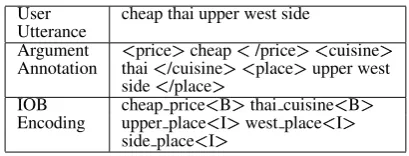
extending each argument label by three additional symbols P,QSRTQVU , following (Ramshaw and
Mar-cus, 1995). These symbols correspond to cases when a token is inside (P ) an argument span,
out-side (R ) an argument span or at the boundary of
two argument spans (U ) (See Table 1).
User cheap thai upper west side Utterance
Argument price cheap /price6 cuisine Annotation thai /cuisineW place upper west
side /place
IOB cheap price B thai cuisine B Encoding upper place I west place I
[image:4.595.77.282.145.223.2]side place I
Table 1: The X I,O,BY encoding for argument
ex-traction.
Given this encoding, the problem of extracting the arguments is a search for the most likely se-quence of tags (Z[< ) given the input multimodal
ut-terance> ?
A as shown in Equation (3). We
approx-imate the posterior probability
K
E,L Z\M> ?
A O
us-ing independence assumptions as shown in Equa-tion (4).
Z
< B]D&E9F&GHD$I
^
K
E,L Z_M->
?
A O (3)
`
D&E9F&GHD$I
^
a9b
K
ELdc
b
M-> bfe
g
b
h
g
Q
c
b
h
A
Q
c
b
hi O (4)
Owing to the large set of features that are used for predicate identification and argument extrac-tion, we estimate the probabilities using a classifi-cation model. In particular, we use the Adaboost classifier (Freund and Schapire, 1996) wherein a highly accurate classifier is build by combining many “weak” or “simple” base classifiersj
b
, each of which may only be moderately accurate. The selection of the weak classifiers proceeds itera-tively picking the weak classifier that correctly classifies the examples that are misclassified by the previously selected weak classifiers. Each weak classifier is associated with a weight (k
b
) that reflects its contribution towards minimizing the classification error. The posterior probability ofK
EL ;NM
I
O is computed as in Equation 5.
K
E,L ;NM
I
O
B l
L
lnm.o hi
<qpTrSs
r
<qt rvuxw7y
O
(5)
4.2 Limitations of this approach
Although, we have shown that the classification approach works for unimodal and simple multi-modal inputs, it is not clear how this approach can be extended to work on lattice inputs. Mul-timodal language processing requires the integra-tion and joint interpretaintegra-tion of speech and gesture input. Multimodal integration requires alignment of the speech and gesture input. Given that the in-put modalities are both noisy and can receive mul-tiple within-modality interpretations (e.g. a circle
could be an “O” or an area gesture); it is neces-sary for the input to be represented as a multiplic-ity of hypotheses, which can be most compactly represented as a lattice. The multiplicity of hy-potheses is also required for exploiting the mu-tual compensation between the two modalities as shown in (Oviatt, 1999; Bangalore and Johnston, 2000). Furthermore, in order to provide the dialog manager the best opportunity to recover the most appropriate meaning given the dialog context, we construct a lattice of semantic representations in-stead of providing only one semantic representa-tion.
In the multimodal grammar-based approach, the alignment between speech and gesture along with their combined interpretation is utilized in deriv-ing the multimodal finite-state transducers. These transducers are used to create a gesture-speech aligned lattice and a lattice of semantic interpre-tations. However, in the classification-based ap-proach, it is not as yet clear how alignment be-tween speech and gesture would be achieved es-pecially when the inputs are lattice and how the aligned speech-gesture lattices can be processed to produce lattice of multimodal semantic represen-tations.
5 Hand-crafted Finite-State Edit Machines
A corpus trained SLM with smoothing is more ef-fective at recognizing what the user says, but this will not help system performance if coupled di-rectly to a grammar-based understanding system which can only assign meanings to in-grammar ut-terances. In order to overcome the possible mis-match between the user’s input and the language encoded in the multimodal grammar (z|{ ), we
in-troduce a weighted finite-state edit transducer to the multimodal language processing cascade. This transducer coerces the set of strings (} ) encoded
in the lattice resulting from ASR (z|~ ) to closest
strings in the grammar that can be assigned an in-terpretation. We are interested in the string with the least costly number of edits (D$EF$G ) that can
be assigned an interpretation by the grammar1. This can be achieved by composition ( ) of
trans-ducers followed by a search for the least cost path through a weighted transducer as shown below.
<BD$E9F&G q
~
z,~Tz, b
z,{ (6)
We first describe the edit machine introduced in (Bangalore and Johnston, 2004) (Basic Edit) then go on to describe a smaller edit machine with higher performance (4-edit) and an edit machine
1We note that the closest string according to the edit
which incorporates additional heuristics (Smart edit).
5.1 Basic edit
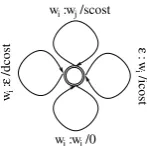
Our baseline, the edit machine described in (Ban-galore and Johnston, 2004), is essentially a finite-state implementation of the algorithm to compute the Levenshtein distance. It allows for unlimited insertion, deletion, and substitution of any word for another (Figure 5). The costs of insertion, dele-tion, and substitution are set as equal, except for members of classes such as price (cheap, expen-sive), cuisine (turkish) etc., which are assigned a higher cost for deletion and substitution.
wj i
w : /scost
i
w :wi/0
i
w
:
ε
/dcost iw:
ε
[image:5.595.145.219.238.311.2]/icost
Figure 5: Basic Edit Machine
5.2 4-edit
Basic edit is effective in increasing the number of strings that are assigned an interpretation (Banga-lore and Johnston, 2004) but is quite large (15mb, 1 state, 978120 arcs) and adds an unacceptable amount of latency (5s on average). In order to overcome this performance problem we experi-mented with revising the topology of the edit ma-chine so that it allows only a limited number of edit operations (at most four) and removed the substitution arcs, since they give rise toR
L
M M
i
O
arcs. For the same grammar, the resulting edit ma-chine is about 300K with 4 states and 16796 arcs and the average latency is (0.5s). The topology of the4-editmachine is shown in Figure 6.
i
/icost
ε:
w:w /0i
w
i i
/dcost
ε
: w
/0 :
wi
/icost
wi
ε
wi:
: wi
/dcost
ε
i i
/dcost
ε
: w
wi
/icost
ε:
w
:
wi /0
i
i
w :
ε: wi
/dcost /icost
w /0 :
wi
ε
i
w /0 :
wi
Figure 6: 4-edit machine
5.3 Smart edit
Smart editis a 4-edit machine which incorporates a number of additional heuristics and refinements to improve performance:
1. Deletion of SLM-only words: Arcs were added to the edit transducer to allow for free deletion of any words in the SLM training data which are not found in the grammar. For example,listingsinthai restaurant listings in midtown thai restaurant in midtown.
2. Deletion of doubled words: A common er-ror observed in SLM output was doubling of monosyllabic words. For example: subway to the cloisters recognized as subway to to the cloisters. Arcs were added to the edit ma-chine to allow for free deletion of any short word when preceded by the same word.
3. Extended variable weighting of words: In-sertion and deletion costs were further subdi-vided from two to three classes: a low cost for ‘dispensable’ words, (e.g. please, would, looking, a, the), a high cost for special words (slot fillers, e.g. chinese, cheap, downtown), and a medium cost for all other words, (e.g.
restaurant, find).
4. Auto completion of place names: It is un-likely that grammar authors will include all of the different ways to refer to named en-tities such as place names. For example, if the grammar includes metropolitan museum of art the user may just say metropolitan museum. These changes can involve signif-icant numbers of edits. A capability was added to the edit machine to complete par-tial specifications of place names in a single edit. This involves a closed world assump-tion over the set of place names. For ex-ample, if the only metropolitan museum in the database is themetropolitan museum of art we assume that we can insert of art af-termetropolitan museum. The algorithm for construction of these auto-completion edits enumerates all possible substrings (both con-tiguous and non-concon-tiguous) for place names. For each of these it checks to see if the sub-string is found in more than one semantically distinct member of the set. If not, an edit se-quence is added to the edit machine which freely inserts the words needed to complete the placename. Figure 7 illustrates one of the edit transductions that is added for the place namemetropolitan museum of art. The algo-rithm which generates the autocomplete edits also generates new strings to add to the place name class for the SLM (expanded class). In order to limit over-application of the comple-tion mechanism substrings starting in prepo-sitions (of art metropolitan museum of art)
or involving deletion of parts of abbreviations are not considered for edits (b c building n b c building).
metropolitan
:
metropolitan museum:museum ε:of ε:art
The average latency ofSmartEditis 0.68s. Note that the application-specific structure and weight-ing of SmartEdit (3,4 above) can be derived auto-matically: 4. runs on the placename list for the new application and the classification in 3. is pri-marily determined by which words correspond to fields in the underlying application database.
6 Learning Edit Patterns
In the previous section, we described an edit ap-proach where the weights of the edit operations have been set by exploiting the constraints from the underlying application. In this section, we dis-cuss an approach that learns these weights from data.
6.1 Noisy Channel Model for Error Correction
The edit machine serves the purpose oftranslating
user’s input to a string that can be assigned a mean-ing representation by the grammar. One of the possible shortcomings of the approach described in the preceding section is that the weights for the edit operations are set heuristically and are crafted carefully for the particular application. This pro-cess can be tedious and application-specific. In or-der to provide a more general approach, we couch the problem of error correction in the noisy chan-nel modeling framework. In this regard, we fol-low (Ringger and Allen, 1996; Ristad and Yian-ilos, 1998), however, we encode the error cor-rection model as a weighted Finite State Trans-ducer (FST) so we can directly edit ASR input lattices. Furthermore, unlike (Ringger and Allen, 1996), the language grammar from our application filters out edited strings that cannot be assigned an interpretation by the multimodal grammar. Also, while in (Ringger and Allen, 1996) the goal is to translate to the reference string and improve recognition accuracy, in our approach the goal is to translate in order to get the reference meaning and improve concept accuracy.
We let >{ be the string that can be assigned a
meaning representation by the grammar and> be
the user’s input utterance. If we consider > to be
the noisy version of the>{ , we view the decoding
task as a search for the string > <
{ that maximizes
the following equation.
>
<
{
BD$E9F&GHD&I 7
K
L
>QS>|{
O (7)
We then use a Markov approximation (trigram for our purposes) to compute the joint probability
K
L
>
QS>
{
O.
> <
{
BD$E9F&GHD$I
a
K
L>
b
QS>
b
{
M>
b
h
A
QS>
b
hi
QS>
b
h
A
{
QS>
b
hi
{
O
(8) where>
B
>
A
>
i
555
>
g
and >|{
B
>
A
{
>
i
{
555 >
{ .
In order to compute the joint probability, we need to construct an alignment between tokens
L >
b
QS>
b
{
O. We use the viterbi alignment provided
by GIZA++ toolkit (Och and Ney, 2003) for this purpose. We convert the viterbi alignment into a
bilanguage representation that pairs words of the string > with words of >{ . A few examples of
bilanguage strings are shown in Figure 8. We compute the joint n-gram model using a language modeling toolkit (Goffin et al., 2005). Equation 8 thus allows us to edit a user’s utterance to a string that can be interpreted by the grammar.
show:show me:me the: map: of: midtown:midtown no: find:find me:me french:french restaurants:around down-town:downtown
I: need: subway:subway directions:directions
Figure 8: A few examples of bilanguage strings
6.2 Deriving Translation Corpus
Since our multimodal grammar is implemented as a finite-state transducer it is fully reversible and can be used not just to provide a meaning for input strings but can also be run in reverse to determine possible input strings for a given meaning. Our multimodal corpus was annotated for meaning us-ing the multimodal annotation tools described in (Ehlen et al., 2002). In order to train the transla-tion model we build a corpus that pairs the refer-ence speech string for each utterance in the train-ing data with a target strtrain-ing. The target strtrain-ing is de-rived in two steps. First, the multimodal grammar is run in reverse on the reference meaning yield-ing a lattice of possible input stryield-ings. Second, the closest string in the lattice to the reference speech string is selected as the target string.
6.3 FST-based Decoder
edited strings to those that are interpretable by the grammar. We achieve this by composing with the language finite-state acceptor derived from the multimodal grammar as shown in Equation 5. Fig-ure 9 shows the input string and the resulting out-put after editing with the trained model.
Input:I’m trying to find african restaurants that are located west of midtown
Edited Output:find african around west midtown
Input:I’d like directions subway directions from
the metropolitan museum of art to the empire state building
Edited Output:subway directions from the
metropolitan museum of art to the empire state building
Figure 9: Edited output from the MT edit-model
7 Experiments and Results
To evaluate the approach, we collected a corpus of multimodal utterances for the MATCH domain in a laboratory setting from a set of sixteen first time users (8 male, 8 female). A total of 833 user inter-actions (218 multimodal / 491 speech-only / 124 pen-only) resulting from six sample task scenarios were collected and annotated for speech transcrip-tion, gesture, and meaning (Ehlen et al., 2002). These scenarios involved finding restaurants of various types and getting their names, phone num-bers, addresses, or reviews, and getting subway directions between locations. The data collected was conversational speech where the users ges-tured and spoke freely.
Since we are concerned here with editing er-rors out of disfluent, misrecognized or unexpected speech, we report results on the 709 inputs that in-volve speech (491 unimodal speech and 218 mul-timodal). Since there are only a small number of scenarios performed by all users, we partitioned the data six ways by scenario. This ensures that the specific tasks in the test data for each parti-tion are not also found in the training data for that partition. For each scenario we built a class-based trigram language model using the other five sce-narios as training data. Averaging over the six par-titions, ASR sentence accuracy was 49% and word accuracy was 73.4%.
In order to evaluate the understanding perfor-mance of the different edit machines, for each partition of the data we first composed the out-put from speech recognition with the edit machine and the multimodal grammar, flattened the mean-ing representation (as described in Section 3.1), and computed theexact string match accuracy be-tween the flattened meaning representation and the reference meaning representation. We then aver-aged this concept sentence accuracy measure over all six partitions.
ConSentAcc
No edits 38.9%
Basic edit 51.5%
4-edit 53.0%
Smart edit 60.2%
Smart edit (lattice) 63.2%
MT-based edit 51.3%
(lattice)
[image:7.595.331.498.59.178.2]Classifier 34.0%
Figure 10: Results of 6-fold cross validation
The results are tabulated in Figure 10. The columns show the concept sentence accuracy (ConSentAcc) and the relative improvement over the the baseline of no edits. Compared to the base-line of 38.9% concept sentence accuracy without edits (No Edits), Basic Edit gave a relative im-provement of 32%, yielding 51.5% concept sen-tence accuracy. 4-edit further improved concept sentence accuracy (53%) compared toBasic Edit. The heuristics in Smart Editbrought the concept sentence accuracy to 60.2%, a 55% improvement over the baseline. Applying Smart edit to lat-tice input improved performance from 60.2% to 63.2%.
TheMT-based edit model yielded concept sen-tence accuracy of 51.3% a 31.8% improvement over the baseline with no edits, but still substan-tially less than the edit model derived from the application database. We believe that given the lack of data for multimodal applications that an approach that combines the two methods may be most effective.
TheClassificationapproach yielded only 34.0% concept sentence accuracy. UnlikeMT-based edit
this approach does not have the benefit of compo-sition with the grammar to guide the understand-ing process. The low performance of the classi-fier is most likely due to the small size of the cor-pus. Also, since the training/test split was by sce-nario the specifics of the commands differed be-tween training and test. In future work will ex-plore the use of other classification techniques and try combining the annotated data with the gram-mar for training the classifier model.
8 Conclusions
is costly to collect and annotate. We have shown how edit machines enable integration of stochas-tic speech recognition with hand-crafted multi-modal understanding grammars. The resulting multimodal understanding system is significantly more robust 62% relative improvement in perfor-mance compared to 38.9% concept accuracy with-out edits. We have also presented an approach to learning the edit operations and a classification-based approach. TheLearned editapproach pro-vides a substantial improvement over the baseline, performing similarly to the Basic edit machine, but does not perform as well as the application-tuned Smart edit machine. Given the small size of the corpus, the classification-based approach performs less well. This leads us to conclude that given the lack of data for multimodal applica-tions a combined strategy may be most effective. Multimodal grammars coupled with edit machines derived from the underlying application database can provide sufficiently robust understanding per-formance to bootstrap a multimodal service and as more data become available data-driven tech-niques such asLearned editand the classification-basedapproach can be brought into play.
References
C. Allauzen, M. Mohri, M. Riley, and B. Roark. 2004. A generalized construction of speech recognition transduc-ers. InICASSP, pages 761–764.
J. Allen, D. Byron, M. Dzikovska, G. Ferguson, L. Galescu, and A. Stent. 2001. Towards Conversational Human-Computer Interaction. AI Magazine, 22(4), December.
S. Bangalore and M. Johnston. 2000. Tight-coupling of mul-timodal language processing with speech recognition. In
Proceedings of ICSLP, pages 126–129, Beijing, China.
S. Bangalore and M. Johnston. 2004. Balancing data-driven and rule-based approaches in the context of a multimodal conversational system. InProceedings of HLT-NAACL.
Robert A. Bolt. 1980. ”put-that-there”:voice and gesture at the graphics interface. Computer Graphics, 14(3):262– 270.
M. Boros, W. Eckert, F. Gallwitz, G. G˘orz, G. Hanrieder, and H. Niemann. 1996. Towards Understanding Spontaneous Speech: Word Accuracy vs. Concept Accuracy. In Pro-ceedings of ICSLP, Philadelphia.
P. Brown, S.D. Pietra, V.D. Pietra, and R. Mercer. 1993. The Mathematics of Machine Translation: Parameter Estima-tion. Computational Linguistics, 16(2):263–312.
A. Ciaramella. 1993. A Prototype Performance Evalua-tion Report. Technical Report WP8000-D3, Project Esprit 2218 SUNDIAL.
Philip R. Cohen, M. Johnston, D. McGee, S. L. Oviatt, J. Pittman, I. Smith, L. Chen, and J. Clow. 1998. Mul-timodal interaction for distributed interactive simulation. In M. Maybury and W. Wahlster, editors,Readings in In-telligent Interfaces. Morgan Kaufmann Publishers.
J. Dowding, J. M. Gawron, D. E. Appelt, J. Bear, L. Cherny, R. Moore, and D. B. Moran. 1993. GEMINI: A natural language system for spoken-language understanding. In
Proceedings of ACL, pages 54–61.
P. Ehlen, M. Johnston, and G. Vasireddy. 2002. Collecting mobile multimodal data for MATCH. InProceedings of ICSLP, Denver, Colorado.
Y. Freund and R. E. Schapire. 1996. Experiments with a new boosting alogrithm. InMachine Learning: Proceedings of the Thirteenth International Conference, pages 148–156.
V. Goffin, C. Allauzen, E. Bocchieri, D. Hakkani-Tur, A. Ljolje, S. Parthasarathy, M. Rahim, G. Riccardi, and M. Saraclar. 2005. The at&t watson speech recognizer. InProceedings of ICASSP, Philadelphia, PA.
M. Johnston and S. Bangalore. 2000. Finite-state mul-timodal parsing and understanding. In Proceedings of COLING, pages 369–375, Saarbr¨ucken, Germany.
M. Johnston and S. Bangalore. 2005. Finite-state multi-modal integration and understanding. Journal of Natural Language Engineering, 11(2):159–187.
M. Johnston, S. Bangalore, G. Vasireddy, A. Stent, P. Ehlen, M. Walker, S. Whittaker, and P. Maloor. 2002. MATCH: An architecture for multimodal dialog systems. In Pro-ceedings of ACL, pages 376–383, Philadelphia.
J. G. Neal and S. C. Shapiro. 1991. Intelligent multi-media interface technology. In J. W. Sullivan and S. W. Tyler, editors, Intelligent User Interfaces, pages 45–68. ACM Press, Addison Wesley, New York.
F.J. Och and H. Ney. 2003. A systematic comparison of various statistical alignment models. Computational Lin-guistics, 29(1):19–51.
S. L. Oviatt. 1999. Mutual disambiguation of recognition errors in a multimodal architecture. InCHI ’99, pages 576–583. ACM Press, New York.
L. Ramshaw and M. P. Marcus. 1995. Text chunking us-ing transformation-based learnus-ing. InProceedings of the Third Workshop on Very Large Corpora, MIT, Cambridge, Boston.
E. K. Ringger and J. F. Allen. 1996. A fertility channel model for post-correction of continuous speech recogni-tion. InICSLP.
E. S. Ristad and P. N. Yianilos. 1998. Learning string-edit distance. IEEE Transactions on Pattern Analysis and Ma-chine Intelligence, 20(5):522–532.
W. Wahlster. 2002. SmartKom: Fusion and fission of speech, gestures, and facial expressions. InProceedings of the 1st International Workshop on Man-Machine Symbiotic Sys-tems, pages 213–225, Kyoto, Japan.
Y. Wang, A. Acero, C. Chelba, B. Frey, and L. Wong. 2002. Combination of statistical and rule-based approaches for spoken language understanding. InProceedings of the IC-SLP, Denver, Colorado, September.